
Research article · 2022 · Full text
International Journal of Horticulture and Food ScienceExploring the effect of rural-urban migration among youths in Abuja municipal area council (AMAC), FCT, Abuja
Volume 4(1) · Pages 82–86 · DOI: 10.33545/26631067.2022.v4.i1b.88 ↗
Research areasUrban and Rural Development Challenges
Abstract
Author-writtenThe study accessed rural-urban migration among youths in Abuja Municipal Area Council (AMAC), FCT, Abuja. The research was carried out in Abuja Municipal Area Council. The study was guided by objectives. A descriptive research design was used in this study. The youths in the research area were chosen using a purposeful sampling method. Multistage approaches were used to sample eight (8) ADP blocks. Gwarimpa, Garki, Gui, Gwagwa, Karu, Karshi, Nyanya, and Kabusa were the blocks chosen for the research. To make 32 cells, four cells were chosen from each of the eight blocks. In addition, 3 farmers were chosen from 31 cells and 4 from the remaining 32 cells, for a total of 97 farmers. A systematic questionnaire was used to obtain primary data. Descriptive statistics were used to analyze the data. 45.3% represent those Searching for white collar jobs, and skill acquisition 22.7% were among top causes of rural urban migration. Reduction in Labour due to migration was found to be high 55.7%. Provision of Infrastructure, at 82.5% was the top and major strategy identified in reducing youth rural urban migration among sampled respondents. In the course of agricultural rural development strategic planning, the study recommended supportive strategic planning at the policy level, by mainstreaming migration into national policy to: systematically address the linkages between youth employment promotion and rural labor promotion, rural infrastructural deficit, rural skill acquisition and training.
Summary
Source-checkedPlain-language reading of the full paper, prepared with AI and checked against the text. Each point links to the authors' own words.
Why it matters
- Rural-urban migration in Nigeria is primarily driven by the search for better economic opportunities and wages in cities, alongside pressure on rural natural resources. View evidence ↗
- Youth migration is particularly impactful because youths contribute 70% of the agricultural labor force, meaning their departure reduces overall agricultural output. View evidence ↗
- Continuous migration leads to urban congestion, which overstretches essential services like healthcare and education and increases the risk of disease outbreaks. View evidence ↗
The question
- The study aims to assess the causes of rural-urban migration among youths specifically within the Abuja Municipal Area Council (AMAC), FCT. View evidence ↗
What they did
- The researchers used a descriptive research design and a purposeful, multi-stage sampling method to select eight ADP blocks. View evidence ↗
- The final sample consisted of 97 farmers, selected by randomly choosing 4 cells from each of the 8 blocks and then selecting 3 to 4 farmers per cell. View evidence ↗
- Primary data was collected from the 97 youth participants using structured questionnaires. View evidence ↗
- Data analysis was performed using SPSS version 24, employing descriptive statistics such as frequencies and percentages. View evidence ↗
What they found
- The primary drivers for migration were the search for white-collar jobs (45.3%), skill acquisition (22.7%), and low income (17.5%). View evidence ↗
- A majority of respondents (56.7%) perceived a reduction in labor supply due to migration, with 12.4% describing this reduction as very high. View evidence ↗
- The most supported strategy to reduce migration was the provision of rural infrastructure and basic amenities (82.5%), followed by government extension services (14.4%). View evidence ↗
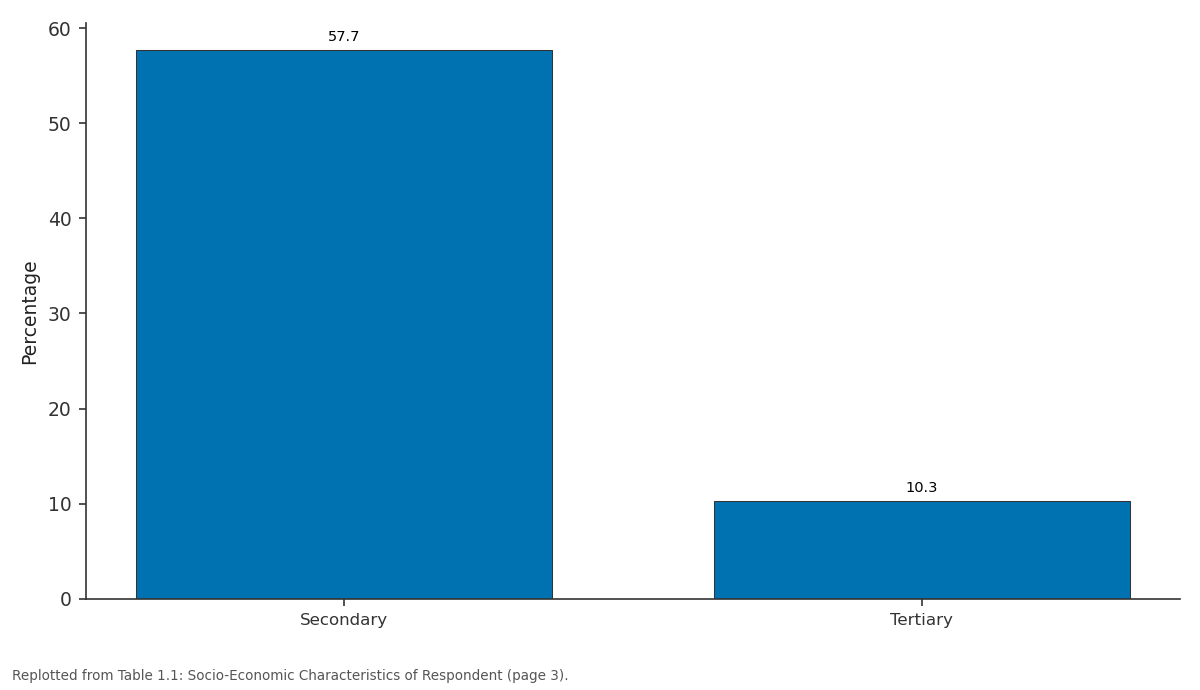
- The sampled youth were mostly educated, with 57.7% having secondary education and 10.3% having tertiary education. View evidence ↗
- Most respondents had limited farming experience, with 36.1% having only 1 to 5 years of experience. View evidence ↗
What it means
- The authors conclude that migration is driven by a combination of the search for white-collar employment, skill acquisition, and poor income. View evidence ↗
Visual summary
2 visualsIllustrations explain the paper; charts are replotted from the paper's own table values.
Percentage: Secondary vs Tertiary
Replotted from Table 1 (page 3) of the original paper. Every bar is the paper's own table value.
View source evidence ↗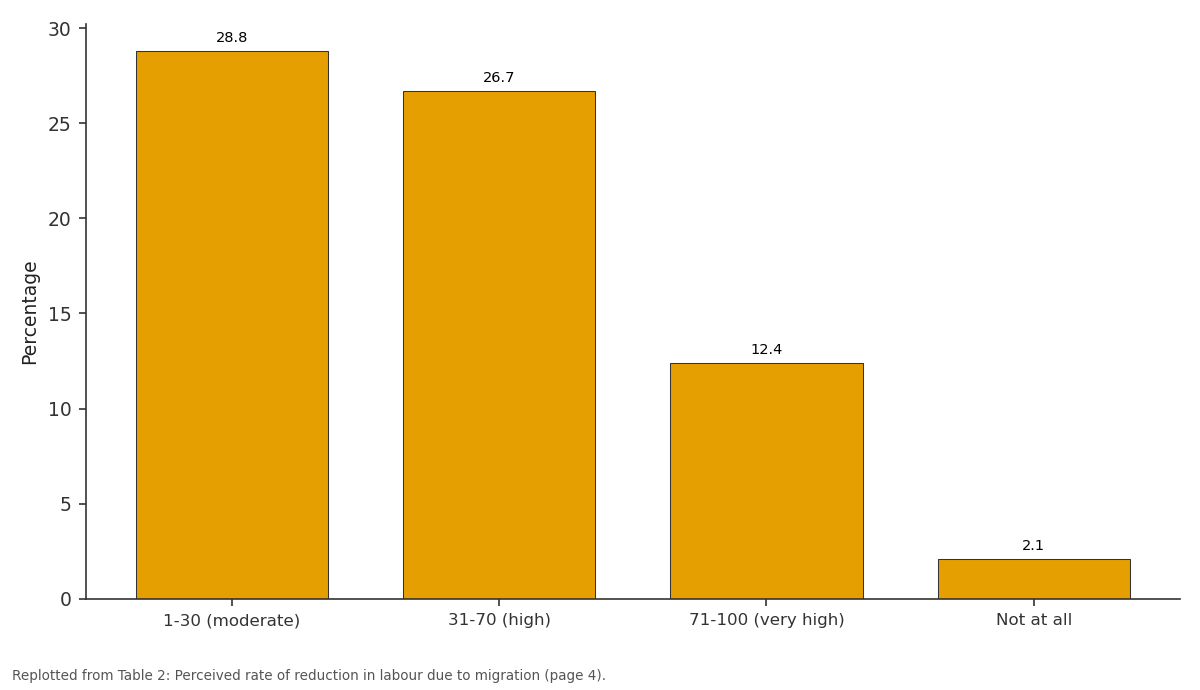
Percentage: 1-30 (moderate) vs 31-70 (high) vs 71-100 (very high) vs Not at all
Replotted from Table 2 (page 4) of the original paper. Every bar is the paper's own table value.
View source evidence ↗Figures & tables
From the original paper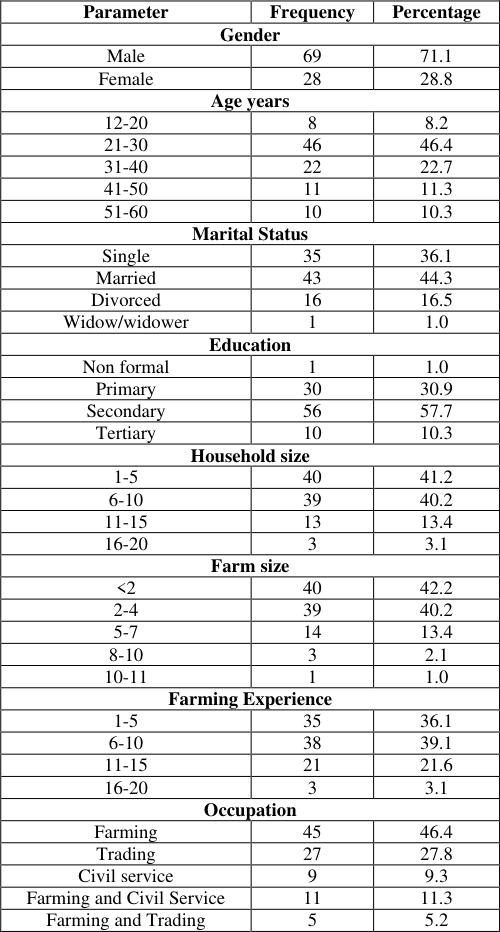 Table 1
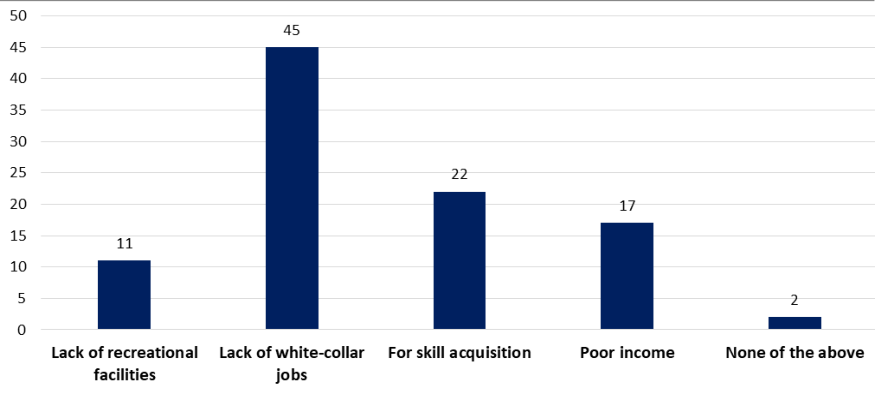 Figure 1
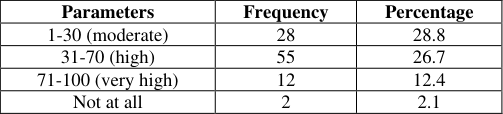 Table 2
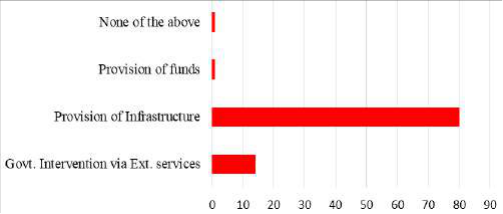 Figure 2
Introduction
Nigeria is Africa's most populous country, with a population of 198 million people (NPC, 2018) [9] . The population, like most of Sub-Saharan Africa, is extremely young, with 55 Nigerians under the age of 20 and 28 between the ages of 20 and 40. (World Bank, 2016) [14] . In the previous two decades, Nigeria has experienced rapid urbanization. Between 1990 and 2014, the urban population grew at a high rate of 4.5% per year, while the rural population grew at a slower rate of 1.4% per year (Egboduku et al. 2021) [4] . According to the United Nations Department of Economic and Social Affairs (2014) [13] , the country will have the third largest absolute increase in its urban population by 2050, which will be three times its current population. Rural-urban migration has been a main driver of Nigeria's rapid urbanization as a result of demographic strain on natural resources in rural areas and larger potential wages and economic opportunities in metropolitan areas (World Bank, 2016) [14] . People in rural areas have been encouraged to move to cities by "push" factors such as declining agricultural incomes due to an overvalued exchange rate and high levels of conflict in the northern and central regions. Individuals who relocate from one geographical place to another, whether temporarily or permanently, are referred to as migrants (Oginni, 2019; Egboduku et al. 2021) [10,4] . Migration may have an impact on individuals or families with certain economic, social, educational, and demographic characteristics (Alarima, 2018) [2] . Initially, migration was seen as a natural process of transferring surplus labor from rural to urban industrial sectors, with migrants obtaining well-paying jobs in cities and returning remittances to their families, so improving the welfare of those left behind in rural areas (Alarima, 2018) [2] . Rural-urban migration has strained job growth and infrastructure in both developing and developed sections of the country up until now. Rural-urban migration is characterized as a temporary or permanent movement of youth from one geographical place to another (Adewale, 2015) [1] .
Young people travel from rural to urban locations for a variety of reasons. As a result of the need to flee violence, traffic, political instability, and real persecution, youth migrate from one location to another (Fadayomi, 2018) [5] . Youths make up over 60% of the population of Nigeria, and their significance to national development cannot be overstated (Sennuga et al. 2021; Omabuwa et al. 2022) [12,11] . Youth migration is frequent in Nigeria, especially from rural to urban areas, as the government ignores rural areas despite their contribution to the country's economic progress. Migration is either by force or choice i.e., involuntary or voluntary. Voluntary migration can be caused by the following. 1. Poor housing condition 2. Poor education opportunity 3. Inadequate infrastructure. e.g., road, water etc. 4. No better job opportunities 5. Problem of rural land tenure and inheritance pattern etc Ethno-religious crises, conflicts and wars, political strikes, and other factors can all lead to involuntary migration. Although discriminatory government policies in favor of urban development, such as income inequality, employment, and other socio-economic amenities, are blamed for some of the causes of youth movement from rural to urban areas. Kanu and Ukonze (2018) [8] summarized the major causes of rural-urban migration in Nigeria.
The impact of youth migration from the countryside to the city
Migration of youths from Rural to Urban led to reduction in agricultural output. This occurred due to the fact that 70% of labour force in agriculture is being contributed by youths. This negative effect on agricultural output has its multiple effects in the following areas: 1. Low gross domestic product for the nation. 2. Low income and standard of living in the study area 3. Under development 4. Food insecurity.
Other effects of Rural-urban migration resulted to overstretching of social amenities which causes spreading of diseases, drainage blockade (Flooding, pollution etc.). According to Kanu and Ukonze (2018) [8] , the continuous migration of rural people to urban areas has resulted in a slew of social, economic, environmental, physical, and other issues, including urban congestion, which has led to communicable disease outbreaks and overstretched social amenities such as electricity, health care, and education. Therefore, the purpose of this study is to access the causes of rural-urban migration among youths in Abuja Municipal Area Council, FCT. The specific objectives of this study are to: 1. Describe the socio-economic characteristics of the respondents. 2. Investigate the causes of rural urban migration in the study area. 3. Ascertain the perceived rate of reduction in labour force due to migration 4. Identify possible solution in the cause of rural-urban migration.
Materials and Methods
The Abuja Municipal Area Council is one of the Federal Capital Territory's six (6) area councils. It is the most developed among the six area coucals. It has 12 political wards with a population density of 1,236 million people and a land mass of 1.769 square kilometer (km 2 ). Source: Abuja Geographical Information System, 2012. Each of the political ward represents ADP block.
Sampling techniques and sample size
A multi-staged sampling technique was employed in the selection of the respondents (youth) using eight (8) ADP blocks. The blocks selected for the study were Gwarimpa, Garki, Gui, Gwagwa, Karu, Karshi, Nyanya and Kabusa. The initial stage involved the random selection of 4 cells from each of the 8 blocks to give 32 cells. The second stage involved the random selection of 3 farmers selected from 31 cells and 4 from the last 32 cell, bringing the overall number of the sampled farmers to 97.
Method of data collection
Primary data was obtained using well-structured questionnaires that were given to 97 youth in the research area. The information obtained includes socio-economic characteristics of the respondents, such as age in years, sex, household size, education level, and marital status, among other things. Data on the causes of rural-to-urban migration in the research area was also obtained. In addition, respondents were asked about their perceptions on the effects of rural-urban migration. Data on possible remedies to the problem of rural-urban migration was also gathered.
Data analysis
The information gathered for the study was examined using descriptive statistics like frequency and percentages. The data was processed and descriptive statistics were utilized to present the results using the Statistical Package for Social Science (SPSS) version 24. By explaining the relationship between the variables in a sample or population, descriptive statistics were used to summarize data in an ordered manner.
Results and Discussions 1.1 Socio-economic Characteristics of Respondents
The demographic characteristics of youth in the research region are shown in Table 1. In the table, respondents' gender, age, occupation, marital status, family size, reading level, and farming experience were all provided. The chart also shows that the bulk of the kids (about 71 percent, or 69 respondents) were male, while the rest (around 28.8%, or 28 respondents) were female. Although females also participated in the movement, this data implies that there were more male youth in the research area. Similarly, the family size of the respondents shows that 42.2 percent, or 40 respondents, have a family size of 1 to 5 people, while the remainder 40. versa, family labor would be more prevalent. According to Aromolaran et al. (2021) [3] , there is a positive relationship between education and youth migration. The majority of the respondents 57.7% had secondary school education; 30.9% had at least primary school education; and only 1% of the respondents (1 respondent) had no formal education. Those with a tertiary education made up the remaining 10.3%, which drew ten responses. The implication of this is that, there is every likelihood that there will be massive rural urban migration in the study area as educated youth tend to migrate more than those not educated, because education is one of the most essential variables determining youth's ability to comprehend current policies, programs, and innovations. All things being equal, education affects productivity through effective resource usage, allocation, and choice of inputs for productive activities.
| Parameter | Frequency | Percentage |
|---|---|---|
| Gender | ||
| Male | 69 | 71.1 |
| Female | 28 | 28.8 |
| Age years | ||
| 12-20 | 8 | 8.2 |
| 21-30 | 46 | 46.4 |
| 31-40 | 22 | 22.7 |
| 41-50 | 11 | 11.3 |
| 51-60 | 10 | 10.3 |
| Marital Status | ||
| Single | 35 | 36.1 |
| Married | 43 | 44.3 |
| Divorced | 16 | 16.5 |
| Widow/widower | 1 | 1.0 |
| Education | ||
| Non formal | 1 | 1.0 |
| Primary | 30 | 30.9 |
| Secondary | 56 | 57.7 |
| Tertiary | 10 | 10.3 |
| Household size | ||
| 1-5 | 40 | 41.2 |
| 6-10 | 39 | 40.2 |
| 11-15 | 13 | 13.4 |
| 16-20 | 3 | 3.1 |
| Farm size | ||
| <2 | 40 | 42.2 |
| 2-4 | 39 | 40.2 |
| 5-7 | 14 | 13.4 |
| 8-10 | 3 | 2.1 |
| 10-11 | 1 | 1.0 |
| Farming Experience | ||
| 1-5 | 35 | 36.1 |
| 6-10 | 38 | 39.1 |
| 11-15 | 21 | 21.6 |
| 16-20 | 3 | 3.1 |
| Occupation | ||
| Farming | 45 | 46.4 |
| Trading | 27 | 27.8 |
| Civil service | 9 | 9.3 |
| Farming and Civil Service | 11 | 11.3 |
| Farming and Trading | 5 | 5.2 |
Table text extracted from the original PDF; superscript letters are shown inline. The original table image is below.
View original table image
The table also shows that the majority, 39.1%, or 38 respondents, had farming experience suggesting an average of 6 to 10 years, while 36.1%, or 35 respondents, had between 1 and 5 years, as well as 21.6%, or 21 respondents, and 3.1, or three respondents. This suggests that the majority of the youth in the research region have less years of agricultural experience, implying that the respondents lack adequate knowledge and experience in the activities they engage in, which could be a contributing factor to rural-urban migration. This finding agrees with the findings of FOA, (2016) [6] that the causes of rural urban migration by the youth is not far-fetched from the fact that they do not have much experience in their activities in the rural areas as a result some underlining factors from inadequate exposure to basic technicalities and applications in carrying out operations. The majority of the 40 respondents had a land holding of less than 2 hectares, with about 40.2% cultivating between 2 and 4 hectares, 13.4% cultivating between 5-7 hectares, and only about 2.1% with three respondents each cultivating between 8 and 10 hectares, and only 1.0% with one respondent having a farm size of 10-11 hectares. According to the findings, the majority of the youths in the research region are more interested in small-scale production.
Causes of Rural Urban Migration
Source: Field survey, (2021) shows that, majority about 45.3% accounting for 43 respondents migrated for white collar jobs, 22.7% numbering 22 respondents each, migrated for skill acquisition. 17.5% numbering 17 respondents migrated as a result of low income; 2.1% of the respondents gave no reason whatsoever for migration. This finding agrees with the findings of Yuguda et al., (2013) that over, 70% of Nigerian youth migrate to the urban areas as a result of poor infrastructure, in search for white collar job, to acquire skills on the income. 2. shows the rate of labour due to migration of youth, that, majority about 56.7% accounting for 55 respondents indicated that there was reduction in the rate of labour supply as a result of migration, 28.8% numbering 28 respondents indicated that reduction in the rate of labour supply was moderate, also, 12.4% of the respondents said rate of reduction in labour supply was very high. However, 2.1% of the respondents were indifferent asto whether or not there was any significant reduction in the rate of labour supply whatsoever for migration. This finding agrees with the findings of young, Fadayomi (2013) that rural urban migration significantly affects the rate supply of labour. This is because; youth are energetic and contribute immensely to the pool of labour supply on the farm.
Perceived Rate of Reduction in Labour due to Migration of Youth
Perceived Rate of Reduction in Labour due to Migration of Youth
Strategies in Reducing Rural Urban Migration
Source: Field survey, 2021
Strategies in Reducing Rural Urban Migration
Fig 2 shows strategies for quelling rural urban migration, majority of respondents about 82.5% accounting for 80 respondents for provision of infrastructure and basic amenities in rural areas as a strategy for reducing rural urban migration, 14.4% numbering 14 respondents felt government intervention through extension services to youth will reduce the current rate of migration, only 1% of the respondents went for provision of fund for the youth as a strategy for reducing rural urban migration. Nevertheless, 1% of the respondents were indifferent to various strategies for reducing rural urban migration. In the findings of FAO (2015) [6] in another research on strategies for reducing rural urban migration by youth; provision of monetary grants to youth for empowerment did not flatten their curve of migration to the city centres as anticipated. Rather, provision of infrastructure and basic amenities gave more inclusion and belongings to the youth in their environment and were more willing to remain in the rural areas.
Conclusion
Migration decisions are influenced by a range of fundamental causes, including the hunt for white collar work, skill acquisition, poor income, and other distant factors, according to the study. These found factors are very context-dependent and are influenced by individual and household characteristics. The core reasons of rural youth distress migration, its effects on agriculture and rural development in the places of origin, and its patterns vary by location. Finding long-term solutions to the reasons of ruralurban migration vary as well.
Recommendations
The following recommendations are provided in the topic area based on the findings in order to identify long-term solutions in the Abuja Municipal Area Council (AMAC): Support policy-level strategic planning by mainstreaming migration into national policy to: 1. In the context of agricultural rural development strategic planning, thoroughly examine the linkages between youth employment promotion and rural labor promotion. 2. Adopt successful extension tactics in the study region for the supply of agricultural services and the creation of jobs. 3. Include rural youth's access to education and information in ARD policies and planning, as well as their specific needs and objectives. 4. Nurture and incubate rural youth's ability to contribute to rural development.
Governments, civil society organizations, the private sector, and development partners should develop policies and programs in rural areas to provide youth in AMAC with skill acquisition training, ensuring that migration and youthrelated priorities are in line with the country's overall development vision and objectives in the study area.
Figures and tables from the paper
| Parameters | Frequency | Percentage |
|---|---|---|
| 1-30 (moderate) | 28 | 28.8 |
| 31-70 (high) | 55 | 26.7 |
| 71-100 (very high) | 12 | 12.4 |
| Not at all | 2 | 2.1 |
Table text extracted from the original PDF; superscript letters are shown inline. The original table image is below.
View original table image
References
12 in the original paper- Adewale TO. Rural-urban migration is a movement of youths from one geographical location to another which may be permanent or temporal. Quarterly Journal of economics. 2015;128(4):1727-1785.
- Alarima CI. Factors Influencing Rural-Urban Migration of Youths in Osun State, Nigeria. Agro-Science Journal of Tropical Agriculture, Food, Environment and Extension. 2018;17(3)34-39.
- Aromolaran AK, Adekola OA, Adekunle CP, Wole-Alo FI, Adekunle J. Comparative Analysis of Pre and PostMigration Livelihood Outcomes of Households With Absentee Heads in Osun State, Nigeria. Nigerian agricultural journal. 2021;5(2):143-154
- Egboduku CO, Sennuga SO, Okpala EF. Factors influencing the interest of youths towards career in agriculture: A case study of Bwari Area Council, Abuja, Nigeria, International Journal of Advance Agricultural Research. 2021;9(2):61-68
- Fadayomi TO. Rural Development and Migration in Nigeria: Impact of the Eastern Zone of Bauchi State Agricultural Development Project. Ibadan Nigeria: Institute of Social and Economic Research, 2018.
- FAO. Addressing rural youths' migration at its root causes: A conceptual frame work: Rome, 2016.
- FAO. Rural Income Generating Activities (RIGA) database, 2015. Available at: www.fao.org/economic/riga/riga-database/en
- Kanu EJ, Ukonze IF. Rural development as a panacea for rural-urban migration in Nigeria. Arts & Humanities Open Access Journal. 2018;5(2):37-45
- Oginni OC. Impacts of rural-urban migration of youths on household's welfare in Nigeria. Invited paper presented at the 6th African Conference of Agricultural Economists, September 23-26, 2019, Abuja, Nigeria, 2019.
- Omabuwa AT, Sennuga SO, Bako H, Olorunniyi AA. Assessment of Factors Militating Against Youths Participation in Agriculture Based Livelihood Activities in Kuje Area Council, Abuja, International Journal of Advanced Multidisciplinary Research and Studies. 2022;2(2):69-74.
- Sennuga SO, Conway JS, Sennuga MA. Impact of Information and Communication Technologies (ICTs) on Agricultural Productivity among Smallholder Farmers: Evidence from Sub-Saharan African Communities, International Journal of Agricultural Extension and Rural Development Studies. 2020;7(1)27-43.
- United Nations Department of Economic and Social Affairs Population Division. World Urbanization Prospects: The 2014 Revision, 2014.
Cited by 2
From OpenAlex, OpenCitations and reference lists read by Scinovex
- Effects of Information and Communication Technologies (ICTs) on Youths Participation in Sesame Seed Production in Kwali Area Council, Abuja, Nigeria ↗
Alfa Mohammed Kudu, Samson Olayemi Sennuga, Maimunatu KH, Ajuma Ebhohon, Funso Omolayo Alabuja · Journal of Media & Management · 2022
Youths play a major role in Agricultural production and enhancement of Agricultural productivity. The broad objective of this study is ascertaining the effects of ICT on youth’s participation in the production of sesame seed in Kwali Area Council of the Federal Capital Territory Abuja. Primary data was used for the study. Purposive sampling of sesame youths farmers was employed to…
❝ 1PDF - Level of Health and Safety Compliance by the Artisans of Construction SMEs of Different Anthropological Cultures in Abuja Municipal Area Council (AMAC) ↗
B. Y. Mailafiya, Yusuf, E., J. D. Garnvwa, Amara Yohanna · International Journal of Mechanical and Civil Engineering · 2025
Health and safety compliance in all industries is a serious issue of concern. More especially in small and medium size construction firms can never be over emphasized. This study was motivated by the reason of daily health and safety related cases on construction sites within and outside the Nigerian construction industry. The differences which exist in the anthropological culture of…
❝ 0PDF