
Research article · 2022 · Full text
International Journal of Horticulture and Food ScienceApplication of lacewing (Chrysopa septempunctata Wesmael) against apple red mite (Panonychus ulmi Koch) in intensive seed orchards
Volume 4(1) · Pages 105–107 · DOI: 10.33545/26631067.2022.v4.i1b.97 ↗
Research areasEngineering and Agricultural Innovations
Abstract
Author-writtenIn the article, the use of lacewing (chrysopa septempunctata wesmael) against apple red mite (Panonychus ulmi Koch), which is found in intensive orchards in the territory of the republic, at different consumption rates (1:5, 1:10, 1:15), based on its pest ratio and biological effectiveness. The results obtained are illuminated. By the end of the season, the number of apple red mites had been found to have decrease to 87.8%. Our research, which is less effective against mites in intensive seed orchards on these entomophagies species, is aimed at combating pandemic apple red mites (Panonychus ulmi) in the Fuji orchards of 1 (one) hectare apple orchard on the territory of SUE in Qibray district, Tashkent region, (chrysopa septempunctata wes) has been studied to determine its biological effectiveness using entomophagies.
Summary
Source-checkedPlain-language reading of the full paper, prepared with AI and checked against the text. Each point links to the authors' own words.
Why it matters
- Tetranychidae family mites are harmful in intensive seed orchards because they significantly reduce productivity and yields. View evidence ↗
- The apple red mite causes damage to young apple branches and leaves, leading to yellow spots, leaf drop, and metabolic disorders. View evidence ↗
- Lacewings are effective biological control agents; a single Chrysopa septempunctata wes larva can consume 60-70 mite eggs, larvae, or imagos daily. View evidence ↗
The question
- The study aimed to determine the biological effectiveness of using Chrysopa septempunctata wes to combat apple red mites in a one-hectare Fuji apple orchard in the Qibray district of the Tashkent region. View evidence ↗
What they did
- The researchers used laboratory-propagated lacewings distributed in various proportions relative to the apple red mite population. View evidence ↗
- Lacewing eggs were placed on tree branches using pieces of cloth, with monitoring conducted every 7, 14, and 21 days. View evidence ↗
- The lacewings were distributed in ratios of 1:10, 1:15, and 1:20 relative to the pest, applied three times at 15-day intervals, totaling 3,000 eggs per season (1,000 eggs per hectare). View evidence ↗
What they found
- The 1:10 distribution ratio showed increasing biological efficiency over the season, starting at 65.7% in May and reaching 87.8% by August. View evidence ↗
- The 1:15 distribution ratio achieved its peak biological efficiency of 85.4% in July. View evidence ↗
- The 1:20 distribution ratio was the least effective, with biological efficiency dropping from 33.9% in May to 25.8% in July, while the mite population increased sharply. View evidence ↗
What it means
- The authors conclude that applying lacewings in a 1:10 ratio in early spring is highly efficient, reaching 85.4% biological efficiency by July. View evidence ↗
Visual summary
1 visualsIllustrations explain the paper; they do not show study data.
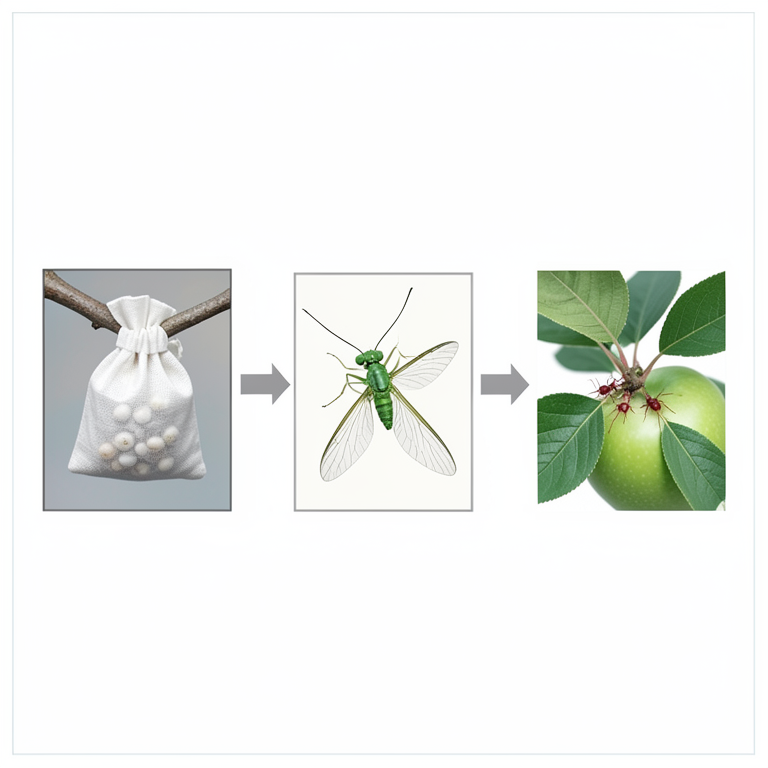
Experimental Setup
AI-generated conceptual illustration (Apple trees (Malus domestica) and green lacewings (Chrysopa septempunctata)). It explains the idea and does not show study data.
View source evidence ↗Figures & tables
From the original paper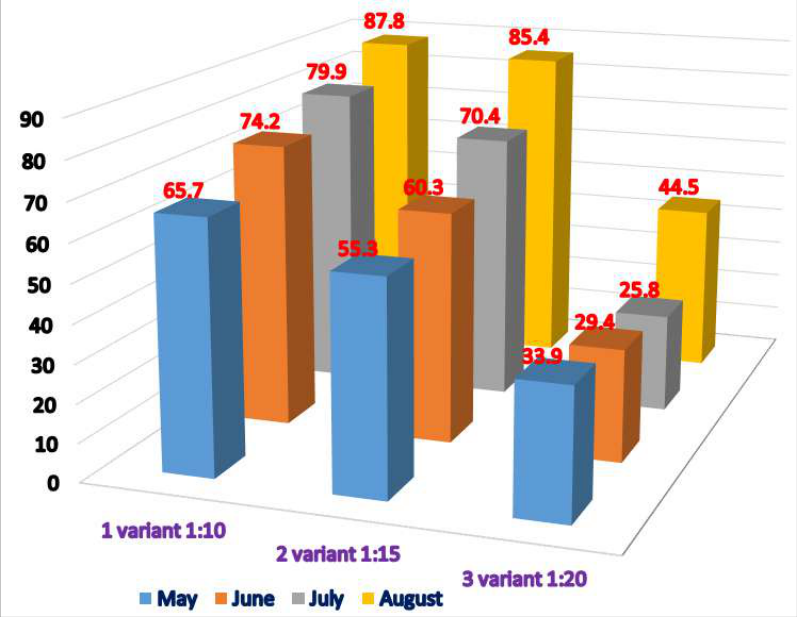 Figure 1
Introduction
In intensive seed orchards, several species of the tetranychidae family are considered harmful and significantly reduce yields and productivity. In some years, mites have been observed to cause severe damage to pear, quince and apple orchards. Apple red mite strongly damages the young branches of apple orchards. Whiteyellow spots appear on the surface of the affected leaves, then the spots enlarge, the leaves turn yellow, the leaves fall off as a result of photosynthesis and metabolic disorders in the leaves. In some years, as a result of strong damage to the leaves, the damaged leaves become completely dry [4,5,7] . In our country, apple red mite (Panonychus ulmi Koch) can cause severe damage. This pest is a common mite and has been found to be more common in intensive seed orchards. Apple red mite (Panonychus ulmi Koch) also infects quince and pear. During the spawning season, the orchards overwinter at the base of the three buds, leaving offspring 5-6 times during the season. The Lacewing entomophagy against the apple red mite (Panonychus ulmi Koch) is effective, and the adult larva of a single lacewing (Chrysopa septempunctata wes) feeds on 60-70 mite imagos, eggs and larvae a day. In the wild, lacewing play an important role in reducing the number of apple red mites, with the predominant species (Chrysopa septempunctata wes, Chrysopa carnea Steph) [1] . The genus (Chrysopa septempunctata West) has a number of advantages over other species, with low norm distribution, rapid reproduction, and high efficiency. Lacewing (Chryzopa carnea Steph) is green, with lacewing, and they feed on the nectar of unusual flowers. It flies well towards the light. The body size of the lacewing mature breed is 19-25 mm, the size of which varies depending on the feeding of the larvae. Basically, they differ from each other in the location of the internal and transverse radial-medial vessels relative to the triangular cell located in the anterior wing [2,3] . Only the worms of the lacewing (Chrysopa septempunctata wes) live in the wild. They will eventually be black. It has fast migration and excellent wintering properties. It is very omnivorous and feeds on more than 70 species of arthropods, including 11 species of mites.
The lifespan of the lacewing (Chrysopa septempunctata wes) is as follows. In the Imagolic phase, it partially overwinters in cocoon-covered soil lumps, under plant debris, in tree and bark hollows, and indoors. Wintering goldfish are naturally active in early spring, ie in late March to early April, when the average daily temperature reaches 10-11 ºC. Insects that emerge from the winter feed on the pollen of flowering plants at this time, mating, and then begin to lay eggs. In most cases, the lacewing (Chrysopa septempunctata wes) lays its eggs in places where the aphids are very abundant, where they can easily find food for their larvae. Laying is smooth, with one female laying up to 65 eggs a day and 500-750 eggs throughout her life. The duration of embryonic development varies from 4 to 15 days, depending on weather conditions [6] . Lacewing (Chrysopa septempunctata wes) is an effective species in intensive seed orchards and is resistant to high temperatures. The larvae do not leave the garden even at an air temperature of + 38 + 40 ºC. This situation increases the possibility of effective use of entomophagous against mites in horticulture. In this case, lacewing (Chrysopa septempunctata wes) can be used in the ratio of 1:20 in the calculation of prey. Our research, which is less effective against mites in intensive seed orchards on these entomophagous species, is aimed at combating pandemic apple mites (Panonychus ulmi) in the Fuji orchards of 1 (one) hectare apple orchard on the territory of SUE in Qibray district, Tashkent region, Chrysopa septempunctata wes has been studied to determine its biological effectiveness using entomophagous. The results of our experiments are shown in Figure 1.
Research Materials and Methods
Laboratory-propagated lacewing (Chrysopa septempunctata wes) were distributed in different proportions, taking into account the apple red mite (Panonychus ulmi Koch) in intensive seed orchards. The lacewing eggs were hung on tree branches in pieces of cloth. Lacewing eggs were distributed separately in each variant, control work was carried out every 7, 14 and 21 days, and the highest biological yield of lacewing was calculated on the 14th day. Distributed in ratios of 1:10, 1:15, 1:20 to the lacewing pest (Panonychus ulmi Koch). According to him, with the appearance of apple red mite (Panonychus ulmi Koch) began to spread, that is, in April and May. Distributed 3 times at 15-day intervals throughout the season. In the above ratios, an average of 3,000 lacewing eggs were distributed per season, for a total of 1,000 eggs per hectare.
Research Results and Discussion
The number of apple red mites (Panonychus ulmi Koch) on a single leaf after the spread of lacewing, the ratio of lacewing larvae was studied. The average number of imagos of the lacewing (Chrysopa septempunctata wes) was calculated by changing the number of apple red mites in each variant over the months. In the first option (1:10), the biological efficiency was 65.7% in May, the number of red apples decreased slightly, in June it was 74.2%, in July it was 79.2%, and in August the biological efficiency was 87.8%. In our second variant, when using lacewing (Chrysopa septempunctata wes) in a ratio of 1:15, the highest biological efficiency was 85.4% in July. In August, however, the lacewing apple failed to exert its influence in controlling the number of red mite (Panonychus ulmi Koch). In the third variant, the ratio of apple red mite (Panonychus ulmi Koch) increased sharply at a ratio of 1:20, and the biological efficiency was low in May, 33.9% in June, 29.4% in July and 25.8% in July.
Conclusion
From our research, it can be said that the application of lacewing (Chrysopa septempunctata) wes in the ratio of 1:10 in early spring against apple red mite cell gave a high efficiency and biological efficiency reached 85.4% of biological efficiency by July. By this time the apple red mite was much rarer. The use of lacewing apple red mite (Panonychus ulmi Koch in intensive seed orchards with low yields gave a high result, their number gradually increased.
References
6 in the original paper- El-Serafi HAK, Abdel-Salam AH, Abdel-Baky NF. Effect of four aphid species on certain biological characteristics and life table parameters of Chrysoperla carnea Stephen and Chrysopa septempunctata wesmael (Neuroptera: Chrysopidae) under laboratory conditions Pakistan journal of biological sciences: PJBS. 2000;2(3):239-245.
- Ghanim A, et al. survey the neuropterous predators and the relative abundance of chrysoperla carnea (steph.) and Chrysopa septempunctata wesm. by using a light trap at mansoura district Journal of Plant Protection and Pathology. 2009;2(34):1373-1384.
- Han B, Zhou C. Attraction effect of main volatile components from tea shoots and flowers on Sphaerophoria menthastri (Diptera: Syrphidae) and Chrysopa septempunctata (Neuroptera: Chrysopidae) Ying yong sheng tai xue bao [The journal of applied ecology]. 2004;4(15):623-626.
- Karg W. Untersuchungen zur Flächendispersion und Befallsentwicklung der Obstbaumspinnmilbe Panonychus ulmi Koch in Sortenblöcken von Apfelintensivanlagen als Grundlage für eine rationelle Überwachung Zeitschrift für Angewandte Entomologie. 2009;1-5(96):433-442.
- Yaqoob Dar M, et al. Biology and demographic parameters of European red mite, Panonychus ulmi Koch (Acari: Tetranychidae) on mulberry in Kashmir valley, India International journal of zoological research. 2015;3(11):76-88.
- Zhang QH, et al. Iridodial: a powerful attractant for the green lacewing, Chrysopa septempunctata (Neuroptera: Chrysopidae) The Science of Nature. 2006;9(93):461465.