
Research article · 2022 · Full text
International Journal of Agriculture Extension and Social DevelopmentAssessing the impact of agricultural education programmes on farm production in rural agricultural communities in Yoni Chiefdom, Tonkolili District, Northern Sierra Leone
Volume 5(1) · Pages 92–102 · DOI: 10.33545/26180723.2022.v5.i1b.129 ↗
Research areasAgriculture and Rural Development Research
Abstract
Author-writtenThe farmers in the northern region of Sierra Leone grow cereal crops, vegetables, root crops, leguminous crops and fruits. The majority of the farmers cultivate only a small or moderate size plots usually scattered in different location using crude tools such as hoes and machetes. Prevalent in most areas is subsistence farming whereby each family struggle to produce barely enough food to feed its household. The need for agricultural education and mechanization of agriculture is essential in the community in order to increase productivity. The study is therefore carried out to investigate the impact of Agricultural Educational Programmes on Farm Production in Yoni Chiefdom.The study used a mixed design, consisting of a descriptive and inferential statistics. Qualitative and quantitative approaches were used to capture the data. The population is 183 subjects with a sample of 73 from Yoni Mamala and Yoni Mabanta Chiefdoms. The significant findings include the following: agricultural education programs were implemented in Yoni chiefdom, the major crops grow in the chiefdom were cash crops, vegetables, small ruminants, improved poultry and Inland swamp rice; the popular and effective teaching methods used in the implementation of agricultural education programmes were hands on activities, demonstration methods, radio teaching methods, and farm visitation. It is concluded that there were certain programs even though implemented in the chiefdom but were not common: these include fish farming, bee farming, leadership development, agricultural show, and production of food and fibres.Major recommendations were: farmers in Yoni chiefdom should be encouraged to practice fish and bee farming; an effective method of teaching adults should be carried out regularly in the chiefdom. Also, the Government should improve on the road network leading to the rural agricultural Communities in Yoni Chiefdom.
Summary
Source-checkedPlain-language reading of the full paper, prepared with AI and checked against the text. Each point links to the authors' own words.
Why it matters
- Agriculture is a critical economic driver in sub-Saharan Africa, providing 70% of employment and 40% of GDP, yet the region faces worsening food supply issues as the population increases. View evidence ↗
- Sierra Leone has an agrarian economy where more than 75% of its approximately seven million people are involved in agriculture or related activities. View evidence ↗
- Rural communities in Sierra Leone, including the Yoni chiefdom in Tonkolili district, suffer from year-round hunger and poverty. View evidence ↗
The question
- The study aims to investigate how agricultural education programs impact farm production within the Yoni Chiefdom. View evidence ↗
What they did
- The researchers used a mixed-methods design, collecting primary data through focus group discussions and self-completed questionnaires. View evidence ↗
- Data analysis was performed using SPSS version 11.5, employing descriptive statistical techniques to tabulate frequencies and percentages. View evidence ↗
What they found
- While 100% of respondents identified inland valley swamp improvement as the most common program, 98% stated that fish farming was not common. View evidence ↗
- Hands-on activities and demonstration methods were both used by 98% of respondents, with 71% and 78% respectively rating them as highly effective. View evidence ↗
- All respondents (100%) identified a wide range of obstacles to program implementation, including poor road linkage, illiteracy, lack of machinery, and inadequate or late supply of farm inputs. View evidence ↗
- Regarding the impact of the programs, 67% of farmers reported a high impact on food access in rural communities, while 31% reported a moderate impact. View evidence ↗
- Leadership development was perceived as having a high impact by 80% of the respondents. View evidence ↗
What it means
- The authors conclude that programs focusing on cash crops, vegetables, inland valley swamp rice, small ruminants, improved poultry, and food/fiber crops were successfully implemented. View evidence ↗
- The authors recommend that the government improve road networks to rural communities to prevent the loss of quality and perishability of agricultural products. View evidence ↗
- The authors recommend encouraging and training the community in fish farming to improve dietary protein intake. View evidence ↗
Figures & tables
From the original paper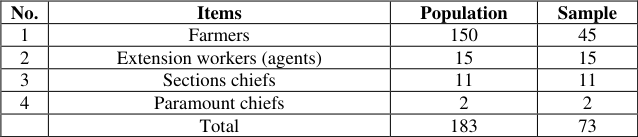 Table 1
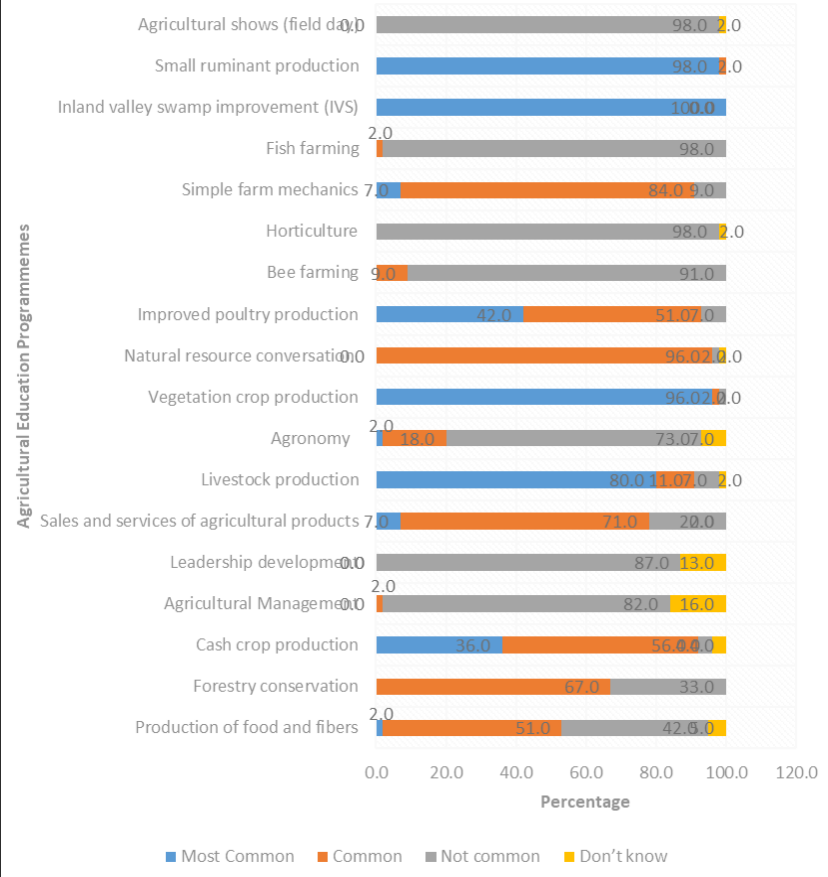 Figure 1
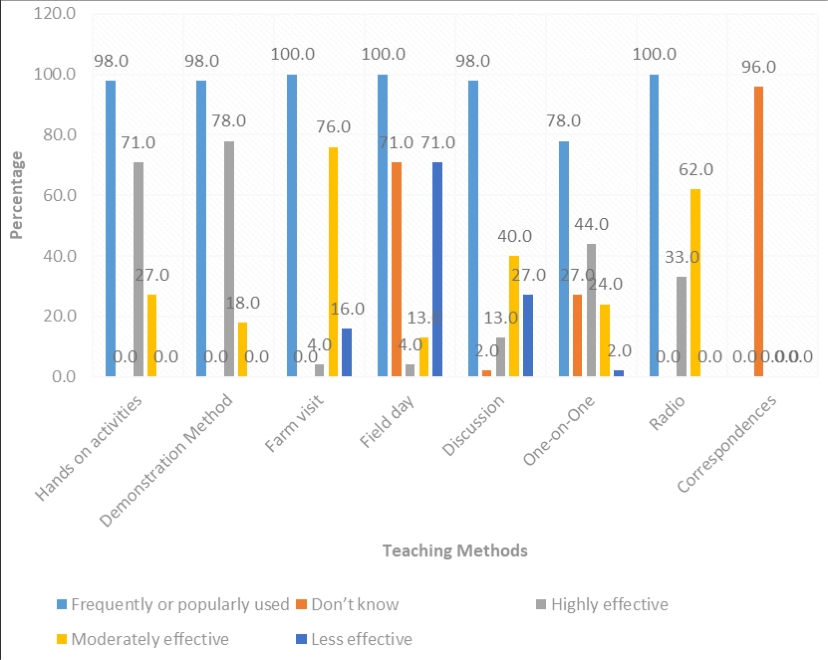 Figure 2
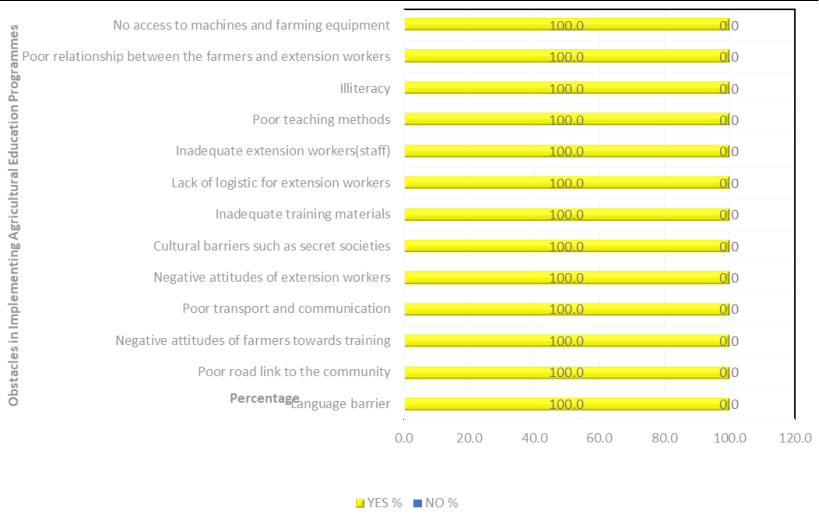 Figure 3
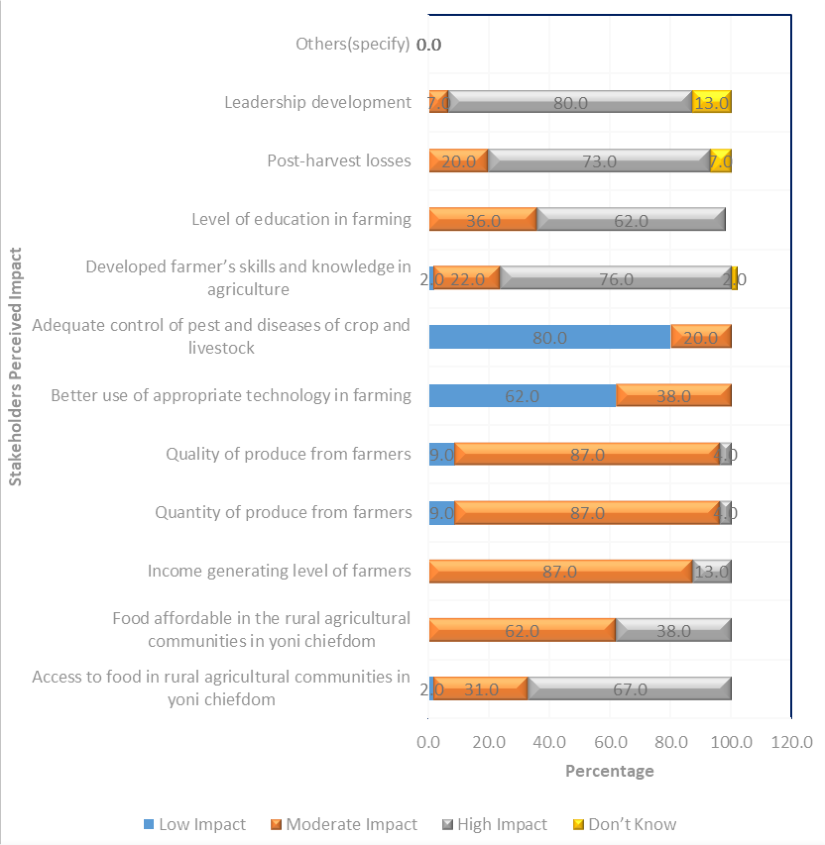 Figure 4
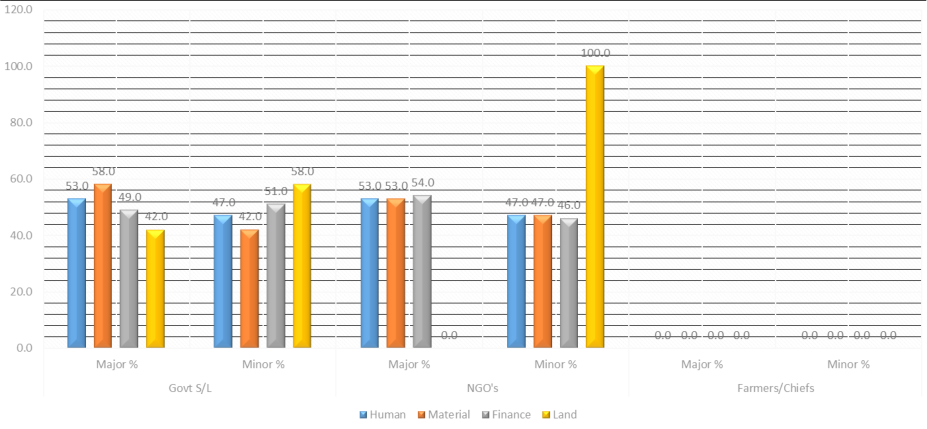 Figure 5
Introduction
Agriculture in sub-Sahara Africa (SSA) accounts for about 40% Gross Domestic Product (GDP) and 70% of employment (Ngongi 2000) [12] , yet SSA is one of the regions of the world where food supply situation continues to worsen as populations grows. Sixteen of the eighteen most under nourished countries in the world are in Africa (FAO, 2005) [3] ; Sub-Sahara Africa has one of the highest global hunger indices, which has its adverse effect of contributing to the highest child mortality (FAO, 2005) [3] . This situation is reportedly due to limited government effectiveness and political instability among other reasons (Ngongi, 2000) [12] . Ngongi, (2000) [12] argues that strong Agricultural Education and training system are necessary for providing human resources needed to drive development. Agricultural Education and training directly raises agricultural productivity by developing producer capacities and strengthening human capital for support services (World Bank, 2007) [15] . Investment in Agricultural Education and training enables the practitioners of research, extension and commercial agriculture to generate high income for farmers (Ngongi 2000) [12] . Agricultural Education and training was an integral part of the development strategies of countries that expanded their agricultural sectors successfully such as Brazil, India, and Malaysia. More than 70 percent of the poor people of Africa live in rural areas and depend on agriculture for food and livelihood. In sub-Saharan Africa, more than 218 million people live in extreme poverty www.extensionjournal.com (Economic Commission for Africa, 2006) [1] . These are predominantly in rural communities. The current focus on rural development and poverty reduction requires a comprehensive "view of reality". Rural community development is important in developing countries where a large part of the population is engaged in farming. The attainment of food security alongside sustainable agriculture and rural development constitutes one of the key global challenges facing the world today. The world population is predicted to rise to a billion by 2025 and estimates suggest that to meet the most basic of needs for this increased global population, food production will need to be double (FAO 2016) [3] . Sierra Leone is an agrarian economy with over 75% of the estimated seven million people engaged in agriculture or related activities. Although the agricultural system is mainly subsistence, this sector contributes to about 40% of the total Gross Domestic Product (GDP) of the country (World Bank 2007) [15] . Though a large number of people are engaged in agriculture and related activities, this sector of the economy is weakly developed. Records show that the capacity of the agricultural sector had been declining at an alarming rate since 1970s; the decline in food production was not only as a result of the civil war, the mass exodus of school dropouts and potential farmers from the rural to urban settings in search of better lives was another major cause. As the world market of most agricultural produces (cocoa, coffee, rubber, palm produce etc.) plummeted on the world market coupled by massive inflation. In the 1980's and 1990's many potential farmers lost faith in their once sacrosanct profession, farming. This prompted many youths and young adults to move to cities and mining areas in search of greener pastures, living the farming activities in the hands of the aged and women. This negative development has resulted in food crisis in rural communities in Africa and Sierra Leone in particular. The people in rural communities in Sierra Leone experience hunger and advert poverty throughout the year and those in Yoni chiefdom, Tonkolili district are no exception. Agricultural Education is therefore absolutely necessary in Yoni chiefdom in order to educate the rural community about the importance of agriculture, the opportunities one derives as dedicated farmers and the basic skills involved in agricultural production. According to Maguire (2000) [16] agricultural education and training (AET) covers a broad range of formal and informal activities that build capacity within the agriculture sector and for wider rural development in encompassing higher education, diploma and certificate levels, vocational and inservice training and informal knowledge and skill acquisitions. Education is often the most valuable asset for rural people such as the Yoni community wishing to engage in jobs involving agriculture value chain where they need both technical knowledge and business skills. For women and young people in particular, vocational training and skill development are instrumental (Creswell 2002) [3] . Rural extension is now a common activity in most countries of the world, and it is a basic element in programs and projects formulated to bring about changes in rural areas. Extension services are similarly a common feature of the administrative structure of rural areas and these services have the responsibility in partnership with the farmers, of directing programs and projects for change (FAO 2016) [8] .
There are probably more extension agents involved in agricultural activities than in any other aspect of rural life. Given the importance of agriculture and the need to produce food both for the farm family and for the nation as a whole, this emphasis upon agricultural extension is understandable since agricultural extension services are based upon a single crop, while others adopt more of a " whole farm" approach. The choice is very much dependent upon the local agricultural system and the national crop requirements. An agricultural extension service offers technical advice on agriculture to farmers, and also supplies them with the necessary inputs and services to support their agricultural product. According to FAO (2016) [8] , extension is a process of working with rural people in order to improve their livelihoods. This involves helping farmers to improve the productivity of their agriculture and also developing their abilities to direct their own future development. Although farmers in Yoni chiefdom already have a lot of knowledge about their environment and their farming systems, extension agents can bring to them improved and recent technical knowledge and information which they do not have; for example, knowledge about the cause of damage to a particular crop by pest, the general principles of pest control, or the ways in which manure and compost are broken down to provide plant nutrients are all areas of knowledge that the agent can usefully bring to farmers. The application of such knowledge often means that the farmer has to acquire new skills of various kinds: for example, technical skills to operate unfamiliar equipment, organizational skills to manage a group project, the skill to assess the economic aspect of technical advice given, or farm management skills for keeping records and allocating the use of farm resources and equipment. The transfer of knowledge and skills to farmers and their families is an important extension activity and the extension agent must prepare himself thoroughly. He must find out which skills or areas of knowledge are lacking among the farmers in his area and then arrange suitable learning experiences through which the farmers can acquire them. A bulk of the farmers in the northern region of Sierra Leone grow rice, cassava, groundnut, maize, beans, fruits and vegetables. Most of the farmers cultivate only a small or moderate size plot usually scattered in different locations using crude tools such as hoes and machetes. Thus, the amount of land under cultivation in a given year is greatly limited. Eventually their production falls short of exception. Prevalent in most areas is subsistence farming where by each family struggle to produce barely enough food to feed it's household. In these communities, there is sky rocketing prices of food stuff. Therefore the need for agricultural education and mechanization of agriculture is actually essential in this community. This study is therefore carried out to investigate the impact of agricultural education programs on farm production in Yoni Chiefdom, Northern Sierra Leone. The study will also examine the effectiveness of extension agents (workers) in the Chiefdom as they execute their role in training the peasant farmers.
Aim and Objectives Aim
The aim of this research is to investigate the impact of agricultural education programs on farm production in rural www.extensionjournal.com agricultural communities in Yoni chiefdom northern Sierra Leone.
Objectives
The objectives of the study were to: Majority of the population are partially educated; that is they have some form of schooling. It is therefore necessary to give this set of the population the education that will improve their skills and knowledge in carrying out their agricultural (farming) and business activities for sustainable development. The 360 villages that made up Yoni Mamaila and Yoni Mabanta Chiefdoms are divided into eleven (11) sections and each of these sections are engaged in one way or the other a kind of farming activities. The study will be limited to the big villages or towns in every section.
Map of Sierra Leone showing the Study Area-Yoni Chiefdom, Tonkolili District
Research Design
Rothim and Greenland (1998) stated that a research design is a specific plan or protocol for conducting the study, which allows the investigator to translate the conceptual hypothesis into an operational one. Research design serves as a logical proof that allows the researcher to draw inferences on relationship among variables (Nachmias 1996) [17] . Thus, the research design sets the domain from which the researcher can make comparisons with the wider population or environment. The study is a mixed design based on qualitative and quantitative approaches to collect primary data from self-participant completed questionnaires and focus group (FGD) discussion. The main purpose of this study is to assess the impact of Agricultural Education www.extensionjournal.com programs on the rural agricultural communities in Yoni Chiefdom, Northern Sierra Leone. The design of this study is mixed, which makes use of descriptive and inferential statistics including frequencies and percentages.
Targeted Population
According to Ogula (2005) [13] a population refers to any group of institutions, people or objects that have common characteristics. The target population for this study comprises the farmers, extension workers, section chiefs, paramount chiefs in Yoni Mamaila and Yoni Mabanta chiefdoms. The total population is estimated as one hundred and eighty three (183) Subjects.
Sample and Sampling Techniques
A sample is a smaller group obtained from the accessible population (Mugenda and Mugenda 1999) [11] . This sub group is carefully selected so as to be representative of the whole population with the relevant characteristics. Each member or case in the sample is referred to as subject, respondents or interviewees. Sampling is a procedure, process or technique of choosing a sub-group from a population to participate in the study (Ogula 2005) [13] . It is the process of selecting a number of individuals for the study in such a way that the individuals selected represent the large group from which they were selected. Simple random sampling technique was used to select the respondents who are mainly farmers. The extension workers, section chiefs and paramount chiefs were purposively selected for the study. The sample frame of the study includes a representative sample of the individuals living in Yoni Mamaila and Yoni Mabanta chiefdoms. At list 30% of the total population is the representative sample of the population (Borg and Gall 2003) [11] . Thus 30% of the accessible population is enough for the sample size.
According to Mugenda and Mugenda (1999) [11] using a simple random sampling technique, forty five (45) of the one hundred and fifty (150) farmers were selected. Fifteen (15) extension workers, eleven (11) section chiefs and two (02) paramount chiefs were purposively selected for the study.
All the extension agents and section chiefs including paramount chiefs were selected for the study; implying that, sub-population units were equal to or contrived as their representative sub-samples.
Instrumentation
In other to elicit information pertinent to the investigation, the researcher developed questionnaires guided by the use of the objectives of the study. The instruments were designed bearing in mind that, they elicit exactly the type and quality of data that were required; that is, the researcher ensured that the questionnaires developed were valid and reliable. The questionnaires were first validated by a panel of experts from the department of Agricultural Education Njala University and were pre-tested in few institutions in Bombali District outside Yoni Chiefdom, in February 2021.
After pre-testing the responses to items in the instrument were analyzed, found to be similar in interpretation by the subjects who responded to the items; which imply that the instrument was reliable. The supervisor gave a final approval after a few amendments were made for the instrument to be administered.
Data Collection
Questionnaires were used to collect data from the study population sample. The questionnaires were administered to farmers, extension workers, section chiefs and paramount chiefs. The respondents were given a period of time to complete the questionnaires. These were later collected. The entire exercise lasted for two weeks.
Method of Data Analysis
The Statistical Package for Social Science (SPSS) version 11.5 was used to analyze the data. The data collected were analysed and tabulated using descriptive statistical techniques. Frequencies of various responses by the respondents were transformed into percentages. Figures were used to presents some of the research findings.
Ethical Consideration in the Study
The researcher explained to the respondents about the research, emphasizing that the study was for academic purposes only. It was made clear that their participation was voluntary and that the respondents were free to decline or withdraw any time during the research period. Respondents were not coerced to participate in the study. The participants had informed consent to make the choice to participate or not. They were guaranteed that their privacy were protected by strict standard of anonymity.
Results and Discussion Identification of the types of agricultural education programs implemented in yoni chiefdom
Source: Field Data 2021 The results revealed that, 42% of the farmers claimed that the production of food and fibers was not common in the chiefdom, while 51% of the respondents stated that it was common. Also 36% of the respondents declared that cash crop production was most common in the chiefdom, while 56% of the respondents stated that, it was a common program in the chiefdom. ) [16] . The types of Agricultural Education programs implemented in Yoni chiefdom reflect the meaning and purpose of Agricultural Education opined by Maguire (2000) [16] . About 93% of the extension agents indicated that, vegetable crop production was one of the most common programs implemented in Yoni chiefdom. Also 60% of the extension agents also stated that inland valley swamp improvement was another common program implemented in the chiefdom. The implementation of these programs in Yoni chiefdom enhanced the farmers in the chiefdom to acquire valuable skills in agriculture that have made them selfreliant. Since majority of the youths have acquired the skills in agriculture, the implementation of these skills in the production of agriculture products have improved their standard of living and most of the basic agricultural crops can now be affordable and accessible in the local markets in Yoni chiefdom. The rural agricultural communities can certainly develop if graduates/learners implement the knowledge and skills they acquire. The most common programs implemented in Yoni chiefdom include cash crop production, vegetable production, improved poultry production, inland valley swamps improvement and small ruminant production. Bee farming, fish farming and fiber production were not common in yoni chiefdom. The reason for this may perhaps be that the techniques used in the implantation of these programs is difficult to acquire and expensive to implement.
Examines the Extension Teaching Methods Used in the Implementation of Agricultural Education Programs in Yoni Chiefdom
Source: Field Data. 2021 The results revealed that 98% of the respondents indicated that, hands on activities was popularly used as teaching method; in terms of effectiveness, 71% of the farmers claimed it was highly effective. Also 98% of the farmers indicated that the demonstration method was frequently used as a method of teaching and 78% of the farmers considered it as highly effective. About 100% of the respondents stated that, radio teaching method was popularly used by the farmers, while 62% of the respondents indicated it was moderately effective. Furthermore, 78% of the respondents claimed that one-to-one teaching method was frequently used; in terms of effectiveness, 44% of the respondents indicated it was highly effective. Also the Figure shows that 100% of the farmers stated that farm visit was the popular teaching method. In terms of effectiveness 76% of the respondents stated it was moderately effective; while 16% of the respondents indicated it was less effective.
In agricultural extension education, a number of proven educational methods exist for extension educators to choose from in other to establish learning situations and maximize the transfer of information to their learners (Eicher, C. K 2006) [4] This statement is reflective of the study which examines the extension teaching method used in the www.extensionjournal.com implementation of Agricultural Education programs in Yoni chiefdom. This researcher identified a variety of teaching methods as follows; hands on activities, demonstration method, farm visit, field day, discussion method, one-onone, radio/TV teaching method and correspondence. Many focused group participant agreed that information to help farmers learn should be understandable regardless of education and experience levels. Many farmers agreed that, hands on activity learning was one of the most preferred methods as reflective on the data. About 98% of the respondents stated that, hands on activities were popularly used method of teaching while 71% of the respondents stated that it was highly effective. Several farmers prefer to see and learn new practices through demonstrations. A number of farmers believe "seeing is believing". One farmer said once someone shows me I can basically do it. It is like someone showing me and then allow me to do it. This can be linked to the data collected which indicated that 78% of respondents claimed that, demonstration method of teaching was highly effective. The vast majority of farmers value the expert who took time to work with them one-on-one basis to help them solve problems and explore new practices; the farmers said "it is pretty much paring an individual with an expert, and then you really have something to talk about". This statement is reflective of the data collected as 78% of the respondents stated that one-on-one teaching method was a popularly teaching method in Yoni chiefdom. Many farmers preferred learning by attending field days sponsored by specialist or agents at Agricultural University Research Centres. They indicated that, this help them gain information on cutting edge research and to discussed their situation with expert and peers. One farmer said "when you have field days or when we have rice school every year it is good". Another farmer said "A lot of field days are the personal interaction we have. You go there and meet people face to face that you know. This is in line with the data collected as 100% of the respondents stated that field day was frequently or popularly used teaching method in Yoni chiefdom.
Major Obstacles Hampering the Implementation of Agricultural Education Programs in Yoni Chiefdom
Source: Field Data 2021 There are a range of different issues and challenges that need to be addressed for successful Agricultural Education programs implementation. Some of these challenges are particularly unique to rural communities. Common challenges were described in the data above as 100% of the respondents stated that poor road link to the communities, language barrier, poor transportation and communication, negative attitudes of extension workers, cultural barriers such as secrets societies, inadequate training materials, and lack of logistics for extension workers are possible obstacles hampering the implementation of agricultural education programs in Yoni chiefdom. Frick and Spotanski (2019) [5,6] www.extensionjournal.com stated that, agricultural literacy is important to the future of our nation and discipline of agriculture. The data above on the other hand stated that 100% of the respondents claimed that illiteracy is a major obstacle hampering the implementation of agricultural education program in Yoni chiefdom.
Grossly inadequate resources have hampered the teaching of Agricultural Education. Most school that offer agriculture as a subject lack adequate facilities like agricultural machinery, chemicals and other teaching aids and facilities (The Sierra Leone government report 2018). This reflects the findings shown in the Figures (i) and (ii) above; which indicated that, 100% of the respondents stated that there was no access to machines and farming equipment; also inadequate supply of appropriate farm inputs to schools and farmers were major obstacles hampering the implementation of Agricultural Education programs in Yoni chiefdom.
Stakeholders Perceived Impact of Agricultural Education Programs in Yoni Chiefdom
Source: Field Data. 2021 The results revealed that 67% of the farmers stated that access to food in rural Agricultural communities in Yoni chiefdom was of a high impact, while 31% of the respondents stated that it was on a moderate impact. Also, 87% of the respondents indicated that the quantity of produce from farmers was of a moderate impact while 4% and 9% of the respondents claimed it was of a high and low impact respectively. Also 38% of the respondents claimed that food affordability in the rural agricultural communities in Yoni chiefdom was of a high impact, while 62% of the respondents stated that it was on a moderate impact. The Figure also shows that 80% of the respondents stated that control of pest and diseases of crops and livestock was of a low impact while 20% of the respondents indicated a moderate impact. Furthermore, 80% of the respondents claimed that leadership development was of a high impact in the chiefdom; 7% of the respondents stated it is moderate while 13% of the respondent stated they did not know what leadership development is all about. Level of education in farming was of a high impact as 62% of the respondents www.extensionjournal.com indicated while 38% of the respondents stated "moderate impact." Also 13% of the respondents indicated that the income generating level of the farmers was of a high impact while 87% of the respondents stated that it was of a 'moderate impact'. The Figure also shows that 87% of the farmers indicated that quality of produce was of a moderate impact while 9% claimed low impact. The Figure also depicts that post-harvest loses was of a high impact as 73% of the respondents stated; while 20% of the respondents claimed moderate impact. Larry (2019) [10] stated that agriculture is the biggest employer in the nation. Twenty-one million Americans or Twenty percent of the U.S work force work in the agricultural sector, and the agricultural sector is growing despite the economic downturn. Agricultural education and training programs in sub Saharan Africa can contribute to agricultural development in rural communities by strengthen innovative capabilities or the ability to introduce new products and processes that are relevant to smallholder farmers and other actors in the agricultural sector. Agricultural education programs are often the most valuable asset for the rural people wishing to engage in jobs in the agricultural value chains where they need both technical knowledge and business skills innovation in rural communities (Burrel 2013) [2] . It is obvious that agricultural education programs are creating key impact on the life of people in rural agricultural communities worldwide and Yoni chiefdom is not an exception as shown in Figure 4(ii) and 4(iii). The results revealed that, 67% of the respondent stated that access to food in rural agricultural communities in Yoni chiefdom was of a high impact. Also 87% of the respondents stated that income generating level of farmers and quantity of produce from farmers were of a moderate impact in the chiefdom. Frick Birkenholz (2019) [5,6] stated that, agricultural education programs has always been a significant factor in the sustainability of human society. The important role of agricultural education programs forms the foundation for secure and durable civilized rural communities. This statement is reflective of the perceptions of stakeholders on the impact of agricultural education programs in Yoni chiefdom especially in the development of leaders as 80% of the respondents claimed that leadership development was of a high impact in the community. "Agricultural literacy is important to the future of our nation and discipline of agriculture" (Frick and Spotanski 2019) [5,6] . It is of utmost importance that best practices in agricultural literacy is maintained in future generation of Americas and the world at large. In Yoni chiefdom the development of farmers skills and knowledge in Agriculture is of high impact as 76% of the respondents attested to that. The data in Figure 5(i) depict the responses of farmers on the sources of resources available to them for the implementation of Agricultural Education programs in Yoni chiefdom. The results revealed that, 53% of the respondents indicated that Sierra Leone government is the major source of human resource in the implementation of Agricultural Education programs in Yoni chiefdom, while 49% of the respondents indicated that, government was a minor source; also the results revealed that, 51% of the farmers claimed that Sierra Leone government was a minor source of finance in the implementation of Agricultural Education programs while 49% of the respondents stated the government was a major source of finance for the implementation of Agricultural Education programs. Furthermore, the results revealed that 58% of the respondents declared that government of Sierra Leone was the major source of material resources for the implementation of agricultural education programs while 44% of the farmers stated that, the government was a minor source for material resources.
Sources of Resources that Support Extension Services in the Implementation of Agricultural Education Programs in Yoni Chiefdom
The researcher found that 53% of the farmers indicated that, Non-Governmental Organizations (NGOs) were the major sources of human resources while 56% of respondents stated they were minor sources of resources for the implementation of Agricultural Education programs in Yoni chiefdom. Furthermore, 54% of the respondents stated that NGOs were the major source of finance for the www.extensionjournal.com implementation of Agricultural Education programs while 49% of the farmers claimed they were minor sources. Also, 53% of the farmers stated that Non-Governmental Organizations were the major sources of material resources while 58% of the respondents indicated they were minor sources of material resources for the implementation of Agricultural Education programs in Yoni chiefdom. Partey and Beintema (2019) [21] stated that the private sectors played an exceptional role in funding Agricultural Extension in Africa. This is not likely to change soon because the potential profit gained from conducting extension on important crops in Africa are not sufficiently high to attract the interest of either domestic or international private firms. In industrial countries, private enterprise fund over 50 percent of agricultural research and extension. The statement of Partey and Beintema reflect the data collected on financial resource support by non-governmental organizations (NGOs) as 49% of the respondents stated that NGOs were the major source of financial and material resources that support extension services in the implementation of Agricultural Education programs in Yoni chiefdom. Burack and Albrecht (1980) [1] stated that, human resource planning forecasts the feature personnel needs of extension organizations. With the rapid changes in technology, needs of farmers, market situation and competitive environment, planning for human resources has become an important challenging task for extension services. It is therefore very important for government to provide the right human resource for the implementation of agricultural education programs. This could be seen in the data collected as 53% of the respondents claimed that government of Sierra Leone was a major source of human resource support in the implementation of Agricultural Education programs in Yoni chiefdom. Extension service providers, NGOs and the private sector should continue to partner to improve the youths, and link them to opportunities that strengthen the extension system and make it more sustainable. Figures 5(i) and (ii) depict the government of Sierra Leone, NGOs, farmers/chiefs as the sources of resources that support extension services in the implementation of Agricultural Education programs in Yoni chiefdom; about 100% of the respondents stated that farmers/chiefs were the major providers of land resource, while 80% of the extension agents indicated that NGOs were the major provider of material resources support. Also the paramount chiefs and farmers stated that, government of Sierra Leone was the major source of human resource in the implementation of Agricultural Education programs in Yoni chiefdom.
Conclusion and Recommendations
It is concluded that the following agricultural Education programs were implemented in the chiefdom: cash crops production, vegetable production, inland valley swamp rice production, small ruminant production, improved poultry production and production of food and fibres crops. Also, the following teaching methods were used in the implementation of agricultural education programs in Yoni chiefdom; demonstration method, audio teaching method, one -to -one teaching method, farm visitation, field day (Agricultural shows) and discussion methods.
Recommendations
The researcher made the following recommendations based on the findings and conclusion of the study.
People in Yoni chiefdom should be encouraged to practice fish farming. They should be trained and motivated to go into this type of farming as protein is very essential in their diet. The farmers in the chiefdom should also be encouraged to engage in Bee farming as this type of farming can generate high income from the Bee products. Since this farming is highly technical they should be trained to acquire the techniques involve in Bee keeping through workshops and seminars. Government should encouraged agricultural shows (field days) in the chiefdom as this will help farmers to exhibit their produce, meet and interact with other farmers from other chiefdoms. It will also help farmers in the chiefdom to learn new skills, gain information on cutting edge research and discuss their situation with experts and peers. Government should encourage farmers in Yoni chiefdom to engage in the production of food and fibres as this will add to their earning power and increase their livelihood in the chiefdom. Extension agents should consider the level of education of the farmers before they chose the method of teaching them for clear understanding of the subject matter. Agricultural programs on radio should be aired out through the language medium that would be understood by the community people. Phone line should be open for farmers to ask questions during an agricultural radio program. Government should improve on the road network leading to rural agricultural communities in Yoni as poor roads are the contributing factors that lead to the quality loss and perishability of agricultural products. Government and NGOs should therefore provide the necessary logistics for extension workers to enable them reach those remote agricultural areas in the chiefdom. Agriculture is time bound therefore stakeholders should always try to supply appropriate farm input on time in order to avoid poor growth of crops and low yield. Illiteracy is a key obstacle hampering the implementation of agricultural education programs in the chiefdom. Therefore adult literacy classes, farmer www.extensionjournal.com field schools should be set up in the chiefdom in order to reduce the level of illiteracy in the chiefdom. Poor transportation is a key factor for quality and quantity loss of agricultural commodities before they could reach the final consumer. The government through the Ministry of Agriculture should provide means of transportation that will take agricultural commodities from farm gates to main roads for onward transportation to the big towns in the shortest possible time to avoid quality and quantity loss. Farmers in Yoni chiefdom should be encouraged to expand their cultivation so as to increase the quantity of produce. In order to effect this, farmers in the chiefdom should be provided with the necessary farm input and on time. Pest and diseases are very difficult to control and the cost of controlling them is very high. Farmers in the chiefdom should therefore be assisted with pesticides and diseases control mechanisms. In order to increase the income level of the farmers, they should be encouraged to grow different varieties of crops, especially short lived crops. Government and NGOs should therefore provide improved seeds of different crops for farmers that will be planted and harvest two or three time in a year. The Government and NGOs should support farmers in the chiefdom with finances and materials to enhance their productivity. This could be done in the form of credit or subsides. Custodians of lands should allow prospective farmers that do not have lands to cultivate on their lands as it will boost productivity in the chiefdom.
Figures and tables from the paper
| No. | Items | Population | Sample |
|---|---|---|---|
| 1 | Farmers | 150 | 45 |
| 2 | Extension workers (agents) | 15 | 15 |
| 3 | Sections chiefs | 11 | 11 |
| 4 | Paramount chiefs | 2 | 2 |
| Total | 183 | 73 |
Table text extracted from the original PDF; superscript letters are shown inline. The original table image is below.
View original table image
References
4 in the original paper- Eicher CK. The Evolution of Agricultural Education and Training: Global insight of Relevance for African staff. Paper presented in 2006, M. I Department of Agricultural Economics, Michigan state University; c2006.
- Hunter-cited by 439. Scholarly articles for FAO. Agriculture in 2050 Recalibrating Targets for Sustainable Agriculture; c2016.
- Pardey, Beintema. Panel Briefing Paper Lunch On 14 th June, 2016 In Malabo Agriculture for Impact; c2002.
- Sierra Leone Annual Country Report. Country Strategic Plan; c2018-2019.