
Research article · 2022 · Full text
International Journal of Horticulture and Food ScienceBiological effectiveness of hamla-550 ec against spider mite (Tetranychus urticae Koch) on apple orchard
Volume 4(1) · Pages 108–109 · DOI: 10.33545/26631067.2022.v4.i1b.98 ↗
Research areasAgriculture and Biological StudiesAgricultural Productivity and Crop Improvement
Abstract
Author-writtenThe article presents materials on the study of the effectiveness of Hamla-550 EC (a.v., Chlorpyriphos 50% + Cypermethrin 5% EC permeate common spider mite on an apple tree. The preparation was tested at a consumption rate of 1.0 l/ha. Ramboll high rates against thin spider mites on apple trees; biological effectiveness after treatment with the drug at a rate of 1.0l/ha was 74.6%; the maximum effect was observed on day 7 and amounted to 86.2%. Standard Nurel-D 55% fee at a rate of 1.0 l/ha showed a biological efficiency of not more than 75.8-70.8%.
Summary
Source-checkedPlain-language reading of the full paper, prepared with AI and checked against the text. Each point links to the authors' own words.
Why it matters
- The Tetranychidae family contains several serious plant pests, including the common spider mite (Tetranychus urticae Koch). View evidence ↗
- Spider mite infestations cause pale dots and whitish spots on leaves due to sap extraction, leading to premature leaf drop, plant weakening, and reduced fruiting. View evidence ↗
The question
- The study aimed to evaluate the effectiveness of Hamla-550 EC (containing 50% Chlorpyriphos and 5% Cypermethrin) against the common spider mite on apple trees. View evidence ↗
What they did
- The insecticide Hamla-550 EC was applied at a consumption rate of 1.0 l/ha. View evidence ↗
- Biological efficiency was calculated using the Abbat formula (1925) to correct experimental data against a control group. View evidence ↗
What they found
- Hamla-550 EC applied at 1.0 l/ha showed a biological efficiency of 74.6% on the 3rd day after treatment. View evidence ↗
- The maximum biological effectiveness of Hamla-550 EC was 86.2%, observed on the 7th day after treatment. View evidence ↗
- The efficiency of Hamla-550 EC decreased to between 77.1% and 72.4% by the 14th to 21st day. View evidence ↗
- The standard treatment, Nurell-D 55% at 1.0 l/ha, had a biological efficiency of 73.2% on the 3rd day. View evidence ↗
What it means
- The authors noted that no phytotoxicity occurred on the apple trees during the experimental period. View evidence ↗
Visual summary
2 visualsIllustrations explain the paper; charts are replotted from the paper's own table values.
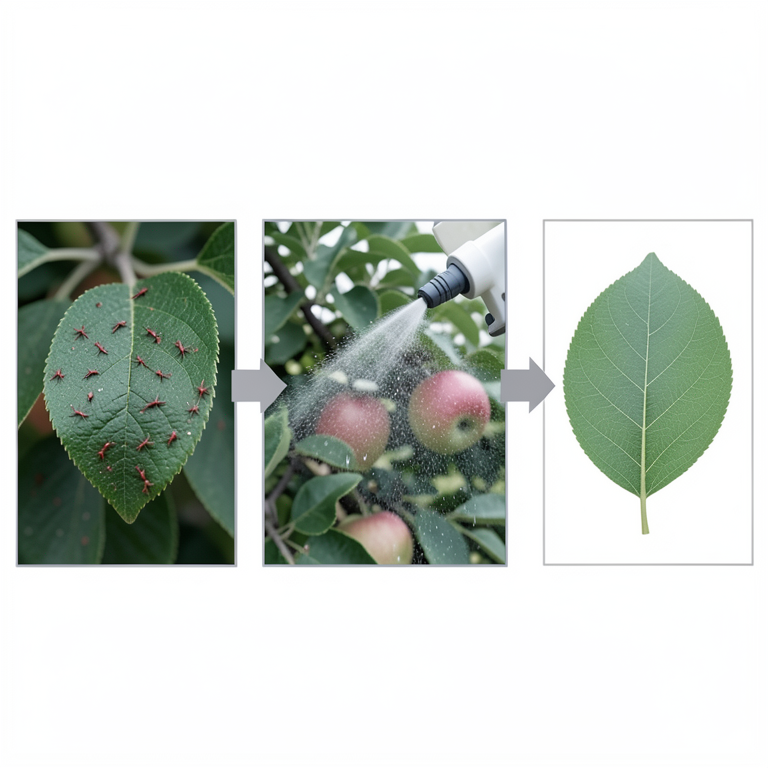
Treatment Application Concept
AI-generated conceptual illustration (apple trees and spider mites (Tetranychus urticae)). It explains the idea and does not show study data.
View source evidence ↗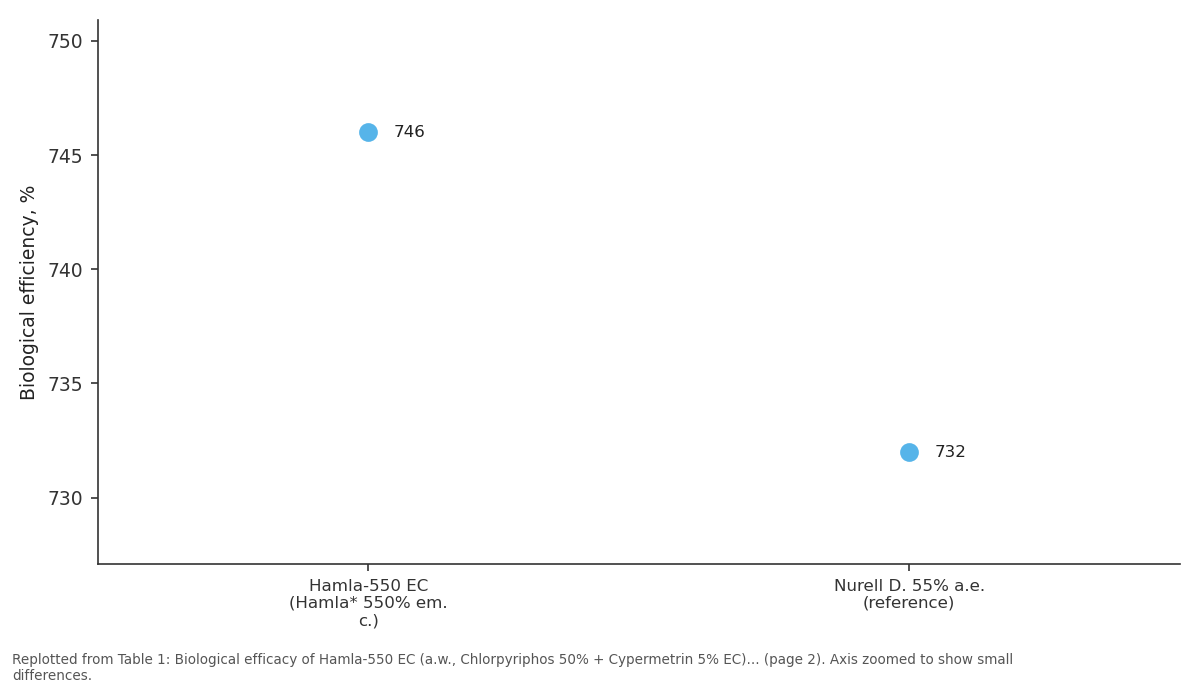
Biological efficiency, %, per day: Hamla-550 EC (Hamla*... vs Nurell D. 55% a.e....
Replotted from Table 1 (page 2) of the original paper. Every bar is the paper's own table value.
View source evidence ↗Figures & tables
From the original paper Table 1
Introduction
Ticks belong to the subclass Acari, the class of arachnids (Arachnida), the subtype of chelicerae (Chelicerata), and the type of arthropods (Arthropoda) [2,9] . These are small, often microscopic arthropods, with characteristic isolation of a very peculiar part of the bodygnathosoma, bearing a complex of mouthparts [4,8] . The meaning of ticks is manifold. First of all, several species cause serious damage to human and animal health. In addition to the general oppression of the host organism, many ticks are carriers and long-term keepers of pathogens of several dangerous diseases [6,12] . Superfamily Tetranychidae The respiratory openings in ticks open externally into long paired peritremes located at the base of the chelicerae [1,13] . The propodosome is often separated from the hysteroscope by an inconspicuous groove. The chelicerae are transformed into a stylophone at the base, and their movable fingers form stylets, which serve to pierce the plant tissue [10,12] . The body is medium in size, 0.3-0.5 mm long, greenish-yellow, brown, bright red. There are often dark spots on the sides of the body [9,13] . The family includes such serious plant pests as the common spiderweb (Tetranychus urticae Koch), hawthorn (Tetranychus viennensis Zacher), red fruit (Panonychus ulmi Koch), garden spider (Schizotetranychus pruni Oud), and other species [3,10] . Red spider mite (Tetranychus cinnabarinus) -belongs to the group of serious pests of almost all garden trees. The adult tick is very small -females -0.5 mm, males -0.3 mm. Females are purple-red, males are bright red. Tick reproduction increases with increasing temperature [7,9] . In addition to the red flat tick, the common spider mite (Tetranychus urticae) and the Atlantic spider mite (Tetranychus atlanticus) are also common. Ticks settle on the upper and lower side of the leaf, on shoots, on branches, and in mass reproduction on fruits [5,7,11] . Damaged plants are distinguished by a pale yellow color. A thin transparent web appears between the leaves and stems of plants. The surface of damaged leaves is first covered with pale dots from sucking out cell sap, but later the spots increase and form continuous whitish spots, the leaves fall off prematurely. The plant weakens, becomes bare, fruiting decreases.
Place and method of testing: Hamla-550 EC production trials (a.w., Chlorpyriphos 50% + Cypermethrin 5% EC). were carried out on stationary garden, "Galaba" farms of the Sariasijsky district of the Surkhandarin region. The preparatory work, setting up and conducting the experiment corresponded to the "Methodological instructions of the State Chemical Commission." (2004).
The biological efficiency of the treatments was calculated according to the well-known Abbat formula (1925), which provides for the correction of experimental data for control.
Eph \u003d Av -Ba * 100 Av
Where, Ef -biological efficiency, in % A -The average number of pests in the experiment before treatment. A -The same after processing B -The average number of pests in the control before treatment. in -the same after processing Test results. Experiments to test the effectiveness of the insecticide Hamla-550 EC (a.w., Chlorpyriphos 50% + Cypermethrin 5% EC) were carried out on stationary garden plots, with different densities of leafworm pest, apple mite. The drug was tested at a consumption rate of 1.0 l/ha. Hamla-550 EC (a.i., Chlorpyriphos 50% + Cypermetrin 5% EC) at a rate of 1.0l/ha, respectively, is noted in the tables below 1. spider mite (Tetranychus urticae Koch). From where it can be seen that the highest rates against the poutine mite on the apple tree, the biological effects on the 3rd day after treatment with the drug at a rate of 1.0l/ha was 74.6%, the maximum effect was noted on the 7th day and amounted to 86.2%. On the 14-21 st day, the efficiency of 77.1-72.4% decreased sharply and equaled, respectively. Standard Nurell-D 55% a.e. at a rate of 1.0 l/ha, the biological efficiency on the 3rd day after treatment with the drug was 73.2%. The maximum effect was noted on the 7th day and amounted to 83.1%. On the 14th-21st day, the biological efficiency is 75.8% -70.8%.
Figures and tables from the paper
| № | Control | Using l/ha | The average number of mites on the 1st infected leaf, and. | — | — | — | — | Biological efficiency, %, per day | — | — | — |
|---|---|---|---|---|---|---|---|---|---|---|---|
| before using | after treatment, per day | ||||||||||
| 3 | 7 | 14 | 21 | 3 | 7 | 14 | 21 | ||||
| 1. | Hamla-550 EC (Hamla* 550% em. c.) | 1,0 | 24,3 | 6,5 | 4,3 | 7,7 | 10,5 | 74,6 | 86,2 | 77,1 | 72,4 |
| 2. | Nurell D. 55% a.e. (reference) | 1,5 | 27,6 | 7,8 | 5,8 | 9,2 | 12,6 | 73,2 | 83,1 | 75,8 | 70,8 |
| 3. | Control (no processing) | - | 34,8 | 36,7 | 43,4 | 48,1 | 4,5 | - | - | - | - |
Table text extracted from the original PDF; superscript letters are shown inline. The original table image is below.
View original table image
References
11 in the original paper- Alatawi FJ. Field studies on occurrence, alternate hosts, and mortality factors of Date Palm Mite, Oligonychus Afroasiatic (McGregor) (Acari: Tetranychidae) Journal of the Saudi Society of Agricultural Sciences. 2020;2(19):146-150.
- Arakawa K. [и др.]. Proteomic evidence for the silk fibroin genes of spider mites (Order Trombidiformes: Family Tetranychidae) Journal of Proteomics. 2021;239:104195.
- Chen WH, Li CY, Chang TY. Temperature-dependent development and life history of Oligonychus litchi (Acari: Tetranychidae), on wax apple Journal of AsiaPacific Entomology. 2016;1(19):173-179.
- Döker İ, Kazak C, Ay R. Resistance status and detoxification enzyme activity in ten populations of Panonychus citri (Acari: Tetranychidae) from Turkey Crop Protection. 2020-2021;(141):1-7.
- Mahesh P. [и др.]. Occurrence of the exotic mite Schizotetranychus krungthepensis (Acarina: Tetranychidae) in sugarcane germplasm in India Crop Protection. 2020-2021;144:105556.
- Landscapes, orchards, pesticidesAbundance of beetles (Coleoptera) in apple orchards along with pesticide toxicity and landscape complexity gradients Agriculture, Ecosystems and Environment. 2017;247:246-254.
- Mirza JH, Kamran M, Alatawi FJ. Phenology and abundance of date palm mite Oligony Afroasiaticticus (McGregor) (Acari: Tetranychidae) in Riyadh, Saudi Arabia Saudi Journal of Biological Sciences. 2021;8(28):4348-4357.
- Park Y Gun, Lee JH. Temperature-dependent development, and oviposition models and life history characteristics of Amblyseius Sharai (Amitai et Swirski) (Acari: Phytoseiidae) preying on Tetranychus urticae (Koch) (Acari: Tetranychidae) Journal of Asia-Pacific Entomology. 2020;4(23):869-878.
- Rameshgar F. [и др.]. Characterization of abamectin resistance in Iranian populations of European red mite, Panonychus ulmi Koch (Acari: Tetranychidae) Crop Protection, 2019, 125.
- Taghizadeh R, Chi H. Demography of Tetranychus urticae (Acari: Tetranychidae) under different nitrogen regimes with estimations of confidence intervals Crop Protection. 2022;155:105920.
- Tiftikçi P, Kök Ş, Kasap İ. Biological control of twospotted spider mites [Tetranychus urticae Koch (Acari: Tetranychidae)] using Phytoseiulus persimilis AthiasHenriot (Acari: Phytoseidae) at different ratios of release on field-grown tomatoes Biological Control. 2020;151:10-15.
Cited by 1
From OpenAlex, OpenCitations and reference lists read by Scinovex
- Burdur İli Fasulye Alanlarından Toplanan Tetranychus urticae Koch (Acari:Tetranychidae) Popülasyonlarında Spiromesifen ve Tebufenpyrad Çapraz Direnç ilişkisi ↗
Sibel Yorulmaz Salman, Hüseyin Kaplan, Orhan Kaya · Ziraat fakültesi dergisi · 2024
Bu çalışmada, 2023 yılı fasulye üretim sezonu boyunca Burdur ilinden toplanan Tetranychus urticae Koch (Acari: Tetranychidae) popülasyonlarında spiromesifen ve tebufenpyrad çapraz direnci araştırılmıştır. Burdur ilinde yoğun olarak fasulye üretimi yapılan Merkez ilçesinden 2, Çeltikçi ilçesinden 2 ve Çavdır ilçesinden 1 olmak üzere 5 adet Tetranychus urticae popülasyonu toplanmıştır. Popülasyonların direnç düzeylerinin belirlenmesi için kuru rezidü yöntemi kullanılmıştır. Denemelerde 7 insektisit…
❝ 0PDF