
Research article · 2022 · Full text
International Journal of Horticulture and Food SciencePrediction of spider mite outbreaks and control methods
Volume 4(1) · Pages 114–115 · DOI: 10.33545/26631067.2022.v4.i1b.100 ↗
Research areasInsect-Plant Interactions and ControlPhytoplasmas and Hemiptera pathogensEntomopathogenic Microorganisms in Pest Control
Abstract
Author-writtenIn the article Apple is one of the most cultivated crops in the world, with an annual production of almost 58 billion tons. It consists of a total of 261.8 thousand hectars in the territory of Uzbekistan. 120,500 hectares are seed orchards; apple orchards make up 95% of all orchards. This shows that apple orchards make up 44% of the total orchard area. The apple tree ranks high due to its adaptability to various soil and climatic conditions, as well as its high productivity and nutritional value as an economic raw material. Agrotechnical activities in horticulture are as follows. Cutting off branches that have dried up due to pests and diseases. Constantly shaping and pruning trees, carrying out rejuvenation activities, and picking fruits that have fallen due to disease and damage. Working between garden rows.Mechanical method. This method includes activities such as cutting off dead parts of trees, putting different types of trapping devices on trees, keeping the surroundings of garden areas clean, and removing pests from the bark of trees. Treating tree trunks with lime water, etc., is effective in preventing pest infestations.
Summary
Source-checkedPlain-language reading of the full paper, prepared with AI and checked against the text. Each point links to the authors' own words.
Why it matters
- Apples are among the most widely grown crops globally, with annual production reaching nearly 58 billion tons. View evidence ↗
- In Uzbekistan, apple orchards cover 261.8 thousand hectares, representing 44% of the total orchard area and 95% of all orchards. View evidence ↗
- The apple red mite and hawthorn mite are significant pests that cause substantial economic losses in fruit orchards. View evidence ↗
The question
- The study aims to predict the spread of spider mite outbreaks and identify effective control methods for apple orchards. View evidence ↗
What they did
- The authors observed spider mite distribution across various districts in the Surkhandarya, Tashkent, and Fergana regions in 2018. View evidence ↗
- The study evaluates a multi-pronged approach to pest control, including agrotechnical, biological, chemical, physical, and mechanical methods. View evidence ↗
What they found
- It was predicted that spider mites would spread over 41,300 hectares of orchards in 2020. View evidence ↗
- Chemical preparations consisting of Abamectin and spirodiclofen were applied to 30,500 hectares of apple orchards to combat spider mites. View evidence ↗
- Spider mite infestation causes leaves to first turn yellow, then brown, and eventually fall off. View evidence ↗
- The application of lime water to tree trunks is identified as an effective mechanical method for preventing pest infestations. View evidence ↗
- Various chemical sprays are recommended for spider mite control, including Pilarstar/Talstar (0.4–0.6 l/ha), Neoron (1.5-3 l/ha), and Nissoran (0.3 kg/ha). View evidence ↗
What it means
- The authors conclude that the goal of pest management should be to increase productivity and produce ecologically clean products with acceptable chemical residue levels. View evidence ↗
Figures & tables
From the original paper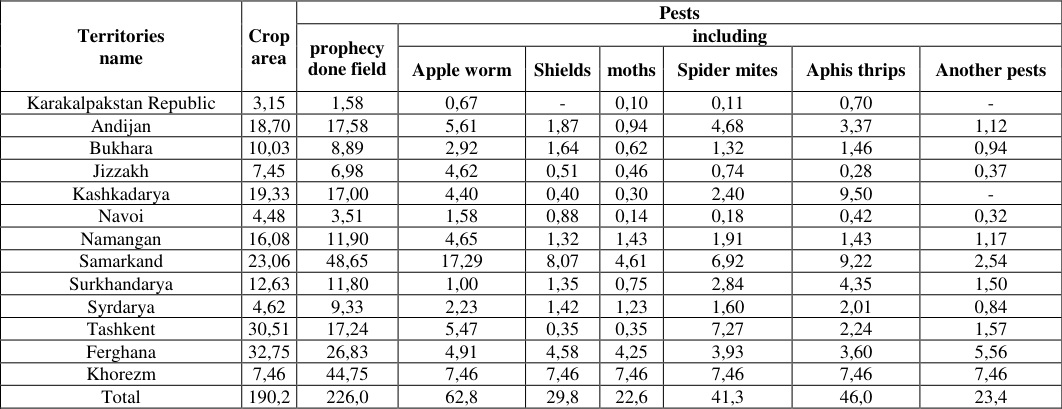 Table 1
Methods
2022; 4(1): 114-115 Rahmonov Ahliddin Habibullaevich and Sharipov Shavkat Xujamurotovich Rahmonov Ahliddin Habibullaevich Basic Doctoral Student, Tashkent State Agrarian University, Yerevan, Armenia Sharipov Shavkat Xujamurotovich Master, Tashkent State Agrarian University, Yerevan, Armenia
Introduction
Apple is one of the most cultivated crops in the world, with an annual production of almost 58 billion tons. It consists of a total of 261.8 thousand hectars in the territory of Uzbekistan. 120,500 hectares are seed orchards, apple orchards make up 95% of all orchards. This shows that apple orchards make up 44% of the total orchard area. The apple tree ranks high due to its adaptability to various soil and climatic conditions, as well as its high productivity and nutritional value as an economic raw material.
In the conditions of 2018, spider mites in orchards were found in Angor, Sarosiyo, Denov and Jarkurgan districts of the Surkhandarya region of the Republic, in Qibray, Zangiota, Yangiyol and Urtachirchik districts of the Tashkent region, in Fergana region, Kuva, Altiariq, It was observed that it spread over large areas in almost all areas of Fergana and Beshariq districts. In 2020, orchard mites are expected to spread over 41,300 hectares. According to the State Statistics Committee, in the first seven months of 2021, Uzbekistan exported 4,200 tons of apples worth 8.6 million dollars to five countries. Apple export decreased by 7.3 thousand tons compared to the same period last year.
The most famous apple varieties: Simirinko, Golden, Besh Yulduz, Rosemary, Tashkent Borovinka, Tilla Alma, Samarkand Alosi, Nafis and others. Apple orchards across the country are located in Tashkent and Samarkand regions. Apples are grown in different cultivars from sea level to 2300 meters. The most productive varieties develop in the range of 400-1800 meters.
Apple red mite (Panonychus ulmi Koch), hawthorn mite (Amphitetranychus viennensis Zacher) are among the pests that cause great economic damage in fruit orchards. In recent years, arachnid spider mites have been causing considerable damage in the orchards of our Republic. In 2020, spider mites are predicted to spread over a total of 41,300 hectares. Abamectin + spirodiclofen preparations were used against spider mites in 30,500 hectares of apple orchards.
The spider mite usually causes more damage to the apple tree, but it also affects other seed and pome fruit trees. Spider mite-infected leaves first turn yellow, and then turn brown and fall off. The fruit spider mite overwinters in clusters under bark and in tree trunk cracks, under weed debris, on branches and partially near buds on branches. The pest feeds on the sap of the leaf cells of fruit trees.
Leaves and fruits will fall if timely fighting is not carried out. http://www.hortijournal.com Table 1: The prediction of the spread of garden pests in thousand hectare Pests including Territories Crop name area prophecy done field Apple worm Shields moths Spider mites Aphis thrips Another pests is to increase productivity, produce ecologically clean products, and achieve the required amount of residues of used chemicals in cultivated products. Reference 1. Abrorov S. Uzbek farmers to learn about apple production technologies and practices. [online] UNDP in Uzbekistan; 2021.
| Territories name | Crop area | Pests | — | — | — | — | — | — |
|---|---|---|---|---|---|---|---|---|
| prophecy done field | including | |||||||
| Apple worm | Shields | moths | Spider mites | Aphis thrips | Another pests | |||
| Karakalpakstan Republic | 3,15 | 1,58 | 0,67 | - | 0,10 | 0,11 | 0,70 | - |
| Andijan | 18,70 | 17,58 | 5,61 | 1,87 | 0,94 | 4,68 | 3,37 | 1,12 |
| Bukhara | 10,03 | 8,89 | 2,92 | 1,64 | 0,62 | 1,32 | 1,46 | 0,94 |
| Jizzakh | 7,45 | 6,98 | 4,62 | 0,51 | 0,46 | 0,74 | 0,28 | 0,37 |
| Kashkadarya | 19,33 | 17,00 | 4,40 | 0,40 | 0,30 | 2,40 | 9,50 | - |
| Navoi | 4,48 | 3,51 | 1,58 | 0,88 | 0,14 | 0,18 | 0,42 | 0,32 |
| Namangan | 16,08 | 11,90 | 4,65 | 1,32 | 1,43 | 1,91 | 1,43 | 1,17 |
| Samarkand | 23,06 | 48,65 | 17,29 | 8,07 | 4,61 | 6,92 | 9,22 | 2,54 |
| Surkhandarya | 12,63 | 11,80 | 1,00 | 1,35 | 0,75 | 2,84 | 4,35 | 1,50 |
| Syrdarya | 4,62 | 9,33 | 2,23 | 1,42 | 1,23 | 1,60 | 2,01 | 0,84 |
| Tashkent | 30,51 | 17,24 | 5,47 | 0,35 | 0,35 | 7,27 | 2,24 | 1,57 |
| Ferghana | 32,75 | 26,83 | 4,91 | 4,58 | 4,25 | 3,93 | 3,60 | 5,56 |
| Khorezm | 7,46 | 44,75 | 7,46 | 7,46 | 7,46 | 7,46 | 7,46 | 7,46 |
| Total | 190,2 | 226,0 | 62,8 | 29,8 | 22,6 | 41,3 | 46,0 | 23,4 |
Table text extracted from the original PDF; superscript letters are shown inline. The original table image is below.
View original table image
Available at: <https://www.uz.undp.org/content/uzbekistan/en/home/ presscenter/pressreleases/2016/04/29/uzbek-farmers-to- learn-about-apple-production-technologies-and-p.html> [Accessed 19 September 2021]. 2. Agronet.uz. Recommendations for growing apples - Internet portal; 2021. Agronet.uz. [online] Available at: <https://agronet.uz/olma-yetishtirish-boyicha- tavsiyalar/> [Accessed 19 September 2021]. 3.
Akhmedov S. Apple crop in Uzbekistan. [online] Academia.edu; 2021. Available at: <https://www.academia.edu/26487384/Apple_crop_in_ Uzbekistan> [Accessed 19 September 2021]. 4. Kasap, İsmail.
Seasonal Population Development of Spider Mites (Acari: Tetranychidae) and Their Predators in Sprayed and Unsprayed Apple Orchards in Van, Turkey. Zoosymposia. 2011;6(1):111-117. 5. Shodieva G. Uzbekistan exported 8.6 thousand tons of apples; 2021. [Online] https://yuz.uz.
Available at: <https://yuz.uz/news/ozbekiston-86-ming-tonna-olma- eksport-qilgan> [Accessed 19 September 2021]. Karakalpakstan Republic 3,15 1,58 0,67 - 0,10 0,11 0,70 - Andijan 18,70 17,58 5,61 1,87 0,94 4,68 3,37 1,12 Bukhara 10,03 8,89 2,92 1,64 0,62 1,32 1,46 0,94 Jizzakh 7,45 6,98 4,62 0,51 0,46 0,74 0,28 0,37 Kashkadarya 19,33 17,00 4,40 0,40 0,30 2,40 9,50 - Navoi 4,48 3,51 1,58 0,88 0,14 0,18 0,42 0,32 Namangan 16,08 11,90 4,65 1,32 1,43 1,91 1,43 1,17 Samarkand 23,06 48,65 17,29 8,07 4,61 6,92 9,22 2,54 Surkhandarya 12,63 11,80 1,00 1,35 0,75 2,84 4,35 1,50 Syrdarya 4,62 9,33 2,23 1,42 1,23 1,60 2,01 0,84 Tashkent 30,51 17,24 5,47 0,35 0,35 7,27 2,24 1,57 Ferghana 32,75 26,83 4,91 4,58 4,25 3,93 3,60 5,56 Khorezm 7,46 44,75 7,46 7,46 7,46 7,46 7,46 7,46 Total 190,2 226,0 62,8 29,8 22,6 41,3 46,0 23,4 Garden pests are combated by agrotechnical, biological, chemical, physical, mechanical methods and quarantine measures are taken. Agrotechnical method. This method is the basis of coordinated protection of orchards.
With the help of agrotechnical methods, it is possible to prevent the increase of pests, sometimes they can be completely eradicated. By successfully applying the agrotechnical method, it is possible to create unfavorable conditions for pests, to create favorable conditions for the good growth and development of orchards and the reproduction of entomophages. The agrotechnical method is mainly useful in two directions. Healthy trees are naturally pest and disease resistant, and using this method also creates unfavorable conditions for these species.
Conditions are created for diseased plants to develop and recover. In addition, the implementation of agrotechnical method together with the measures of the integrated method is one of its advantages. This method usually does not require additional expenses. Agrotechnical activities in horticulture are as follows.
Cutting off branches that have dried up due to pests and diseases. Constantly shaping and pruning trees, carrying out rejuvenation activities, picking fruits that have fallen due to disease and damage. Working between garden rows. Mechanical method.
This method includes activities such as cutting off dead parts of trees, putting different types of trapping devices on trees, keeping the surroundings of garden areas clean and removing pests from the bark of trees. Treating tree trunks with lime water, etc., is effective in preventing pest infestations. Chemical method. The use of chemicals against harmful organisms gives good results in the coordinated protection of orchards.
It is recommended to spray one of the following chemicals against spider mites in orchards. Pilarstar or Talstar – 0.4–0.6; Neoron - 1.5-3; Bi-58 (new), Nugor or Danadim – 1–2; Atilla, Karate or Wrestling - 0.4-0.8; Break-ME – 0.2–0.4; Omayt or Uzmayt - 1.5-3; Danitol - 1.5; Duet, Nurell-D, Sayren-S, Tagrell-D, Sipi plus or Siperfos - 1-1.5 l/ha; Nissoran - 0.3 kg/ha. Biological method. The biological method means the use of natural pesticides and their vital products against pests.
Natural pests include predatory and parasitic insects, mites, entomophages, microorganisms, bacteria, fungi and viruses. Natural products include pheromone, attractant, repellants. The integrated control system against the pests of fruit trees