
Research article · 2022 · Full text
International Journal of Horticulture and Food ScienceMain types of spider mites (Tetranychidae) and entomophagy in entomophagy type of composition, level of meeting
Volume 4(1) · Pages 110–113 · DOI: 10.33545/26631067.2022.v4.i1b.99 ↗
Research areasDiptera species taxonomy and behaviorInsect-Plant Interactions and ControlInsect and Pesticide Research
Abstract
Author-writtenThe article conducted research on the main species of spiders (Tetranychidae) in seed orchards and monitored their occurrence rates. According to him, a total of 6 species of mites are recorded from the species belonging to the family Tetranychidae of the class of mites. As a result of the analysis of the natural cousins ​​of the mites, 9 types of cousins ​​were recorded. The most common of these species are phytoseyulus, Mobius, Prius, stertorous beetle, metaseyulus, and entomophagous. Based on the results obtained, conclusions and recommendations are given.
Summary
Source-checkedPlain-language reading of the full paper, prepared with AI and checked against the text. Each point links to the authors' own words.
Why it matters
- Orchards are susceptible to damage from several types of mites, primarily those from the Tetranychidae (four-legged) and Eriophyidae (two-legged) families. View evidence ↗
- The common spider mite is a critical pest in Central Asia, capable of destroying over half of crop yields in some fields, with typical annual losses ranging from 6% to 14%. View evidence ↗
- Spider mites are widespread, infecting 1,200 plant species, with 150 of those species facing high economic risk. View evidence ↗
The question
- The study aimed to investigate the species composition and the damage caused by mites found in the horticultural regions of the Republic. View evidence ↗
What they did
- Surveys were conducted between 2020 and 2021 in local and intensive seed orchards located in the Tashkent and Surkhandarya regions. View evidence ↗
- Mite samples were systematically analyzed at the Plant Protection Laboratory of Tashkent State Agrarian University using literary and internet sources for identification. View evidence ↗
- Morphological features were distinguished using an XSZ-152 s microscope and an EMMERT IPP IPP55 plus thermostat. View evidence ↗
What they found
- The researchers recorded a total of 6 species of mites belonging to the Tetranychidae family in the seed orchards. View evidence ↗
- In apple trees, the apple red mite and the simple spider mite were found in high abundance (+++). View evidence ↗
- In pear trees, the apple red mite and the gray fruit mite were the most abundant species (+++). View evidence ↗
- The simple spider mite was the most abundant species found in quince trees (+++). View evidence ↗
- The analysis of natural enemies (cousins) of the mites identified 9 different types. View evidence ↗
- Chrysopa septempunctata was found in high abundance (+++) in both the Tashkent and Surkhandarya regions. View evidence ↗
- The number of macrophages decreased when there was a sharp increase in air temperature, indicating that climatic conditions affect the migration of wild insects and mites. View evidence ↗
What it means
- The authors conclude that entomophagy (the use of predatory organisms) plays an important role in controlling mite populations in gardens. View evidence ↗
- The authors identified the apple red mite, gray fruit mite, and common spider mite as the most damaging pests to the leaves, young twigs, and fruits of the studied trees. View evidence ↗
Figures & tables
From the original paper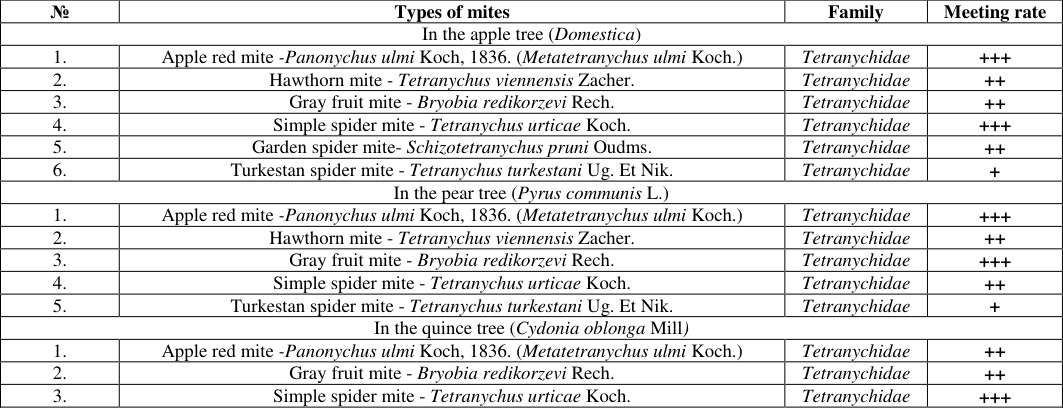 Table 1
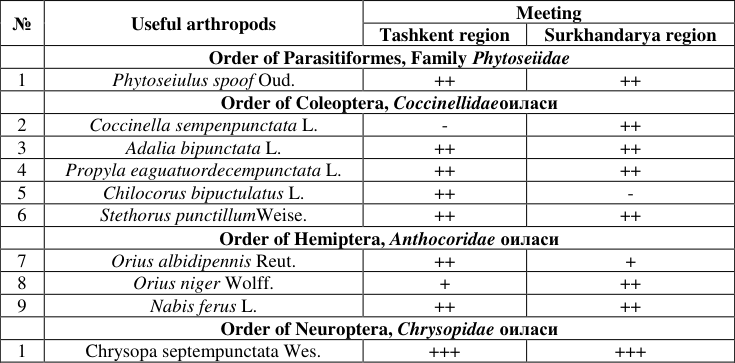 Table 2
Introduction
In orchards, several types of mites cause damage. They belong mainly to two families, the first being the four-legged mites (Tetranychidae) and the two-legged mites (Eriophyidae). These mites mite be seen in the field under a special magnifying glass, in the laboratory under a microscope. The main mites in the orchards of the country are ordinary spiders, hawthorn mites, and garden spiders (Sh. Khodjaev, 2019). In horticultural farms, several species of mites, mainly with high levels of damage, have been found to cause significant damage. These are the gray fruit mite (Bryobia redikorzevi Rech), the hawthorn mite (Tetranychus viennensis Zacher), the apple red mite (Metatetranychus ulmi Koch), the common spider mite (Tetranychus urticae Koch), and other gall-forming mites. Spider mites mainly develop and multiply under cobwebs. (V. N.shchegolev, 1964). Spider mite (Tetranychus urticae Koch). Although several species of plant mites damage cotton and other crops in Uzbekistan, the most dangerous of them is the common spider. It is a herbivore belonging to the class of arachnids (Arachnida), a family of aeriform mites (Azimov D., 1993). The common spider is the most dangerous pest of cotton and other crops in Central Asia. This pest might destroy more than half of the crop yield in some fields. In normal years, the spider kills 6-10% of the gross crop, and in some years even 14% (Kosobutsky M., 1959). The spider is more dangerous and harmful than other mites (Tetranychus urticae), the main pest of melons, industrial crops and horticulture, ornamental trees. Spiders have been recorded as the main pest of more than 150 species of crops worldwide (Jhansi and Mohan, 1997). According to the research of other scientists, mites are distributed in almost all agricultural areas of the earth, and phytophagous mites, compared to other mites, all stages of its development are associated with plants. Spiders have been found to infect 1,200 species of cultivated and other plants, and 150 species of these plants are at high economic risk (Jeppson et al., 1997;Zhang, 2003;Xie et al., 2006). In our country, research has been conducted on the occurrence of mites in horticultural farms and their bioecological characteristics and systematic status, but not in-depth study. For this reason, we aimed to research the mites encountered in the horticultural regions of the Republic and their species composition, damage.
Object and methods of research
Research Surveys were conducted in the existing local and intensive seed orchards in the Tashkent Surkhandarya region in 2020-2021. The research has been conducted over the years in the horticultural areas of the provinces, collecting samples from the mites and their natural neighbors identified in the seed orchards during the season. The samples were systematically analyzed in the Plant Protection Laboratory of Tashkent State Agrarian University based on various literary and Internet sources. Indicators such as mite location, systematic analysis, and their incidence rate were identified. In laboratory studies, the thermostat EMMERT IPP IPP55 plus, microscope type XSZ-152 s was used to distinguish morphological features.
Research results and their discussion
In the study, areas affected mainly by mites were isolated and monitored throughout the season. Initially, the collected channels in 2020-2021 were compared with each other, and their types were systematically clarified. According to him, encounter rates were determined for mites, apple, pear, and quince trees, which are numerous and highly harmful. According to him, 6 species of mites were found in seed trees in the studied areas. However, not all of them had high levels of development and population density. In seed orchards, the species of spiders, mainly belonging to the family Tetranychidae, were found. Of these, the apple red mite -Panonychus ulmi Koch, 1836 (Metatetranychus ulmi Koch.), Hawthorn mite -Tetranychus viennensis Zacher., Gray fruit mite -Bryobia redikorzevi Rech., Common spider -Tetranychus urticae Koch., Garden spider., Garden spider. turkey spider -Tetranychus Turkestani Ug. Et Nik. It was observed that the tribes met. These mites are infested by fruit tree species and their incidence varies, and in some cases co-development of several mite species in fruit trees of the same species has been observed. These cases were mainly observed in apple and pear trees. Apple red mite, a common spider, hawthorn mite, gray fruit mite, and garden spider were found to be medium-infested mites. As a rare species compared to other mites, Turkestan was found to be a spider. In the apple tree, a gray mite was also found along with the red apple mite at the same time (Table 1). Simple spider mite -Tetranychus urticae Koch. Tetranychidae +++ Comment: (+++)many, (++)middle, (+)few Pear fruit trees were observed in moderate amounts with red apple mite, gray mite, hawthorn mite and spider mite during the season. The Turkestan spider was found in very small numbers. The quince tree was also found to have a high incidence of mite infestation, mainly as a simple spider with a high level of infestation. However, in some places, apple red mite and gray fruit mites were also moderately damaged.
| № | Types of mites | Family | Meeting rate |
|---|---|---|---|
| In the apple tree (Domestica) | |||
| 1. | Apple red mite -Panonychus ulmi Koch, 1836. (Metatetranychus ulmi Koch.) | Tetranychidae | +++ |
| 2. | Hawthorn mite - Tetranychus viennensis Zacher. | Tetranychidae | ++ |
| 3. | Gray fruit mite - Bryobia redikorzevi Rech. | Tetranychidae | ++ |
| 4. | Simple spider mite - Tetranychus urticae Koch. | Tetranychidae | +++ |
| 5. | Garden spider mite- Schizotetranychus pruni Oudms. | Tetranychidae | ++ |
| 6. | Turkestan spider mite - Tetranychus turkestani Ug. Et Nik. | Tetranychidae | + |
| In the pear tree (Pyrus communis L.) | |||
| 1. | Apple red mite -Panonychus ulmi Koch, 1836. (Metatetranychus ulmi Koch.) | Tetranychidae | +++ |
| 2. | Hawthorn mite - Tetranychus viennensis Zacher. | Tetranychidae | ++ |
| 3. | Gray fruit mite - Bryobia redikorzevi Rech. | Tetranychidae | +++ |
| 4. | Simple spider mite - Tetranychus urticae Koch. | Tetranychidae | ++ |
| 5. | Turkestan spider mite - Tetranychus turkestani Ug. Et Nik. | Tetranychidae | + |
| In the quince tree (Cydonia oblonga Mill) | |||
| 1. | Apple red mite -Panonychus ulmi Koch, 1836. (Metatetranychus ulmi Koch.) | Tetranychidae | ++ |
| 2. | Gray fruit mite - Bryobia redikorzevi Rech. | Tetranychidae | ++ |
| 3. | Simple spider mite - Tetranychus urticae Koch. | Tetranychidae | +++ |
Table text extracted from the original PDF; superscript letters are shown inline. The original table image is below.
View original table image
In the orchards of Uzbekistan, 16 species of predatory mites feed on phytophagous mites and insects. Most species of arachnids live only in the wild, and wild arachnids are divided into 2 groups: parasitiform and aeriform [2, 4] . The biological method of pest control in orchards is based on the use of natural relatives and entomophagous organisms of pests. The natural cousins of arthropods are divided into entomophagous (insectivorous) or carpophagous (mite-feeding) in terms of their nutritional properties. In practice, the biological method is carried out by artificially inseminating the insects of certain insects and mites in areas where there is a risk of reproduction of a pest. There are 2 ways to use entomophagy on a large scale, the first is to find local species of entomophagous and use them effectively, and the second is to introduce aggressive species from abroad (introduction) to local conditions [5, 7] . In nature, macrophages play an important role in managing the number of mites. The actual reduction in the quantitative number of mites by macrophages depends on many factors, including climate and weather conditions, the physiological state of the population, various biocenosis connections, and so on. Therefore, it is not always possible to determine the negative quantitative relationship between the total quantitative number of channels and macrophages. In Uzbekistan, 43 native species of wild mites belonging to 11 families and 27 genera have been identified. Most of these species are found mainly in garden biotopes where insecticides are rarely used, as well as in grasses around field crops [6, 9] . Research The survey was conducted in 2018-2019 in existing local and intensive seed orchards in Tashkent and Surkhandarya regions. The study followed years of observations of the horticultural areas of the provinces, identified and sampled the natural neighbors of the seedbearing garden mites during the season. The research was carried out based on generally accepted methods (Bondarenko N.V., Bey-Bienko G.Ya., J.Azimov) in determining the species composition, distribution, and damage of sucking pests and entomophagous in orchards and collecting samples. In the study, areas with mainly natural cousins (entomoacariphas) were observed separately and observed throughout the season. Initially, the Kushans collected in 2020-2021 were compared with each other, and their types were systematically clarified. According to him, encounter rates were found for cousins, apple, pear, and quince trees with high levels of usefulness. According to him, 9 species of natural cousins were found in fruit trees in the studied areas. However, not all of them had high levels of development and population density. In the orchards were found species and other cousins, mainly members of the family Coccinellidae. Of these, the Stetorus beetle is Stethorus punctum Ws, Orius albidipennis Reut of the Prius caterpillar. and Orius niger Wolff, Mobius Nabis ferus L, thrips Thysanoptera, phytoseiulus Phytseiulus corniger W., Neuroptera family, Chrysopidae family Chrysopa septempunctata Wes. Kabi species were observed [8, 10] . These Kushans have different levels of occurrence in fruit tree species, and in some cases, separate development of several kush and a species has been observed in fruit trees of the same species. These cases were mainly observed in apple and quince trees. Phytoseiulus, Mobius, oriuskandalasi, stertorous beetle, and other metaseyulius were found in the pear tree at the same time as phytoseiulus (Table 2). The mites encountered in the studies differed from one another in terms of development and distribution. According to him, the most common mites are Adalia bipunctata L., Propylaea guatuordecempunctata L., Phytoseiulus spoof Oud., Nabis ferus L., Chrysopa septempunctata Wes. such species are found in both regions and be important in reducing the number of mites in orchards. The migration of wild bloodsucking insects and mites was observed to vary depending on climatic conditions, and a sharp increase in air temperature led to a decrease in the number of macrophages.
| № | Useful arthropods | Meeting | — |
|---|---|---|---|
| Tashkent region | Surkhandarya region | ||
| Order of Parasitiformes, Family Рhytоseiidae | |||
| 1 | Phytoseiulus spoof Oud. | ++ | ++ |
| Order of Coleoptera, Coccinellidaeоиласи | |||
| 2 | Coccinella sempenpunctata L. | - | ++ |
| 3 | Adalia bipunctata L. | ++ | ++ |
| 4 | Propyla eaguatuordecempunctata L. | ++ | ++ |
| 5 | Chilocorus bipuctulatus L. | ++ | - |
| 6 | Stethorus punctillumWeise. | ++ | ++ |
| Order of Hemiptera, Anthocoridae оиласи | |||
| 7 | Orius albidipennis Reut. | ++ | + |
| 8 | Orius niger Wolff. | + | ++ |
| 9 | Nabis ferus L. | ++ | ++ |
| Order of Neuroptera, Chrysopidae оиласи | |||
| 1 | Chrysopa septempunctata Wes. | +++ | +++ |
Table text extracted from the original PDF; superscript letters are shown inline. The original table image is below.
View original table image
Conclusion
Studies have shown that in seed trees (apple, pear, quince) a total of 6 species of mites belonging to the family Tetranychidae are found. Of these, 3 species were identified as the most pests and predators. Of these, apple red beetle, gray fruit beetle, and common spider were observed to damage the leaves, young twigs, and fruits of fruit trees to a high degree. The branches of the damaged trees were manifested by cold blows, the shedding of the leaves, and the appearance of various spots on the fruit. During the study, a total of 9 species of mite species were found in orchards. The most common of these were phytoseyulus, Mobius, Prius, stertorous beetle, metaseiulus. This entomophagy has been found to play an important role in managing the number of mites in gardens.
References
10 in the original paper- Азимов А. ва бошқалар. Насекомые Узбекистана». - Ташкент, изд. «Фан»; 1993.
- Кособуцкий МИ. Вертикальное перемещение (миграции) паутинного клещика по кормовому растению: //Тр.Уз ГУ, Самарканд. 1959;87:3-31.
- Сулаймонов БА, Болтаев БС, Комилов ШГ. Қишлоқ хўжалиги экинлари зараркунандалари, касалликлари ва уларга қарши кураш чоралари. Тошкент; 2013, p. 3
- Хамраев А, Насриддинов К. Ўсимликларни биологик ҳимоялаш. Тошкент; 2003. p. 55-57.
- Хамраев А, Хасанов БА, Сулаймонов БА, Кожевникова АГ. Ўсимликларни биологик ҳимоя қилиш воситадари. Тошкент; 2012. p. 152-153
- Яхонтов ВВ. Ўрта Осиё қишлоқ хўжалиги зараркунандалари. Тошкент; 1962. p. 492.
- Щеголев ВН. Энтомология. Изд. Высшая школа, - Москва; 1964. p. 279.
- Jhansi RB, Mohan NJ. Pest management in ornamental crops in progressive floriculture. Edition J.S. Yadav and M. L. Chaudhary House of Saipan Bangalore. 1997;26:169-181.
- Jeppson LR, Keifer HH, Baker EW. Mites Injurious to Economic Plants. University of California Press, Berkeley, CA, 1997, 458 pp.
- Xie L, Miao H, Xiao-Yue Hong XY. The two-spotted spider mite Tetranychus urticae Koch and the carmine spider mite Tetranychus cinnabarinus (Boisduval) in China mixed in their Wolbachia phylogenetic tree. Zootaxa. 2006;1166:33-46.