
Research article · 2022 · Full text
International Journal of Agriculture Extension and Social DevelopmentObservation of local, improved and hybrid rice varieties in Rampur Baghelan, Satna district (M.P.) India
Volume 5(1) · Pages 88–91 · DOI: 10.33545/26180723.2022.v5.i1b.128 ↗
Research areasRice Cultivation and Yield ImprovementGABA and Rice ResearchAgricultural Economics and Practices
Abstract
Author-writtenThe field studies were carried out for performance of local, improved and hybrid varieties of rice in Rampur Baghelan, Satna district. Study of performance was done from 2020 to 2021. To study the incidence of various pests 16 rice cultivars five were local cultivars namely Dehula, Newari, Bhataphool, Loachai & Lohindi & six were improved varieties viz Pusabasmati, IR-36, IR-64, Vandana, IR-20 & Pusa Sugandha and five were hybrid varieties i.e. PA-6201, KRH-2, PRH-10, JRH-4 & JRH-5. The observations were made regarding the plant height, number of tillers, number of primary and secondary panicle, maturity days and grain yield.
Summary
Source-checkedPlain-language reading of the full paper, prepared with AI and checked against the text. Each point links to the authors' own words.
Why it matters
- Rice is a critical food crop in India, significantly influencing the economy, diets, and culture of millions of people. View evidence ↗
- In Madhya Pradesh, rice productivity (989 kg/ha) is significantly lower than the national average of 2010 kg/ha. View evidence ↗
- Hybrid rice varieties are noted for having more extensive root systems and producing grain yields approximately 14-18% higher than other types. View evidence ↗
The question
- The study aimed to observe and compare the performance of local, improved, and hybrid rice varieties in the Rampur Baghelan area of the Satna district during 2020. View evidence ↗
What they did
- The researchers tested 16 rice cultivars: five local (Dehula, Newari, Bhataphool, Loachai, Lohindi), six improved (Pusabasmati, IR-36, IR-64, Vandana, IR-20, Pusa Sugandha), and five hybrid (PA-6201, KRH-2, PRH-10, JRH-4, JRH-5). View evidence ↗
- Performance was measured based on plant height, tiller count, primary and secondary panicle numbers, days to maturity, and grain yield. View evidence ↗
- The study took place in 2020, with temperatures ranging from 15.64 °C to 30.6 °C and total rainfall of 669.6 mm over 41 rainy days. View evidence ↗
What they found
- In 2020, the IR 64 variety had the highest number of tillers per plant (14.6), while the Dehula variety had the lowest (4.4). View evidence ↗
- The hybrid variety PA-6201 showed the maximum number of tillers per square meter (260.9), whereas Lohandi showed the minimum (120.1). View evidence ↗
- The longest panicles were found in JRH-5 (29.5 cm) and Pusabasmati (29.2 cm), while Lohandi had the shortest (23.5 cm). View evidence ↗
- Panicle weight was highest in PRH 10 (5.9 g) and lowest in Dehula (2.7 g) during 2020. View evidence ↗
- The variety PRH 10 produced the maximum number of filled grains per panicle (296.9), while the minimum was 130.1. View evidence ↗
- PA-6201 had the highest number of chaffy grains per panicle (35.7), while JRH-5 had the lowest (17.5). View evidence ↗
- The Dehula variety matured the fastest (90 days), whereas Bhantaphool took the longest time to mature (140 days). View evidence ↗
- The maximum 1000-grain weight was observed in JRH-5 (27.77 g), and the minimum was in IR-201 (19.5 g). View evidence ↗
- The highest grain yield in 2020 was 91.8 q/ha for PA-6201, while the lowest was 16.4 q/ha for Dehula. View evidence ↗
What it means
- The authors recommend adopting cultural practices such as using pest- and disease-resistant varieties, timely planting, and the judicious use of nutrients and water. View evidence ↗
- The authors conclude that while research has improved food security, policies focusing solely on increasing food volume have ignored health and environmental issues, leading to negative consequences. View evidence ↗
Visual summary
3 visualsIllustrations explain the paper; charts are replotted from the paper's own table values.
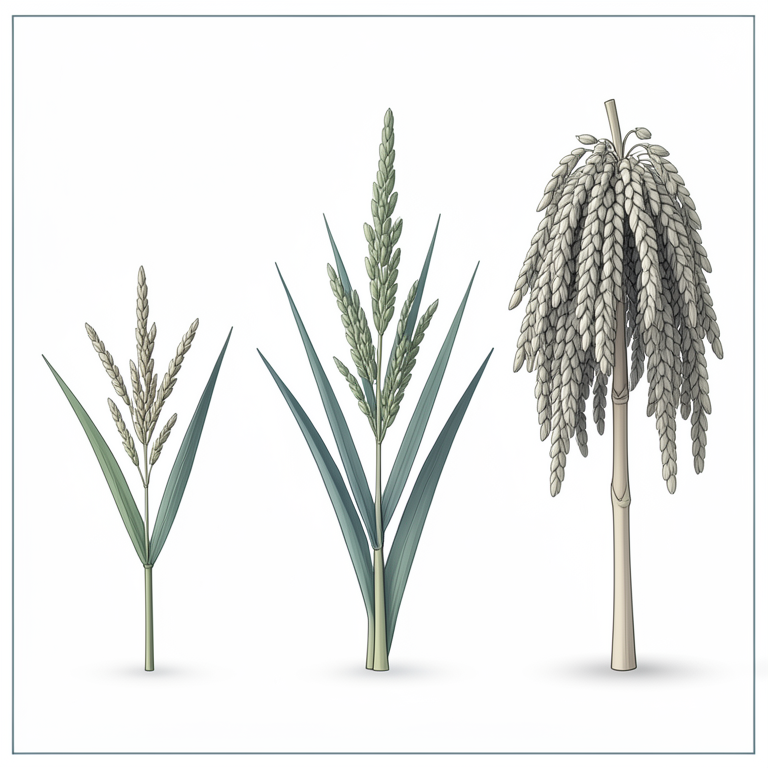
Yield Comparison
AI-generated conceptual illustration (rice plants (Oryza sativa)). It explains the idea and does not show study data.
View source evidence ↗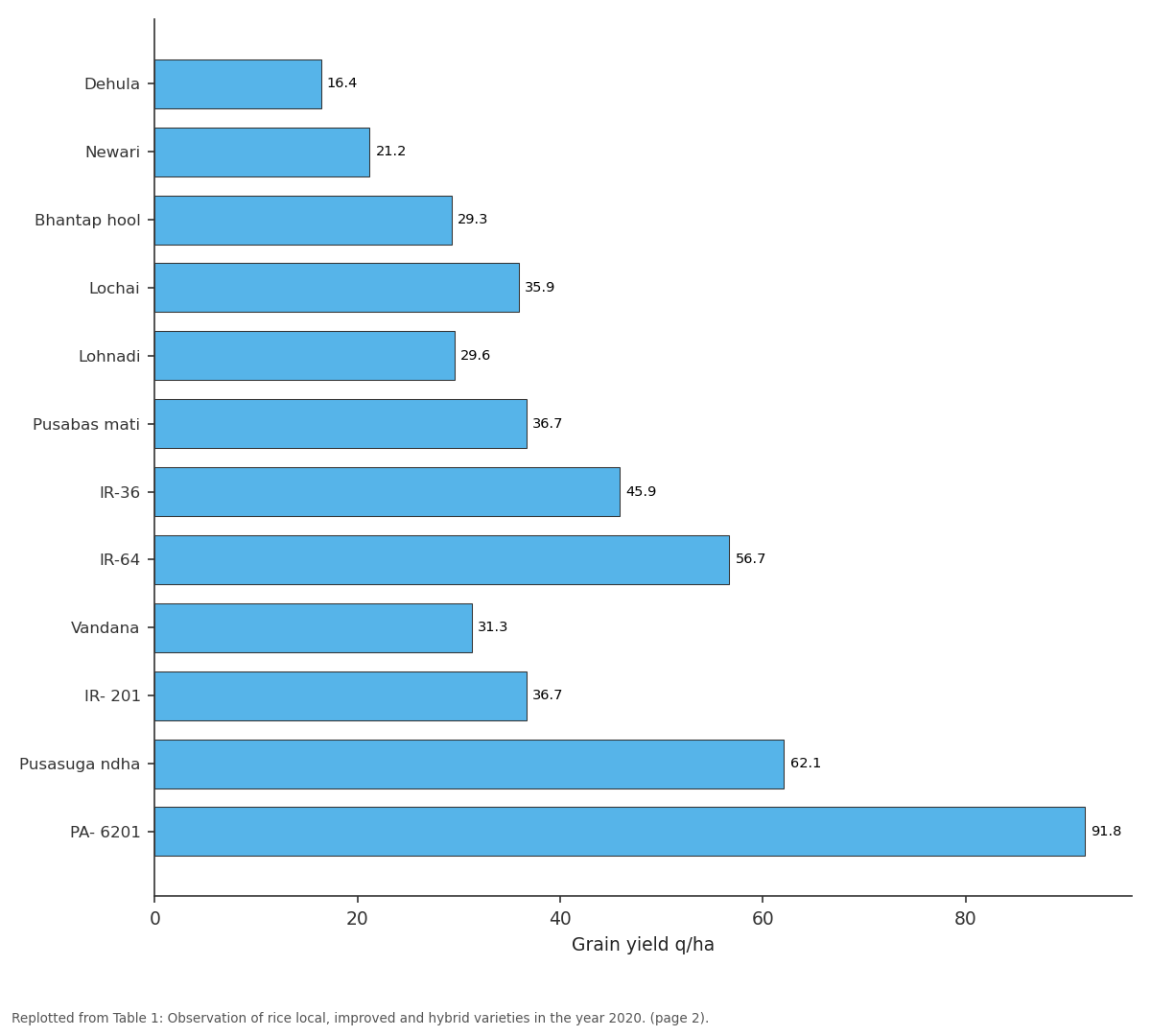
Grain yield q/ha: Dehula vs Newari vs Bhantap hool vs Lochai vs Lohnadi
Replotted from Table 1 (page 2) of the original paper. Every bar is the paper's own table value.
View source evidence ↗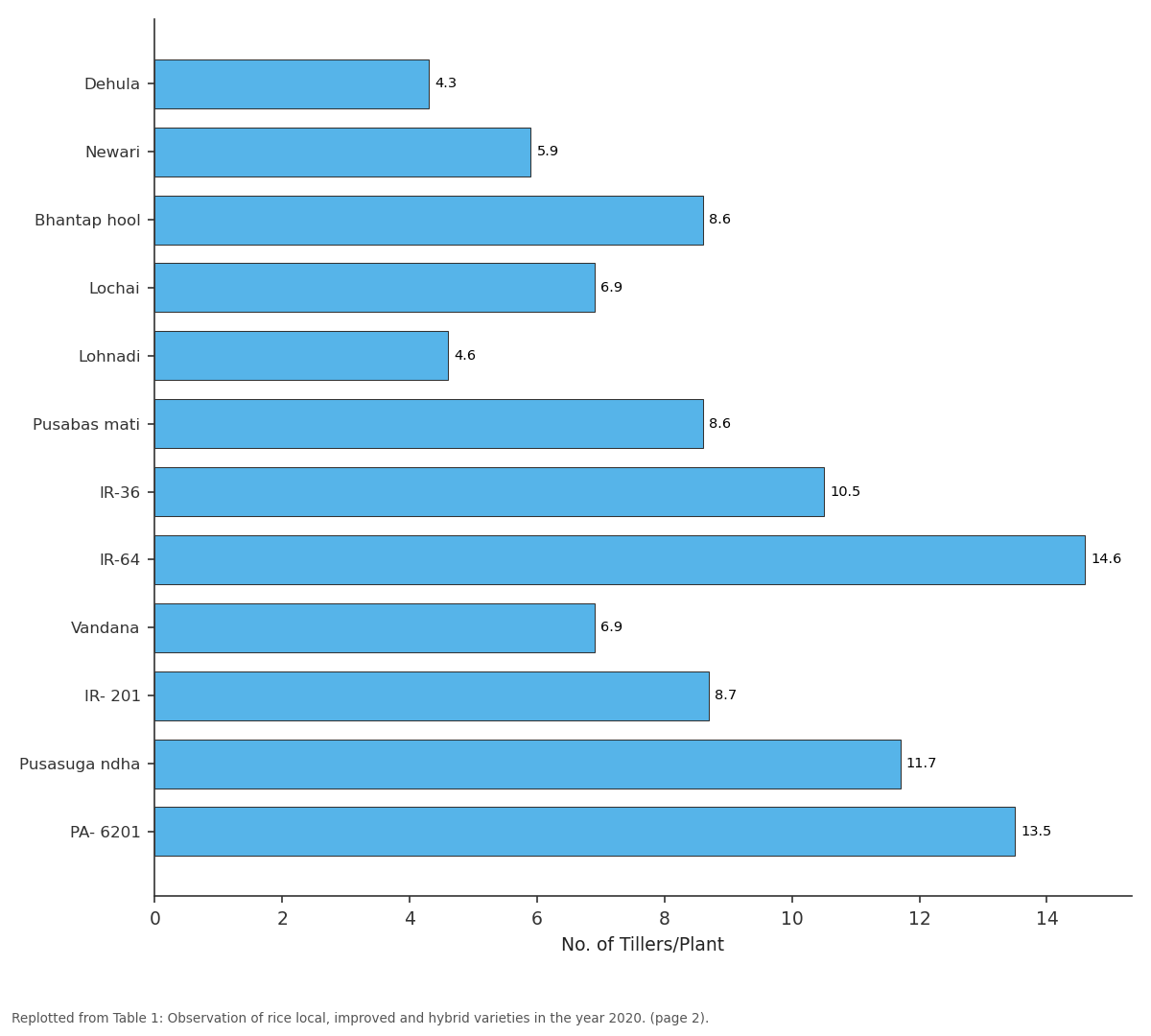
No. of Tillers/ Plant: Dehula vs Newari vs Bhantap hool vs Lochai vs Lohnadi
Replotted from Table 1 (page 2) of the original paper. Every bar is the paper's own table value.
View source evidence ↗Figures & tables
From the original paper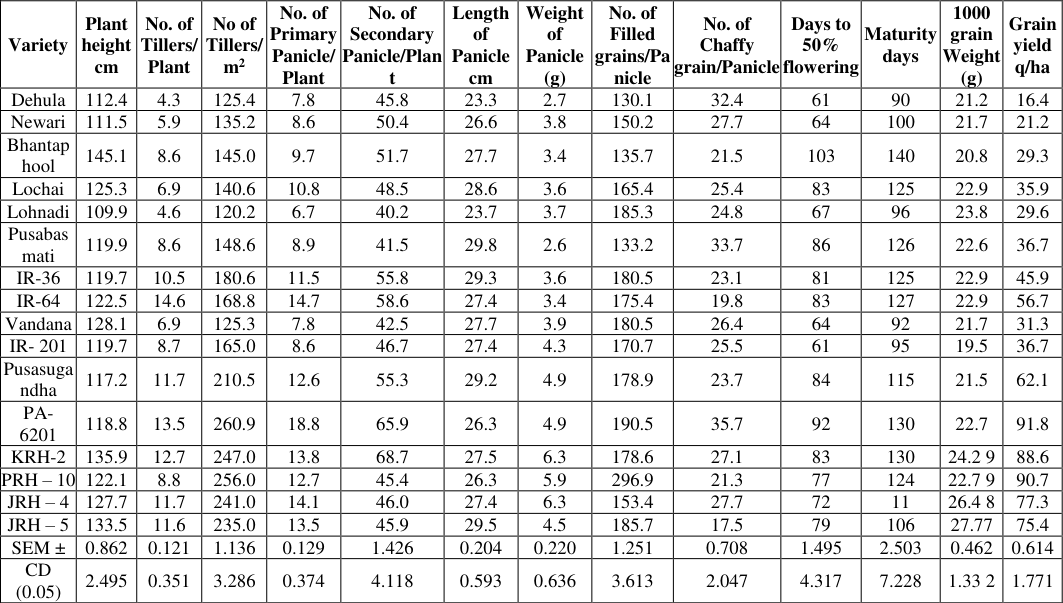 Table 1
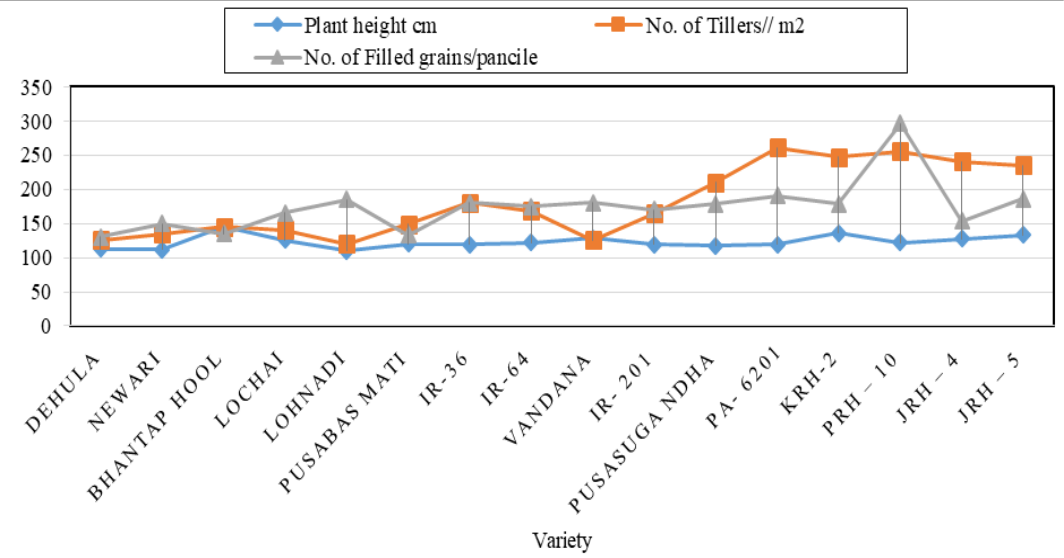 Figure 1
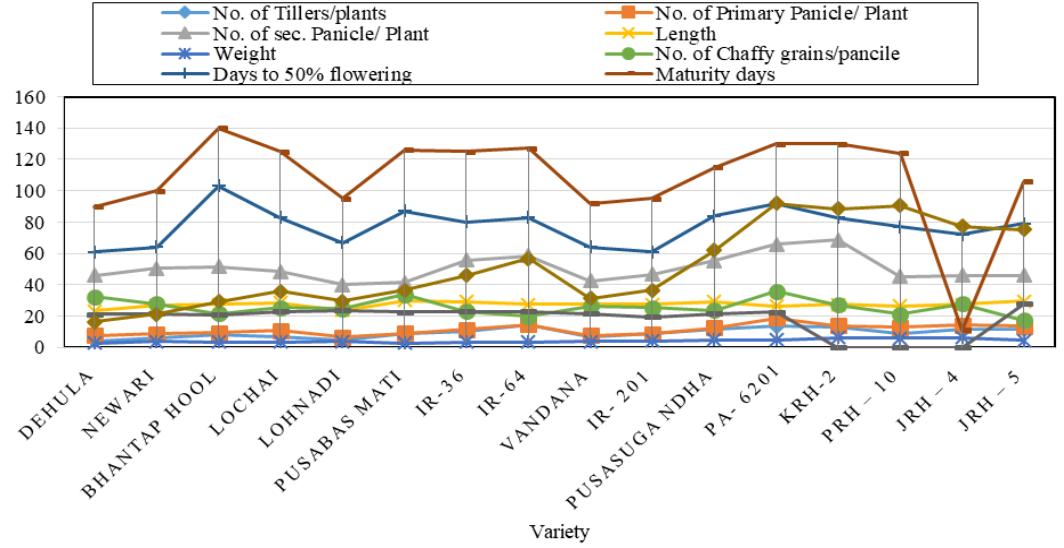 Figure 2
Introduction
Rice (Oryza sativa Linn.) is one of the most important food crops of India. Rice has shaped the culture, diets and economic of Thousands of millions of peoples. For more than half of the humanity "rice is life". Major share of rice is cultivated during Kharif season (Krishnaiah et al. 2012) [1] . Madhya Pradesh is an agrarian state with about 74% population of the state depending directly or indirectly on agriculture. Agriculture and its allied services contribute 31% share of the state's economy. In M.P. rice is grown in the area of about 15.59 lakh ha with production of 14.62 lakh tons and productivity 989 kg/ha which is far below than the average national productivity (2010 kg/ha). In Madhya Pradesh around 5000 ha is under hybrid rice particular in under irrigated production system. Rice hybrid produce about 14-18% higher grain yield including a more vigorous and extensive root system (Neeta et al. 2013 and Anonymous, 1998) [2,11] . There is a decline in per capita land holding from 0.5 ha in 1951-52 to 0.14 ha in 1995-96, and is expected to further decline to a level of 0.09 to 0.05 ha by the end of first two decades of the twenty first century. For attaining and maintaining sustained self-sufficiency the production growth rate of rice has to be raised to 2.35 t ha -1 (Chauhan, et al. 1991) [12] . Though there has been impressive rate of growth in the rice production in the non-traditional rice growing areas, the growth rate has been comparatively poor in the traditional rice growing areas of eastern India where 62% of the total rice lands are located. Due to continuous cereal-cereal cropping sequence in the non-traditional rice growing areas, there is soil degradation and rice cultivation may be phased out in due course of time (Cramer, 1967 and DRR, 2002) [5,6] . The present investigation was observed local, improved and hybrid rice varieties performances during 2020 in Rampur Baghelan, Satna district.
Materials and Methods
The study was conducted in the season of 2020. During this time period, the average temperature was 30.6 °C (maximum) and 15.64 °C (minimum). During 2020 the monsoon was received on 16th June whereas in 2020 it was on 12th June. Rainfall was adequate in 2020 (669.6 mm) in 41 rainy days but in the year 2020 it was comparatively high ranging up to 672.5 mm. In order to study the 16 rice cultivars were tested during year 2020. Among the tested cultivars, five were local cultivars namely Dehula, Newari, Bhataphool, Loachai & Lohindi & six were improved varieties viz Pusabasmati, IR-36, IR-64, Vandana, IR-20 & Pusa Sugandha and five were hybrid varieties i.e. PA-6201, KRH-2, PRH-10, JRH-4 & JRH-5. The observations were made regarding the plant height, number of tillers, number of primary and secondary panicle, maturity days and grain yield. The quantitative method was used to this study.
Results and Discussion
Rice, the staple diet of over half of the world's population, is grown on over 145 million ha in more than 110 countries, and occupies almost one-fifth of the total world cropland under cereals (Pathak and Dhaliwal, 1981) [7] . John (1981) www.extensionjournal.com [8] reported that inadequate crop protection in India causes annual losses more than 36 percent by insects alone. In the present study during 2020 season, the performance of 16 experimental rice varieties were observed under the following heads Plant height in cm, Number of Tillers/plant, Number of Tillers per m 2 , Number of primary panicle per plant, Number of secondary panicle per plant, Length of panicle in cm, Wt of panicle in grams, Number of filled grains per panicle, Number of chaffy grains per panicle, Days for 50% flowering, Maturity days, Weight in grams of 1000 grains and Grain yield in q/ha (Table 1).
| Variety | Plant height cm | No. of Tillers/ Plant | No of Tillers/ m2 | No. of Primary Panicle/ Plant | No. of Secondary Panicle/Plan t | Length of Panicle cm | Weight of Panicle (g) | No. of Filled grains/Pa nicle | No. of Chaffy grain/Panicle | Days to 50% flowering | Maturity days | 1000 grain Weight (g) | Grain yield q/ha |
|---|---|---|---|---|---|---|---|---|---|---|---|---|---|
| Dehula | 112.4 | 4.3 | 125.4 | 7.8 | 45.8 | 23.3 | 2.7 | 130.1 | 32.4 | 61 | 90 | 21.2 | 16.4 |
| Newari | 111.5 | 5.9 | 135.2 | 8.6 | 50.4 | 26.6 | 3.8 | 150.2 | 27.7 | 64 | 100 | 21.7 | 21.2 |
| Bhantap hool | 145.1 | 8.6 | 145.0 | 9.7 | 51.7 | 27.7 | 3.4 | 135.7 | 21.5 | 103 | 140 | 20.8 | 29.3 |
| Lochai | 125.3 | 6.9 | 140.6 | 10.8 | 48.5 | 28.6 | 3.6 | 165.4 | 25.4 | 83 | 125 | 22.9 | 35.9 |
| Lohnadi | 109.9 | 4.6 | 120.2 | 6.7 | 40.2 | 23.7 | 3.7 | 185.3 | 24.8 | 67 | 96 | 23.8 | 29.6 |
| Pusabas mati | 119.9 | 8.6 | 148.6 | 8.9 | 41.5 | 29.8 | 2.6 | 133.2 | 33.7 | 86 | 126 | 22.6 | 36.7 |
| IR-36 | 119.7 | 10.5 | 180.6 | 11.5 | 55.8 | 29.3 | 3.6 | 180.5 | 23.1 | 81 | 125 | 22.9 | 45.9 |
| IR-64 | 122.5 | 14.6 | 168.8 | 14.7 | 58.6 | 27.4 | 3.4 | 175.4 | 19.8 | 83 | 127 | 22.9 | 56.7 |
| Vandana | 128.1 | 6.9 | 125.3 | 7.8 | 42.5 | 27.7 | 3.9 | 180.5 | 26.4 | 64 | 92 | 21.7 | 31.3 |
| IR- 201 | 119.7 | 8.7 | 165.0 | 8.6 | 46.7 | 27.4 | 4.3 | 170.7 | 25.5 | 61 | 95 | 19.5 | 36.7 |
| Pusasuga ndha | 117.2 | 11.7 | 210.5 | 12.6 | 55.3 | 29.2 | 4.9 | 178.9 | 23.7 | 84 | 115 | 21.5 | 62.1 |
| PA- 6201 | 118.8 | 13.5 | 260.9 | 18.8 | 65.9 | 26.3 | 4.9 | 190.5 | 35.7 | 92 | 130 | 22.7 | 91.8 |
| KRH-2 | 135.9 | 12.7 | 247.0 | 13.8 | 68.7 | 27.5 | 6.3 | 178.6 | 27.1 | 83 | 130 | 24.2 9 | 88.6 |
| PRH – 10 | 122.1 | 8.8 | 256.0 | 12.7 | 45.4 | 26.3 | 5.9 | 296.9 | 21.3 | 77 | 124 | 22.7 9 | 90.7 |
| JRH – 4 | 127.7 | 11.7 | 241.0 | 14.1 | 46.0 | 27.4 | 6.3 | 153.4 | 27.7 | 72 | 11 | 26.4 8 | 77.3 |
| JRH – 5 | 133.5 | 11.6 | 235.0 | 13.5 | 45.9 | 29.5 | 4.5 | 185.7 | 17.5 | 79 | 106 | 27.77 | 75.4 |
| SEM ± | 0.862 | 0.121 | 1.136 | 0.129 | 1.426 | 0.204 | 0.220 | 1.251 | 0.708 | 1.495 | 2.503 | 0.462 | 0.614 |
| CD (0.05) | 2.495 | 0.351 | 3.286 | 0.374 | 4.118 | 0.593 | 0.636 | 3.613 | 2.047 | 4.317 | 7.228 | 1.33 2 | 1.771 |
Table text extracted from the original PDF; superscript letters are shown inline. The original table image is below.
View original table image
Number of Tillers /m 2 :
The number of tillers /m 2 were maximum in PA-6201 during the year 2020 (260.9) while Lohandi showed minimum number of tillers/m 2 (120.1).
Number of primary panicle/plant: Number of primary panicle/plant were maximum in PA-6201 during the year 2020 (18.8) while Lohandi showed minimum number of primary panicle/plant (6.6 and 6.8). Length of panicle in cm: Panicle length was found to be maximum in JRH -5during the year 2020 (29.5 cm) followed by Pusabasmati (29.2 cm) while Lohandi showed minimum length of panicle (23.5 cm).
Number of Secondary
Number of Secondary
Weight of panicle
The weight of panicle was recorded as maximum in PRH 10 during the years 2020 (5.9) while Dehula showed minimum weight of panicle (2.7).
Number of Filled grains / panicle
Number of filled grains/panicle where found to be maximum in PRH 10 during the year 2020 (296.9) while showed minimum number of filled grains/panicle (130.1).
Number of Chaffy grains / panicle
The number of chaffy grains/panicle were maximum in PA-6201 during the year 2020 (35.7) while JRH -5 showed minimum number of chaffy grains/panicle (17.5). Grain yield q/ha: Grain yield was recorded as highest i.e. 91.8 q/ha in PA-6201 and lowest in Dehula i.e. 16.4 q/ha in the year 2020 respectively. Singh et al. (2013) [9] have studies field performance of rice varieties in South Asia. Dattatreyulu (1994) [10] also worked on performance of rice varieties.
Conclusion
In the present course of the investigation, we have to explore the performance of Local, Improved and Hybrid Rice Varieties in the Rampur Baghelan, Satna district. Adoption of cultural practices like cultivation of pests and diseases resistant / tolerant varieties, timely planting, judicious use of water and nutrient, optimum plant stand. The agricultural research though made considerable progress in addressing food security, adopted policies to grow more and more food to support the growing populations in Asian countries ignoring the issues of health and environment which lead to disastrous situation.
Acknowledgement
AcknowledgementThe authors are thankful to the authorities of the Agriculture Department of Satna district (M.P.) India to carry out this work.
Figures and tables from the paper
References
10 in the original paper- Neeta M, Geeta C, Dinseh P, Amitabh M. Army WormA Serious Sporadic Insect Pest of Rice in Rewa Region of Madhya Pradesh. Indian Journal of Applied Research. 2013;3(9):489-490.
- Pinjari SS, Meshram NA, Jagtap DN, Rathod RR, Sagvekar VV, Bodke PS. Impact of green manuring and growth stimulants on soil properties of organically grown transplanted rice (Oryza sativa L.). Int. J Adv. Chem. Res. 2020;2(1):33-37. DOI: 10.33545/26646781.2020.v2.i1a.59
- Sumekar Y, Widayat D, Riswandi D, Kurniadie D. Effects of metsulfuron methyl herbicide doses on weed suppression, growth and yield of rice (Oryza sativa L.). Int. J Agric. Food Sci. 2020;2(1):18-23. DOI: 10.33545/2664844X.2020.v2.i1a.30
- Cramer HH. Plant protection land world crop protection pflanzenschutz Nachar. 1967;20:1-524.
- DRR, Progress Report, Entomology and Pathology, All India Coordinated Rice Improvement Programme, Directorate of Rice Research, Rjaendranagar, Hyderabad A.P., India, 2002-2001;2:500-530.
- John S. Pest management need for integrated approach. Pesticides. 1981;15(9):3-5.
- Singh US, Dar M, Singh S, Zaidi NW, Bari MA, Mackill DJ, et al. Field performance, dissemination, impact and tracking of submergence tolerant (sub 1) rice varieties in south Asia. Journal of Breeding and Genetics. 2013;45(1):112-131.
- Dattatreyulu M. Export potential of agricultural commodities in the new economic environment. Foreign Trade Review. 1994;29(1):84-113.
- Anonymous. Insecticide evaluation trial Rabi. Directorate of Rice Research, Rajendranagar, Hyderabad. Annual Progress Report. 1998;2:116-118.
- Chauhan VS, Chauhan JS, Variar M. Current status of Production and future strategy to enhance rice yields in rainfed ecosystem of plateau region of Bihar Oryza. 1991;28:326-337.
Cited by 1
From OpenAlex, OpenCitations and reference lists read by Scinovex
- Floristic composition and distribution of weeds in different crop ecosystems of Rewa in India ↗
Chandra Prabha Devi, Shobha Gupta, R. K. Pandey · International Journal of Advanced Academic Studies · 2023
The present communication pertains to major weeds of different crop ecosystems of Rewa in India. The study was based on extensive and intensive fields surveys made during different months of rainy and dry season 2020-2022. Surveys were made in five important crops ecosystems of total eight developmental blocks of Rewa district during both Kharif and Rabi seasons of the year.…
❝ 0PDF