
Research article · 2022 · Full text
International Journal of Horticulture and Food ScienceApple tree biological effectiveness of the dimethoate against spider mites determination
Volume 4(1) · Pages 32–33 · DOI: 10.33545/26631067.2022.v4.i1a.82 ↗
Research areasAgricultural Practices and Plant Genetics
Abstract
Author-writtenEuropean red mites are the most frequent mite in Uzbekistan apple orchards, and they may be found from early spring through harvest. The orange-colored adults of twospotted spider mites overwinter beneath the bark of trees or on weeds. In the spring, populations typically cluster beneath the tree and in nearby areas on broadleaf weeds, brambles, and sucker growth. Damage. Twospotted spider mites induce bronzing on the leaves. Spider mites leave a characteristic webbing pattern on the underside of the leaf.
Summary
Source-checkedPlain-language reading of the full paper, prepared with AI and checked against the text. Each point links to the authors' own words.
Why it matters
- The European red mite and the twospotted spider mite are the primary mite pests affecting apple orchards in Uzbekistan. View evidence ↗
- Uncontrolled mite populations can strain apple trees, negatively impacting shoot development, fruit bud set, and various fruit quality metrics like size, weight, and color. View evidence ↗
- Severe stress caused by mites can lead to the death of apple trees during harsh winters. View evidence ↗
The question
- The study aimed to determine the biological effectiveness of the insecticide Dimethoate 40% a.e. against spider mites on apple trees. View evidence ↗
What they did
- Testing was conducted on stationary garden plots at the Tashkent State Agrarian University's experimental farm in the Kibray district of the Tashkent region. View evidence ↗
- The study used Emaphos 42% a.e. applied at 1.0 l/ha as a reference variant for efficiency comparison. View evidence ↗
- Biological efficiency was calculated using the Abbott (1925) formula to correct experimental data against the control group. View evidence ↗
What they found
- Dimethoate 40% a.e. was found to be not inferior in efficiency compared to the reference Emaphos 42% a.e. View evidence ↗
- The preparative form of Dimethoate 40% a.e. is characterized as easy to use, lacking a strong odor, and forming a stable emulsion with water. View evidence ↗
What it means
- The authors conclude that Dimethoate 40% a.e. at 0.8-2.0 l/ha is highly effective against mites, aphids, and codling moth on apple trees. View evidence ↗
- The authors noted that no phytotoxicity occurred in the apple trees during the experimental period. View evidence ↗
Visual summary
1 visualsIllustrations explain the paper; they do not show study data.
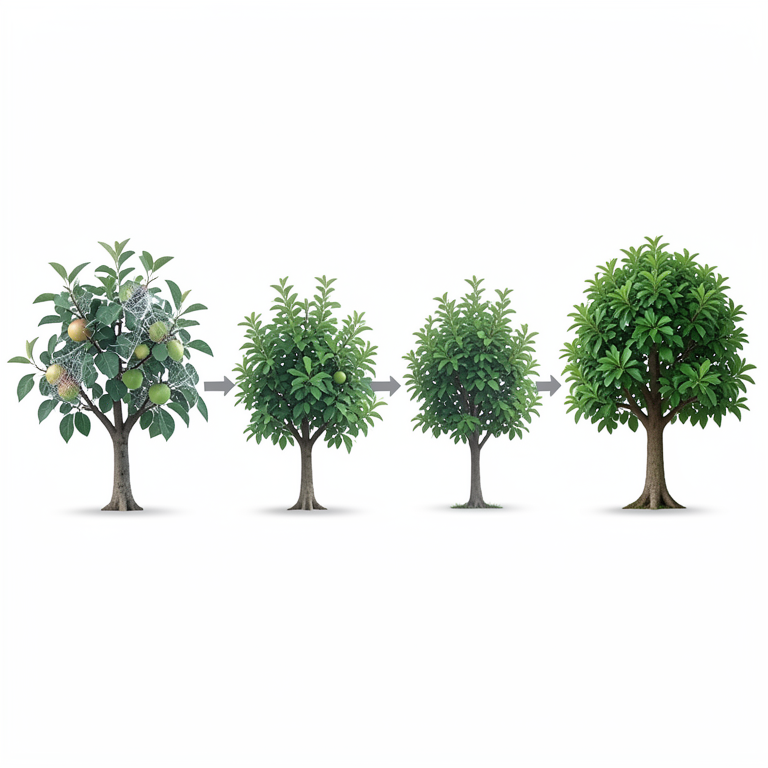
Experimental Treatment Groups
AI-generated conceptual illustration (apple trees with spider mite infestations). It explains the idea and does not show study data.
View source evidence ↗Figures & tables
From the original paper Table 1
Introduction
The red mite, (Panonychus ulmi Koch) and the twospotted spider mite, (Tetranychus urticae Koch) are the two principal mite pests of apple orchards in Uzbekistan. Both species are pests of numerous crops, including tree fruit, small fruit, vegetable, ornamental, and field crops, and are members of the phytophagous mite [2, 4]. European red mites are the most frequent mite found in Uzbekistan apple orchards, and they are present from early spring through harvest. The eggs of the European red mite are crimson, somewhat flattened (onion-shaped), and have a hair-like stalk extending from the top.
Larvae (newly born nymphs) have three pairs of legs. Adults and older nymphs have four pairs of legs [Error! Reference source not found., 1]. Immature mites are normally crimson, but may become green after molting.
Twospotted spider mites are less abundant in orchards than European red mites and come later in the season. Twospotted spider mites are more abundant than European red mites in producing areas such as Tashkent and east of Surxondaryo. Twospotted spider mites overwinter as orange-colored adults beneath the tree's bark or on weeds. In the spring, populations frequently congregate on broadleaf weeds, brambles, and sucker growth beneath the tree and in neighboring regions.
Although twospotted spider mites may successfully overwinter on trees, significant numbers of them frequently move into the tree canopy from the orchard floor in mid to late summer as weeds and other plants on the orchard floor dry up. Twospotted spider mite populations will continue to grow until the cold, late summer weather decreases population activity. Every year, three to five generations are born. Wind and air currents can distribute these mites over large distances and from orchard to orchard.
Damage. Bronzing on the foliage is caused by twospotted spider mites. Spider mites leave a distinctive webbing on the underside of the leaf. Mites and their eggs are protected by webbing against natural adversaries and environmental variations.
Prolonged feeding by uncontrolled mite populations strains the tree, resulting in decreased shoot development and fruit bud set the next year. Fruit color, soluble solids, hardness, size, and weight are all influenced. In extreme circumstances, mite-induced tree stress can lead to mortality during hard winters [3, 2]. Place and Methodology of Testing: Experiments on the production test of the drug Dimethoate 40% a.e. were carried out on stationary garden plots of the educational and
Experimental
farm of the Tashkent State Agrarian University, located in the Kibray district of the Tashkent region. IJHFS 2022; 4(1): 32-33 Anorbayev Azimjon Raimkulovich Director of the Scientific- Research Institute of Plant Quarantine and Protection Tashkent, Uzbekistan Rahmonov Ahliddin Xabibullayevich Basic Doctoral Student of the Department of Plant Protection, Tashkent State Agrarian University, Tashkent-100140, University Str., 3, Uzbekistan Anorbayev Azimjon Raimkulovich Director of the Scientific- Research Institute of Plant Quarantine and Protection Tashkent, Uzbekistan http://www.hortijournal.com The preparatory work, setting up and conducting the experiment corresponded to the “Methodological instructions of the State Chemical Commission.” (2004). The biological efficiency of the treatments was calculated according to the well-known formula of Abbott (1925), which provides for the correction of experimental data for control. b - The same after processing.
Results
Experiments to test the effectiveness of the insecticide Dimethoate 40% a.e. were carried out in stationary garden plots, with different densities of spider mites on an apple tree. The drug was tested at a consumption rate of 0.8-2.0 l/ha. During the testing of the drug on the apple tree, all phases of tick development were present. The results of the experiments showed the high biological efficiency of Dimethoate 40% a.e. at a consumption rate of 0.8-2.0 l/ha, respectively, increased on the 7 th day is noted in table 1.
| № | Varianty | Consumption rates l/ha | The average number of mites on the 1st infected leaf, ind. | — | — | — | — | Biological efficiency, %, for the day | — | — | — |
|---|---|---|---|---|---|---|---|---|---|---|---|
| before processing | after treatment, per day | ||||||||||
| 1 | 3 | 7 | 14 | 1 | 3 | 7 | 14 | ||||
| 1. | Dimethoate 40% a.e. | 0,8 | 39,5 | 17,5 | 10,8 | 10,3 | 16,4 | 60,2 | 78,9 | 87,9 | 82,8 |
| 2. | Dimethoate 40% a.e. | 2,0 | 41,9 | 7,9 | 6,9 | 6,5 | 13,4 | 82,7 | 87,3 | 91,1 | 86,8 |
| 3. | Emaphos 42% a.e. | 1,0 | 45,8 | 9,2 | 8,8 | 10,2 | 16,3 | 81,7 | 85,2 | 87,2 | 85,3 |
| 4. | Control (no processing) | - | 49,7 | 54,7 | 64,7 | 86,5 | 120,4 | - | - | - | - |
Table text extracted from the original PDF; superscript letters are shown inline. The original table image is below.
View original table image
It should be noted that in all tested variants, the drug Dimethoate 40% a.e. was not inferior in efficiency to the reference variant Emaphos 42% a.e. applied at a rate of 1.0 l/ha. Preparative form Dimethoate 40% a.e. easy to use, does not have a strong odor, forms a good stable emulsion with water. Ef-biological efficiency, in % A - The average number of pests in the experiment before processing. a - The same after processing. B - The average number of pests in the control before treatment.
Table 1: The biological effectiveness of the drug Dimethoate 40% a.e. against ticks on an apple tree. Production experience. (Tashkent region, Kibray district, Training and experimental farm of TashGAU.06.06.2019) The average number of mites on the 1st Consumption infected leaf, ind. Biological efficiency, %, № Varianty rates l/ha for the day before processing after treatment, per day 1 3 7 14 1 3 7 14 1. Dimethoate 40% a.e. 0,8 39,5 17,5 10,8 10,3 16,4 60,2 78,9 87,9 82,8 2.
Dimethoate 40% a.e. 2,0 41,9 7,9 6,9 6,5 13,4 82,7 87,3 91,1 86,8 3. Emaphos 42% a.e. 1,0 45,8 9,2 8,8 10,2 16,3 81,7 85,2 87,2 85,3 4. Control (no processing) - 49,7 54,7 64,7 86,5 120,4 - - - - European red mite, Panonychus ulmi (Koch),(Acari: Tetranychidae) in Japanese apple orchards. Applied entomology and zoology. 2003;38(3):387-391.
Conclusions
1. Insecticide Dimethoate 40% a.e. showed high biological efficiency against aphids, codling moth, mites on an apple tree at a consumption rate of 0.8-2.0 l/ha. And against fruit moth at a rate of 0.8-2.0 l/ha. 2. The drug has a convenient, safe preparative form, easy to use. 3.
During the period of the experiments, no phytotoxicity was noted in relation to the apple tree. 4. It is recommended to register the preparation of the State Chemical Commission as an insecticide against spider mites, on an apple tree with consumption rates of 0.8-2.0 l/ha. Reference 1. Aslan İ, Özbek H, Çalmaşur Ö, Şahi̇n F.
Toxicity of essential oil vapours to two greenhouse pests, Tetranychus urticae Koch and Bemisia tabaci Genn. Industrial Crops and Products. 2004;19(2):167-173. 2. Bakr EM. A new software for measuring leaf area, and area damaged by Tetranychus urticae Koch.
Journal of applied Entomology. 2005;129(3):173-175. 3. Rameshgar F, Khajehali J, Nauen R, Dermauw W, Van Leeuwen T. Characterization of abamectin resistance in Iranian populations of European red mite, Panonychus ulmi Koch (Acari: Tetranychidae). Crop Protection, 2019;125:104903. 4.
Thwaite WG. Resistance to clofentezine and hexythiazox in Panonychus ulmi from apples in Australia.
Experimental
& applied acarology. 1991;11(1):73-80. 5. Toyoshima S. A candidate of predatory phytoseiid mites (Acari: Phytoseiidae) for the control of the
References
0 in the original paperCited by 1
From OpenAlex, OpenCitations and reference lists read by Scinovex
- USE OF PREDATORY MITES FOR PEST MANAGEMENT IN APPLE ORCHARDS ↗
Assel A. Karabayeva, Bakyt K. Kopzhasarov, G. Zhaparkulova, A. Amanbek · Vestnik of M Kozybayev North Kazakhstan University · 2026
In Kazakhstan, protection of apple orchards against tetranychid and fruit mites is of considerable agricultural importance because intensive pesticide use contributes to resistant phytophagous populations, reduces beneficial acarofauna, and disturbs the ecological balance of orchard agrocenoses. The aim of this study was to evaluate chemical and biological approaches to spider mite control on apple trees and to substantiate the inclusion…
❝ 0PDF