
Research article · 2022 · Full text
International Journal of Agriculture Extension and Social DevelopmentAgricultural extension: Historical perspective and futuristic approach
Volume 5(1) · Pages 135–140 · DOI: 10.33545/26180723.2022.v5.i1b.133 ↗
Research areasAgricultural Economics and PracticesAgricultural Innovations and PracticesAgricultural Systems and Practices
Abstract
Author-writtenExtension has always been at the core of agricultural development. It bridges the gap between laboratories and farms. With ever changing environmental and agricultural needs, extension approaches also keep on changing. This paper throws a light on the historical as well futuristic perspectives of agriculture. Historically when there was lack of science and research in agriculture sector, rulers used to send trainers to the farmers to save their crops from natural calamities. In the modern era when we are equipped with technologies like ICT and robotics, need is to explore these technologies and to implement them for agricultural development to meet the challenges of present and coming future.
Summary
Source-checkedPlain-language reading of the full paper, prepared with AI and checked against the text. Each point links to the authors' own words.
Why it matters
- Agricultural extension is fundamental to development because it connects scientific research from laboratories to practical application on farms. View evidence ↗
- Global agriculture currently faces several critical challenges, including climate change, soil degradation, shifting food systems, and reduced government support. View evidence ↗
- Extension services are designed to protect small-scale farmers from global agricultural shifts by delivering timely and relevant information. View evidence ↗
The question
- The paper aims to examine the historical evolution and the future directions of agricultural extension. View evidence ↗
What they did
- The author explores the implementation of Information and Communication Technology (ICT) and robotics to address contemporary and future agricultural challenges. View evidence ↗
What they found
- Early evidence of agricultural extension dates back to approximately 1800 BC in Mesopotamia, where farm advice was inscribed on clay tablets. View evidence ↗
- Modern agricultural extension in Europe was catalyzed by the potato blight famine in Ireland between 1845 and 1851. View evidence ↗
- In 1956, India experimented with 'Charcha-Mandals' via All India Radio in Pune, covering 156 villages to promote rural development. View evidence ↗
- The 1975 SITE project, a collaboration between ISRO and international agencies, covered 2,330 villages across 26 districts in 6 Indian states over one year. View evidence ↗
- The ATMA agency, launched in 1998 to centralize extension services, expanded from 28 districts to the entire country by 2005. View evidence ↗
- The private initiative e-Choupal, launched in June 2000, has reached over 4 million farmers across 10 Indian states. View evidence ↗
- The Agmarknet portal covers more than 3,200 markets, with over 2,700 markets actively reporting data. View evidence ↗
- Unlike traditional top-down information flow, ICT enables continuous two-way communication between farmers, researchers, and extension workers. View evidence ↗
What it means
- The author concludes that traditional agricultural systems are insufficient for current demands and that smart technologies are necessary for competitive development. View evidence ↗
- The author recommends that India systematically study and unlock the opportunities provided by ICT-associated technologies to elevate its agricultural sector. View evidence ↗
Visual summary
1 visualsIllustrations explain the paper; they do not show study data.
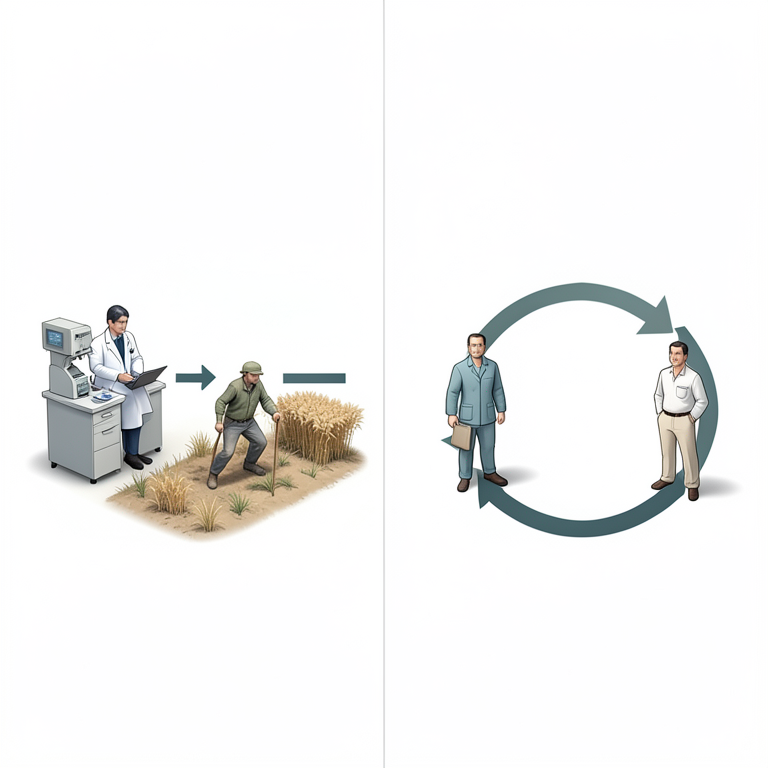
Communication Flow Shift
AI-generated conceptual illustration (a rural farmer, a research scientist in a laboratory, and a field extension worker). It explains the idea and does not show study data.
View source evidence ↗Introduction
The basic purpose of extension has always been to help underprivileged sections of society, involving them in decision-making and encouraging them to choose alternative solutions to their problems. Food and agriculture organization i.e. FAO explains extension as an informal educational process which is aimed toward the rural population. The extension process helps the farm families in solving their problems. It aims at enhancing the efficiency of the farm families by increasing their production and by increasing their standard of living. While explaining the objectives of extension services Oakley (1985) [13] says that the main objective of extension is to change farmers' outlook toward their difficulties. Extension is not about developing big industries or big economic achievements. Extension is about the upliftment of the marginal sections of society and bringing them in the mainstream development process. Extension agents, therefore try to involve people of the target groups in active discussions and help them in gaining a clearer insight of their problems. Extension workers also provide target groups with the potential solutions of their issues. So extension can also be defined as a process of working with rural people with the purpose of improving their livelihoods. IFPRI explains agricultural extension, as a process to increase agricultural production. Agriculture extension boasts of food security for the masses and uplifts livelihood of rural people. According to IFPRI extension helps the rural producers to meet the new challenges of agriculture. Globally agriculture is going through multiple challenges like climate change, deterioration of natural soil resources, change of global food systems like the emergence of supermarkets, depletion of government support etc. Small and marginal farmers do not have capability to buffer these changes. Extension services tries to safeguard the small farmers against these changes by providing them with timely and relevant information. Extension is the process of educating farmers about new innovations and technologies of agricultural practices. Extension services act as a bridge between farms and the laboratories, as they help in transforming new knowledge of laboratories into novel farm practices. Van dan Ban (2000) [3] says that extension is conscious use of communication to provide masses with necessary information. Extension activities help the masses in making sound opinions and good decisions.
Historical Perspective
Agricultural communication or agricultural extension has a deep-rooted history. One of the initial examples of agriculture extension could be found in Mesopotamia (Present day Iraq) at around 1800BC. Archaeologists have unearthed many clay tablets of those times with multiple farm advices inscribed on them. (Ahmed, 1982) [2] . An important milestone in the process of evolution of agriculture extension services was the beginning of agricultural writings. Though very few number of such kind of writings are left now, but the earliest writings were written during the ancient Greek civilizations. Researches have shown that many important books were written in Latin language on agriculture. These texts were written, on practical farming experience, to help farmers to protect their farms and increase their revenue. Marcus Porcius Cato (234-149 BCE) was a prominent Roman politician, orator, and writer in the first half of the second century BCE. He was always devoted to agriculture. He wrote a book named De agriculture. In this book, he discussed multiple topics related to agriculture. (Hollander, 2019) [4] . The history of modern agriculture extension can be traced in www.extensionjournal.com Europe in early 1845 when many European powers came into potato blight. Ireland was severely hit by this as most of the peasant population was dependent on potatoes. This great famine lasted till 1851. During this period of crisis, British viceroy Earl of claredon arranged many informative lectures for the farmers in association with various societies, where farmers were taught about various ways of protecting their crops from natural calamities and were also taught about employing modern means in agriculture. From Ireland the practice of agriculture communication started spreading to the whole Europe and by the coming of 1900, practices of agriculture extension had completely established themselves in northern America also. (Prasad, 2009) [14] .
Governments of India adopted different extension approaches in post-independence to resolve agricultural challenges. Paramount objectives of these extension programs were to bring changes in the traditional agricultural means and methods. Most of these programmes were based on promoting farmer participation, including expert advices, and the usage of modern audio-visual aids. Community Development Programs were introduced in 1952 with the objectives of developing resources for rural people, to improve health and educational facilities for rural people, to improve the production of crops and animals. National Extension Services were initiated in 1953 with the purpose of covering large number of rural people and enhancing farmer participation. Under these schemes block level divisions were done and BDOs were appointed for consolidated rural and agricultural development. Intensive Agricultural District Programs were launched in 1960s with the purpose of communicating about new innovations in agriculture, to improve traditional agricultural practices. Efforts were done to impart knowledge regarding new seeds, new fertilizers, pesticides, new soil and water management techniques, crop storage, marketing etc. through cooperative efforts. These programs were more goal oriented and focused. Extension workers were much more trained and equipped with modern means of imparting information. But a part of increase in production of some particular crops in certain areas, these programs could not yield fruitful results. That's why they were replaced by Intensive Agricultural Area Production scheme. This scheme was introduced in the areas with already existing strong irrigation system. Prominence was given to development of scientific and progressive agriculture in the areas with the potential of heavy agricultural growth. These programs also antedate the introduction of high yielding variety program and made a way for green revolution in India.
To provide need based technical skills to youth under the age of 18-35 from the poor section of the society and to enable them for self-employment, Training of Rural Youth for Self-Employment was launched in 1979. The goal of these programs was to bring change in the production technologies of farmers through professional assistance from well-trained extension workers. Market facilities were also improved for farmers and another rural craftsman to increase their income. These programs were time-bound and there was a single line of work. Regular, professional and research based trainings were provided to the extension workers before their visits to the fields. Major drawback of these programs was the lack of involvement of farmers and their feedback. That's why in 1990s these programs took a back seat after the withdrawal of World Bank grants.
I. Extension Support to Central Institutions
This programme focuses on the capacity building of extension agents and agricultural institutions. Efforts are done to give skill based education to rural youth, farmers and farmer women. The major institutions involved in this effort are -DOE, MANAGE Hyderabad, EEIs at regional levels and SAMETIs at the state level.
The main programmes under the scheme are as under: a) Programmes for Capacity Building b) Kisan Call Center (KCC). c) Programmes for Skill Development:
II. Establishment of Agri-Clinic and Agri-Business
Centers by Agriculture Graduates This programme encourages youth who are agriculture graduates to set their own agricultural clinics or set their agricultural business centers to give extension services to the farmers. They can give their services free as well as paid to increase agricultural production and farm incomes. This scheme gives opportunities of self-employment to unemployed graduates and also, amplifies the works of public extension.
III. Mass Media Support to Agricultural Extension
Under this scheme, multitier publicity and information support is given to the farmers and extension workers. The aim of this scheme is to make farmers aware of modern technologies and researches occurring in the field of agriculture and its allied areas. Information and communication technologies facilitate the faster and wider dissemination of the technology and provide sustainable and easy solutions to the farming community. These technologies are quite cost effective and practically employ the agricultural information amongst the farmers, extension agents and other stake holders. Meenambigai (2018) [10] says that agriculture extension systems have always underestimated the importance of free and open information flow regarding the new agricultural technologies. Information has always been provided in topdown manner, which is of less local importance without taking any feedback from the farmers. Information and communication technologies encourage continuous two-way interactions between the farmers, researchers and extension workers. According to Sharma (2000) [17] Internet offers ample potential for two-way communication between distant parties via computer network spread over the globe.
IT revolution has opened huge opportunities for providing access to information as well as to interactive distant learning in rural India. Government of India has been experimenting extensively to introduce ICTs for the agricultural welfare in India. Many programmes have been initiated by the government as well as Non-Government Organizations at different time intervals.
I. National e-Governance Programme-Agriculture
(Negp-A) The Department of Agriculture and Cooperation (DAC), Government of India has initiated an e-Governance program called National e-Governance Programme-Agriculture (Negp-A). It is a Mission Mode Project in the agriculture sector. This project covers Agriculture sector, Livestock Sector and Fisheries Sector. The main objective of this project is to address the information needs of farming community along with other stakeholders, by providing timely information and services through various channels available in their neighborhood.
II. Central Agricultural Portal\
This portal is designed to fulfill different information needs of farmers and other stakeholders through single window access. Information regarding different government schemes, policies collaborations and initiatives is given on one common platform. Thus it illuminates the need of browsing different windows and facilitates the process of information gathering for agricultural purposes. It provides a secure and personal view of multiple online resources and various agricultural services and is working as bridge between the government and other stakeholders of farming.
III. Text and Voice Based Services on Mobile/m-Kissan
Portal An SMS portal has been created by the Department of Agriculture & Cooperation, for Farmers. Under this portal researchers, extension workers, Officers, Scientists and Experts can send the required knowledge and information on various agricultural activities to the farmers. These portals are used quite frequently to provide farmers with weather updates, seasonal advisories etc. To give more personalized and localized information the registered phone numbers are grouped based on the State, District, Block and the Crops/Activities selected by the farmers.
IV. Kissan Call Centers
Department of Agriculture & Cooperation, Ministry of Agriculture, Government of India, started Kissan Call Centers in 2004. Centers were opened throughout the country with the purpose of delivering quality extension services to the farmers. These centers were instructed to talk to the farmers in their local language so that their problems can be addressed effectively.
V. Community Information Centers
To support eight North-Eastern states of India to come out of the plunges of under development, in 2002, Community Information Centers were established at block levels by the government of India. All these centers are equipped with computers and internet facilities. Through these centers basic trainings regarding the usage of internet are given to the locals. Locals are given the trainings about the usage of internet to get necessary information on agriculture, farming, health, education etc.
VI. Agrisnet (Agriculture Resources Information
System and Networking): This project is sponsored by DAC. Ministry of Agriculture initiated this project to strengthen and promote Agricultural Information & Communication amongst the farmers. This project is running in 17 states and provides services like market price, soil information, crop diseases and their management, etc. Under AGRISNET state governments have initiated many projects like ASHA in Assam, Kissan and e-krishi in Kerla, Krishi Martha Vahini in Karnataka. All these projects are aimed at achieving agricultural development with the help of ICTs under diverse circumstances.
VII. Dacnet
It is an e-Governance project of the Government of India. To facilitate Indian agriculture online, this project was initiated by National Information Centers. This project aims to provide farmers with one window access to every kind of information at affordable prices. Major motive of this project is to provide farmers with quick and easy delivery of required information in a simplified manner. Employees of DACNET are given special trainings about various web based applications at national, regional and field units. Information under this scheme focuses on crop weather watch, market price analysis, pest management, fertilizers, farm machinery etc.
VIII. E-Nam
To streamline the agricultural marketing an all India electronic trading portal has been established by the GOI, called National Agriculture Market (e NAM). It has connected all the Agriculture Produce Market Committees (APMC) to provide all with single window services to the mandis. Information like mandi rates, trading offers, commodity arrivals can be easily found through this portal. SFAC is the main agency for implementing eNAM in India.
IX. Digital India Land Record Modernization Program
The land reform division launched Digital Land Records Modernization in 2008 with the objective of bringing all the land records in a digital system, to bring integration between textual and spatial records, interconnecting revenue generation and registration etc. features of this scheme are: a) Computerization of land records b) Survey/re-survey c) Computerization of registration.
Districts are taken as the primary unit of working under this scheme and the government is expecting to cover all the districts of India by the end of 12 th five year plan.
X. Agmarknet
To provide electronic connectivity to the mandis of the country AGMARKNET was launched in 2000. The motive of this portal is to disseminate market information related to different crops and commodities to the farmers, traders, www.extensionjournal.com Policy makers and other stakeholders. Under this portal more than 3200 markets are covered and more than 2700 markets are reporting data at Agmarknet portal. Directorate of Marketing & Inspection is implementing this scheme with the assistance of National Information center. State Agriculture Market Boards are also directed to be the part of this portal so that nationwide network of the mandis can be established and maintained. Farmers in India are not much aware of the marketing aspects of the crops. That's why to provide right and timely information to the farmers is quite pivotal. This information helps the farmers in taking timely and right decisions about their crops.
XI. Agropedia
This portal was launched in January 2009 as a part of the NAIP project which was aimed at re-designing extension research and services throughout India. AGROPEDIA aims to build and e-community of scientists, researchers, teachers, students, extension workers, farmers, traders, entrepreneur. Motive behind building this online community is to enhance conversations amongst these group on this portal. AGROPEDIA is very unique in its design as it support semantically enabled information, which enable the farmers in getting extremely streamlined information. Apart from these initiatives Government of India as well as private companies are running some area based ICT initiatives in agriculture. Some of them are as follows a) e-Krishi It is a market driven agricultural initiative through IT enabled agri-business centres in Kerala. This portal is designed to bridge the gap between agriculture information flow and transaction management.
b) e-Arik
This project was started in Arunachal Pradesh one of the most backward states of India. Under this project single window access was provided to farmers with improved agricultural information. Every kind of media like internet, mobile phones, television and radio was used to increase the accessibility of the message amongst farmers. Expert consultations are also provided to farmers under this service. Under this program staff regularly makes visits to the farms to learn about crop condition, diagnosis of pests, nutrient deficiency and to know the psychological position of the farmers.
c) e-Choupal
An initiative by ITC this scheme was started with the purpose to inform and empower farmers through mobile and internet services. This was initiated with the purpose of delivering timely information to the farmers so that quality of agricultural products can be improved. Through e-Choupal, ITC has created more than 6,500 computer centers in rural areas. Through this technology, farmers can order supplies, can know about best agricultural practices, can get knowledge about weather updates and get knowledge about prices of every crops of their region. This helps farmers to eliminate the middleman from the market process leading them to get higher profits of their crops. e-choupal has followed many unconventional measures which were completely new to the Indian agricultural system at the time when it was started. ITC had launched e-choupal in June 2000, and now it has become largest internet based initiative of its kind in the rural India. 'e-Choupal' services are reaching out to over 4 million farmers across 10 states. These farmers are growing a wide range of crops like soyabean, coffee, wheat, rice, pulses etc.
d) e-Saggu
This programme was initiated by IIT Hyderabad, with the objective to improve productivity of farms. High quality expert advice is given to the farmers through this programme. Advice is given about every phase of farming from selecting the right seed, to the harvesting. Such initiatives reduce the input cost of farming and increase the profits of the farmers.
Conclusion
The world is rapidly moving toward the fourth industrial revolution. ICT is playing a vital role in taking this world toward the cusp of the fourth IR. Latest developments in the field of Information and Communication Technologies (ICTs) have unleashed never seen before opportunities in different fields of work. The 4 th Industrial Revolution is based on modern revolutionary technologies such as Artificial intelligence, genetic modifications, robotics, drone technologies, neuro-technologies etc. All these technologies have substantial potential to increase productivity in agriculture as well as to solve agricultural problems in more efficient manner. The increasing demand of food grains due to rapidly increasing population, and fast environmental changes are some challenges that modern agriculture is going through. Traditional agriculture system cannot handle such issues without the support of modern technology. Smart technologies will help agricultural development in a more competitive manner. Such technologies have advantageous outcomes for encouraging advanced agricultural systems, reducing labor costs and increasing crop quality. Globally many developed and developing countries are trying to unfold the potential of ICT in the agriculture sector. In India, the need is to study the possibilities of the technologies associated with ICT and to unlock those opportunities in a systematic manner to elevate the agriculture sector of the country.
References
8 in the original paper- Ban WA, Hawkins SH. Agricultural Extension. CBS Publishers and Distributors. New Delhi. 2002;2:30-32.
- Keelery S. Number of Social Network Users in India 2015-2023. Statista; c2020. Retrieved from: https://www.statista.com/statistics/278407/number-ofsocial-network-users-in-india/
- Mittal S, Mehar M. How Mobile Phones Contribute to the Growth of Small Farmers? Evidence from India. Quarterly Journal of International Agriculture. 2012;51(3):227-244.
- Prasad K. Communication for Development; Reinventing Theory and Action. BR Publishing Corporation. New Delhi. 2009;1:11.
- Rogers E. Communication in Development. The Annals of the American Academy of Political and Social Science. 1974;412(1):44-54. Retrieved 2020 No 6, from: http://www.jstor.org/stable/1040398
- Sharma VP. Cyber Extension in the context of Agricultural Extension in India. Manage Extension Research Review. National Institute of Agricultural Extension Management. 2000;1(1):24-41.
- United Nations Development Programme. Social media for youth and civic engagement in India. Ministry of Youth Affairs and Sports. United Nations; c2019. p. 1821.
- Vidiya P, Manivannan C. Development of an Education Interactive Video-DVD on diary Health management Practices. International Journal of Education and Development using Information and Technology. 2010;6(1):30-39.