
Research article · 2022 · Full text
International Journal of Horticulture and Food ScienceThe effect of spacing on the growth, phenology and yield of two cucumber (Cucumis sativus L.) varieties in the forest-savanna: Transition agro-ecological zone of Nigeria
Volume 4(2) · Pages 96–100 · DOI: 10.33545/26631067.2022.v4.i2b.111 ↗
Research areasAfrican Botany and Ecology Studies
Abstract
Author-writtenThe increasing population in Nigeria has resulted in a high demand for food. Some of cucumber production constraints include limited high yielding varieties and appropriate spacing. Therefore, two field trials were conducted to determine growth and yield of two cucumber varieties in 2019, at the research farm of Federal University of Agriculture Abeokuta (Latitude 7°15¹N and Longitude 3°25¹E). The experimental design was a three-time replicated Randomized Complete Block Design (RCBD) in a split-plot layout. The main and the sub plots were given the factors: variety and spacing, respectively. The data was analyzed using ANOVA, and the means of significant treatments were separated using Least Significant Difference (p<0.05). Monalisa produced significantly (p<0.05) longer vines than CU 999 in the early season. The results of the experiment showed that increase in plant density brought about increase in fruit yield.
Summary
Source-checkedPlain-language reading of the full paper, prepared with AI and checked against the text. Each point links to the authors' own words.
Why it matters
- Cucumber is a highly popular fruit and vegetable in Nigeria. View evidence ↗
- Production of cucumbers is limited by a lack of high-yielding varieties and the absence of optimized plant spacing. View evidence ↗
- Correct plant spacing is critical for maximizing resource use and reducing competition between plants. View evidence ↗
The question
- The study aimed to identify the most appropriate plant spacing to increase cucumber productivity and meet consumer demand. View evidence ↗
What they did
- The research was conducted at the Federal University of Agriculture, Abeokuta, located in Nigeria's forest-savanna-transition agro-ecological zone. View evidence ↗
- The study used a split-plot Randomized Complete Block Design with three replications, testing two varieties (CU 999 and Monalisa) across three spacing options: 75x25 cm, 75x50 cm, and 75x75 cm. View evidence ↗
- Growth was monitored by measuring primary vine length and counting leaves on five tagged plants at 3, 4, and 5 weeks after sowing (WAS). View evidence ↗
- Phenology and yield were measured by recording days to 50% flowering and fruiting, as well as weighing the harvested fruits. View evidence ↗
What they found
- The Monalisa variety exhibited longer primary vines than the CU 999 variety. View evidence ↗
- Wider plant spacing (75 cm x 75 cm) resulted in longer primary vines. View evidence ↗
What it means
- The authors concluded that CU 999 is the higher-yielding variety and that crop spacing is a critical factor for optimizing growth and yield. View evidence ↗
Visual summary
3 visualsIllustrations explain the paper; charts are replotted from the paper's own table values.
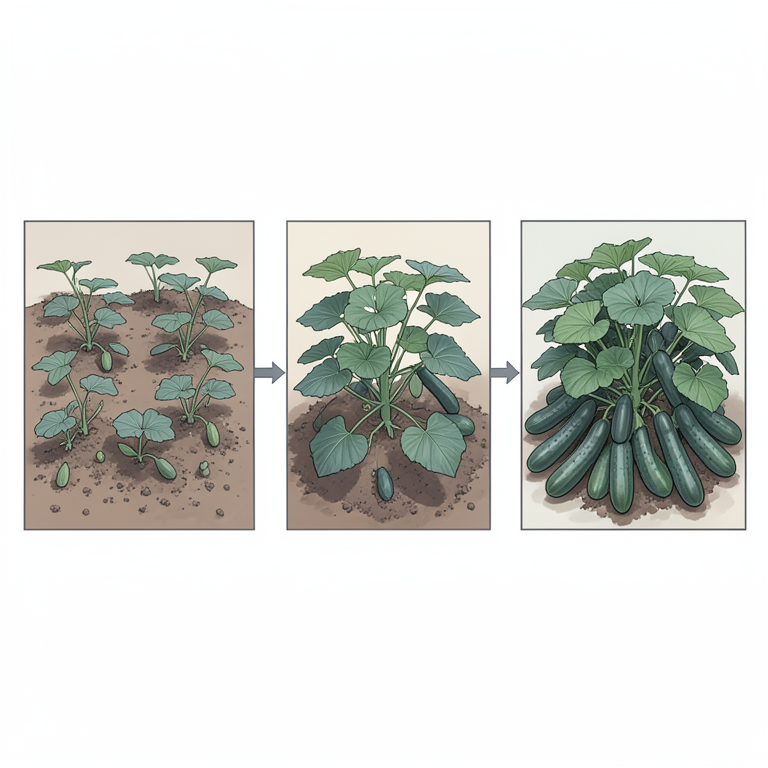
Impact of Spacing on Yield
AI-generated conceptual illustration (cucumber plants (Cucumis sativus L.)). It explains the idea and does not show study data.
View source evidence ↗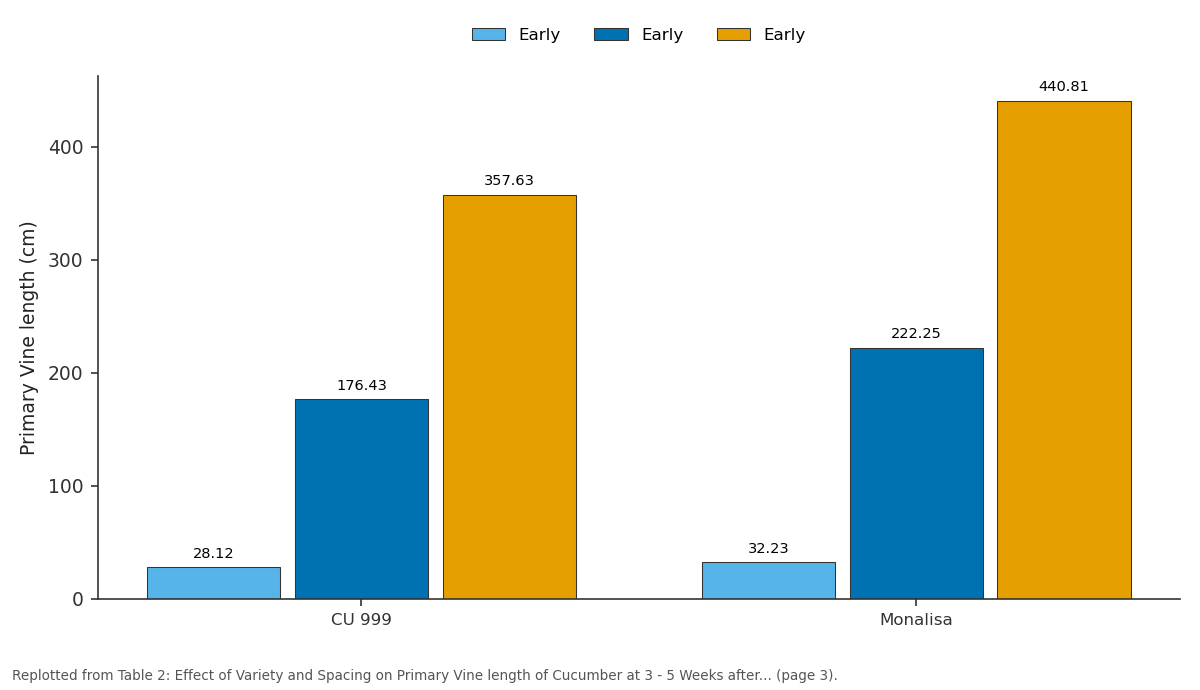
Early and Early and more: CU 999 vs Monalisa
Replotted from Table 2 (page 3) of the original paper. Every bar is the paper's own table value.
View source evidence ↗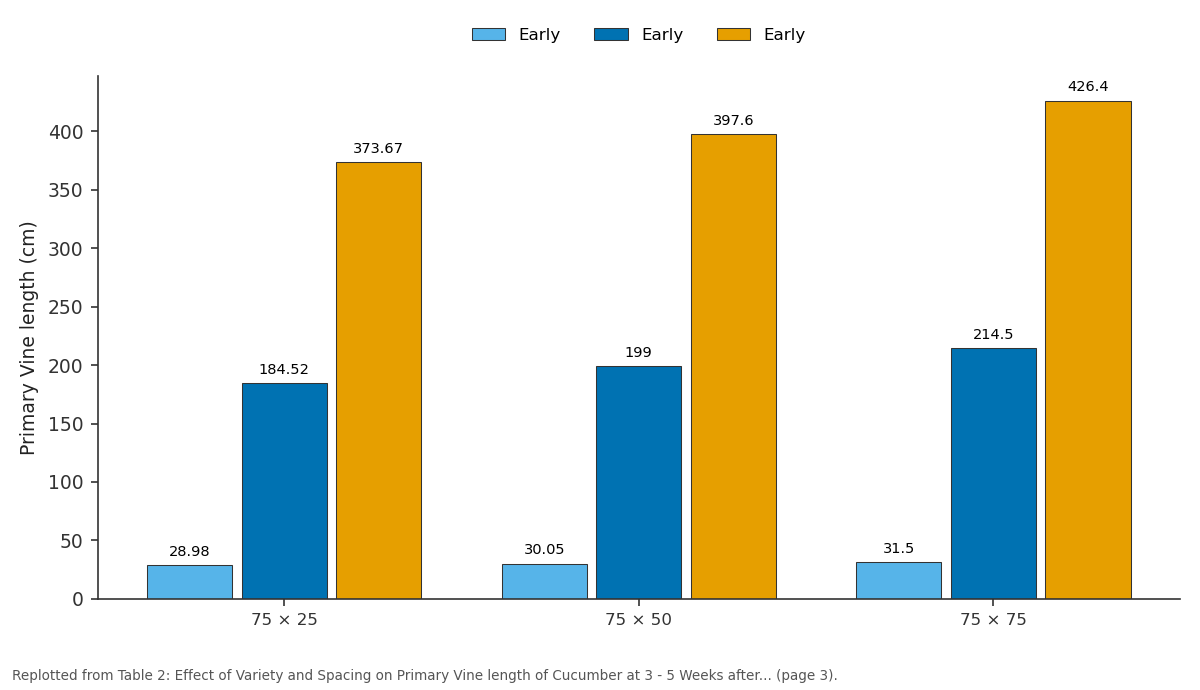
Early and Early and more: 75 × 25 vs 75 × 50 vs 75 × 75
Replotted from Table 2 (page 3) of the original paper. Every bar is the paper's own table value.
View source evidence ↗Figures & tables
From the original paper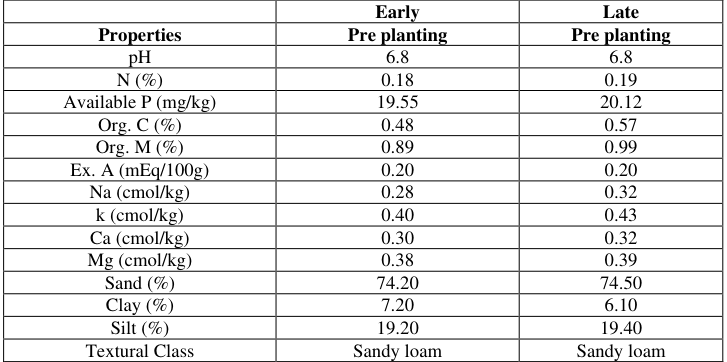 Table 1
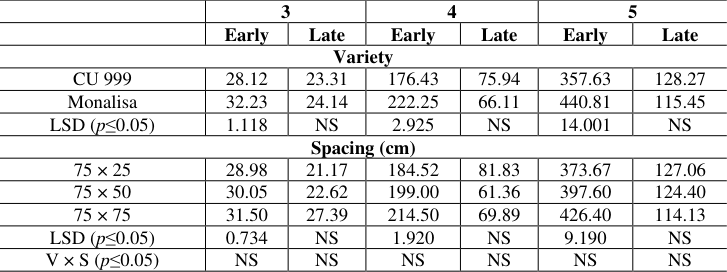 Table 2
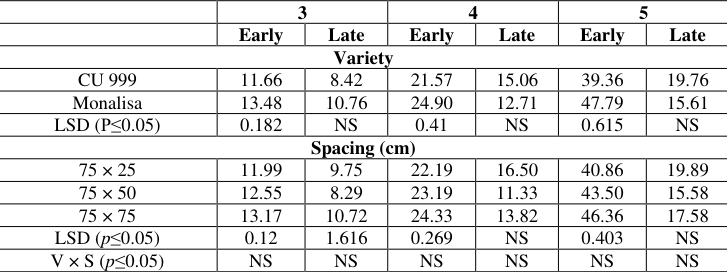 Table 3
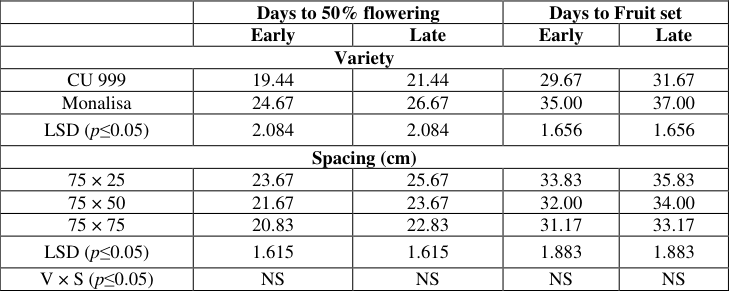 Table 4
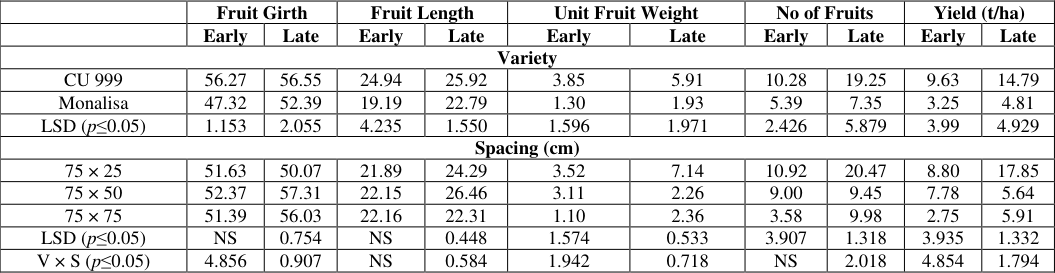 Table 5
Introduction
Cucumber (Cucumis sativus L.) is one of Nigeria's most popular fruits and vegetables. It is the world's fourth most farmed vegetable and is often regarded as one of the healthiest foods available [1] . It belongs to the Cucurbitaceae family and is one of the most popular members. Cucumber is a South Asian native that is now grown on practically every continent. Cucumbers are available in a wide range of forms and sizes and are sold all over the world [2,3] . They are vine crops that are cultivated on the ground, on poles, or on anchored trellises to suspend fruit [2,3] . Cucumber fruit is high in vitamins A, C, K, B6, potassium, dietary fiber, pantothenic acid, magnesium, and phosphorus [4] . Cucumber cultivation is growing increasingly popular in a large area of Nigeria, according to [5] , possibly due to its strong nutritional and medicinal benefits, as well as its use as a component ingredient in pharmaceuticals [6] . Plant spacing is one of the most essential elements in crop production, according to [7] , since proper crop spacing makes optimal use of resources by limiting competition among plants with similar cultural requirements. [8] Investigated the influence of plant spacing on cucumber yield in a protected environment and found that a plant spacing of 60 cm 60 cm produced the maximum yield when compared to 60 cm 30 cm or 90 cm 60 cm spacing. According to [9] , increasing plant density from 2 to 10 plants per m2 increased yield per plant but decreased productivity per unit area, whereas decreasing plant density increased yield per unit area [10] . Tested the effect of plant population on cucumber yield and fruit quality, and discovered that plant population had significant impact on cucumber yield. He found that as plant density increased, reproductive yield (kg/plant) decreased. The highest plant density resulted in the largest fruit output. [11] Investigated the influence of spatial arrangement on three cucumber types grown in a controlled environment, finding that close spacing resulted in a high total and marketable yield per unit area. Growth and yield of plant all rose dramatically as plant spacing increased, according to an experiment done by [12,5] .
Investigated the impact of plant spacing on cucumber growth and yield in a protected environment and found that the closest plant spacing (50 cm x 30 cm) produced the most fruits, and fruits with higher weight than the 50 cm x 40 cm spacing. This research was therefore done to determine the appropriate spacing for increased productivity to meet the consumers' demand.
Materials and Method
The experiment was carried out at the Directorate of University Farms' (DUFARMS) Teaching and Research site of the Federal University of Agriculture, Abeokuta, in the forest-savanna-transition agro-ecological zone. The rainfall distribution pattern for Abeokuta is bimodal, having the first mode between June and July and the second mode in September. The annual rainfall ranges from 1145 to 1270 mm. The experiment was conducted in two trials in 2019. Soil samples collected from experimental sites were subjected to routine laboratory analysis before planting. The treatments were arranged as a split plot fitted into a Randomized Complete Block Design with three replications using sub plot size of 2 m × 2 m. The treatment consisted of two cucumber varieties (CU 999 and Monalisa) and plant spacing (75 × 25, 75 × 50, 75 × 75) cm. At 3, 4, and 5 WAS, primary vine length was measured from the soil surface to the tip of the stem of the five tagged plants in the center row using a meter rule. At 3, 4, and 4 WAS, the number of leaves on the sample plants were counted. Days to 50% flowering/blooming were calculated using the number of flowers observed on 50% of cucumber stands in each plots and days to fruiting were calculated using this same method. Weight of fruit was done using a top scale to weigh the fruits harvested from each net plot. Number of fruits harvested from the sample plants was counted at each harvest. Fruit girth was done using a veneer caliper while fruit length was done with a meter ruler.
Statistical analysis
The collected data were subjected to Analysis of Variance (ANOVA). At a 5% level of probability, the Least Significant Difference (LSD) was used to separate the means of significant treatments.
Results and Discussion
The experimental site's soil texture was sandy loam. The soil had a slightly acidic pH. The pH was (6.8) in both trials of 2019. The nitrogen content of the soil was medium (between 0.16% and 0.19%). Low nitrogen content is < 0.15%, medium is 0.15% to 0.20% and high is > 0.20%. The soil had a low organic matter content (Table 1). Significant (p≤0.05) varietal difference existed in primary vine length of the cucumber varieties at 3, 4 and 5 WAS in the early season of 2019 while no difference was observed in the late season (Table 2). Monalisa variety had longer vines compared to CU 999. Spacing significantly (p≤0.05) influenced primary vine length at 3, 4 and WAS in the early season of 2019 and no such difference was observed in the late season. Plants in plots with spacing of 75 cm × 75 cm had longer vines. Significant difference was observed on number of leaves of the varieties at 3, 4 and 5 WAS in the early season of 2019 (Table 3). In comparison to CU 999, the Monalisa variety produced plants with more leaves. At 3 and 4 WAS, spacing had a significant (p≤0.05) impact on the number of leaves in the early and late season while at 4 and 5 WAS, significant differences were observed only in the early season. Cucumber plants in plots with spacing of 75 cm × 75 cm producing plants with higher number of leaves. During the experiment, there were substantial differences in primary vineal length and number of leaves/plant of cucumber; the disparities in growth rate indices are generally linked to their genetic make-up, according to [13] . This was in line with the findings of [14] , who found that genetic variables improved plant height, leaf area, and pod output. Variety had significant (p≤0.05) effect on days to 50% flowering and days to fruit set of cucumber in the early and late season of 2019 (Table 4). Variety CU 999 flowered earlier than Monalisa. Effect of spacing on days to 50% flowering and days to fruit set was significant (p≤0.05) in both seasons of 2019. Plants spaced at 75 cm × 75 cm flowered earlier than those spaced at 75 cm × 25 cm and 75 cm × 50 cm Variety significantly (p≤0.05) influenced fruit girth in both seasons of 2019. CU 999 produced fruits with larger girth compared to Monalisa variety (Table 5). Effect of spacing on fruit girth was significant (p≤0.05) only in the late season. Plants spaced at 75 cm × 50 cm produced larger fruits while plants spaced at 75 cm × 75 cm had the smallest fruit girth. There was significant (p≤0.05) interaction between variety and spacing on fruit girth in both seasons. Varietal influence was observed on fruit length in both seasons of 2019 (Table 5). Variety CU 999 produced significantly (p≤0.05) longer fruits than Monalisa. Fruit length was significantly (p≤0.05) influenced by spacing only in the late season. Plants spaced at 75 cm × 50 cm in the late produced longer fruits. Variety significantly (p≤0.05) influenced fruit weight/plant in both seasons with CU 999 producing heavier cucumber fruits than Monalisa in both seasons (Table 5). Spacing significantly (p≤0.05) impacted fruit weight/plant in both seasons. Plant in plots spaced at 75 cm × 25 cm produced fruits with higher weight. Variety had significant (p≤0.05) influence on number of fruits per plants in the two seasons with CU 999 producing more cucumber fruits than Monalisa in both seasons (Table 5). Spacing also had a significant (p≤0.05) impact in both seasons. Plant in plots spaced at 75 cm × 25 cm produced more fruits. Varietal influence was observed on fruit yield (t/ha) in both seasons of 2019. Yield of CU 999 was higher compared to Monalisa (Table 5). Spacing significantly (p≤0.05) influenced yield (t/ha) in both seasons of 2019. In both seasons, plots spaced at 75 cm × 25 cm had higher yield. Differential yield features were found in the CU 999 variety. Monalisa had a much lower number of fruits per plant, weight of fruits per plant, and total yield per hectare. Different cucumber researchers from around the world have reported on these differences in cucumber growth and production. The genetic composition of the types employed can be blamed for the discrepancies in vegetative and yield characteristics. The CU 999 type may have adapted to the surroundings more quickly than Monalisa. The CU 999 variety's vegetative features may have been more active, resulting in a robust source-to-sink interaction that led in the variety's high yields [15] . This was in line with [16] findings, which claimed that cucumber yield is influenced by genetic and environmental factors, and so varies depending on growing season and locale. One of the most significant aspects of agricultural productivity is plant spacing. The highest plant density yielded the highest fruit production in this study. This opposed [17] findings, which showed that increasing plant spacing led to an increase in the no. of fruits/plant, fruit length, and weigh of fruit/plant, while decreasing plant spacing led to increased plant height and no. of leaves. [18] Found that cassava ultimate leaf size and lateral shoot growth rose when planting density reduced, corroborating these findings. Plant density has a significant impact on growth and marketability of many fruit and vegetable crops, according to [19] . In their investigation of the influence of varied plant spacing on the output and quality of cucumbers in a greenhouse, [20] discovered that closer plant spacing resulted in a significantly lower fruit yield per plant. The increased fruit weight in closer plants could be attributable to greater assimilate use and increased assimilate allocation to the economic section. [21,20,22,23,24,25,26] all reported similar results. Plants with the widest spacing outperformed those that had smaller spacing in most of the growth indices studied. The higher fruit production could be attributed to the higher population density attained at a tight spacing of 75 cm x 25 cm, resulting in superior weed control through canopy shade, improved water usage due to minimal rate of evapo-transpiration and better radiant energy utilization. According to [27] , reduction in weed infestation, more oxygen supply and improved movement of water in the soil all contributed to increased okra development. The cucumber vines' failure to smother weeds due to a lack of plants and adequate room for weeds to thrive could explain the low yield achieved at wider spacing as crop and weed had to battle for available resources due to the vast quantity of space available. Plants in plots with spacing of 75 cm x 25 cm were determined to have the better yield, which was in line with [28] , who discovered that the best spacing for optimum cucumber yield was 70 cm x 30 cm [29] . Also discovered that the closer the plant spacing, the higher the output [9] . Also found that when plant density grew from four to ten plants per meter square, the number of fruit declined. However, the results of the trial contradict those of [30] , who found that higher plant spacing had the maximum yield.
| — | Fruit Girth | — | Fruit Length | — | Unit Fruit Weight | — | No of Fruits | — | Yield (t/ha) | — |
|---|---|---|---|---|---|---|---|---|---|---|
| Early | Late | Early | Late | Early | Late | Early | Late | Early | Late | |
| Variety | ||||||||||
| CU 999 | 56.27 | 56.55 | 24.94 | 25.92 | 3.85 | 5.91 | 10.28 | 19.25 | 9.63 | 14.79 |
| Monalisa | 47.32 | 52.39 | 19.19 | 22.79 | 1.30 | 1.93 | 5.39 | 7.35 | 3.25 | 4.81 |
| LSD (p≤0.05) | 1.153 | 2.055 | 4.235 | 1.550 | 1.596 | 1.971 | 2.426 | 5.879 | 3.99 | 4.929 |
| Spacing (cm) | ||||||||||
| 75 × 25 | 51.63 | 50.07 | 21.89 | 24.29 | 3.52 | 7.14 | 10.92 | 20.47 | 8.80 | 17.85 |
| 75 × 50 | 52.37 | 57.31 | 22.15 | 26.46 | 3.11 | 2.26 | 9.00 | 9.45 | 7.78 | 5.64 |
| 75 × 75 | 51.39 | 56.03 | 22.16 | 22.31 | 1.10 | 2.36 | 3.58 | 9.98 | 2.75 | 5.91 |
| LSD (p≤0.05) | NS | 0.754 | NS | 0.448 | 1.574 | 0.533 | 3.907 | 1.318 | 3.935 | 1.332 |
| V × S (p≤0.05) | 4.856 | 0.907 | NS | 0.584 | 1.942 | 0.718 | NS | 2.018 | 4.854 | 1.794 |
Table text extracted from the original PDF; superscript letters are shown inline. The original table image is below.
View original table image
| — | Days to 50% flowering | — | Days to Fruit set | — |
|---|---|---|---|---|
| Early | Late | Early | Late | |
| Variety | ||||
| CU 999 | 19.44 | 21.44 | 29.67 | 31.67 |
| Monalisa | 24.67 | 26.67 | 35.00 | 37.00 |
| LSD (p≤0.05) | 2.084 | 2.084 | 1.656 | 1.656 |
| Spacing (cm) | ||||
| 75 × 25 | 23.67 | 25.67 | 33.83 | 35.83 |
| 75 × 50 | 21.67 | 23.67 | 32.00 | 34.00 |
| 75 × 75 | 20.83 | 22.83 | 31.17 | 33.17 |
| LSD (p≤0.05) | 1.615 | 1.615 | 1.883 | 1.883 |
| V × S (p≤0.05) | NS | NS | NS | NS |
Table text extracted from the original PDF; superscript letters are shown inline. The original table image is below.
View original table image
| — | 3 | — | 4 | — | 5 | — |
|---|---|---|---|---|---|---|
| Early | Late | Early | Late | Early | Late | |
| Variety | ||||||
| CU 999 | 11.66 | 8.42 | 21.57 | 15.06 | 39.36 | 19.76 |
| Monalisa | 13.48 | 10.76 | 24.90 | 12.71 | 47.79 | 15.61 |
| LSD (P≤0.05) | 0.182 | NS | 0.41 | NS | 0.615 | NS |
| Spacing (cm) | ||||||
| 75 × 25 | 11.99 | 9.75 | 22.19 | 16.50 | 40.86 | 19.89 |
| 75 × 50 | 12.55 | 8.29 | 23.19 | 11.33 | 43.50 | 15.58 |
| 75 × 75 | 13.17 | 10.72 | 24.33 | 13.82 | 46.36 | 17.58 |
| LSD (p≤0.05) | 0.12 | 1.616 | 0.269 | NS | 0.403 | NS |
| V × S (p≤0.05) | NS | NS | NS | NS | NS | NS |
Table text extracted from the original PDF; superscript letters are shown inline. The original table image is below.
View original table image
| — | 3 | — | 4 | — | 5 | — |
|---|---|---|---|---|---|---|
| Early | Late | Early | Late | Early | Late | |
| Variety | ||||||
| CU 999 | 28.12 | 23.31 | 176.43 | 75.94 | 357.63 | 128.27 |
| Monalisa | 32.23 | 24.14 | 222.25 | 66.11 | 440.81 | 115.45 |
| LSD (p≤0.05) | 1.118 | NS | 2.925 | NS | 14.001 | NS |
| Spacing (cm) | ||||||
| 75 × 25 | 28.98 | 21.17 | 184.52 | 81.83 | 373.67 | 127.06 |
| 75 × 50 | 30.05 | 22.62 | 199.00 | 61.36 | 397.60 | 124.40 |
| 75 × 75 | 31.50 | 27.39 | 214.50 | 69.89 | 426.40 | 114.13 |
| LSD (p≤0.05) | 0.734 | NS | 1.920 | NS | 9.190 | NS |
| V × S (p≤0.05) | NS | NS | NS | NS | NS | NS |
Table text extracted from the original PDF; superscript letters are shown inline. The original table image is below.
View original table image
| — | Early | Late |
|---|---|---|
| Properties | Pre planting | Pre planting |
| pH | 6.8 | 6.8 |
| N (%) | 0.18 | 0.19 |
| Available P (mg/kg) | 19.55 | 20.12 |
| Org. C (%) | 0.48 | 0.57 |
| Org. M (%) | 0.89 | 0.99 |
| Ex. A (mEq/100g) | 0.20 | 0.20 |
| Na (cmol/kg) | 0.28 | 0.32 |
| k (cmol/kg) | 0.40 | 0.43 |
| Ca (cmol/kg) | 0.30 | 0.32 |
| Mg (cmol/kg) | 0.38 | 0.39 |
| Sand (%) | 74.20 | 74.50 |
| Clay (%) | 7.20 | 6.10 |
| Silt (%) | 19.20 | 19.40 |
| Textural Class | Sandy loam | Sandy loam |
Table text extracted from the original PDF; superscript letters are shown inline. The original table image is below.
View original table image
Conclusions
From the study, it was established that variety CU 999 is higher yielding than Monalisa and the optimum growth and high fruit yield in cucumber is dependent on crop spacing in the field.
Acknowledgment
Acknowledgment
References
21 in the original paper- Natural News. 10 Health benefits of cucumbers http://www.naturalnews.com/036769_cucumbers_healt h_benefits_rehydration.html. 2014.
- Nonneck IL. Vegetable production pub. Nan No. 1 Sotram Reinhold Company N.Y. 1989. p. 608-112.
- Wells J. Cucumber Business Leaves Family Farm in a Pickle. The Hamiton Spectator (Ontario, Canada) Retreived 13 Nov, 2017; c2016.
- Olaniyi JO, Ogunbiyi EM, Alagbe DD. Effects of organo-mineral fertilizers on growth, yield and mineral nutrients uptake in cucumber. Journal of Animal & Plant Sciences. 2009;5(1):437-442.
- Nweke IA, Orji EC, Ijearu SI. The effect of staking and plant spacing on the growth and yield of cucumber (Cucumis sativus L.). J Environ Sci Tox Food Technol.(IOSR-JESTFT). 2013;3(4):26-31.
- Kumar D, Kumar S, Singh J, Rashmi N, Vashistha BD, Singh N. Free radical scavenging and analgesic activities of Cucumis sativus L. fruit extract. Journal of Young Pharmacology. 2010;2(4):365-368.
- Jacques LS, Jeronimo LA, Aron BH. Dry matter accumulation and partitioning of pickling cucumber plants under different plants densities. Clientia Rural Santa Maria. 2002;32:3-41.
- Lacob FC, Campeanu G, Atanasiu N. Effect of culture technique upon pickling cucumber hybrids in solarium tunnels in the Tartasesti-racan. Horticultura. 2009;53:133-136.
- Ibrahim R, Amans EB, Ahmed A, Abubakar IU. Growth and Yield of Tomato (Lycopersicum estulentum Mill) varieties influenced by crop spacing at Samaru, Northern Nigeria. Nig. J Hort. Sc. 2002;5:52-57.
- Sajjan AS, Shekhargounda M, Badanur. Influence of data of sowing, spacing and levels of nitrogen on yield attributes and seed yield of Okro. Ikamataka Journal of Agricultural Science. 2002;15(2):267-274.
- Cavatorta J, Moriarty G, Henning M, Glos M, Kreitinger M, Munger HM. A Monoecious Slicing Cucumber Inbred with Multiple Disease and Insect Resistances. Hort science. 2007;42(3):707-709.
- Serquen FC, Bacher J, Staub JE. Genetic analysis of yield components in cucumber at low plant density. Journal of American Society of Horticulture Science. 1997;122:522-528.
- Kosson R, Dobrzanska J. The effect of plant training system on yielding and storability of cucumber fruits. Vegetable Crops Research Bulletin. 2002;56:57-65.
- Choudhari SM, More TA. Fertigation, fertilizer and spacing requirement of Tropical gynoecious cucmber hybrids. ISHS. Tsukuba, Japan. Acta Hort. 2002;61:588.
- Motsenbocker CE, Arancibia RA. In-row spacing influences triploid watermelon yield and crop value. Hort Technology. 2002;12(3):437-440.
- Khalid EA, Elwan MWM. Dependence of Pumpkin Yield on Plant Density and Variety. American Journal of Plant Sciences. 2011;2:636-643.
- Zhang F, Cui Z, Fan M, Zhang W, Chen X, Jiang R. Integrated soil crop system management: reducing environmental risk while increasing crop productivity and improving nutrient use efficiency in China. J Environ Qual. 2011;40:1051-1057. https://doi.org/10.2134/jeq2010.0292.
- Sharma HSS, Fleming C, Selby C, Rao JR, Martin T. Plant biostimulants: a review on the processing of macroalgae and use of extracts for crop management to reduce abiotic and biotic stresses. J Appl Phycol. 2014;26:465-490. https://doi.org/10.1007/s10811-0130101-9.
- Udensi EU, Omovbude S, Nwachukwu JC. Response of Cucumber (Cucumis sativus L.) and Weeds to Plant Spacing and Weeding Regimes in a Humid Forest Agro-Ecology of Southeastern Nigeria. 2018;22(1):113. Article no.IJPSS.39638
- Dhillon NS, Sharma P, Sharma KD, Kumar P. Effect of Plant Density and Shoot Pruning on Yield and Quality of Polyhouse Grown Cucumber. Environment & Ecology. 2017 Oct-Dec;35(4B):3023-3026. Website: environmentandecology.com ISSN 0970-0420
- Quian H. Effect of pruning and spacing on yield and quality of cucumber. Hort. Sci. 2000;36(2):274-278.
Cited by 1
From OpenAlex, OpenCitations and reference lists read by Scinovex
- Variety plant spacing and NPK fertilizer rate influence postharvest quality and nutritional composition of cucumber fruits ↗
Olamide Oluwatosin Falaiye, Asimiu Olusegun Kasali, Nurudeen Olatunbosun Adeyemi, Olanrewaju Emmanuel Oni, Rukayat Adeola Somoye, Oluwatosin Mary Falaiye et al. · Research Square · 2026
❝ 0PDF