
Research article · 2022 · Full text
International Journal of Agriculture Extension and Social DevelopmentDevelopment of scale to measure the perception of agriculture university teachers and students about utilization of ICT tools in agricultural education
Volume 5(2) · Pages 17–23 · DOI: 10.33545/26180723.2022.v5.i2a.140 ↗
Research areasDiverse Educational Innovations StudiesGender and Technology in EducationTechnology-Enhanced Education Studies
Abstract
Author-writtenA scale was developed to measure the perception of Agriculture University teachers and students about utilization of ICT tools in Agricultural Education by following the Liker’s summated rating scale. Based on the review of literature and discussion with the experts, 124 statements were prepared on dimensions. Relevancy rating was sent to 250 scientists and extension specialists working in research institutes of Indian Council of Agriculture Research (ICAR), State Agricultural University and development Departments for critical evaluation of statements on five point continuum. Seventy five judges sent in time were analyzed and aggregate of 100 statements were selected by finding the relevancy weightage scores (RWS) equal or more than 0.75 and mean relevancy score of 3.00 were selected for the item analysis. In item analysis the selected statements were administered to 40 teachers and 40 students in non-sample area in University of Agricultural Sciences, Dharwad. Finally a total of 38 statements were selected for the study based on ‘r’ values (> 1.75) they were included in the final scale. The ‘r’ value of the scale was found to be 0.86, which was significant at one % level indicating the high reliability. The scale developed was found to be reliable and valid, hence it is recommended to use. To study, utilization of ICT tools in Agricultural Education.
Summary
Source-checkedPlain-language reading of the full paper, prepared with AI and checked against the text. Each point links to the authors' own words.
Why it matters
- Information Communication Technology (ICT) consists of global networks using tools like computers and cell phones to facilitate the sharing of knowledge and information. View evidence ↗
- ICT tools are reshaping education by challenging traditional teaching methods and changing how students and teachers access knowledge. View evidence ↗
- The rapid pace of technological advancement has made it difficult for some education faculty to integrate ICT into their teaching practices. View evidence ↗
The question
- The study aimed to develop a Likert-based scale to measure how agriculture university teachers and students perceive the use of ICT tools in their education. View evidence ↗
What they did
- To ensure relevancy, 124 statements were sent to 200 experts, with 75 experts providing responses over two months. View evidence ↗
- Statements were filtered based on a relevancy percentage > 75%, weightage > 0.75, and mean score > 3.00, resulting in 100 selected statements. View evidence ↗
What they found
- Following item analysis, the final scale was reduced to 38 statements that had a discriminating 't' value of 1.75 or higher. View evidence ↗
- The final 38-item scale produces a perception score ranging from a minimum of 38 to a maximum of 190. View evidence ↗
What it means
- The authors conclude that the developed Likert scale is a valid scientific method for measuring the perceptions of teachers and students regarding ICT tool utilization in agricultural education. View evidence ↗
Visual summary
2 visualsIllustrations explain the paper; charts are replotted from the paper's own table values.
Scale Development Pipeline
AI-generated conceptual illustration (Agricultural university teachers and students using ICT tools). It explains the idea and does not show study data.
View source evidence ↗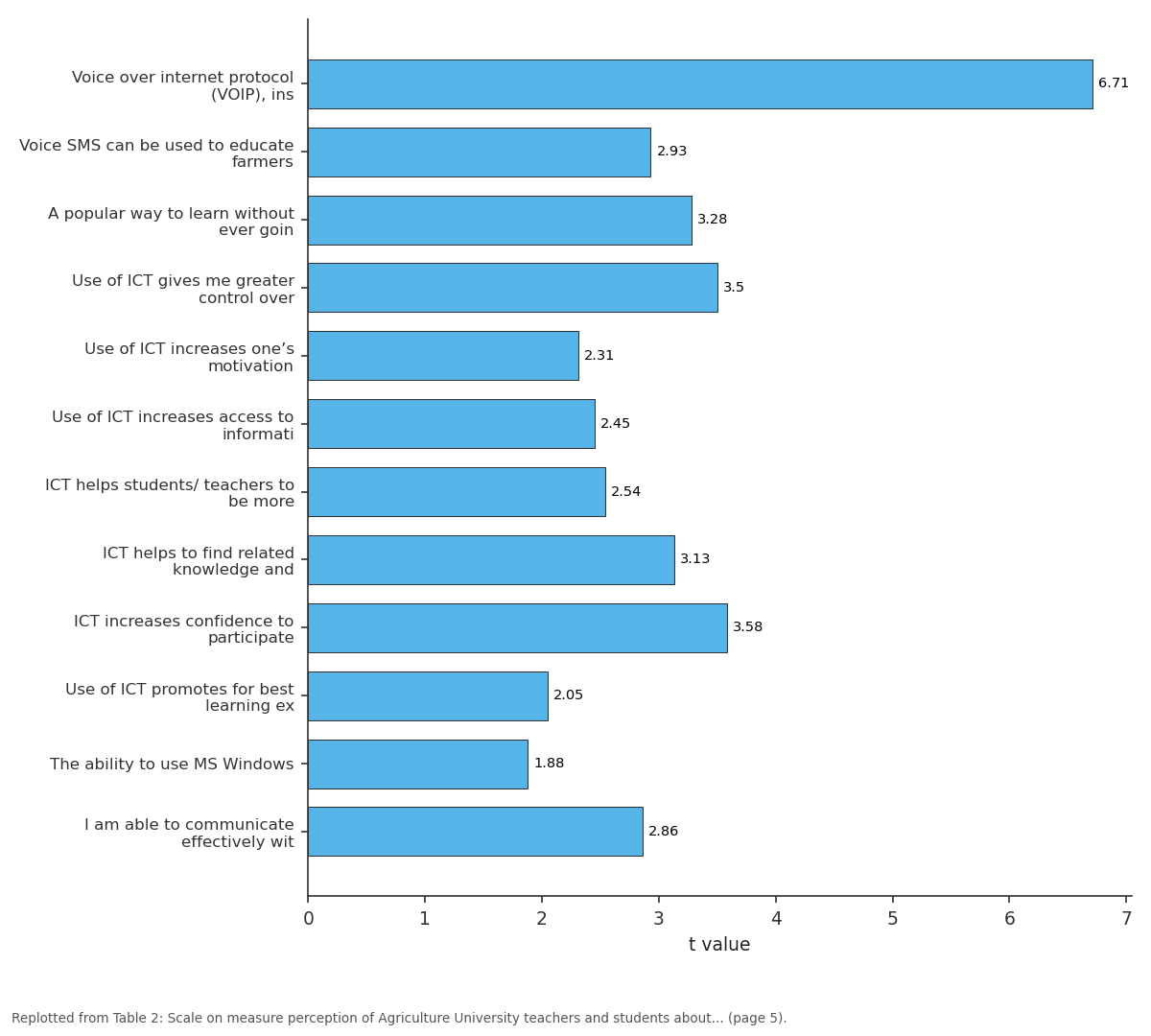
‘t’ value: Voice over internet... vs Voice SMS can be used... vs A popular way to learn... vs Use of ICT gives me... vs Use of ICT increases...
Replotted from Table 2 (page 5) of the original paper. Every bar is the paper's own table value.
View source evidence ↗Figures & tables
From the original paper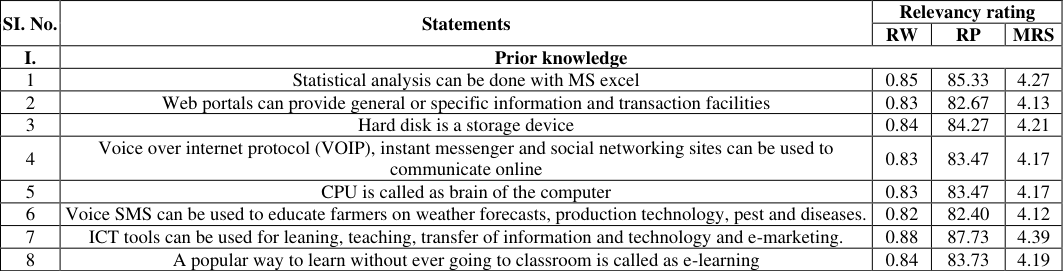 Table 1
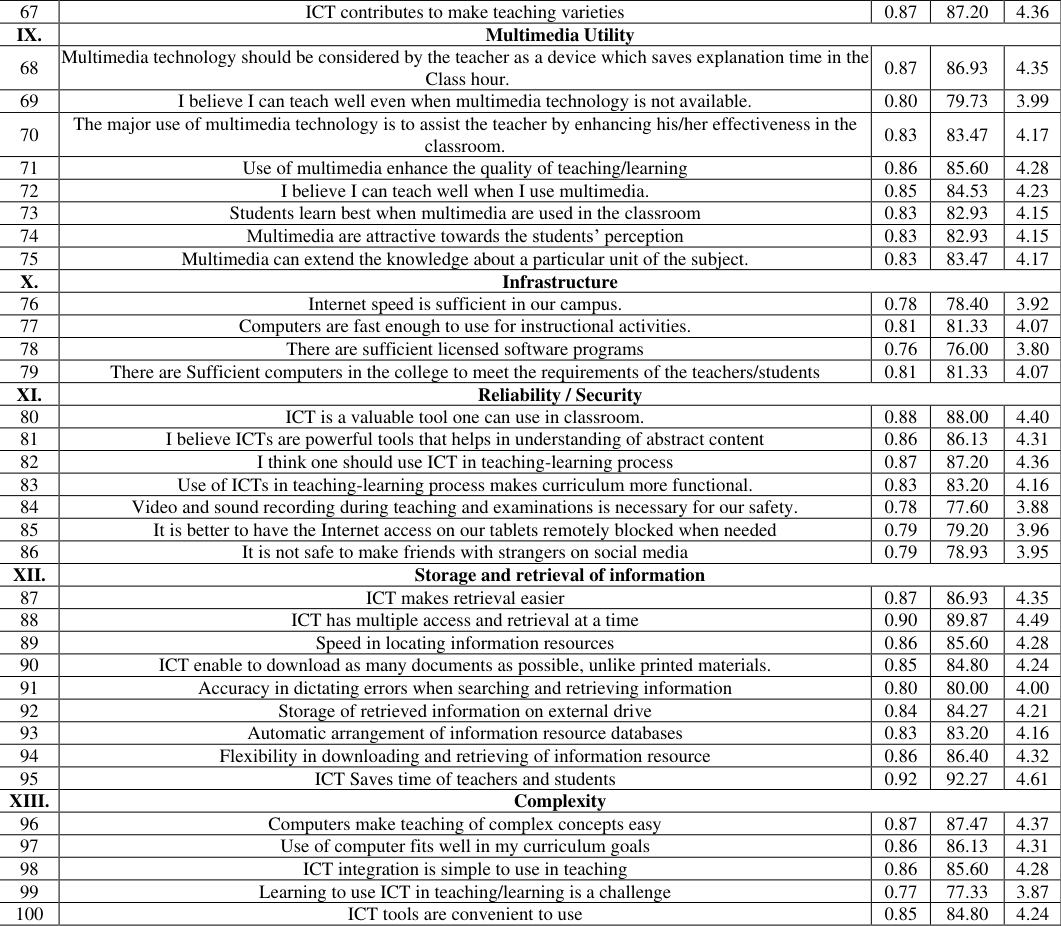 Table 2
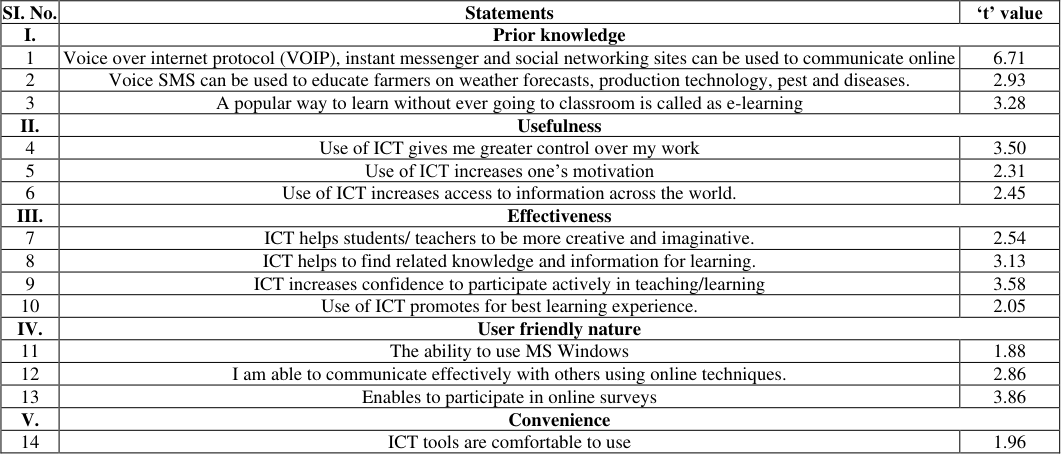 Table 2
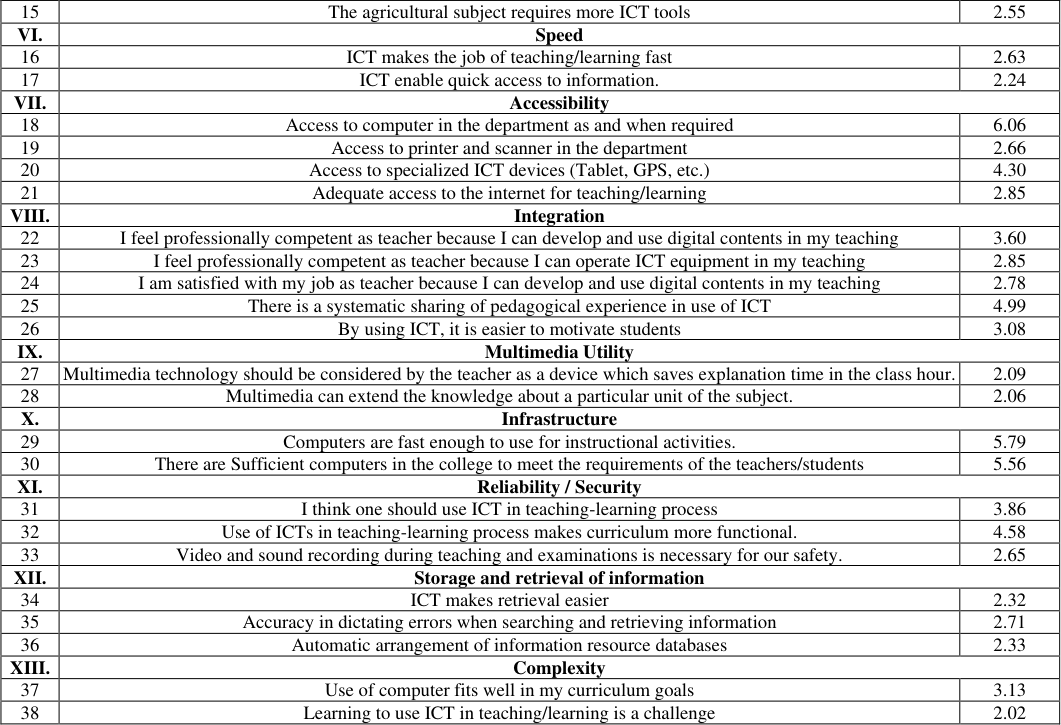 Table 3
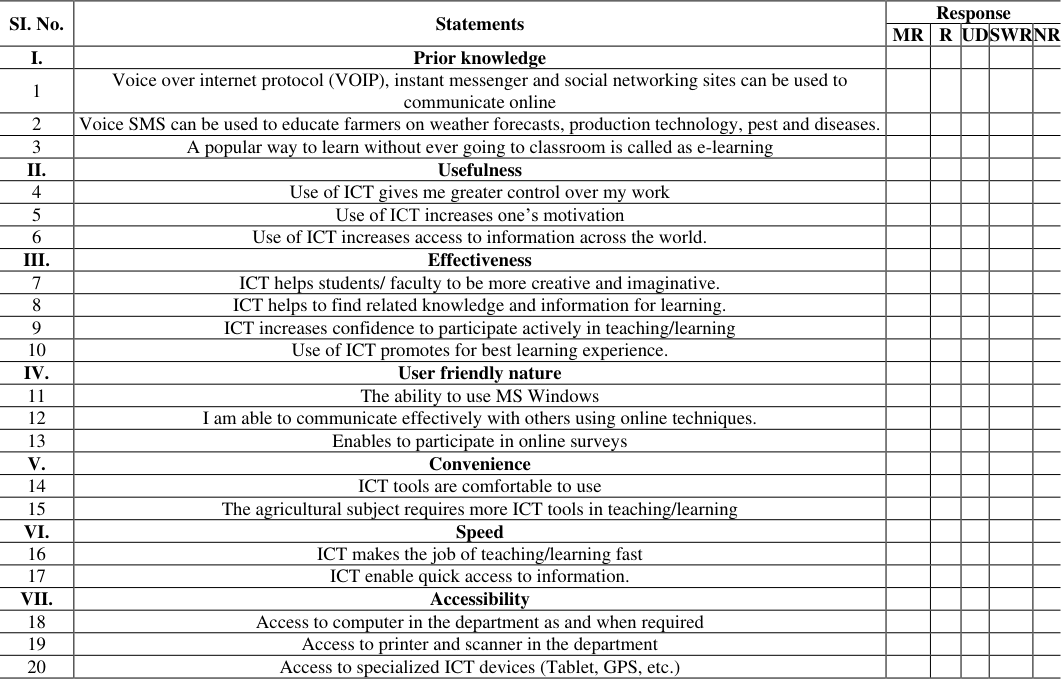 Table 3
Introduction
Information Communication Technology (ICT) is defined as a worldwide network in which individuals are connected via the use of ICT tools such as cell phones and technology such as computers to share information and knowledge. The advancement ICT has resulted in changes that have an impact on many elements of our society and are becoming increasingly crucial in our everyday lives. Education has reaped the greatest benefits from technological improvements. The first-hand technologies challenge traditional teaching and learning methodologies and materials, and have fundamental implications for traditional teaching and learning methods by reshaping how teachers and learners gain access to knowledge. Computers, the Internet, and wireless communication technologies, as well as strong software that can analyse and integrate sound, text, and video into electronic media are examples of current ICT tools. Universities and cultural organizations across India are rapidly recognizing the importance of reforming education via the use of modern ICTs. The National Policy for ICT in Education, which is currently being developed, emphasizes the importance of including ICT as a subject in the curriculum as well as reinforcing the overall teaching and learning process. In India, EDUSAT (Educational Satellite) and other TV and radio channels are used to distribute content to open and distance education systems. However, ICT has yet to play a substantial role in the content delivery. Many sectors around the world have found ICTs to be a valuable source of modernization and competency enhancement. In the field of education, in particular, the usage of ICT has become an integral aspect of university students' learning. Universities that have completely embraced ICT have seen significant improvements in the use of ICT to improve learning techniques, teaching, research, and development. Faculty of Education teachers have found it difficult to keep up with the integration of ICT into teaching due to the rapid pace of technological development in education. New teaching and research methodologies have been introduced as a result of the use of ICTs. ICT not only opens up new possibilities, but it also puts users' trust to the test. ICT integration into educational classroom teaching has reached a new high point in recent years. ICT provides teachers and students with access to a wealth of information. This covers the case for ICT as a powerful tool for expanding knowledge access. Teachers and students now have better access to various forms of information and communication technology, allowing them to do more www.extensionjournal.com informed research. It also allows individuals to make contact with, collaborate with, and develop productive relationships with other teachers who share similar interests. ICTs empower students to take charge of their own learning, think critically and analytically, and collaborate more effectively. ICT in the educational sector has the potential to significantly improve educational quality. Learners can control the content, timing, and pace of their learning through a variety of ICT applications. This gives students the option of picking and choosing what they want to learn.
Methodology
Likert method of scale development was used to develop scale The steps followed in developing the scale to measure perception of teachers and students about utilization of ICT tools in Agricultural Education is presented below twelve dimensions were identified.
Identification of dimensions
Based on the review of the past studies and discussion with the specialists in the concerned field. The dimensions including prior knowledge, usefulness, effectiveness, user friendly nature, convenience, speed, accessibility, integration, multimedia utility, infrastructure, reliability/ security, storage and retrieval of information and complexity.
Identification of items/statements 2.1. Collection of items /statements
One hindered eighty draft statements on the perception of teachers and students about utilization of ICT tools were formed based on review of literature, researcher's own experience. These statements were carefully edited in the light of 14 criteria suggested by Edward (1957) [3] , and 124 statements were selected.
Relevancy weightage
All the statements were subjected to scrutiny by an expert panel to determine the relevancy and screening for inclusion in the final scale. The list of scrutinized 124 statements was sent to a 200 experts to critically evaluate each statement for its relevancy to measure perception of teachers and students about utilization of ICT tools in Agricultural Education. The experts were requested to give their response on a five point continuum viz., Most Relevant (MR), Relevant (R), Somewhat Relevant (SR), Less Relevant (LR) and Not Relevant (NR) with scores 5, 4, 3, 2 and 1, respectively for positive statements and scoring was reversed for negative statements. 75 experts responded in a time span of two months. The relevancy score of each item was ascertained by adding the scores on rating scale for all the 75 experts' responses. Relevancy Percentage (RP), Relevancy Weightage (RW) and Mean Relevancy score (MRS) were worked out for all the 124 items/ statements by using the following formulae.
The statements having relevancy percentage more than (75.00%) & relevancy weightage more than 0.75 and mean relevancy score more than 3.00 were considered for final selection of statements. By this process, out of 124 statements, 100 statements had relevancy percentage above 75, relevancy weightage above 0.75 and mean relevancy score more than 3.00 and they were isolated in the first stage of screening, suitably modified and rewritten as per the comments of experts. Thus, finally 100 statements (Table 1) were selected after the relevancy test.
| SI. No. | Statements | Relevancy rating | — | — |
|---|---|---|---|---|
| RW | RP | MRS | ||
| I. | Prior knowledge | |||
| 1 | Statistical analysis can be done with MS excel | 0.85 | 85.33 | 4.27 |
| 2 | Web portals can provide general or specific information and transaction facilities | 0.83 | 82.67 | 4.13 |
| 3 | Hard disk is a storage device | 0.84 | 84.27 | 4.21 |
| 4 | Voice over internet protocol (VOIP), instant messenger and social networking sites can be used to communicate online | 0.83 | 83.47 | 4.17 |
| 5 | CPU is called as brain of the computer | 0.83 | 83.47 | 4.17 |
| 6 | Voice SMS can be used to educate farmers on weather forecasts, production technology, pest and diseases. | 0.82 | 82.40 | 4.12 |
| 7 | ICT tools can be used for leaning, teaching, transfer of information and technology and e-marketing. | 0.88 | 87.73 | 4.39 |
| 8 | A popular way to learn without ever going to classroom is called as e-learning | 0.84 | 83.73 | 4.19 |
Table text extracted from the original PDF; superscript letters are shown inline. The original table image is below.
View original table image
Item analysis
The selected 100 statements were subjected to item analysis to demarcate the items. Thus scrutinized statements representing the perception of teachers and students about utilization of ICT tools in Agricultural Education to 80 respondents from non-sample area of University of Agricultural Sciences, Dharwad were pre tested. The respondents were asked to indicate their degree of agreement or disagreement with each statement on a five point continuum viz., strongly agree, agree, undecided, disagree and strongly disagree with scores of 5, 4, 3, 2 and 1, respectively and negative statements scores were reversed. The summated score for the total statements of each respondent was calculated. For each respondent the maximum possible score for 100 statements was 500 and the minimum was 100. The scores of the respondents were then arranged in a descending order. The 25% from highest scores (high group) and 25% from lowest scores (low group) were taken for the item analysis. These responses were subjected to item analysis for selection of the items that constitute the final perception and acceptance scale. The critical ratio of (t-value) measure, the extent to which a given statement differentiates between the high and low groups of respondents for each statement was calculated by using the following formula After calculating the t-values for all the items of the perception & acceptance scale using the formula, the values of the statements were arranged in descending order from www.extensionjournal.com the highest to the lowest and 100 statements were selected from the scale whose values are highest (t-values more than 1.75), for both positive and negative statements.
Selection of perception and acceptance of statements for final Scale
After computing "t" value for all the items, 38 statements with highest "t" value equal to or greater than 1.75 were selected. The thumb rule of rejecting items with't' value less than 1.75 was followed as suggested by, Edward (1957) [3] . As per the thumb rule selection of items to be retained in the scale, includes the scales with highest discriminating values excluding the scales with poor discriminating ability and questionable validity. Thus, 38 statements were retained for consideration in the final scale based on the following norms The 't' value should be more than 1.75 The statement should present a new idea (the idea not overlapping with that expressed other) The statement should be simply worded and brief.
Reliability and validity of perception and acceptance scale
The scale developed was further standardized by establishing its reliability and validity. Reliability is the accuracy or precision of measuring instrument. Split-Half method was followed, to know the reliability of the scale.
Split-Half methodology
The 38 selected perception items were divided into two halves by odd-even method. The two halves were administered separately to 20 teachers and 20 students in a non-sample area. The scores were subjected to product moment correlation test in order to find out the reliability of the half-test. The half-test reliability coefficient (r) was 0.86, which was significant at one % level of probability. Further, the reliability coefficient of the whole test was computed using the Spearman-Brown prophecy formula given below.
By formulae
Where ∑X= Sum of the scores of the odd number items ∑Y= Sum of the scores of the even numbers items ∑X 2 = Sum of the squares of the odd number items ∑Y 2 = Sum of the squares of the even number items n = Number of respondents The whole test of the scale was 862, which was highly significant at one % level indicating the high reliability of the scale.
Content validity of the perception and acceptance scale
The validity of the scale was established through content validity i.e., the representativeness or sampling adequacy of the content of a measuring instrument. The scale satisfies both these criteria as the clause of universe of statements that could be made about utilization of ICT tools in Agricultural Education formulated from the standards and also in consultation with experts. Care was taken for obtaining a fair degree of content validity. The calculated "t" value being significant for all the finalized statements of the score indicated that the perception statements of the scale have discriminating values. Hence, it seems reasonable to accept the scale as a valid measure of the perception and acceptance.
Results and Discussion Administration and scoring of perception and acceptance scale
The final scale consisted of 38 statements (Table 2). The responses had to be recorded on a five point continuum representing strongly agree, agree, undecided, disagree and strongly disagree with scores of 5, 4, 3, 2, and 1, respectively for positive statements and vice versa for negative statements. The perception score on this scale ranges from a minimum of 38 to maximum of 190. The perception and acceptance level was operationalized as level of perception of the teachers and students about utilization of ICT tools in Agricultural Education. The responses elicited from the teachers and students were quantified.
| SI. No. | Statements | ‘t’ value |
|---|---|---|
| I. | Prior knowledge | |
| 1 | Voice over internet protocol (VOIP), instant messenger and social networking sites can be used to communicate online | 6.71 |
| 2 | Voice SMS can be used to educate farmers on weather forecasts, production technology, pest and diseases. | 2.93 |
| 3 | A popular way to learn without ever going to classroom is called as e-learning | 3.28 |
| II. | Usefulness | |
| 4 | Use of ICT gives me greater control over my work | 3.50 |
| 5 | Use of ICT increases one’s motivation | 2.31 |
| 6 | Use of ICT increases access to information across the world. | 2.45 |
| III. | Effectiveness | |
| 7 | ICT helps students/ teachers to be more creative and imaginative. | 2.54 |
| 8 | ICT helps to find related knowledge and information for learning. | 3.13 |
| 9 | ICT increases confidence to participate actively in teaching/learning | 3.58 |
| 10 | Use of ICT promotes for best learning experience. | 2.05 |
| IV. | User friendly nature | |
| 11 | The ability to use MS Windows | 1.88 |
| 12 | I am able to communicate effectively with others using online techniques. | 2.86 |
| 13 | Enables to participate in online surveys | 3.86 |
| V. | Convenience | |
| 14 | ICT tools are comfortable to use | 1.96 |
Table text extracted from the original PDF; superscript letters are shown inline. The original table image is below.
View original table image
| 67 | ICT contributes to make teaching varieties | 0.87 | 87.20 | 4.36 |
|---|---|---|---|---|
| IX. | Multimedia Utility | |||
| 68 | Multimedia technology should be considered by the teacher as a device which saves explanation time in the Class hour. | 0.87 | 86.93 | 4.35 |
| 69 | I believe I can teach well even when multimedia technology is not available. | 0.80 | 79.73 | 3.99 |
| 70 | The major use of multimedia technology is to assist the teacher by enhancing his/her effectiveness in the classroom. | 0.83 | 83.47 | 4.17 |
| 71 | Use of multimedia enhance the quality of teaching/learning | 0.86 | 85.60 | 4.28 |
| 72 | I believe I can teach well when I use multimedia. | 0.85 | 84.53 | 4.23 |
| 73 | Students learn best when multimedia are used in the classroom | 0.83 | 82.93 | 4.15 |
| 74 | Multimedia are attractive towards the students’ perception | 0.83 | 82.93 | 4.15 |
| 75 | Multimedia can extend the knowledge about a particular unit of the subject. | 0.83 | 83.47 | 4.17 |
| X. | Infrastructure | |||
| 76 | Internet speed is sufficient in our campus. | 0.78 | 78.40 | 3.92 |
| 77 | Computers are fast enough to use for instructional activities. | 0.81 | 81.33 | 4.07 |
| 78 | There are sufficient licensed software programs | 0.76 | 76.00 | 3.80 |
| 79 | There are Sufficient computers in the college to meet the requirements of the teachers/students | 0.81 | 81.33 | 4.07 |
| XI. | Reliability / Security | |||
| 80 | ICT is a valuable tool one can use in classroom. | 0.88 | 88.00 | 4.40 |
| 81 | I believe ICTs are powerful tools that helps in understanding of abstract content | 0.86 | 86.13 | 4.31 |
| 82 | I think one should use ICT in teaching-learning process | 0.87 | 87.20 | 4.36 |
| 83 | Use of ICTs in teaching-learning process makes curriculum more functional. | 0.83 | 83.20 | 4.16 |
| 84 | Video and sound recording during teaching and examinations is necessary for our safety. | 0.78 | 77.60 | 3.88 |
| 85 | It is better to have the Internet access on our tablets remotely blocked when needed | 0.79 | 79.20 | 3.96 |
| 86 | It is not safe to make friends with strangers on social media | 0.79 | 78.93 | 3.95 |
| XII. | Storage and retrieval of information | |||
| 87 | ICT makes retrieval easier | 0.87 | 86.93 | 4.35 |
| 88 | ICT has multiple access and retrieval at a time | 0.90 | 89.87 | 4.49 |
| 89 | Speed in locating information resources | 0.86 | 85.60 | 4.28 |
| 90 | ICT enable to download as many documents as possible, unlike printed materials. | 0.85 | 84.80 | 4.24 |
| 91 | Accuracy in dictating errors when searching and retrieving information | 0.80 | 80.00 | 4.00 |
| 92 | Storage of retrieved information on external drive | 0.84 | 84.27 | 4.21 |
| 93 | Automatic arrangement of information resource databases | 0.83 | 83.20 | 4.16 |
| 94 | Flexibility in downloading and retrieving of information resource | 0.86 | 86.40 | 4.32 |
| 95 | ICT Saves time of teachers and students | 0.92 | 92.27 | 4.61 |
| XIII. | Complexity | |||
| 96 | Computers make teaching of complex concepts easy | 0.87 | 87.47 | 4.37 |
| 97 | Use of computer fits well in my curriculum goals | 0.86 | 86.13 | 4.31 |
| 98 | ICT integration is simple to use in teaching | 0.86 | 85.60 | 4.28 |
| 99 | Learning to use ICT in teaching/learning is a challenge | 0.77 | 77.33 | 3.87 |
| 100 | ICT tools are convenient to use | 0.85 | 84.80 | 4.24 |
Table text extracted from the original PDF; superscript letters are shown inline. The original table image is below.
View original table image
Conclusion
The scale to measure the perception of teachers and students about utilization of ICT tools in Agricultural Education was developed following Likert method. The scale be can used to measure perception of teachers and students about utilization of ICT tools in Agricultural Education as a scientific methods.
Figures and tables from the paper
| 15 | The agricultural subject requires more ICT tools | 2.55 |
|---|---|---|
| VI. | Speed | |
| 16 | ICT makes the job of teaching/learning fast | 2.63 |
| 17 | ICT enable quick access to information. | 2.24 |
| VII. | Accessibility | |
| 18 | Access to computer in the department as and when required | 6.06 |
| 19 | Access to printer and scanner in the department | 2.66 |
| 20 | Access to specialized ICT devices (Tablet, GPS, etc.) | 4.30 |
| 21 | Adequate access to the internet for teaching/learning | 2.85 |
| VIII. | Integration | |
| 22 | I feel professionally competent as teacher because I can develop and use digital contents in my teaching | 3.60 |
| 23 | I feel professionally competent as teacher because I can operate ICT equipment in my teaching | 2.85 |
| 24 | I am satisfied with my job as teacher because I can develop and use digital contents in my teaching | 2.78 |
| 25 | There is a systematic sharing of pedagogical experience in use of ICT | 4.99 |
| 26 | By using ICT, it is easier to motivate students | 3.08 |
| IX. | Multimedia Utility | |
| 27 | Multimedia technology should be considered by the teacher as a device which saves explanation time in the class hour. | 2.09 |
| 28 | Multimedia can extend the knowledge about a particular unit of the subject. | 2.06 |
| X. | Infrastructure | |
| 29 | Computers are fast enough to use for instructional activities. | 5.79 |
| 30 | There are Sufficient computers in the college to meet the requirements of the teachers/students | 5.56 |
| XI. | Reliability / Security | |
| 31 | I think one should use ICT in teaching-learning process | 3.86 |
| 32 | Use of ICTs in teaching-learning process makes curriculum more functional. | 4.58 |
| 33 | Video and sound recording during teaching and examinations is necessary for our safety. | 2.65 |
| XII. | Storage and retrieval of information | |
| 34 | ICT makes retrieval easier | 2.32 |
| 35 | Accuracy in dictating errors when searching and retrieving information | 2.71 |
| 36 | Automatic arrangement of information resource databases | 2.33 |
| XIII. | Complexity | |
| 37 | Use of computer fits well in my curriculum goals | 3.13 |
| 38 | Learning to use ICT in teaching/learning is a challenge | 2.02 |
Table text extracted from the original PDF; superscript letters are shown inline. The original table image is below.
View original table image
References
8 in the original paper- Albirini A. Teachers' attitudes toward information and communication technologies. Journal of Computer and Education. 2006;47(4):373-398.
- Galanouli D, Mc Nair V. Students' perceptions of ICTrelated support in teaching placements. Journal of Computer Assisted Learning. 2001;17(4):396-408.
- George PL. Assessing Students' Perceptions of Synchronous Internet-Based Learning Environments. Paper submitted to the AARE 2001 Conference at Fremantle, Australia, from 2 nd to 6 th 2001.
- Kale RB, Meena MS, Singh YV, Meena HM. Scientists 'perception towards role of information and communication technologies in agricultural extension. National Academy Science Letters. 2016;39(2):91-93.
- Ozdamli F, Uzunboylu H. Learning adequacy and perceptions of students and teachers in secondary schools. British Journal of Educational Technology. 2015;46(1):159-172.
- Raksha Rao, Rani SI, Meera SV, Shaik N. Attitude of agriculture students towards informal and communication technology (ICT) based agriculture education. Journals of Communication Studies. 2014;31(3):118-122.
- Shakuntla, Mehta S. Perceptions of college going boys about effectiveness of cable T.V. Journal of Communication Studies. 2002:12(2):70-79.
- Zhang S, Fulford CP. Are interaction time psychological interactivity the something in the distance learning television classroom? Education Technology. 1994;34(6):58-64.
Cited by 1
From OpenAlex, OpenCitations and reference lists read by Scinovex
- Assessing gender-specific training needs for climate-smart agriculture in the upland Shan region of Myanmar: a comparison between climate-smart and non-climate-smart villages ↗
Kyaw Min, Monika Wason, R.N. Padaria, Satyapriya, Sitaram Bishnoi, Ankur Biswas et al. · Frontiers in Sustainable Food Systems · 2026
Introduction In 2024, a study was conducted in the Upland Shan Region of Myanmar to assess gender-specific training needs for Climate-Smart Agriculture (CSA). The primary objective was to identify gaps in knowledge to enhance the inclusiveness and resilience of smallholder farmers facing climate-related challenges. Methods The study utilized a stratified random sampling method to select 200 farmers, ensuring equal representation…
❝ 0PDF