
Research article · 2022 · Full text
International Journal of Horticulture and Food ScienceCost economics and economic viability of cold press oil extraction unit
Volume 4(2) · Pages 140–142 · DOI: 10.33545/26631067.2022.v4.i2b.123 ↗
Research areasMarket Dynamics and Volatility
Abstract
Author-writtenThe present study has been carried to study the different parameters for the establishment of cold press oil extraction unit. Calculated the production cost of cold press groundnut oil by considering all parameters and determined breakeven point of the cold press oil extraction unit at different market prices. Study revealed that, within 2 years cold press oil extraction business will achieve the breakeven point for Rs. 310 as market price. Breakeven point determination gives the clarity about all the parameters which effects on the oil extraction business establishment. Entrepreneur had been facing the different problems while establishing the unit hence efforts were taken to resolve the problems related to the cold press oil extraction unit with the efficient data and technical solutions. The mentioned study act as basic model for the start-up business entrepreneur of oil extraction unit.
Summary
Source-checkedPlain-language reading of the full paper, prepared with AI and checked against the text. Each point links to the authors' own words.
Why it matters
- Cold press oil extraction is an environmentally friendly method that requires less energy compared to other extraction techniques. View evidence ↗
- Cold-pressed oils are preferred by consumers because they are natural, safe, and possess better nutritional properties than refined oils, potentially improving human health. View evidence ↗
- Despite its benefits, cold-pressing technology faces challenges such as low oil yield and high residual oil rates. View evidence ↗
The question
- The study aimed to provide a detailed cost estimation for a cold press oil extraction unit to serve as a budget and costing baseline for efficient operation. View evidence ↗
What they did
- The researchers collected six months of financial and expense records from an active oil extraction plant at Krushi Vigyan Kendra, Akola. View evidence ↗
- The economic analysis assumed the plant operated for six months, working 24 days per month with 4 batches processed daily. View evidence ↗
What they found
- The recovery rates for groundnut oil and deoiled cake were found to be 40% (vl/wt) and 57.6%, respectively. View evidence ↗
- The production cost for one liter of cold pressed groundnut oil was determined to be Rs. 265.1. View evidence ↗
- The total fixed assets cost for the oil extraction unit was calculated at 517,240 Rs. View evidence ↗
- The production quantity required to reach the breakeven point decreased as the market price increased, ranging from 34,780 liters at Rs. 280 to 11,528 liters at Rs. 310. View evidence ↗
- An entrepreneur selling 500 liters of oil per month can reach the breakeven point in 23 months. View evidence ↗
- Low oil recovery negatively impacts the business by increasing the consumption of electricity and manpower, thereby raising production costs. View evidence ↗
- Improper oil extraction leads to fungal growth on the deoiled cake during storage, a problem that accelerates during the monsoon season. View evidence ↗
What it means
- The authors conclude that their findings can serve as a basic model for entrepreneurs to start and run an oil extraction business efficiently. View evidence ↗
- The study concludes that the sale of deoiled cake, a by-product of the process, contributes to the overall profit of the unit. View evidence ↗
Visual summary
1 visualsIllustrations explain the paper; they do not show study data.
Breakeven Relationship
AI-generated conceptual illustration (cold press oil extraction equipment and bottled vegetable oil). It explains the idea and does not show study data.
View source evidence ↗Figures & tables
From the original paper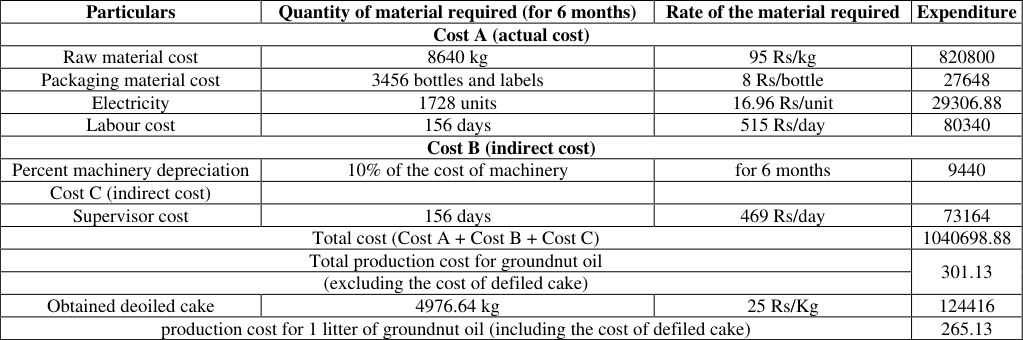 Table 1
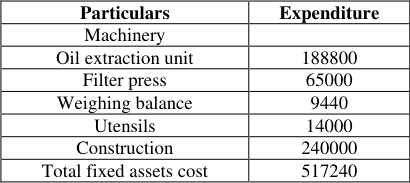 Table 2
 Table 3
Introduction
Cold press extraction is one of the oil extraction method required less energy than other oil extraction techniques and also environmental friendly. It is used to extract oil from a range of oilseeds. High-quality oils can be obtained by performing production at low temperatures using cold press method. It has an environmentally friendly use with no solvents. In other words, the cold-press extraction does not involve either heat or chemical extraction. Moreover, these oils are interesting for consumers due to their natural and safe as well as prevent certain diseases and improve human health. These oils have better nutritive properties than refined oils. However, they have a lot of advantages; one of the disadvantages of this technique is low productivity. Another disadvantage of this technique is hard to extract same quality product. A long cylindrical contraption known as 'ghani' was used to extract oil from oilseeds. However, a new technique known as cold pressing technique was introduced in 1983. Coldpressed technique is a method of extracting oil from oilseeds such as sesame, olive and coconut. Cold pressing technique avoids heat generation by controlled temperature setting and enhances the taste of the oil. It also retains the subtle colour and nutritional value of the extracted oil. Oil extracted through this process do not contain added chemicals or any types of preservatives and hence, is considered to be more healthy. The method is also eco-friendly and does not cause any harm to the environment. At the same time, the meal from coldpressing technology possesses higher nutritional value. Based on above benefits, coldpressing technology is an ideal method for oil extraction. Even so, cold-pressing technology still has some problems, for instance low oil yield and high residual oil rate which need to be investigated further. Estimation of cost economics is beneficial for the improvement of particular business. It helps for the entrepreneur to take decision regarding the investment and marginal cost. The objective of the current study was to make detailed cost estimation for the cold press oil extraction unit to use these as a basic for estimating the required budget and costing of oil that would allow a cold press oil extraction unit efficiently. This information will benefit individuals and organizations in the planning stages for oil extraction unit. The particular study is beneficial for the afterwards problem which could be happen after establishment.
Methods
Detailed financial and expenses records for 6 months were collected from running oil extraction plant at Krushi Vigyan Kendra, Akola. All expenses were categorized by Cost A, cost B and Cost C viz as actual cost, percent deprecation and invisible cost respectively. All the cost was considered while calculating the cost economics such as raw material, packaging and labelling, electricity, manpower and other expenses.
For the detailed study of problems occurred after the establishment of cold press extraction unit organised the dissuasion session of entrepreneurs of cold press oil extraction unit and collected the data in terms of measure and minor problems. With the help of technical expertise tried to resolve their problems. In the study of cost economics we assumed as the oil extraction plant is running for six months, 24 days per month with 4 batches per day. The cost was considered according to the wholesale price at Akola market for the raw material i.e. groundnut.
Result and Discussion 1. Production cost Table 1 summarizes the expenses for the production of cold pressed groundnut oil respectively with the determination of cost at breakeven point according to the data collected from the Krushi Vigyan Kendra, Akola. Also, determined the cost at which cold pressed oil business will be at economically viable stage with the basic model. The calculations summarised according to the assumptions and the average recovery data obtained. According to the data by Krushi Vigyan Kendra, Akola it is found that the recovery of groundnut oil and deoiled cake is 40 % (vl/wt) and 57.6 % respectively. Expenses for the production of 1 litre of cold pressed groundnut oil determined as Rs. 265.1.
| Particulars | Quantity of material required (for 6 months) | Rate of the material required | Expenditure |
|---|---|---|---|
| Cost A (actual cost) | |||
| Raw material cost | 8640 kg | 95 Rs/kg | 820800 |
| Packaging material cost | 3456 bottles and labels | 8 Rs/bottle | 27648 |
| Electricity | 1728 units | 16.96 Rs/unit | 29306.88 |
| Labour cost | 156 days | 515 Rs/day | 80340 |
| Cost B (indirect cost) | |||
| Percent machinery depreciation | 10% of the cost of machinery | for 6 months | 9440 |
| Cost C (indirect cost) | |||
| Supervisor cost | 156 days | 469 Rs/day | 73164 |
| Total cost (Cost A + Cost B + Cost C) | 1040698.88 | ||
| Total production cost for groundnut oil | 301.13 | ||
| (excluding the cost of defiled cake) | |||
| Obtained deoiled cake | 4976.64 kg | 25 Rs/Kg | 124416 |
| production cost for 1 litter of groundnut oil (including the cost of defiled cake) | 265.13 |
Table text extracted from the original PDF; superscript letters are shown inline. The original table image is below.
View original table image
Breakeven point
Every entrepreneur needs information on whether the business would give the returns on their total investments. A number of tools are available for seeking such information. One of such tool is the use of breakeven point analysis which determines the viability of an investment, this point is the level of production volume at which the total revenue equals the total expenses there is no net loss or gain. In determining the Break Even Point, the investor needs to consider at least three variables these are the total fixed costs, the selling price per unit and the variable cost per unit. This analysis is an important tool that allows for comparative studies between costs, revenues and profits. (Nwachukwu, 2004 [3] and Pappas 1981) [4] .
To determine the breakeven point of the cold press oil production business considered the fixed cost (Table 2) which included investment for machinery and construction. Breakeven point is determined for different market price of the cold press oil, the difference between the market cost and production cost of the product known as contribution margin, is directly proportional to the quantity of production at breakeven point which is summarised in Table 3. it causes the settlement of sediments at the bottom of oil bottle which is natural process. 4. Space requirement: 60 % of by-product is obtained from the raw material which needs more space for storage than the processing unit. 5. Market demand for deoiled cake: Peoples are continually using the cottonseed deoiled cake as animal feed and similar to the cold press oil people are not awarded about the deoiled cake and its benefits. 6. Marketing linkage: Only the rich society demands for the cold press oil. 7. Financial problem: For starting the business needs more investment for machinery and construction.
| Quantity of production at Breakeven point = | Fixed assets cost | — | — | — |
|---|---|---|---|---|
| Market cost – variable (production) cost | ||||
| Market cost (Rs.) | 280 | 290 | 300 | 310 |
| Production quantity at breakeven point (litter/unit) | 34780 | 20797 | 14833 | 11528 |
Table text extracted from the original PDF; superscript letters are shown inline. The original table image is below.
View original table image
| Particulars | Expenditure |
|---|---|
| Machinery | |
| Oil extraction unit | 188800 |
| Filter press | 65000 |
| Weighing balance | 9440 |
| Utensils | 14000 |
| Construction | 240000 |
| Total fixed assets cost | 517240 |
Table text extracted from the original PDF; superscript letters are shown inline. The original table image is below.
View original table image
Suggestions
After discussing with the entrepreneur we observed that they had the valid reasons or problems to shut down their business. Hence, we visited the different oil extraction unit for relevant study and observed that with some precautions and technical solutions can run the unit in economically viable stage. 1. To maintain the uniformity in the oil recovery need to use the same variety of raw material with high oil content and skilled staff for oil extraction. 2. Deoiled cake (by-product) obtained from the oil extraction unit should be dried up to optimum moisture content level at which fungal growth can be avoided. Sun drying is feasible to removal the moisture. 3. Arrange the awareness sessions of people aware them about the benefits of oil and also try settle their misassumptions regarding oil settlement. 4. Target mostly the educated and health conscious people to increase the sale of the cold pressed oil. 5. Give training to the manpower for better improvement in the yield and minimise the processing and handling losses. 6. Free sample distribution of deoiled cake for trial purpose may work feasible for increasing the sale of deoiled cake. 7. Production of different type of cold press oil e.g.
Coconut and sesame oil helps to cover the all type of market. 8. For the filtration of cold press oil use the sedimentation process which helps to reduce the cost in initial investment.
Summary and Conclusion
The data obtained from Krishi Vigyan Kendra, Akola is utilised for the determination of production cost of 1 litre of cold pressed groundnut oil by considering all the parameters. The costing is considered in terms of direct and indirect cost which includes the factors such as manpower, electricity, raw material, machinery depreciation and packaging material. Determination of production cost shows that selling of deoiled cake gives the profit. It was concluded that, the production cost for the 1 liter of oil is Rs. 265.12 excluding the price of groundnut deoiled cake (by-product). Determined production cost and fixed assets cost is considered for the evaluation of breakeven point for the cold press oil extraction unit. Study revealed that the at different market prices breakeven point will be achieved at different quantity of production. Breakeven point also reached soon by increasing the production. It gives the clear idea about when the business will reach to the no loss no profit i.e. breakeven point. For the particular unit at Krushi Vigyan Kendra, Akola breakeven point is reached in 23 months with the production of 500 litre of oil per month. The discussion sessions organised at Krushi Vigyan Kendra ranked the problems according to the ranking as measure and minor problems. With efforts suggested the technical resolutions for the ranked problems. Conclusion to this study, it gives the solution on over all problems which helps entrepreneur to take the decisions while starting the business. The present findings could be applied as basic model to start up and run the oil extraction business in the efficient manner.
References
2 in the original paper- Soto C, Zuniga JCE. Antioxidant content of oil and defatted meal obtained from borage seeds by an enzymatic-aided cold pressing Process biochemistry. 2008;43(6): 696-699.
- Pawel G, Aleksander S, Karina J. Cold-pressed Japanese quince (Chaenomeles japonica (Thunb.) Lindl. EX Speech) seed oil as a rich source of аtocopherol, carotenoids and phenolic: A comparison of the composition and antioxidant activity with nine other plant oils Lipid Science and Technology. 2014;116(5):563-570.
Cited by 1
From OpenAlex, OpenCitations and reference lists read by Scinovex
- A review on optimization of process parameters of cold pressed oil extraction for high output and for enhanced quality and retained nutrients ↗
Mahesh Laxman Rathod, Basavaraj M. Angadi, Iresh G. Bhavi · Food and Humanity · 2025
❝ 15