
Research article · 2022 · Full text
International Journal of Agriculture Extension and Social DevelopmentAwareness among rural women in panchayats of Haryana
Volume 5(2) · Pages 62–64 · DOI: 10.33545/26180723.2022.v5.i2a.160 ↗
Research areasSocial and Economic Development in IndiaAgricultural Economics and PracticesSouth Asian Studies and Conflicts
Abstract
Author-writtenPanchayati Raj expresses that the word Panchayat is derived from Sanskrit word 'Panch' and Ayatnam. The person who form a body of five persons to arbitrate upon a dispute and dispense justice and were called 'Panches'. The villages consider them as the representatives of God. Panchayati Raj bodies have been working as genuine and effective democratic decentralized institutions, provide ample of opportunities, to a large number of rural masses to take genuine and effective participation in the development and in the democratic decision making process and infuse in the mind of rural people a spirit of self-help, self independence, self-reliance and to obtain the experience in the art of local self government. The present study was conducted in Sirsa district of Haryana State which was related purposively. It was concluded that the regarding overall awareness among rural women respondents reveals that more than fifty percentage of the respondents (52%) had low level of awareness followed by high level (25%) and remaining (23%) had medium level of awareness regarding Panchayati Raj System.
Summary
Source-checkedPlain-language reading of the full paper, prepared with AI and checked against the text. Each point links to the authors' own words.
Why it matters
- The Panchayati Raj system serves as a decentralized democratic institution designed to allow rural populations to participate in development and decision-making. View evidence ↗
- Women in rural Haryana face precarious social status and disadvantages, primarily driven by strong patriarchal leanings and a lack of education. View evidence ↗
- The 73rd Constitution Amendment Act aimed to empower women by establishing village panchayats and providing a one-third reservation for women. View evidence ↗
The question
- The study aimed to determine the level of awareness that rural women have regarding the Panchayati Raj System. View evidence ↗
What they did
- The research was conducted with a randomly selected sample of 200 women from Kagdana village in the Sirsa district of Haryana. View evidence ↗
- Awareness was measured using a questionnaire with dichotomous (Yes/No, correct/incorrect, True/false) responses, where correct answers were scored as one and incorrect as zero. View evidence ↗
- Respondents were categorized into low, medium, and high awareness levels based on their total scores using the weighted cumulative frequency method. View evidence ↗
What they found
- Awareness varied by age: middle-aged women had the highest proportion of medium and high awareness (33.9% each), while the majority of old-age respondents (84.8%) had low awareness. View evidence ↗
- A Chi-square test (X2=29.6767) indicated a significant association between age and the level of awareness. View evidence ↗
- Annual income was highly significantly associated with awareness (X2 = 11.2345), with 70.8% of women in the low-income group having low awareness. View evidence ↗
What it means
- The authors conclude that half of the women have very poor awareness of the system, likely due to lack of education and prevailing socio-economic barriers. View evidence ↗
- The authors suggest that information dissemination should be prioritized through nuclear families, while special efforts should be directed toward joint families. View evidence ↗
Figures & tables
From the original paper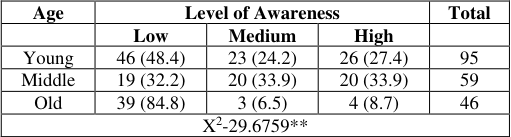 Table 2
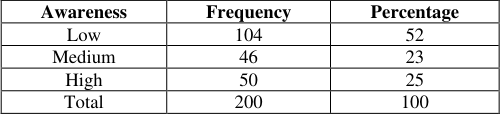 Table 1
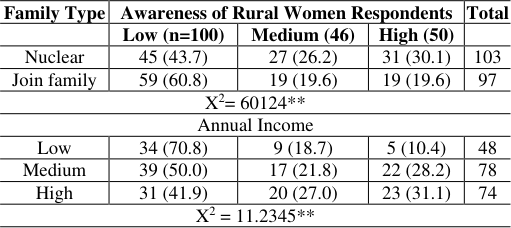 Table 3
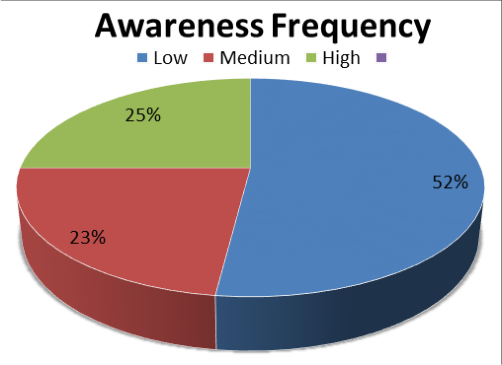 Figure 1
Introduction
In India the origin of Panchayat is nothing new in Indian politics. The word Panchayat is derived from the Sanskrit 'Panch and Ayatinam'. The persons who formed a body of five to arbitrate upon a dispute and disperse justice in each village were called 'Panches'. The village considered them the representatives of God (Dubey 1954, Desai 1973, Dhama 1973, Dhama 1980, Tamta 1994) [11,12,13,14] . For the purpose of making this agency really effective it was proposed to devolve adequate powers on these Panchayats. The Panchayats have flourished and the Panchayati Raj bodies have been working as genuine and effective democratic decentralized democracy. These institutions provide ample opportunities to the rural masses to effectively participate in the development and democratic decision making process, thereby helping to infuse in the minds of rural people a spirit of self-help, self-independence and self-reliance. It gives them an administrative experience in the art of local self government (Dubey, 1953; Malaviya, 1956; Mukherjee, 1961; Desai, 1973; Dhama, 1980) [15,16,17,12,13] . Then came the era of Rajiv Gandhi, who realised the significance of Panchayati Raj System like his grandfather Pandit Nehru, after a gap of about three decades. In December, 1992, the Constitution of India was amended (73rd Amendment as it is commonly know as), to give a constitutional status and guarantee to the democratic structure, power, functions and hopes of the local governmental system or Panchayti Raj in India. Keeping in view the present study was undertaken to ascertain the level of awareness among rural women regarding Panchayati Raj System. As Haryana State is largely agriculture based state; most of its population live in villages. The rural Haryana combined with strong patriarchal leanings make the status of women in rural Haryana precarious. Rural women in Haryana, as in other parts of India, suffer from variety of disadvantages. Foremost among them is lack of education among women. Hence we need to aware women in rural Haryana. This can be done in a variety of ways, like, through spread of education and awareness about rights, changing the patriarchal mindset/system. Concerted efforts are being made in that direction by the government and other agencies to uplift and educate the rural women. Similarly, the 73rd Constitution Amendment Act created the institutions of village panchayats and local bodies, and gave one-third reservation to women. How far the institution of panchayats in Haryana has changed their status or empowered them. Decentralization of power to the panchayats is seen as a means of empowering women and involving them in decision making process. Local governments being closer to the women can be more responsive to local needs and can make better use of resources. The democratic system in a country can be ensured only if there is mass participation in the governance. Therefore, the system of democratic decentralization popularly known as Panchayati Raj is considered as an instrument to ensure democracy and socioeconomic transformation of rural women (Kumar 2006) [4] .
Material and Method
The present study was carried out on a group of women in village Kagdana district Sirsa. The sample of 200 women was drawn randomly for the purpose of the study. The questionnaire comprised of two section. In the first sectionto study the profile of Rural Women Respondents. The www.extensionjournal.com independent Socio-economic and demographic variables while in the second section the awareness level of women in Panchayati Raj System. Awareness for the purpose of the study referred to the amount of correct information possessed by respondents regarding various aspects of Panchayati Raj System. Scoring Pattern -The respondents were asked to reply on the components comprised of several questions containing specific information about the components. The respondents were required to respond on dichotomous response category of Yes/No, correct/incorrect, True/false. One score was assigned to 'correct' reply and zero score to 'incorrect', 'no' reply of a question or part thereof. The scores obtained from the respondents were computed to find out overall awareness score of the respondents regarding the constitution of Panchayati Raj System. The awareness scores so obtained by the respondents were arranged in ascending order and then divided into low, medium and high categories by application of weighted cumulative frequency method. The data were collected on the basis of the well structured pre-tested interview schedule. The data were coded, tabulated and analyzed by suitable statistical techniques were also used to draw the meaningful inferences.
Result and Discussion
The study is done on the basis of the socio-economic demographic status and level of awareness regarding Panchayti Raj System. The respondents were classified into three categories viz. low, medium and high on the basis of awareness score obtained by using mean (x) and standard deviation formula. The data regarding overall awareness among Rural Women respondents reveals that 52% had low level of awareness whereas 25% and 23% had high and medium level of awareness. The remaining 25% of the respondents had high level of awareness regarding Panchayati Raj System. These findings indicate that half of the women still had very poor awareness regarding Panchayati Raj System. The reason behind this may be due to lack of education and various social and economic barriers prevailing in the rural society.
Therefore, this may be on account of low exposure of Panchayat institutions. Similar observations were made by Gowarlat and Kaushik (1994) [3] . The other various reasons are social and economic barriers prevailing in the rural society. The same observations were made by Bhargawa et al. (1994) [18] , Rathi (1999) [9] and Rathi et al. (2002) [10] also concluded that majority of the women respondents had low level of awareness regarding Panchayati Raj System.
Association between age and awareness
Age-wise distribution of the respondents across awareness have been presented. It is evident that sizeable percentage of the young age respondents (48.4%) had low, followed by high (27.4%) and medium (24.2%) awareness scores regarding Panchayati Raj. Among the middle age respondents 32.2 per cent had low awareness, where as equal (33.9%) had medium and high awareness about Panchayati Raj System of the old age category respondents, majority (84.8%) had low awareness followed by 8.7 per cent and 6.5 per cent respondents who had high and medium awareness scores, respectively. The results thus, indicated that majority of respondents in young and old age category projected low to medium awareness, as compared to middle age respondents. This might be due to less exposure to young and limited scope of expansion of awareness for old age respondents. Association between age and awareness of the respondents, tested through Chi-square was found to be significant (X 2 =29.6767) which implies that awareness about Panchayati Raj System was dependent upon the age of the respondents. However, a critical look at the data, revealed that respondents with nuclear family had medium (26.2%) and www.extensionjournal.com high (30.1%) awareness to the extent of 56.3 per cent as compared to 43.7 per cent low awareness. The nuclear family seems to share the information because of effective intimacy as compared to joint family system. Statistically the chi-square test showed significant association (X 2 = 6.124) between family type and awareness respondents regarding Panchayati Raj System. Thus, it may be employed that for effective dissemination of information about Panchayati Raj System and execution of awareness of rural women may fast be geared through nuclear families along with special efforts with joint families.
Association between average monthly income and awareness
The data furnished in shows that with low average monthly income majority of the respondents (70.8%) had low awareness, followed by medium (18.4%) and high (10.4%) awareness about Panchayati Raj System. The respondents who happen to fall under medium category indicator showed that a sizeable number of the respondents had low awareness (50.0%) followed by medium (21.8) and high (28.2%) awareness category. However, (31.1%) of the respondents from high income group had high level awareness followed by medium (28.2%) and low (10.4%) level of awareness about Panchayati Raj System. The chisquare value (X 2 = 11.2345) of Table-3 clearly indicates that the annual income and the level of awareness of the women respondents were found highly significant associated. It implies that average monthly income had influence on awareness level of the respondents, which might be due to the fact, pointed out by Sharma (1995) [19] that Indian politics is associated with 3M's -Money, Muscle and Men.
Conclusion
It was concluded that in concern of overall awareness it is found that (23%) of the respondents had medium level of awareness while more than fifty percentage (52%) of the respondents still had low level of awareness regarding Panchayati Raj System. Remaining (25%) of the respondents had high level of awareness regarding Panchayati Raj System. These findings indicate that half of the women still had very poor awareness regarding Panchayati Raj System. The reason behind this may be due to lack of education and various social and economic barriers prevailing in the rural society.
Figures and tables from the paper
| Age | Level of Awareness | — | — | Total |
|---|---|---|---|---|
| Low | Medium | High | ||
| Young | 46 (48.4) | 23 (24.2) | 26 (27.4) | 95 |
| Middle | 19 (32.2) | 20 (33.9) | 20 (33.9) | 59 |
| Old | 39 (84.8) | 3 (6.5) | 4 (8.7) | 46 |
| X2-29.6759** |
Table text extracted from the original PDF; superscript letters are shown inline. The original table image is below.
View original table image
| Awareness | Frequency | Percentage |
|---|---|---|
| Low | 104 | 52 |
| Medium | 46 | 23 |
| High | 50 | 25 |
| Total | 200 | 100 |
Table text extracted from the original PDF; superscript letters are shown inline. The original table image is below.
View original table image
| Family Type | Awareness of Rural Women Respondents | — | — | Total |
|---|---|---|---|---|
| Low (n=100) | Medium (46) | High (50) | ||
| Nuclear | 45 (43.7) | 27 (26.2) | 31 (30.1) | 103 |
| Join family | 59 (60.8) | 19 (19.6) | 19 (19.6) | 97 |
| X2= 60124** | ||||
| Annual Income | ||||
| Low | 34 (70.8) | 9 (18.7) | 5 (10.4) | 48 |
| Medium | 39 (50.0) | 17 (21.8) | 22 (28.2) | 78 |
| High | 31 (41.9) | 20 (27.0) | 23 (31.1) | 74 |
| X2 = 11.2345** |
Table text extracted from the original PDF; superscript letters are shown inline. The original table image is below.
View original table image
References
12 in the original paper- Jain LC. Panchayats Women will win. Kurukshetra. 1994;62(9):3510.
- Joshi U. Women's role imperative for strong PRIs. Kurukshetra. 1994;62(9):19-21.
- Kumar K. Strategies for empowerment of women in PRI's Kurukshetra. 1994;42(9):05.
- Mahipal. Empowering Women through Panchayati Raj. Kurukshetra. 1994;62(9):29-34.
- Narayanan R. Women in Panchayati Raj. The divide between intent and implementation. Kurukshetra. 1994;42(9):45.
- Rathi T, Dahiya S, Singh SP. Factors affecting awareness of rural females about Panchayati Raj Institutions. Haryana Agriculture University Research. 2002;32(1):59-62.
- Dubey VD. A study on blood pressure amongst industrial workers of Kanpur. Journal of the Indian Medical Association. 1954;23(11):495-8.
- Tamta SR. Possible mechanism for concentration of fluoride in groundwater. Bhujal News. 1994;6:11.
- Dubey VD. Streptomycin in bubonic plague. Journal of the Indian Medical Association. 1953;22(6):250-52.
- Mukherjee SK, Ganguly AK, Majumder NK. Activation cross sections with 14 MeV neutrons. Proceedings of the Physical Society (1958-1967). 1961;77(2):508.
- Bhargava RN, Gallagher D, Hong X, Nurmikko AJ. Optical properties of manganese-doped nanocrystals of ZnS. Physical Review Letters. 1994;72(3):416.
- Sharma K, Ziyadeh FN. Hyperglycemia and diabetic kidney disease: The case for transforming growth factor-β as a key mediator. Diabetes. 1995;44(10):1139-1146.
Cited by 4
From OpenAlex, OpenCitations and reference lists read by Scinovex
- Impact of national-level policy execution on the socio-economic life of tribal women: A case study of Lefunga block, Tripura ↗
Shankha Shubhra Bhadra · Asian Journal of Management and Commerce · 2025
Government of India on time-to-time basis launches various schemes, programs and policies for the welfare of the people, particularly those who are poor, marginalised and vulnerable. Whether those policies and programs reaches those people or not it also need to be ensured. In this regard the present study enquires the awareness level of the tribal women regarding central government program
- Ethnomedicinal plants used by the tribal women during childbirth, postpartum and infant healthcare in the rural areas of Karauli District, Rajasthan, India ↗
Praveen Mala Meena, Sitaram Khandelwal · International Journal of Herbal Medicine · 2025
Tribals in rural areas of Karauli district, Rajasthan (India), still rely on medicinal plants for their main source of health care. In addition, several diseases are addressed by medicinal plants, such as childbirth, postnatal care and infant’s health. The present study was conducted with the main aim of documenting the traditional knowledge of tribal and other village people of the
- Study on farmers' perception towards Pradhan Mantri Kisan Samman Nidhi Yojana in Shamli district of Western Uttar Pradesh ↗
Arun Solanki, Lalit Verma · South Asian Journal of Agricultural Sciences · 2024
The Pradhan Mantri Kisan Samman Nidhi Yojana (PM-KISAN Yojana) introduced by the Government of India in 2019 aims to provide financial assistance to small and marginal farmers through direct bank transfers. This study focuses on the Shamli district of Uttar Pradesh, analyzing farmers' perception towards PM-KISAN Yojana. Data collected from 80 beneficiaries revealed overall satisfaction with the scheme, particularly in
- Political and social empowerment of tribal woman in India: A study of Draupadi Murmu’s journey from a tribal woman to becoming the President of India ↗
Rekha Chandel · International Journal of Political Science and Governance · 2023
It has always been a serious issue to empower the tribal women of the schedule. Over the last three decades, there has been a continuous rise in awareness of the need to empower women through greater social, economic, and political fairness, broader access to basic human rights, and advancements in nutrition, basic health, and education. In the current article, an