
Research article · 2022 · Full text
International Journal of Horticulture and Food ScienceDeterminant factors affecting adoption of modern bee hive technology towards smallholder farmers: The case of Sodo Zuria Woreda, Wolaita Zone, Southern Ethiopia
Volume 4(2) · Pages 61–65 · DOI: 10.33545/26631067.2022.v4.i2a.108 ↗
Research areasInsect and Arachnid Ecology and BehaviorInsect and Pesticide Research
Abstract
Author-writtenThis study was undertaken to investigate the determinant factors affection adoption of modern box bee hive technology. The study areas were selected based on high-potential beekeeping activates. A simple random sampling method was employed to select a sample of 115 household farmers using face to face interviews, focus group discussions, key informants and field observations. The binary logistic regression model and descriptive statistics were used to analyze the data. The results showed that 48.4% were adopters and 59.4% of the sampled farmers were non adopters. The results of the study indicated that sex, education, participation in cooperative organization, utilization to credit, contact with extension agent, Farm size, training, distance to market center and relative disadvantage were found to have positive and significant influence on adoption of improved box bee hive technology. Consequently, policy makers should take into attention the determinant factors affecting adoption of modern box bee hive technology.
Summary
Source-checkedPlain-language reading of the full paper, prepared with AI and checked against the text. Each point links to the authors' own words.
Why it matters
- Ethiopia possesses significant potential for beekeeping due to its diverse vegetation and climatic resources. View evidence ↗
- Beekeeping provides important economic and ecological benefits, including employment generation and biodiversity conservation. View evidence ↗
- The beekeeping sector is hindered by issues such as a lack of skills, inappropriate technology, and limited financial capacity. View evidence ↗
The question
- The study aims to investigate the factors that hinder smallholder farmers from adopting improved box hive technology. View evidence ↗
What they did
- The researchers used simple random sampling to select 115 household farmers for data collection via interviews, focus groups, and observations. View evidence ↗
- Data analysis was performed using SPSS version 20, employing descriptive statistics and a binary logit model to analyze adoption factors. View evidence ↗
- The study was conducted in three randomly selected kebeles within the Sodo Zuria woreda: Gilo Bisare, Gulgula, and Buge wanche. View evidence ↗
What they found
- Among the sampled farmers, 48.4% were adopters of the technology, while 59.4% were non-adopters. View evidence ↗
- The primary reasons for non-adoption were the expensiveness of the technology (24.6%) and cash shortages (22.8%). View evidence ↗
What it means
- The authors recommend that the government boost farmer education through adult education and strengthen extension services at the village level to increase adoption rates. View evidence ↗
- The authors suggest strengthening existing cooperatives and encouraging the formation of savings and credit cooperatives to provide financing for apiary expansion. View evidence ↗
- The authors state that further research is needed to continue improving box hive and beekeeping technology in the study area. View evidence ↗
Visual summary
1 visualsIllustrations explain the paper; charts are replotted from the paper's own table values.
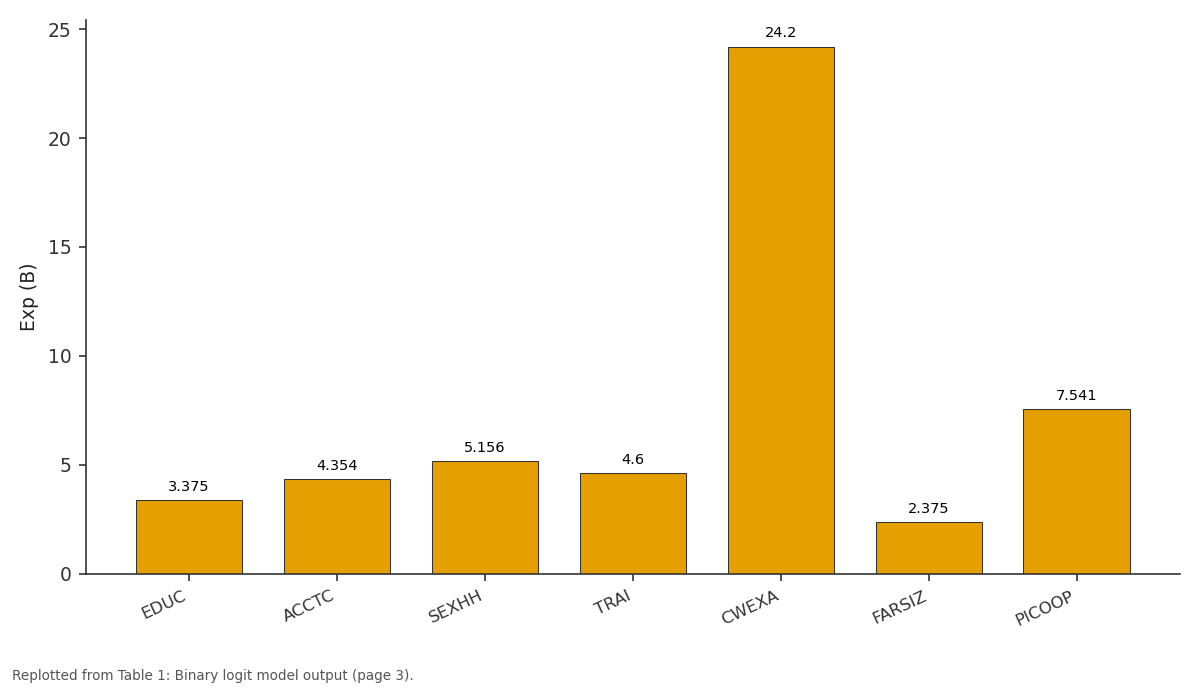
Exp (B): EDUC vs ACCTC vs SEXHH vs TRAI vs CWEXA
Replotted from Table 1 (page 3) of the original paper. Every bar is the paper's own table value.
View source evidence ↗Figures & tables
From the original paper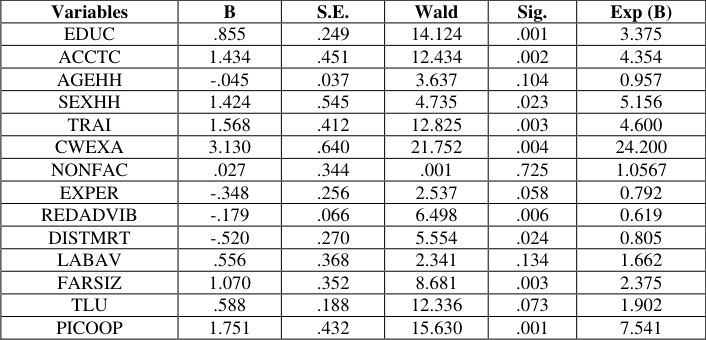 Table 1
Introduction
Ethiopia has a huge potential for beekeeping production because of its endowment with diversity in climate and vegetation resources for beekeeping (Kidane, 2014) [32] . In Ethiopia traditional, transitional and improved beehives were recognized for honey production with total of 5.15 million beehives (of 93% traditional) and the farm households keeping bees were 1.4 million. Endowing with diverse agro-climatic zones, the total honey and beeswax production estimates about 39,700 and 3,800 tons per year. Such an amount puts the country 10th in honey and 4th in beeswax production worldwide. Moreover, Ethiopia has the potential to produce up to 500, 000 tons of honey and 50, 000 tons of beeswax per year (GDS, 2009) [30] . Beekeeping, also called apiculture, is management of honey bee colonies for pollination of crops and honey and other products (Bradbear, 2009) [12] . It is an environmentally friendly and non-farm business activity undertaken by farmers and landless people. That means, it does not occupy cultivated land, requires less investment and provides quick economic benefits, besides, it being a nonpolluting intensive agricultural practice (Conrad, 2007) [18] . Honey and bees-wax are the two main products generated by the beekeeping subsector. World Trade of honey fluctuates between 997, 000 tons and 1, 000, 000 tons yearly. Totally one third amount of honey produced in the world is from the two biggest honey producer countries Russia and China. Developing countries taken as a group produce about 500,000 tons. Beekeeping offers environmentally beneficial activity that can help the developing countries in alleviation of poverty and maintaining natural biodiversity (MASHAV, 2016). Ethiopia has a huge potential for beekeeping production because of its endowment with diversity in climate and vegetation resources for beekeeping (Kidane, 2014) [33] . Beekeeping activity has important contribution economically and ecologically (Ajebush, 2018) [2] . This sub sector has remarkable potential to contribute to employment generation, local and global market, livelihood improvement, and biodiversity conservation and helps ensuring economic advantages of women, youths and Ethiopia's geographical position poor households. Development of the Beekeeping practices could significantly enhance crop production, food security, maintenance of plant diversity and ecosystem stability 9-(Apimondia International Symposium, 2018) [4] .
Moreover, the importance of beekeeping as an incomegenerating activity pivots on the fact that many people use honey as food, medicine and for sale. Beekeeping offers a great potential for development and is comparatively less demanding in terms of investment, labour and time. In addition, beekeeping is advocated to improve human welfare by alleviating poverty through increased household income: it is a source of food and nutritional security, raw materials for various industries, medicine, increased government revenue through levies and taxes, improved biodiversity conservation and enhancing environmental resilience (Kihwele et al., 1999; MNRT, 2004) [34] . Apiculture also plays a role in generating and diversifying the income of subsistence Ethiopian smallholder farmers mainly the small land holders and landless (EARO, 2000; Gezahegn, 2001) [24,6] . Offa district has potential for beekeeping activities because relatively covered with rich natural resources and thus the apiculture is immense in it. In the district, where there is a high potential of natural resources, honey production is entirely a mean of income for small scale farmers. In this area, most of the beekeepers keep bees and use the income generated from that to purchase grains, agricultural input, clothes and to pay land tax. However, despite its potential role in the development of rural economy, the beekeeping sector faces several major problems such as lack of beekeeping skills, inappropriate production technologies, weak market access, weak price incentive systems, and limited financial capacity of beekeepers (Melaku et al., 2008) [31] . To solve these challenges, national efforts has made in linking small scale farmers with agricultural marketing chains. Access to market, credit service, new technologies and risk reduction are some of the benefits for farmers from producers association. But, small-scale farmers are often reluctant to adopt new production technologies. Thus, this study is designed to investigate the information gap on factors affect smallholder farmers' adoption hinder to use improved box hive technology.
Objectives of this study
The specify objective of this study is: To discover factors affecting adoption of improved box hive technology in the study area. To ascertain the perception of smallholder farmers towards improved box hive technology.
Research Methodology Description of study area
The study was accompanied in Sodo zuria district, found in southern Ethiopia. Livelihood of Most of people is Agriculture and the agricultural activities of rural poors is depends on rain fall. This exposes them to lead their life continuously in severe circumstance.
Study design
This study was engaged both quantitative and qualitative design for descriptive research. The method of research which concerns itself with the present phenomena in terms of conditions, practices beliefs, processes, relationships or trends invariably is termed as descriptive survey study. According to Aggarwal (1998) [35] , descriptive research is devoted to the gathering of information about prevailing conditions or situations for the purpose of description and interpretation. Similarly, this study were intended to gather relevant information, which utilizes a semi-structured questionnaire on perception of smallholder farmers towards modern box hive technology and its contribution in household food security and current status of honey production potentials in the study area. Questionnaires of quantitative data were analyzed through descriptive statistics using SPSS version 20 software whereas Factors affect Adoptors and non-adopters of the hive was analyzed through descriptive statistics and binary logit model was used.
Sample size and Sampling techniques
Multisrage-stage sampling procedure was used to select sample respondents. First, three kebele in Sodo Zuria woreda were designated by simple randomly Gilo Bisare, Gulgula and Buge wanche. Second, beekeepers were stratified into sub-groups based on agro-ecology zones, and users and non-users of box hive technology. Third, purposive sampling was used to select household for survey.
The sampling frame of the study was the total households of selected kebeles. The sample size was determined by using simplified formula of Yamane n= N/1+N (e) 2
Type and Source of Data
Both quantitative and qualitative data obtained from primary and secondary sources. Household data collection methods such as survey questionnaire, FGDs and key informant interviews were used to obtain primary data. The primary data that were collected for quantitative research regarding to explanatory variables. Secondary data such as description about the study area location, topography, climate, population, agricultural production was collected from relevant sources like books, internet, related journals and annual report of zone and woreda agricultural office.
Methods of Data Collection
The central data gathering tool for this study was semistructured interview. In addition to that, for qualitative study, Key informant Interview and group discussion were used.
The quantitative primary data required for the study was collected from sampled households by conducting formal survey using Semi-structured interview.
Data Analysis
The (Xi, X2, X3, Xk) is given by:
Results and discussions Results of Descriptive statistics of variables
Regarding its relationship with adoption of improved box bee hive, therefore the Pearson chi-square test indicated that sex of the household head had significant relationship (χ 2 = 6.553, p=0.028). Results of Pearson chi-square test indicated that education level of the household head had significant relationship (χ 2 = 29.8, 0.000) with adoption of improved box bee hive at 1% significance level. The mean age of non-adopters and adopters were found to be 45.74 And 43.54 years respectively. Result of mean test using oneway ANOVA indicated that there was no significant mean difference (F=0.772, P=0.7690) among adoption categories, implying the absence of significant relationship of age with adoption of improved box bee hive technology. The result of participates in cooperatives while (44.5%) did not participate in cooperative association (X2 = 18.274, P = 0.000). The result revealed that there is significant relationship between membership and the adoption of improved box bee hive at 1% level. During the study it was found that 60.9% (26.4% adopters and 34.5% non-adopters) and Chi-square analysis revealed between non-farm employment and adoption of modern box hives insignificant. The results of one way ANOVA with value of F= 2.602 and P= 0.014 indicates that there was statistically significant mean difference among adoption categories of farm size. The one way ANOVA (F=.644, P=.816) suggests that there is no statistically significant difference between the holding of household livestock and the adoption of modern box hive technology. The one way ANOVA result shows the significant mean difference (F=.013, P=0.000) between adoption categories in relation to perceived comparative disadvantages of the technology characteristics and existence of significant mean difference between adoption categories at 1 percent probability level. The reason replied by most of respondent on why they are not adopting modern beehive was cash shortage and expensiveness of the technology were 22.8% and 24.6% respectively.
Econometric analysis
Econometric analysis
Recommendations
The study revealed that education status of household head positively and significantly affects farmers' decision to adopt modern box hive technology. More educated household heads are in the better position to adopt the new technology. Therefore, the regional and zonal Government sector involved in education should boost the educational status of the farmers through adult education. Extension services was found to be significantly influencing adoption MBH hive, it should be strengthened down to the village level to inform farmers in order to increase the rate of adoption. Zone and woreda cooperative office should strengthen the existing cooperative beekeepers and Encarouge those to form as savings and credit cooperatives as finance to increase their apiary size. The respondents were found to face marketing limitations which significantly bound their benefit from improved box bee hive adoption. Hence, greatly emphasis of zonal and woreda government has to be given to the improvement of market and marketing system particularly through cooperative unions. Farmers were found to face marketing constraints which significantly limit their benefit from beekeeping. Thus, considerably emphasis of zonal and woreda government has to be given to the improvement of market and marketing system particularly through cooperative unions. Participation in training was among the important variable that positively influenced the adoption of improved box bee hive. This indicates that extension service should be extended by establishing additional development centers and empowering them. Therefore, to sustain the positive contribution of the extension service to the adoption of improved box bee hive, strengthening extension services is necessary. Therefore, attention should be given to the research and extension linkages, and frequent training must be organized for beekeepers to adopt improved technologies. Female-headed households are less adopter of improved box hive than male headed households. This might be due to lack of access to information sources. Hereafter, increase the participation of women and awareness creation should be done both by governmental and nongovernmental organizations about the versatile of improved box bee hive technology more effectively. According on the discovery of this study further researches can be executed in the forthcoming in order to improve box hive and beekeeping technology in the study area
Figures and tables from the paper
| Variables | B | S.E. | Wald | Sig. | Exp (B) |
|---|---|---|---|---|---|
| EDUC | .855 | .249 | 14.124 | .001 | 3.375 |
| ACCTC | 1.434 | .451 | 12.434 | .002 | 4.354 |
| AGEHH | -.045 | .037 | 3.637 | .104 | 0.957 |
| SEXHH | 1.424 | .545 | 4.735 | .023 | 5.156 |
| TRAI | 1.568 | .412 | 12.825 | .003 | 4.600 |
| CWEXA | 3.130 | .640 | 21.752 | .004 | 24.200 |
| NONFAC | .027 | .344 | .001 | .725 | 1.0567 |
| EXPER | -.348 | .256 | 2.537 | .058 | 0.792 |
| REDADVIB | -.179 | .066 | 6.498 | .006 | 0.619 |
| DISTMRT | -.520 | .270 | 5.554 | .024 | 0.805 |
| LABAV | .556 | .368 | 2.341 | .134 | 1.662 |
| FARSIZ | 1.070 | .352 | 8.681 | .003 | 2.375 |
| TLU | .588 | .188 | 12.336 | .073 | 1.902 |
| PICOOP | 1.751 | .432 | 15.630 | .001 | 7.541 |
Table text extracted from the original PDF; superscript letters are shown inline. The original table image is below.
View original table image
References
17 in the original paper- Ajabush D. Review of Economic and Ecological Importance of Bee and Bee Products in Ethiopia. Journal of Animal Husbandry and Dairy Science. 2018;2(2):18-26.
- Assefa Admassie, Gezahegn Ayele. Adoption of improved technology in Ethiopia. Journal of Economics. 2010;1(5):155-178.
- Beyene T, David Ph. Ensuring Small Scale Producers in Ethiopia to Achieve Sustainable and Fair Access to Honey Markets; c2007. Availableat:<http://www.mu.edu.etmejs/pdfs/v2n1/496 54-67504-1-PB.pdf> [accessed on 01/07/2014].
- Birhanu Gebremedhin, Belets Gebremicael. Adoption of improved box hive technology: Analysis of smallholder farmers in northern Ethiopia. International Journal of Agricultural Economics and Extension. 2014;2(2):77-82. ISSN 2329-9797.
- Bowley AL. Measurement of the precision attained in sampling. Bulletin of the International Statistical Institute, 22, Supplement to Liv. 1926;1:6-62.
- CAP (Coordinated Agriculture Program) Small-scale Review of Honey: Short analysis of demand and supply in the honey sector. Center for Agricultural Policy Prosperity Initiative. Ministry of Agriculture and Rural Development (MAoRD) of the Government of Viet Nam; c2008. Retrieved August 30, 2011 from
- CBI (Centre for the promotion of imports from developing countries. Honey and sugars: a compact survey of The Honey and Sugars Market in the European Union. Compiled for the CBI by Profound. Centre for the Promotion of Imports from developing countries (CBI), Rotterdam and the Netherlands; c2008. Retrieved August 30, 2011 from http://www.fepat.org.ar/files/evento s/759630.pdf
- Central Statistical Agency of Ethiopia; c2012a. Agricultural Sample Survey. Available at: <http://www.csa.gov.et/newcsaweb/images/general/ne ws/livestock%20report%202005%20ec_2012_13.pdf> [accessed on 26/06/2014].
- CSA (Central Statistical Authority). Agricultural Sample Survey: Report on Livestock, Poultry and Beehives Population, CSA, Addis Ababa, Ethiopia. 1995;2(132):28.
- CSA (Central Statistics Authority). Survey on Livestock; c2010-11, 2(468). CSA, Addis Ababa Ethiopia. Available at: <http://www.ncbi.nlm.nih.gov/pmc/articles/PMC40780 45/ > [accessed at 23/07/2014].
- Desalgne P. Ethiopian Honey: Accessing International Markets with Inclusive Business and Sector Development, SNV Ethiopia; c2011. Available at: <file:///C:/Users/gebruiker/Downloads/7._soc_ethiopia _honey %20(23). pdf> [accessed on 12/07/2014].
- Emana B. Market Assessment and Value Chain Analysis in Benishangul Gumuz Regional State, Ethiopia; c2010. Available at: <http://www.scribd.com/doc/76409350/BG-MarketAssessment-FinalReport-300510> [accessed on 15/07/2014].
- Feder L, Just RE, Zilberman O. Adoption of Agricultural Innovation in Developing Countries: A Survey Economic Development and Cultural Change. 1985;32(2):255-297.
- Melaku S, Morris V, Raghavan D, Hosten C. Seasonal variation of heavy metals in ambient air and precipitation at a single site in Washington, DC. Environmental Pollution. 2008 Sep 1;155(1):88-98.
- Kidane D, Chae WJ, Czochor J, Eckert KA, Glazer PM, Bothwell AL, et al. Interplay between DNA repair and inflammation, and the link to cancer. Critical reviews in biochemistry and molecular biology. 2014 Mar 1;49(2):116-39.
- Kidane D, Chae WJ, Czochor J, Eckert KA, Glazer PM, Bothwell AL, et al. Interplay between DNA repair and inflammation, and the link to cancer. Critical reviews in biochemistry and molecular biology. 2014 Mar 1;49(2):116-139.
- Mangano CM, Diamondstone LS, Ramsay JG, Aggarwal A, Herskowitz A, et al. Renal dysfunction after myocardial revascularization: risk factors, adverse outcomes, and hospital resource utilization. Annals of internal medicine. 1998 Feb 1;128(3):194-203.