
Research article · 2023 · Full text
International Journal of Agriculture Extension and Social DevelopmentFarmers’ knowledge, perceptions, and management of major diseases of potato at Kavrepalanchok, Nepal
Volume 6(1) · Pages 23–27 · DOI: 10.33545/26180723.2023.v6.i1a.165 ↗
Research areasPlant Pathogens and ResistanceBanana Cultivation and Research
Abstract
Author-writtenMandandeupur, Panchkhal, Banepa and Panauti municipalities were chosen from Kavrepalanchok district based on higher yield potential, and 25 households were chosen at random from each municipality, yielding a sample size of 100. The primary and secondary data collection methods were used. The results revealed that, of the five major problems of farmers in the study area, disease is the most serious, with an index value of 0.818. Knowledge level was classified as 0, 1, 2, 3, and 4 representing no knowledge, knowledge about one disease, knowledge about two diseases, knowledge about three diseases, and knowledge about four or more diseases. The majority of farmers (42%) in the study area were found to be familiar with three diseases. The majority of farmers (85%) considered Late blight to be the most serious disease. The majority of farmers (42%) believe the severity of diseases is minor (< 40% of plant population affected). The majority of farmers (46%) believed disease had affected a moderate area of their field (40-60% of the area). The majority of farmers (99%) thought that chemical methods were the best for disease management and control. The majority of farmers (55%) were found to be using more than the recommended dose of chemical pesticide for disease management. The majority of farmers (48%) believe the extent of disease spread is decreasing.
Summary
Source-checkedPlain-language reading of the full paper, prepared with AI and checked against the text. Each point links to the authors' own words.
Why it matters
- Agriculture is a cornerstone of Nepal's economy, with potatoes specifically contributing 6.57% of the agricultural GDP and 2.17% of the total GDP. View evidence ↗
- Late blight is recognized as the most serious disease affecting potato production globally. View evidence ↗
- Farmers in Nepal often rely on inexpensive but potentially harmful agrochemicals for disease management. View evidence ↗
The question
- The study aimed to evaluate the knowledge and perceptions of farmers regarding potato diseases and the management methods they use to address them. View evidence ↗
What they did
- The research sampled 100 households (25 from each of four municipalities: Mandandeupur, Panchkhal, Banepa, and Panauti) in the Kavrepalanchok district. View evidence ↗
- Data were analyzed using MS Excel and SPSS, employing descriptive statistics, Chi-square tests, and one-way ANOVA. View evidence ↗
- A five-point scaling technique (ranging from 0.2 to 1) was used to quantify farmers' perceptions of problem severity. View evidence ↗
What they found
- Among five major farming problems, disease was ranked as the most serious with an index value of 0.818. View evidence ↗
- The most common knowledge level among farmers was familiarity with three different diseases (42%). View evidence ↗
- A large majority of farmers (85%) identified Late blight as the most severe potato disease. View evidence ↗
- The most frequent perception of disease severity was 'minor', meaning less than 40% of the plant population was affected (42% of farmers). View evidence ↗
- Nearly all farmers (99%) perceived chemical methods as the most effective way to manage and control diseases. View evidence ↗
- Over half of the farmers (55%) used chemical pesticides in doses exceeding the recommended amounts. View evidence ↗
- The largest group of farmers (48%) believed that the spread of diseases is currently decreasing. View evidence ↗
Visual summary
2 visualsIllustrations explain the paper; charts are replotted from the paper's own table values.
Ranking of Potato Farming Problems
AI-generated conceptual illustration (potato plants in a field). It explains the idea and does not show study data.
View source evidence ↗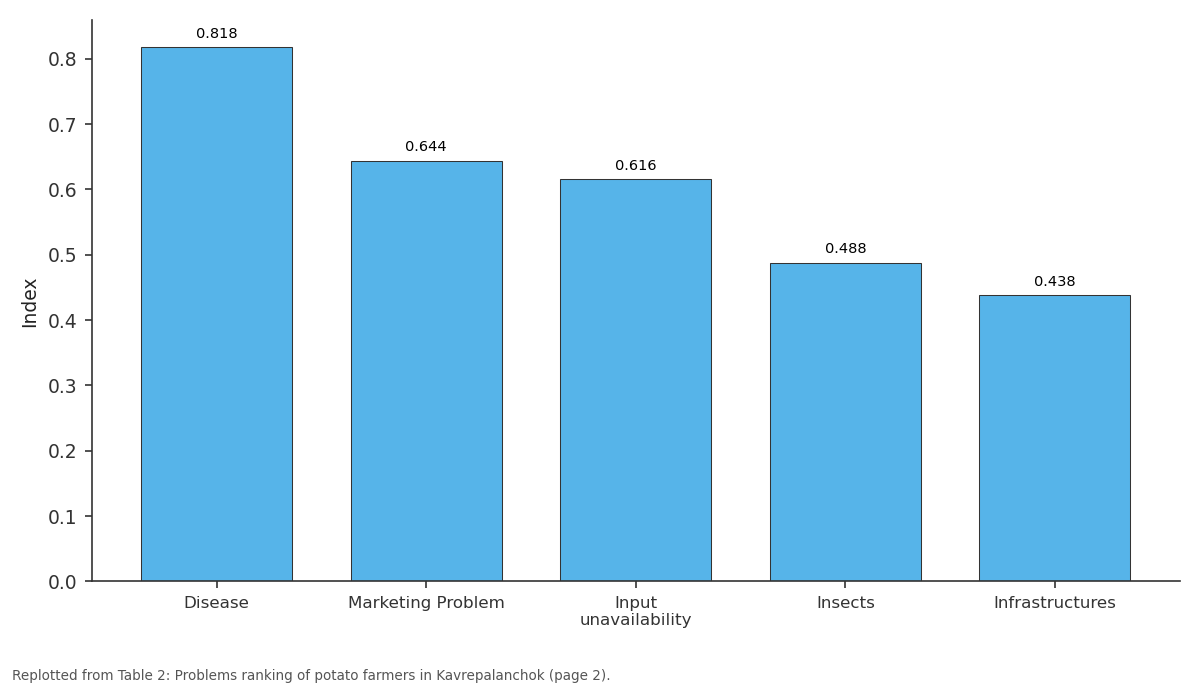
Index: Disease vs Marketing Problem vs Input unavailability vs Insects vs Infrastructures
Replotted from Table 2 (page 2) of the original paper. Every bar is the paper's own table value.
View source evidence ↗Figures & tables
From the original paper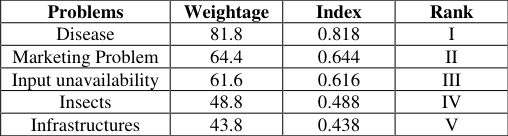 Table 2
 Table 1
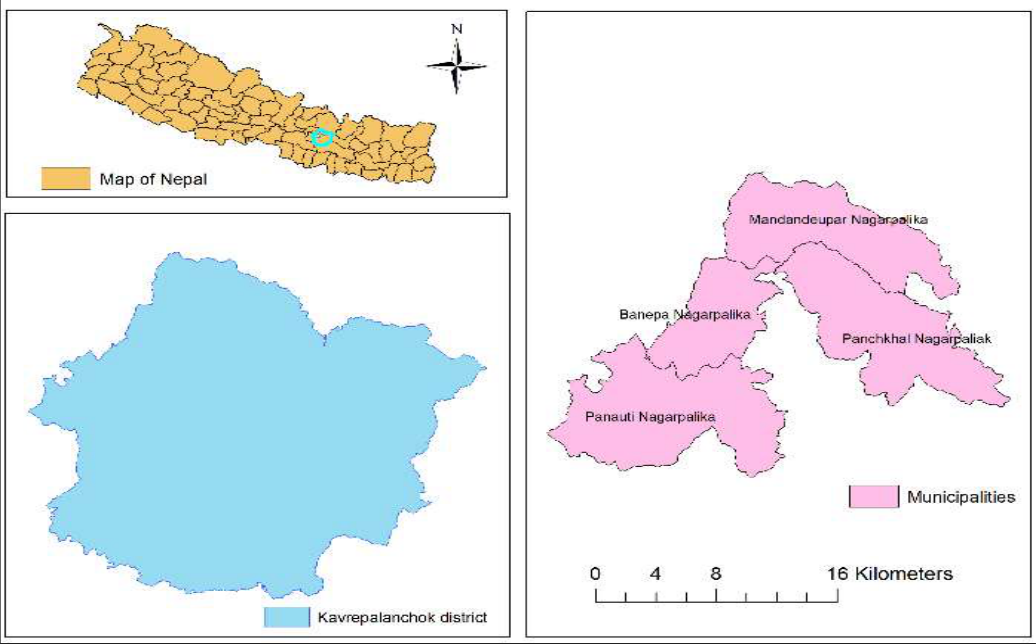 Figure 1
 Figure 1
 Table 3
 Table 4
 Table 5
 Table 6
 Table 7
 Table 8
 Table 9
Introduction
A solanaceous crop that yields tubers is the potato (Solanum tuberosum). After rice, wheat, and maize, it is the fourthmost significant food crop. Nepal is the world's twentyfourth-largest producer of potatoes. Agriculture has traditionally supported Nepal's economy. Agriculture employs nearly 54% of the population and accounts for 24.26% of the country's GDP and potato contributes 6.57% of AGDP and 2.17% of total GDP Potato is a staple food crop in Nepal's mid-and high-hills, with an annual per capita consumption of 30 kg. So, from an economic and consumption standpoint, potato is a major crop in Nepal. Despite being an important crop, Potato production and storage have suffered from various diseases all over the world. The most serious potato disease in the world is late blight. In India, it is the most problematic disease of potatoes. In mid and high-hilly areas of Nepal, late blight is a common disease and in the Terai region, it occurs in each third year when weather conditions are favorable. The pathogen Phytophthora infestans, a fungus from the family Peronosporaceae and order Peronosporales, is responsible for late blight. Brownish lesions on the surface of the leaves and whitish development on the underside of necrotic lesions are two of the main signs of late blight. If late blight is exposed to favourable environmental conditions, such as a wet, chilly climate between 12 and 18 degrees Celsius in water-saturated or nearly saturated conditions, it can spread more readily. Except for late blight Early blight is caused by Alternaria solani, Bacterial wilt/ Brown rot is caused by Ralstonia solanacearum, Common scab is caused by Streptomyces scabies, Black scurf caused by Rhizoctonia solani, Wart is caused by Synchytrium endobioticum and Viral diseases are other common diseases of potato in Nepal. It is obvious that so many farmers rely on agrochemicals for problems management, and this is most prevalent in developing and underdeveloped countries and in Nepal, where older, quasi, more harmful, durable in the surroundings, and less expensive chemicals are widely employed, the problems related with such chemicals are evident even more.
Materials and Methods
The study was conducted in the Kavrepalanchok district which lies in the hilly region of the country. Out of its 13 municipalities 4 municipalities namely, Panchkhal, Banepa, Mandandeupur and Panauti municipalities were selected on the basis of their higher production potential of potatoes in the district. www.extensionjournal.com 25 households were selected from each of the 4 municipalities making a total of 100 sample size. Stratified simple random sampling was followed to the population list obtained from the preliminary survey. Data analysis was done by using software like MS. Excel and statistical packages for social science (SPSS). Descriptive statistics like frequency count and percentage were estimated. Chi-square tests and one-way ANOVA tests were also carried out. Data analysis was done to find out the association of variables across 4 selected municipalities using the Chisquare test for categorical variables across 4 municipalities. For continuous variables, one-way ANOVA tests were carried out to compare the mean difference of variables across selected municipalities. Farmers' perception towards problems was presented in the five-point scaling technique comprising most severe, severe, moderate, mild and most-mild. The scale values of 1, 0.8, 0.6, 0.4 and 0.2 were used for most severe, severe, moderate, mild and most-mild problems, respectively.
Results and Discussion
Results and Discussion
Problem ranking by farmers for potato cultivation
Farmers were asked to rank the five main issues in order of severity, starting with the most serious issue and working down to the least, after five were identified from key informant interviews. Farmers ranked diseases as the most severe problem, marketing issues (market unavailability, low price, etc.) as highly severe, input issues (lack of seeds, fertilizer, labor, machinery, etc.) as moderately severe, insect pest issues as less severe, and a lack of adequate infrastructure (roads, canals, etc.) as the least severe issue, in that order.
Knowledge level of farmers for diseases
The majority of farmers were familiar with 3 diseases with their damage symptoms (41%). The majority of farmers familiar with 1 disease (12%) and 2 diseases (44%) with their damage symptoms were found higher at www.extensionjournal.com
Mandandeupur. Farmers familiar with 3 diseases with their damage symptoms were found higher at Panauti (68%) and farmers familiar with 4 or more diseases with their damage symptoms were found higher at Panchkhal (24%). The result was found statistically significant at a 5% level of significance.
Farmers' perception of most severe disease
The majority of farmers perceive Late blight disease to be the most severe (86%). Farmers who perceive Late blight to be the most severe were found higher (100%) at Panchkhal and Mandandeupur. Farmers who perceive Bacterial wilt to be the most severe were found higher (52%) at Banepa. The result was found statistically significant at 1% level of significance.
Perception on severity of diseases
Majority of farmers perceived severity of diseases to be minor (41%). Farmers who perceived disease severity to be major were found higher at Panchkhal (40%), those who perceived disease severity to be moderate were found higher at Mandandeupur (52%) and those perceived diseases severity to be minor were found higher at Banepa (76%). The result was found statistically significant at 1% level of significance.
Perception of farmers on the effectiveness of disease management
Majority of farmers (66%) perceived their management practice to be effective. Farmers who perceive their management practice to be effective were found higher at Banepa (80%), those who perceive their management practice to be fair were found higher at Panchkhal (60%) and those who perceive their management practice to be not effective were found higher at Panchkhal (4%). The result was found statistically significant at 5% level of significance.
Perception on best disease management practice
Majority of farmers (99%) perceived the Chemical method to be best management practice for diseases and only 1% perceived the Physical/Cultural method to be the best. The result was found statistically non-significant across 4 municipalities. www.extensionjournal.com
Dose of chemical Pesticide used by farmers for disease control
Majority of farmers (55%) used more than recommended dose of pesticide for disease management followed by those who use recommended dose (38%) and those who use less than recommended dose (7%) of pesticide. Farmers who use less than recommended dose of pesticide (12%) and those who use recommended dose (60%) were found higher at Mandandeupur. Farmers who use more than recommended dose of pesticide for disease management were found higher at Banepa (80%). The result was found statistically significant at 1% level of significance.
Perception of farmers on extent of disease spread
Farmers who perceive extent of spread of diseases is in decreasing trend were found higher (48%). Farmers who perceive extent of spread of disease to be in increasing trend is found higher at Panchkhal (32%), those who perceive extent of spread to be in decreasing trend were found higher (76%) at Mandandeupur and those who perceive it to be same were found higher at Banepa (44%). The result was found statistically significant at 1% level of significance.
Conclusion
The study was carried out to find out farmers' knowledge, perception towards potato diseases and management methods being applied by them to tackle these problems.
The study was carried out in the Kavrepalanchok district. Four municipalities of Kavrepalanchok district were selected based on production potential and 25 respondents each from 4 municipalities were selected at random for data collection. Descriptive analysis and various statistical tests like the Chi-square test, and one-way ANOVA test were used to draw the results using MS Excel and SPSS software. From five major identified problems of farmers regarding potato farming, farmers ranked diseases as most severe problem, marketing problems (market unavailability, low price etc.) as highly severe, input unavailability (Seeds, Fertilizer, Labor, Machineries etc. unavailability) as moderately severe, insect pests' problems as less severe and no proper Infrastructures (Road, canals etc.) as least severe problem in rank I, II, III, IV and V respectively. For knowledge level of farmers regarding identification of diseases, farmers were asked to name the diseases with their damage symptoms. Majority of farmers were found to be familiar with 3 diseases (42%) in the study area. Among various major diseases, Late blight disease of potato was found to be the most severe disease for the majority of farmers (85%) in the study area.
For perception on severity of diseases, majority of farmers (42% each) perceive severity of diseases was minor (<40% plant population affected).
For different management method available, majority of farmers (99%) perceive chemical method to be best for disease management and control. They stated that chemical method of management is easier to apply, less time consuming and have higher efficiency of disease and pest control. However, they were seeming to be well aware regarding harmful impacts of chemical method of management on human health and environment. Chemical pesticides being used by farmers were studied for the dose of pesticide being used by them. For disease management, majority of farmers (55%) were found to be using more than the recommended dose of chemical pesticide. Farmers were also asked for their perception regarding extent of spread of diseases and insect pests in comparison with recent past years. The majority of farmers (48%) perceive the extent of spread of disease is in decreasing trend. They perceived this has happened because of late blight (a very significant disease) tolerant variety like Janakdev and farmers getting trainings and extension www.extensionjournal.com services regarding diseases management which has led to better application of management practices helping to reduce the extent of spread of diseases.
Figures and tables from the paper
| Problems | Weightage | Index | Rank |
|---|---|---|---|
| Disease | 81.8 | 0.818 | I |
| Marketing Problem | 64.4 | 0.644 | II |
| Input unavailability | 61.6 | 0.616 | III |
| Insects | 48.8 | 0.488 | IV |
| Infrastructures | 43.8 | 0.438 | V |
Table text extracted from the original PDF; superscript letters are shown inline. The original table image is below.
View original table image
References
9 in the original paper- Chaurasia PC. Economic management of late blight (Phytophthora infestans L.) of potato in Eastern Tarai of Nepal. Nepal Agriculture Research Journal. 2005;6:57-61.
- Hardy B, Trognitz B, Forbes G. Late blight breeding at CIP. Circular (Lima-Peru). 1995;21:2-5.
- Haverkort AJ, Struik PC, Visser GF, Jacobson EJ. Applied biotechnology to combat late blight in potato caused by Phytophthora infestans. Potato Research. 2009;52:249-264.
- Ojha DN, Hidalgo OA, Lama TL. A Report on Informal High Quality Seed-Potato Production and Marketing in Nepal. Scientist and farmer: partners in research for the 21 st Century. Program Report 1999-2000. 2001:245250.
- Secor GA, Rivera-Varas VV. Emerging diseases of cultivated potato and their impact on Latin America. Revista Latinoamericana de la Papa. 2004;1:1-8.
- Singh D. Fungicidal spray schedule for economic management of potato late blight in North-western hills of India. Indian Journal of Mycology and Plant Pathology. 1996;26(3):252-255.
- STATISTA. Nepal: Distribution of gross domestic product (GDP) across economic sectors from 2009 to 2019. H. Plecher; c2019.
- Thapa SP. Study on farmers' Pest management strategy, knowledge on pesticide safety and practice of pesticide use at Bhaktapur district, Nepal. Cogent Food & Agriculture. 2021;7(1):1916168.
- Tripathi S, Shah KK, Tiwari I, Shrestha J. Farmers' perception about major insect pests of cucurbits and their management. Indonesian Journal of Agricultural Research. 2020 Nov 17;3(3):153-170.