
Research article · 2023 · Full text
International Journal of Advanced Biochemistry ResearchLinseed (Linnum usitatissimum L.): An oilseed crop with used in different ways
Volume 7(1S) · Pages 25–27 · DOI: 10.33545/26174693.2023.v7.i1sa.174 ↗
Research areasPhytoestrogen effects and researchAgricultural Science and FertilizationSoybean genetics and cultivation
Abstract
Author-writtenA field investigation was conducted at Agronomy research farm A. S. (P.G) College, Lakhaoti, Bulandshahr during rabi seasons of 2006 and 2007. The treatments consisted of combination of four cropping systems viz. chickpea sole (M1), linseed sole (M2), chickpea+ linseed 2:1 ratio (M3) and pigeonpea + linseed 4:2 ratio (M4) in main plots; two irrigations viz. two irrigations at vegetative stages (30-40 days) and flowering stage (70-75 days) (S1) and one irrigation at flowering stage (70-75 days) (S2) in sub plots and three levels of phosphorous viz. control (L1), 30 kg P2O5/ha (L2) and 60 kg P2O5/ha (L3) in sub-sub plots in split plots design replicated thrice during the rabi season. The linseed variety neelam were used in the cropping systems during rabi season. The soil of the experimental site was low in organic carbon (0.47 and 0.48 kg/ha) and total nitrogen (154.0 and 155.1 kg/ha). It was low in available phosphorus (9.2 and 9.24 kg/ha) and medium in available potassium (203.0 and 203.6 kg/ha) and sandy loam in texture having alkaline reaction (pH 7.5). The weather during the both years of the experiment was by and large normal and devoid of any extreme conditions. The net return was found to be maximum under chickpea: linseed in 4:2 row ratio with two irrigations and 60 kg P2O5/ha. (Rs. 21,632 and Rs. 22,128) followed by sole chickpea with two irrigation and 60 kg P2O5/ha. Due to relatively higher gross return. The maximum B:C ratio of 1.87 and 1.91 was obtained from chickpea: linseed in 4:2 with one irrigation at flowering and 60 kg P2O5/ha, because of reduced cost of on irrigation and higher gross return of the system.
Summary
Source-checkedPlain-language reading of the full paper, prepared with AI and checked against the text. Each point links to the authors' own words.
Why it matters
- Linseed (Linum usitatissimum) is a plant used globally in temperate climates for both food and fiber production. View evidence ↗
- Intercropping oilseed crops with legumes, cereals, or fibers is considered an effective method for increasing overall production. View evidence ↗
- Phosphorus is a critical nutrient that directly influences the quality and yield of crops like chickpea by supporting essential physiological processes. View evidence ↗
The question
- The study aimed to investigate the effects of different cropping systems, irrigation schedules, and phosphorus levels on linseed during the rabi seasons of 2006 and 2007. View evidence ↗
What they did
- The researchers tested four cropping systems: sole chickpea, sole linseed, and chickpea-linseed intercropping in 2:1 and 4:2 ratios. View evidence ↗
- Two irrigation regimes were compared: one providing water at both vegetative (30-40 days) and flowering (70-75 days) stages, and another providing water only at the flowering stage. View evidence ↗
- Phosphorus application was tested at three levels: a control group, 30 kg P2O5/ha, and 60 kg P2O5/ha, using a thrice-replicated split-plot design. View evidence ↗
- The experimental soil was sandy loam with an alkaline pH of 7.5, characterized by low organic carbon, nitrogen, and phosphorus, and medium potassium levels. View evidence ↗
What they found
- The highest net returns (Rs. 21,632 and Rs. 22,128) were achieved using a 4:2 chickpea-linseed ratio with two irrigations and 60 kg P2O5/ha. View evidence ↗
- The best benefit-cost (B:C) ratio (1.87 and 1.91) occurred in the 4:2 chickpea-linseed system with one irrigation at flowering and 60 kg P2O5/ha. View evidence ↗
- Sole linseed cropping produced the highest oil yield (452.32 and 464.84 kg/ha) compared to the intercropped 2:1 and 4:2 ratios. View evidence ↗
- Increasing phosphorus levels up to 60 kg P2O5/ha led to an increase in oil yield, rising from 260.20-265.15 kg/ha (control) to 308.29-316.47 kg/ha. View evidence ↗
- While higher phosphorus levels (60 kg P2O5/ha) increased overall seed yield, they were associated with a decrease in the oil content of the seeds. View evidence ↗
- Applying irrigation at both vegetative and flowering stages resulted in taller plants and greater dry matter accumulation than irrigation at only one stage. View evidence ↗
What it means
- The authors conclude that specific combinations of one irrigation and certain phosphorus levels can result in maximum oil content. View evidence ↗
Visual summary
3 visualsIllustrations explain the paper; charts are replotted from the paper's own table values.
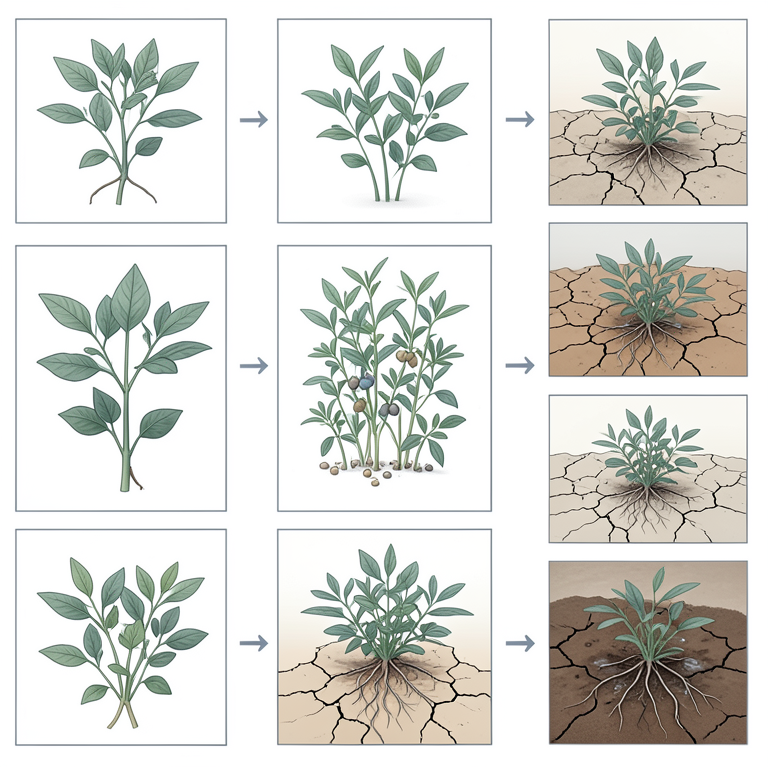
Experimental Treatment Matrix
AI-generated conceptual illustration (linseed and chickpea plants). It explains the idea and does not show study data.
View source evidence ↗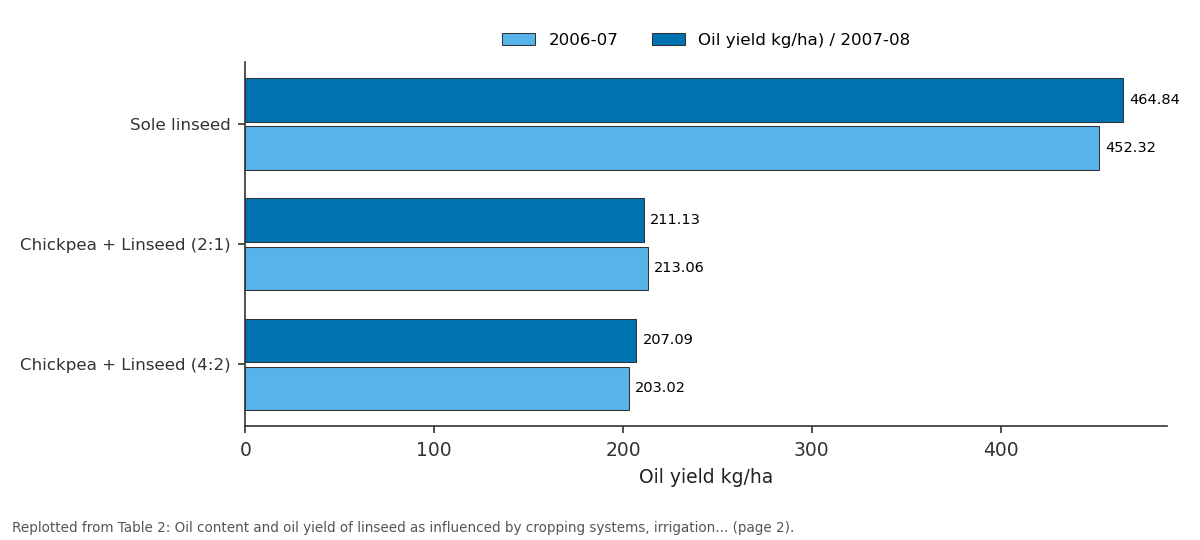
2006-07 and Oil yield kg/ha) / 2007-08: Sole linseed vs Chickpea + Linseed (2:1) vs Chickpea + Linseed (4:2)
Replotted from Table 2 (page 2) of the original paper. Every bar is the paper's own table value.
View source evidence ↗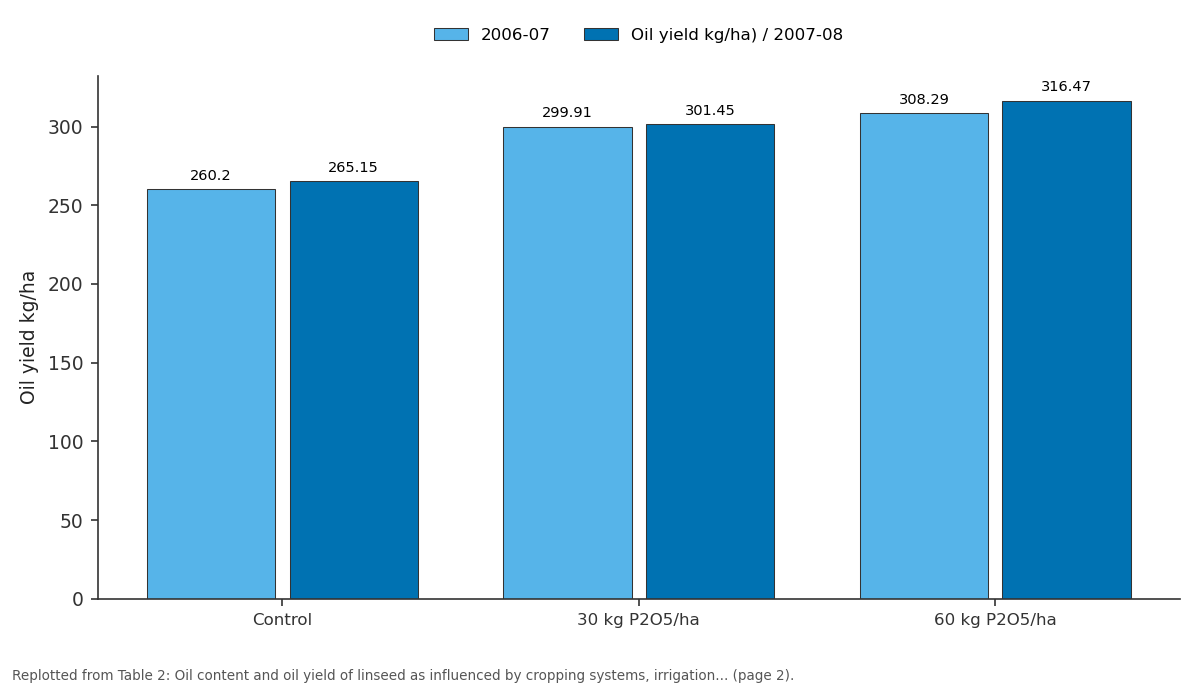
2006-07 and Oil yield kg/ha) / 2007-08: Control vs 30 kg P2O5/ha vs 60 kg P2O5/ha
Replotted from Table 2 (page 2) of the original paper. Every bar is the paper's own table value.
View source evidence ↗Figures & tables
From the original paper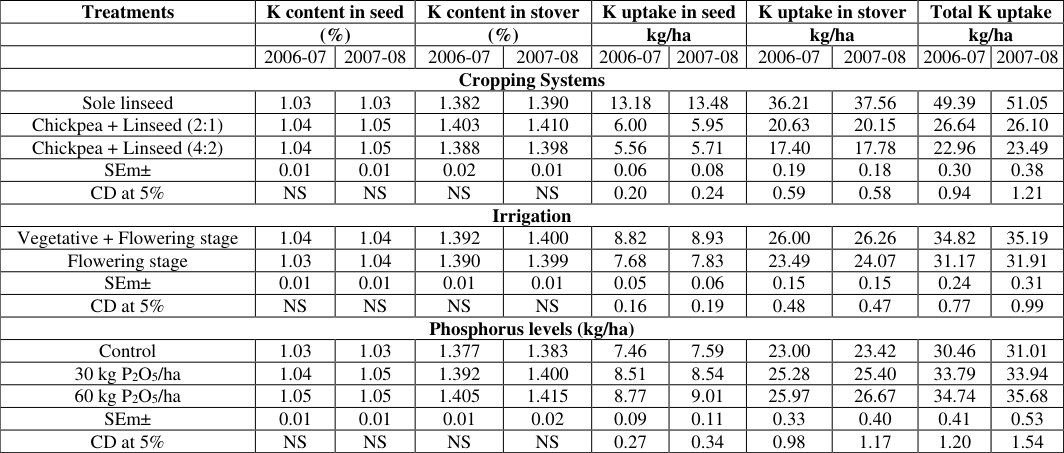 Table 1
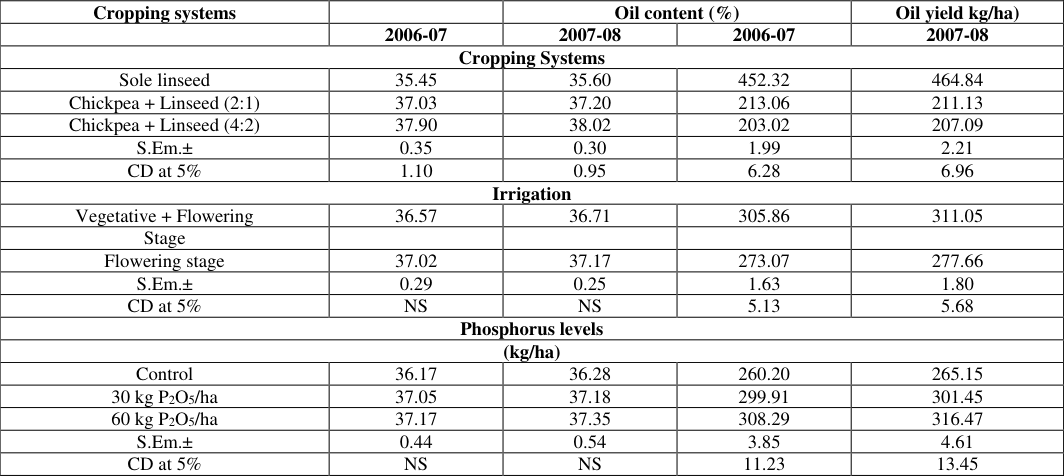 Table 2
Introduction
Flax, also known as common flax or linseed, is a flowering plant, Linum usitatissimum, in the family Linaceae. It is cultivated as a food and fiber crop in regions of the world with temperate climates. Textiles made from flax are known in English as linen and are traditionally used for bed sheets, underclothes, and table linen. Its oil is known as linseed oil. In addition to referring to the plant, the word "flax" may refer to the unspun fibers of the flax plant. The plant species is known only as a cultivated plant [2] and appears to have been domesticated just once from the wild species Linum bienne, called pale flax [3] . The plants called "flax" in New Zealand are, by contrast, members of the genus Phormium. lntercropping is an agronomic refinement of the old practice of crop mixture, where in the crop components, usually two are sown in separate rows, their population ratios are know and they can be harvested singly and produce recorded separately. The crop components often have. Different growth period and growth habits, statistical analysis and interpretation of the total and individual products is, thus, possible and valid, for drawing conclusion of the propriety or otherwise of the system in a given region. Among various measures adopted for improving the productivity of oil seed crops, one technique may be to grow these crops with legumes. It has been observed that intercropping of oil seed with cereals, pulses and fibers is one of the best techniques to increase production. Phosphorus is the most vital nutrient, which contributes directly to both yield and quality of chickpea. It plays an important role to various physiological processes. Moreover, it is constituent of ADP, ATP, nucleic acids and nucleo proteins and several co-enzymes, which are of great importance in energy transformation and metabolic activities of the plant. Phosphorus deficiency is usually the key factor for poor yield of pulses on most of the soils. In absence of inadequate supply of phosphorus sometimes, other nutrient elements also become ineffective for plant use. good supply of phosphorus to the plants helps in better root development and hastens maturity. Optimum levels of phosphorus increases growth, nodulation and nitrogen fixation in legumes. However, there is a considerable variation in its requirement, which need careful study before making any recommendation for getting economical yield. The linseed variety neelam were used in the cropping systems during rabi season. The soil of the experimental site was low in organic carbon (0.47 and 0.48 kg/ha) and total nitrogen (154.0 and 155.1 kg/ha). It was low in available phosphorus (9.2 and 9.24 kg/ha) and medium in available potassium (203.0 and 203.6 kg/ha) and sandy loam in texture having alkaline reaction (pH 7.5). The weather during the both years of the experiment was by and large normal and devoid of any extreme conditions. The experiment was conducted as per the standard procedures and all the pre and post-harvest observations were recorded and analyzed as per the prescribed statistical procedures. The experimental data pertaining to each character were subjected to statistical analysis by using the technique of analysis of variance (ANOVA) and their significance was tested by "F" test. Standard error of means (SEm+) and least significant difference (LSD) at 0.05 probabilities were worked out for each character studied to evaluate differences between treatment means.
Materials and Methods
Materials and Methods
A field investigation was conducted at
A field investigation was conducted at
Discussion
The oil content of seed of linseed was not improved by different planting patterns in inter-cropping systems. The higher seed yield in sole crop resulted in maximum oil yield in sole crop than 2:1 and 4:2 ratio which recorded lower seed yield. Oil content in linseed showed decreasing trend with the application of phosphorus. However, the difference were found non-significant among fertilizer levels. The oil yield increased with the increasing phosphorus levels upto 60 kg P2O5/ha. It was interesting to note that the oil content in seed decreased with increasing levels of phosphorus, whereas an increase seed yield was recorded with increasing fertilizers 60 kg P2O5/ha. The increasing seed yield with increasing P levels is responsible for producing higher oil yield. These results are in conformity with the results of Yadav et al. (1990) [5] and Kumar and Singh (2006) [1] . Crop irrigated at vegetative and flowering stages significantly improved the growth of linseed in both the years. Two (vegetative + flowering) produced taller plants and higher dry matter accumulation as compared to irrigation at sowing stage in both the years. This could be attributed to availability of more water in the root zone and favourable effect of cell formation and enlargement of plants on the other hand, supply of irrigation water induced proper plant growth and helped development of yield attributes and yield. This observation is supported by Malik et al. (2001) [2] .
Conclusion
In recent decades several studies have revelated that one irrigstion and phosphorus level in resulted maximum oil content.
Figures and tables from the paper
| Treatments | K content in seed | — | K content in stover | — | K uptake in seed | — | K uptake in stover | — | Total K uptake | — |
|---|---|---|---|---|---|---|---|---|---|---|
| (%) | (%) | kg/ha | kg/ha | kg/ha | ||||||
| 2006-07 | 2007-08 | 2006-07 | 2007-08 | 2006-07 | 2007-08 | 2006-07 | 2007-08 | 2006-07 | 2007-08 | |
| Cropping Systems | ||||||||||
| Sole linseed | 1.03 | 1.03 | 1.382 | 1.390 | 13.18 | 13.48 | 36.21 | 37.56 | 49.39 | 51.05 |
| Chickpea + Linseed (2:1) | 1.04 | 1.05 | 1.403 | 1.410 | 6.00 | 5.95 | 20.63 | 20.15 | 26.64 | 26.10 |
| Chickpea + Linseed (4:2) | 1.04 | 1.05 | 1.388 | 1.398 | 5.56 | 5.71 | 17.40 | 17.78 | 22.96 | 23.49 |
| SEm± | 0.01 | 0.01 | 0.02 | 0.01 | 0.06 | 0.08 | 0.19 | 0.18 | 0.30 | 0.38 |
| CD at 5% | NS | NS | NS | NS | 0.20 | 0.24 | 0.59 | 0.58 | 0.94 | 1.21 |
| Irrigation | ||||||||||
| Vegetative + Flowering stage | 1.04 | 1.04 | 1.392 | 1.400 | 8.82 | 8.93 | 26.00 | 26.26 | 34.82 | 35.19 |
| Flowering stage | 1.03 | 1.04 | 1.390 | 1.399 | 7.68 | 7.83 | 23.49 | 24.07 | 31.17 | 31.91 |
| SEm± | 0.01 | 0.01 | 0.01 | 0.01 | 0.05 | 0.06 | 0.15 | 0.15 | 0.24 | 0.31 |
| CD at 5% | NS | NS | NS | NS | 0.16 | 0.19 | 0.48 | 0.47 | 0.77 | 0.99 |
| Phosphorus levels (kg/ha) | ||||||||||
| Control | 1.03 | 1.03 | 1.377 | 1.383 | 7.46 | 7.59 | 23.00 | 23.42 | 30.46 | 31.01 |
| 30 kg P2O5/ha | 1.04 | 1.05 | 1.392 | 1.400 | 8.51 | 8.54 | 25.28 | 25.40 | 33.79 | 33.94 |
| 60 kg P2O5/ha | 1.05 | 1.05 | 1.405 | 1.415 | 8.77 | 9.01 | 25.97 | 26.67 | 34.74 | 35.68 |
| SEm± | 0.01 | 0.01 | 0.01 | 0.02 | 0.09 | 0.11 | 0.33 | 0.40 | 0.41 | 0.53 |
| CD at 5% | NS | NS | NS | NS | 0.27 | 0.34 | 0.98 | 1.17 | 1.20 | 1.54 |
Table text extracted from the original PDF; superscript letters are shown inline. The original table image is below.
View original table image
| Cropping systems | — | Oil content (%) | — | Oil yield kg/ha) |
|---|---|---|---|---|
| 2006-07 | 2007-08 | 2006-07 | 2007-08 | |
| Cropping Systems | ||||
| Sole linseed | 35.45 | 35.60 | 452.32 | 464.84 |
| Chickpea + Linseed (2:1) | 37.03 | 37.20 | 213.06 | 211.13 |
| Chickpea + Linseed (4:2) | 37.90 | 38.02 | 203.02 | 207.09 |
| S.Em.± | 0.35 | 0.30 | 1.99 | 2.21 |
| CD at 5% | 1.10 | 0.95 | 6.28 | 6.96 |
| Irrigation | ||||
| Vegetative + Flowering | 36.57 | 36.71 | 305.86 | 311.05 |
| Stage | ||||
| Flowering stage | 37.02 | 37.17 | 273.07 | 277.66 |
| S.Em.± | 0.29 | 0.25 | 1.63 | 1.80 |
| CD at 5% | NS | NS | 5.13 | 5.68 |
| Phosphorus levels | ||||
| (kg/ha) | ||||
| Control | 36.17 | 36.28 | 260.20 | 265.15 |
| 30 kg P2O5/ha | 37.05 | 37.18 | 299.91 | 301.45 |
| 60 kg P2O5/ha | 37.17 | 37.35 | 308.29 | 316.47 |
| S.Em.± | 0.44 | 0.54 | 3.85 | 4.61 |
| CD at 5% | NS | NS | 11.23 | 13.45 |
Table text extracted from the original PDF; superscript letters are shown inline. The original table image is below.
View original table image
References
5 in the original paper- Kumar A, Singh BP. Effect of row ratio and phosphorus level on performance of chickpea (Cicer arietinum)- Indian mustard (Brassica juncea) intercropping. Indian J. Agron. 2006;51(2):100-102.
- Malik MR, Khan HR, Haqqani AM, Zahid MA, Malik BA. Production potential and economic viability of different chickpea-based cropping system. Sarhad J.f Agric. 2001;17(1):111-117.
- Mandal BK, Barik AK, Jana TK, Saha S, Saha A. Comparative suitability of Indian mustard (Brassica juncea) in intercropping with lentil (Lens culinaris) and gram (Cicer arietinum) under rainfed condition. Indian J. Agril. Sci. 1997;67(3):102-105.
- Shrivastava A, Sharma YM, Sharma AM. Performance of linseed at different levels of nitrogen and phosphorus. Agric. Sci. Digest, Karnal. 1994;14(2):8789.
- Yadav LN, Jain AK, Singh PP, Vyas MD. Response of linseed to nitrogen and phosphorus application. Indian J. Agron. 1990;35(4):427-428.