
Research article · 2023 · Full text
International Journal of Agriculture Extension and Social DevelopmentPerceived sociocultural factors affect women's participation in watershed management
Volume 6(1) · Pages 96–100 · DOI: 10.33545/26180723.2023.v6.i1b.181 ↗
Research areasLivestock Management and Performance ImprovementSouth Asian Studies and ConflictsRangeland Management and Livestock Ecology
Abstract
Author-writtenWomen reproductive role and domestic engagements drive them to know about the environment as they interact with it providing for household. They are real subsistence farmers and their role in natural resource management projects is so crucial that without their participation no efficient and sustained results can be imagined. A descriptive research design was used to meet the objective set forth for the study. Uttarakhand has been selected as the universe of the study. Out of 13 districts two districts namely Uttarkashi and Bageshwar were selected purposively as the locale for the proposed study. More than half of the (52 percent) belonged to the middle age group followed by 40 percent who belonged to the young age group. In hills, old ones used to be busy with social gatherings, and young or middle-aged people are generally engaged in subsistence farming. The educational status of respondents indicates that 80 percent of respondents were illiterate and read-only. The study area was dominated by the general caste category (81.66 percent) either Brahmins or Thakurs. And eleven percent belonged to OBC category. The majority of the respondents (78.33 percent) had farming as a major occupation with only 2.66 being engaged in service. It was noted that ownership of land is the driving force for women's participation other than ownership. 59 percent of respondents perceived poor attitude and support from society as an important factor that affects women's participation in watershed management.
Summary
Source-checkedPlain-language reading of the full paper, prepared with AI and checked against the text. Each point links to the authors' own words.
Why it matters
- Women are essential to natural resource management because their roles as subsistence farmers and household providers give them deep environmental knowledge. View evidence ↗
- Including women in development projects is viewed as a primary method for reducing social inequality and powerlessness. View evidence ↗
- Despite having the necessary capacity and experience, women are often excluded from the planning, implementation, and evaluation of watershed programs. View evidence ↗
The question
- The study aims to address the challenge of quantifying women's roles and participation in integrated watershed management. View evidence ↗
What they did
- The research was conducted in the Uttarkashi and Bageshwar districts of Uttarakhand, India. View evidence ↗
- The study used a structured schedule to interview 300 respondents (150 men and 150 women) from six villages selected via the Probability Proportionate to Size method. View evidence ↗
- Researchers used an observation guide and field diaries to record women's daily routines, lifestyles, and housing conditions. View evidence ↗
What they found
- Among women beneficiaries, 52% were in the middle age group (38-52 years) and 40% were in the young age group. View evidence ↗
- A significant majority of the respondents (80%) were either illiterate or could only read. View evidence ↗
- 89% of respondents reported that women's reproductive roles hindered their participation in watershed management activities. View evidence ↗
- Lack of property rights was identified by 82.33% of respondents as the most influential factor affecting women's participation. View evidence ↗
- Male migration for work, reported by 75.66% of respondents, increases women's active participation due to family needs but also increases their agricultural burden. View evidence ↗
- 59% of respondents perceived poor societal attitude and lack of support as a significant barrier to women's participation. View evidence ↗
- Male supremacy was cited by 70% of respondents as a key factor limiting women's participation. View evidence ↗
- Women's involvement in forming Self-Help Groups (SHGs) or Women Groups (WGs) was the highest-rated institutional arrangement (WMS 2.62). View evidence ↗
- Regular visits by the Project Implementing Agency (PIA) to share information were the least effective institutional arrangement (WMS 1.64). View evidence ↗
What it means
- The authors conclude that moral and financial support from both husbands and society is critical for motivating women's participation. View evidence ↗
- The authors recommend that the integration of women into watershed management should be treated as an immediate priority. View evidence ↗
Visual summary
2 visualsIllustrations explain the paper; charts are replotted from the paper's own table values.
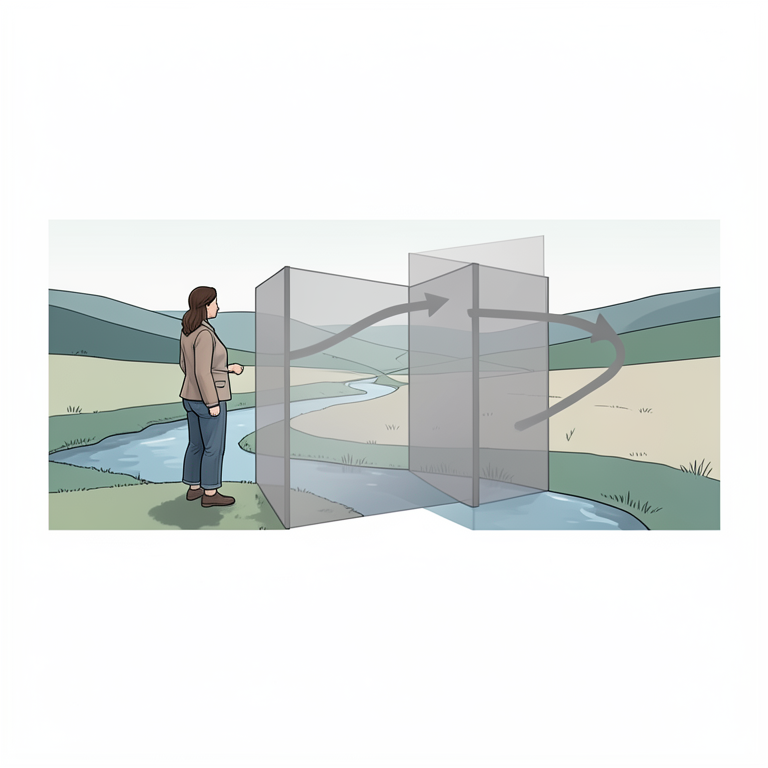
Barriers to Participation
AI-generated conceptual illustration (Rural women in a watershed landscape). It explains the idea and does not show study data.
View source evidence ↗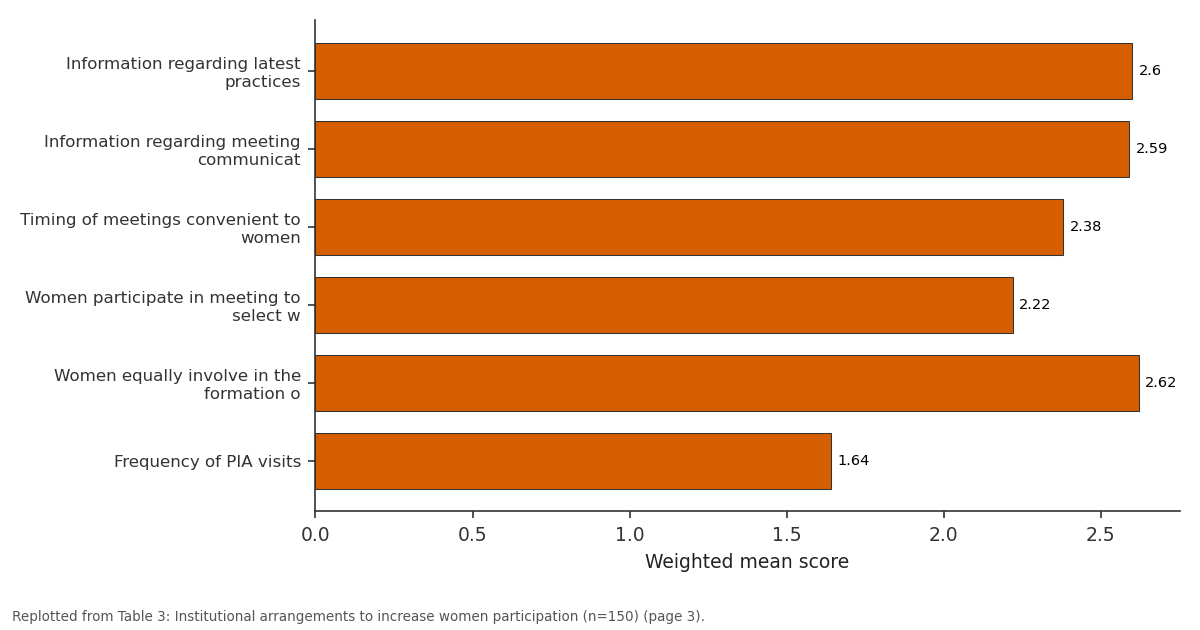
Weighted mean score: Information regarding... vs Information regarding... vs Timing of meetings... vs Women participate in... vs Women equally involve...
Replotted from Table 3 (page 3) of the original paper. Every bar is the paper's own table value.
View source evidence ↗Figures & tables
From the original paper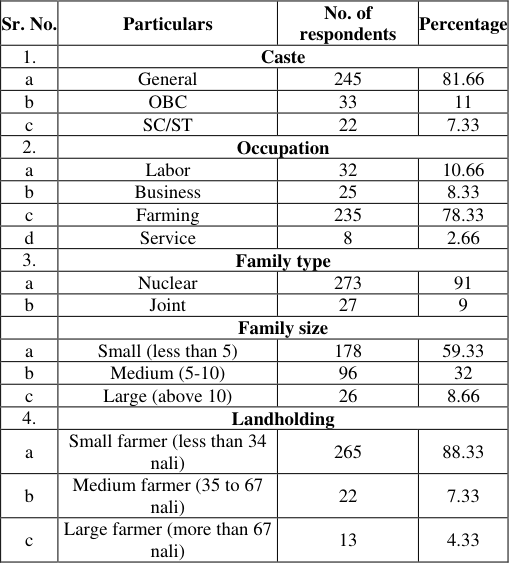 Table 2
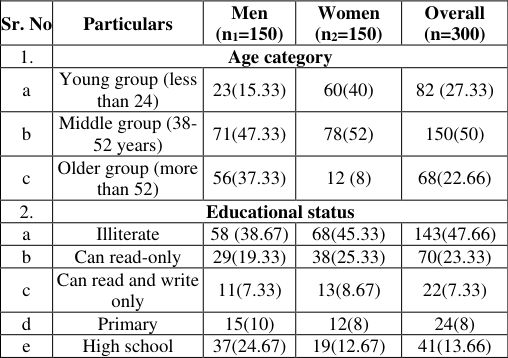 Table 1
 Table 3
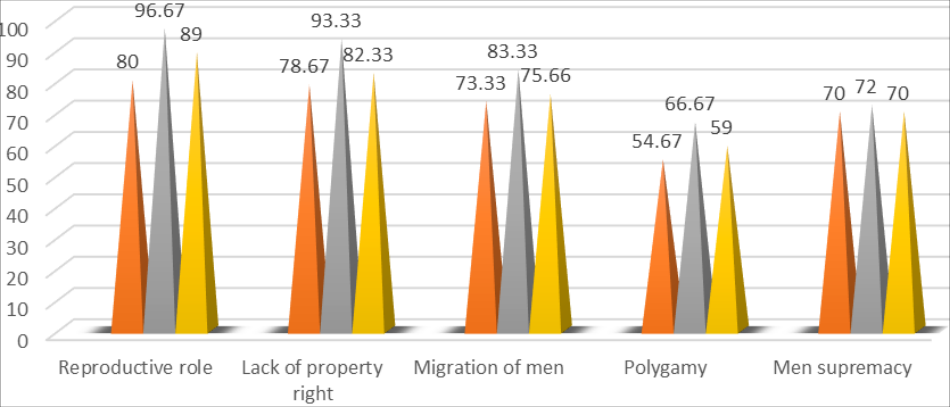 Figure 1
Introduction
Women are playing a very remarkable and important role in almost all fields of life. As economic providers, caregivers, and household managers, women are responsible for ensuring that their families must have basic resources for their daily lives. They are often the managers of community natural resources and have learned to protect these resources to preserve them for future generations (managers of sustainability). Participation of women in development programs or projects at all levels is considered the most effective tool for removing inequality and powerlessness. Women's traditional knowledge should not be left out, as it can contribute greatly to natural resource management science and practices. By incorporating gender relations, more specific diverse information can be obtained; particularly Watershed Management Programs can be more successful and have a positive social impact on the entire household and can make more efficient use of natural resources (Wilde and Vianio-Mattila, 1995) [6] . The role of women in forestry activities is very important because they are widely acknowledged as primary users of the forest. Women are quite knowledgeable both about the environment and natural resources base and their uses. Considering women's dependence on and knowledge about water and forest resources, women's participation is essential for the sustainable use of natural resources and their management (Adhikari, 2011) [1] . The successful and innovative efforts of women in every region must be highlighted to sensitize the planners and policymakers. The perfect ecosystem can be maintained only when women's participation in natural resource management has been recognized as the best manager of the ecosystem. (Mishra, 2003) [2] . Women's participation is crucial for the success of the watershed. Participation of households belonging to the lower strata remains in question. Similarly, women do not get the opportunity to plan, implement, monitor, and evaluate the program, even though they have the knowledge, experience, and capacity to perform. At the household level, they do not enjoy the freedom to decide and their access to and control over productive resources is very limited. They fail to show their talents because of their subordinate position in society. Quantifying the role of women and their participation in integrated watershed management remains a challenge at all levels of planning, management, and utilization of watershed resources (Critchley, 1991; WEDO, 2003) [3,5] . Gender equality in opportunity is the right way to bring women to the mainstay of development.
Materials and Methods
The present paper has been based on primary data. Uttarakhand has been selected as the universe of the study. There are 13 districts in Uttarakhand which are grouped into two divisions: Kumaon and Garhwal. Out of 13 districts two districts namely Uttarkashi and Bageshwar were selected purposively as the locale for the proposed study. There is www.extensionjournal.com Krishna; Muradi and Bhatiya villages from Uttarkashi district and Tallihat, Matena, and Kausani from Bageshwar district were selected using simple random sampling. A detailed primary survey of the study area had been conducted and from these six villages, 300 respondents were selected by using PPS (Probability Proportionate to Size) method. For the collection of data, a structured schedule was developed for the respondents. Primary data had been collected by conducting interviews with 150 women and 150 men in six selected villages located within the watershed. The observation guide was prepared for focused observation along with that general observation of women was done like their daily routine, lifestyle, housing conditions, wood storage, etc. field dairy method was used to jot down all the observations. Suitable statistical techniques were used to analyse the data.
Result and Discussion
Socio-economic and personal profile of beneficiaries Data regarding age composition has been presented in Table 1. It depicts that most of the respondents (50%) belonged to the middle age group. Being a productive group both biologically and economically, they are more involved in farming activities and thus more reliable in watershed management than the other groups. Watershed activities are labour intensive thus side-lining old people. Out of the total sample, fifty-two percent of women belonged to the middle age group followed by 40 percent who belonged to the young age group. There were eight percent of respondents belonged to the old age group. In the case of men, 47.33 percent belonged to the middle age group followed by 37.33per cent belonged to the old age group. Only 15.33 percent were from young age group. As compared to men more women beneficiaries were younger than men beneficiaries. In hills, old ones used to be busy with social gatherings, and young or middle-aged people are generally engaged in subsistence farming. This factor might have led to a higher percentage of middle/old-aged respondents in the study area. The educational status of respondents indicates that 80 percent of respondents were illiterate and read-only. Only 7.33 percent of respondents could read and write. Among the educated respondents, only eight percent had education up to primary level followed by 13.66 percent with high school. It shows that on average 28.99 percent of respondents were literate and the rest were illiterate. The study area was dominated by the general caste category (81.66 percent) either Brahmins or Thakurs. And eleven percent belonged to the OBC category. OBCs in the hills are generally engaged in business and for that, they had migrated to areas at lower elevations. Very few respondents (7.33 percent) belonged to SC/ST. In the case of marital status, nearly all respondents (97 percent) were married only 3 percent of them were widows or widowers. Occupation in the present study reveals that majority of the respondents (78.33 percent) had farming as a major occupation with only 2.66 were engaged in service. Dependency on farming was high among the respondents as there was a lack of other opportunities available in the hills. This might be the reason a higher percentage of respondents were engaged in farming. Only few of the respondent's 10.66 percent and 8.33 percent had labour and business respectively. 91 percent of respondents had a nuclear family and only few i.e., nine percent belonged to joint family. Traditionally in hill areas, people used to live in joint family type, but this trend has not remained the same. This trend was contradictory to the usual trend as in rural areas most of the family type was joint. It might be due to the increasing trend of the nuclear family. 55.36 percent of respondents belonged to the nuclear family and 44.64 percent to the joint family.
| Sr. No | Particulars | Men (n1=150) | Women (n2=150) | Overall (n=300) |
|---|---|---|---|---|
| 1. | Age category | |||
| a | Young group (less than 24) | 23(15.33) | 60(40) | 82 (27.33) |
| b | Middle group (38- 52 years) | 71(47.33) | 78(52) | 150(50) |
| c | Older group (more than 52) | 56(37.33) | 12 (8) | 68(22.66) |
| 2. | Educational status | |||
| a | Illiterate | 58 (38.67) | 68(45.33) | 143(47.66) |
| b | Can read-only | 29(19.33) | 38(25.33) | 70(23.33) |
| c | Can read and write only | 11(7.33) | 13(8.67) | 22(7.33) |
| d | Primary | 15(10) | 12(8) | 24(8) |
| e | High school | 37(24.67) | 19(12.67) | 41(13.66) |
Table text extracted from the original PDF; superscript letters are shown inline. The original table image is below.
View original table image
Most of the respondents (59.33 percent) had a small family size (< 5 members). The medium family size (5-10 members) was only 32 percent of respondents. Very few respondents (8.66 percent) were having large family size (>10 members). It was observed that in rural areas people www.extensionjournal.com are not very conscious about the population, but this thinking was changed because 91 percent of respondents were living in a nuclear family. Nearly 88.33 percent of respondents belonged to small farmers and seven percent belonged to medium farmers (7.33%). Only 4.33 percent of respondents belonged to large farmers.
Socio-cultural factors
The reproductive role of women hindered their participation in Integrated Watershed Management activities of conversing water and soil resources within their catchment reported by 89 percent of respondents. Most of the time, women spend on household activities, and it remains the same for the entire year. Women's participation in watershed management is usually voluntary and it is unpaid work undertaken in their free time. Data revealed that 82.33 percent of respondents reported that lack of property rights was considered the most influential factor in women's participation. The land was the most crucial property as far as watershed management was concerned. It was noted that ownership of land is the driving force for women's participation other than ownership. The majority of the respondents reported that though women were not the rightful landowners and accessibility to land was guaranteed especially for married women.
The study found that the migration of men was another important factor affecting women's participation in watershed management activities. It was reported by 75.66 percent of respondents that migration of men to other parts of the state or nearby states is in search of better job opportunities. This factor has led to the active participation of women due to the needs of the family but also leaves the burden of agricultural production on women. Results have revealed that 59 percent of respondents perceived poor attitude and support from society as an important factor that affects women's participation in watershed management. It was observed that men have the power to make decisions on behalf of the entire community without any input from women. Women are mostly discouraged to challenge men's decisions in a public forum. If they are doing so, they are considered to have unfeminine behaviour. It was reported by 70 percent of respondents that male supremacy was a key factor that affects women's participation. Women have to take permission from the males for domestic and agricultural pursuits. Lack of support from husbands physically and financially limits women's participation. Therefore, this confirms that both moral and financial support from husband and society is very important for motivating women and accelerating their growth or performance. A cursory look at the Table No.3 indicates that women were equally involved in the formation of SHGs or WGs which ranked I with the highest weighted mean score (WMS 2.62), Information regarding the latest practices under IWMP was frequently received by the respondents with the WMS of 2.6, ranked II, followed by information regarding meetings communicated timely to the women (WMS 2.59) ranked III. The maximum number of respondents opined that the www.extensionjournal.com timing of meetings is sometimes convenient for women (WMS 2.38, ranked IV). It was also observed that women sometimes participated in the meetings to select women representation in WMC (V, WMS 2.22). Data regarding regular visits of PIA to share information with beneficiaries received the least weighted mean score (WMS 1.64), ranked VII. From the data, it can be concluded that along with PIA, it is the village watershed committee that was responsible for planning and decision-making in watershed development projects. It was the responsibility of PIA to facilitate the participation of women in community activities by providing institutional arrangements such as childcare facilities, convenient time and venue of the meetings, and information communicated timely. This might be an explanation of the requirement of institutional arrangements to enhance the active participation of women. Women are important stakeholders in watershed management. Quantifying women's role and participation in integrated watershed management is a challenge in the planning and management of resources. The activities/issues observed by the researcher in the study area are as follows: The researcher found that special arrangements are needed to make it possible for women to attend training, and meetings e.g., transport arrangements. The venue of training for women, if possible, arranged in their village as their mobility is restricted. Women have to take permission from male members of the family for attending training outside their village; childcare facilities at the training venue should be provided. In addition, the duration and timing of the training are other important aspects. Women cannot easily stay away for longer periods, so a short training, allowing women to be home for chores in the early morning and at the end of the day, is often best. In watershed management projects women are largely unrecognized as a farmer. It was also shared by women that they are heavily burdened with domestic work, and it has affected their participation in the training and meetings. Women were not playing a dominant role in decisionmaking because their representation at the institutional level was still low. Most of the time women's needs and priorities were not considered by the watershed management committee. Women were not invited to training, or meetings just because of this assumption that information automatically transferred from husband to wife. The meeting should be arranged in such a way that men sit on one side and women on the other so that women will be able to hear what is said which makes it somewhat easier for them to participate. Women's work and contributions still lack the recognition they deserve when entering the public domain; the men take up leadership positions and take the lead role in decision-making processes in the watershed committee. As a result, women are excluded from management activities.
FGD was conducted to analyze the gender issues and problems in the management, sharing, and control of resources. Key issues of focused group discussion are as follows:
Men dominated the decision-making position in the watershed committee. It was essential to arrange training for them to understand issues related to women's roles and needs. Women expressed that deeply rooted socially constructed roles heavily favored men and become a major obstacle for the local women to actively participate in the watershed management project. Women expressed that they want to participate in community activities, but they can do so only after completing their household and own fieldwork. Sometimes they viewed it as an extra burden on their shoulder. Women expressed that project staffs tend to speak to men only when assessing the needs of communities. Female staff recruited under the project so that they can easily contact women beneficiaries. But there was a need to increase the number of female staff. Women expressed that they faced animals' problem, especially monkeys, who damaged their crops or fields.
Women revealed that they decided to solve this problem on their own to control the damage. Mahila Mandal dals were made a group of five women (one woman from each family) who scared away monkeys from the village boundary every day. This method helped them a lot to control the loss. Women confirmed that women facilitators rarely visited the village because of the unavailability of staff. They further mentioned that very few women facilitators were appointed for several villages. They revealed that meetings were conducted by the committee members mostly in the daytime; this was the busiest time for rural people, engaged in fieldwork. They were unable to attend meetings, so the timing of meetings should be morning or evening. (April to June was the busiest time and December to January free time in hill areas).
Conclusion
Women's participation in watershed management is usually voluntary and it is unpaid work undertaken in their free time. The land was the most crucial property as far as watershed management was concerned. It was noted that ownership of land is the driving force for women's participation other than ownership. The study found that the migration of men was another important factor affecting women's participation in watershed management activities. It was observed that men have the power to make decisions on behalf of the entire community without any input from women. Women are mostly discouraged to challenge men's decisions in the public forum. Therefore, it confirms that both moral and financial support from husband and society are very important to motivate women and accelerate their growth or performance. Integration of women in watershed management is needed from an immediate rather than a long-term perspective.
Figures and tables from the paper
| Sr. No. | Particulars | No. of respondents | Percentage |
|---|---|---|---|
| 1. | Caste | ||
| a | General | 245 | 81.66 |
| b | OBC | 33 | 11 |
| c | SC/ST | 22 | 7.33 |
| 2. | Occupation | ||
| a | Labor | 32 | 10.66 |
| b | Business | 25 | 8.33 |
| c | Farming | 235 | 78.33 |
| d | Service | 8 | 2.66 |
| 3. | Family type | ||
| a | Nuclear | 273 | 91 |
| b | Joint | 27 | 9 |
| Family size | |||
| a | Small (less than 5) | 178 | 59.33 |
| b | Medium (5-10) | 96 | 32 |
| c | Large (above 10) | 26 | 8.66 |
| 4. | Landholding | ||
| a | Small farmer (less than 34 nali) | 265 | 88.33 |
| b | Medium farmer (35 to 67 nali) | 22 | 7.33 |
| c | Large farmer (more than 67 nali) | 13 | 4.33 |
Table text extracted from the original PDF; superscript letters are shown inline. The original table image is below.
View original table image
| Sr. No | Institutional Arrangements | Always f (%) | Sometimes f (%) | Never f (%) | Weighted mean score |
|---|---|---|---|---|---|
| 1. | Information regarding latest practices | 100 (66.67) | 40(26.67) | 10(6.67) | 2.6 |
| 2. | Information regarding meeting communicated timely | 97 (64.74) | 45(30) | 8(5.33) | 2.59 |
| 3, | Timing of meetings convenient to women | 62(41.33) | 83(55.33) | 5(3.33) | 2.38 |
| 4. | Women participate in meeting to select women representative in WMC | 54(36) | 76(50.67) | 20(13.33) | 2.22 |
| 5. | Women equally involve in the formation of SHGs or WGs | 99(66) | 46(30.36) | 5(3.33) | 2.62 |
| 6. | Frequency of PIA visits | 28(18.67) | 40(26.67) | 82(54.67) | 1.64 |
Table text extracted from the original PDF; superscript letters are shown inline. The original table image is below.