
Research article · 2021 · Full text
International Journal of Research in AgronomyAdaptability evaluation of recently released hot pepper (capsicum anum) varieties at highland areas of west Hararghe, Ethiopia
Volume 4(2) · Pages 87–93 · DOI: 10.33545/2618060x.2021.v4.i2a.116 ↗
Research areasAgricultural Practices and Plant Genetics
Abstract
Author-writtenIn Ethiopia, hot pepper [Capsicum annum (L)] is one of the leading vegetable crop: in terms of total production, the share of hot pepper is high as compared to other vegetables such as lettuce, tomatoes, head cabbage, onion. Likewise, West Hararg he highlands of study site is hot pepper potential area, and hot pepper is a major spice and vegetable crop which has been produced by the majority of farmers since now. However, its production is hampered by many biotic and abiotic factors specially lack of improved hot pepper variety suitable for the study area is the major challenge that affecting the productivity and production of hot pepper crop. Therefore, field experiment was conducted to evaluate adaptability of recently released hot pepper varieties. Treatments were consisted of three released hot pepper [Capsicum annum (L)] varieties (Melka awaze, Melka shote & Mareko fana) and arranged in a randomized complete block design (RCBD) with three replications. All the collected data were analyzed using R software (R 3.4.1). The combined analysis of variance showed that hot pepper varieties were significantly (p≤0.05) different from one another in number of primary branches per plant, significantly (p≤0.01) different in plant height, highly significantly (p≤0.001) different in days to 50% flowering, in days to 50% fruiting, in number of green fruits per plant, single green fruit weight, marketable green fruit yield, unmarketable green fruit yield and total green fruit yield. According to analysis of variance, the tallest plant height (62.33 cm), highest total green fruit weight (10.68 kgplot-1), marketable green fruit yield (18.04 tha-1) and total green fruit yield (19.07 tha-1) were recorded from variety Melka awaze. On the other hand, the longest (48 ) days to 50% flowering, highest number of primary branches per plant (11), days to 50% fruiting (75.33), number of green fruits per plant (97.67) and unmarketable green fruit yield (1.08 tha-1) were obtained from variety Melka shote. Thus, among hot pepper varieties evaluated, variety Melka awaze was superior in total green fruit weight, marketable green fruit yield and total green fruit yield. Hence, variety Melka awaze caused extra 16.76%, 17.12% & 15.05% total green fruit weight, marketable green fruit yield and total green fruit yield respectively as compared to hot pepper varieties with lowest result of these parameters. Therefore, as variety Melka awaze is superior over the rest varieties in these parameters, could be recommended for study areas to maximize productivity and production of hot pepper.
Summary
Source-checkedPlain-language reading of the full paper, prepared with AI and checked against the text. Each point links to the authors' own words.
Why it matters
- Hot pepper is a leading vegetable crop in Ethiopia, with a higher share of total production than other common vegetables like tomatoes and onions. View evidence ↗
- The productivity of hot pepper is limited by various factors, most notably the lack of improved varieties specifically suited for certain production areas. View evidence ↗
- The highland areas of West Hararghe are identified as a high-potential region for hot pepper production. View evidence ↗
The question
- The study aimed to evaluate how well recently released hot pepper varieties adapt to the West Hararghe highlands. View evidence ↗
What they did
- The field experiment took place in the highland areas of West Hararghe during the 2018 to 2020 cropping seasons. View evidence ↗
- Three released varieties, Melka awaze, Melka shote, and Mareko fana, were tested using a randomized complete block design with three replications. View evidence ↗
- Fertilization included 200 kg/ha of NPS and 100 kg/ha of Urea, applied in stages at transplanting, 15 days post-transplanting, and 45 days post-transplanting. View evidence ↗
- The researchers measured growth parameters (flowering time, branches, height) and yield components (fruiting time, fruit number, fruit weight, and marketable/unmarketable yields). View evidence ↗
What they found
- Melka awaze produced the tallest plants at 62.33 cm, while Melka shote produced the shortest at 48.73 cm. View evidence ↗
- Melka shote had the most primary branches per plant (11), whereas Mareko fana had the fewest (7). View evidence ↗
- Mareko fana was the earliest to reach 50% flowering (41.33 days), while Melka shote was the slowest (48 days). View evidence ↗
- Melka shote produced the highest number of green fruits per plant (97.67), while Melka awaze produced the lowest (52.67). View evidence ↗
- Melka awaze achieved the highest total green fruit weight per plot (10.68 kg), compared to the lowest from Melka shote (8.89 kg). View evidence ↗
- Melka awaze showed a 16.76% increase in total green fruit weight per plot compared to Melka shote. View evidence ↗
- Melka awaze had the highest marketable green fruit yield (18.04 t/ha), while Melka shote had the lowest (14.79 t/ha). View evidence ↗
- Melka awaze recorded the highest total fruit yield (19.07 t/ha), whereas Melka shote recorded the lowest (15.87 t/ha). View evidence ↗
What it means
- The authors concluded that Melka awaze performed best in terms of fruit yield and its components compared to the other varieties. View evidence ↗
- The authors recommend the Melka awaze variety for the West Hararghe highlands to maximize hot pepper productivity. View evidence ↗
Visual summary
3 visualsIllustrations explain the paper; charts are replotted from the paper's own table values.
Experimental Setup
AI-generated conceptual illustration (hot pepper plants (Capsicum annuum)). It explains the idea and does not show study data.
View source evidence ↗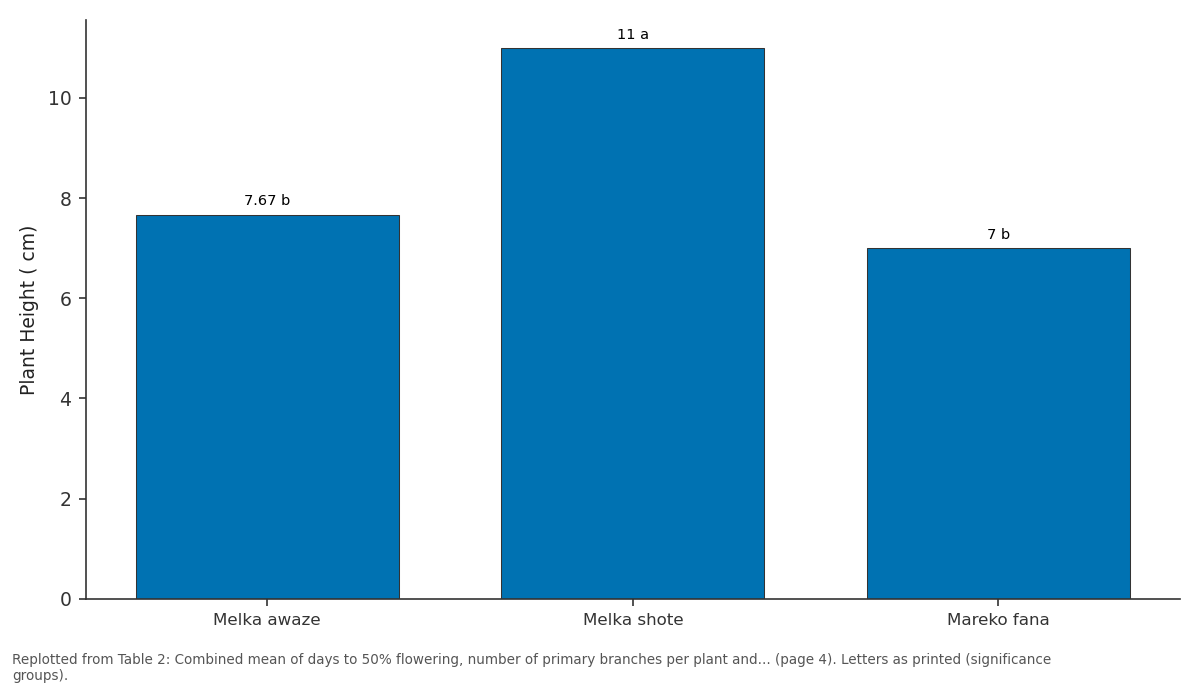
Number of Primary Branches per Plant: Melka awaze vs Melka shote vs Mareko fana
Replotted from Table 2 (page 4) of the original paper. Every bar is the paper's own table value.
View source evidence ↗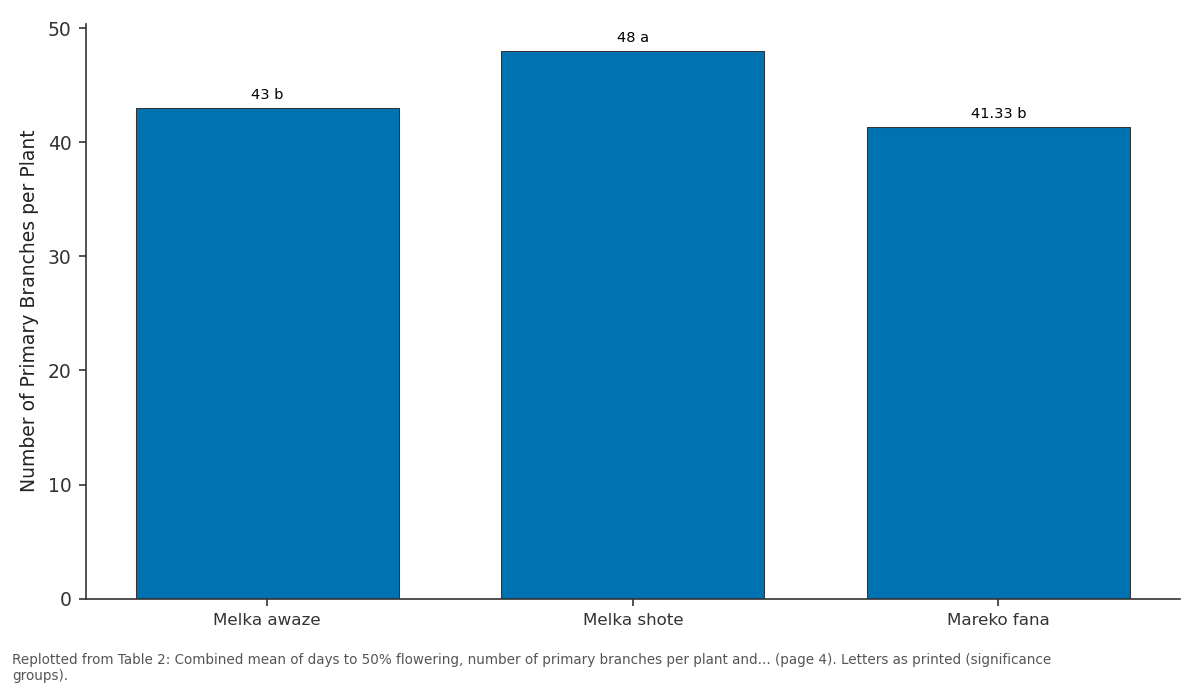
Days to 50% Flowering: Melka awaze vs Melka shote vs Mareko fana
Replotted from Table 2 (page 4) of the original paper. Every bar is the paper's own table value.
View source evidence ↗Figures & tables
From the original paper Table 1
 Table 2
 Table 3
Introduction
The hot pepper [Capsicum annuum (L.)] crop is belonging to the genus Capsicum and family Solanaceae Rodriguez et al. (2008). According to Terry and Subodh (2005) [28] , the genus Capsicum consists of about 20 species and only four species are under cultivation, out of which Capsicum pendulum and Capsicum pubescens are restricted to South and Central America, and other two species such as Capsicum annuum and Capsicum frutescent are commonly cultivated throughout the world, and among the cultivated species, the cultivation of Capsicum annuum L. is the most widely spread all over the world. Moreover, as mentioned by Boland (1992) [5] , despite their vast trait differences most cultivars of peppers commercially cultivated in the world belongs to the species Capsicum baccatum Purse love et al. (1981) [25] reported that the origin of Capsicum Species is extended from Mexico in the North to Bolivia in the South of Latin America, where it has been part of the human diet since about 7500 BC. Hot pepper [Capsicum annuum (L.)] is considered as vegetable and spice crop and grown extensively under various environmental and climatic conditions. Similarly, hot pepper is an important cash crop for smallholder farmers in developing countries such as Ethiopia, Niger Ghana, China, India, Pakistan, Bhutan, Indonesia, Cambodia, and Thailand (Khan and Raj, 2006) [20] . According to the report of Ahmed et al. (2000) [2] , India is the largest producer of chilli in the world. Due to its high cash value and consumption rate, the annual trade of chilli is approximately 17% of the total spice trade in the world (MARC, 2004) [22] . According to the report of FAOSTAT (2017) [12] , in Ethiopia, in terms of total production, the share of pepper is high as compared to other vegetables such as lettuce, tomatoes, head cabbage, onion, and others (FAOSTAT, 2017) [12] . Hot pepper is one of the most important vegetable crops in the world. Regarding production status of hot pepper in the country, FAOSTAT (2018) [13] reported that in Ethiopia, in 2018 cropping season, the total cultivated area under pepper was 8001 hectare with a production quantity of 4889 tons. Also, the productivity of the crop in Ethiopia is 6.11 tha -1 (FAOSTAT, 2018) [13] .Based on the report of USAID (2013) [30] , the national average yields of hot pepper are 6.3 t ha -1 for green pod and 1.8 tha -1 for the dry pod, which is far below the dry pod yield (2.5-3.7 tha -1 ) of improved varieties at research fields of Ethiopia and world average yield of 3 to 4 tha -1 .In Ethiopia, three major hot pepper producing regions recognized. As reported by Ethiopian export promotion agency (EEPA) (2003) [11] the major hot pepper producing regions in Ethiopia are Amhara, Southern Nations and Nationality People's Regional State and Oromia pepper generated an income of 122.80 million Birr for farmers in 2000/2001, and this value further jumped to 509.44 million Birr for smallholder farmers in 2004/2005. Hot pepper is a multipurpose crop, used as a vegetable and spice, and also it is source of income for Ethiopian smallholder farmers. As mentioned by Assefa et al., 2020) [3] , the hot pepper is an important food and cash crop in Eastern and Central Africa including Ethiopia playing a major role in national food security and nutrition, poverty alleviation and income generation, and; provides employment opportunity in the production, processing and marketing sub-sectors. Hot pepper is in the daily diet of most Ethiopians, and fruits are consumed as fresh, dried, or processed products, like vegetables, as spices or condiments (Assefa et al., 2020) [3] and similar idea was reported by Acquaah (2004) [1] . Nowadays, it is produced in many parts of the country because, for most Ethiopians food is tasteless without hot pepper. Because it is the main parts of the daily diet of most Ethiopian societies. The fine powdered pungent product is an indispensable flavoring and coloring ingredient in the common traditional sauce "Wot", whereas the green pod is consumed as a vegetable with other food item (Melaku et al., 2015) [23] . According to the report of CSA (2018) [8] , The average daily consumption of hot pepper by Ethiopian adults is estimated 15 gm, which is higher than tomatoes and most other vegetables. As identified by many researchers in Ethiopia, several factors limiting the productivity of hot pepper: the major ones are lack of stable well-adapted varieties, lack of knowledge in using optimum nutrient supply in every area of production zone, an insufficient supply of disease and insect pests' tolerant varieties (Assefa et al., 2020). [3] Similarly, Similarly, the major reasons associated with yield reduction in Ethiopia are shortage of improved varieties, infestation of disease and pests, poor agronomic practices, poor post-harvest handling. According to Fekadu and Dendena (2006) [14] , despite its importance, Ethiopian hot pepper production has been hampered by a number of factors, including the use of inferior varieties, poor cultural practices, and the increasing prevalence of fungal, bacterial, and viral diseases. CSA (2006) [7] reported that in spite of its importance, the hot pepper production system for green and dry pod has stayed as low input and low output with a national average yield of 7.6 t/ha for green pod whereas it was 1.6 t/ha for the dry pod respectively. Fekadu and Dandena (2006) [14] also expressed that the decline of hot pepper production is also attributed to poor varieties, poor cultural practices, the prevalence of fungal (blights) and bacterial as well as viral diseases. Likewise, West Haraghe highlands of study site is potential area for hot pepper production. As mentioned by Kinde and Asfaw (2016) [21] , in West Hararghe highlands hot pepper is a major spice and vegetable crop which has been produced by the majority of farmers. However, its production is hampered by many biotic and abiotic factors specially lack of improved hot pepper variety suitable for the study area is the major challenge that affecting the productivity and production of hot pepper crop. Therefore, objective of the experiment was to evaluate adaptability of recently released hot pepper varieties for the study area of the West Hararge highlands.
Materials and Method 2.1. Experimental Area Description
Field experiment was conducted from 2018 -2020 cropping seasons at highland areas of West Hararge. West Hararghe Zone is located at 8 ° 39' 59.99" N latitude and 40 ° 29' 59.99" E longitudes (Nigus et al., 2022) [24] . Moreover, this Zone is subdivided into three major climatic Zones namely highland locally known as Dega (12.49%), midland known as Woinadega (38%) and lowland locally known as Kola (49.5%). The topography of west Hararghe is characterized by steep slopes in the highlands and mid-plains in the lowland areas. Mean monthly temperature range of west Hararghe is from 20.5-24 ⁰C (Nigus et al., 2022). Similarly, the rainfall of west Hararghe is dispersed and the year is classified in to two rainy seasons, Belg from February to April and Meher or the main season rainfall from June to September with small showers in dry months. The average annual rainfall is ranged from 600-2000 mm for higher elevations of Woinadega and Dega areas, and altitude of west Hararghe is ranged from 1200-3600 m.a.s.l. (Nigus et al., 2022) [24] .
Treatments and Experimental Procedures
Field experiment was conducted from 2018 -2020 cropping seasonsto evaluate adaptability of recently released hot pepper [Capsicum annum (L.)] varieties. Hence, treatments composed of three released hot pepper varieties (Melka awaze, Melka shote & Mareko fana) arranged in a randomized complete block design (RCBD) with three replications. Details about hot pepper varieties presented in the (Table 1). [19] 2.3. Land preparation, Sowing and Transplanting After the nursery area had been preparation, three level seed beds of 5 m x 1 m (5 m 2 ) sized were prepared for three hot pepper varieties separately. Before sowing, soil of each seed beds was top dressed with100 g NPS fertilizer to improve the nutrient content of the soil of beds. After top dressing of the soil of each seedbed with NPS fertilizer, hot pepper seeds were sown in rows at 15 cm apart between rows and covered with light soil and then seed beds were mulched with 3 cm thick dry grass. After sowing and mulching, seed beds were watered properly using watering can and also watering operation was done every day and continued until the hot peeper seeds get germinated and then done every two days and twice in a week interval. Accordingly, to get vigor seedlings, other relevant nursery activities such as weeding, hoeing, thinning and shade construction were done. Before transplanting, experimental field was well tilled, leveled and divided into three blocks and nine (9) individual plots of 4 m x 2.8 m (11.2 m 2 ) sized to accommodate 4 rows of 70 cm apart to contain 13 and 53 plants per row and per plot respectively. When hot pepper seedlings attained transplanting height of 15-25 cm, carefully uprooted and transplanted to the well-prepared experimental plots at 70 cm and 30 cm inter-row and intra-row spacing respectively. As far as fertilizer application is concerned, 200 kgha -1 NPS and 100 kgha -1 Urea were used: 150 kg NPS was applied at transplanting, 25 kg NPS & 50 kg Urea were applied after 15 days of transplanting and the remaining 25 kg h NPS & 50 kg Urea were applied after 45 days of transplanting.
| Name of varieties | Year of release | Maturity ( Days) | Dry fruit yield (tha1) | Altitude (m.a.s.l) | Rain Fall(mm) | Temperature (0C) |
|---|---|---|---|---|---|---|
| Melka awaze | 2007 | 100-110 | 2.5-2.8 | 1200-2200 | 900-1300 | 18/29 |
| Melka shote | 2007 | 110-120 | 2.0-3.0 | 1000-2200 | 900-1300 | 15//27 |
| Mareko fana | 1984 | 110-130 | 1.5-2.0 | 1400-2200 | 600-1337 | 20/29 |
Table text extracted from the original PDF; superscript letters are shown inline. The original table image is below.
View original table image
Data Collection 2.4.1. Growth and Phonological Parameters of Hot Pepper [Capsicum annum (L.)]
Under these parameters, collected data were consisted of days to 5% flowering, number of primary branches and plant height. Days to 50% flowering was recorded and determined by counting the number of days from date of transplanting up to the days when 50% of the plants get flowered and used for analysis. The number of days where 50% of the plants started flowering beginning from the days of transplanting was used to measure days to 50% flowering. Number of primary branches per plant were determined based on the primary branches of ten randomly selected plants from net plot area taken at the maturity stage and their average values were used for analysis. Plant height was determined by measuring the heights of ten randomly selected ten plants from the ground level to the apex from net plot area using rules at maturity stage and mean values were used for analysis.
Yield and Yield Component Parameters of Hot Pepper [Capsicum annum (L.)]
Collected data under this parameter composed of days to 50% fruiting, number of green fruits per plant, single green fruit weight, marketable green fruit yield, unmarketable green fruit yield and total green fruit yield. Hence, Days to 50% fruiting was recorded and determined by counting the number of days from date of transplanting up to the days when 50% of plants get fruited. Numbers of physiologically matured green fruits per plant were recorded from ten randomly selected sample plants per plot from middle rows of each experimental plot and then average values in g per plant were used for analysis. Total green fruit weight per plot was determined from fruits often randomly selected samples plants from middle rows per plot harvested and weighted using sensitive balance and their average fruit weight per plant was multiplied by the total number of plants from net plot area of each experimental plots and then their product was considered as total green fruit weight per plot used for analysis. Single physiologically matured green fruit weight was calculated from fruits of ten random sample plants that is total green fruit weight of sample plants in gram divided by the total number of fruits harvested were used as an average single green fruit weight and then taken for analysis. Marketable green fruit yield (tha -1 ) was determined by taking entire green fruits free from any form of defect and visible damages taken from net plot area of each experimental plots considered as marketable fruit yield and then weighed using sensitive balance in kg and converted in to ton basis per hectare. Unmarketable green fruit yield (tha -1 ) was determined by considering small sized, discolored, rotten, infected, pest attacked and those fruits lacked uniformity recorded from net plot area of each experimental plot were taken as unmarketable fruit yield and weighed using sensitive balance in kg and converted in to ton basis per hectare. Similarly, total green fruit yield (tha -1 ) was determined from entire matured fruits from middle two rows of net plot area of each experimental plot were considered as total green fruit yield and then weighed using sensitive balance in kg and converted in to ton basis per hectare. Moreover, total fruit yield (tha -1 ) was also determined by adding marketable and unmarketable fruit yield
Data Analysis
All the hot pepper parameter data collected were subjected to analysis of variance using R software (R 3.4.1). Means that differ significantly were separated using the least significant difference (LSD) procedure at 5% probability level of significance
Results and Discussion
Results and Discussion
Growth and Phonological Parameters of Hot Pepper [Capsicum annum (L.)] 3.1.1. Days to 50% Flowering
According to combined analysis of variance, hot pepper varieties were significantly varied at p≤ 0.001 probability level in days to 50% flowering (Table 2). It is in line with finding of Melaku et al. (2015) [23] who revealed that the number of days to 50% flowering showed highly significant. Delelegn et al. (2014) [10] reported that hot pepper varieties were highly significant different for days to 50% flowering in Jim ma and Sekachekorsa areas. But it is in disagreement with the finding of Cherne et al. (2019) [6] who explained that days to 50% flowering showed non-significant differences among the hot pepper varieties. According to analysis of variance, hot pepper varietiesattained50%flowering in different day lengths (Table 2).Variety Mareko fana attained its 50% flowering in 41.33 days, Melka awaze 43 days and Melka shote in 48 days (Table 1). Thus, variety Melka shote attained its 50% flowering in longest (48) days however, variety Marko fan attained its 50% flowering in shortest (41.33) days. In agreement with the finding of Kahsay Yemane (2017) [19] who showed that Melka Shote took longer days to flower while Mareko fana flowered earlier. Differences among hot pepper varieties in days to50% flowering might be because of genotypic variability among them and also due environmental influences on them. Never the less, variety Mareko fana and Melka awaze were not statistically different from each other in days to 50% flowering. The range between longest and shortest days to 50% flowering was 7 days. This is indicating that variety Melka shote needs additional 7 days to attain its 50% flowering as compared to variety Mareko fana. Hence, variety Melka shote is late flowering type as compared to Mareko fana followed by Melka Awaze. Variations among hot pepper varieties in relation to days to 50% flowering could be due to genetic makeup differences among them. In line with the finding of Melaku et al. (2015) [23] who reported that the variation in the days to 50% could be probably due to their genetic factor.
| Variety treatments | Days to 50% Flowering | Number of Primary Branches per Plant | Plant Height ( cm) |
|---|---|---|---|
| Melka awaze | 43b | 7.67b | 62.33a |
| Melka shote | 48a | 11.00a | 48.73c |
| Mareko fana | 41.33b | 7.00b | 57.03b |
| LSD (0.05) | 2.20 | 3.02 | 4.88 |
| CV% | 8.20 | 15.58 | 9.84 |
| Significant level | *** | * | ** |
Table text extracted from the original PDF; superscript letters are shown inline. The original table image is below.
View original table image
Number of Primary Branches per Plant
Hot pepper varieties were significantly differed from one another at p≤0.05 probability level in number of primary branches per plant (Table2).It is disagreed with the finding of Melaku et al. (2015) [23] who showed that no significant difference was observed on branch number of different pepper varieties. The analysis results of number of primary branches per plant (7, 7.67 and 11) were statistically dissimilar and were in range of 7 -11 per plant. Variety Mareko fana was caused (7) primary branches per plant, Melka awaze (7.67) and Melka shote (11) branches per plant (Table 2).This shows that the highest (11) number of primary branches per plant was obtained from variety Melka shote while the lowest (7) was obtained from variety Mareko fana. The range between highest and lowest number of primary branches per plant was4. However, variety Mareko fana and Melka awaze were statistically at par in number of primary branches.
Plant Height
Based on the combined analysis of variance, hot pepper varieties were significantly differed at p≤0.01 probability level in relation to plant height (Table 2). This result in line with the report of Gebremeskel et al. (2015) [15] who found that there was significant differences among three varieties evaluated for two years in Raya valley, Northern Ethiopia for plant height. However, disagreed with the finding of Melaku et al. (2015) [23] who showed that no significant difference was observed on plant height of different pepper varieties. Due to varietal difference effect, plant height results (48.73 cm, 57.03 cm & 62.33 cm) were statistically different and ranged between 48.73 cm -62.33 cm. accordingly, the plant height (48.73 cm) was obtained from variety Melka shote, 57.03 cm from variety Mareko fana and 62.33 cmfrom variety Melka awaze. Thus, the tallest (62.33 cm) plant height was recorded from variety Melka awaze whereas the shortest (48.73 cm) was obtained from variety Melka shote (Table 2).Difference in plant height between variety Melka awaze and Melka shote was about 13.6 cm. An increment in plant height in percent basis with variety Melka awaze over Melka shote was 21.82%.Hence, this is showing that variety Melka awaze was tallest, variety Mareko fan a an intermediate and variety Melka shote was shortest. Another thing is regarding variation in plant height among hot pepper varieties might be due to genetic potential variability among them.
Fruit Yield and Fruit Yield Components of Hot Pepper [Capsicum annum (L.)] 3.2.1. Days to 50% Fruiting
The combined analysis of variance showed that days to 50% fruiting results were statistically differed from one another at p≤0.001 level of probability (Table 3). In agreement with the finding of Cherne and Zibelo (2019) [6] who reported that hot pepper varieties evaluated showed significant difference for days to 50% fruiting. However, in disagreement with the finding of Cherne et al. (2019) [6] who reported that days to 50% fruiting showed non-significant differences among the hot pepper varieties.
Number of Green Fruits per Plant
Hot pepper varieties showed significant (P≤0.01) difference for number of green fruits per plant (Table 3). In line with the finding of Melaku et al. (2015) [23] who reported that pepper varieties were significantly different at p≤0.001 probability level in relation to number of fruits per plant. According to the finding of Kahsay Yemane (2017) [19] , there was a significant difference in fruit number per plant of the varieties. This is agreed with the report of Delelegn et al. (2014) [10] who mentioned that hot pepper varieties were highly significant different for number of fruits per plant in Jimma and Seka-chekorsa. [6] who revealed that the highest number of green pod yield per plant was obtained from Mareko fan a (608.7). A hot pepper variety with the highest number of green fruit per plant could be due to having more number of branches enabling the formation of more number of fruits per plant. On the other hand, variations among hot pepper varieties in number of green fruits per plant could be because of genetic potential difference among them and effect of environment on growth and development of the crop.
Hot pepper varieties were significantly (p≤0.001) differed from one another in total fruit weight per plot (Table 3). The analysis results of total green fruit weight (8.89 Moreover, the range between the highest and the smallest total green fruit weight per plot was 1.79kgha -1 , which is an increment in total green fruit weight due to effect of variety Melka awaze over variety Melka shote, Again, this difference in percent basis was 16.76% due to effect of variety Melka awaze as compared to variety Melka shote.
According to analysis of variance hot pepper varieties were significantly differed at p≤0.001 probability level in relation to single green fruit weight (Table 3). Due to varietal difference effect, single green fruit weight results (3.96g,5.96g and 7.98g) per fruit were statistically dissimilar and ranged between 3.96 -7.98 g per fruit.With this result, variety Melka shote was caused single green fruit weight of (3.96 g fruit -1 ), Melka awaze (5.96 g fruit -1 ) and Mareko fana (7.96 g fruit -1 ). This is showing that the largest (7.98 g fruit -1 ) single green fruit was obtained from variety Mareko fana. But the smallest (3.96 g fruit -1 )was obtained from variety Melka shote(Table 3).This lowest result with Melka shote variety is in agreement with the finding of Kahsay Yemane (2017) [19] who showed that the lowest single fruit weight per fruit was obtained from variety Melka shote. Cherne et al. (2019) [6] also reported that variety Mareko fana produced the largest fruit size (7.3 g) while Melka shote had the least pod weight (4.5 g).
The range between the largest and the smallest single green fruit weight was 4.02 g fruit -1 . With this, variety Mareko fana caused extra 50.38% single green fruit weight as compared to variety Melka shote. On the other hand, the lowest single fruit weight per fruit with variety Melka shote might be due to cumulative effect of genotype and environmental factors. This idea is also agreed with the report of Kahsay Yemane (2017) [19] who revealed that the lowest fruit weight with variety Melka shote affected by both genotype and environment.
In addition, large sized green fruits are likely to be more accepted by the consumers as well as in the markets. This idea is in agreement with the report of Beyene and David (2007) [4] who revealed that hot peppers with larger pod sizes are appreciated for their quality, and fresh and dried pods are in high demand in Ethiopian markets. As fruit weight has direct effect on fruit yield, affected by genotype and environmental factors. This is in line with report of Seleshi et al. (2014) [27] who mentioned that both genotype and environment influence fruit weight. A hot pepper variety with largest fruit weight is an indication of high yielding potential and this character is mainly genetically.
Marketable Green Fruit Yield (tha -1 )
Marketable fruit yield is the component of total fruit yield and highly affected by unmarketable fruit yield. The marketable green fruit yield results were significantly differed at p< 0.001 level of probability (Table 3). This is in agreement with the finding of Melaku et al. (2015) [23] who mentioned that there was high significant difference among hot pepper varieties in marketable. Delelegn et al. (2014) [10] reported that hot pepper varieties were highly significant different for marketable fruit yield in Jimma and Seka-chekorsa areas. Similarly, Cherne and Zibelo (2019) [6] found that hot pepper varieties evaluated showed significant difference for marketable green fruit yield. Moreover, supporting idea was reported by Gebremeskel et al.
(2015) [15] who found that significant differences among three varieties evaluated for two years in Raya valley, Northern Ethiopia for marketable fruit yield. Marketable green fruit yield result (14.79 tha -1 , 16.28 tha -1 & 18.04 tha -1 ) were statistically dissimilar due to varietal difference effect and ranged from14.79tha -1 -18.04 tha - 1 .Marketable green fruit yield of 14.79tha -1 tha -1wasresulted from variety Melka shote, 16.28 tha -1 from Mareko fanaand18.04 tha -1 was from Melka awaze (Table 3). The highest (18.04 tha -1 ) marketable fruit yield was obtained from variety Melka awaze, an intermediate (16.28 tha -1 ) was from variety Mareko fan a while the lowest (14.79 tha -1 ) was caused by variety Melka shote (Table 3).
The difference between the highest and lowest marketable green fruit yield was 3.25 tha -1 , however, the difference between highest and an intermediate was 1.76 tha -1 .Indicating that variety Melka awaze was superior and produced 17.12% & 9.24% extra marketable green fruit yield over variety Melka shote and Mareko fan respectively. Differences among hot pepper varieties in relation to marketable fruit yield could be due to combined effect of genetic makeup differences and environmental factors.
In line with the finding of Tibebu and Bizuayehu (2014) [29] who confirmed that fruit yield influenced by environmental factors like temperature and also yield related traits. Marame et al (2008) [8] also reported that the variation in marketable fruit yield of varieties could be due to difference in genetic characteristics and agro ecological adaptability nature. Moreover, a hot pepper variety with the highest marketable fruit yield is implication of best performance and high yielding potential and also these characteristics are mainly genetically.
Unmarketable Green Fruit Yield (tha -1 )
Unmarketable green fruit yield is the component of total fruit yield. The combined analysis of variance indicated that hot pepper varieties were significantly (p≤0.01) varied in unmarketable green fruit yield (Table 3). In line with the finding of Melaku et al. (2015) [23] who revealed that there was a very high significant difference among the hot pepper varieties in terms unmarketable fruit yield. Unmarketable green fruit yield (tha -1 ) is obtained by sorting the diseased discolored, shrunken shape and small sized fruits from total fruit yield. Unmarketable green fruit yield also obtained by deducting the marketable fruit yield from the total fruit yield and highly affected by marketable fruit yield. Unmarketable fruit green yield results were arranged in an ascending orders (0.92 tha -1 , 1.02 tha -1 & 1.08 tha -1 ) and ranged between 0.92 tha -`1 -1.08 tha -1 . Difference in unmarketable fruit yield could be due to varietal variability effect. Unmarketable green fruit yield (0.92tha -1 ) was obtained from variety Mareko fan a 1.02tha -1 from variety Melka shote and 1.08tha -1 was from variety melka awaze. Hence the highest (1.08tha -1 ) unmarketable green fruit yield obtained from variety Melka shote followed by variety Melka awaze (1.02tha -1 ) while the lowest (0.92tha [16] discovered that variety Melka Awaze produced the maximum yields in Woreta, Northwestern Ethiopia. The difference between the highest and the lowest total fruit yield was 3.2 tha -1 , but the difference between the highest and an intermediate was 1.87 tha -1 . With this, variety Melka awaze was superior and resulted in 15.05% & 7.93% extra total green fruit yield as compared to variety Melka shote and Mareko fan respectively.
Conclusion and Recommendations
Field experiment was conducted from 2018-20 cropping season at hot pepper potential areas of West Hararge highlands aimed at adaptability evaluation of three recently released hot pepper varieties such as Melka awaze, Melka shote and Mareko fan a under supplementary irrigation conditions. West Hararg he highland areas of study site is potential area for hot pepper production. Moreover, at West Hararg he highlands of study area, farmers have been producing hot pepper for consumption and market purposes since right now, however, its productivity and production is low due to lack of improved hot pepper varieties suitable for the study are a and then farmers obliged to use local hot pepper which is low yielder. Thus, productivity and production of hot pepper could be maximized using improved hot pepper variety suitable for the study area. According to the result of this study, variety Melka awaze showed best performance in fruit yield and fruit yield components of hot pepper over the rest varieties evaluated. Therefore, as the variety Melka awaze was superior in these parameters, could maximize productivity and production of hot pepper and recommended for the study site.
Acknowledgments
First of all, we would like to thank almighty Allah for helping us to start and successfully complete this work. Then next we would like to thank the Ethiopian Institute of Agricultural Research (EIAR) and Crop Research Directorate for the provision of research budget. Also we would like to acknowledge the Melkassa Agricultural Research Center, vegetable research team for provision of vegetable seeds and technical advice. Lastly, we would like also to acknowledge the Chiro Sorghum Research and Training Center (SRTC) research team who actively involved in the research process.
References
21 in the original paper- Ahmed J, Shivhare US, Raghavan GSV. Rheological characteristics and kinetics of colour degradations of green chilli puree. Journal of Food Engineering. 2000;44:239-244.
- Assefa G, Girma S, Deresa D. Response of hot pepper (Capsicum annuum L.) as affected by np fertilizer and planting method on yield and yield related traits in West Hararghe zone, Eastern Ethiopia. American Journal of BioScience. 2020;8(4):113-122.
- Beyene T, David P. Ensuring small scale producers in Ethiopia to achieve sustainable and fair access to pepper market. Uganda Journal of Agriculture. 2007;3(2):113-119.
- Bosland PW. Chiles: a diverse crop. Hort. Technology. 1992;2:6-10
- Chernet S, Zibelo H. Evaluation of hot pepper (Capsicum annuum L.) varieties for green pod yield and yield components in Western Tigray, Northern Ethiopia. Journal of Plant Breeding and Crop Science. 2019;11(9):260-264.
- CSA. Agricultural sample survey. 2005/2006 Report on area and production of crops. Statistical bulletin. 2006;1:361. Addis Ababa, Ethiopia
- CSA (Central Statistical Agency Ethiopia). Report on area and production of major crops. Agricultural sample survey. Addis Ababa Statistical Bulletin. 2018;1(584):14-68.
- Delelegn S, Belew D, Mohammed A, Getachew Y. Evaluation of elite hot pepper varieties (Capsicum Sp.) for growth, dry pod yield and quality under Jimma Condition, South West Ethiopia. International Journal of Agricultural Research. 2014;9(7):364-374.
- Fekadu M, Dandena G. Review of the status of vegetable crops production and marketing in Ethiopia. Uganda J Agric. Sci. 2006;12(2):26-30.
- Gebremeskel H, Abebe H, Biratu W, Jelato K. Performance evaluation of hot pepper (Capsicum annuum L.) varieties for productivity under irrigation at Raya Valley, Northern, Ethiopia. Basic Research Journal of Agricultural Science and Review. 2015;4(7):211-216.
- Getahun D, Habtie B. Growth and Yielding Potential of Hot Pepper Varieties under Rain-Fed Production at Woreta, Northwestern Ethiopia. International Journal of Research Studies in Agricultural Sciences (IJRSAS). 2017;3(3):1118.
- Kahsay Y. Evaluation of hot pepper varieties (Capsicum Species) for growth, dry pod yield and quality at M/Lehke District, Tigray, Ethiopia. International Journal of Engineering Development and Research. 2017;5(3);15-27.
- Khan MS, Raj SK. The first report of molecular detection of an Aster yellows phytoplasma ('Candidatus Phytoplasma asteris') isolates infecting chilli (Capsicum annuum) in India. Plant Pathology. 2006;55:822-822. 10.1111/j.13653059.2006.01482.
- Kinde L, Asfaw Z. Effect of spacing and fertilizer dose on growth and yield of potato (Solanum tuberosum L) Gudane variety at West Hararghe, Eastern Ethiopia. International Journal of Horticulture and Ornamental Plants. 2016;2(1): 011-018.
- Melaku FT, Alemayehu TG. Lidet BT. Adaptation trail of different improved hot pepper (Capsicum Species) varieties under Gedeo Zone, Dilla, Ethiopia. International Journal of Life Sciences. 2015;4(4):216-220.
- Nigus M, Shimelis H, Mathew I, Abady S. Wheat production in the highlands of Eastern Ethiopia: opportunities, challenges and coping strategies of rust diseases. Acta Agriculturae Scandinavica, Section B-Soil & Plant Science. 2022;72(1):563-575.
- Purseg love JW, Brown EG, Green CI, Robbins SRI. Spices. LongmanInc. New York. 1981;1(1):365.
- Rodriguez Yaritza, Depestre Tomas. Gomez Olimpia. The efficiency of selection in pepper lines (Capsicum annuum), from four sub-populations, in characters of productive interest. Ciencia e Investigacion Agraria. 2008;35:29-40.
- Seleshi D, Derebew B, Ali M. Pepper varieties (Capsicum Spp.) for growth, dry pod yield and quality under Jimma condition, South-West Ethiopia. Int. J Agric. Res. 2014:9(7):364-374.
- Terry Berke, Subodh Joshi. Perspectives of Bell Pepper Breeding, Journal of New Seeds. 2005;6:(2-3):51-74. DOI: 10.1300/J153v06n02_04.
- Tibebu S, Bizuayehu T. Growth and productivity of hot pepper (Capsicum annuum L.) as affected by variety, nitrogen and phosphorous at Jinka, Southern Ethiopia. Res. J. Agric. Environ. Manage. 2014;3(9):427-433.
Cited by 4
From OpenAlex, OpenCitations and reference lists read by Scinovex
- Physiological, growth, yield, and quality responses of hot pepper due to shade level ↗
Sadik Ahmed, Amsalu Gobena Roro, Hussien Mohammed Beshir, Ashenafi Haile · International Journal of Vegetable Science · 2023
High temperatures, high relative humidity, and frequent rainfall limit productivity and quality of red chili pepper (Capsicum annuum L) with 30,000 to 50,000 Scoville units. Growers in greenhouses use shading screens to limit incidence radiation in order to avoid the issue of too high temperatures and high radiation. A pot experiment was conducted to assess growth, physiology, yield, and quality…
❝ 6 - Effect of blended NPS fertilizer and cattle manure on soil property and hot pepper productivity in Jabi Tehnan Ethiopia ↗
Bekele Azmeraw, Mekuria Bereded Sheferie, Tiegist Dejene Abebe, Muhajer Kedir Abedalla · Heliyon · 2024
Hot pepper is one of the most important spice vegetable crops in Ethiopia and is widely cultivated for dry pod production. However, its productivity is low in Ethiopia due to degraded soil fertility and an unbalanced nutrient supply in the soil. An experiment was conducted to evaluate the effect of NPS fertilizer and cattle manure (CM) on soil chemical properties…
❝ 3PDF - Characterization and identification of hot pepper-associated endospore-forming bacteria with potential applications as biofertilizers and in biocontrol of pepper wilt pathogens ↗
Shiferaw Demissie Tola, Diriba Muleta, Fassil Assefa, Farideh Ghadamgahi, Ramesh Raju Vetukuri, Beira H. Meressa · BMC Microbiology · 2025
BACKGROUND: Although hot pepper contributes significantly to Ethiopia's national economy, its production is hindered by devastating outbreaks of phytopathogens such as Fusarium wilt and Meloidogyne incognita disease complexes. It is known that bacteria in the pepper rhizosphere can promote plant growth by suppressing soil-borne pathogens and producing growth-promoting substances. Therefore, hot pepper-associated endospore-forming bacteria were evaluated for plant growth-promoting traits…
❝ 1PDF - Temporal shifts in the socio-ecological factors of red pepper cultivation across elevation gradients in Ethiopian highlands ↗
Ermias Debie · Discover Agriculture · 2026
This study examines how ecological, social, and experiential factors associated with red pepper ( Capsicum annuum ) cultivation decisions and land allocation have shifted over time using logistic and linear regression within a mixed-methods framework among 296 households in the Lah watershed, Northwest Ethiopia. Among previously non-cultivating households, 71.8% began cultivation after 2022, an empirically observed turning point marked by…
❝ 0PDF