
Research article · 2021 · Full text
International Journal of Research in AgronomyEffects of COVID-19 countermeasures on food supply systems and productivity of agricultural enterprises: A case study of Namelok Estate farm at Kajiado, Kenya
Volume 4(2) · Pages 120–122 · DOI: 10.33545/2618060x.2021.v4.i2a.135 ↗
Research areasCOVID-19 Pandemic Impacts
Abstract
Author-writtenIn this descriptive study, we document how health precaution protocols (cessation and restriction of movement) on COVID 19 pandemic affected the productivity and supply systems of Namelok Estate Farm. Data was collected through direct interviews and field observations. The study found out that countermeasures towards the pandemic affected the availability, stability and accessibility of food. Besides, the countermeasures put to contain the spread of the virus reduced mobility of labor and key agricultural inputs. Resilience-building into small and large-scale farming system, government investment in input supply systems and subsidies to cushion agriculture productivity is recommended.
Summary
Source-checkedPlain-language reading of the full paper, prepared with AI and checked against the text. Each point links to the authors' own words.
Why it matters
- The COVID-19 pandemic has significantly impacted global agriculture since its emergence in 2019. View evidence ↗
- Containment measures implemented to stop the virus led to declines in both farm productivity and the efficiency of agricultural supply chains. View evidence ↗
- Movement restrictions disrupted the flow of farm produce leaving the farm and the arrival of necessary production inputs. View evidence ↗
The question
- The study aims to determine how lockdowns and movement restrictions affected agricultural productivity, using Namelok Estate in Kajiado, Kenya, as a case study. View evidence ↗
What they did
- The researchers used a qualitative approach, gathering data through field observations and personal interviews. View evidence ↗
- Semi-structured interviews were held with the General Manager of Namelok Estate and several field workers. View evidence ↗
- The study utilized photography to capture data during field observations. View evidence ↗
What they found
- The cost of essential agricultural inputs, including planting materials, pesticides, and fertilizers, increased during the pandemic. View evidence ↗
- Namelok Estate experienced difficulties transporting its agricultural produce to nearby towns. View evidence ↗
- The farm reduced the volume of produce transported because consumers were unable to purchase in large quantities. View evidence ↗
- Namelok Estate scaled down its operations to match the target market and prevent waste. View evidence ↗
- The loss of supply orders from public schools and large hotels led to the retrenchment of daily laborers at the farm. View evidence ↗
- The reduction in active farm size forced management to scale down labor, resulting in unemployment for daily workers. View evidence ↗
What it means
- The authors conclude that COVID-19 containment measures had a detrimental impact on agricultural productivity and food supply systems. View evidence ↗
- The authors recommend that the government provide subsidies to farmers during emergencies and work to build resilience into local food supply chains. View evidence ↗
Figures & tables
From the original paper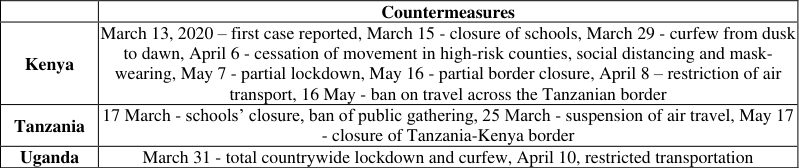 Table 1
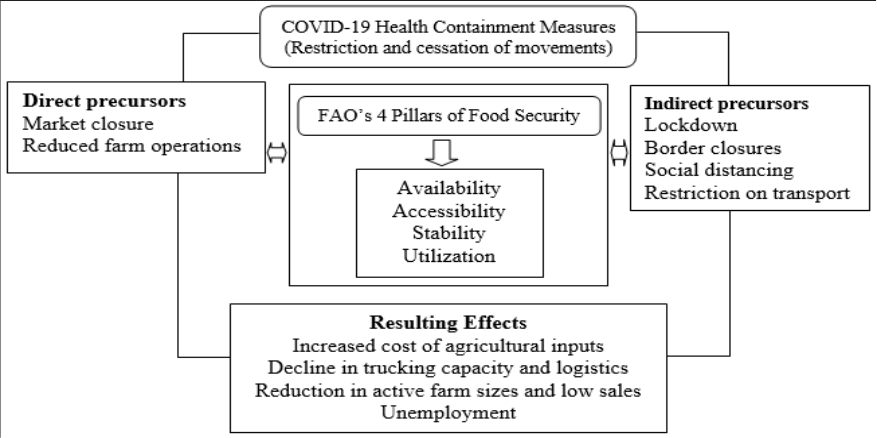 Figure 1
Introduction
The COVID 19 pandemic has had major implications on world agriculture since it was first documented at Wuhan, China in 2019 (Zhu et al., 2020) [1] . This has led to implementation and enforcement of containment measures that led to decline in agricultural production both in farm productivity and restriction of supply chains. Restrictions and cessation of movement highly negated outflow channels of farm produce, inflow channels of farm inputs and other production cycles (Pu & Zhong, 2020) [2] . Other countermeasures include ban of public gatherings that affected outdoor market systems of major cereals and vegetables. COVID-19 has disrupted global economies, with restrictions in movement (both domestic and international) leading to increased unemployment rates and global GDP (Gross Domestic Product) fluctuations. UN Migration Agency (2020) [3] Countermeasures Kenya Morton (2020) [4] argued that the effect of the pandemic on agricultural productivity can be seen from a multidimensional perspective. While some studies focused on the effect of the pandemic on food security (Pu and Zhong, 2020, Workie et al., 2020) [2,5] , others focused on the impact on agricultural supply chains (Gray, 2020) [6] . Other studies looked at the impact on food safety (Unhale et al., 2020) [7] . There are few research studies that focus on the implications of COVID-19 counteractive measures on agricultural productivity. This paper contributes to the already increasing literature on the effect of COVID-19 on agriculture. Our focus is on how lockdowns, restriction and cessation of movement affected agricultural productivity, assuming a case study from Namelok Estate, Kajiado Kenya. The COVID-19 pandemic affected agricultural productivity directly or indirectly. Direct impacts of the pandemic include; closure of markets and reduced on-farm productivity activities due to the precedented transport and logistic challenges caused by restriction of movements. These direct impacts led to an instant cut of food supplies from the retail outlets to the consumer. Restriction of movement was a major precursor to movement of inputs such as labor and seeds and agrochemicals which negated farm operations. Indirect precursors to reduced agricultural productivity and supply chains are closure of borders, social distancing, restricted transportation and logistics and lockdowns.
Conceptual Framework
Conceptual Framework
Methodology
The research assumed a qualitative method of data collection. Data was collected through personal interviews and field observations. Interviews were selected due to their appropriateness when exploring the views, beliefs and motivations of subjects, provides deeper understanding of social phenomena than would be possible if a quantitative approach was used (Silverman, 2013) [8] , and good if little is known about the phenomena of interest (Gill et al., 2008) [9] . Semistructured interviews were conducted with Namelok General manager Dickson Mutuku, and a few field workers. Field observations were also made and data was captured through photography.
Challenges 4.1 Increased costs of key agriculture inputs
The pandemic led to a great disruption in global value chains. Munywoki (2020) [10] noted that global manufacturing industry suffered a big blow due to disruptions arising from direct supply which increased direct supply deficiencies. Agricultural inputs such as fertilizers, pesticides and planting material rose in prices.
A rise in cost of these key implements led to an increase in cost of production, uneconomic production and low sales.
Decline in trucking capacity and logistics
Since registering its first COVID-19 case in 12th March 2020, the government put in place management interventions such asccessation of movements, curfew and lockdowns. Although provision of agriculture was highlighted as a key essential service, a major shift in demand from commercial to households tethered to limited availability of logistical services had a negative impact to the sector. For Namelok estate farm, it was hard to transport its produce to its neighboring towns. Besides, the farm opted to truck relatively smaller volumes of produce due to consumers' inability to buy in large quantities. Both transporters and traders had challenges in accessing farms and markets due to restriction of movements.
Reduction in active farm sizes and low sales
Intervention strategies put in place by the government (lockdown, curfew and cessation of movement) made people to decongest from eateries and hotels for meals. Instead, many people flocked at supermarkets for supplies. This change made Namelok farm to scale down its operations only to satisfy target market and avoid wastages. For instance, big hotels and public schools were no longer calling for supplies and this led to a dendritic chain of effects at the farm level such as retrenchment of daily laborers.
Unemployment
The reduction in active farm sizes at Namelok led to the farm management scaling down labor input which led to unemployment of daily laborers at the farm. This was also a change management to ensure the farm does not incur huge operational costs amidst a low responsive market.
Conclusion and policy implications
The enforcement of containment measures in the wake of COVID 19 had detrimental effects on the food supply systems as well as productivity of agricultural enterprises. Cessation and restriction of movement as health containment measures affected mobility of labor, farm produce and on-farm inputs such as fertilizers and insecticides. We recommend building resilience into the local agricultural food supply chains, and provision of government subsidies to cushion farmers during emergency.
Figures and tables from the paper
References
8 in the original paper- Pu M, Zhong Y. Rising concerns over agricultural production as COVID-19 spreads: Lessons from China. Global food security. 2020;26:100409.
- Un Migration Agency. Displacement Tracking Matrix (DTM) COVID-19 Regional Overview on Mobility Restrictions; c2020. Retrieved from: https://dtm.iom.int/reports/east-and-horn-africa- %E2%80%94-covid-19-regional-overview-mobilityrestrictions-16-july-2020
- Morton J. On the susceptibility and vulnerability of agricultural value chains to COVID19. World Development. 2020;136:105132
- Workie E, Mackolil J, Nyika J, Ramadas S. Deciphering the impact of COVID-19 pandemic on food security, agriculture, and livelihoods: A review of the evidence from developing countries. Current Research in Environmental Sustainability. 2020;2:100014.
- Gray RS. Agriculture, transportation, and the COVID-19 crisis. Canadian Journal of Agricultural Economics/Revue canadienne d'agroeconomie. 2020;68(2):239-243.
- Unhale SS, Ansar QB, Gajghane V, Bharudkar SS, Gadekar PP, Biyani KR. Impact of COVID-19 on food safety and food security. World journal of advance healthcare research. 2020;4(3):2457-0400.
- Gill P, Stewart K, Treasure E, Chadwick B. Methods of data collection in qualitative research: interviews and focus groups. British dental journal. 2008;204(6):291-295.
- Munywoki GN. Economic Effects of Novel Coronavirus (COVID-19) on the Global Economy. The Impact of Coronavirus. 2020;1(2).