
Research article · 2022 · Full text
International Journal of Research in AgronomyImpact of cutting and splitting of nitrogen doses on growth, yield and quality of fodder oat
Volume 5(2) · Pages 39–41 · DOI: 10.33545/2618060x.2022.v5.i2a.111 ↗
Research areasCrop Yield and Soil FertilityAgricultural Science and Fertilization
Abstract
Author-writtenA field experiment was conducted at Forage research field under All India Coordinated Research Project on (Forage Crops & Utilization) situated at College of veterinary science and Animal Husbandry, Kanke Ranchi (Jharkhand) to evaluate the effect of cutting and splitting of nitrogen levels on oat. Pooled of three years data showed that, the oat variety RO-19 recorded more plant height (104.58 cm), GFY (461.12 q ha-1), DFY (90.91 q ha-1), crude protein content (5.93), crude protein yield (5.38), crude fiber (46.25%), IVDMD (60.55%), Gross return (Rs 69,168 only), net return (Rs. 43,483 only) and B:C ratio (2.71).While among the cutting and nitrogen management three cuts + 50% Basal + 25% at 1st cut + 25% at 2nd cut recorded some marginal better tillers per meter row length (111.78), green fodder yield (437.0 q ha-1), DFY (85.91 q ha-1) crude fiber (47.45%), crude fat (5.90%),.With regards to economic Variety RO-19 with Two cut + 50% Basal+50% at 1st cut recorded better than other variety JHO-85 and UPO-212 with different combinations of cutting and nutrient management.
Summary
Source-checkedPlain-language reading of the full paper, prepared with AI and checked against the text. Each point links to the authors' own words.
Why it matters
- India supports a significant portion of the global human and livestock populations despite having limited land and water resources. View evidence ↗
- The state of Jharkhand faces specific pressure to provide food for millions of people and a portion of the national livestock with very limited land. View evidence ↗
- Oat is a viable Rabi fodder crop because it can survive dry conditions and performs well with irrigation. View evidence ↗
The question
- The study aimed to evaluate how different cutting intervals and the splitting of nitrogen doses affect the growth, yield, and quality of fodder oat. View evidence ↗
What they did
- Researchers used a Split plot Design testing three oat varieties (RO-19, JHO-85, and UPO-212) against four different combinations of cutting and nitrogen application. View evidence ↗
- The crops were sown at a seed rate of 80 kg ha-1 with a recommended fertilizer dose of 80:40:30 kg ha-1 for N, P2O5, and K2O. View evidence ↗
What they found
- The RO-19 variety achieved the greatest plant height at 104.58 cm. View evidence ↗
- Variety JHO-85 had significantly more tillers per meter row length (133.83) and took longer to reach 50% flowering (96.33 days) than RO-19 and UPO-212. View evidence ↗
- RO-19 produced the highest green fodder yield (461.12 q ha-1) and dry fodder yield (90.91 q ha-1) compared to JHO-85 and UPO-212. View evidence ↗
- Among the management treatments, the combination of three cuts with 50% basal nitrogen and 25% at the first and second cuts yielded the most green fodder (437.00 q ha-1) and dry fodder (85.91 q ha-1). View evidence ↗
- RO-19 exhibited superior quality with 5.93% crude protein, a protein yield of 5.38 q ha-1, and a leaf:stem ratio of 0.55. View evidence ↗
- In-vitro dry matter digestibility (IVDMD) was highest (62.34%) with two cuts and 60% basal nitrogen, and lowest (57.38%) with three cuts and 50% basal nitrogen. View evidence ↗
- While three cuts produced more green fodder yield, two cuts were more economical because the labor cost of a third cutting outweighed the additional yield. View evidence ↗
What it means
- The authors conclude that the RO-19 variety is the best performing in terms of growth, yield, quality, and economic returns. View evidence ↗
Visual summary
2 visualsIllustrations explain the paper; charts are replotted from the paper's own table values.

Yield vs. Profit Trade-off
AI-generated conceptual illustration (fodder oat plants). It explains the idea and does not show study data.
View source evidence ↗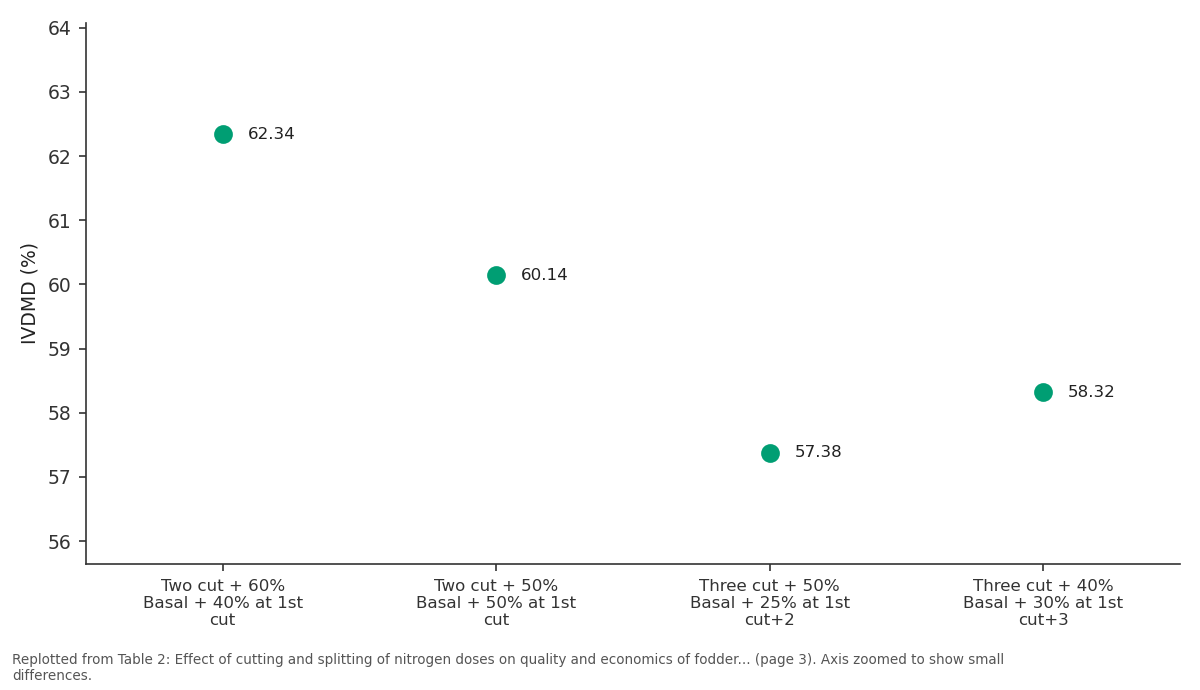
IVDMD (%): Two cut + 60% Basal +... vs Two cut + 50% Basal +... vs Three cut + 50% Basal +... vs Three cut + 40% Basal +...
Replotted from Table 2 (page 3) of the original paper. Every bar is the paper's own table value.
View source evidence ↗Figures & tables
From the original paper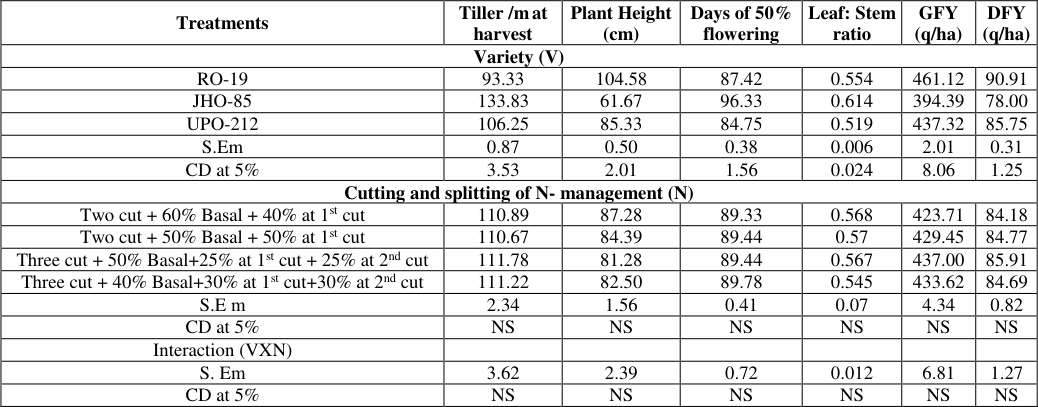 Table 1
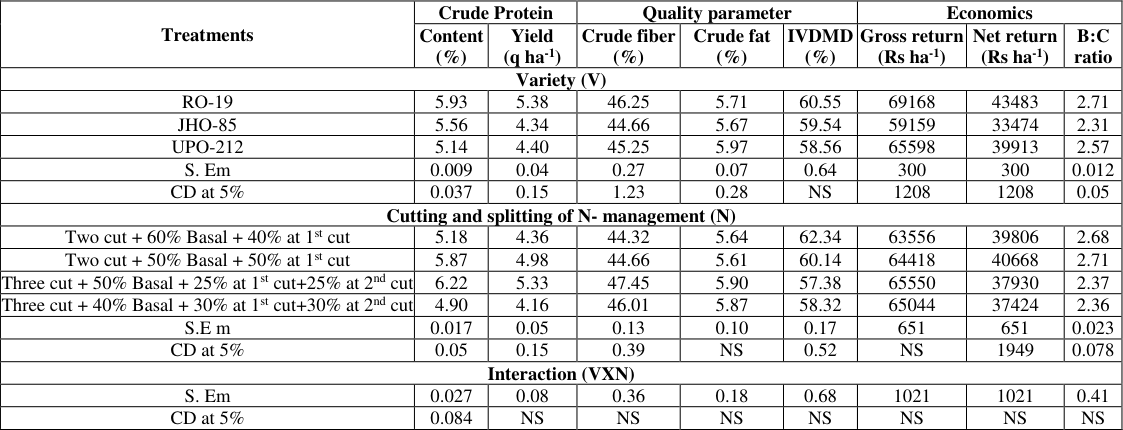 Table 2
Introduction
Among the different Agricultural activities crop and livestock production is a key component of farming systems not only in India but also among South-East Asia and in Africa particularly with small and marginal farmers, estimated about 678 million, which indicates importance of livestock to their livelihoods (Anonymous, 2000). India with 2.4 per cent of the land and 4.0 per cent of water resources supports livelihood to 17.84 per cent of global human population as well as nearly 20 per cent of the world livestock. Jharkhand faces pressure to feed the 32 million human and 3.42 per cent of national livestock population with just 2.42 per cent land of the country. In this state livestock is rearing over 0.12 per cent of fodder area and 0.95 per cent of grazing land and contributing equal percentage of fodder and milk (0.9%) yield in national pool with 180 g day -1 capita -1 available milk for Jharkhand people against the 240 g day -1 capita -1 for national average (Anonymous, 2016). Thus, there is scope/need to grow green fodder during Rabi season under limited irrigation condition. Among the different Rabi fodder Oat has enough potential to survive dry condition and also perform well under assured irrigation. Cutting and nitrogen application are major components for optimum quality fodder production thus the experiment was laid out.
Materials and Methods
A Field experiment was conducted during Rabi season of three consecutive years 2019-20, 2020-21 and 2021-22 at Ranchi in the state of Jharkhand situated at 23 o .34' N latitude and 85 o .31 ' E longitudes at an altitude of 645.45 meter above the mean sea level. It falls under humid sub-tropical climatic conditions, which have features of hot dry summers and cool dry winters. The soil of the experimental field was sandy loam in texture, slightly acidic in reaction having different physical and chemical properties mentioned as organic carbon 3.84 g kg-1 of soil, soil Ph 6.12, Available N 245 kg ha -1 , (Subbiah and Asija (1956) [9] . P2O5 26.87 kg ha -1 and K2O 185 kg ha -1 and water holding capacity 37.5%. The experiment was laid out in Split plot Design (SPD) having main plot three different varieties viz RO-19, JHO-85 and UPO-212 sub plot four combinations of cutting and nitrogen levels as Two cut + 60% Basal + 40% at 1 st cut, Two cut + 50% Basal + 50% at 1 st cut, Three cut + 50% Basal+25% at 1 st cut + 25% at 2nd cut and Three cut + 40% Basal + 30% at 1 st cut + 30% at 2 nd cut. Above treatment were sown in plot size 4 m x 3 m and replicated thrice.
Initialy well decomposed Farm Yard Mannure @10 tons ha-1 were applied.The recomended seed rate (RSR) for Oat: 80 kg ha-1 with Recomended dose of fertilizer (RDF) -80:40: 30 (N: P2O5:K2O kg ha -1 Rabi season during the crop period received very less rain fall which was occurred during early sowing stage i.e just after sowing. The post monsoon period (October to December) had a fair weather with gradual fall of temperature without rain. The pooled average of crop year the maximum and minimum temperature for crop were 23.43 °C and 6.85 °C, the relative humidity fluctuated from 85.9 to 37.1. Crops were in good condition and irrigation and other Agronomical practices were made on time to reach their requirement for better growth and yield. Fodder were fertilized and harvested at proper time. Data on diffrent parameters were collected and analyzed follow the standered formulla prescribed by Cochran WG and Cox GM, 1957 [1] .
Result and Discussion
Results on growth and yield are elaborated with proper discussion here under different sub head as-
Growth characters
Three years pooled data reflects that, among the growth characters tillers per meter row length (133.83), & taken 96.33 days to attain 50% flowering by Oat variety JHO-85, which were significantly more over other tested variety RO-19 and UPO-212, while RO-19 recorded significantly more plant height (104.58 cm).This was due to fact that distribution of photosynthate produced resulted into dry matter accumulation being converted in formation of tillers, attaining height and other life survival activity. (Table 1). Kumar et al. (2001) [5] had also state the similar facts regarding development of tillers and corresponding height attend by the fodder oat. In other hand combinations of nitrogen and cutting management, i.e, three cuts + 50% Basal+25% at 1 st cut+25% at 2 nd cut recorded slightly better in terms of tillers per meter row length (111.78), plant height (81.28 cm) over other combinations. Splitting of nitrogen improved nutrient use efficiency as well as less proliferation of weed. Raja, Waseem (2013) [6] also stated the same and advocated regarding cutting and spliting of nitrogen.
| Treatments | Tiller /m at harvest | Plant Height (cm) | Days of 50% flowering | Leaf: Stem ratio | GFY (q/ha) | DFY (q/ha) |
|---|---|---|---|---|---|---|
| Variety (V) | ||||||
| RO-19 | 93.33 | 104.58 | 87.42 | 0.554 | 461.12 | 90.91 |
| JHO-85 | 133.83 | 61.67 | 96.33 | 0.614 | 394.39 | 78.00 |
| UPO-212 | 106.25 | 85.33 | 84.75 | 0.519 | 437.32 | 85.75 |
| S.Em | 0.87 | 0.50 | 0.38 | 0.006 | 2.01 | 0.31 |
| CD at 5% | 3.53 | 2.01 | 1.56 | 0.024 | 8.06 | 1.25 |
| Cutting and splitting of N- management (N) | ||||||
| Two cut + 60% Basal + 40% at 1st cut | 110.89 | 87.28 | 89.33 | 0.568 | 423.71 | 84.18 |
| Two cut + 50% Basal + 50% at 1st cut | 110.67 | 84.39 | 89.44 | 0.57 | 429.45 | 84.77 |
| Three cut + 50% Basal+25% at 1st cut + 25% at 2nd cut | 111.78 | 81.28 | 89.44 | 0.567 | 437.00 | 85.91 |
| Three cut + 40% Basal+30% at 1st cut+30% at 2nd cut | 111.22 | 82.50 | 89.78 | 0.545 | 433.62 | 84.69 |
| S.E m | 2.34 | 1.56 | 0.41 | 0.07 | 4.34 | 0.82 |
| CD at 5% | NS | NS | NS | NS | NS | NS |
| Interaction (VXN) | ||||||
| S. Em | 3.62 | 2.39 | 0.72 | 0.012 | 6.81 | 1.27 |
| CD at 5% | NS | NS | NS | NS | NS | NS |
Table text extracted from the original PDF; superscript letters are shown inline. The original table image is below.
View original table image
Fodder yield
Different oat varieties harvested as per cutting management, total yield of different cuts in year and accordingly pooled yield of three years in green as well as dry condition are presented in table 1. Results reflects that, Variety RO-19 yielded 461.12 q ha-1 as green fodder & 90.91 q ha-1 as dry fodder which were significantly more over other tested variety JHO-85 (394.39 & 78.0 q/ha) & UPO-212 (437.32 & 85.75 q ha-1 ). This is due to combined effect of genetic potential of varieties coupled with effects of tillers as well as height. Joon et al. (1993) [2] also reported the same. In other hand combinations of nitrogen and cutting management, i.e, three cuts + 50% Basal + 25% at 1 st cut + 25% at 2 nd cut recorded more GFY (437.00 q ha-1 ) and DFY (85.91 q ha-1 ). Number of cutting as well as splitting of nitrogen had no effect on GFY & DFY. Joshi, et al. (1997) [3] also advocated regarding spliting of nitrogen is essential for better growth as wll as yield of forage oat.
Quality character
Among the different quality characters leaf: stem ratio and crude protein content and yield were calculated and presented at table 2. Results showed that, Variety RO-19 contains 5.93% crude protein and produced 5.38 q ha-1 with leaf: stem ratio 0.55 which were more over other varieties under test Besides it three cuts + 50% Basal + 25% at 1 st cut + 25% at 2 nd cut recorded more CP content (6.22%) and CPY (5.30 q/ha). Among the other quality parameter variety RO-19 recorded more crude fiber (46.25%), IVDMD (60.55%), while variety UPO-212 contains more crude fat (5.97%). In other hand cutting and splitting of nitrogen influenced the crude fiber, crude fat as well as IVDMD. Among the different cutting and splitting of nitrogen as three cut + 50% Basal+25% at 1 st cut+25% at 2 nd cut recorded more crude fiber (47.45%), crude fat (5.90%), however, IVDMD decreased with the increased number of cutting and reduced dose of nitrogen at later cut. Two cut + 60% Basal + 40% at 1 st cut recorded more IVDMD (62.34%) while same was lower under Three cut + 50% Basal + 25% at 1 st cut + 25% at 2 nd cut (57.38%). This is due to better nitrogen uptake and succulence of the variety. Singh and Dubey (2008) [8] stated regarding quality in terms of protein content of double cut fodder oat. They stated quality of fodder oat deteriorated as advancement of age and cutting of the fodder. [4] and Sheoran, et al. (2002) [7] stated regarding better economic of oat up-to double cut.
| Treatments | Crude Protein | — | Quality parameter | — | — | Economics | — | — |
|---|---|---|---|---|---|---|---|---|
| Content (%) | Yield (q ha-1) | Crude fiber (%) | Crude fat (%) | IVDMD (%) | Gross return (Rs ha-1) | Net return (Rs ha-1) | B:C ratio | |
| Variety (V) | ||||||||
| RO-19 | 5.93 | 5.38 | 46.25 | 5.71 | 60.55 | 69168 | 43483 | 2.71 |
| JHO-85 | 5.56 | 4.34 | 44.66 | 5.67 | 59.54 | 59159 | 33474 | 2.31 |
| UPO-212 | 5.14 | 4.40 | 45.25 | 5.97 | 58.56 | 65598 | 39913 | 2.57 |
| S. Em | 0.009 | 0.04 | 0.27 | 0.07 | 0.64 | 300 | 300 | 0.012 |
| CD at 5% | 0.037 | 0.15 | 1.23 | 0.28 | NS | 1208 | 1208 | 0.05 |
| Cutting and splitting of N- management (N) | ||||||||
| Two cut + 60% Basal + 40% at 1st cut | 5.18 | 4.36 | 44.32 | 5.64 | 62.34 | 63556 | 39806 | 2.68 |
| Two cut + 50% Basal + 50% at 1st cut | 5.87 | 4.98 | 44.66 | 5.61 | 60.14 | 64418 | 40668 | 2.71 |
| Three cut + 50% Basal + 25% at 1st cut+25% at 2nd cut | 6.22 | 5.33 | 47.45 | 5.90 | 57.38 | 65550 | 37930 | 2.37 |
| Three cut + 40% Basal + 30% at 1st cut+30% at 2nd cut | 4.90 | 4.16 | 46.01 | 5.87 | 58.32 | 65044 | 37424 | 2.36 |
| S.E m | 0.017 | 0.05 | 0.13 | 0.10 | 0.17 | 651 | 651 | 0.023 |
| CD at 5% | 0.05 | 0.15 | 0.39 | NS | 0.52 | NS | 1949 | 0.078 |
| Interaction (VXN) | ||||||||
| S. Em | 0.027 | 0.08 | 0.36 | 0.18 | 0.68 | 1021 | 1021 | 0.41 |
| CD at 5% | 0.084 | NS | NS | NS | NS | NS | NS | NS |
Table text extracted from the original PDF; superscript letters are shown inline. The original table image is below.
View original table image
Although GFY was more under three cuts while, better economic was recorded under two cut only due to cost of labour in third cutting which succeeded over third cuts yield.
Summery and Conclusion
In order to asses better combinations of varieties, with cutting and nutrient management experiment for three years was conducted and pooled /mean performance in terms of growth, yield, quality and economic were studied. Results summarized as oat variety RO-19 performed better growth, yield, quality and economic.
Acknowledgement
AcknowledgmentI acknowledge the contribution of Biochemist of AICRP on forage crops of Rhuri centre for his help in quality analysis and also thankful to the Department of Agronomy, BAU Ranchi for his support in soil analysis and other moral support.
References
8 in the original paper- Joon RK, Yadav BD, Faroda AS. Effect of nitrogen and cutting management on grain production of multi-cut oat (Avena sativa). Indian Journal of Agronomy. 1993;38(1):19-21.
- Joshi YP, Singh V, Verm SS. Effect of nitrogen and cutting managements on herbage yield of oat varieties. Forage Research. 1997;22(4):249-252.
- Kumar Y, Sharma BL, Yadav GL, Sharma PK. Nitrogen management in fodder crop of double-cut oat (Avena Sativa L.). Indian Journal of Agronomy. 1997;42(2):313-315.
- Kumar Arvind, Jaiswal RS, Verma ML, Joshi YP. Effect of nitrogen level and cutting management on yield and quality of different varieties of oat fodder. Indian Journal of Animal Nutrition. 2001;18(3):262-266.
- Raja Waseem. Suitable cropping system and weed management practices for higher fodder oat production. Indian Journal of Weed Science. 2013;45(3):210-203.
- Sheoran RS, Rana DS, Garewal RPS. Influence of Azotobacter inoculation conjunction with graded doses of nitrogen on forage yield of oat (Avena sativa. L). Forage Research. 2002;28(1):8-12.
- Singh SD, Dubey SN. Effect of sources of nutrient on yield and nutritive value of fodder oat (Avena sativa Linn) under two cutting systems International Journal of Agricultural Science. 2008;4(1):237-241.
- Subbiah BV, Asija HL. A rapid procedure for estimation of the available nitrogen in soil. Current science. 1956;25:259260.