
Research article · 2019 · Full text
International Journal of Agriculture Extension and Social DevelopmentAn appraisal of utilization level of screw press technology among Gari producers in Kwara state, Nigeria
Volume 2(2) · Pages 41–46 · DOI: 10.33545/26180723.2019.v2.i2a.31 ↗
Research areasLivestock and Poultry ManagementAgriculture and Rural Development Research
Abstract
Author-writtenThe study assessed utilization level of manual screw press for gari production in Kwara, State, Nigeria. Using multistage sampling technique and a semi structured questionnaire as instrument, data for the study were collected from a sample of three hundred and eighty four (384) gari processors who use the screw press in the state. Descriptive statistics namely frequency count, percentages, and mean was used for analysis of data. The study established that though level of utilization of agricultural innovation was low generally in the region; nonetheless utilization level of the manual screw press was high in the study area. The study concluded that gari processors in the study area utilize the manual screw press at a high level because the technology has considerable relative advantage over traditional methods
Summary
Source-checkedPlain-language reading of the full paper, prepared with AI and checked against the text. Each point links to the authors' own words.
Why it matters
- Sub-Saharan Africa faces significant food insecurity and has some of the lowest rates of agricultural technology use globally. View evidence ↗
- The cassava sector is limited by poor access to and low use of improved processing technologies, despite growth in production. View evidence ↗
- The reliance on traditional methods over improved cassava processing technologies is linked to annual crop losses in the region. View evidence ↗
The question
- The study aimed to assess the level of utilization of the manual screw press for gari production in Kwara State, Nigeria. View evidence ↗
What they did
- The research used a multi-stage sampling technique to select 384 gari processors in Kwara State, Nigeria. View evidence ↗
- Data were collected via face-to-face interviews and analyzed using descriptive statistics, including frequency counts, percentages, and means. View evidence ↗
- Utilization was measured as a continuous variable based on the percentage of production using the screw press, ranging from 'Very low' (1-20%) to 'Very high' (81-100%). View evidence ↗
What they found
- Gari processing in the study area is dominated by women, who made up 89% (343) of the respondents compared to 11% (41) males. View evidence ↗
- The average age of the gari processors surveyed was 51 years. View evidence ↗
- Respondents were well-experienced, with a mean of 22.31 years in gari processing. View evidence ↗
- Extension contact was very low, with 93.0% (358) of respondents reporting no contact with extension agents in the previous year. View evidence ↗
- A high level of utilization was found, with 46.5% (179) of respondents using the screw press for 81-100% of their production. View evidence ↗
- An additional 12.5% (48) of respondents showed a 'high' utilization level, using the technology for 61-80% of their production. View evidence ↗
- Moderate utilization (41-60% of production) was reported by 32.7% (126) of the respondents. View evidence ↗
- Low utilization (21-40%) was seen in 6.2% (24) of respondents, and very low utilization (1-20%) in 1.8% (7) of respondents. View evidence ↗
What it means
- The authors conclude that the high utilization is due to the screw press's relative advantages over traditional methods, including reduced labor, ease of use, faster processing, and better gari quality. View evidence ↗
- The study concludes that the manual screw press is utilized at a high level because it offers a considerable relative advantage over traditional methods. View evidence ↗
Visual summary
1 visualsIllustrations explain the paper; they do not show study data.
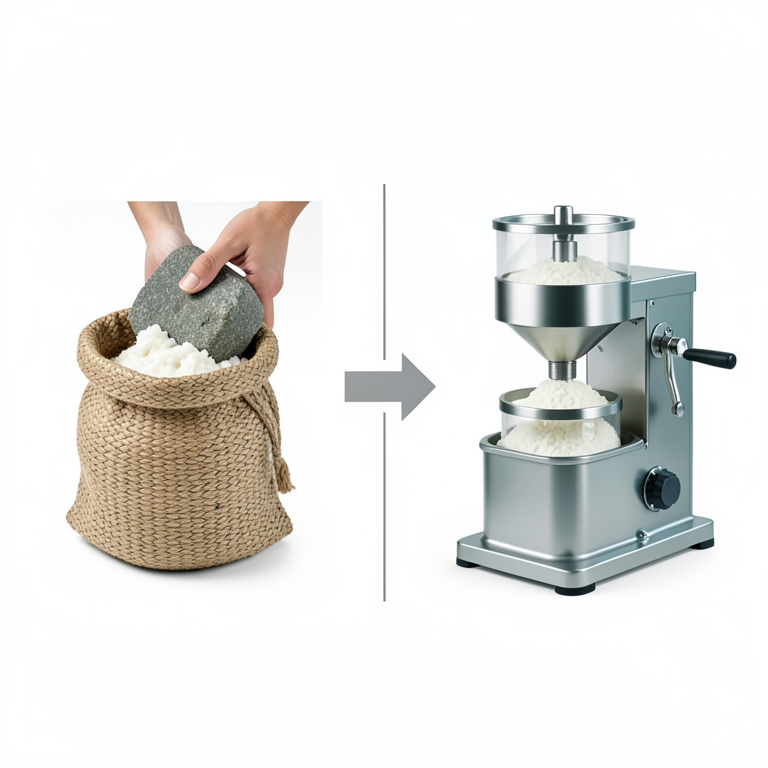
Relative Advantages of Screw Press
AI-generated conceptual illustration (Cassava pulp and a mechanical screw press machine). It explains the idea and does not show study data.
View source evidence ↗Figures & tables
From the original paper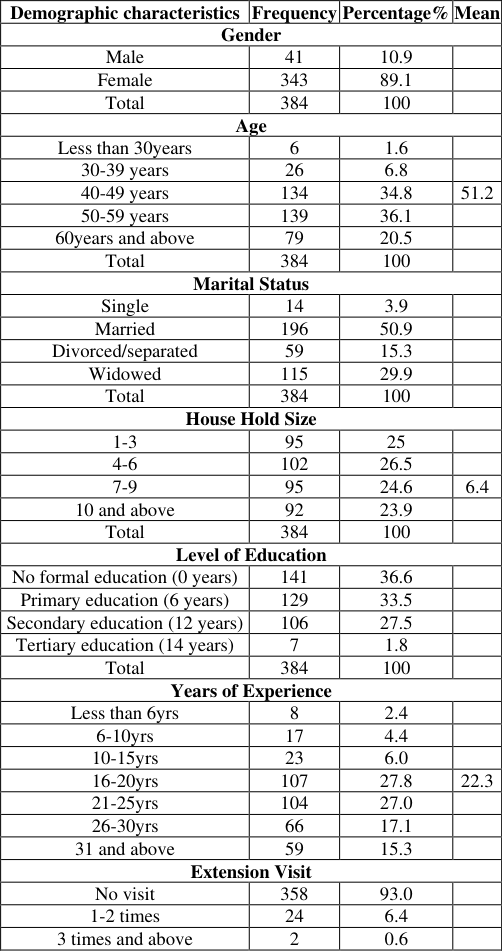 Table 1
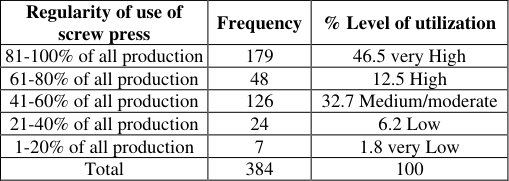 Table 2
Introduction
Sub-Saharan Africa suffers from one of the highest rates of food insecurity, and has one of the lowest levels of agricultural technology utilization (Challa, 2013) [6] . In other words, despite decades of investment in agricultural innovations, hunger, and poverty have continued to afflict Africa, specifically sub-Saharan Africa where use of improved agricultural technologies is low and their effects less apparent (Saka & Lawal, 2009, Quartey & Darkwah, 2015) [29,27] . For instance, most of the improved rice postharvest technologies have not been adopted and utilized by stakeholders in the rice postharvest sector in Nigeria (Arimi & Adekoya, 2013) [4] . Similar to Arimi & Adekoya (2013) [4] , FAO & IFAD (2005) [10] maintained that despite the rapid growth in cassava production, the cassava subsector is constrained by inadequate access and low utilization of improved processing technologies. Agricultural sector in Africa remains characterized by low use of improved technology and low productivity and thus incapable to meet the increasing food requirements of a growing population (Obisesan, 2014) [21] . Improving the livelihoods of rural farm households via agricultural productivity would remain a mere wish if agricultural technology utilization level continues to be low in developing countries (Ajayi, Franzel, Kuntashula, & Kwesiga, 2003) [2] . Despite the benefits of improved technology for the day to day farming operations as a departure from the conventional or traditional mode, many farmers have not, or are hesitant to integrate improved technologies into their farming activities (Gagnon & Dragon, 1998, and Allen & Seaman, 2007) [12,3] . Whilst there have been some evidence of new crop varieties in some countries in Africa, utilization rates remain far lower than countries in Asia, casting fears on the possibility of a green revolution; for instance, in year 2000, African adoption rates of improved rice, wheat and maize varieties per area harvested were less than half those of rates in East and Southeast Asia, and the situation has not changed much (Dethier & Effenberger, 2012) [7] . While most African countries are at the bottom of technology utilization index, some of these countries have displayed steady progress either in ranking or overall score. For example, six of the region's countries made the top 100, including Mauritius, Seychelles, South Africa, Rwanda, Kenya, and Cape Verde (Pepper, 2015) [25] . Despite the fact that data are scarce to quantify agricultural technology usage amongst nations and regions of the world, mobile phone innovation usage can give an insight on level of utilization of agricultural innovation around the world; data available for mobile phone utilization show that mobile phone use among adults in developed nations is about twice of that of underdeveloped nations. For example, in year 2017 89% of all adults in United States of America use a mobile phone, Nigeria 42%, Ghana 26%, and Sweden 92% (Silver & Johnson, 2018) [31] . Majority of small scale farmers in Africa rely on utilization of traditional methods instead of improved ones (Saka & Lawal, 2009) [29] . For example, low utilization of improved cassava processing technologies and utilization of traditional methods has been indicted for annual losses for cassava in this region (Heike, 2013) [13] . Categorically, in East Africa, many farmers are slow to adopt technology innovations (Doss, 2003) [8] . Corroborating Doss (2003) [8] , Association for Strengthening Agricultural Research in Eastern and Central Africa (ASARECA) (2012) [5] maintained that adoption of improved agricultural technology in East Africa is low. Through 'Leapfrogging' (rapid spread of technology in the Third World, especially in Africa) however, areas with poor technology utilization in Africa have moved forward rapidly in the course of adoption of modern technology without going through intermediary steps (Ramirez, 2018) [28] . Though utilization of improved postharvest technologies even on a small scale can have a positive effect on food security (Obayelu, 2014) [20] , evidences from developing countries have shown that utilization of these technologies is lagging compared with usage in developed countries (Suleman, 2012, Adeyeye, and Oladipo, & Adeyeye, 2013) [32, 1] . For example, the African continent generally has not kept pace with utilization of technological innovations compared with developed countries, and the most affected region is Sub-Saharan Africa (United Nations Centre on Transnational Corporations (UNCTAD), 2003) [34] .
Material and Methods
The study was conducted in Kwara State, Nigeria. The state is located between Latitude 8 0 05 ' and 10 0 05 ' North and Longitude 2 0 50 ' and 6 0 05 ' East of Greenwich Meridian (Oyebanji, 2000) [24] . According to National Bureau of Statistics (2012) [18] Kwara state has a land mass of 35,705 square kilometres (km 2 ). The 2006 population census by the National Population Commission put the population of the state at 2,371,089 (Federal Government of Nigeria, 2007) [11] . However, it was projected that the population of the state would have risen to 3,192,893 by 2016 (National Bureau of Statistics, 2018) [19] . Agriculture and agroprocessing is the main source of the economy of the state. This study evolved a cross-sectional survey research design. Multi-stage sampling technique was used to select respondents for the study. For this study, a necessary sample size of 384 was calculated and adopted using the formula by Smith (2013) [30] for determining necessary sample size when the population is unknown or approximated. One local government area (LGA) apiece from the four agricultural zones of the state namely Kaima, Edu, Asa, and Ifelodun was purposively selected to ensure that the study cuts across the Agricultural Development Project (ADP) zones in the state. Three (3) wards from each selected local government area (LGA) were selected at random. Consequent upon the fact that it is difficult, if not impossible to come up with a sample frame for the study by the researcher or from secondary sources; because of the nature of the population itself, it was imperative that Gari processors who utilize the manual screw press who have been previously identified through the assistance of local resource persons from each ward were selected through a simple random sampling. Data was collected by the researcher through face to face interviews technique. To ensure that our instrument possesses both face and content validity in accordance with objective of the study, our research instrument was validated by competent staff of Department of Sociology, Benue State University, and seasoned extension officials from the department of Outreach Services, Nigerian Stored Products Research Institute, Ilorin, Kwara state. Thereafter, necessary modifications were made; ambiguous items were made precise while irrelevant items were jettisoned. Afterwards, the test for reliability for the research instrument was conducted (using a test-retest method) in Ilorin, Kwara state with 20 randomly selected gari processors within an interval of two weeks. The score for each exercise was computed and subjected to Pearson product moment correlation analysis. The Coefficient of reliability (r) was 0.7 and implied that the instrument was reliable. Afterwards our instrument was adapted and administered on gari processors selected for our study. Descriptive statistics (frequency count, percentages, and mean) was used for data analysis. The combine population figure for the four local Government Areas based on figures from National Bureau of Statistics (2012) [18] [17] utilization usually www.extensionjournal.com takes on a value of 1% to 100%. For this study utilization was measured thus: 81-100% use of the manual screw press in all production (Very high utilization level), 61-80% (High utilization level), 41-60% (Moderate utilization level), 21-40% (Low utilization level), and 1-20% (Very low utilization).
Results and Discussion
Results and Discussion
Gender
Table 1 shows that 11% (41) of the respondents were males while 89% (343) were females; indicating female domination in gari processing in the study area. The possible reason for this disparity could be that cultural norms and values, and gender relations have limited men participation in gari processing. In addition, cassava itself is seen as a crop for women in the study area. This result is in agreement with the findings of Ogunleye, Adeola, & Ibigbami (2008) [22] , and Koledoye, Deji, Owombo & Toromade (2012) [15] that showed that women are more involved than men in gari processing in Nigeria.
| Demographic characteristics | Frequency | Percentage% | Mean |
|---|---|---|---|
| Gender | |||
| Male | 41 | 10.9 | |
| Female | 343 | 89.1 | |
| Total | 384 | 100 | |
| Age | |||
| Less than 30years | 6 | 1.6 | |
| 30-39 years | 26 | 6.8 | |
| 40-49 years | 134 | 34.8 | 51.2 |
| 50-59 years | 139 | 36.1 | |
| 60years and above | 79 | 20.5 | |
| Total | 384 | 100 | |
| Marital Status | |||
| Single | 14 | 3.9 | |
| Married | 196 | 50.9 | |
| Divorced/separated | 59 | 15.3 | |
| Widowed | 115 | 29.9 | |
| Total | 384 | 100 | |
| House Hold Size | |||
| 1-3 | 95 | 25 | |
| 4-6 | 102 | 26.5 | |
| 7-9 | 95 | 24.6 | 6.4 |
| 10 and above | 92 | 23.9 | |
| Total | 384 | 100 | |
| Level of Education | |||
| No formal education (0 years) | 141 | 36.6 | |
| Primary education (6 years) | 129 | 33.5 | |
| Secondary education (12 years) | 106 | 27.5 | |
| Tertiary education (14 years) | 7 | 1.8 | |
| Total | 384 | 100 | |
| Years of Experience | |||
| Less than 6yrs | 8 | 2.4 | |
| 6-10yrs | 17 | 4.4 | |
| 10-15yrs | 23 | 6.0 | |
| 16-20yrs | 107 | 27.8 | 22.3 |
| 21-25yrs | 104 | 27.0 | |
| 26-30yrs | 66 | 17.1 | |
| 31 and above | 59 | 15.3 | |
| Extension Visit | |||
| No visit | 358 | 93.0 | |
| 1-2 times | 24 | 6.4 | |
| 3 times and above | 2 | 0.6 |
Table text extracted from the original PDF; superscript letters are shown inline. The original table image is below.
View original table image
Age
Table 1 shows that 1.6% (6) of the respondents were within the age range of 20 to 29 years, 6.8% (26) were within the age range of 30 to 39, 34.8% (134) were between 40 and 49 years, 36.1% (139) fell within the 50 and 59 age range, while 20.5% (79) were either 60 years of age or more. The average age of the respondents was 51 years, indicating a relatively high proportion of processors have passed middle age. Overall, the result implies that the respondents are relatively young, active, likely to be very productive, have lower degree of risk aversion and can participate actively in utilization of agricultural innovations.
Marital status
Table 1 further show that 3.9% ( 14) of the respondents are single, followed by 50.9% (196) who are married. Again, 15.3% (59) of our respondents are either divorced or separated, and 29.9% (115) are widowed. The result implies that majority of the gari processors using the screw press in the study area are married.
Household size
Table 1 shows that the households that had between 1 to 3 members made up 24.4% (95) of the respondents, 4 to 6 member household constituted 26.5% (102), 7 to 9 member constituted 24.7% (95), while those households with 10 members or more made up 23.9% (92) of the respondents. The average household size of the respondents is 6.4 members; a number that is a little higher than the national average of 6.1. The implication of this result is that the respondents have a large-sized household. Household size has been recognized to play a vital role in the utilization of most technologies or farm practices (Idrisa, Gwary, & Ibrahim, 2008); it influences the availability and supply of unpaid labor especially in cassava processing were labor is intensive.
Level of education
Table 1 revealed that 36.6% (141) of the respondent lacked formal education, 33.5% (129) of respondents had primary education, while 27.5% (106) had secondary education. However, a meager 1.8% (7) of the respondents had education beyond secondary education. An examination of the level of formal education is necessary because, it determines to what extent the processor could imbibe new ideas as well as innovations. The result indicated that majority of respondents had formal educational but at a relatively low level. In other words a larger number of our respondents are formally educated and by implication possess the education to understand the implications of utilizing the manual screw press.
Processing experience
Table 1 again shows that 2.4% (8) of the respondents had below 6 years of processing experience, 4.4% (17) had between 6 and 10 years of experience, while 6.0% (23) had between 11 and 15 years of processing experience. Furthermore, 27.8% (107) of the respondents had between 16-20 years' experience, while 27.0% (104) had between 21 www.extensionjournal.com and 25 years processing experience. Processors with 26 to 30 years processing experience constituted 17.1% (66) of the respondents, whereas 15.3% (59) had 31 years or more of such experience. Majority of the processors had processing experience of 16-20 years. The mean years of processing experience was 22.31 years, implying that the processors are well experienced. Long years of experience will enhance processors understanding and aid adoption of the screw press for dehydrating/dewatering cassava mash for gari production. Long years of experience of the respondent could be adduced for the high level of utilization of the manual screw press identified later on in the study.
Extension contact
Table 1 shows that 93.0% (358) of the respondents have not had contact with extension agents in the past year, while 6.4% (24) have had 1 to 2 contact(s). However, a meagre 0.6% has had contacts 3 times and above. The result indicates that extension contact in the study area is low. The implication of this is that respondents would have low awareness level of agricultural technologies in general, and other relevant dehydrating technologies for cassava processing into gari in particular in the area. The result confirms the finding of Oluwasuji & Akanni (2014) [23] that farmers contact with extension services in Nigeria is poor. For example, extension agent farming family ratio in Kwara state is at a ridiculous one (1) agent to four thousand (4000) farming families (Kwara State Government, 2017) [16] . Table 2 shows the distribution of respondents based on their level of utilization of the manual screw press technology for gari production. The Table shows that 46.5% (179) of the respondents use the screw press in about 81% to 100% of the time in their gari production. In other words, the utilization level of 46.5% of respondents is high (very high). 12.5% (48) of the respondents use the screw press in about 61% to 80% of the time in their gari production. In other words, utilization level of 12.5% of respondents is high. Also, 32.7% (126) of the respondents use the screw press 41% to 60% of the time in their gari production. In other words, utilization level of 32.7% of respondents is moderate. Furthermore, 6.2% (24) of the respondents use the screw press 21% to 40% of the time in their gari production. That is 6.2% of respondent have low level utilization. Lastly, 1.8% (7) of the respondents uses the screw press in their gari production 1% to 20% of the time. In other words, 1.8% of respondents have very low utilization level. Our finding is consistent with that of Mbanaso (2011) who found that utilization level for improved dewatering practices for sweet potato mash is high among farmers in south-eastern Nigeria. This study is also in conformity with the position of Pepper (2015) [25] that though most African countries are at the bottom of technology utilization index, some African countries have displayed steady progress either in ranking or overall score. For example, six of the region's countries made the top 100, including Mauritius, Seychelles, South Africa, Rwanda, Kenya, and Cape Verde. Through 'Leapfrogging' countries with poor technology utilization in Africa have moved forward rapidly in the course of utilization of modern technology without going through intermediary steps (Ramirez, 2018) [28] . Nevertheless, our finding is at variance with that of Suleman (2012) [32] and Saka & Lawal (2009) [29] who found in their studies that level of utilization of improved agricultural technologies is low in Nigeria. Our finding also contradicts Duflo, Kremer, & Robinson, (2008) who maintain that proven technologies and improved practices hold great promises for reducing poverty in developing countries, but utilization of these, especially in sub-Saharan Africa has been slow at best. Our finding as well does not support the position of Udoh (2009) [33] , Suleman (2012) [32] , Adeyeye, Oladipo, & Adeyeye (2013) [1] , and Effiong, & Eko, (2016) that developing countries' adoption level of agricultural innovation is low. The result of this study is not also in sync with Saka & Lawal (2009) [29] that posit that majority of small scale farmers in Africa rely on utilization of traditional methods instead of improved ones. The finding of this study however needs to be treated with a bit of caution as facts at hand indicate that utilization of agricultural innovation is actually low in developing countries, Nigeria inclusive. Nevertheless, this study does prove that despite the fact that utilization of agricultural technology is low in developing countries generally; some innovations do have high utilization level. The study confirms the position of Poushter, Bishop, & Chwe (2018) [26] that it is not all technological innovations that suffer low utilization in Sub-Saharan Africa; for example, level of internet use has continued to rise in Sub-Saharan Africa but plateaus across developed countries. On the whole, the result indicates that the level of utilization of manual screw press for dehydration of cassava mash for gari production is high in the study area. The reason for this perhaps is that the manual screw press has considerable vivid relative advantage over the traditional dehydrating presses in the study area. For example, the manual screw press requires less labour, it's easy to practice, gives good quality gari, and faster than the traditional methods of dehydrating cassava mash for gari production used in the area. Again, the manual screw press is compatible with other stages in the gari processing flow. Simply put, processors in the study area most likely utilize the manual screw press at a high level because the manual screw press has innegligible relative advantage over traditional methods. What's more, Table 1 gives a clue as to why the level of utilization is high for the study in accordance with diffusion of innovation theory; mean years of experience was 22, and 63% of respondent were educated. According to the theory experienced processors would not stick to traditional methods or resist change especially when such has a high relative advantage; just like experience, education influences processors' attitude and thoughts making them
| Regularity of use of screw press | Frequency | % Level of utilization |
|---|---|---|
| 81-100% of all production | 179 | 46.5 very High |
| 61-80% of all production | 48 | 12.5 High |
| 41-60% of all production | 126 | 32.7 Medium/moderate |
| 21-40% of all production | 24 | 6.2 Low |
| 1-20% of all production | 7 | 1.8 very Low |
| Total | 384 | 100 |
Table text extracted from the original PDF; superscript letters are shown inline. The original table image is below.
View original table image
References
21 in the original paper- Nigeria Official Gazette, Printed and Published by the Federal Government Printer, Lagos, Nigeria. 2007; 94(24):190-191.
- Gagnon Y, Dragon J. The Impact of Technology on Organizational Performance, Optimum, the Journal of Public Sector Management. 1998; 28(1):19-31.
- Heike O. Losses in Cassava and Maize value Chain in Nigeria and Ecological Footprint. Food Security Centre, University of Hohenheim, 2013.
- Idrisa YL, Gwary MM, Ibrahim A. Determinants of Adoption of Cassava Farming Technologies in Mubi North Local Government Area of Adamawa State, Nigeria. Production and Technologies (PAT). An International Journal of Agricultural Research. 2002; 2(1):26-36.
- Koledoye GF, Deji OF, Owombo PT, Toromade OG. Analysis of Occupational and Environmental Hazards Associated with Cassava Processing in Edo state. Agricultural and Food Science. 2012; 1:26-32.
- Morris M, Doss C. How does Gender Affect the Adoption of agricultural innovations? The Case of Improved Maize Technology in Ghana: Paper at the Annual Meeting, American Agricultural Economics Association (AAEA), Nashville, Tennessee, August 811, 1999.
- Obayelu AE. Postharvest Losses and Food Waste: The Key Contributing Factors to African Food Insecurity and Environmental Challenges. African journal of food, Agriculture, Nutrition and Development. 2014; 14(2):18.
- Obisesan AA. Gender Differences in Technology Adoption and Welfare Impact among Nigerian Farming Households. MPRA Paper No. 58920, 2014. http://mpra.ub.uni-muenchen.de/58920/
- Ogunleye KY, Adeola RG, Ibigbami IO. Cassava Processing Activities among Processors in Ogo Oluwa Local Government Area of Oyo state. International Journal of agricultural economics and rural Development. 2008; 1(1):30-37.
- Oluwasuji JO, Akanni YO. Effectiveness of Extension Services among Food Crop Farmers in Ekiti State. Journal of Agricultural and Food Information. 2014; 15(4):324-341. hhttps://do.org/10.1080/10496505.2014.952175
- Oyebanji JO. Kwara State. In Mamman AB, Oyebanji JO, Petters SW. (Edt.), Nigeria: A People United, A Future Assured, Survey of States. Federal Ministry of Information, Abuja, 2000, 2.
- Pepper R. The Paradox of Technology's Impact on Inequality in Africa, 2015. www.weforum.org/agenda/2015/06/the-paradox-oftechnology-impact-on-inequality-in-africa/
- Poushter J, Bishop C, Chwe H. Social Media Use Continues to Rise in Developing Countries but Plateaus across developed ones. Pew Research Center, 2018. www.extensionjournal.com www.pewglobal.org/2018/06/19/social-media-usecontinues-to-rise-in-developing-countries-but-plateauacross-developed-ones
- Quartey ET, Darkwah S. Factors Affecting the Use of Modern Technologies in Agro Processing in Ghana. Academia Journal of agricultural Research. 2015; 3(7):99-115.
- Ramirez VB. Leapfrogging Tech is changing millions of Lives. Here's how, 2018. www.google.com/amp/s/singularityhub.com/2018/05/06 /leapfrogging-tech-is-changing-millions-of-liveshow/amp/
- Saka JO, Lawal BO. Determinants of Adoption and Productivity of Improved Rice Varieties in Southwestern Nigeria. African Journal of Biotechnology. 2009; 8(19):4923-4932.
- Smith C. Determining sample size: How to ensure you get the correct sample size, 2013. qualtrics.com/experiencemanagement/research/determine-sample-size
- Silver L, Johnson C. Internet Connectivity seen as Having Positive Impact on Life in Sub-Saharan Africa, 2018. www.pewglobal.org/2018/10/09/internetconnectivity-seen-as-having-positive-impact-on-life-insub-sahara-africa/#table
- Suleman A. Factors Influencing Adoption of Improved Cassava Processing Technologies by Women Processors in Akoko-Edo Local Government Area, Edo state, Nigeria. Unpublished thesis, Ahmadu Bello University, Zaria, in partial fulfilment of the requirements for the award of M.Sc. degree in Agricultural Extension and Rural sociology, 2012.
- Udoh AJ. Adoption of Post-Harvest Crop Processing Machines for Increased Cassava and Maize Production: A Food Security Measure for Poor Income Farmers in Rural Nigeria, Indian Res. J Ext. Edu. 2009; 9(3):78-83.
- United Nations Centre on Transnational Corporations (UNCTAD) Africa's Technology Gap, 2003. UNCTAD/ITE/IPC/Misc.13. www.iteipcmisc_en.pdf
Cited by 2
From OpenAlex, OpenCitations and reference lists read by Scinovex
- Oil expelling from whole and dehulled sunflower seeds: Optimization of screw pressing parameters and Physico-chemical quality ↗
D. Mridula, Dhritiman Saha, Raj Kumar Gupta, Sheetal Bhadwal, Simran Arora, Pankaj Kumar et al. · International Journal of Chemical Studies · 2020
The important oil expelling parameters was optimized using dehulled and whole sunflower seeds at variable sample moisture and press head temperature in two different experiments. Box-Behnken design of response surface methodology was used to plan the study considering 60-80g dehulled sunflower, 20-40g whole sunflower and 6-10% (w.b.) sample moisture while press head temperature was 50-90oC. The oil expelling parameters such
- Effect of cold milling for recovery of omega-3 fatty acid rich flaxseed oil from hydraulic press ↗
Hetal K Bhatt, RV Prasad, Amee Ravani, Butti Prabhakar · Journal of Pharmacognosy and Phytochemistry · 2020
Flaxseed is regaining its popularity from its traditional usage as a raw material in oil production because of the reported health benefits of omega-3 fatty acids. The aim of the present investigation was to develop cold milling extraction process to get omega-3 fatty acid rich oil form flaxseed. The experiments for optimization of flaxseed oil extraction for obtaining omega-3 fatty