
Research article · 2023 · Full text
International Journal of Horticulture and Food Scienceto study the effect of different chemicals and packing materials on the physiological and organoleptic characteristics of Mosambi (Citrus limetta) fruit
Volume 5(1) · Pages 87–90 · DOI: 10.33545/26631067.2023.v5.i1b.163 ↗
Research areasPlant Physiology and Cultivation StudiesPostharvest Quality and Shelf Life ManagementFood Science and Nutritional Studies
Abstract
Author-writtenThe experiment was conducted “to study the effect of different chemicals and packing materials on the physiological and organoleptic characteristics of Mosambi (Citrus limetta) fruit” at the Agricultural laboratory of Sant Baba Bhag Singh University, Jalandhar, Punjab (India) and Punjab agro. Juice ltd. Hoshiarpur FSSC LIC NO.10014063000386 and at Lal path lab, Nandachor, Punjab (India) during the year 2020. The experiment was laid out in Completely Randomized Design (CRD) with three replications and 10 treatments. After washing and drying, fruits are pre-treated with chemicals viz. 2,4-dichlorophenoxyacetic acid (2,4-D) and gibberellic acid (GA3) and packed in various packaging materials viz. high-density polyethylene (HDPE) and other packaging materials, Low-density polyethylene (LDPE) with or without perforations) and sealed with an electronic sealing system after being dehumidified. Fruits samples were analysed for various physiological characteristics and organoleptic chaacteres after 7 days of interval of storage (0, 7th, 14th, and 21th). The result revealed that among the different treatments T4 (HDPE perforated) treatment was superior for characters like fruit appearance, individual fruit weight, rind thickness, fruit juice content %, colour and flavor as compared to other treatments in respect of maintaining morphological and organoleptic parameters. However, least values were recorded in T0 (Control) for most of the parameters analysed. Therefore, treatment of T4 (HDPE perforated) may be suggested as effective and economical treatment for improving shelf life.
Summary
Source-checkedPlain-language reading of the full paper, prepared with AI and checked against the text. Each point links to the authors' own words.
Why it matters
- Packaging is essential in post-harvest operations for horticultural crops to extend the shelf life of the fruit. View evidence ↗
- Sealed packaging can protect fruit from decaying infections caused by secondary agents. View evidence ↗
The question
- The study aimed to investigate how various chemicals and packaging materials affect the physiological and organoleptic characteristics of Mosambi (Citrus limetta) fruit. View evidence ↗
What they did
- The researchers used a Completely Randomized Design (CRD) featuring 10 different treatments and three replications. View evidence ↗
- Treatments included various packaging (LDPE, HDPE, and perforated versions), cold storage, chemical treatments with 2,4-D or GA3 at 50 or 100 ppm, and a control group. View evidence ↗
- Fruit samples were analyzed for physiological and organoleptic traits at 7-day intervals over a 21-day storage period. View evidence ↗
- The measured parameters included fruit appearance, diameter, weight, rind thickness, juice percentage, color, flavor, and overall acceptability. View evidence ↗
What they found
- Perforated HDPE (T4) showed the least weight loss, maintaining 153.49 gm by day 21, compared to the control (T0) which dropped to 124.50 gm. View evidence ↗
- The highest juice content (51.31%) was found in the perforated HDPE (T4) treatment, while the lowest (46.21%) was in the control (T0). View evidence ↗
- Perforated HDPE (T4) achieved the highest flavor score (5.48), whereas the control (T0) recorded the minimum value. View evidence ↗
- The highest overall acceptability score (5.41) was recorded for cold treatment (T7), while the control (T0) had the lowest score (2.12). View evidence ↗
- Perforated HDPE (T4) slowed the rate of color modification compared to the control (T0), which experienced the most rapid color changes. View evidence ↗
What it means
- The authors recommend perforated HDPE (T4) as an effective and economical method for improving the shelf life of Mosambi fruits. View evidence ↗
- The study concludes that the T4 treatment was superior to other tested treatments in maintaining both physical and organoleptic traits. View evidence ↗
Visual summary
3 visualsIllustrations explain the paper; charts are replotted from the paper's own table values.
Experimental Treatment Matrix
AI-generated conceptual illustration (Mosambi (Citrus limetta) fruit). It explains the idea and does not show study data.
View source evidence ↗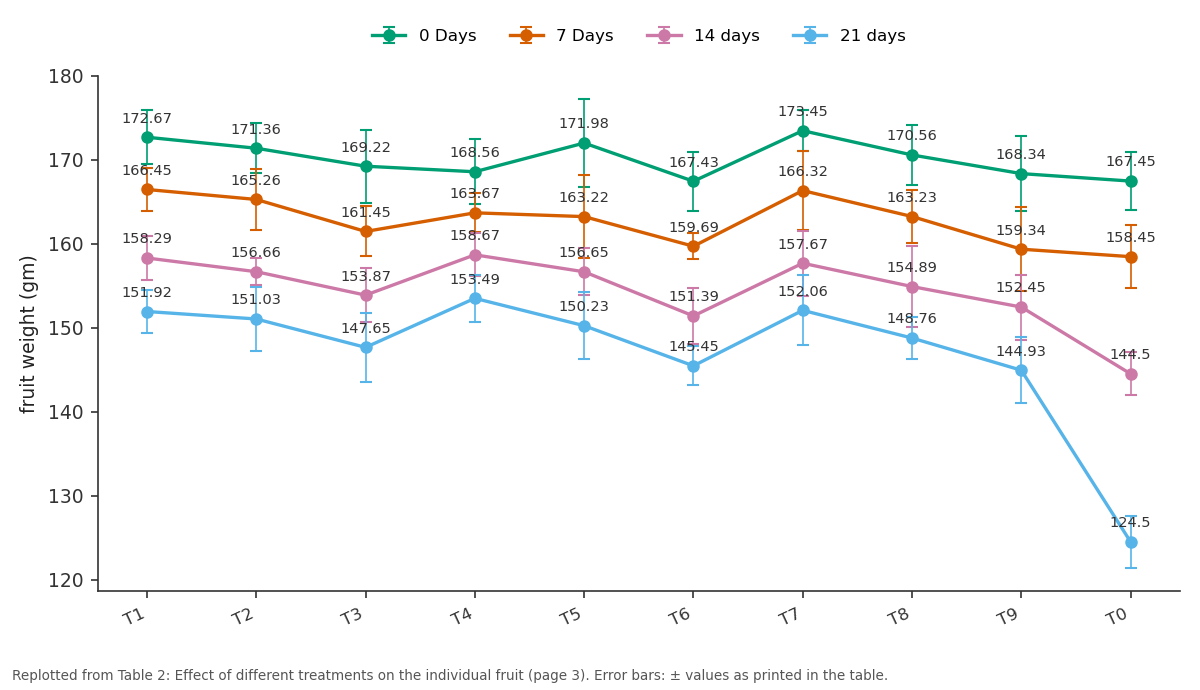
0 Days and 7 Days and more: T1 vs T2 vs T3 vs T4 vs T5
Replotted from Table 2 (page 3) of the original paper. Every bar is the paper's own table value.
View source evidence ↗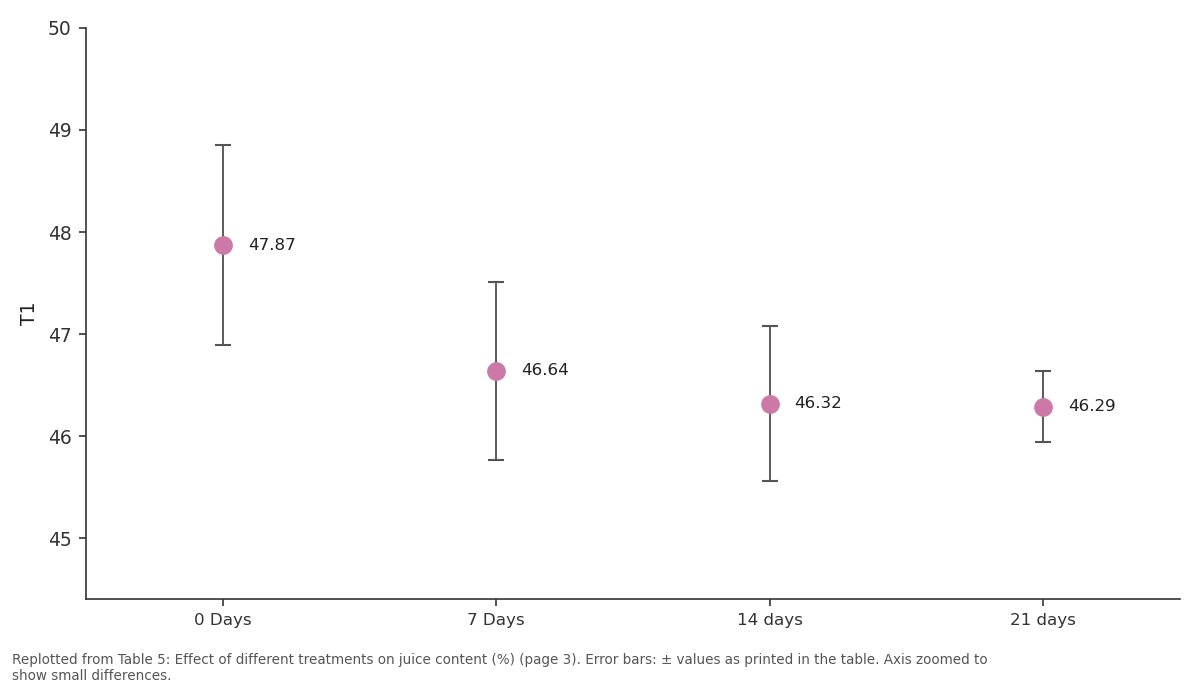
T1: 0 Days vs 7 Days vs 14 days vs 21 days
Replotted from Table 5 (page 3) of the original paper. Every bar is the paper's own table value.
View source evidence ↗Figures & tables
From the original paper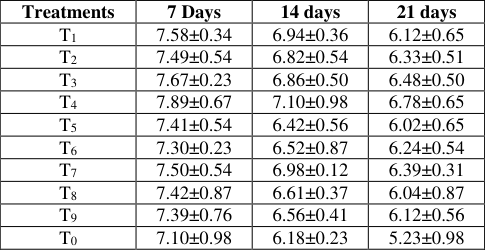 Table 1
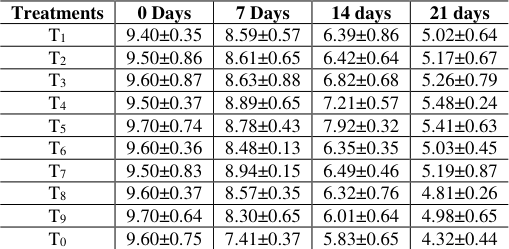 Table 7
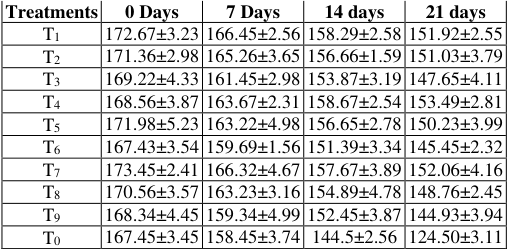 Table 2
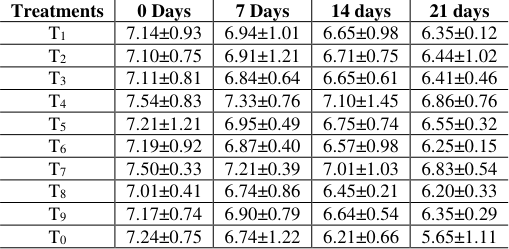 Table 3
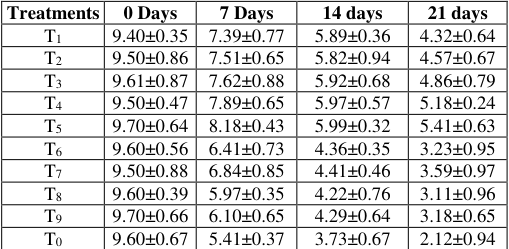 Table 8
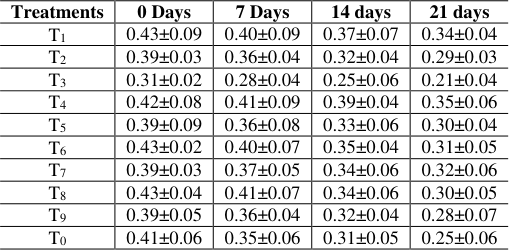 Table 4
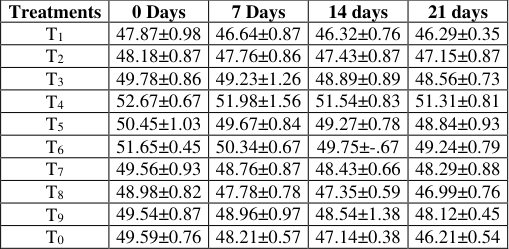 Table 5
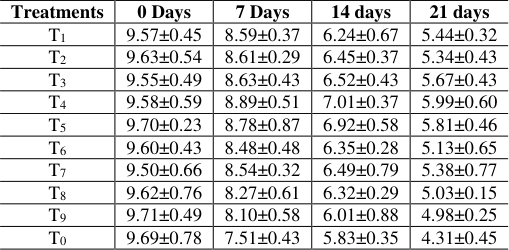 Table 6
Introduction
Citrus limetta, is considered to be a variety of Sweet orange and citrus varieties, belongs to the Rutaceae family, and is often referred to Mosambi and Sweet limetta. Citrus limetta can be grown locally in tropical or subtropical climates, and fruit production begins to appear on plants that are 5 to 7 years old. It starts to evolve and produces a good yield from 10 to 18 years. Global production of sweet oranges in 2014 was 70.9 million tons, 24% of the total global production was produced by Brazil followed by China and India [3] . During 2016-2017, overall area under cultivation of Mosambi was 209.19 / ha with fruit production of 3497.35 MT and productivity 16.7 MT/ha [4] . The role of packaging to increase the shelf life of fruit is very crucial in post-harvest operations of horticultural fruit crops. Each polymersealed fruit is better than a few fruits stored in a plastic bag because sealing each fruit allows for a more efficient environment against respiratory biomass and even each sealed packaging helps in preventing the fruit from decaying infections that are considered secondary agents [2] . In view of the above fact, the present study was carried out to investigate the effect of different chemicals and packing materials on the physiological and organoleptic characteristics of Mosambi fruit.
Methods and Materials
The experiment was laid out in Completely Randomized Design in which 10 treatments were implemented with 3 replications after 7 days of interval (0, 7 th , 14 th , and 21 th ) for identification of better effect of different chemicals and packaging materials on physiological and organoleptic traits of Mosambi in December 2020. Fruits are pre-treatment with hot water (55 °C) and the fruits were air dried room temperature for one hour after pre-treatment.
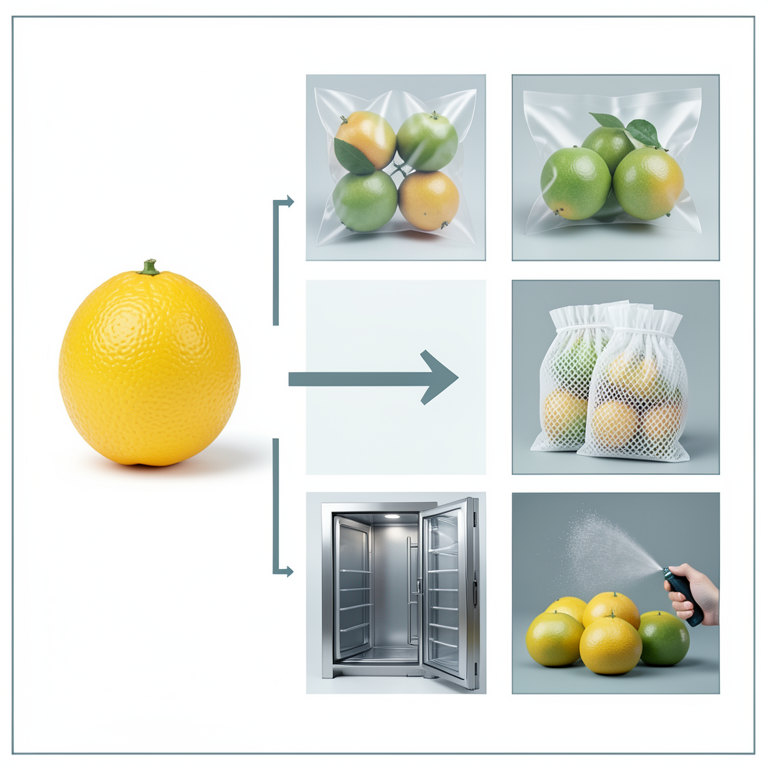
The mosambi fruits were wrapped in various packaging materials viz. high-density polyethylene (HDPE) and other packaging materials, Low-density polyethylene (LDPE) with or without perforations) and sealed with an electronic sealing system after being dehumidified. Chemically viz. 2, 4-dichlorophenoxyacetic acid (2, 4-D), and gibberellic acid (GA3), prepared fruits were also kept at (ambient) room temperature. Fruit samples were analysed for various physical characteristics viz. Fruit appearance, Fruit diameter, Individual fruit weight, Rind Thickness and Fruit juice % and organoleptic characteristics viz. Colour, Flavour, and Overall Acceptability. Therefore, present investigation was conducted with 10 different treatments viz., T 1 (LDPE), T 2 (LDPE perforated), T 3 (HDPE), T 4 (HDPE perforated), T 5 (Cold storage), T 6 (Treated with 2,4-D 50 ppm (without packaging)), T 7 (Treated with 2,4-D 100 ppm (without packaging)), T 8 (Treated with GA3 50 ppm (without packaging)), T 9 (Treated with GA3 100 ppm (without packaging)), T 0 (Control).
Results and Discussion
The analysis of variance revealed significant differences among the treatments for all the traits attributes under study. Data recorded on the effect of different chemicals and packing materials on physiological and organoleptic parameters of Mosambi (Citrus limetta) fruit.
Physiological parameter Fruit Appearance
This study shows that chemicals and packaging materials have a significant impact on Mosambi at the end or end of the 21 st storage period. Maximum value of appearance (6.78) was obtained in HDPE perforated (T 4 ) whereas minimum (5.23) was recorded in control (T 0 ) shown in Table 1. These findings are supported by Tatl and Ozguven (1999) [10] , as well as Tugwell and Chvyl (1996) [11] .
| Treatments | 7 Days | 14 days | 21 days |
|---|---|---|---|
| T1 | 7.58±0.34 | 6.94±0.36 | 6.12±0.65 |
| T2 | 7.49±0.54 | 6.82±0.54 | 6.33±0.51 |
| T3 | 7.67±0.23 | 6.86±0.50 | 6.48±0.50 |
| T4 | 7.89±0.67 | 7.10±0.98 | 6.78±0.65 |
| T5 | 7.41±0.54 | 6.42±0.56 | 6.02±0.65 |
| T6 | 7.30±0.23 | 6.52±0.87 | 6.24±0.54 |
| T7 | 7.50±0.54 | 6.98±0.12 | 6.39±0.31 |
| T8 | 7.42±0.87 | 6.61±0.37 | 6.04±0.87 |
| T9 | 7.39±0.76 | 6.56±0.41 | 6.12±0.56 |
| T0 | 7.10±0.98 | 6.18±0.23 | 5.23±0.98 |
Table text extracted from the original PDF; superscript letters are shown inline. The original table image is below.
View original table image
Individual fruit weight
Chemicals and packaging materials were found to have a significant impact on individual fruit weights as shown in Table 2. The minimum reduction in weight from 0 days to 21 days (153.49 gm) was obtained in HDPE perforated treatment (T 4 ) whereas, minimum value (124.50 gm) in control (T 0 ) on 21 th day of the storage due to maturation and decrease during respiration and respiration. The current results are supported by Bhullar [1] , who investigated that chemically treated fruits with 2, 4-D, and high-density polyethylene can be stored.
| Treatments | 0 Days | 7 Days | 14 days | 21 days |
|---|---|---|---|---|
| T1 | 172.67±3.23 | 166.45±2.56 | 158.29±2.58 | 151.92±2.55 |
| T2 | 171.36±2.98 | 165.26±3.65 | 156.66±1.59 | 151.03±3.79 |
| T3 | 169.22±4.33 | 161.45±2.98 | 153.87±3.19 | 147.65±4.11 |
| T4 | 168.56±3.87 | 163.67±2.31 | 158.67±2.54 | 153.49±2.81 |
| T5 | 171.98±5.23 | 163.22±4.98 | 156.65±2.78 | 150.23±3.99 |
| T6 | 167.43±3.54 | 159.69±1.56 | 151.39±3.34 | 145.45±2.32 |
| T7 | 173.45±2.41 | 166.32±4.67 | 157.67±3.89 | 152.06±4.16 |
| T8 | 170.56±3.57 | 163.23±3.16 | 154.89±4.78 | 148.76±2.45 |
| T9 | 168.34±4.45 | 159.34±4.99 | 152.45±3.87 | 144.93±3.94 |
| T0 | 167.45±3.45 | 158.45±3.74 | 144.5±2.56 | 124.50±3.11 |
Table text extracted from the original PDF; superscript letters are shown inline. The original table image is below.
View original table image
Fruit diameter
The results of this study showed that the packaging material had a significant effect on fruit diameter, but the minimal reduction in fruit diameter found during cold storage (T5) showed better results than other packaging materials on the other hand in chemical treatment of fruit treated with 2, 4 -D 100 ppm (T 7 ) showed minimal diameter reduction compared to other pretreatment chemicals. The maximum diameter reduction was found in the control (T 0 ), (Table 3).
| Treatments | 0 Days | 7 Days | 14 days | 21 days |
|---|---|---|---|---|
| T1 | 7.14±0.93 | 6.94±1.01 | 6.65±0.98 | 6.35±0.12 |
| T2 | 7.10±0.75 | 6.91±1.21 | 6.71±0.75 | 6.44±1.02 |
| T3 | 7.11±0.81 | 6.84±0.64 | 6.65±0.61 | 6.41±0.46 |
| T4 | 7.54±0.83 | 7.33±0.76 | 7.10±1.45 | 6.86±0.76 |
| T5 | 7.21±1.21 | 6.95±0.49 | 6.75±0.74 | 6.55±0.32 |
| T6 | 7.19±0.92 | 6.87±0.40 | 6.57±0.98 | 6.25±0.15 |
| T7 | 7.50±0.33 | 7.21±0.39 | 7.01±1.03 | 6.83±0.54 |
| T8 | 7.01±0.41 | 6.74±0.86 | 6.45±0.21 | 6.20±0.33 |
| T9 | 7.17±0.74 | 6.90±0.79 | 6.64±0.54 | 6.35±0.29 |
| T0 | 7.24±0.75 | 6.74±1.22 | 6.21±0.66 | 5.65±1.11 |
Table text extracted from the original PDF; superscript letters are shown inline. The original table image is below.
View original table image
Rind thickness
In the present study, it was found that chemically treated fruits, cold handling, and packaging materials were of very different sizes, as shown in Table 4. Minimal reduction in skin thickness was noted in T 4 . The maximum shrinkage of bark thickness was recorded in the treatment or control (T 0 ). The reduction in skin thickness of unprocessed fruit is maximal under ambient or ambient temperature conditions, resulting in greater moisture loss and skin thickness shrinkage, a term used by Wills et al. [12] .
| Treatments | 0 Days | 7 Days | 14 days | 21 days |
|---|---|---|---|---|
| T1 | 0.43±0.09 | 0.40±0.09 | 0.37±0.07 | 0.34±0.04 |
| T2 | 0.39±0.03 | 0.36±0.04 | 0.32±0.04 | 0.29±0.03 |
| T3 | 0.31±0.02 | 0.28±0.04 | 0.25±0.06 | 0.21±0.04 |
| T4 | 0.42±0.08 | 0.41±0.09 | 0.39±0.04 | 0.35±0.06 |
| T5 | 0.39±0.09 | 0.36±0.08 | 0.33±0.06 | 0.30±0.04 |
| T6 | 0.43±0.02 | 0.40±0.07 | 0.35±0.04 | 0.31±0.05 |
| T7 | 0.39±0.03 | 0.37±0.05 | 0.34±0.06 | 0.32±0.06 |
| T8 | 0.43±0.04 | 0.41±0.07 | 0.34±0.06 | 0.30±0.05 |
| T9 | 0.39±0.05 | 0.36±0.04 | 0.32±0.04 | 0.28±0.07 |
| T0 | 0.41±0.06 | 0.35±0.06 | 0.31±0.05 | 0.25±0.06 |
Table text extracted from the original PDF; superscript letters are shown inline. The original table image is below.
View original table image
Fruit juice % This study showed that juice weight decreased with increasing storage time and showed a significant effect of different treatments on fruit juices as shown in Table 5. The maximum juice content (51.31%) was determined in perforated high-density polyethylene (T 4 ) and the minimum juice content (46.21%) in the control (T 0 ) was recorded. This may be due the property of high-density polyethylene, supplying a barrier in opposition to the water vapor and continues relative humidity which decreases the transpiration rate. The current findings are supported through Kaur [5] and Singh [7] in Kinnow Mandarin.
| Treatments | 0 Days | 7 Days | 14 days | 21 days |
|---|---|---|---|---|
| T1 | 47.87±0.98 | 46.64±0.87 | 46.32±0.76 | 46.29±0.35 |
| T2 | 48.18±0.87 | 47.76±0.86 | 47.43±0.87 | 47.15±0.87 |
| T3 | 49.78±0.86 | 49.23±1.26 | 48.89±0.89 | 48.56±0.73 |
| T4 | 52.67±0.67 | 51.98±1.56 | 51.54±0.83 | 51.31±0.81 |
| T5 | 50.45±1.03 | 49.67±0.84 | 49.27±0.78 | 48.84±0.93 |
| T6 | 51.65±0.45 | 50.34±0.67 | 49.75±-.67 | 49.24±0.79 |
| T7 | 49.56±0.93 | 48.76±0.87 | 48.43±0.66 | 48.29±0.88 |
| T8 | 48.98±0.82 | 47.78±0.78 | 47.35±0.59 | 46.99±0.76 |
| T9 | 49.54±0.87 | 48.96±0.97 | 48.54±1.38 | 48.12±0.45 |
| T0 | 49.59±0.76 | 48.21±0.57 | 47.14±0.38 | 46.21±0.54 |
Table text extracted from the original PDF; superscript letters are shown inline. The original table image is below.
View original table image
Organoleptic parameter Colour
The records presented in the Table 6 is indicating that the packaging material used to be appropriate for preserving the fruit colour; fruits sealed in excessive density polyethylene with perforation (T 4 ) confirmed less color modifications with slower rate. Whereas, the maximum rapid and quick colour changes regarded in control (T 0 ). The current findings are supported through the end result obtained by means of the Siddiqui [8] and Mandhyan [6] .
| Treatments | 0 Days | 7 Days | 14 days | 21 days |
|---|---|---|---|---|
| T1 | 9.57±0.45 | 8.59±0.37 | 6.24±0.67 | 5.44±0.32 |
| T2 | 9.63±0.54 | 8.61±0.29 | 6.45±0.37 | 5.34±0.43 |
| T3 | 9.55±0.49 | 8.63±0.43 | 6.52±0.43 | 5.67±0.43 |
| T4 | 9.58±0.59 | 8.89±0.51 | 7.01±0.37 | 5.99±0.60 |
| T5 | 9.70±0.23 | 8.78±0.87 | 6.92±0.58 | 5.81±0.46 |
| T6 | 9.60±0.43 | 8.48±0.48 | 6.35±0.28 | 5.13±0.65 |
| T7 | 9.50±0.66 | 8.54±0.32 | 6.49±0.79 | 5.38±0.77 |
| T8 | 9.62±0.76 | 8.27±0.61 | 6.32±0.29 | 5.03±0.15 |
| T9 | 9.71±0.49 | 8.10±0.58 | 6.01±0.88 | 4.98±0.25 |
| T0 | 9.69±0.78 | 7.51±0.43 | 5.83±0.35 | 4.31±0.45 |
Table text extracted from the original PDF; superscript letters are shown inline. The original table image is below.
View original table image
Flavor
The different packaging treatments affected the flavor at the last of storage, large value recorded in packaging material was in high-density polyethylene with perforation (T 4 ) (5.48), and minimum value was recorded in control (T 0 ) shown in Table 7. The present findings are supported by Sonkar and Ladaniya [9] .
| Treatments | 0 Days | 7 Days | 14 days | 21 days |
|---|---|---|---|---|
| T1 | 9.40±0.35 | 8.59±0.57 | 6.39±0.86 | 5.02±0.64 |
| T2 | 9.50±0.86 | 8.61±0.65 | 6.42±0.64 | 5.17±0.67 |
| T3 | 9.60±0.87 | 8.63±0.88 | 6.82±0.68 | 5.26±0.79 |
| T4 | 9.50±0.37 | 8.89±0.65 | 7.21±0.57 | 5.48±0.24 |
| T5 | 9.70±0.74 | 8.78±0.43 | 7.92±0.32 | 5.41±0.63 |
| T6 | 9.60±0.36 | 8.48±0.13 | 6.35±0.35 | 5.03±0.45 |
| T7 | 9.50±0.83 | 8.94±0.15 | 6.49±0.46 | 5.19±0.87 |
| T8 | 9.60±0.37 | 8.57±0.35 | 6.32±0.76 | 4.81±0.26 |
| T9 | 9.70±0.64 | 8.30±0.65 | 6.01±0.64 | 4.98±0.65 |
| T0 | 9.60±0.75 | 7.41±0.37 | 5.83±0.65 | 4.32±0.44 |
Table text extracted from the original PDF; superscript letters are shown inline. The original table image is below.
View original table image
Overall acceptability
In this experiment, various treatments of packaging, cold treatments, and chemical treatments significantly affects the fruits overall acceptability shown in Table 8. The maximum value (5.41) of acceptability recorded in cold treatment (T 7 ) and this may be due to the low temperature, which limits the biochemical activity, reduces the respiration rate of the fruit, causing delays in ripening and the fruit can be stored for days. Whereas, minimum value (2.12) was recorded in control (T 0 ).
| Treatments | 0 Days | 7 Days | 14 days | 21 days |
|---|---|---|---|---|
| T1 | 9.40±0.35 | 7.39±0.77 | 5.89±0.36 | 4.32±0.64 |
| T2 | 9.50±0.86 | 7.51±0.65 | 5.82±0.94 | 4.57±0.67 |
| T3 | 9.61±0.87 | 7.62±0.88 | 5.92±0.68 | 4.86±0.79 |
| T4 | 9.50±0.47 | 7.89±0.65 | 5.97±0.57 | 5.18±0.24 |
| T5 | 9.70±0.64 | 8.18±0.43 | 5.99±0.32 | 5.41±0.63 |
| T6 | 9.60±0.56 | 6.41±0.73 | 4.36±0.35 | 3.23±0.95 |
| T7 | 9.50±0.88 | 6.84±0.85 | 4.41±0.46 | 3.59±0.97 |
| T8 | 9.60±0.39 | 5.97±0.35 | 4.22±0.76 | 3.11±0.96 |
| T9 | 9.70±0.66 | 6.10±0.65 | 4.29±0.64 | 3.18±0.65 |
| T0 | 9.60±0.67 | 5.41±0.37 | 3.73±0.67 | 2.12±0.94 |
Table text extracted from the original PDF; superscript letters are shown inline. The original table image is below.
View original table image
Conclusion
Findings from the experiment showed that the perforated HDPE packaging content performed better than all of the other treatments. Further, it can be concluded that among the different treatments, the T 4 treatment proved superior as compare to other treatments in respect of maintaining physical and organoleptic traits. However, the minimum value was recorded for T 0 (Control) for most of the traits the traits studied. Therefore, treatment of T 4 (HDPE perforated) may be suggested as effective and economical treatment for improving shelf-life of mosambi fruits.
References
5 in the original paper- Bhullar JS, Farmahan HL, Agnihotri RP. Studies on storage behavior and extending the shelf life of Kinnow Mandarin. Progressive Horticulture. 1981;13(3-4):115119.
- Indian database of horticulture. Horticultural Statistics at the Glance 2017. Government of India Ministry of Agriculture and Farmer's Welfare, Krishi Bhawan, New Delhi; c2017. p. 1-481.
- Mandhyan BL. Retention of freshness of guava fruits with respect to package material. Journal of Food Science and Technology. 1999;36(1):46-48.
- Siddiqui S, Sharma RK, Gupta OP. Effect of Individual fruit wrapping by different materials on the shelf life of Guava Cv. Allahabad Safede. Acta Horticulture. 1997;735:535-545.
- Sonkar RK, Ladaniya MS. Individual film wrapping of Nagpur mandarin (Citrus reticulata Blanco) with heatshrinkable and stretch-cling films for refrigerated Storage. Journal of Food Science and Technology. 1999;36(3):273-276.