
Research article · 2023 · Full text
International Journal of Veterinary Sciences and Animal HusbandryStudies on economics of weaned Osmanabadi kids fed with different combination of leguminous foliage
Volume 8(3) · Pages 154–156 · DOI: 10.22271/veterinary.2023.v8.i3c.535 ↗
Research areasWeed Control and Herbicide ApplicationsAgronomic Practices and Intercropping SystemsAgricultural Science and Fertilization
Abstract
Author-writtenTwenty four Osmanabadi weaned kids of same age and uniform confirmation was selected for experimental trails. The kids were grouped under same weight and average age in four treatment group with six kids (3male 3female) in each group. The control (T0) included 80% DCP through concentrate mixture + 20% DCP through green Sorghum + sorghum Kadbi should be given in ad-lib; T1 included 20% DCP through concentrate mixture +20% DCP through green sorghum fodder+ 30% DCP from Sesbania grandiflora (Hadaga) foliage + 20% DCP from Leucaena leucocephala (Subabul) foliage + 10% DCP from Desmanthus virgatus (Dashrath) foliage + ad-lib sorghum kadbi; T2 included 20% DCP from 20% DCP from green sorghum fodder + 20% DCP from Sesbania grandiflora (Hadaga) foliage + 20% DCP from Leucaena leucocephala (Subabul) foliage + 30% DCP from Desmanthus virgatus (Dashrath) foliage + ad- lib sorghum kadbi; T3included 20% DCP from 20% DCP from green sorghum fodder + 10% DCP from Sesbania grandiflora (Hadaga) foliage + 30% DCP from Leucaena leucocephala (Subabul) foliage + 20% DCP from Desmanthus virgatus (Dashrath) foliage + ad- lib sorghum kadbi; The experimental period was 270 days and 10 days as a pre-experimental period.
Summary
Source-checkedPlain-language reading of the full paper, prepared with AI and checked against the text. Each point links to the authors' own words.
Why it matters
- Goat meat, or 'chevon,' is highly valued in India for its taste and nutritional profile, featuring high protein (22 g) and lower fat (12.3 g) and cholesterol (94 mg) compared to other meats. View evidence ↗
- Leguminous foliages like Agathi (25-30% crude protein), Dashrath (22.4% crude protein), and Subabul (27.5% crude protein) are used as nutrient-rich feed supplements for livestock. View evidence ↗
- Goat husbandry is a critical sector for providing employment, nutritional security, and economic prosperity to small and marginal farmers in India. View evidence ↗
The question
- The study aimed to evaluate the economics of feeding weaned Osmanabadi kids with various combinations of leguminous foliage in the Maharashtra region. View evidence ↗
What they did
- The study took place at the Goat unit in Parbhani, Maharashtra, from February 12 to November 12, 2021, consisting of a 270-day experimental period and a 10-day pre-experimental period. View evidence ↗
- Four diets were tested: T0 (control with 80% concentrate), and T1, T2, and T3, which replaced most concentrate with varying proportions of Hudga, Subabul, and Dashrath foliage. View evidence ↗
- The primary measurement was the feeding cost calculated per kilogram of live weight gain for each treatment group. View evidence ↗
What they found
- The feeding cost per kg of live weight gain was Rs. 158.26 for T0, Rs. 115.97 for T1, Rs. 106.02 for T2, and Rs. 125.36 for T3. View evidence ↗
- Treatment T2 had the lowest feeding cost (Rs. 106.02) compared to all other groups, including the control T0. View evidence ↗
- The highest total live weight gain was observed in the T2 group (17.26 kg), while the lowest was in T3 (14.27 kg). View evidence ↗
- The average total cost per kid was highest in the control group T0 (Rs. 2366) and lowest in T1 (Rs. 1742). View evidence ↗
What it means
- The authors conclude that the T2 treatment group, utilizing a specific combination of leguminous foliage, is the most economical option for feeding weaned Osmanabadi kids. View evidence ↗
Visual summary
2 visualsIllustrations explain the paper; charts are replotted from the paper's own table values.
Dietary Composition Comparison
AI-generated conceptual illustration (Osmanabadi goat kids). It explains the idea and does not show study data.
View source evidence ↗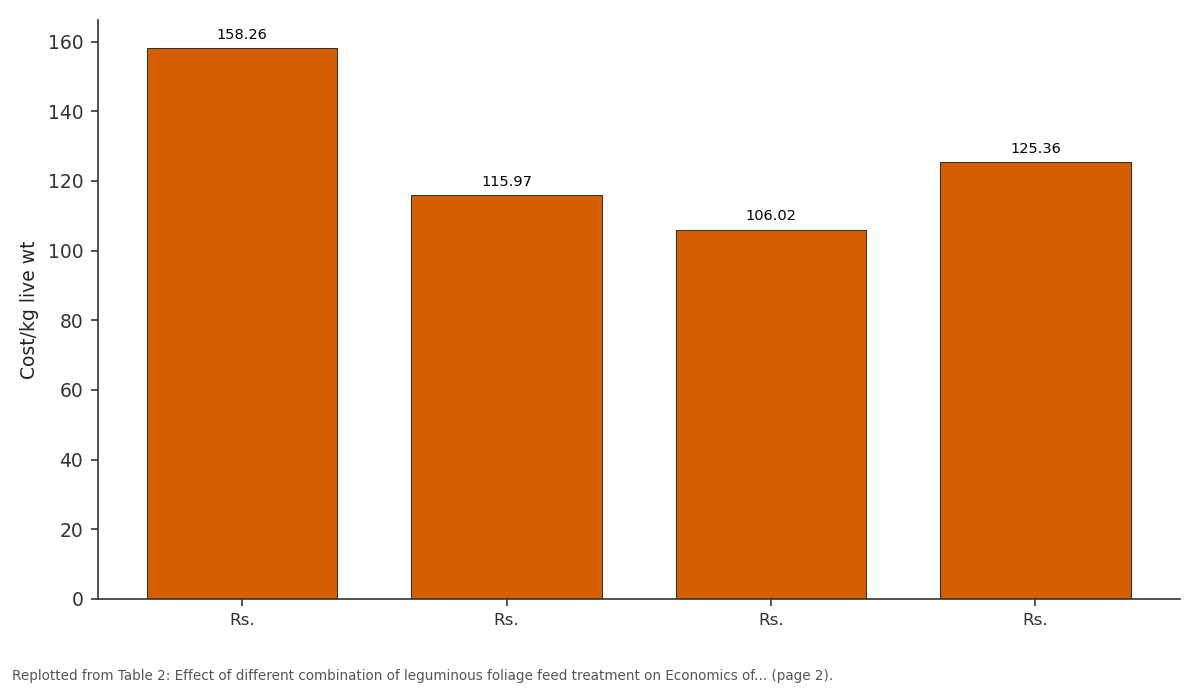
Cost/kg live wt: Rs. vs Rs. vs Rs. vs Rs.
Replotted from Table 2 (page 2) of the original paper. Every bar is the paper's own table value.
View source evidence ↗Figures & tables
From the original paper Table 1
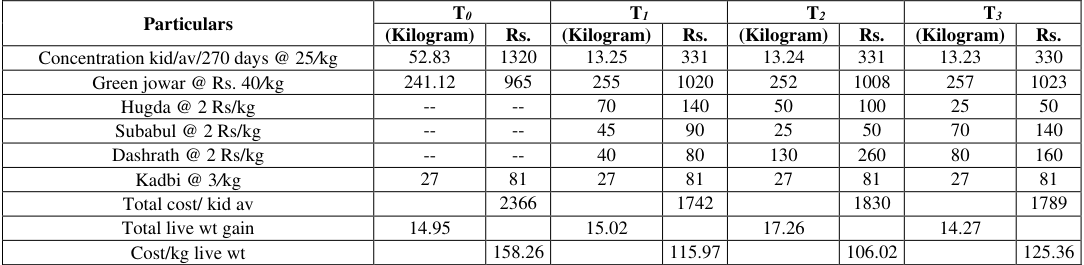 Table 2
Introduction
In India, some goat breeds are basically reared for meat purpose. The goat meat, known as 'chevon,' is preferred by the country's non-vegetarians because to its great taste, wonderful flavour, high protein (22 g), low fat (12.3 g), calories (2 Kcal), saturated fat 85 mg and less cholesterol (94 mg) than other species meat such as chicken, cattle, pork and mutton. Higher value of iron, potassium and thiamine associated with a low sodium level further aggravate the consumption of meat (Eastridge and Johnson, 1990) [2] . Although goat meat intake is not associated with any religious attitude, it is critical to raise goats and increase their number at a faster rate. Goats are regarded as valuable 'gold' that can be cashed by their owners at any time. Agathi (Sesbania grandiflora L.) is a legume plant found in tropical Asia and popular among the dairy farmers which is used to supplement rice straw in animal diets due to high levels crude protein which is near about 25-30%, of content in leaves (Karmakar et al, 2016) [12] . Agathi is traditionally used for anti-microbial activities anti-inflammation, anti-diabetic, antioxidant activities, anti-cancer, anti-ulcer activity, an immune-modulatory activity, and various associated diseases such as renal diseases, respiratory diseases and hepatic diseases Agathi leaves and pods were reported palatable and non-toxic to cattle according to Jiraungkoorskul and Jiraungkoorskul, 2015 [4] . Hedge Lucerne or Dasharath (Desmanthes virgatus L.) is grown as a forage legume which produces green fodder. This Hedge contains high amount of crude protein with good palatability, which contains near about 22.4% crude protein. The yield is up to 15-25 t/ ha under favorable soil and climate conditions. Subabul (Leucaena leucocephala) which conatins higher protein amount as 27.5% and production of these forage crop is up to 60 t/ha/year which contains nutrient rich leaf biomass. leaves, pods and seeds of subabul are also rich in minerals, proteins and essential fatty acids. Due to which growth rate and milk production increases in animals. Most preferred feed for goat and sheep due to its high palatability, selectivity and dry matter intake level (Gunasekaran et al, 2014) [3] .
Important income source for the farmers may be sale of breeding stock. This versatility allows the producer to plan and operate a more stable economic production unit. All breeds may be raised for fiber, meat, and milk and cheese production in some parts of the world. In coming years demand for export and internal consumption of goat milk and milk products is expected to rise. Goat husbandry provides glimpses of future hope for employment generation, nutritional security and prosperity to the millions of small and marginal farmers in the country reported by AMAM Zonaed Siddiki et al. (2010) [1] . Cost analysis or economics of goat rearing is different due to breeds and various areas. That's why this study was under taken to study the economics of weaned Osmanabadi kids fed with different combination of leguminous foliage rearing under different groups in Maharashtra region.
Materials and Methods
Twenty four Osmanabadi weaned kids of same age and uniform conformation was selected from the Goat Unit, Department of AHDS, VNMKV, Parbhani to conduct the experiment. Kids were grouped under same weight and average age in four treatment groups with six kids in each group. All the kids were free from diseases and physiological disorders. The details of selected experimental kids are given in Table 1.
| Treatments | Feed details |
|---|---|
| T0 | 80%DCP through concentrate mixture + 20% DCP through green sorghum fodder + sorghum kadbi ad lib |
| T1 | 20% DCP through concentrate mixture + 20% DCP through green sorghum fodder +30% DCP through hudga foliage + 20% DCP through subabul foliage + 10% DCP through dashrath foliage + sorghum kadbi ad lib |
| T2 | 20% DCP through concentrate mixture + 20% DCP through green sorghum fodder 20%DCP through hudga foliage + 10% DCP through subabul foliage + 30%DCP through dashrath foliage + sorghum kadbi ad lib |
| T3 | 20% DCP through concentrate mixture + 20% DCP through green sorghum fodder +10% DCP through hudga foliage + 30% DCP through subabul foliage + 20% DCP through dashrath foliage + ad lib sorghum kadbi |
Table text extracted from the original PDF; superscript letters are shown inline. The original table image is below.
View original table image
Collection of foliage
Different foliage i.e Hudga (Sesbania grandiflora), Subabul (Leucaena leucocephala) and Dashrath (Desmanthus virgatus) were cut and carry, and collected from CCBP, AHDS Department, VNMKV, Parbhani.
Duration of experiment
The experiment was conducted from 12 th February 2021 to 12 th November 2021 at Goat unit, Department of AHDS, VNMKV, Parbhani Maharashtra state. The experimental period was 270 days and 10 days as a pre-experimental period.
Dressing percentage
The meat production performance of the male kids was measured in terms of dressing percentage.
Where, PSW Pre-slaughter weight in kilogram ELW Empty live weight in kilogram
Results and Discussion
The results of present research work entitled "Studies on economics of weaned Osmanabadi kids fed with different combination of leguminous foliage" were recorded, analyzed and presented in the following headings.
Economics of feeding
The feeding cost of the Osmanabadi weaned kids per kg live weight of kids under four different treatment were calculated and presented in Table 2.
| Particulars | T0 | — | T1 | — | T2 | — | T3 | — |
|---|---|---|---|---|---|---|---|---|
| (Kilogram) | Rs. | (Kilogram) | Rs. | (Kilogram) | Rs. | (Kilogram) | Rs. | |
| Concentration kid/av/270 days @ 25/kg | 52.83 | 1320 | 13.25 | 331 | 13.24 | 331 | 13.23 | 330 |
| Green jowar @ Rs. 40/kg | 241.12 | 965 | 255 | 1020 | 252 | 1008 | 257 | 1023 |
| Hugda @ 2 Rs/kg | -- | -- | 70 | 140 | 50 | 100 | 25 | 50 |
| Subabul @ 2 Rs/kg | -- | -- | 45 | 90 | 25 | 50 | 70 | 140 |
| Dashrath @ 2 Rs/kg | -- | -- | 40 | 80 | 130 | 260 | 80 | 160 |
| Kadbi @ 3/kg | 27 | 81 | 27 | 81 | 27 | 81 | 27 | 81 |
| Total cost/ kid av | 2366 | 1742 | 1830 | 1789 | ||||
| Total live wt gain | 14.95 | 15.02 | 17.26 | 14.27 | ||||
| Cost/kg live wt | 158.26 | 115.97 | 106.02 | 125.36 |
Table text extracted from the original PDF; superscript letters are shown inline. The original table image is below.
View original table image
The feeding cost of the Osmanabadi weaned kids is given per kg live weight gain in T 0, T 1 , T 2 and T 3 were 15.8.26, 115.97, 106.02 and 125.36, respectively. From the result, it was observed that the feeding cost of T 2 (Rs. 106.02) treatment group was comparatively less than T 1 (Rs. 115.97), T 3 (Rs.125.36) and T 0 (Rs.158.26). The results of this study were agreement with the Liu et al.
(2001) [7] Lie et al. presented in their research that the effects of Mulberry leaves were replaced with rape seed meal. This replacement of leaves were compared with performance of feeding sheep on ammonia treated rice straw. Forty five lambs were used for experiment. They were divided into five equal groups. The groups were then divided with their body weight and gender. Lamb in each groups were kept in three pens as male, female and mixed. In each group one male and two female were mixed in pens, and received one of the following dietary treatments: 100 g RSM (A), 75 g RSM plus 60 g Mulberry leaves (B), 50 g RSM plus 120 g Mulberry leaves (C), 25 g RSM plus 180 g Mulberry leaves (D) and 240 g Mulberry leaves (E). All these experimental animals were gives 100 g ground corn per head per day with ABRS ad lib.
In Nigeria country Bamikole et al. (2005) [11] reported nutritive value of Mulberry (Morus spp.) leaves. The experiment was taken for the growing Rabbits. Bamikole et al. (2005) [11] presented that weight gain and FCE were only significantly depressed below the level achieved with an all concentrate ration when mulberry leaves comprised more than 50% of the ration where mulberry leaves increased, reduction in FCE and weight gain might have resulted from the combination of lower intake of Dry Matter of leaves because of its low Dry Matter content. Means only 262 gram/kilogram vs. 925 gram/kilogram in the concentrate) and lower intake and digestibility of NFE and possibly digestible energy. With comparable DM intake, weight gain as well as digestibility in all concentrate rations achieved with up to 50% substitution of concentrate in ration, less cost can be achieved with rapid growth rate of rabbits. Korake et al. (2015) [6] reported in their experiment that feeding cost of live weight gain per kilogram in T 0 , T ).The results were in agreement with those of Radhakrishnan (2005a) [9] conducted experiment with weaned male kids fed with complete ration containing neem leaves at 0,20,40 and 60 percent level as roughage source and reported lower feeding cost per kilogram live weight gain in treatment group as compared to control. Radha Krishnan (2005) [9] showed the Madrared lamb fed with ration containing 60 percent of green fodder hay (T 1 ) and ration contained 60 percent of Neem: SS: GNH25:37.5:37.5, (T 3 ) Subabul: GNH:RS25:37.5:37.5 and (T 4 ) Gliricidia: GNH:RS 25:37.5:37.5 and recorded lower feeding cost per kilogram live weight gain in treatment groups as compare to control. Madhavi et al. (2006) [8] [10] stated that the effect of feeding hedge lucerne (Desmanthus virgatus) at replacement of 50% and 100% concentrate mixture. They reported that total cost of production was significantly higher in control group T 1 than treatment group T 2 and T 3 and also found that the highest net profit per goat in T 2 group than other treatment. They concluded that up to 50% hedge lucerne to replace concentrate in diet of experimented goats may increases net profit with improvement in growth performance in experimental goats.
Summary and Conclusion
The economics or the feeding cost of weaned Osmanabdi kids per kilogram live weight gain in T 0, T 1 , T 2 and T 3 were Rs. 158.26, Rs. 115.97, Rs. 106.02 and Rs. 125.36, respectively.
From the result, it was observed that the feeding cost of T 2 (Rs. 106.02) treatment group was comparatively less than T 1 (Rs. 115.97), T 3 (Rs.125.36) and T 0 (Rs. 158.26).
References
8 in the original paper- Gunasekaran S, Vishwannathan K, Bandeswaran C. Selectivity and palatability of tree fodder in sheep and goat fed by cafeteria method. International Journal of Science Environment Technology. 2014;3:1767-1771.
- Jiraungkoorskul K, Jiraungkoorskul W. Sesbania grandiflora: new nutraceutical use as antidiabetic. International Journal Pharm. Science. 2015;7(7):26-29.
- Tirfi AG. Sorghum yield response to climate and other input factors in Ethiopia. Int. J Agric. Food Sci. 2022;4(2):88-100. DOI: 10.33545/2664844X.2022.v4.i2b.100
- Korake RL, Shinde AT, Jadhav SN, Gavit DP. Effect of feeding water washed neem (Azadiracta indica) seed cake and salt sprinkedneem (Azadiracta indica) leaves on blood parameter, feed conversion efficiency and economic of feeding in Osmanabadi kids. Research Journal of Animal Husbandry and Dairy Science. 2015;6(2):93-98.
- Liu JX, Yao J, Yan B, Yu JQ, Shi ZQ. Effect of mulberry leaves to replace rapeseed meal on performance of sheep feeding on ammoniated rice straw diet. Small Ruminant. Research. 2001;39:131-136.
- Madhavi K, Reddy TJY, Ramana R, Reddy GVN. Effect of feeding differently processed detoxified Neem (Azadirachta indica) seed cake based complete diet on growth, nutrient utilization and carcass characteristics in Nellore sheep. Livestock Research for Rural Development. 2006;18(10):815-826.
- Sonawane AS, Deshpande KY, Rathod SB, Shelke PR, Nikam MG, Gholve AU, et al. Effect of feeding Hedge Lucerne (Desmanthus virgatus) on intake, growth performance and body condition score in growing Osmanabadi goats. Indian Journal of Animmal Science. 2019;89(8):881-884.
- Bamikole MA, Ikhatua MI, Ikhatua UJ, Ezenwa IV. Nutritive value of mulberry (Morus spp.) leaves in the growing rabbits in Nigeria. Pakistan Journal of nutrition. 2005;4(4):231-236.