
Research article · 2022 · Full text
International Journal of Geography Geology and EnvironmentGlobal and national climate change concerns in India
Volume 4(2) · Pages 187–190 · DOI: 10.22271/27067483.2022.v4.i2b.161 ↗
Research areasClimate Change Policy and EconomicsWater-Energy-Food Nexus StudiesGlobal Energy and Sustainability Research
Abstract
Author-writtenOne of the most important global environmental challenges affecting food production, water supply, health, energy, etc. is climate change. Tackling climate change requires sound scientific understanding and coordinated action at national and global levels. This paper addresses these challenges. Historically, much of the responsibility for increases in greenhouse gas emissions has rested with the industrialized world, although developing countries are likely to be the source of an increasing proportion of future emissions. The climate change projected in different scenarios is likely to affect food production, water supply, coastal settlements, forest ecosystems, health, energy security, etc. The adaptive capacity of the communities most affected by climate change in developing countries is low. Efforts made through the provisions of the UNFCCC is clearly insufficient to meet the challenge of climate change. The most effective way to counteract climate change is to embark on a sustainable development path by switching to environmentally sustainable technologies and promoting energy efficiency, renewable energy, forest protection, reforestation, water conservation, etc. The most important issue for developing countries is shrinking. The vulnerability of their natural and socioeconomic systems to projected climate change. India and other developing countries will face the challenge of promoting mitigation and adaptation strategies, considering the costs of such an effort and considering their impact on economic growth.
Summary
Source-checkedPlain-language reading of the full paper, prepared with AI and checked against the text. Each point links to the authors' own words.
Why it matters
- Climate change is a critical global environmental challenge that impacts essential systems including food production, water supply, health, and energy. View evidence ↗
- India's large population and unique geography make it highly susceptible to extreme climate events like floods, hurricanes, and droughts, which hinder social and economic progress. View evidence ↗
- Socio-economic factors, including poverty, inequality, and the needs of a growing population, increase India's vulnerability to climate change. View evidence ↗
The question
- The paper aims to address the challenges of climate change by emphasizing the need for scientific understanding and coordinated action at both national and global levels. View evidence ↗
What they did
- The analysis utilizes high-resolution forecasts for India based on the PRECIS Regional Climate Modeling system, applying IPCC scenarios A2 and B2. View evidence ↗
What they found
- Between 1971 and 2007, India's mean temperature rose by approximately 0.2 °C per decade, though the north-western region experienced a cooling trend. View evidence ↗
- Recent heat waves in India, with temperatures surpassing 46.6 °C, resulted in more than 1,800 deaths. View evidence ↗
- By the end of the century, surface temperatures in India are projected to increase by 3 to 5 °C (A2 scenario) or 2.5 to 4 °C (B2 scenario), with the north experiencing more warming. View evidence ↗
- Summer monsoon precipitation is forecast to increase by 20% across India, except in Tamil Nadu, Rajasthan, and Punjab, where slight decreases are expected. View evidence ↗
- Projections for 2085 suggest that 77% (A2 scenario) or 68% (B2 scenario) of India's forest network could undergo changes in forest types. View evidence ↗
- Global mean sea levels are estimated to rise by 26–55 cm under low emissions and 45–82 cm under high emissions, posing risks to India's coastal regions. View evidence ↗
- Simulations indicate that rising temperatures in various parts of India are likely to lead to a decrease in crop yields. View evidence ↗
What it means
- The authors conclude that the most effective countermeasure to climate change is adopting a sustainable development path through renewable energy, energy efficiency, and conservation efforts. View evidence ↗
- The authors state that India must contribute to scientific progress and international cooperation to promote adaptation and protection, requiring capacity building and extensive consultation. View evidence ↗
Visual summary
1 visualsIllustrations explain the paper; they do not show study data.
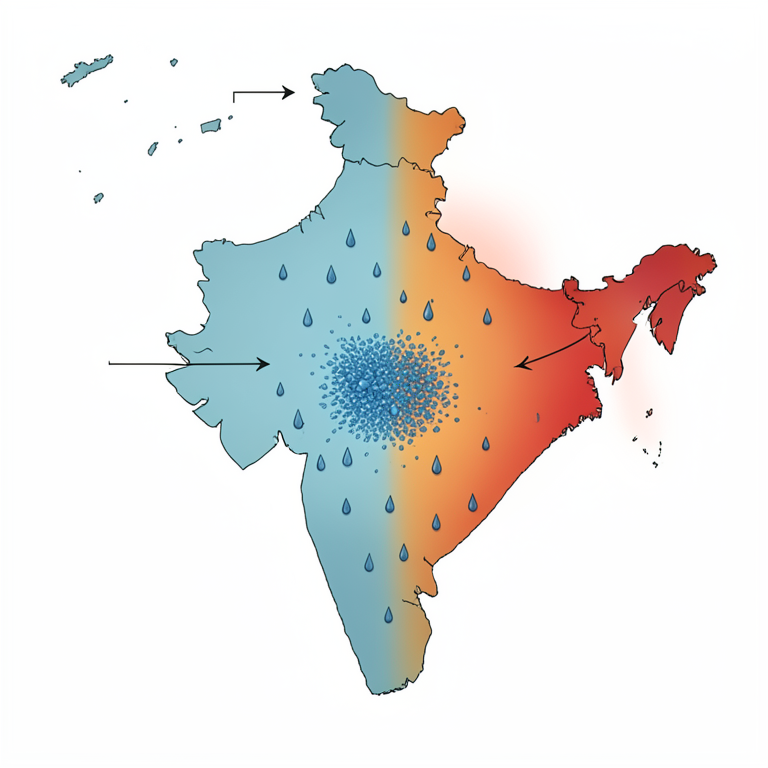
Projected Climate Shifts in India
AI-generated conceptual illustration (A map of India). It explains the idea and does not show study data.
View source evidence ↗Introduction
India, the seventh largest country in the world by area, is home to over 1.21 billion people. Its geographic location in the subtropics, surrounded by the Himalayas to the north, the Indian Ocean to the south, the Arabian Sea to the west, and the Bay of Bengal to the east, allows it to experience diverse climatic conditions and varied biogeography. Because of this unique geography, the country is also exposed to many extreme climate events such as hurricanes, floods and droughts that have endangered lives, damaged infrastructure and slowed economic and social progress. These threats are expected to become even more pronounced as climate change changes, increasing the risk of extreme weather conditions, sea level rise, glacial retreat and melting ice. India's vulnerability to climate change is driven by underlying socio-economic issues such as poverty and inequality, the resource needs of an ever-growing population, and the development priorities of an emerging economy. Although India currently ranks as the third largest economy in the world (World Bank, 2014), the benefits of economic growth over the past few decades have not been felt everywhere. Millions of Indians still live in poverty, lack adequate access to essential resources such as productive land, water and energy, and rely on climate-sensitive livelihoods such as agriculture, livestock and fisheries. This situation increases India's vulnerability to climate variability and change. India is aware of this risk and has initiated various plans and programs to adapt to climate change. Such initiatives are diverse, large-scale, both in context and content, and involve a wide range of stakeholders, from national governments to donor-supported community-based actions. Climate change is one of the most important global environmental challenges facing humanity, impacting food production, natural ecosystems, freshwater supplies, health and more. According to the latest scientific assessments, the Earth's climate system has changed significantly since the pre-industrial era, both at a global and regional level. Additional evidence suggests that most of the observed warming (0.1 °C per decade) over the past 50 years is due to human activities.
India's climate has changed significantly in the last few decades. During the period 1971-2007, the mean temperature across the subcontinent increased by about 0.2 °C per decade, although the north-western region of the country shows an overall cooling trend. ENSO events have had significant impacts on temperature anomalies in some seasons. As for the rainfall thus, the observed changes in precipitation patterns are quite diverse in different regions of India, and there is a tendency for the number of one-day extreme rains to increase in many parts of the country (Government of India [GOI], 2012). In addition, a comprehensive statistical analysis of precipitation observations (1951-2011) shows changes in wet and dry extremes during the monsoon season. The study found a statistically significant decrease in peak-season precipitation as well as an increase in daily-scale precipitation variability. A statistically significant increase in the frequency but decreased intensity of dry attacks and an increase in the intensity of wet attacks were also noted (Singh, Tsiang, Rajaratnam & Differnbagh, 2014) [14] . The Intergovernmental Panel on Climate Change (IPCC) estimates that the average global temperature will rise between 1.4 and 5.8 °C by the year 2100. (C) may increase between This unprecedented increase is expected to have severe impacts on global water systems, ecosystems, sea levels and crops. Production and related processes. The effects will be particularly severe in tropical regions, which primarily include developing countries such as India. The problem of climate change is part of the larger challenge of sustainable development. Therefore, climate policy can be more effective when consistently embedded in broader strategies aimed at making national and regional development paths more sustainable. The impacts of climate variability and change, climate policy responses and associated socio-economic development will affect countries' ability to achieve the Sustainable Development Goals. The pursuit of these goals will in turn have an impact on the opportunities and success of climate policy. In particular, the socio-economic and technological characteristics of different development paths will strongly influence emissions, the rate and magnitude of climate change, climate change impacts, adaptation potential and mitigation potential. The Fifth Assessment Report of the Intergovernmental Panel on Climate Change (IPCC) confirms these projected climate changes for India. An increasing trend in mean annual temperature and a significant increase in temperature extremes and frequency of heat waves is observed in India (Christensen et al., 2013) [2] . For example, the recent heat waves in India killed over 1,800 people, with daily temperatures exceeding 46.6 °C (Inani, 2015) [5] . In addition to such extreme temperatures, the report also forecasts more frequent and heavier rainy days in the high-emissions scenario by the mid-21st century, noting that the increase in monsoon-related extreme rains could be due in large part to the very likely it would be. India. The IPCC estimates a global mean sea level rise of 26 cm to 55 cm under a low emissions scenario and 45 cm to 82 cm under a high emissions scenario (IPCC, 2013); Both scenarios pose significant risks to India's densely populated coastal regions and the vast expanses of their economies. The United Nations Conference on Environment and Development (UNCED) in Rio de Janeiro in 1992 gave rise to the FCCC (Framework Convention on Climate Change), which provided the framework for eventual stabilization of greenhouse gases in the atmosphere with shared but distinct responsibilities. And identifies the associated skills and social and economic conditions. Historically, industrialized countries have been the main contributors to CO 2 emissions. According to one estimate, developed countries account for about 83% of the increase in cumulative rted CO 2 emissions associated with fossil fuels since 1800. In the 1990s they accounted for about 53% of the 6.3 GtC/year released as CO 2 from fossils. Fuel combustion. These countries contributed little to CO 2 emissions from vegetation burning, mainly due to deforestation of tropical forests during this period. According to another estimate, developing countries were responsible for only 37% of cumulative CO 2 emissions from industrial sources and land-use change over the period 1900-1999, while developed countries accounted for 63%, but their higher population and economic development is due to the rate at which CO 2 -Emissions of fossil fuels from developing countries will soon match or even exceed those of developed countries. Large countries like China and India could match United States year 2000 greenhouse gas emissions within two to three decades. Looking at CO2 emissions from fossil fuels alone, countries as a group will soon overtake developed countries in their contribution to population and economic growth in the coming decades. Historically, much of the responsibility for increased emissions has rested with the industrialized world, although developing countries are likely to be the source of an increasing share of future increases. Developing countries face immediate concerns related to forest and land degradation, freshwater depletion, food security, and air and water pollution. Climate change will exacerbate the effects of deforestation and other economic imperatives, leading to water scarcity, land degradation and desertification. Rising global temperatures will cause sea levels to rise. Populations living on small islands and/or low-lying coastal areas face severe social and economic disruption from sea level rise and storm surges. Is a particular threat that can destroy cities and destroy the livelihoods of large coastal areas? The widespread retreat of glaciers and ice caps in the 21st century will also increase land surface temperatures and increase water pressure. By 2025, two-thirds of the world's population, much of it in developing countries, could be suffering from moderate to severe water stress. Estimates of the impact of climate change on crop yields are mostly negative for tropical regions, even when accounting for adaptation and direct impacts of CO 2 on plant processes. Climate change and sea level rise will alter ecological productivity and biodiversity, putting some endangered species at risk of extinction. While the ability to forecast regional differences in impacts is still emerging, the impacts of climate change are expected to be more severe in tropical regions. This applies to all sectors that are likely to bear the brunt of climate changesea levels, water resources, ecosystems, crop production, fisheries and human health. The populations of developing countries are more vulnerable because their infrastructure is not strong and widespread enough to withstand the damaging effects.
Mitigation and Adaptation
In the global debate on climate change, reducing the vulnerability of their natural and socio-economic systems to projected climate change is of paramount importance for developing countries. Over time there has been a clear shift towards adaptation in discussions about global climate change. Adaptation can complement mitigation as a costeffective strategy to reduce climate change risks. It is predicted that the impacts of climate change will vary within and between countries. Properly designed mitigation and adaptation policies can promote sustainable development and equity both within countries and between generations. One way to balance the focus on adaptation and mitigation strategies is to compare the costs and benefits of both strategies. If climate change adaptation can be done at negligible costs, it may be more cost-effective than any alternative strategy, at least in the short term. Of course, quantifying the benefits of adaptation and the resulting harm that can be avoided is difficult. In addition, many mitigation and adaptation measures have significant additional benefits that need to be assessed. Side effects can be an important to play a role in decision-making regarding the implementation of a mitigation or adaptation strategy. The effects of climate protection measures will only be felt by future generations in the long term. However, the effects or benefits of adaptation measures are immediate and tangible for implementing the measures. The areas where remedial actions are implemented may differ from the areas where the impacts occur. The current generation in developed countries can invest in climate action and the next generation especially in developing countries can be the main beneficiaries. The choice between mitigation and adaptation strategies has spatial (geographical) and temporal (different generations) dimensions. An optimal mixture of mitigation and adaptation strategies can escape the climate negotiations due to spatial and temporal dimensions as well as different perceptions of industrialized and developing countries. India is a large developing country with about 700 million rural population directly dependent for their livelihood and livelihood on climate-sensitive sectors (agriculture, forestry and fisheries) and natural resources (such as water, biodiversity, mangroves, coastal areas, grasslands on the plains of). In addition, the adaptability of dryland farmers, forest dwellers, fishermen and nomadic pastoralists is very low10. Climate change is likely to impact all natural ecosystems as well as socioeconomic systems, India's National Communications Report to the UNFCCC shows. The latest high-resolution climate change scenarios and forecasts for India are based on the Regional Climate Modeling (RCM) system known as PRECIS, developed by the Hadley Center and implemented for India using IPCC scenarios A2 and B2. They show the following: An annual mean increase in surface temperature by the end of the century of 3 to 5 °C in the A2 scenario and 2.5 to 4 °C in the B2 scenario, with more warming in northern parts of India. A 20% increase in summer monsoon precipitation is forecast for India as a whole, and a further increase in precipitation for all states except Punjab, Rajasthan and Tamil Nadu, which saw slight decreases. Extreme high and low temperatures are also expected to increase, as is extreme precipitation, particularly over India. The west coast and west-central India show significant growth.
Forests
Forests
Water Supplies
The water cycle is likely to change and drought severity as well as flood intensity are likely to increase in different parts of India. In addition, a general reduction in the amount of runoff available is projected.
Agriculture
Dynamic crop model simulations indicate a decrease in crop yield as temperatures rise in different parts of India. Although this is offset by a moderate increase in temperature and an increase in CO2 at higher temperatures, a negative effect on crop productivity is predicted due to a shorter harvest duration.
Coastal Area
Simulation models show an increase in tropical cyclone frequency in the Bay of Bengal; Particularly violent events are expected in the period after the monsoon. Sea level rise is expected to displace populations in coastal areas, increase flooding of low-lying areas, and reduce crop yields due to flooding and salinization.
Human Health
Malaria is likely to occur in many states texist and new areas could become susceptible to malaria and the length of the malaria transmission window is likely to increase in the northern and western states and decrease in the southern states. promote sustainable development activities and ensure a long-term reduction in greenhouse gas emissions or an improvement in the carbon sink. Rational energy pricing based on long-run marginal cost theory can level the playing field for renewable energy, increase the uptake of energy efficient and renewable energy technologies, and improve utility economics. Ultimately, reducing greenhouse gas emissions can lead to deficits.
Climate Change and Sustainable Development
Climate Change and Sustainable Development
Conclusion
India is a large developing country with almost two-thirds of its population directly dependent on climate-sensitive sectors such as agriculture, fisheries and forestry. Projected climate change is likely to impact food production, water supply, biodiversity and livelihoods under different scenarios. Therefore, India has a significant share in scientific progress and in an international understanding to promote climate protection and adaptation. This requires advanced scientific understanding, capacity building, networking and extensive consultation processes.
References
16 in the original paper- Bolin B, Sukumar R. Global perspective. In Land use, Landuse Change and Forestry (eds. Watson RT, Noble IR and Bolin B.), Intergovernmental Panel on Climate Change, Cambridge University Press, Cambridge. 2000.
- Christensen JH, Hewitson B, Busuioc A, Chen A, Gao X, Held I, et al. Regional Climate Projections. In S. Solomon, D. Qin, M. Manning, Z. Chen, M. Marquis, K.B. Averyt, M. Tignor and H.L. Miller (Eds.), Climate Change 2007: The Physical Science Basis. Contribution of Working Group I to the Fourth Assessment Report of the Intergovernmental Panel on Climate Change (Chapter 11). Cambridge University Press, UK: IPCC. 2007.
- AL-Kaabi HJ. Preserving and canning food products by optimal methods, and protecting it from spoilage. Int. J. Agric. Nutr. 2022;4(2):4-6. DOI: 10.33545/26646064.2022.v4.i2a.55
- Climate Change 2001: The Scientific Basis, Summary for Policy Makers and Technical Summary of the Working Group I Report, Intergovernmental Panel on Climate Change, Geneva, Switzerland, 2001.
- Inani R. The death toll from India's hellish heat wave is now more than 1800. Time. 2015, May 29. Retrieved from http://time.com/3901185/india-heat wave-deathtoll-climatechange-heat-monsoon/
- India's Initial National Communications to the United Nations Framework Convention on Climate Change, Ministry of Environment and Forests, New Delhi, 2004.
- Jacob James, The science, politics and economics of global climate change: Implications for the carbon sink projects, Curr. Sci. 2005;89(3):464-474.
- Jepma CJ, Munasinghe M. Climate Change Policy; Facts, Issues and Analyses, Cambridge University Press, Cambridge, UK, 1998.
- Loske R. Scope of the Report: Setting the Stage: Climate Change and Sustainable Development, Third Assessment Report of Working Group III to Intergovernmental Panel on Climate Change, 1996.
- Pielke RAJ. Rethinking the role of adaptation in climate policy. Global Environ. Change. 1998;8(2):159-170.
- Ravindranath NH, Sathaye J. Climate Change and Developing Countries, Kluwer Academic Publishers, Dordrecht, Netherlands, 2002.
- Ravindranath NH, Joshi NV, Sukumar R, Saxena A. Impact of climate change on forests in India. Curr. Sci. 2005;90:354-361.
- Rupa Kumar K, et al., High-resolution climate change scenarios for India for the 21 st century. Curr. Sci. 2005;90:334-345.
- Singh D, Horton DE, Tsiang M, Haugen M, Ashfaq M, Mei R. et al. Severe precipitation in northern India in June 2013: Causes, Historical context, and the changes in probability. In S. C. Herring, M.P. Hoerling, T.C. Peterson, & P.A Stott (Eds.), Explaining extreme events of 2013 from a climate perspective, special supplement to the Bulletin of the American Meteorological Society, 2014, 95(9).
- United Nations Framework Convention on Climate Change 1992 (UNFCCC), Geneva, Switzerland, United Nations Environment Program Information Unit on Climate Change, 1992.
- World Resources 2000-2001, People and Ecosystems: The Fraying Web of Life, World Resources Institute, Oxford University Press, New York, 2001. 17. Climate Change 2001: Synthesis Report, Intergovernmental Panel on Climate Change, Geneva, Switzerland, 2001.
Cited by 7
From OpenAlex, OpenCitations and reference lists read by Scinovex
- Exploring big data innovations in food and agriculture research: An in-depth analysis
Gangadhara Doggalli, Suvidha P Kulkarni, Soumya C Meti, Shweta Krishna Pattar, S. Aravind, Jhonsonraju Sankati · International Journal of Research in Agronomy · 2024
In recent years, the integration of big data technologies has revolutionized various industries, including food and agriculture. This article provides an in-depth analysis of the impact of big data innovations on research within the food and agriculture sector. It explores how big data analytics, IoT (Internet of Things), machine learning, and other advanced technologies are reshaping agricultural practices, and improving productivity, sustainability, and food security. Through case studies and examples, this article delves into the transformative potential of big data in addressing key challe
- Greenhouse gardening for food production and the environment
Abdeen Mustafa Omer · International Journal of Horticulture and Food Science · 2024
A greenhouse is essentially an enclosed structure, which traps the short wavelength solar radiation and stores the long wavelength thermal radiation to create a favourable microclimate for higher productivity. The sun’s radiation incident on the greenhouse has two parts: Direct radiation and an associated diffuse sky radiation. The diffuse part is not focused by the lenses and goes right through Frensel lenses onto the surface of the absorbers. This energy is absorbed and transformed into heat, which is then transported via the liquid medium in copper pipes to the water (heat) storage tanks or
- Insecticidal Potential of Endophytic Fungal Extracts from Adhatoda vasica against Dengue vector, Aedes aegypti and Diamondback Moth, Plutella xylostella ↗
Jenifer Jincy. T, Biji CP, A. Chithra · International Journal of Mosquito Research · 2024
Food production and disease control are two critical challenges that humanity faces in the 21st century. There is an urgent need for eco-friendly control tools for fighting mosquito vectors and agricultural pests. The current study aimed to isolate the fungal strain Humicola fuscoatra from the leaves of Adhatoda vasica and extract their secondary metabolites using ethyl acetate. The effectiveness of
- Nutritional and medicinal attributes of edible mushrooms in human health
RS Chauhan, Yadav Ns, Bochalya MS, Hariom Yadav, Prakash M. Chauhan, Vandana Gandhi · International Journal of Advanced Biochemistry Research · 2024
Global food production faces many challenges, including climate change, a water crisis, land degradation, and desertification. These challenges require research into non-traditional sources of human foods. Edible mushrooms as a component of farming system as well as an independent venture to address the issues of diversification in agriculture, quality food, health and environment by collaborative and coordinated efforts of farmers, entrepreneurs, marketers, agro-industry. Hence, there is a need to shift towards controlled agriculture and secondary agriculture. Mushroom cultivation is one such
- Importance of Argo-Chemical Companies in Indian Agri Sector: An Analysis
Alok Sundar Samanta, Snehashis Roy, Kallal Banerjee, Jeet Goswami, P. Bhattacharya, Sahely Kanthal · International Journal of Agriculture and Food Science · 2024
Agricultural chemicals, also referred to as agrochemicals, encompass a diverse range of chemical substances used in modern agriculture including pesticides to control insect, weed, and fungal infestations, fertilizers to improve soil fertility and nutrient availability, as well as plant growth regulators to influence plant development. The importance of agrochemicals in modern agriculture cannot be overstated. These chemicals play a vital role in ensuring food security by increasing crop yields and safeguarding plants from a range of threats. The judicious and responsible use of agricultural c
- A study of vector-borne disease as an impact of climate change on human health ↗
Ashutosh Kumar Tripathi · Journal of Entomology and Zoology Studies · 2023
Climate change is one of the most important global environmental challenges of the present century. The IPCC (The intergovernmental panel on climate change) report of 2007 concludes that climate change is projected to increase threat to human health, particularly in lower income countries. It will have implications on food production water supply, air quality, coastal settlements and human health. As…
❝ 0PDF - Induction of polyploids in cayenne pepper (capsicum frutescens L.) through various concentrations of colchicine
Abdullah Rahman Zain, Mahfudz Mahfudz, Zainuddin Basri · International Journal of Agriculture and Nutrition · 2022
Polyploidy was declared as an attempt to obtain a new variety with the hope of increasing the quality of diploid (2n) plants by changing the chromosome arrangement to become tetraploid (4n) using the 2n chili seed soaking method for 30 days at a concentration of colchicine, namely K0 = 0.0% (control); K1 = 0.1%; K2 = 0.2%; and K3 = 0.3%. Data from the analysis of variance (ANOVA) stated that there was a very significant effect (**) on all observed variables. The results of the analysis on the variable percentage of seed germination showed that the treatment with a concentration of 0.0% was 92.