
Research article · 2023 · Full text
International Journal of Veterinary Sciences and Animal HusbandrySerological detection of bovine tuberculosis and John’s disease by Elisa in South Gujarat
Volume 8(3) · Pages 25–27 · DOI: 10.22271/veterinary.2023.v8.i3a.514 ↗
Research areasMycobacterium research and diagnosisTuberculosis Research and EpidemiologyVeterinary medicine and infectious diseases
Abstract
Author-writtenBovine tuberculosis is a chronic bacterial disease of cattle characterized by respiratory signs and production of progressive granulomatous lesions caused by Mycobacterium bovis. Johne’s disease (JD) is a chronic progressive granulomatous enteritis of ruminants caused by Mycobacterium avium subsp. paratuberculosis (MAP). A study was conducted from 2019- 2021 for prevalence of bovine tuberculosis and Johne's disease in cattle and buffaloes from organized dairy farms of south Gujarat region, India by ELISA technique. Total 719 bovine serum samples comprising 461 cattle, 41 bull and 217 buffaloes for bovine tuberculosis, while 637 serum samples comprising 380 cattle, 40 bull and 217 buffaloes were screened for prevalence of Johne's disease. Overall prevalence of bovine tuberculosis and Johne’s disease recorded was 6.25% (45 of 719 animals) and 8.63% (55 of 637 animals), (p>0.05) respectively. Animal wise higher prevalence was noted in cow compared to buffaloes for bovine tuberculosis and Johne’s disease. Among cattle higher prevalence was recorded in female animals than male animals for TB and JD. ELISA is considered as rapid, simple and sensitive technique that could is used for screening and detection of the infected cases of TB and JD in bovines.
Summary
Source-checkedPlain-language reading of the full paper, prepared with AI and checked against the text. Each point links to the authors' own words.
Why it matters
- Cattle and buffaloes are critical to the economy of Gujarat, India, as they are the primary species used for milk production. View evidence ↗
- Bovine tuberculosis (TB) is a zoonotic disease causing inflammatory lesions, while Johne's disease (JD) leads to significant economic losses through weight loss, diarrhea, and animal death. View evidence ↗
- M. bovis is a global health and economic threat, with annual worldwide costs estimated at USD 3 billion due to trade restrictions and reduced productivity. View evidence ↗
The question
- The study aimed to determine the prevalence of bovine tuberculosis and Johne's disease in cattle and buffaloes from organized dairy farms in South Gujarat, India, using the ELISA technique. View evidence ↗
What they did
- The researchers screened 719 serum samples (461 cattle, 41 bulls, 217 buffaloes) for TB and 637 serum samples (380 cattle, 40 bulls, 217 buffaloes) for JD. View evidence ↗
- Animals of both sexes aged between 2 and 8 years were selected for the study between January 2019 and December 2022. View evidence ↗
- Bovine tuberculosis was detected using a direct ELISA kit (Bionote BTB Ab ELISA kit 2.0 from Korea). View evidence ↗
- Johne's disease antibodies were detected using a Paratuberculosis Indirect ELISA Kit from ID.VET, France. View evidence ↗
What they found
- The overall prevalence of bovine tuberculosis in the studied population was 6.25%, with 45 out of 719 animals testing positive. View evidence ↗
- For bovine tuberculosis, cows showed a significantly higher prevalence (8.89%) compared to buffaloes (0.46%). View evidence ↗
- Within the cattle group, female animals had a higher prevalence of TB (8.89%) than male animals (7.31%). View evidence ↗
- The overall prevalence of Johne's disease was 8.63%, with 55 out of 637 animals testing positive. View evidence ↗
- For Johne's disease, cows exhibited a significantly higher prevalence (13.68%) than buffaloes (0.92%). View evidence ↗
- Among cattle, female animals had a higher prevalence of JD (13.68%) compared to male animals (2.50%). View evidence ↗
What it means
- The authors conclude that ELISA is a useful tool for the screening and monitoring of TB and JD, and recommend regular screening of dairy animals. View evidence ↗
Visual summary
1 visualsIllustrations explain the paper; they do not show study data.
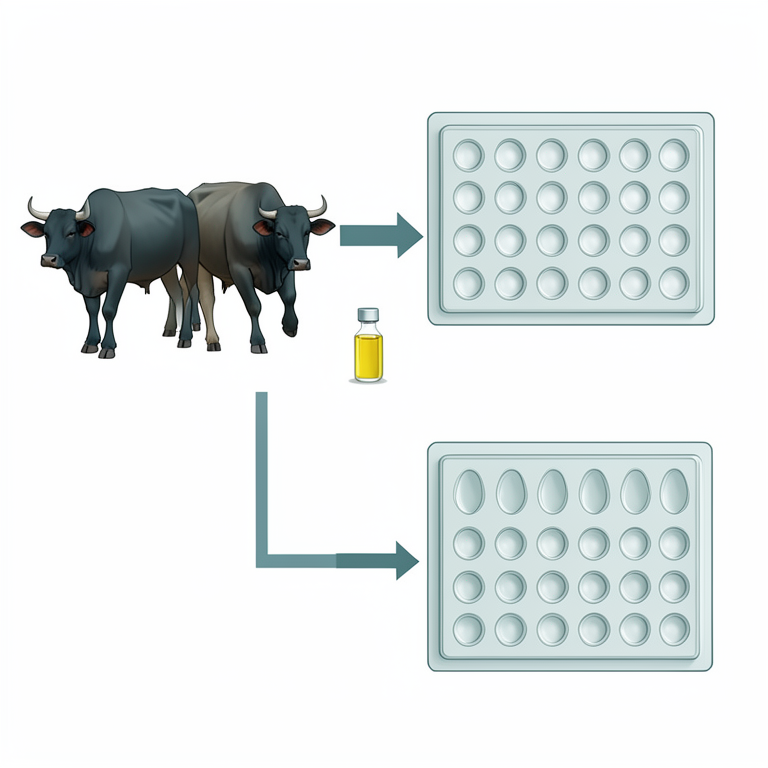
Study Workflow
AI-generated conceptual illustration (cattle and buffaloes). It explains the idea and does not show study data.
View source evidence ↗Figures & tables
From the original paper Table 1
 Table 2
Introduction
Gujarat is one of the well known states for milk production. Both cattle and buffaloes are main milk producer species and imperative pillars of economy of the state. Many infectious diseases are associated with health status of these animals which directly influence the economy of the state. Bovine tuberculosis is a chronic infectious zoonotic disease of domestic, wild animals as well as humans (Radostitis et al., 2002 [6] ) and is responsible for granulomatous inflammatory lesions in animals. Similarly, Johne's disease cause high economic loss due to decrease in cattle production which suffer from persisting diarrhoea with continuously loss of weight and finally death or culling of infected cattle. Mycobacterium bovis (M. bovis) poses a significant threat to global health and also a major cause for economic concern, costing an estimated USD 3 billion worldwide annually due to losses from reduced cattle productivity, culling and movement and trade restrictions (Waters et al., 2012 [11] , Olea-Popelka et al., 2014 [5] , Srinivasan et al., 2018 [7] ). Since MAP cells may survive pasteurization and can be transmitted to humans through raw milk, meat, and even contact with animals, it has the potential to have an impact on public health (Bhutediya et al., 2017 [1] ). Therefore TB and JD both conditions pose major public health threat. For diagnosis of these conditions, cultural isolation is a gold standard test, but it requires specialized media and longer incubation (3-5 months). To prevent spread of these conditions timely, accurate and sensitive diagnostic technique is required. ELISA is considered as rapid, easier and sensitive technique that could be used for screening and detection of the infected cases of TB and JD in bovines.
Materials and Methods
Materials and Methods
Sample Collection
Total 719 serum samples (461 cattle, 41 cow bull and 217 buffaloes), While 637 serum samples (380 cattle, 40 cow bull and 217 buffaloes) were screened for prevalence of bovine tuberculosis and Johne's disease, respectively from different areas of south Gujarat. Animals from both sex aged between 2-8 yrs were selected in the period between January 2019 to December 2022.
ELISA based detection of Mycobacterium bovis
Detection of Mycobacterium bovis was employed by ELISA technique using direct ELISA kit (Bionote BTB Ab ELISA kit 2.0, Korea), according to manufacturer instructions. ELISA plates coated with purified BTB antigen were incubated with 50 µl of positive control, negative control, 50 µl serum samples and 50 µl M. bovis antigen-HRP conjugate for 60 minutes at 37℃. After incubation unbound material was removed by washing and then 100 µl substrate was added. 100 µl stopping solution was added to stop the reaction and colorimetric reaction was measured by using spectrophotometer at 450 nm wavelengths.
ELISA based detection of Mycobacterium avium subspp. paratuberculosis
Antibodies of Mycobacterium avium subspp. Paratuberculosis detected with the use of Paratuberculosis Indirect ELISA Kit (ID.VET-France). This test was performed according to the procedure given in the kit. Samples were pre-incubated in neutralised buffer containing Mycobacterium phlie before being transferred to the coated plate in order to prevent cross-reaction. Any anti-MAP antibodies that are present combine with the MAP epitopes to form an antibody-antigen complex. The microwells were supplemented with an anti-ruminant IgG-peroxidase (Po) conjugate. In order to generate an antigen-antibodyconjugate-peroxides complex, it binds to the anti-Map antibodies. The substrate solution (TMB) was added after washing to get rid of the extra conjugate. The amount of particular antibodies present in the specimen to be examined determined the colouring that resulted; when antibodies were present, a blue solution appeared, which turned yellow following the addition of the stopping solution; when antibodies were absent, no coloration appeared. A spectrophotometer (ELISA reader, IGeneLabserve) reading the microplate at 450 nm was used.
Results
Overall prevalence of bovine tuberculosis recorded was 6.25% (45 of 719 animals) (p>0.05). Animal wise higher prevalence was noted in cow (8.89%) compared to buffaloes (0.46%) for bovine tuberculosis (p≤0.05). Among cattle higher prevalence was recorded in female animals (8.89%) than male animals (7.31%) for TB (Table 1). Overall prevalence of Johne's disease recorded was 8.63% (55 of 637 animals) (p>0.05). Animal wise higher prevalence was noted in cow (13.68%) compared to buffaloes (0.92%) for Johne's disease (p≤0.05). Among cattle higher prevalence was recorded in female animals (13.68%) than male animals (2.50%) for JD (Table 2).
| Year | 2019 | — | 2020 | — | 2021 | — | Total | — |
|---|---|---|---|---|---|---|---|---|
| No. of samples | Tested | Positive | Tested | Positive | Tested | Positive | Tested | Positive |
| Cow | 44 | 07 | 298 | 34 | 38 | 11 | 380 | 52 (13.68%) |
| Cow bull | 01 | 00 | 38 | 01 | 01 | 00 | 40 | 01 (2.50%) |
| Buffalo | - | - | 105 | 02 | 112 | 00 | 217 | 02 (0.92%) |
| Total | 45 | 07 | 480 | 17 | 151 | 0 | 637 | 55 (8.63%) |
Table text extracted from the original PDF; superscript letters are shown inline. The original table image is below.
View original table image
| Year | 2019 | — | 2020 | — | 2021 | — | Total | — |
|---|---|---|---|---|---|---|---|---|
| No. of samples | Tested | Positive | Tested | Positive | Tested | Positive | Tested | Positive |
| Cow | 87 | 28 | 336 | 13 | 38 | 0 | 461 | 41 (8.89%) |
| Cow bull | 01 | 0 | 39 | 03 | 01 | 0 | 41 | 03 (7.31%) |
| Buffalo | - | - | 105 | 01 | 112 | 0 | 217 | 01 (0.46%) |
| Total | 88 | 28 | 480 | 17 | 151 | 0 | 719 | 45 (6.25%) |
Table text extracted from the original PDF; superscript letters are shown inline. The original table image is below.
View original table image
Discussion
Tuberculosis is considered as one of the most prevalent and devastating diseases of animals, that not only pose economic significance but also have risk make threats for human health. Bovine tuberculosis infection is usually diagnosed in the live animal on the basis of delayed hypersensitivity reactions by intradermal testing. Subclinical infection is common and clinical signs are non-specific in many cases. A sensitive and accurate diagnostic tool is required because purified protein derivative (PPD) tests have been known to have 65.6% sensitivity (Wood and Rothel, 1994 [12] ). The serological diagnostic test is suitable for massive screening of bovine tuberculosis. ELISA can be employed in massive screening technique instead of PPD and no cross reaction with other mycobacterium species hence it could be considered as important serological test that can be employed for detection as well as eradication of bovine tuberculosis. Bovine Tuberculosis has been reported in cattle by several researchers by in India and the pooled prevalence estimate of bovine TB for all of India was found to be 7.3% (Srivastava et al., 2008 [8] ).
Paratuberculosis is a granulomatous infection caused by MAP mostly found among domestic ruminants including cattle, buffalo, sheep, goat, and camelids as well as wild ruminants (OIE, 2014 [4] ). It is responsible for huge economic loss to the dairy cattle industry and also important due to its zoonotic potential and is believed to be a pathogenic agent for Crohn's disease in human (Bhutediya et al., 2017 [1] ). Regular screening of herd to know the prevalence pattern of MAP affecting dairy animals is, an essential requirement to develop diagnostic methods and immunoprophylaxis for control and prevention of JD. Intradermal skin test measures DTH response after intradermal injection of PPD and it takes 72 hrs for interpretation, also but it gives false positivity for JD. Compared to this, ELISA is rapid and more sensitive technique for herd screening as well as to detect infection in animals. In present study 8.63% positivity is recorded for JD that is in corroboration with the findings of ElSayed, 2014 [2] , who also reported less positivity in cattle. In contrast to this, Trangdia et al., 2012 [9] has reported 13.39% positivity for JD from Gujarat. Limited reports available on the prevalence of the JD disease in various states of the country that ranges from 15.60 to 22.50% sero-positivity in cattle and buffaloes (Garg et al., 2007 [3] , Tripathi et al., 2007 [10] ).
Conclusions
It can be concluded that animals should be regularly screened for bovine tuberculosis and paratuberculosis and ELISA is a useful method for screening, monitoring and serosurveillance TB and JD in dairy animals.
References
8 in the original paper- Bhutediya JM, Dandapat P, Chakrabarty A, Das R, Nanda PK, Bandyopadhyay S, et al. Prevalence of paratuberculosis in organized and unorganized dairy cattle herds in West Bengal, India. Veterinary World. 2017;10(6):574-579.
- ElSayed MS. LCD array and IS900 efficiency in relation to traditional diagnostic techniques for diagnosis of Mycobacterium avium subspecies paratuberculosis in cattle in Egypt. International Journal of Mycobacteriology. 2014;3:101-107.
- Olea-Popelka F, Muwonge A, Perera A, Dean AS, Mumford E, Erlacher-Vindel E, et al. Zoonotic tuberculosis in human beings caused by Mycobacterium bovis-A call for action. The Lancet Infectious Diseases. 2014;17(1):e21-e25.
- Srinivasan S, Easterling L, Rimal B, Niu XM, Conlan AJ, Dudas P, et al. Prevalence of bovine tuberculosis in India: a systematic review and meta-analysis. Transboundary and Emerging Diseases. 2018;65(6):1627-1640.
- Srivastava K, Chauhan DS, Gupta P, Singh HB, Sharma VD, Yadav V, et al. Isolation of Mycobacterium bovis and M. tuberculosis from cattle of some farms in north India possible relevance in human health. Indian Journal of Medical Research. 2008;128(1):26-31.
- Trangadia BJ, Rana SK, Nagmani K, Srinivasan VA. Serological investigation of bovine brucellosis, Johne's disease and infectious bovine rhinotracheitis in two states of India. Journal of Advanced Veterinary Research. 2012;2(1):38-41.
- Waters WR, Palmer MV, Buddle BM, Vordermeier HM. Bovine tuberculosis vaccine research: Historical perspectives and recent advances. Vaccine. 2012;30(16):2611-2622.
- Wood PR, Rothel JS. In vitro immunodiagnostic assays for bovine tuberculosis. Veterinary microbiology. 1994;40(1-2):125-135.