
Research article · 2022 · Full text
International Journal of Biology SciencesEstimation of crop loss caused by important insect-pests of mango
Volume 4(2) · Pages 194–197 · DOI: 10.33545/26649926.2022.v4.i2c.123 ↗
Research areasPlant Physiology and Cultivation StudiesInsect behavior and control techniquesColeoptera: Cerambycidae studies
Abstract
Author-writtenA field experiment was conducted at Regional Horticultural Research Station, ASPEE College of Horticulture and Forestry, Navsari Agricultural University, Navsari (Gujarat) during 2009-10 to 2010-11. Application of recommended as well as need based insecticides in protected plots resulted in significantly lower hoppers (3.95 hoppers/twig or panicle), thrips (5.47 thrips/twig or panicle), damages of leaf gall midge (7.24% leaf damage), leaf webber (3.54 web/tree) and fruit fly (7.86% fruit infestation) as compared to the unprotected plots. Number of fruits set at stone (378.54/tree) and harvest stages (232.25/tree) were higher in protected trees giving significantly higher yield in protected (58.06 kg/tree) over untreated (21.82 kg/tree) trees followed by significant lower fruit dropping (38.51%) in the former over the latter (50.58%). The avoidable yield losses due to insect-pests was to the tune of 61.51% resulting into net profit of Rs. 69,780/ ha. in protected trees over control.
Summary
Source-checkedPlain-language reading of the full paper, prepared with AI and checked against the text. Each point links to the authors' own words.
Why it matters
- Mango is the national fruit of India, highly valued for its taste, nutrition, and popularity. View evidence ↗
- In the south Gujarat mango ecosystem, mango hoppers are considered a major and widespread pest throughout the year. View evidence ↗
- Hoppers damage mango crops by sucking cell sap from various plant parts, leading to flower non-setting and premature fruit drop. View evidence ↗
The question
- The study aimed to estimate the crop loss caused by important insect-pests of mango. View evidence ↗
What they did
- Protected trees received endosulfan (0.07%) at bud initiation, with imidacloprid (0.005%) and thiamethoxam (0.0084%) applied as needed. View evidence ↗
- Pest populations were measured using visual counts for hoppers and thrips, leaf damage counts for gall midges, total webs for leaf webbers, and damaged fruit counts for fruit flies. View evidence ↗
What they found
- Protected trees had significantly lower populations of hoppers (3.95 vs 8.82) and thrips (5.47 vs 14.77 per twig or panicle) compared to unprotected trees. View evidence ↗
- Protected trees showed significantly less leaf damage (7.24% vs 20.68%), fewer webs (3.54 vs 5.56 per tree), and lower fruit fly infestation (7.86% vs 24.80%) than untreated trees. View evidence ↗
- Fruit set was significantly higher in protected trees at both the stone size stage (378.54 vs 179.71 per tree) and harvest stage (232.25 vs 87.29 per tree). View evidence ↗
- Protected trees produced a significantly higher yield (58.06 kg/tree vs 21.82 kg/tree) and experienced lower fruit drop (38.51% vs 50.58%). View evidence ↗
- The use of recommended and need-based treatments resulted in an avoidable yield loss of 61.51% and a net profit of Rs. 69,780 per hectare. View evidence ↗
What it means
- The authors conclude that applying recommended and need-based insecticides significantly reduces the population and damage caused by major mango insect-pests. View evidence ↗
Visual summary
2 visualsIllustrations explain the paper; charts are replotted from the paper's own table values.
Comparison of Protected vs Unprotected Trees
AI-generated conceptual illustration (mango trees). It explains the idea and does not show study data.
View source evidence ↗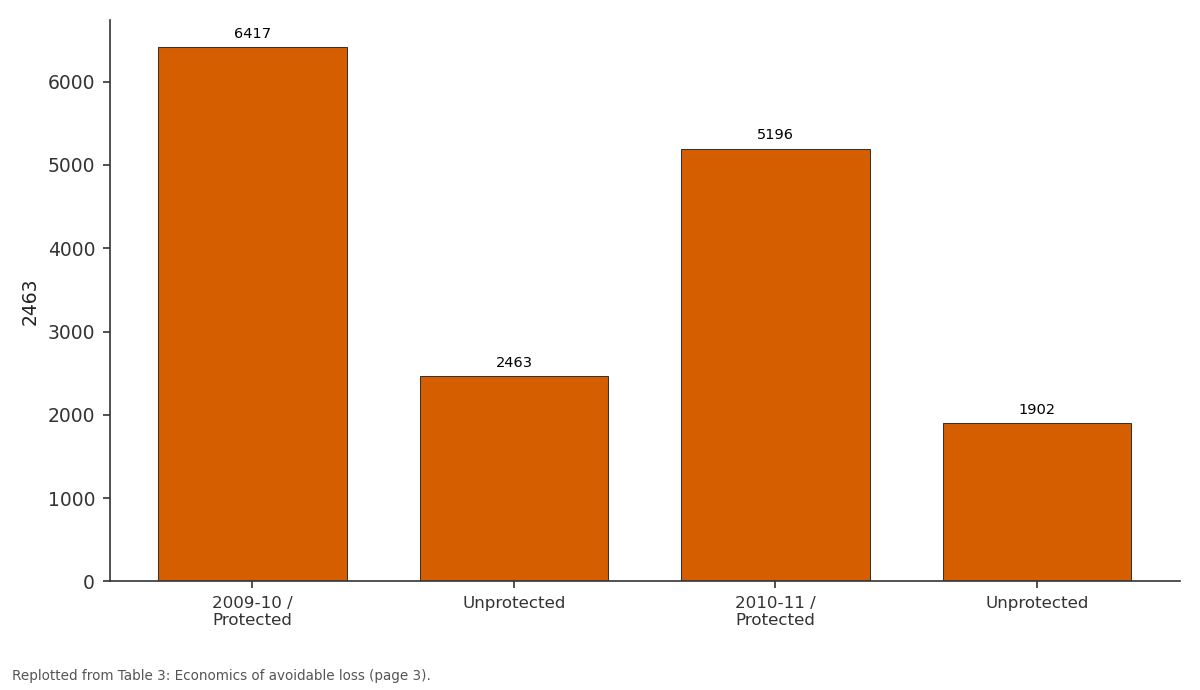
2463: 2009-10 / Protected vs Unprotected vs 2010-11 / Protected vs Unprotected
Replotted from Table 3 (page 3) of the original paper. Every bar is the paper's own table value.
View source evidence ↗Figures & tables
From the original paper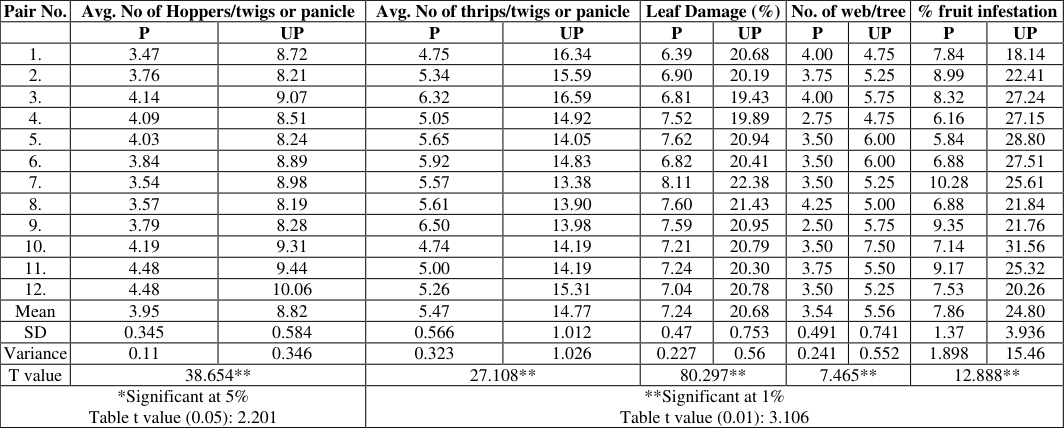 Table 1
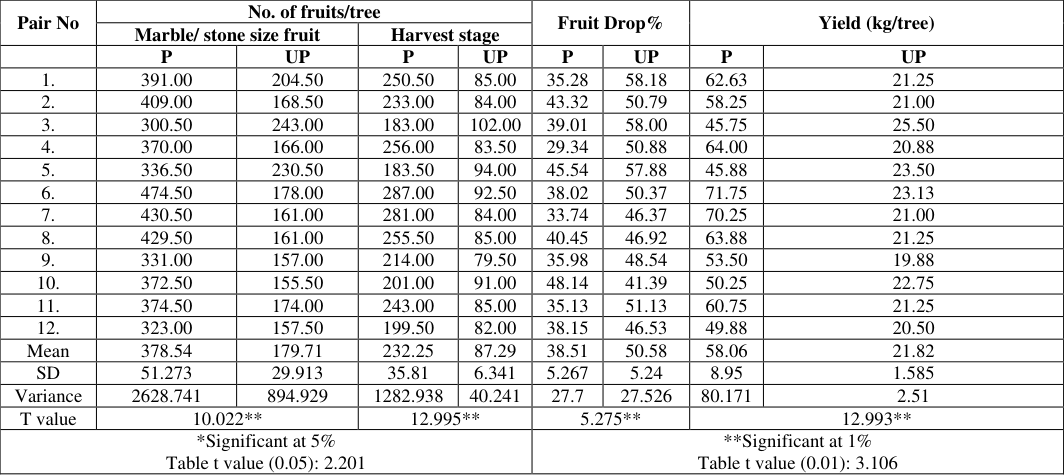 Table 2
 Table 3
Introduction
Mango (Mangifera indica Linnaeus) is national fruit of India and known as "King of fruits" due to its wide adaptability, excellent taste, exotic flavour, exemplary nutritive value, richness in variety, attractive colour, appearance and popularity among the masses. The major mango producing countries in the world are India, China, Pakistan, Mexico, Thailand, Indonesia, Brazil, Philippines, Nigeria and Viet Nam. India ranks first in production of mango in the world. Various insect-pests of mango viz., hoppers, mealybugs, leaf gall midges, shoot gall psylla, fruitfly, thrips, leag webber, stem borer. Among the insect pests, mango hoppers are major, serious and wide-spread throughout the year in south Gujarat mango ecosystem. Hoppers species viz., Amritodus atkinsoni (Lethierry), Idioscopus clypealis (Lethierry) and Idioscopus nitidulus (Walker) remains active and damage each crop stage of mango from emergence of new flush to flowering cum fruit setting stages [3,18] and causes up to 100% losses. Both nymph and adult hoppers are observed sucking cell sap from young leaves, tender shoots, inflorescences or panicles and rachis of the young fruits which results in non-setting of flowers and dropping of immature fruits. Hoppers also excretes huge quantities of honey dew results in sooty mould formation, thus affects the photosynthesis of the plant. Other than hopper, thrips are major yield limiting factors in south Gujarat and elsewhere [1,7,19] . It is a polyphagous, cryptic mannered pest having short life cycle, high mobility towards development of insecticide resistance and infest a wide variety of host plants [11,21] . In India, the greatest damage to mango crop is caused by these hoppers and at times they are responsible for total crop failure [28] . Not much work has been done on the quantification of losses caused by mango hoppers, although, 20 to 100% loss of inflorescences reported by [26] . The losses due to hopper to the tune of 25-60% [8,10] . Similarly, [5] has recorded the losses up to 60%. Nymph and adult thrips suck cell sap from tender leaves, shoots, inflorescence and fruits of the mango which results in silvery shine with leaf edges, curling upwards, stunted growth, discoloration of buds and panicles, malformed, premature drops and bronzing of the fruit surface with feeding scars on fruits, thus adversely affects the quality of the marketable produce. Fruit flies, Bactrocera dorsalis (Hendel), B. zonata (Saunders) and B. correcta (Bezzi) are considered to be major bottleneck in economical mango production [2,31] . It assumes great significance as a quarantine pest. During ripening stage of mango, female fruit fly lays eggs in the fruit skin with the help of ovipositor and after hatching, the maggots start feeding inside the fruit pulp and causes internal discoloration, emits off flavours, pulp rotting and fruit drop and lastly, pupates in the soil. It causes up to 80% yield loss in mango [29] and total Rs 29, 460 million annual losses in mango, guava, citrus and sapota [22] . Fruit flies cause up to 40% yield loss in heavy rainfall zone of south Gujarat [25] . Other pests viz., shoot borer, leaf webber, stem borer, mealy bug, leaf gall midge, leaf damaging insect (ash grey beetle and leaf miner), scale insect, mite, red ants, hairy caterpillar, bark eating caterpillar, semi-looper and fruit borer are recorded as a minor or sporadic pest of mango [14,25,27,29] . So the present investigation to estimate crop loss caused by important insect-pests of mango was carried out at the Regional Horticultural Research Station, Navsari Agricultural University, Navsari.
Material and Methods
A field experiment was conducted at Regional Horticultural Research Station, ASPEE College of Horticulture and Forestry, Navsari Agricultural University, Navsari (Gujarat)
during 2009-10 to 2010-11 to estimate avoidable losses due to pest complex in mango cv. Kesar. Twenty four trees were selected with two treatments (treated and untreated). The pest incidence was recorded at weekly interval. Ten terminal twigs and ten panicles were selected randomly during vegetative and flowering stages from the lower canopy of the mango tree. The population of nymphs and adults of mango hopper and thrips were counted by visual count method. In case of leaf gall midge, numbers of healthy as well as damaged leaves were counted on each of the ten terminal twigs from the lower canopy of each tree. Observations of leaf webber were made on the basis of total number of webs on each selected trees, while those of fruit fly were made on the basis of total number of damaged fruits. Percent avoidable losses of fruit yield in different treatments were calculated by comparing the fruit yield of respective treatments with unprotected treatment by adopting following formula.
Avoidable crop loss = Yield in treated plot (kg/ha)-Yield in control plot (kg/ha) X 100 Yield in treated plot (kg/ha) Avoidable economic loss = Income in treated plot (kg/ha)-Income in control plot (kg/ha) X 100 Income in treated plot (kg/ha)
The treatments were randomized and data on population of important pests of mango were recorded before as well as after each insecticide application. In each treatment except untreated control, need based applications of insecticides were given based on Economic Threshold Level of important pests of mango which is as under:
Pests ETL Fruit fly Presence of fruit fly 5.
For recording fruit setting per tree, total number of fruits per tree was counted at harvest stage (Physiologically mature fruit) which was later expressed as number of fruits or fruit bearing per tree. For recording yield, the total produce harvested from each selected tree was weighed and expressed as yield in kilograms per tree.
Result and Discussion
Population of mango hopper was compared in protected (P) as well as unprotected (UP) plots (one tree was considered as unit replicate) before and after spraying. Subsequently, cumulative yield loss was compared in both the sets. Hopper population in protected trees (3.95) was significantly lower than in unprotected trees (8.82) (Table-1) whereas, thrips population in protected trees was significantly lower (5.47 thrips/twig or panicle) than unprotected trees (14.77). Moreover, leaf damage (%) in protected trees was significantly lower (7.24%) than in untreated trees (20.68). Protected trees indicated significantly lower webbing (3.54/tree) as compared to the unprotected trees (5.56). For fruit fly, fruit infestation was significantly lower (7.86%) in protected trees as compared to the unprotected trees (24.80).
In protected plots, recommended pest management practices (Endosulfan 0.07% at bud initiation stage followed by need based application of imidacloprid 0.005% and thiamethoxam 0.0084%) were given as and when pests attained economic threshold level, whereas trees in unprotected plot were kept free from any insecticide application. Application of recommended insecticides followed by need based application significantly reduced hopper population in protected trees over unprotected trees. Imidacloprid at 0.2-0.6 ml/lit was found effective for a period of 21 days against hoppers complex of Idioscopus nagpurensis at 0.2 ml/lit against I. niveosparsus [30] . Similar observations were reported by [17] against mango hoppers, I. clypealis and I. brevistylus in Sri Lanka during February-March. Imidacloprid at 3-4 ml/10 lit of water equally and significantly effective for the control of mango hopper [12] . It also indicated highest reduction of hopper using imidacloprid in Andhra Pradesh [15] . However, higher efficacy of imidacloprid (0.005%) with 96.56% reduction over control reported by [6] . Two applications of thiamethoxam, once at the beginning of flowering and another at the full bloom stage at 50 and 100 g a.i checked mango hopper infestation [23] . In the present investigation, protected trees were applied endosulfan (0.07%) at bud initiation as recommended practice followed by application of imidacloprid (0.005%) and thiamethoxam (0.0084%) on need basis. Mango trees treated with imidacloprid 0.005% had significantly lower leaf damage (1.73%) during March [24] . The maximum fruit infestation coincided with harvesting period i.e. May to July in mango. Similar, observations were made by [16,20] in Gujarat and [9] in Uttar Pradesh. Highest (34.66%) fruit infestation reported in second week of June by [4] .
Fruit Yield
Number of fruits set at stone size fruit (378.54/tree) and harvest (232.25/tree) stages were significantly higher on protected trees than unprotected trees (179.71 and 87.29/tree at respective stages) which ultimately resulted in significantly higher yield in protected (58.06 kg/tree) as compared to the unprotected (21.82 kg/tree) trees. Significant lower fruit dropping was also observed from protected trees (38.51%) over the unprotected trees (50.58%) (Table 2).
| Pair No | No. of fruits/tree | — | — | — | Fruit Drop% | — | Yield (kg/tree) | — |
|---|---|---|---|---|---|---|---|---|
| Marble/ stone size fruit | Harvest stage | |||||||
| P | UP | P | UP | P | UP | P | UP | |
| 1. | 391.00 | 204.50 | 250.50 | 85.00 | 35.28 | 58.18 | 62.63 | 21.25 |
| 2. | 409.00 | 168.50 | 233.00 | 84.00 | 43.32 | 50.79 | 58.25 | 21.00 |
| 3. | 300.50 | 243.00 | 183.00 | 102.00 | 39.01 | 58.00 | 45.75 | 25.50 |
| 4. | 370.00 | 166.00 | 256.00 | 83.50 | 29.34 | 50.88 | 64.00 | 20.88 |
| 5. | 336.50 | 230.50 | 183.50 | 94.00 | 45.54 | 57.88 | 45.88 | 23.50 |
| 6. | 474.50 | 178.00 | 287.00 | 92.50 | 38.02 | 50.37 | 71.75 | 23.13 |
| 7. | 430.50 | 161.00 | 281.00 | 84.00 | 33.74 | 46.37 | 70.25 | 21.00 |
| 8. | 429.50 | 161.00 | 255.50 | 85.00 | 40.45 | 46.92 | 63.88 | 21.25 |
| 9. | 331.00 | 157.00 | 214.00 | 79.50 | 35.98 | 48.54 | 53.50 | 19.88 |
| 10. | 372.50 | 155.50 | 201.00 | 91.00 | 48.14 | 41.39 | 50.25 | 22.75 |
| 11. | 374.50 | 174.00 | 243.00 | 85.00 | 35.13 | 51.13 | 60.75 | 21.25 |
| 12. | 323.00 | 157.50 | 199.50 | 82.00 | 38.15 | 46.53 | 49.88 | 20.50 |
| Mean | 378.54 | 179.71 | 232.25 | 87.29 | 38.51 | 50.58 | 58.06 | 21.82 |
| SD | 51.273 | 29.913 | 35.81 | 6.341 | 5.267 | 5.24 | 8.95 | 1.585 |
| Variance | 2628.741 | 894.929 | 1282.938 | 40.241 | 27.7 | 27.526 | 80.171 | 2.51 |
| T value | 10.022** | 12.995** | 5.275** | 12.993** | ||||
| *Significant at 5% Table t value (0.05): 2.201 | **Significant at 1% Table t value (0.01): 3.106 |
Table text extracted from the original PDF; superscript letters are shown inline. The original table image is below.
View original table image
Avoidable loss
Avoidable yield loss from important insect-pests of mango was worked out to the tune of be 61.51% which resulted in net profit worth of Rs. 69,780 per ha. By imposition of recommended and need based treatments in protected trees (Table 3). From the present findings, it may be interpreted that application of recommended insecticides (endosulfan 0.07% at bud initiation) followed by imidacloprid 0.005% and thiamethoxam 0.0084% on need basis showed avoidable loss of 60.79-63.39% from important insect-pests of mango in protected plots. 20-100% loss of inflorescences by hoppers reported by [30] . Losses due to hoppers to the extent of 25-60% reported by [8,10] . Similarly, [5] has also recorded loss up to 60%. In a field experiment conducted in Maharashtra during 1998, 1999 and 2001, 46.30 and 41.09% increase in yield was also observed over control in second and third sprays, respectively [4] .
| — | 2009-10 | — | 2010-11 | — | 2009-11 (Pooled) | — |
|---|---|---|---|---|---|---|
| Treatment | ||||||
| Protected | Unprotected | Protected | Unprotected | Protected | Unprotected | |
| Total spray | 3 | - | 3 | - | 3 | - |
| Yield (kg/ha) | 6417 | 2463 | 5196 | 1902 | 5806.50 | 2182.50 |
Table text extracted from the original PDF; superscript letters are shown inline. The original table image is below.
View original table image
Conclusion
Application of recommended as well as need based insecticides in protected plots resulted in significantly lower hoppers and thrips and damages of leaf gall midge, leaf webber and fruit fly as compared to the unprotected plots. Number of fruits set at stone and harvest stages were higher in protected trees giving significantly higher yield in protected (58.06 kg/tree) over untreated (21.82 kg/tree) trees followed by significant lower fruit dropping in the former over the latter. The avoidable yield losses due to insect-pests was to the tune of 61.51% leading to net profits over control of Rs. 69,780 per ha.in protected trees. Where, P=Protected, UP=Unprotected.
Figures and tables from the paper
| Pair No. | Avg. No of Hoppers/twigs or panicle | — | Avg. No of thrips/twigs or panicle | — | Leaf Damage (%) | — | No. of web/tree | — | % fruit infestation | — |
|---|---|---|---|---|---|---|---|---|---|---|
| P | UP | P | UP | P | UP | P | UP | P | UP | |
| 1. | 3.47 | 8.72 | 4.75 | 16.34 | 6.39 | 20.68 | 4.00 | 4.75 | 7.84 | 18.14 |
| 2. | 3.76 | 8.21 | 5.34 | 15.59 | 6.90 | 20.19 | 3.75 | 5.25 | 8.99 | 22.41 |
| 3. | 4.14 | 9.07 | 6.32 | 16.59 | 6.81 | 19.43 | 4.00 | 5.75 | 8.32 | 27.24 |
| 4. | 4.09 | 8.51 | 5.05 | 14.92 | 7.52 | 19.89 | 2.75 | 4.75 | 6.16 | 27.15 |
| 5. | 4.03 | 8.24 | 5.65 | 14.05 | 7.62 | 20.94 | 3.50 | 6.00 | 5.84 | 28.80 |
| 6. | 3.84 | 8.89 | 5.92 | 14.83 | 6.82 | 20.41 | 3.50 | 6.00 | 6.88 | 27.51 |
| 7. | 3.54 | 8.98 | 5.57 | 13.38 | 8.11 | 22.38 | 3.50 | 5.25 | 10.28 | 25.61 |
| 8. | 3.57 | 8.19 | 5.61 | 13.90 | 7.60 | 21.43 | 4.25 | 5.00 | 6.88 | 21.84 |
| 9. | 3.79 | 8.28 | 6.50 | 13.98 | 7.59 | 20.95 | 2.50 | 5.75 | 9.35 | 21.76 |
| 10. | 4.19 | 9.31 | 4.74 | 14.19 | 7.21 | 20.79 | 3.50 | 7.50 | 7.14 | 31.56 |
| 11. | 4.48 | 9.44 | 5.00 | 14.19 | 7.24 | 20.30 | 3.75 | 5.50 | 9.17 | 25.32 |
| 12. | 4.48 | 10.06 | 5.26 | 15.31 | 7.04 | 20.78 | 3.50 | 5.25 | 7.53 | 20.26 |
| Mean | 3.95 | 8.82 | 5.47 | 14.77 | 7.24 | 20.68 | 3.54 | 5.56 | 7.86 | 24.80 |
| SD | 0.345 | 0.584 | 0.566 | 1.012 | 0.47 | 0.753 | 0.491 | 0.741 | 1.37 | 3.936 |
| Variance | 0.11 | 0.346 | 0.323 | 1.026 | 0.227 | 0.56 | 0.241 | 0.552 | 1.898 | 15.46 |
| T value | 38.654** | 27.108** | 80.297** | 7.465** | 12.888** | |||||
| *Significant at 5% Table t value (0.05): 2.201 | **Significant at 1% Table t value (0.01): 3.106 |
Table text extracted from the original PDF; superscript letters are shown inline. The original table image is below.
View original table image
References
31 in the original paper- Bana JK, Ghoghari PD, Kalaria GB, Saxena SP, Shah NI. Efficacy of IPM Modules against Mango Hopper Complex. Indian J Ent. 2015;77:320-322.
- Bana JK, Sharma H, Kumar Sushil, Singh P. Impact of weather parameters on population dynamics of oriental fruit fly, Bactrocera dorsalis (Hendel) (Diptera: Tephritidae) under south Gujarat mango ecosystem. J Agromet. 2017;19:78-80.
- Bana JK, Singh P, Makwana Amit. Influence of abiotic factors and crop stages on population dynamics of hoppers, Idioscopus spp. in Mango ecosystem. Annals of Pl. Pro. Sci. 2016;24:286-289.
- Bansode GM. Studies on comparative biology, population dynamics and management of orchard flies (Bactrocera spp.). Ph.D. (Agril.) Thesis submitted to Navsari Agricultural University, Navsari (unpublished), 2009.
- Bap Reddy. Plant Protection in India. Allied Publishers, New Delhi, 1968, 219-261.
- Bhaskar LV, Manjunath J, Gopal V. Evaluation of new insecticides against mango hoppers Amritodus atkinsoni L. Pestology. 2007;31(2):33-34.
- CABI. Crop Protection Compendium: Global Module. CABI Publishing, Wallingford, UK, 2003.
- Cheema GS, Bhatt S, Naik KC. Commercial Fruits of India, Macmillan and Co. Ltd. Calcutta, 1954, 322.
- Dwivedi SC, Kuldeep Singh SM, Katyar RR. Seasonal incidence of insect pests associated with mango crop. Annals of Pl. Prot. Sci. 2003;11(1):159-160.
- Gangolly SR, Singh R, Katyal SL, Singh D. The Mango, ICAR, New Delhi, 1967, 530.
- Global Pest, Disease Database. (GPDD). Report on GPDD Pest ID 1276 Scirtothrips dorsalis-Animal and Plant Health Inspection Service (APHIS), 2011, 1-15.
- Godase SK, Bhole SR. Efficacy of imidacloprid 200 SL against hopper complex of mango, Mangifera indica. Pestology. 2002;26(3):29-10.
- Godase SK, Bhole SR, Shivpuje PR, Patil BP. Assessment of yield loss in mango (Mangifera indica) due to mango hopper (Idioscopus niveosparsus) (Homoptera: Cicadellidae). Ind. J Agri. Sci. 2004;74(7):370-372.
- Gundappa, Rajkumar B, Srivastava K, Singh S. Rearing of mango stem borer, Batocera rufomaculata De Geer (Coleoptera: Cerambycidae) on artificial diet. Pest Management in Hortil. Ecosy. 2015;21:219-220.
- Indumathi N, Savithri P. Efficacy of some insecticides against mango hopper complex. Ind. J Pl. Prot. 2003;31(2):114-115.
- Jhala RC, Patel ZP, Shah AH, Patel MB, Patel CB. Population rhythm of fruit fly D. correctus in mango and chiku orchards. Proceeding of National Symposium on Animal Behaviour, Bhavnagar, Gujarat, 1989, 4-8.
- Kudagamage C, Rajapakshe HL, Dez Rajapakshe RHS, Disna Ratnasekra. The population dynamics and insecticidal control of three leaf hoppers, Amritodus brevistylus Leth; Idioscopus niveosparsus Leth. And Idioscopus clypealis Leth. (Homoptera: Cicadellidae) in mango. J Entomol. Res. 2001;25(2):121-125.
- Kumar S, Desai HR, Patel ZP, Bhatt BK. Impact of climatic variability and crop phenology in abundance of mango hopper. International conference: Changing scenario of pest problems in Agri-Horti ecosystem and their management held at MPUAT, Udaipur, 2014, 114128.
- Kumar S, Patel CB, Bhatt RI, Rai AB. Population dynamics and insecticidal management of the mango thrips, Scirtothrips dorsalis Hood (Thysanoptera: Thripidae) in South Gujarat. Pest Management and Econ. Zool. 1994;2:59-62.
- Kumar S, Patel CB, Bhatt RI. Studies on seasonal cyclicity of B. correctus in mango and sapota orchard using methyl eugenol trap. Gujarat Agricultural University Research Journal. 1997;22(2):68-74.
- Kumar Vivek, Dakshina RS, Garima K, Mckenzie CL, Osborne LS. New tropical fruit hosts of Scirtothrips dorsalis (Thysanoptera: Thripidae) and its relative abundance on them in south Florida. Florida Entomologist. 2012;95:205-207.
- Mumford John D. Management of fruit flies in India (Diptera: Tephritidae) Funding application and project memorandum. Department of International development (DFID), UK, 2001, 1-95.
- Murugan M, Ramachandran K. Biological efficacy of Actara 25 WG insecticides against mango sucking pests. Pestology. 2001;25(9):39-41.
- Patel AT. Seasonal incidence, varietal screening and chemical control of mango leaf gall midge, Procontarinia matteiana Kieffer & Cecconi. MSc. (Agril.). Thesis submitted to Navsari Agricultural University, Navsari (unpublished), 2009.
- Patel KB, Saxena SP, Patel KM. Fluctuation of fruit fly oriented damage in mango in relation to major abiotic factors. Hort. Flora Research Spectrum. 2013;2:197201.
- Rao RY. Mango hopper problems in South India. Agri. J India. 1930;25:17-25.
- Reddy DS. Relative incidence of leaf webber, Orthaga exvinacea Hamp. on varieties and hybrids of mango (Mangifera indica L.). Pest Management in Hort. Ecosystem. 2013;19:234-236.
- Singh LB. The Mango, Botany, Cultivation and Utilization, Leonard Hill, London, 1968, 293.
- Verghese A, Jayanthi PDK. Integrated pest management in fruits. In: Pest Management in Horticultural Ecosystems, (Parvatha Reddy P, Verghese A, Krishna Kumar NK. Eds.), Capital Publishing Company, New Delhi. 2001, 1-23.
- Verghese Abraham. Effect of imidacloprid, lambdacyhalothrin and azadirachtin on the mango hopper, Idioscopus niveosparsus (Leth.) (Homoptera: Cicadellidae). Acta Hort. 2000;509:733-736.
- Verghese Devi. Seasonality and sampling of the mango shoot borer, Chlumetia transversa Walker (Lepidoptera: Noctuidae) Pest Management in Hort. Ecosys. 1998;4:16-20.
Cited by 5
From OpenAlex, OpenCitations and reference lists read by Scinovex
- Evaluation of a Native Isolate of Metarhizium anisopliae (Metschn.) Sorokin Against the Mango Leaf Hopper Complex (Idioscopus spp.) Infesting Mango (Mangifera indica L.) for Organic Fruit Production ↗
T. K. Radha, P. N. Ganga Visalakshy, P. V. Rami Reddy, A. Nithish, Sachin Chavan, Pooja Shrivastava et al. · Applied Fruit Science · 2025
❝ 2 - RETRACTED ARTICLE: Studies on population dynamics and bio-intensive management of the mango hopper, Idioscopus nagpurensis (Pruthi) (Cicadellidae: Hemiptera) under high-density planting system conditions of the Eastern hill and plateau region of India ↗
ARBUD LALA, Archita Das · International Journal of Tropical Insect Science · 2026
❝ 0 - Sticky trap using Melaleuca essential oil as a natural insecticide to control fruit fly pests in organic farming system ↗
Agus Kardinan, Samsudin, Paramita Maris, A Khalifah, S Aprilla · IOP Conference Series Earth and Environmental Science · 2026
Abstract Fruit flies ( Bactrocera spp) are major pests that attack several horticultural commodities. Synthetic insecticides are often used to control fruit flies. However, in the organic farming system, the use of synthetic insecticides is forbidden. Therefore, natural insecticides are needed. This study aimed to determine the most effective and efficient concentration of Melaleuca essential oil in sticky trap formula…
❝ 0PDF - The inhibition of browning of mango embryos by endophytes ↗
Haiyan Shu, Qing Zhong Wei, Songbiao Wang, Rulin Zhan, Shenghe Chang · European Journal of Plant Pathology · 2026
❝ 0 - Immune Responses of Mango Callus Infected by Agrobacterium tumefaciens Inhibited Transformation ↗
Haiyan Shu, Zilhas Ahmed Jewel, Md. Omor Faruk, Luqiong He, Qing Wei, Rulin Zhan et al. · International Journal of Molecular Sciences · 2025
Mango is a vital fruit crop in tropical and subtropical regions, yet pests and diseases cause 30–70% production losses. Developing disease-resistant cultivars through transgenic methods could mitigate these issues. Agrobacterium-mediated callus transformation is a common genetic engineering approach, but successful transgenic mango plants from callus remain unreported due to severe browning and necrosis post-infection. We hypothesized that Agrobacterium-induced immune responses…
❝ 0PDF