
Research article · 2023 · Full text
International Journal of Agriculture and Food ScienceEffects of micro-water harvesting techniques on sesame growth, yield and soil moisture on clay soil in rain fed area
Volume 5(1) · Pages 01–07 · DOI: 10.33545/2664844x.2023.v5.i1a.107 ↗
Research areasSesame and Sesamin ResearchCassava research and cyanide
Abstract
Author-writtenSesame (Sesamum indicum L.) is the major cash crop yearly grown in rain fed areas as alternative to Sorghum crop, but their grain yield is remarkably reduced by soil moisture stress when cultivated in cracking clay soil under semi-arid climate. This require employing good Vertisol water management practices that conserve moisture during dry spell period and excess moisture during wet periods. Possible practice to adopt is to utilize relevant water harvesting technique. Therefore, the main objective of this study is to investigate the performance of three water harvesting methods namely: semi-circular bund, ridge and furrow, and sowing on flat soil surface, on soil moisture distribution and Sesame crop growth attributes (Days to 50% flowering, days to 90%maturity, number of branches per plant, and plant height). Yield Attributes (number of seeds per capsule, thousand seed weight,) and seed yield (Weight per unit area). The field study was conducted at El Migrih in Butana rain fed area during 2019/2020 and 2020/2021 growing seasons in vertisol soil type. The experiment was laid out in randomized complete block design (RCBD) with three replications using variety Khidir. Statistical analysis revealed that water harvesting techniques had a significant effect on soil moisture and agronomic parameters. The ridge and furrow method conserved best soil moisture resulting in the highest sesame seed yield (548 kg ha-1) while the lowest yield (390 kg ha -1) was obtained with flat traditional method.
Summary
Source-checkedPlain-language reading of the full paper, prepared with AI and checked against the text. Each point links to the authors' own words.
Why it matters
- Sesame is a primary cash crop in rain-fed areas, but its yield is significantly lowered by soil moisture stress in semi-arid climates with cracking clay soils. View evidence ↗
- In the studied region, annual sesame yields (0.274 t/ha) are substantially lower than the international average of 0.512 t/ha. View evidence ↗
- The Central Clay Plain is dominated by vertisols, which are difficult to manage because they become hard when dry and sticky when wet. View evidence ↗
The question
- The study aimed to evaluate how three water harvesting methods, semi-circular bunds, ridge and furrow, and flat soil sowing, affect soil moisture distribution and sesame growth. View evidence ↗
What they did
- The research was conducted over the 2019/2020 and 2020/2021 growing seasons in vertisol soil at El Migrih in the Butana rain-fed area. View evidence ↗
- The experiment used a randomized complete block design (RCBD) with three replications, planting the Khidir sesame variety. View evidence ↗
- The ridge and furrow treatment featured a furrow depth of 30 cm, a bed height of 30 cm, and furrow spacing of 0.8 m. View evidence ↗
- Soil moisture was measured using the gravimetric oven dry method from a one-meter profile at 0.2 m intervals. View evidence ↗
What they found
- Plant height was lowest on flat land (69 cm), while ridge and furrow (75 cm) and semi-circular bunds (78 cm) produced taller plants. View evidence ↗
- The number of capsules per plant was highest with the ridge and furrow method (33.9) and lowest with flat sowing (29.3). View evidence ↗
- There was no significant difference in soil moisture 15 days after sowing across all methods, likely due to rapid water intake through soil cracks. View evidence ↗
What it means
- The authors recommend the ridge and furrow technique as an effective climate change adaptation strategy for dry land areas facing water shortages and erratic rainfall. View evidence ↗
Visual summary
3 visualsIllustrations explain the paper; charts are replotted from the paper's own table values.
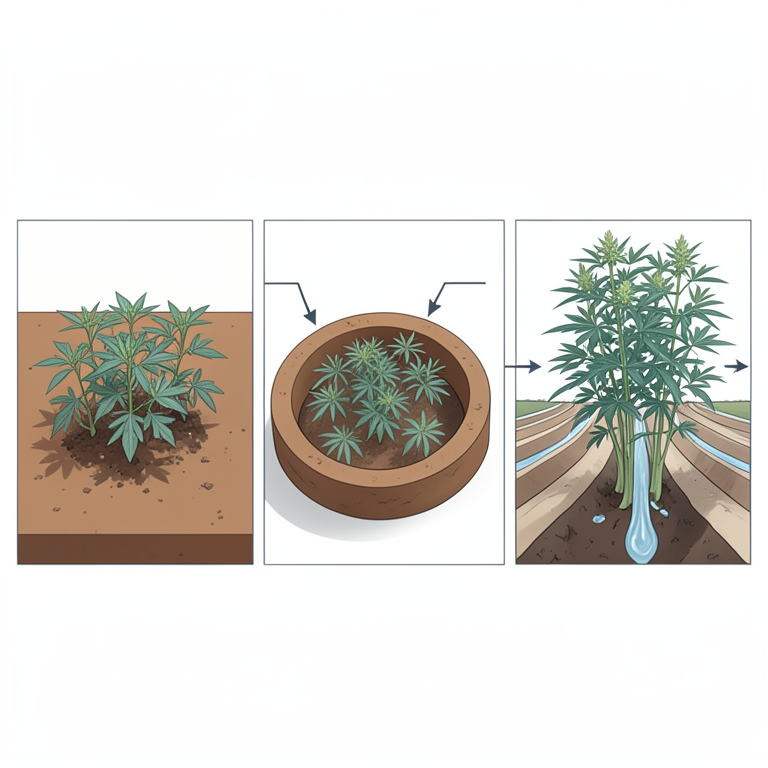
Comparison of Water Harvesting Methods
AI-generated conceptual illustration (Sesame plants (Sesamum indicum) grown in clay soil). It explains the idea and does not show study data.
View source evidence ↗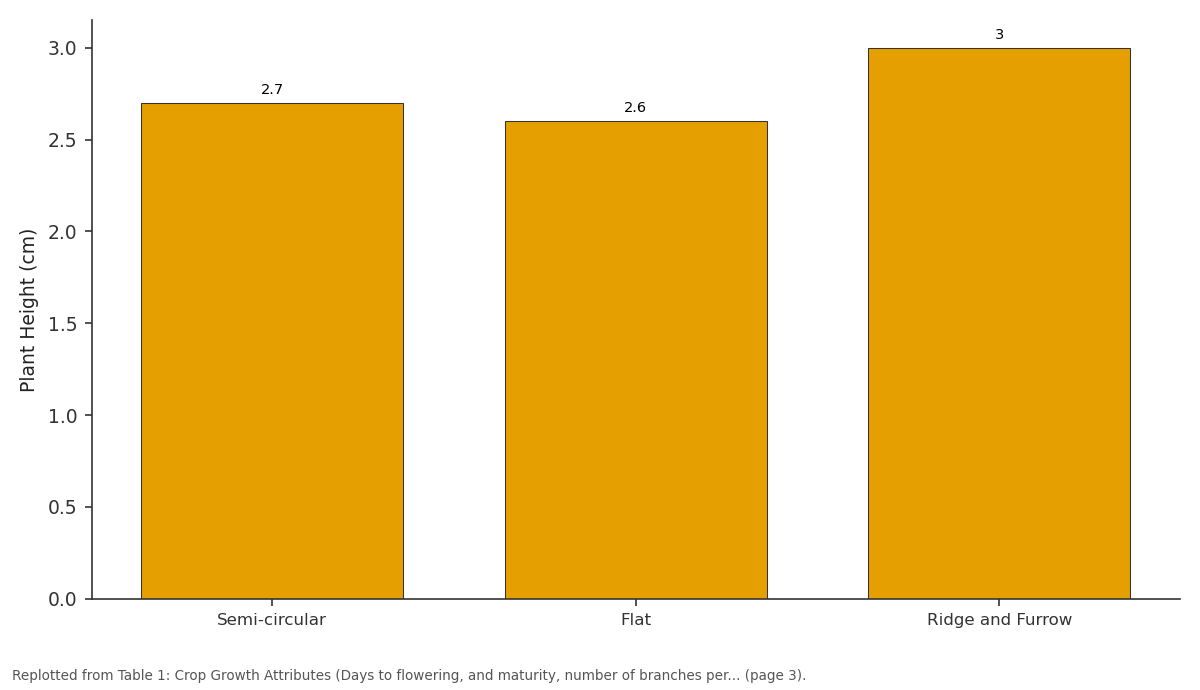
No. Braches/plant: Semi-circular vs Flat vs Ridge and Furrow
Replotted from Table 1 (page 3) of the original paper. Every bar is the paper's own table value.
View source evidence ↗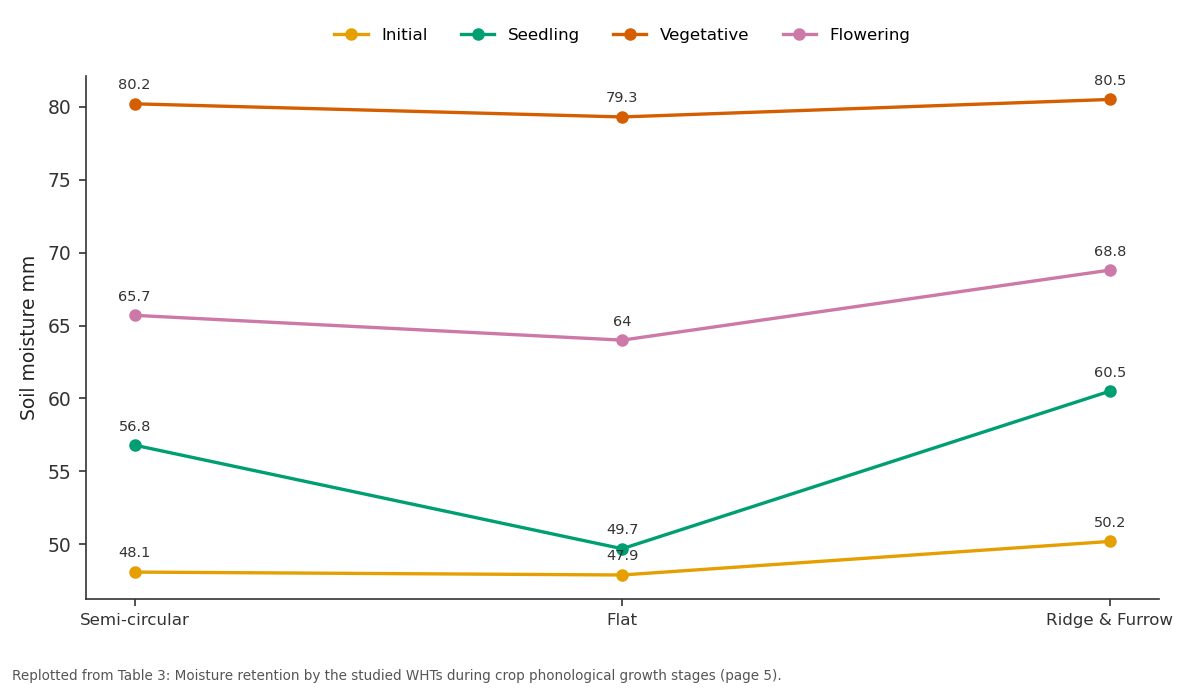
Initial and Seedling and more: Semi-circular vs Flat vs Ridge & Furrow
Replotted from Table 3 (page 5) of the original paper. Every bar is the paper's own table value.
View source evidence ↗Figures & tables
From the original paper Table 1
 Table 2
 Table 1
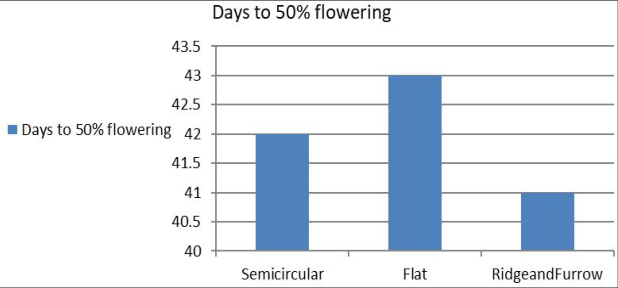 Figure 1
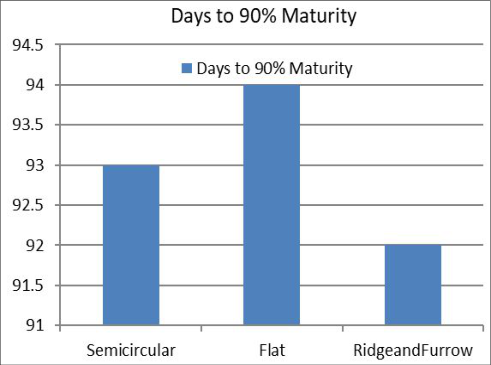 Figure 2
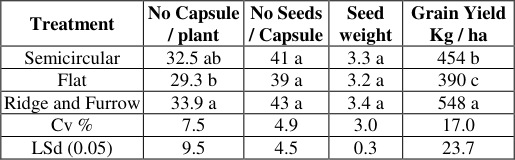 Table 2
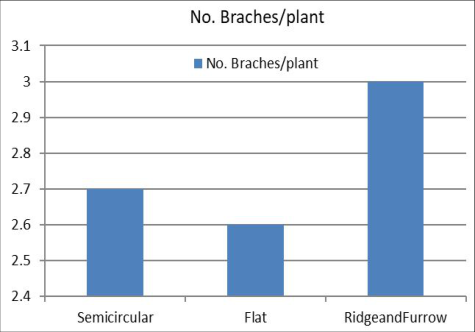 Figure 3
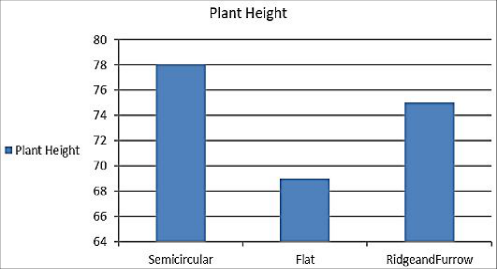 Figure 4
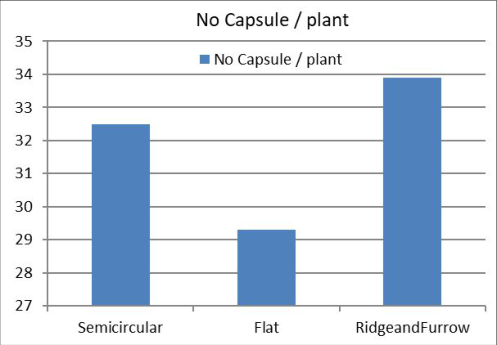 Figure 5
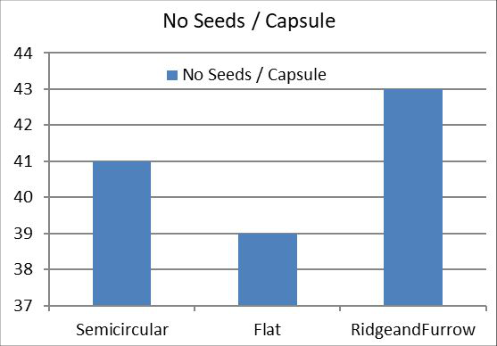 Figure 6
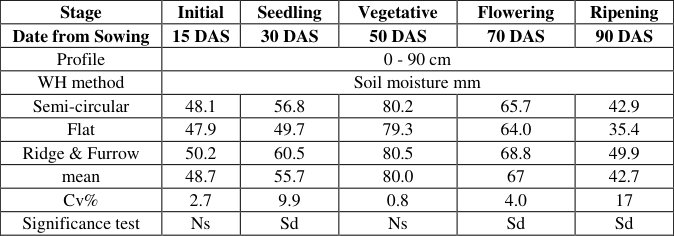 Table 3
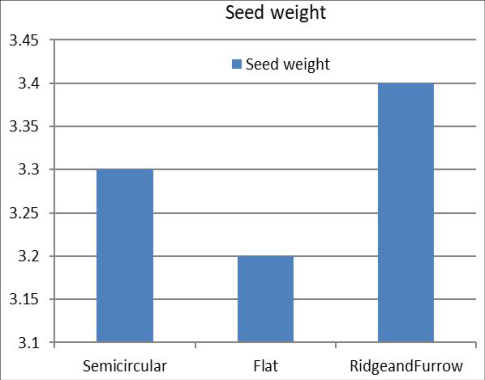 Figure 7
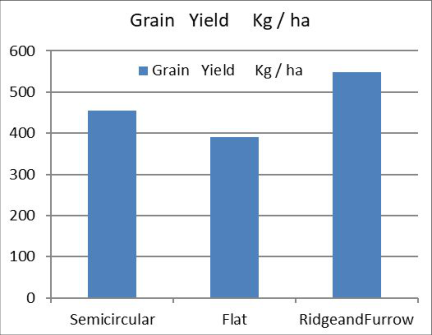 Figure 8
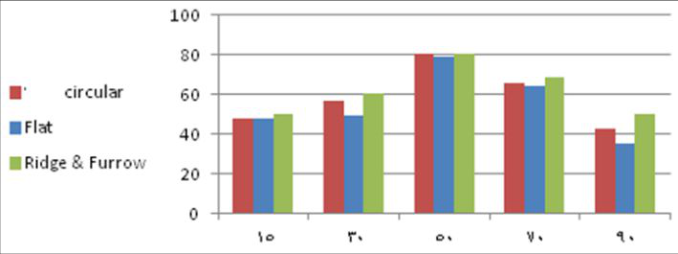 Figure 9
Introduction
Sesame is produced as main cash crop mainly in the rain-fed areas within the central clay plains of Sudan where research is limited by funding and staff. This producing area (2.4 million hectares annually in Northern Gadaref "300-400 mm rain", Central Gadaref "400-500 mm rain") has limited rainfall which is erratic in nature and of uneven distribution which results in soil moisture stress when accompanied by high evaporation. Annual yield of sesame (0.274 t/ha) are by far below the international average (0.512 t/ha). Available data showed that yields of sesame progressively declined with time (Elleuch et al., 2011) [7] . Similarly, moisture stress could have resulted when transpiration of water exceeding the rate of absorption. Sesame is planted, annually, in about (2.4 million hectares). The Central Clay Plain is part of the guild of east Africa and dominated by vertisols are renowned by their high difficulties in water management for the soil is hard when dry and sticky when it is wet. Sesame grain yield is easily affected by soil moisture stress in semi-arid climate. Sarhadi, and Sharif, (2014) [22] and Nimir, (2002) [24] both confirm Sesame sensitivity to water shortage by studying effect of deficit irrigation on sesame growth, yield and yield Sesame crop is characterized by its high sensitivity to water stress at its early growth phases (germination and seedling -Boureima et al., 2011) [2] and at reproductive stage (Nilanthi et al. 2015) [18] . Consequently, searching for relevant water harvesting techniques and cultural operations that conserve moisture during dry period and drain excess moisture during wet periods is critically needed. Therefore, in this study, three land water harvesting techniques (WHTs) are proposed as ways for land configuration and to be compared on their effect on sesame productivity. These are: semicircular bund, ridge and furrow, and sowing on flat. Although other cultural practices such as weeding fertilization and tillage have a great influence on sesame crop performance and yield they will be kept consistent and same in all conducted trials.
Materials and Methods
Materials and Methods
Study Area
The experiment was conducted in 2019/2020 and 2020/2021 growing seasons at El Gadambalyia in Butana rain fed area located between (latitudes 13°45′ and 14 ° 15′ N and longitudes 34°45′ and 35°) The soil is cracking vertisol which is sticky when wet and hard when dry with low infiltration rate (2-3 mm/hr), low nitrogen content (0.212%), low organic matter (1.4%) (El Abbas, et al., 2017) [6] . The ranges of field capacity, wilting point, and bulk density were 31.69-32.38%, 21.20-21.53%, and 1.31-1.37 gm/cm respectively, and water holding capacity is high (Table 1.0).
| Treatment | Days to 50% flowering | Days to 90% Maturity | No. Braches/plant | Plant Height (cm) |
|---|---|---|---|---|
| Semi-circular | 42 | 93 a | 2.7 | 78 a |
| Flat | 43 | 94 b | 2.6 | 69b |
| Ridge and Furrow | 41 | 92 a | 3.0 | 75a |
| Cv. % | 2.3 | 1.0 | 7.5 | 6.1 |
| LSd. (0.05) | 3 | 1.9 | 0.7 | 0.9 |
Table text extracted from the original PDF; superscript letters are shown inline. The original table image is below.
View original table image
| Layer | Field | Wilting | Bulk | EC | pH | Lime | Clay | Sand | Silt | Texture |
|---|---|---|---|---|---|---|---|---|---|---|
| thickness | capacity | point | density | (dS / m) | (%) | (%) | (%) | (%) | (%) | |
| (cm) | (%) | (%) | (gm /cm3) | |||||||
| 0 - 30 | 31.94 | 21.53 | 1.31 | 0.200 | 8.7 | 20.22 | 61.64 | 8.85 | 29.51 | Clay |
| 30 - 60 | 31.69 | 21.20 | 1.32 | 0.165 | 7.7 | 20.03 | 66.06 | 8.56 | 25.35 | Clay |
| 60 - 90 | 32.38 | 21.53 | 1.37 | 0.156 | 7.5 | 19.45 | 66.98 | 8.76 | 24.26 | Clay |
Table text extracted from the original PDF; superscript letters are shown inline. The original table image is below.
View original table image
Experimental treatments, design and cultural practices
The experiment was made in a randomized complete block design (RCBD) with three replications. Treatments includes: semi-circular bund, ridge and furrow, and sowing on flat soil surface. The dimensions of the semi-circular bund (Critchley and Siegert, 1991) [4] are: height: 0.2 to 0.5 m, base width: 0.70 m, side slopes: 3: 1, crest width: 0.1-0.25 m, and diameter: 12 m-40 m. The ridge and furrow are with a furrow depth of 30 cm; furrow spacing at 0.8 m and bed height is 30 cm from soil surface. The flat land sowing is typical to farmer practice using wide level disc machine. These water harvesting techniques were intended to configure the land for maximizing rainfall infiltration, minimizing erosion, and reduction of total runoff to facilitates drainage and finally improves water use efficiency. A spacing distance of 1.5 m was kept between blocks between and 1.0 m between plots inside each block. Khidir sesame variety was sown after field was plowed with disc harrow, leveled and shaped according to specifications of the intended water harvesting technique. Other cultural practices (Seed rate, weeding, fertilizer) as recommended by Agricultural Research Corporation (ARC) is kept the same for all treatments (Ahmed, 1998, Loggale. 2018) [1,14] .
Data Collection
Data collected includes crop data (growth stages, Yield and yield components), and Soil moisture data).
Crop data
Crop growth stages were determined by visual observation and guided by Doorenbos et al. (1979) [3] . 1. Initial stage (from planting to initiation of seedlings and ends after 15 days from sowing). 2. Establishment of Seedlings to vegetative stage (after 30 days from sowing). 3. Vegetative stage (after 50 days from sowing). 4. Flowering stage (after 70 days from sowing and when 50% of plants flower).
The crop growth components (Number of branches per plant, number of capsules per plant, number of seeds per capsule and plant height) were determined from randomly selected five plants per plot. Crop growth rate was determined by counting days to 50% flowering and days to 90% maturity. The yield components (number of seeds per capsule, thousand seed weight, and seed yield as weight per area) were determined after harvesting: For number of seeds per capsule, the seeds of three capsules (Lower, medium, and uppermost position on the plant) from each of five plants were counted. 1000 seeds number and weight were determined from each plot after sun drying. Seed yield per plot was weighed in grams per plot unit area (kg/ha).
Soil moisture data
The gravimetric oven dry method was used to determine soil moisture from a profile of one meter depth at interval of 0.2 m using an auger. Data was replicated three times per plot, at two weeks interval. Soil data were taken after 15, 30, 45, 60, and 75 day from sowing.
Data Analysis
Collected data was analyzed by descriptive statistics using Statistic 10 software to determine analysis of variance using the least significant difference of 5% and, mean separation using least significance difference (DB Duncan, 1955) [5] . [10,9] . 1.0 shows analysis of variance for days to flowering determined for the various WHTs and illustrated an insignificant effect (p>0.05) of WHT on the 50% flowering. The ridge and furrow and took shorter period (41 days) for the 50% flowering, while the longer days to the 50% flowering were needed for flat land sowing.
Results and Discussion
Conservation and availability of moisture retained by ridge and furrows may be the cause of speeding flowering processes leading to early maturing (Figure 1). This result agrees with Reddy et al., (2009) [20] and Goitom et al.
(2021) [9] . Early maturity as proxy-indicator of healthy growth is achieved by ridge and furrow, followed by semi-circular bund, and the latest is sowing on flat soil surface. This result is in line with days to flowering (Figure 1.0). The differences between ridge and furrow, and semi-circular bund are not significant (p<0.05) but they both differ significantly from sowing on flat (Table 1.0).
c. Number of branches per plant:
The data in table1.0 indicated that the all WHTs didn't show a significant difference (p>0.05) on the number of branches per plant. The highest number of branches (3.0) was recorded by ridge and furrow and the lowest (2.6) was recorded under the flat land WHT (Figure 3.0). This is may be taken as proxyindicator of more yield (Goitom et al. 2021) [9] .
As given in Table 1.0 it is evident that plant height showed significant differences at (p<0.05) between WHTs treatments. The minimum plant height (69 cm) was recorded on the flat land while that measured by Semicircular and Plant Height are higher but not significantly (p>0.05) different from each other (Figure 4). This result is typical to the results obtained for days to maturity. Plant height is a yield component that is affected by, pests and disease, and weed infestation, and stress by in excess or deficit water. It is evident from figure 4 that capability of WHT to conserve soil moisture can be expressed by plant height and is rank the WHTs in a descending order as Flat (69 cm), Ridge and Furrow (75 cm), and Semicircular (78 cm). This result is the same to that stated by Goitom et al. (2021) [9] . [12,11,9] . Consequently, the performance of the three WHTs with respect to yield and yield attributes (No Capsule per plant, No Seeds per Capsule, Seed weight, and Grain Yield) is depicted in table 2.0.
| Treatment | No Capsule / plant | No Seeds / Capsule | Seed weight | Grain Yield Kg / ha |
|---|---|---|---|---|
| Semicircular | 32.5 ab | 41 a | 3.3 a | 454 b |
| Flat | 29.3 b | 39 a | 3.2 a | 390 c |
| Ridge and Furrow | 33.9 a | 43 a | 3.4 a | 548 a |
| Cv % | 7.5 | 4.9 | 3.0 | 17.0 |
| LSd (0.05) | 9.5 | 4.5 | 0.3 | 23.7 |
Table text extracted from the original PDF; superscript letters are shown inline. The original table image is below.
View original table image
| Climate Element | Jan | Feb | Mar | Apr | May | Jun | Jul | Aug | Sep | Oct | Nov | Dec |
|---|---|---|---|---|---|---|---|---|---|---|---|---|
| Min Temp (C) | 16.81 | 18.27 | 21.20 | 24.52 | 26.37 | 27.11 | 24.39 | 23.92 | 24.63 | 24.00 | 21.05 | 17.68 |
| Average Temp (C) | 24.54 | 27.00 | 30.18 | 33.22 | 34.18 | 33.43 | 29.82 | 29.23 | 31.89 | 31.94 | 28.75 | 25.20 |
| Max Temp (C) | 32.26 | 35.12 | 38.56 | 41.91 | 41.99 | 39.74 | 34.85 | 34.54 | 39.14 | 39.87 | 36.44 | 32.72 |
| RH (%) | 14.89 | 10.37 | 7.42 | 6.68 | 11.53 | 17.25 | 25.96 | 28.73 | 21.86 | 14.73 | 12.70 | 15.96 |
| Wind (m/s) | 1.94 | 2.04 | 2.03 | 1.77 | 1.64 | 2.19 | 2.28 | 2.04 | 1.66 | 1.42 | 1.83 | 1.87 |
| RF (mm) | 0.02 | 0.00 | 0.60 | 1.49 | 12.38 | 18.75 | 76.75 | 100.48 | 28.83 | 9.15 | 2.54 | 0.00 |
| Solar | 20.69 | 23.61 | 26.17 | 27.42 | 25.09 | 24.16 | 20.30 | 20.07 | 21.33 | 20.94 | 20.80 | 19.46 |
Table text extracted from the original PDF; superscript letters are shown inline. The original table image is below.
View original table image
i. Number of capsules per plant: Table 2.0 showed significant differences (p<0.05) on capsules number per plant with different WHTs. The highest number of capsules (33.9) was recorded at the ridge and furrow WHT and it is significantly higher than measured in flat sowing but do not differ significantly from capsules of semi-circular bund WHT. However, Malik et al., (2003) [17] , and Goitom et al.
(2021) [9] gave similar results. 2.0 shows that there is no significant difference (p>0.05) in number of seeds per capsule recorded for the three WHTs. Figure 6 shows that the highest number of seeds per capsule is found with Ridge and furrow method, followed by semicircular bud and this result is in agreement with Malik et al., (2003) [17] and Goitom et al. (2021) [9] . 2). According to figure 7 the highest thousand seed weight (3.4 g) was recorded at the ridge and furrow, followed by semicircular bund (3.3 g) and the least is noted for sowing on flat (3.2 g). This is in line with Malik et al., (2003) [17] and Goitom et al. (2021) [9] . 2.0 indicates that there is significant difference (p<0.05) in the yield obtained by WHTs. The highest yield (548 Kg/ha) was measured for Ridge and Furrow followed by semicircular bund (548 Kg/ha) and then sowing on flat (390 Kg/ha). In a similar study, Goitom et al. (2021) [9] reported that the highest sesame seed yield (558 kg ha) was recorded at ridge and furrow, while the lowest (400 kg ha -1 ) was found at the flat land configuration method.
The high yield obtained by Ridge and furrow method and the minimum yield with conventional application method is in agreement with Hailu et al., (2018) [11] and Goitom et al.
(2021) [9] . The yield values for sowing on flat is above the average yield recorded for the central clay plains of Sudan (274 Kg/ha), while the yields recorded for Ridge and Furrow and semicircular bund are higher than the international average (512 Kg/ha). Reddy et al., (2009) [20] , Goitom et al. (2021) [9] and Rajput et al., (2009) [19] attributed the highest yield values obtained under the Ridge and Furrow to be due to the high efficiency build in the water harvesting techniques to conserve soil moisture resulting in higher plants height and more branches, large number of capsules per plant, and number of seeds per capsule. [23,9] . During the growth period of vegetative growth to flowering (50 DAS) and in the growth period of flowering to grain filling stage (70 DAS) the WHTs there significant differences in WHTs of store water with least amount is retained by fat soil surface (its shape provide no storage facility). During grain filling stage (90 DAS) the high water stored by both ridge and furrow and semi-circular bund resulted in generating high crop grain yield. This result agrees with Reddy et al., (2009) [20] who claimed that the maximum yield obtained by the ridge and furrow technique is attributed to the technique capability to store high water reserve. Likewise in a typical study conducted by Goitom et al. (2021) [9] indicated that the ridge and furrow methods conserved best soil moisture for highest plant and seed yield performance. Ns=not significant; Sd significant For vertisols of central clay plains of Sudan Farbrother (1987) [8] reported that soil profile moisture capacity is 93 mm, which need to be filled during each irrigation event. As given in Figure 9 shows that the variation of the moisture of the whole soil profile along the length of the growing season follow a curve of bell shape showing lower retention during early stage and increase in water accumulated in the soil profile till the plant reach full canopy and then the stored water starts to diminish by rise of crop water depletion due to increase in crop evapotranspiration (Roa, and Raju, 1991 and Goitom et al. 2021) [21,9] . [15,9] , and Keteku et al., 2020) [13] . Typical to the results depicted in figure 9 Reddy et al., (2009) [20] reported the highest moisture conservation efficiency obtained by Ridge and Furrows compared to the semi-circular or flat land configuration at 30, 70 and 90 days after sowing. Likewise, Hailu et al., (2018) [11] made study of nine treatments with three levels of irrigation water for identifying optimum soil moisture stress for sesame to determine appropriate water-saving irrigation methods and also productivity under limited water resource conditions. Hailu et al., (2018) [11] concluded that the conventional furrow application method is best practice of soil moisture -saving strategies to improve sesame yield
Conclusion
The WHTs have direct and significant impacts on soil moisture and sesame seed yield. The result obtained ranked the studied WHTs on basis of soil moisture retention, yield, yield attributes in descending order of, effectiveness as: ridge and furrow technique, semi-circular bund and sowing on flat soil surface. It is thus recommended to adopt ridge and furrow technique as effective and important climate change adaptation strategy in dry land areas where water shortage, late onset and early cessation of rain occur.
Acknowledgment
The financial support provided by Ministry of Higher Education is greatly acknowledged
Figures and tables from the paper
| Stage | Initial | Seedling | Vegetative | Flowering | Ripening |
|---|---|---|---|---|---|
| Date from Sowing | 15 DAS | 30 DAS | 50 DAS | 70 DAS | 90 DAS |
| Profile | 0 - 90 cm | ||||
| WH method | Soil moisture mm | ||||
| Semi-circular | 48.1 | 56.8 | 80.2 | 65.7 | 42.9 |
| Flat | 47.9 | 49.7 | 79.3 | 64.0 | 35.4 |
| Ridge & Furrow | 50.2 | 60.5 | 80.5 | 68.8 | 49.9 |
| mean | 48.7 | 55.7 | 80.0 | 67 | 42.7 |
| Cv% | 2.7 | 9.9 | 0.8 | 4.0 | 17 |
| Significance test | Ns | Sd | Ns | Sd | Sd |
Table text extracted from the original PDF; superscript letters are shown inline. The original table image is below.
View original table image
References
17 in the original paper- Ahmed MH. Release of cultivar Khidir for production in high rainfall areas, (Southern Gadarif and Damazine) Sudan Journal of Agriculture Research. 1998;1(1):89.
- Boureima S, Eyletters M, Diouf M, Diop TA, Van Damme P. Sensitivity of seed germination and seedling radical growth to drought stress in sesame (Sesamum indicum L.). Research Journal of Environmental Sciences. 2011;5(6):557-564.
- Duncan DB. Multiple range and multiple F tests. Biometrics. 1955;11(1):1-42.
- El Abbas Doka MA, Aitken J, Munro NR. Studying the Characteristics of Vertisols to Set Up Field Management Practices at Dinder Area (Sennar StateSudan). Advances in Image and Video Processing. 2017;5(5):21-21.
- Teame G, Tsegay A, Weldearegay D. Effect of land configuration ways on soil moisture and sesame seed yield in Ethiopia. Teame et al. Turkish Journal of Food and Agriculture Sciences. 2021;3(1):1-6. -ISSN: 26873818. Doi:10.14744/turkjfas.2021.001
- Berhane GA. Performance of Sesame (Sesamum indicum L.) Under Different Supplementary Irrigation and Nitrogen Fertilizer Levels in Humera, Northern Ethiopia. Modern Concepts & Developments in Agronomy. 2019;5(1):502-505. MCDA.000605.2019. DOI: 10.31031/MCDA.2019.05.000605
- Hailu EK, Urga YD, Sori NA, Borona FR, Tufa KN. Sesame Yield Response to Deficit Irrigation and Water Application Techniques in Irrigated Agriculture, Ethiopia. Hindawi International Journal of Agronomy. 2018;2018(1):6. Article ID 5084056. https://doi.org/10.1155/2018/5084056
- Kadkhodaie A, Morteza Zahedi M, Razmjoo J, Pessarakli M. Changes in some anti-oxidative enzymes and physiological indices among sesame genotypes (Sesamum indicum L.) in response to soil water deficits under field conditions. Acta Physiologiae Plantarum. 2014;36(3):641-650.
- Keteku AK, Kadam AK, Dana S, Blege PK. Influence of land configuration and fertilization techniques on soybean (Glycine max (L.) Merrill.) productivity, soil moistureand fertility. Acta Agriculture Slovenica. 2020;115(1):79-88.
- Loggale LB. Performance of Two Sesame Cultivars as Influenced by Supplemental Irrigation at Abu Naama. IOSR Journal of Agriculture and Veterinary Science (IOSR-JAVS). 2018;11(9):06-11.
- Zewdie T, Tehulie NS. Review on effects of plant densities and nitrogen fertilization on sesame (Sesamum indicum L.) Yield and yield components. International Journal of Research in Agronomy. 2019;2(1):42-47. DOI: 10.33545/2618060X.2019.v2.i1a.66
- Malik MA, Saleem MF, Cheema MA, Ahmed S. Influence of different nitrogen levels on productivity of sesame (Sesamum indicum L.) under varying planting patterns. International Journal of Agriculture Biology. 2003;5(4):490-492.
- Nilanthi D, Alawathugoda C, Ranawake A. Effects of water stress on yield and some yield components of three selected oil crops; Groundnut (Arachis hypogea L.), sunflower (Helianthus annus L.) and sesame (Sesamum indicum L.) International Journal of Scientific and Research Publications. 2015;5(2):22503153.
- Rajput R, Kauraw DL, Bhatnagar RK, Bhavsar M, Velayutham M, Lal R. Sustainable management of vertisols in central India. Journal of Crop Improvement. 2009;23(2)119-135.
- Roa V, Raju C. Effects of soil moisture stress at deferent development phases on growth and yield of sesame, Journal of Oilseeds Research. 1991;8(2):240243.
- Sarhadi J, Sharif M. Effect of deficit irrigation on sesame growth, yield and yield components in drought conditions on base of sustainable agriculture, International Journal of Farming and Allied Sciences. 2014;3(10):1061-1064.
- Tantawy MM, Oudu SA, Khalil FA. Irrigation optimization for different Sesame varieties grown under water stress condition. Journal of Applied Science Research. 2007;3(1):7-12.
Cited by 1
From OpenAlex, OpenCitations and reference lists read by Scinovex
- Effects of soil bund age on selected soil physical properties in Chyulu landscape, Kajiado County ↗
CLEMENT CHERUIYOT, Caroline Maina, Joseph Alele, Jesse Omondi Owino · Environmental Research Communications · 2025
Abstract Soil degradation threatens sustainable provision of ecosystem services and adversely affects the livelihoods in Kenya, especially in arid and semi-arid areas. To mitigate the impacts of soil degradation, soil conservation measures such as terraces, retention ditches, cut-off drains, and soil bunds have been adopted. In Chyulu landscape, soil bunds have been adopted over the last eight years. However, their…
❝ 0PDF