
Research article · 2023 · Full text
International Journal of Agriculture and NutritionHormonal influence of gibberellin and auxin on early growth of Parkia biglobosa (Jacq (Benth))
Volume 5(1) · Pages 96–98 · DOI: 10.33545/26646064.2023.v5.i1b.104 ↗
Research areasLeaf Properties and Growth MeasurementFlowering Plant Growth and CultivationPlant Diversity and Evolution
Abstract
Author-writtenThe slow growth of parkia biglobosa (Jacq (Benth)) bean has continued to posed a great challenge to the conservators and silviculturist. This study was carried out to determine the hormonal influence of gibberellin and auxin on the early growth of parkia biglobosa under nursery condition. The experiment lasted for eight (8) weeks, where the number of leaves on the plants, the plants height and collar diameter were determined. Complete Randomized Design (CRD) was used for the conduction of the experiment. The experiment had three (3) treatments; T1 (gibberellin), T2 (auxin) and T3 (control) with fifteen (15) replicates per treatment. The growth parameters measured were subjected to analysis of variance (ANOVA). The result from the experiment showed that the growth hormones had significant influence (p0.05) on plant height and collar diameter. The Least Significant Difference (LSD) (p≥0.05) was carried out for the number of leaves and the result showed that the treatment were significantly different from one another. This study therefore showed that the performance of parkia biglobosa can be improved when the seeds are treated with growth hormones at early stages as observed in the increase of number of leaves, however the limitation of the species makes the influence of the growth hormones not to be fully expressed on plant height and collar diameter.
Summary
Source-checkedPlain-language reading of the full paper, prepared with AI and checked against the text. Each point links to the authors' own words.
Why it matters
- The slow growth rate of Parkia biglobosa presents a significant challenge for those involved in silviculture and conservation. View evidence ↗
- Parkia biglobosa, known as the African locust bean, is a valuable source of plant proteins and vitamins, particularly when the seeds are processed into fermented 'Dawadawa'. View evidence ↗
- Gibberellins and auxins are plant hormones recognized as growth-promoting factors that regulate various developmental stages. View evidence ↗
The question
- The study aimed to evaluate how gibberellin and auxin influence the early growth of Parkia biglobosa in a nursery setting. View evidence ↗
What they did
- Seeds were soaked for 12 hours in a solution of 5 grams of hormone diluted in 100ml of distilled water before being planted. View evidence ↗
- Over an eight-week period, the researchers weekly measured plant height using a meter rule, collar stem diameter using a veneer caliper, and the number of leaves via direct counting. View evidence ↗
- Statistical analysis was performed using Analysis of Variance (ANOVA) and the Least Significant Differences (LSD) test with a significance level of 0.05. View evidence ↗
What they found
- Gibberellin (T1) produced the highest average number of leaves per branch (58.26), followed by Auxin (T2) at 53.53, and the Control (T3) at 48.26. View evidence ↗
- The difference in the number of leaves per branch among the treatments was statistically significant (p < 0.05) after eight weeks. View evidence ↗
- While Gibberellin (T1) resulted in the greatest plant height (17.56 cm) and the Control (T3) the lowest (11.56 cm), these differences were not statistically significant. View evidence ↗
- ANOVA results indicated that plant height did not differ significantly (p > 0.05) across treatments at the eight-week mark. View evidence ↗
- The control group (T3) exhibited the largest collar diameter (4.97 cm), whereas the hormone-treated groups (T1 and T2) had smaller diameters of 1.56 mm and 1.21 mm, respectively. View evidence ↗
- The differences in collar diameter between the treatments were not statistically significant (p > 0.05) after eight weeks. View evidence ↗
What it means
- The authors conclude that treating seeds with growth hormones at early stages can improve the performance of Parkia biglobosa, specifically by increasing the number of leaves. View evidence ↗
- The authors state that the inherently slow growth of the species limited the ability of the hormonal treatments to produce significant effects on plant height and collar diameter. View evidence ↗
Visual summary
3 visualsIllustrations explain the paper; charts are replotted from the paper's own table values.
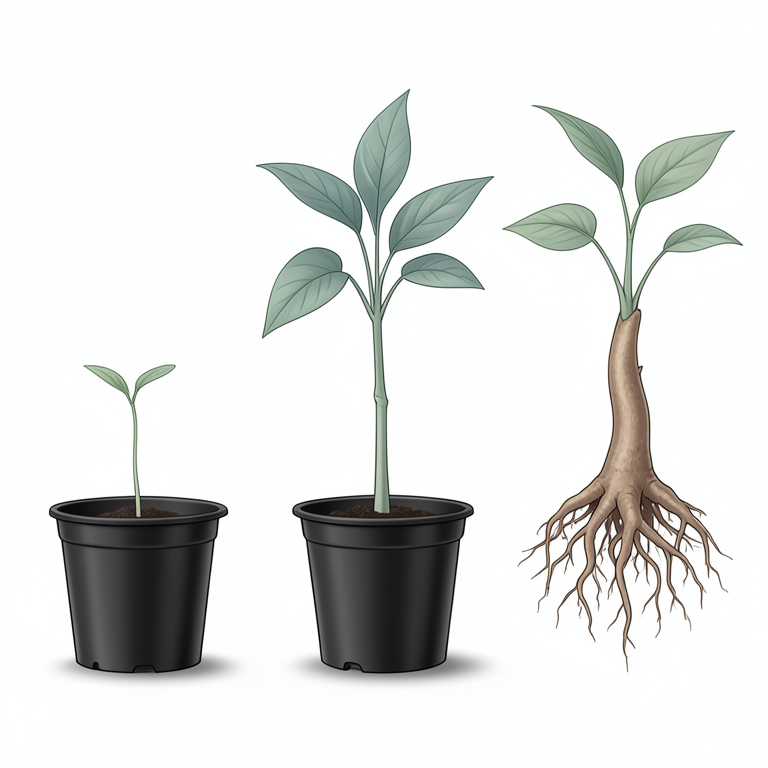
Experimental Setup
AI-generated conceptual illustration (Parkia biglobosa seedlings in pots). It explains the idea and does not show study data.
View source evidence ↗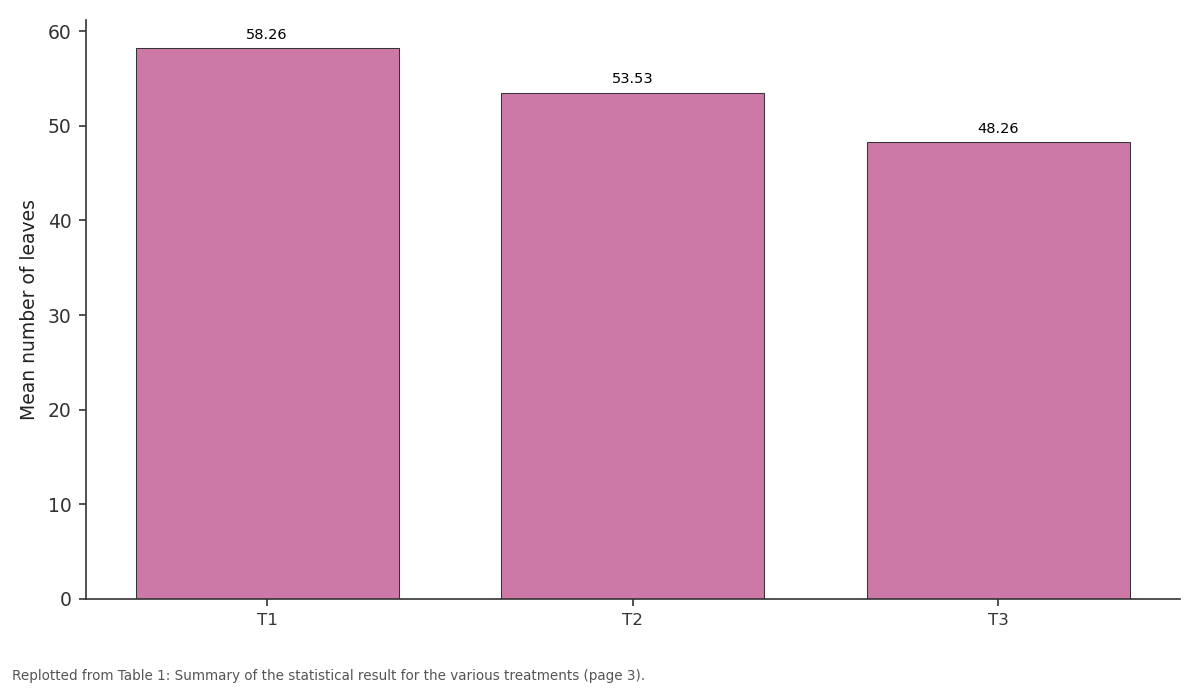
Mean: T1 vs T2 vs T3
Replotted from Table 1 (page 3) of the original paper. Every bar is the paper's own table value.
View source evidence ↗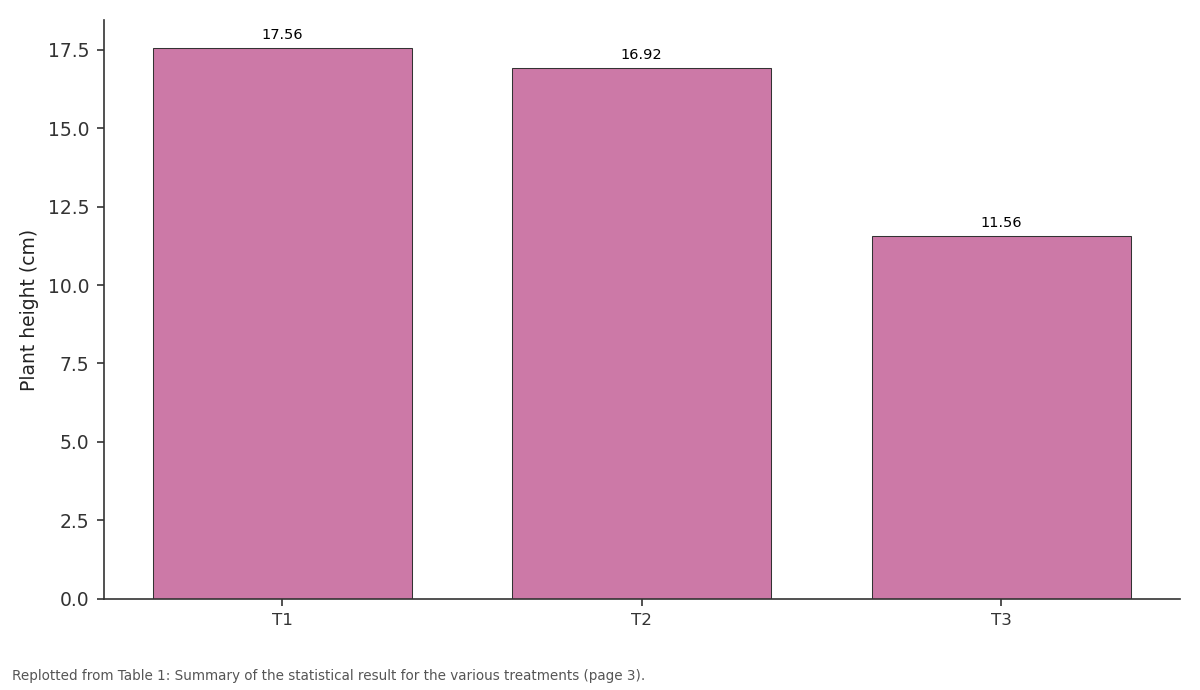
Mean: T1 vs T2 vs T3
Replotted from Table 1 (page 3) of the original paper. Every bar is the paper's own table value.
View source evidence ↗Figures & tables
From the original paper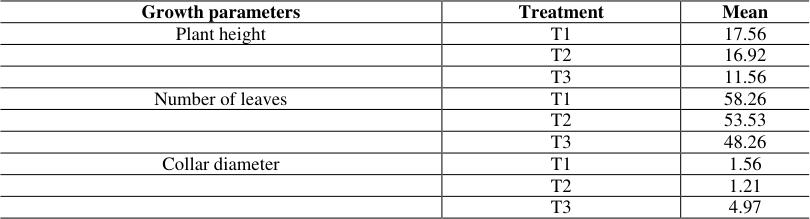 Table 1
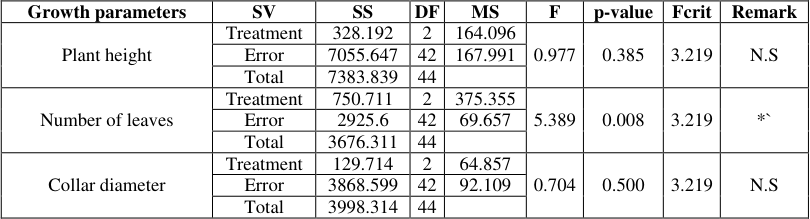 Table 2
 Table 3
Introduction
Parkia biglobosa (Jacq (Benth)) is a medium-sized legume tree that belongs to the family leguminoseae, reaches 20 -30 m high. It has a dense, widely spreading umbrella-shaped crown and a cylindrical trunk that can reach up to 130cm in diameter often branching low. The bark is longitudinally fissures, thick, ash-grey to greyish-brown in colour. It exudes an amber gum when cut. The leaves are alternate and bipinnately compound, 30 -40cm long bearing up to 17 pairs of pinnae. Its beanets are numerous (13-60/pinna), subopposite, 8-30mm long X 1.5-10mm wide rounded or obtuse at apex, glabrous but slightly ciliate near apex. The inflorescence is held on a long (10-35 cm) drooping peduncle. The flower head is 4.5-7cm long X 3.5-6 cm broad and it has a strong pungent smell. The many flowers are either bisexual, sterile or nectar is attractive to bats that pollinate the flowers. The flowers begin to open at dusk, close and wilt at dawn, lasting only a single night. The fruit is a linear, glabrous and smooth with indehiscent pod that becomes brown at maturity. It is 12 -30cm long X 15 -2.5cm wide and contains up to 23 seeds embedded in a yellowish mealy pulp. The seeds are 5 -15mm, smooth and glossy dark in colour. There are about 2800-6700 seeds/kg. The seeds are hard coated and can remain viable up to 8 years (Hopkins, 1983, Sina et al., 2002, NRC, 2006, Orwa et al., 2009) [5,14,7,8] . In Nigeria, particularly in rural areas most people can not afford animal products which are a source of protein because they are either too expensive or not easy to get. Most people feed on cereal grains or starchy roots all the times which may lead to various health problems associated with protein and vitamin/mineral deficiencies. In the search for plant proteins and vitamin substitutes parkia biglobosa (African locust bean) was found very useful especially the fermented 'Dawadawa' (in Hausa) form, which is made from the seeds. According to Uwaegbute (1996) [16] the powdery fruit pulp contains more carbohydrate than the seeds. The fruit pulp of parkia biglobosa (African locust bean) is sweet to test which shows the presence of natural sugars thus a vital energy source. The appealing yellow color shows the presence of phto-nutrients, possibly carotenoids, which are important precursors of retinol (vitamin A).
It has a sour test which shows the presence of ascorbic acid (vitamin C). The fruit pulp is used in the areas of Africa during emergencies when the grain store is empty which is an indication of its edibility and non-toxicity (Owoyele et al., 1987, Akoma et al., 2001) [10,2] . It is also used as an ingredient in the preparation of various soups for the consumption of cereals; pressed into cakes and preserve for used in the preparation of some indigenous drinks (Muller, 1988) [6] . It is adequate and meet the food Agricultural Organization (FAO) and World Health Organization (WHO) recommended daily allowance of protein of 0.59g/kg body weight for an average healthy individual and 0.88g/kg body weight for children aged 1-10years (Shakuntala and Shadaksharaswamy, 1987) [15] . Parkia biglobosa is a slow growing species like it had been reported for several indigenous tree species in Nigeria and West Africa (Oni 2002) [9] . Phytohormones, ethylene and abscise acid, are key players in the tight control and coordination of plant growth and development, integrating environmental cues and internal signals. Gibberellins and auxins are considered to be 'growth promoting' factors, and regulate numerous aspect of growth and development throughout the life cycle of plants. Gibberellins are involved in the control of seed germination, leaf expansion stem elongation, induction of flowering, flower and seed development amongst others (Sun and Gubler 2004; Yamaguchi 2008) [13,18] . The effects of auxins include the regulation of stem elongation, lateral branching of roots and shoots, establishment of embryonic polarity, vascular development and tropic growth responses (Woodward and Bartel 2005) [17] . Therefore the purpose of this study is to examine the hormonal influence of auxin and gibberellin on the early growth of parkia biglobosa (African locust bean).
Materials and Methods
Materials and Methods
Experimental site
The experiment was conducted in the department of Forestry and Wildlife Management Nursery, Faculty of Agriculture, Modibbo Adama University, Yola. It is located between latitude 8 0 N and 11 0 N and longitude; 11.5 0 E and 13.5 0 E. Adamawa State fall under the Sudan southern and Guinea Savanna types of vegetation. It experiences distinct dry and wet season with temperature and humidity varying with season. The wet season last from April-November and the average amount of rainfall recorded in the area is 972mm. The dry season period is between December to March and is characterized by dry dusty and hazy wind that blows over the area from Sahara Desert. Temperature of the area ranges from 27 0 C -40 0 C. December and January are the coldest months with an average temperature of 34 0 C (Adebayo et al., 2020) [1] . The Vegetation has a wide varieties of Savanna tree species among which are:-Adansonia digitata, Parkia biglobosa, Anogeissius leocarpus, Acacia spp etc. (Adebayo et al., 2020) [1] .
Source of seed/Experimental design
The seeds of parkia biglobosa were obtained from Agricultural Development Project (ADP) office in Yola. The experiment was a potted experiment that was laid out in Completely Randomized Design (CRD) with three treatments T1 (Gibberellin) T2 (Auxin), T3 (Control) and fifteen (15) replications. This gives a total of forty five (45) pots. Five (5) grams of auxins and gibberellins were diluted with 100ml of distiled water. The seeds of Parkia biglobosa were soaked for 12 hours thereafter, removed and planted immediately inside the plastic pots.
Data Collection and Analysis
The experiment was monitored for eight (8) weeks and the parameter readings were taken at weekly interval till the end of the experiment. The growth parameters that were taken were as follows; number of leaves per plants were determined by direct counting of leaves on the plants, plant heights of the plant from the base to the top where the newly developed leaves started using a meter rule and collar stem diameter was determined by measuring the thickness of the plant stem with the aid of a veneer caliper. Data collected were subjected to Analysis of Variance (ANOVA) and Least Significant Differences (LSD) test at a significance level of 0.05 was carried out to determine whether there is any significant differences among the treatments.
Results and Discussion
Results and Discussion
Growth parameters
As shown in Table 1 treatment T1 (Gibberellin) has the highest plant height of 17.56cm followed by treatment T2 (Auxin) which recorded a moderate plant height 16.92cm while the least plant height was observed in treatment T3 (Control) 11.56cm. This shows the influence of treatments gibberellin and auxin had on the plant height. The result in the Table 2 further revealed that the height of plant is not significant (p>0.05) at eight weeks after planting. This agrees with the findings of Sale (2016) [12] who also reported no significant difference (p>0.05) after eight weeks of planting. This is also in agreement with the findings of Duchung et al (2023) [3] in a similar study who reported that mean height, collar diameter were tested using ANOVA and the results were not significantly different after eight weeks of planting. The results on the number of leaves showed that treatment T1 (Gibberellin) has the highest average number of leaves per branch 58.26, followed by treatment T2 (Auxin) 53.53 while treatment T3 (Control) has the least number of leaves per branch 48.26 (Table 1). This study clearly showed that the performance of growth hormones has the potentiality to increase the number of leaves yield, as also reported by Faizanullah et al (2010) [5] . Rahimi et al., (2011) [11] reported a strong influence on leaves yield by various growth hormones for seedling growth, each 5g of giberrellin and auxin showed promotory effects in field as well as in pot conditions. The result in Table 2 showed the number of leaves per branch to be significantly different (p<0.05) at eight weeks after planting. This result however disagrees with the findings of Sale (2016) [12]. Who reported that gibberellin and auxin had no influence on the number of leaves eight weeks after planting but conforms with the findings of Dachung et al (2023) [3] in a similar study who reported that the number of leaves and leaf area were tested using ANOVA and the result was significantly different. The LSD test conducted in Table 3 shows that T1, T2, and T3 are significantly different from one another. The result in Table 1 showed that treatment T3 (control) has the highest collar diameter 4.97cm while treatment T1 and T2 recorded the least stem diameter of 1.56mm and 1.21mm respectively. This implies that plants treated with no growth hormones had the highest collar diameter than those treated with T1 (Gibberellin) and T2 (Auxin) respectively. The collar diameter of the plant was observed not to be significant (p>0.05) at eight weeks after planting Table 2. This findings agrees with Sale (2016) [12]. Who also reported that the stem diameter of the plant (Parkia biglobosa) was not significant (P>0.05) at eight weeks after planting
| Treatment | Mean |
|---|---|
| T1 | 58.26a |
| T2 | 53.53b |
| T3 | 48.26c |
Table text extracted from the original PDF; superscript letters are shown inline. The original table image is below.
View original table image
| Growth parameters | SV | SS | DF | MS | F | p-value | Fcrit | Remark |
|---|---|---|---|---|---|---|---|---|
| Plant height | Treatment | 328.192 | 2 | 164.096 | 0.977 | 0.385 | 3.219 | N.S |
| Error | 7055.647 | 42 | 167.991 | |||||
| Total | 7383.839 | 44 | ||||||
| Number of leaves | Treatment | 750.711 | 2 | 375.355 | 5.389 | 0.008 | 3.219 | *` |
| Error | 2925.6 | 42 | 69.657 | |||||
| Total | 3676.311 | 44 | ||||||
| Collar diameter | Treatment | 129.714 | 2 | 64.857 | 0.704 | 0.500 | 3.219 | N.S |
| Error | 3868.599 | 42 | 92.109 | |||||
| Total | 3998.314 | 44 |
Table text extracted from the original PDF; superscript letters are shown inline. The original table image is below.
View original table image
| Growth parameters | Treatment | Mean |
|---|---|---|
| Plant height | T1 | 17.56 |
| T2 | 16.92 | |
| T3 | 11.56 | |
| Number of leaves | T1 | 58.26 |
| T2 | 53.53 | |
| T3 | 48.26 | |
| Collar diameter | T1 | 1.56 |
| T2 | 1.21 | |
| T3 | 4.97 |
Table text extracted from the original PDF; superscript letters are shown inline. The original table image is below.
View original table image
Conclusion
This study revealed that parkia biglobosa is a slow growing species and this limitation makes the various treatment influence not to be fully expressed on the plant height and collar diameter however from the study it was observed that the plant treated with no growth hormones T3 had the highest collar diameter than those treated with T1 (gibberellin) and T2(auxin) respectively.
References
11 in the original paper- Akoma O, Onvora SA, Akoma AO, Ozigis AA. Physico-chemical attributes of wine produced from the yellow pulp of Parkia biglobosa using traditional juice extraction technique. Nig. Food J. 2001;19:76-79.
- Dachung G, Amonum JI, Change IB, Adeka P. Effect of Acid Pretreatment of Seeds on the Germination and Early Growth of Albizia lebbek (L) Benth in Makurdi Benue State, Nigeria. Asian Journal of Research in Agriculture and Foretry. 2023;9(3):27-35.
- Faizanullah, Bani A, Nosheen A. Role of plant growth regulators on oil yield and biodiesel production of linseed (Linum usitatissimum L.) Journal of chemical Society of Pakistan. 2010;32:668-671.
- Hopkins HC. The taxonomy, reproductive biology and economic potential of Parkia (Leguminosae: Mimosoideae) in Africa and Madagascar. Bot. J Linnean Soc. 1983;87(2):135-167.
- Muller HG. An Introduction to Tropical Food Science. Cambridge University Press, Cambridge. 1988. p. 112118.
- Oni O. Effect of seed size on Seedlings vigour in Indigbo (Terminalia ivorenses). Journal of Tropical Forestry Science. 2002;4(3):215-224.
- Owoyele JA, Shok M, Olagbemiro T. Some chemical constituents of the fruit pulp of Parkia clappertoniana as a potential raw material. Savanna. 1987;9(2):24-27.
- Rahimi MM, Zarei MA, Armenian A. Selection Criteria of flax (Linum usitatissimum L.) for seed yield components and biochemical composition under various planting dates and Nitrogen. African Journal of Agriculture Research. 2011;6:3167-3175.
- Sale FA. Effects of Different Growth Hormones on seed Germination and Seedling growth of African Locust Bean (Parkia biglobosa Jacq Benth). International Journal of Forestry and Horticulture. 2016;2(2):14-20.
- Sun TP, Gubler F. Moleculer Mechanism of gibberellin signaling in plants. Annu Rev plant Biol. 2004;55:197223
- Woodward AW, Bartel B. Auxin: regulation, action and interaction. Ann Bot. 2005;95:707-735.