
Research article · 2022 · Full text
International Journal of Advanced Chemistry ResearchEffect of seed rate and irrigation scheduling on growth and yield of direct seeded rice (Oryza sativa)
Volume 4(1) · Pages 57–60 · DOI: 10.33545/26646781.2022.v4.i1a.80 ↗
Research areasRice Cultivation and Yield Improvement
Abstract
Author-writtenA field experiment entitled “Effect of seed rate and irrigation scheduling on growth and yield of direct seeded rice (Oryza sativa)" was conducted at the Students research Farm, Khalsa College, Amritsar during kharif season 2020-21. The soil of the experimental field was sandy loam, with neutral soil pH, low in organic carbon and available nitrogen, medium in available potassium and available phosphorus. The field experiment was conducted in randomized block design having 10 treatments with 3 replications described as T1: DSR with seed rate of 15 kg ha-1 and first irrigation at 14 DAS, T2: DSR with seed rate of 15 kg ha-1 and first irrigation at 18 DAS, T3: DSR with seed rate of 15 kg ha-1 and first irrigation at 22 DAS, T4: DSR with seed rate of 20 kg ha-1 and first irrigation at 14 DAS, T5: DSR with seed rate of 20 kg ha-1 and first irrigation at 18 DAS, T6: DSR with seed rate of 20kg ha-1 and first irrigation at 22 DAS, T7: DSR with seed rate of 25 kg ha-1 and first irrigation at 14 DAS, T8: DSR with seed rate of 25kg ha-1 and first irrigation at 18 DAS, T9: DSR with seed rate of 25kg ha-1 and first irrigation at 22 DAS, T10: Transplanting of seedling in puddled conditions. T10: Transplanting of seedling in puddled conditions produced higher grain yield (42.9 q ha-1) and straw yield (66.3 q ha-1) over the DSR. Among the DSR T7: DSR with seed rate of 25kg ha-1 and first irrigation at 14 DAS produce significantly higher grain yield (40.3 q ha-1) and straw yield (61.7 q ha-1) over the other treatments in DSR.
Summary
Source-checkedPlain-language reading of the full paper, prepared with AI and checked against the text. Each point links to the authors' own words.
Why it matters
- Rice is a critical global crop, serving as the primary food source for over one-third of the world's population. View evidence ↗
- Traditional transplanting in puddled soil is problematic because it damages soil physical properties and leads to the over-exploitation of groundwater. View evidence ↗
- Direct-seeded rice (DSR) is considered a more efficient alternative to transplanting as it saves labor, reduces costs, improves soil conditions, and allows for earlier crop maturity. View evidence ↗
The question
- The study aimed to evaluate how different seed rates and irrigation schedules affect the growth and yield of direct-seeded rice. View evidence ↗
What they did
- The study used a randomized block design with 10 treatments (three seed rates of 15, 20, and 25 kg/ha combined with first irrigation at 14, 18, or 22 days after sowing) and one transplanting control (T10), each with three replications. View evidence ↗
- The researchers used 'Pusa basmati 1509' seeds sown at 20 cm spacing and applied 135 kg of urea per hectare in three equal splits at 3, 6, and 9 weeks after sowing. View evidence ↗
What they found
- Transplanting (T10) resulted in the highest dry matter accumulation at harvest (845.2 g/m²), which was significantly higher than most DSR treatments but comparable to T7. View evidence ↗
- Transplanting (T10) achieved the highest grain yield at 42.9 q/ha, outperforming most DSR treatments. View evidence ↗
- Within the DSR group, T7 (25 kg/ha seed rate and first irrigation at 14 DAS) produced the highest grain yield (40.3 q/ha) and straw yield (61.7 q/ha). View evidence ↗
- The harvest index varied across treatments, with the highest value recorded in T5 (39.8) and the lowest in T1 (37.5). View evidence ↗
- T7 provided the highest economic efficiency with a benefit-cost ratio of 1.5, followed by T4. View evidence ↗
What it means
- The authors conclude that for PUSA-basmati-1509, a seed rate of 25 kg/ha with first irrigation at 14 days after sowing is the best DSR treatment for maximizing productivity and profitability. View evidence ↗
Visual summary
3 visualsIllustrations explain the paper; charts are replotted from the paper's own table values.
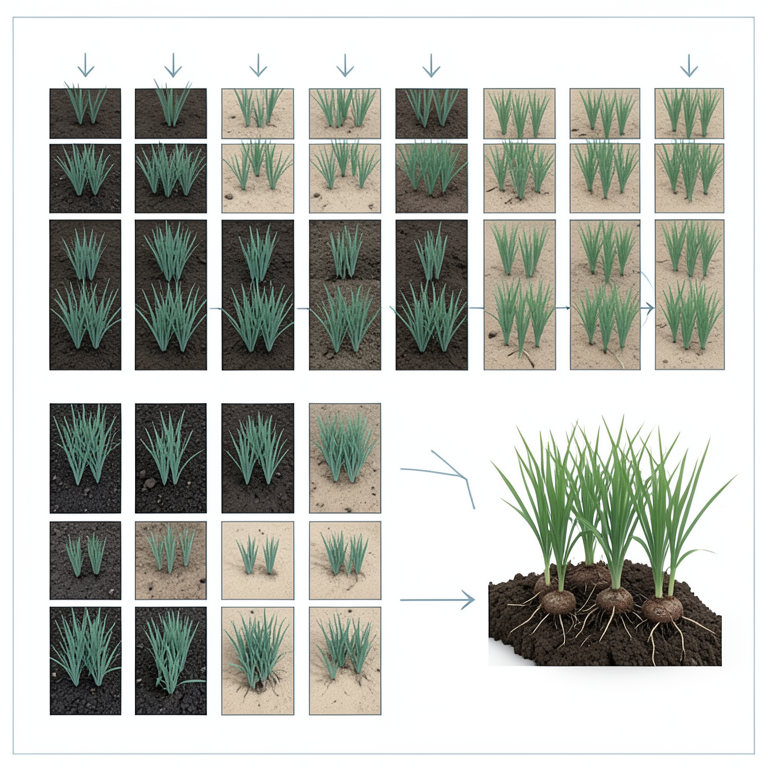
Experimental Treatment Matrix
AI-generated conceptual illustration (direct seeded rice (Oryza sativa) plants in field plots). It explains the idea and does not show study data.
View source evidence ↗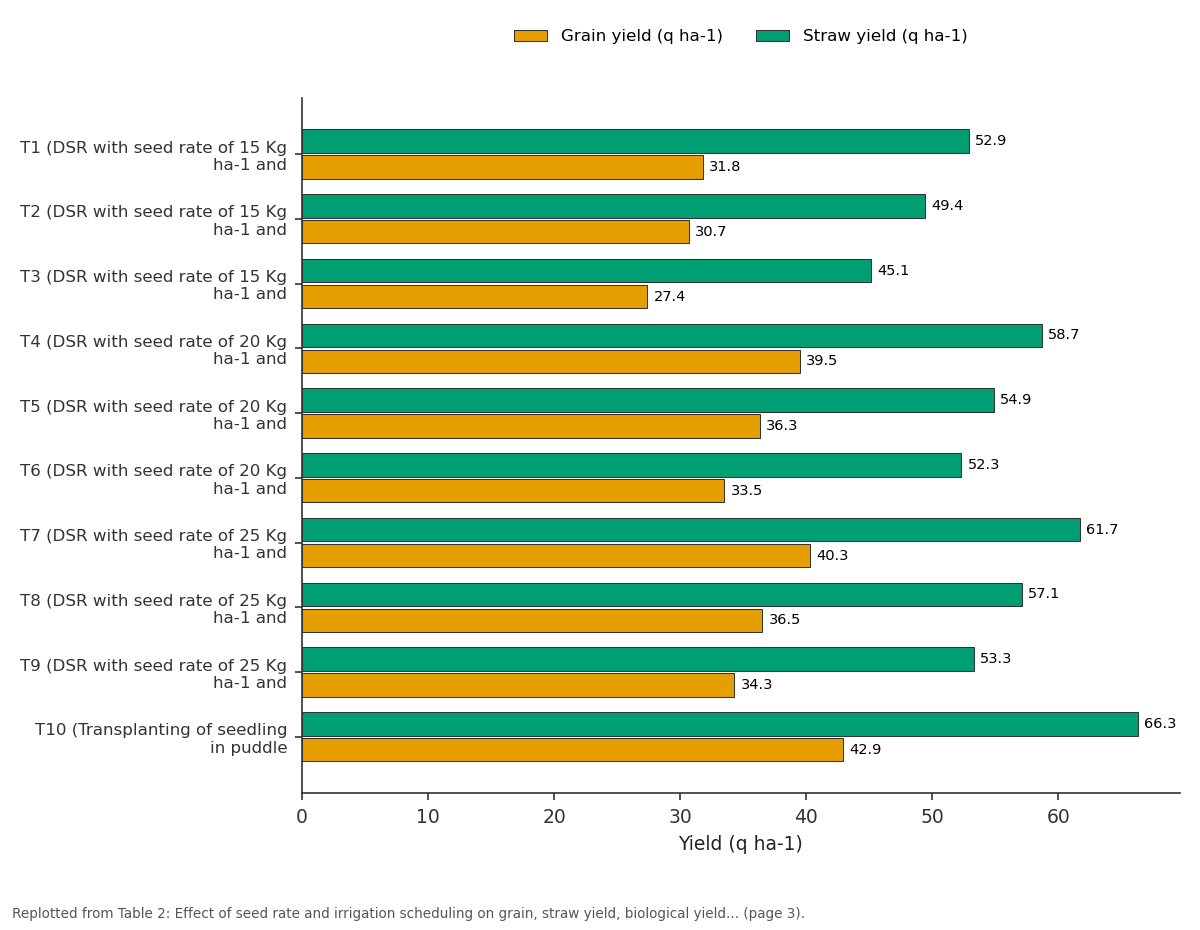
Grain yield (q ha-1) and Straw yield (q ha-1): T1 (DSR with seed rate... vs T2 (DSR with seed rate... vs T3 (DSR with seed rate... vs T4 (DSR with seed rate... vs T5 (DSR with seed rate...
Replotted from Table 2 (page 3) of the original paper. Every bar is the paper's own table value.
View source evidence ↗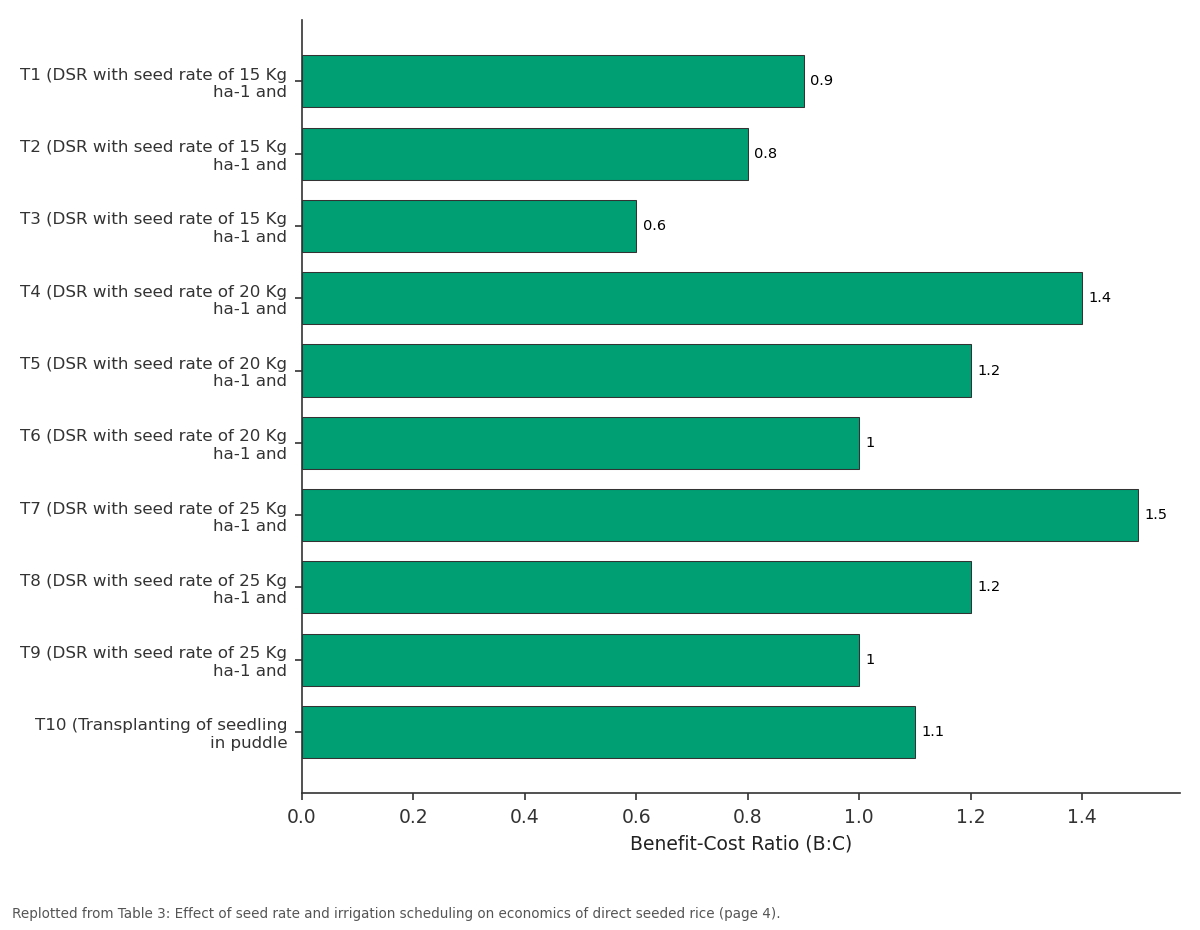
B:C: T1 (DSR with seed rate... vs T2 (DSR with seed rate... vs T3 (DSR with seed rate... vs T4 (DSR with seed rate... vs T5 (DSR with seed rate...
Replotted from Table 3 (page 4) of the original paper. Every bar is the paper's own table value.
View source evidence ↗Figures & tables
From the original paper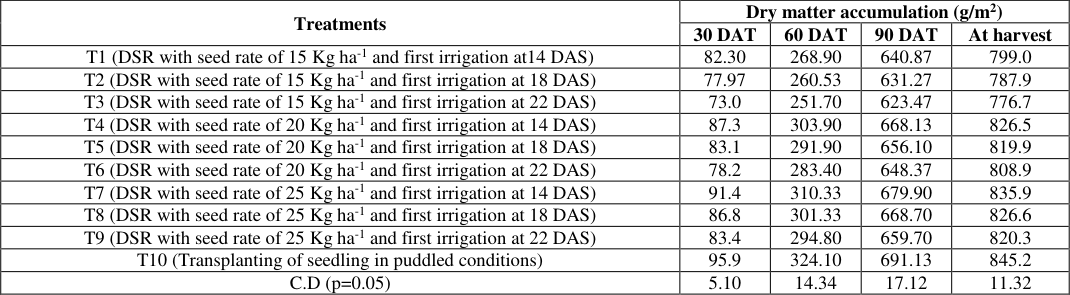 Table 1
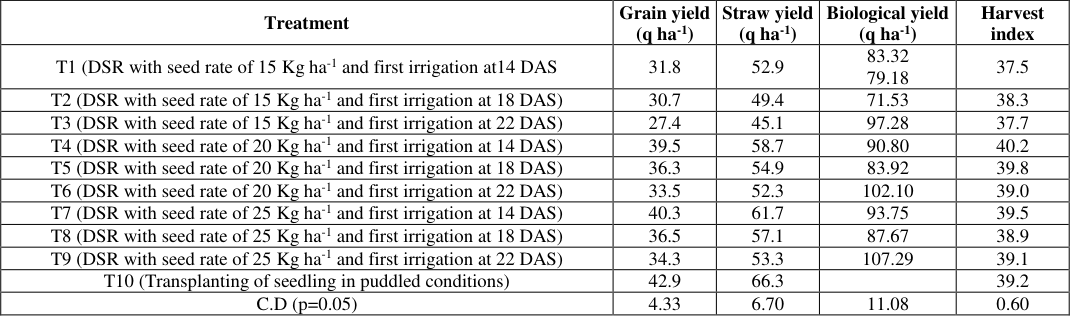 Table 2
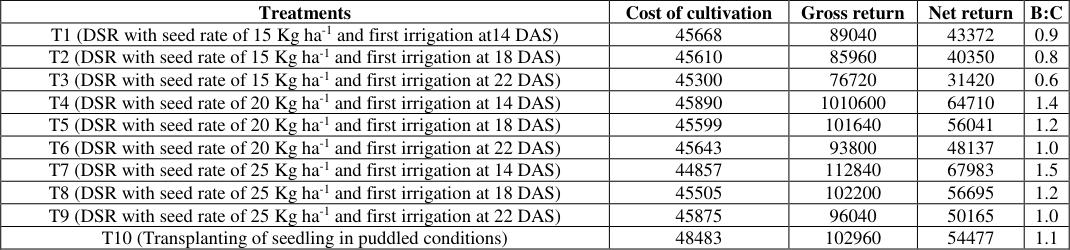 Table 3
Introduction
Rice (Oryza sativa L.) belongs to the family Poaceae. It is the primary food source for more than one third of world's population. It is cultivated in 114 countries across the world. India has largest area under paddy in the world and rank second in production after China. In India rice is grown in 43.86 million ha. Rice crop occupied 31.03 lakh hectares in Punjab with total production of 191.36 lakh tones (128.2 lakh tone of rice) during 2018-19 (Anon., 2020) [1] . Transplanting of rice seedlings is an age-old practice. In India rice is grown by transplanting in puddled soil. It requires puddling and continuous ponding of water for at least 15 days for establishment of seedlings. Repeated puddling adversely affects soil physical properties. It also causes evapotranspiration losses during hot summer days. To meet the water need of transplanted paddy, underground water is being over exploited by excessive pumping resulting into decline in water table. Direct-seeding of rice (DSR) under unpuddled conditions as appears to be the most credible option and efficient irrigation water technology apart from its cost and labour effectiveness. DSR is labour saving, ensures timely sowing and early maturity (7-10 days) of crop and reduced production cost, improves soil physical conditions. seed rate has a great impact on plant density and the competitiveness of the crop stand, tiller, time to maturity and yield in DSR (Singh et al., 2017) [3] . The objective of the research is to check the effect of seed rate and irrigation scheduling on growth and yield of Direct seeded rice (DSR).
Materials and Methods
The study was carried out at Student's Research farm of P.G. Department of Agriculture, Khalsa College Amritsar, during kharif season 2020-2021. The soil of the experimental field was categorized as sandy loam. The soil of the experimental field was categorized as sandy loam. The soil tested low in organic carbon, available nitrogen (N) and available phosphorus (P). However, potassium (K) status was high. The soil pH and electrical conductivity values were within the normal range.
The field experiment was conducted in randomized block design having 10 treatments with 3 replications described as T1: DSR with seed rate of 15kg/ha and first irrigation at 14 DAS, T2: DSR with seed rate of 15kg/ha and first irrigation at 18 DAS, T3: DSR with seed rate of 15kg/ha and first irrigation at 22 DAS, T4: DSR with seed rate of 20kg/ha and first irrigation at 14 DAS, T5: DSR with seed rate of 20kg/ha and first irrigation at 18 DAS, T6: DSR with seed rate of 20kg/ha and first irrigation at 22 DAS, T7: DSR with seed rate of 25kg/ha and first irrigation at 14 DAS, T8: DSR with seed rate of 25kg/ha and first irrigation at 18 DAS, T9: DSR with seed rate of 25kg/ha and first irrigation at 22 DAS, T10: Transplanting of seedling in puddled conditions. In this experiment Certified seed of variety "Pusa basmati 1509" as per treatments i.e. @ 15kg ha -1 , 20kg ha -1 and 25kg ha -1 were sown in lines having 20 cm spacing. Recommended dose of fertilizers (135 kg urea ha -1 ) were applied to the crop in three equal split 3, 6 and 9 weeks after sowing. Irrigation was applied as per treatments, i.e.14 days after sowing, 18 days after sowing, 22 days after sowing. Subsequent irrigations were given at weekly interval and as per requirement (when there is rainfall). Harvesting was done manually with sickle. On October 5, 2020, the crop was harvested. All data on growth, yield and yield component were measured from the central areas of each plot. Statistical analysis of the data recorded was done as per randomized block design using EDA 1.1 software developed by PAU, Ludhiana. The comparisons were made at five per cent level of significance.
Results and Discussion
Dry matter accumulation (DMA) Dry matter accumulation (DMA) is an important growth parameter which expresses the metabolic efficiency of the plants. As the data presented in table 1, revealed that the DMA of crop increased with the advancement of the stages up to harvest. At harvest, significantly higher DMA was recorded in transplanting T10 than all other treatments in DSR but at par with treatment T7 supported by plant height and LAI. Similar trend was observed from initial growth to harvest i.e. 30, 60 and 90 DAS. The increase in DMA under treatment T10 was 1.11 percent, 2.26 percent, 5.78 percent and 8.81 percent more than T7, T4, T1 and T3 respectively. Among the DSR T7 produce significantly higher DMA at 30, 60, 90 DAS and at harvest as compare to other treatments in DSR but at par treatments with T4 and T8. Higher DMA with higher seed rate and more irrigation may be due to more no of plants per unit area as compare to others. The statistically less DMA was recorded in T3 as compare to the other treatments in which rice sown directly having seed rate 15 kg ha -1 and irrigation applied of 22 DAS but at par with treatment T2 in which 15 kg ha -1 seed rate was applied and irrigation at 18 DAS. these results are in agreement with those obtained by the Hayat ( 2004) [4] .
| Treatments | Dry matter accumulation (g/m2) | — | — | — |
|---|---|---|---|---|
| 30 DAT | 60 DAT | 90 DAT | At harvest | |
| T1 (DSR with seed rate of 15 Kg ha-1 and first irrigation at14 DAS) | 82.30 | 268.90 | 640.87 | 799.0 |
| T2 (DSR with seed rate of 15 Kg ha-1 and first irrigation at 18 DAS) | 77.97 | 260.53 | 631.27 | 787.9 |
| T3 (DSR with seed rate of 15 Kg ha-1 and first irrigation at 22 DAS) | 73.0 | 251.70 | 623.47 | 776.7 |
| T4 (DSR with seed rate of 20 Kg ha-1 and first irrigation at 14 DAS) | 87.3 | 303.90 | 668.13 | 826.5 |
| T5 (DSR with seed rate of 20 Kg ha-1 and first irrigation at 18 DAS) | 83.1 | 291.90 | 656.10 | 819.9 |
| T6 (DSR with seed rate of 20 Kg ha-1 and first irrigation at 22 DAS) | 78.2 | 283.40 | 648.37 | 808.9 |
| T7 (DSR with seed rate of 25 Kg ha-1 and first irrigation at 14 DAS) | 91.4 | 310.33 | 679.90 | 835.9 |
| T8 (DSR with seed rate of 25 Kg ha-1 and first irrigation at 18 DAS) | 86.8 | 301.33 | 668.70 | 826.6 |
| T9 (DSR with seed rate of 25 Kg ha-1 and first irrigation at 22 DAS) | 83.4 | 294.80 | 659.70 | 820.3 |
| T10 (Transplanting of seedling in puddled conditions) | 95.9 | 324.10 | 691.13 | 845.2 |
| C.D (p=0.05) | 5.10 | 14.34 | 17.12 | 11.32 |
Table text extracted from the original PDF; superscript letters are shown inline. The original table image is below.
View original table image
Effective tillers
Tillering is the most important phase of the crop growth. Effective tillers are considered as the most important component among the yield attributing characters. influenced by scheduling of irrigation in basmati rice with different seed rates. The analyzed data revealed that the Scheduling of irrigation with different seeding rates had significantly affected the number of effective tillers per meter square. It has been observed that the transplanting T10 produce significantly higher effective tillers as compare to DSR treatments except T4, T7, T8. Similar results are found in Sorour et al. (2005). Among the DSR T7 produce significantly higher effective tillers as compare to other treatments in DSR but at pat treatments with T4 and T8 this may be due to more no of irrigation and high seed rate due to which more no of total tillers per meter square than other treatments. The lowest no of effective tillers were produced by T3 which significantly at par with T2 as compare to other treatments in DSR. These results were in line with those observed by Aslam et al. (2002).
Panicle length
It is an important yield contributing character. Data revealed that scheduling of irrigation in basmati rice with different seed rates influence the panicle length. Panicle length ranges from 20.59 to 24.7 cm. The significantly higher panicle length was recorder in T10 (transplanting) which was at par with treatments T2 and T3 as compare to other treatments in DSR. The maximum panicle length was recorded in the treatment T3 which was at par with treatment T2 but significantly higher than all other treatments in DSR. Lowest panicle length was observed in treatment T7 which was at par with treatments T4, T8 and T9. The panicle length highest in T3 is due to less seed rate due to which competition for light, space and nutrients is less which result in better availability of these factor to the crop and produce more panicle length. These results are in line with the experiment conducted by Phoung et al. (2005) [6] .
Number of grains/panicle
Number of filled grains/panicle is an important yield contributing character of basmati rice. More number of filled grains, more will be yield of crop. Data revealed that the number of filled grains per panicle ranged from (48.9 to 54.6) Maximum number of filled grains/panicle was recorded in treatment T10 (transplanting) which was at par with treatment T2, T3 but significantly higher than all other treatments in DSR. Among the DSR T3 produce significantly higher no of grain per panicle as compare to other treatments in DSR but at par with treatment T2, the highest number of grains per panicle is due to less competition for light, space, water and nutrient which resulted in better availability of these factors to the crop and in turn produced more grains per panicle. The lowest number of grains per panicle was observed in T7 as compare to other treatments but at par with treatments T4, T8, T9 in DSR. Similar results are founded by Phoung et al. (2005) [6] .
Test weight gm -1
It is an important yield component of basmati rice which determines the nature and extent of grain development. As the perusal of data revealed that scheduling of irrigation in basmati rice ( 1509) with different seed rates shows nonsignificant effect in test weight. the highest test weight was recorded in treatment T4. Lowest test weight was recorded in treatment T9.
Grain yield (q ha -1 ) Grain yield is main criteria for judging the effect of different treatments. The data present in table 2, revealed that scheduling of irrigation in basmati rice ( 1509) with different seed rates significantly influence the grain yield. The significantly higher grain yield (42.9q/ha) was observed in transplanting of rice as compare to the DSR treatments except T4 and T7. Similar result also found by Choudhary et al. (2018). Among the DSR T7 produce significantly higher yield as compare to other treatments in DSR but at par with treatments T4, T5, T8. This might be due to increase in number of irrigation in T7 as compare to other treatments.
| Treatment | Grain yield (q ha-1) | Straw yield (q ha-1) | Biological yield (q ha-1) | Harvest index |
|---|---|---|---|---|
| T1 (DSR with seed rate of 15 Kg ha-1 and first irrigation at14 DAS | 31.8 | 52.9 | 83.32 79.18 | 37.5 |
| T2 (DSR with seed rate of 15 Kg ha-1 and first irrigation at 18 DAS) | 30.7 | 49.4 | 71.53 | 38.3 |
| T3 (DSR with seed rate of 15 Kg ha-1 and first irrigation at 22 DAS) | 27.4 | 45.1 | 97.28 | 37.7 |
| T4 (DSR with seed rate of 20 Kg ha-1 and first irrigation at 14 DAS) | 39.5 | 58.7 | 90.80 | 40.2 |
| T5 (DSR with seed rate of 20 Kg ha-1 and first irrigation at 18 DAS) | 36.3 | 54.9 | 83.92 | 39.8 |
| T6 (DSR with seed rate of 20 Kg ha-1 and first irrigation at 22 DAS) | 33.5 | 52.3 | 102.10 | 39.0 |
| T7 (DSR with seed rate of 25 Kg ha-1 and first irrigation at 14 DAS) | 40.3 | 61.7 | 93.75 | 39.5 |
| T8 (DSR with seed rate of 25 Kg ha-1 and first irrigation at 18 DAS) | 36.5 | 57.1 | 87.67 | 38.9 |
| T9 (DSR with seed rate of 25 Kg ha-1 and first irrigation at 22 DAS) | 34.3 | 53.3 | 107.29 | 39.1 |
| T10 (Transplanting of seedling in puddled conditions) | 42.9 | 66.3 | 39.2 | |
| C.D (p=0.05) | 4.33 | 6.70 | 11.08 | 0.60 |
Table text extracted from the original PDF; superscript letters are shown inline. The original table image is below.
View original table image
As more number of irrigation were applied, there was no stress affect the crop growth and also in T7 more seed rate is due to which more no of effective tillers per meter 2 . Similar results also found by Choudhary et al. (2018). T3 produce least yield as compare to others but at par with treatments T2. Transplanted treatments (T10) produce 6.4 percent and 56.5 percent more yield than T7 and T3. Among the DSR T7 produce 17.4 percent, 2 percent and 47 percent more yield than T9, T4 and T3.
Straw yield (q ha -1 ) Straw yield is a function of interplay of various yield component such as number of tillers per square meter. The data present in table 2, revealed that the the scheduling of irrigation in basmati rice with different seed rate significantly influence the straw yield. The significantly higher straw yield was observed in T10 (transplanting) of basmati rice as compare to DSR treatments except T7. Among the DSR T7 produce significantly higher straw yield as compare other treatments but at with treatments T8 and T4. The least straw yield was produced by T3 as compare to others but at par with treatment T2. The higher straw yield production in T7 is due to higher seed rate and more irrigation, due to which plants per unit area and dry matter accumulation is more as compare to other treatments. The results are also founded by Shrivastava and Tripathi (1993).
Harvest index
Harvesting index expressed as percentage determine the percentage ratio of economical yield (grain yield to biological yield). Harvesting index indicates portioning of photo assimilates to grain. The data present in table 2, revealed that the the scheduling of irrigation in basmati rice with different seed rate significantly influence the harvesting index. The highest harvesting index recorded in treatment T5 (39.8) and lowest value recorded in treatment T1 (37.5).
Table 2:
Effect of seed rate and irrigation scheduling on grain, straw yield, biological yield and harvest index of direct seeded rice
Treatment
Straw yield (q ha -1 ) Biological yield (q ha -1 )
Harvest index
Harvest index
Figures and tables from the paper
| Treatments | Cost of cultivation | Gross return | Net return | B:C |
|---|---|---|---|---|
| T1 (DSR with seed rate of 15 Kg ha-1 and first irrigation at14 DAS) | 45668 | 89040 | 43372 | 0.9 |
| T2 (DSR with seed rate of 15 Kg ha-1 and first irrigation at 18 DAS) | 45610 | 85960 | 40350 | 0.8 |
| T3 (DSR with seed rate of 15 Kg ha-1 and first irrigation at 22 DAS) | 45300 | 76720 | 31420 | 0.6 |
| T4 (DSR with seed rate of 20 Kg ha-1 and first irrigation at 14 DAS) | 45890 | 1010600 | 64710 | 1.4 |
| T5 (DSR with seed rate of 20 Kg ha-1 and first irrigation at 18 DAS) | 45599 | 101640 | 56041 | 1.2 |
| T6 (DSR with seed rate of 20 Kg ha-1 and first irrigation at 22 DAS) | 45643 | 93800 | 48137 | 1.0 |
| T7 (DSR with seed rate of 25 Kg ha-1 and first irrigation at 14 DAS) | 44857 | 112840 | 67983 | 1.5 |
| T8 (DSR with seed rate of 25 Kg ha-1 and first irrigation at 18 DAS) | 45505 | 102200 | 56695 | 1.2 |
| T9 (DSR with seed rate of 25 Kg ha-1 and first irrigation at 22 DAS) | 45875 | 96040 | 50165 | 1.0 |
| T10 (Transplanting of seedling in puddled conditions) | 48483 | 102960 | 54477 | 1.1 |
Table text extracted from the original PDF; superscript letters are shown inline. The original table image is below.