
Research article · 2019 · Full text
International Journal of Advanced Chemistry ResearchThe second hyper-zagreb indices and coindices of disjunction and symmetric difference of graphs
Volume 1(1) · Pages 37–42 · DOI: 10.33545/26646781.2019.v1.i1a.50 ↗
Research areasGraph theory and applicationsComputational Drug Discovery MethodsHistory and advancements in chemistry
Abstract
Author-writtenA topological index is a numerical descriptor of a molecule, based on a certain topological feature of the corresponding molecular graph. In this paper, we explore here some basic mathematical properties and present explicit formulas for the second Hyper-Zagreb coindex under graph operations (disjunction and symmetric difference).
Summary
Source-checkedPlain-language reading of the full paper, prepared with AI and checked against the text. Each point links to the authors' own words.
Why it matters
- Topological indices serve as numerical descriptors for molecules, derived from the topological features of their corresponding molecular graphs. View evidence ↗
- Computing topological indices and coindices is particularly useful for obtaining medical information about new drugs without needing expensive chemical experiments. View evidence ↗
The question
- The study aims to explore mathematical properties and establish explicit formulas for the second Hyper-Zagreb coindex when applied to graph disjunction and symmetric difference operations. View evidence ↗
What they did
- The mathematical analysis is conducted using finite and simple graphs. View evidence ↗
- The study utilizes the disjunction operation, where the resulting graph's vertex set is the union of the original sets, and adjacency is defined by the adjacency of vertices in either original graph. View evidence ↗
- The second Hyper-Zagreb index is calculated as the sum of specific weights associated with the graph. View evidence ↗
What they found
- The authors derived a specific formula for the Hyper-Zagreb coindex of the disjunction of two graphs. View evidence ↗
- The authors derived a specific formula for the Hyper-Zagreb coindex of the symmetric difference of two graphs. View evidence ↗
- The study established a proposition relating a graph's properties to its number of vertices (n) and edges (m) to support the coindex derivations. View evidence ↗
What it means
- The authors conclude that they have successfully investigated the mathematical properties and obtained explicit formulas for the second Hyper-Zagreb coindex under disjunction and symmetric difference operations. View evidence ↗
Visual summary
1 visualsIllustrations explain the paper; they do not show study data.
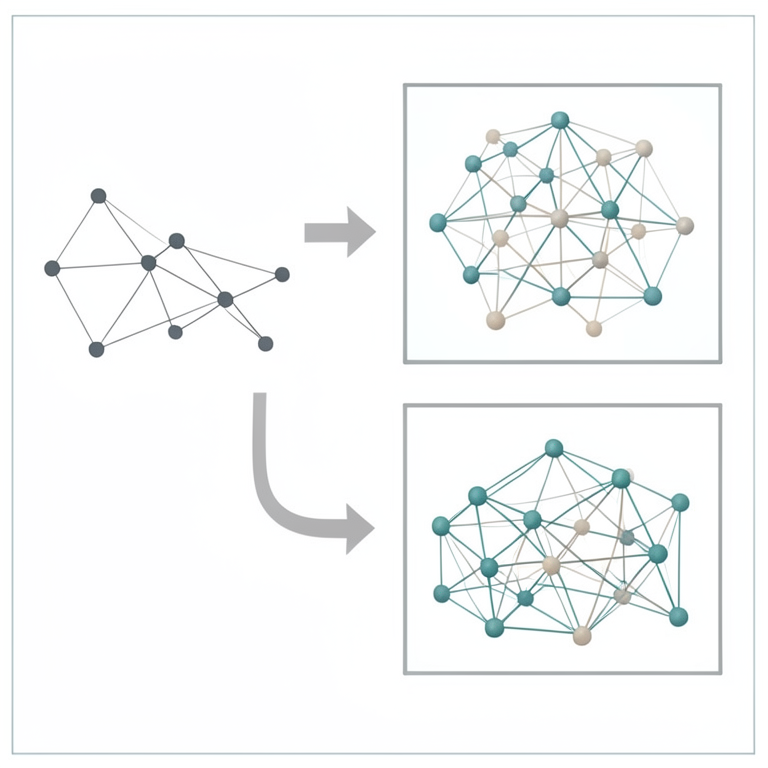
Graph Operations Concept
AI-generated conceptual illustration (abstract mathematical graphs consisting of nodes and edges). It explains the idea and does not show study data.
View source evidence ↗Introduction
A graph can be recognized by a numeric number, a polynomial, a sequence of numbers or a matrix which represent the whole graph, and these representations are aimed to be uniquely defined for that graph. Topological index and coindex are a numeric quantity with a graph which characterizes the topology of the graph and are invariant under graph automorphism [1, 2]. The methods on topological index and coindex computation are very suitable and serviceable for developing countries in which they can yield available medical information about new drugs without chemical experiment [3, 4]. All graphs in this paper are finite and simple, let G be a finite simple graph on vertices and edges, the degree of a vertex is the number of edges incident to , denoted by .
The first and second Zagreb indices have been introduced by Gutman and Trinajestić in 1972 [5]. They are defined as: Trinajestić in 1972 [5]. They are defined as: The first and second Zagreb coindices have been introduced by A.R. Ashrafi, et al. in 2010 [6].
They are defined as: In 2013, G.H. Shirdel, H. Rezapour and A.M. Sayadi [7].
Introduced degree-based of Zagreb indices named Hyper-Zagreb index which is defined as: In 2014, G. B. A. Xavier et al. [8]. re-defined the generalized version for Zagreb indices, the third Zagreb indices for a graph defined as: 37 In 2016, Maryam Veylaki et al. [9]. introduced distance-based of Zagreb indices named Hyper-Zagreb coindex which is defined as: In 2016, Wei Gao et al. [10] defined new version of Zagreb topological indices, based on the Hyper-Zagreb index that defined as above.
Then, the Second Hyper-Zagreb index of a graph G, which is defined as the sum of the weights and is equal to: Furtula and Gutman in 2015 introduced forgotten index (F-index) [11]. which defined as: N. De, S.M.A. Nayeem and A. Pal. in 2016 defined forgotten coindex (F-coindex) [12]. which defined as: In 2020, computed exact formulas for the Y-index of some graph operations by A.
Alameri et al. [13]. They defined a new degree- based of Zagreb indices named Y-index or” Yemen index” defined as: Also, A. Alameri et al in 2020, introduced Y-coindex [14] defined as: Here, we define a new version of Zagreb topological indices, based on the Hyper-Zagreb index that defined as above. Then, the Second Hyper-Zagreb index of a graph G, which is defined as the sum of the weights such that and is equal to [15]: 1.
Preliminaries In this section we give basic and preliminary concepts which we shall use later [16]. To unexplained terminology, we refer the interest reader to [4]. Definition 2.1 The disjunction of graphs and is the graph with vertex set and is adjacent with whenever or . The symmetric difference of two simple and connected graphs and is the graph with vertex set and or but not both}. Lemma 2. 2: Let and be graphs with , , , and , then a. , b. , Proposition 2.3: Let be two graphs with vertices and edges, respectively, then 38 a. b. c. d. e.
Theorem 2.4: Let be two simple graphs with vertices and edges, respectively, then 39 Theorem 2.5: Let be two simple graphs with vertices and edges, respectively, then a. b. 2. Main results In the following section, we study the second Hyper-Zagreb coindex of disjunction and symmetric difference , will be explained, we consider a finite simple connected graph with vertex and edge sets , and , respectively. For a graph , the degree of a vertex u is the number of edges incident to u, denoted by . The complement of , denoted by , is a simple graph on the same set of vertices in which two vertices and are adjacent, i.e., connected by an edge , if and only if they are not adjacent in .
Hence, , if and only if . Obviously , and , the degree of a vertex u in is the number of edges incident to u, denoted by . Proposition 3.1: Let be a graph with n vertices and m edges. Then.
Theorem 3.2: The Hyper-Zagreb coindex of is given by: 40 Proof. The proof follows from the relations , given in Proposition 3.1, and by replacing each with , which yield , and given in Theorem 3.4 in [31]. given in Theorem 2.5 in [13]. and given in (Theorem 3.5 in [16]). Theorem 3.3 The Hyper-Zagreb coindex of is given as: Proof. Similarly, as theorem 3.2, we obtain the required.
Conclusion
In this paper, we have investigated some of the basic mathematical properties of the second Hyper-Zagreb coindex and obtained explicit formula for their values under graph operations, exactly disjunction and symmetric difference. Authors Contribution All authors discussed the results and contributed to the final manuscript. Data Availability All the data supporting the results are included in the manuscript. Conflicts of Interest The authors declare that they have no conflicts of interest. 41 Funding statement This research did not receive any specific grant from funding.
References
30 in the original paper- Ayache A, Alameri A. Topological indices of the mk-graph, J. Assoc. Arab Univ. Basic and Appl. Sci. 2017;24:283-291.
- Ahmed H, Farahani MR, Alwardi AM, Salestina MR. Domination topological properties of some chemical structures using φp- Polynomial approach, Eurasian Chemical Communications. 2021;3(4):210-218.
- Ayache A, Alameri A, Alsharafi M, Ahmed H. The Second Hyper Zagreb Coindex of Chemical Graphs and Some Applications, Journal of Chemistry, 2021. ID 3687533, 8 pages.
- Alsharafi M, Zeren Y, Alameri A. The Second Hyper-Zagreb Index of Complement Graphs and Its Applications of Some Nano Structures. Asian Journal of Probability and Statistics. 2021;15(4):54-75.
- Gutman I, Rusčić B, Trinajstić N, Wilcox Jr CF. Graph theory and molecular orbitals. XII. Acyclic polyenes, J. Chem. Phys. 1975;62(9):3399-3405.
- Ashrafi AR, Došlić T, Hamzeh A. The Zagreb coindices of graph operations, Discret Appl. Math. 2010;158(15):1571-1578.
- Shirdel GH, Rezapour H, Sayadi AM. The hyper-Zagreb index of graph operations, Iranian Journal of Mathematical Chemistry. 2013;4(2):213-220.
- Ranjini PS, Lokesha V, Usha A. Relation between phenylene and hexagonal squeeze using harmonic index, International Journal of Graph 5eory. 2013;1(4):116-121.
- Veylaki M, Nikmehr MJ, Tavallaee HA. The third and hyper Zagreb coindices of some graph operations, Journal of Applied Mathematics and Computing. 2016;50(12):315-325.
- Gao W, Farahani MR, Siddiqui MK, Jamil MK. On the first and second zagreb and first and second hyper-zagreb indices of carbon nanocones CNCk[n],'' J. Comput. Theor. Nanosci. 2016;13(10):7475-7482.
- Furtula B, Gutman I. A forgotten topological index, Journal of Mathematical Chemistry. 2015;53(4):1184-1190.
- De Nayeem S, Pal A. The F-coindex of some graph operations, SpringerPlus. 2016;5(1):221.
- Alameri A, Al-Naggar N, Al-Rumaima M, Alsharafi M. Y-index of some graph operations, Int. J. Appl. Eng. Res. 2020;15(2):173e179.
- Alameri A, Al-Rumaima M, Almazah M. Y-coindex of graph operations and its applications of molecular descriptors, J. Mol. Struct., 2020, 1221. Art. no. 128754.
- Alameri A. Second Hyper-Zagreb index of Titania Nanotubes and their Applications, IEEE Access. 2021;9:9567-9571.
- Modabish A, Alameri A, Gumaan MS, Alsharafi M. The second Hyper-Zagreb index of graph operations. J. Math. Comput. Sci., 2021;11(2):1455-1469.
- Ahmed H, Alwardi A, Salestina MR, Nandappa DS. Domination, c-domination, topological indices and φp-polynomial of some chemical structures applied for the treatment of COVID-19 patients, Biointerface Research in Applied Chemistry, 2021, p. 13290-13302.
- Alsharafi M, Shubatah M, Alameri A. On the Hyper-Zagreb coindex of some graphs. J. Math. Comput. Sci. 2020;10(5):1875- 1890.
- Alsharafi M, Shubatah M, Alameri A. The hyper-Zagreb index of some complement graphs. Advances in Mathematics: Scientific Journal. 2020;9(6):3631-3642.
- Ayache A, Alameri A, Ghallab A, Modabish A. Wiener polynomial and Wiener index of conical graphs, Sylwan Journal. 2020;164(3):107-116.
- Alsharafi M, Shubatah M, Alameri A. The forgotten index of complement graph operations and its applications of molecular graph, Open Journal of Discrete Applied Mathematics. 2020;3(3):53-61.
- Alameri A. New Binary operations on Graphs, Journal of Science and Technology, 2016, 1607- 2073.
- Alsharafi M, Shubatah M, Alameri A. The First and Second Zagreb Index of Complement Graph and Its Applications of Molecular Graph, Asian Journal of Probability and Statistics. 2020;8(3):15-30.
- Alameri A, Shubatah M, Alsharafi M. Zagreb indices, Hyper-Zagreb indices and Redefined Zagreb indices of conical graph, Advances in Mathematics: Scientific Journal. 2020;9(6):3631-3642.
- Alsharafi M, Shubatah M, Alameri A. On the Hyper-Zagreb coindex of some Graphs, J. Math. Comput. Sci. 2020;10(5):1875- 1890.
- Alameri A, Modabish A, Ayache A, New Product Operation on Graphs and its Properties, International Mathematical Forum. 2016;11(8):357-368.
- Alsharafi M, Shubatah M, Alameri A. The hyper-Zagreb index of some complement graphs, Advances in Mathematics: Scientific Journal. 2020;9(6):3631-3642.
- Bilal M, Jamil MK, Waheed M, Alameri A. Three Topological Indices of Two New Variants of Graph Products, Mathematical Problems in Engineering. 2021;9:19, ID 7724177.
- Binyamin MA, Chaudry SA, Abbasi Alameri MSA. On the Planarity of Extended Zero Divisor Graphs of Local Rings. Mathematical Problems in Engineering, 2022.
- Wang W, Nisar A, Fahad A, Qureshi MI, Alameri A. Modified Zagreb Connection Indices for Benes Network and Related Classes, Journal of Mathematics, 2022.Alameri A, Alsharafi M, Ali E, Gumaan MS. A note on Topological indices and coindices of disjunction and symmetric difference of graphs. Discret. Appl. Math. 2021;304:230-235. https://doi.org/10.1016/j.dam.2021.07.037. 42