
Research article · 2019 · Full text
International Journal of Advanced Chemistry ResearchPhytochemical and oral toxicity profile of the methanol leaf extract of Haematostaphis Barteri hook f. (Anacardiaceae)
Volume 1(1) · Pages 05–06 · DOI: 10.33545/26646781.2019.v1.i1a.2 ↗
Research areasDrug-Induced Hepatotoxicity and ProtectionEthnobotanical and Medicinal Plants StudiesPhytochemicals and Medicinal Plants
Abstract
Author-writtenDespite the increase use of herbal medicine, there are inadequate research evidences on their toxicity. Haematostaphis barteri is an important medicinal plant used for the treatment of anemia, hemorrhoid and malaria among others. The phytochemicals and acute oral toxicity profile of the leaves of the plant was investigated using established procedures. Forty albino rats were grouped into 6 groups of 5 rats each receiving 250, 500, 1000, 2000, 3000 and 4000 mg/kg respectively. The control groups received 1 ml of tween-80 the control vehicle. The phytochemical screening revealed the presence of important secondary metabolites, the results of the acute toxicity studies did not show any apparent pharmacotoxic signs. There was no body weight gain and that of vital organs during the observation period. The median lethal dose was found to be greater than 4000 mg/kg body weight. Haematostaphis barteri leaves extract is relatively safe when administered orally to rodents.
Summary
Source-checkedPlain-language reading of the full paper, prepared with AI and checked against the text. Each point links to the authors' own words.
Why it matters
- Haematostaphis barteri is a medicinal plant used by traditional healers in northern Nigeria to treat various conditions, including cancer, malaria, anemia, and hepatitis. View evidence ↗
- While medicinal plants are widely used, there is often a lack of knowledge regarding the extent of their adverse effects. View evidence ↗
- Toxicity testing is essential to evaluate the safety of herbs and drugs used for treating various ailments. View evidence ↗
The question
- The study aimed to determine the safety profile of the methanol leaf extract of Haematostaphis barteri. View evidence ↗
What they did
- The extract was prepared by cold macerating 350 g of powdered leaves in 2 L of absolute methanol for 72 hours. View evidence ↗
- The study used adult non-pregnant Wistar albino rats of both sexes, weighing between 120-150g. View evidence ↗
- Forty rats were divided into six groups receiving doses of 250, 500, 1000, 2000, 3000, and 4000 mg/kg, with control groups receiving 1 ml of tween-80. View evidence ↗
- Body weights were measured before and after a 14-day period, and surviving animals were euthanized to extract the liver, heart, and kidney. View evidence ↗
What they found
- The crude methanol extract of the leaves had a percentage yield of 4.77%. View evidence ↗
- Phytochemical screening confirmed the presence of tannins, saponins, alkaloids, cardiac glycosides, flavonoids, and reducing sugars in the extract. View evidence ↗
- Daily administration of the extract for 14 days resulted in no observed mortality or signs of toxicity. View evidence ↗
- There was no significant change in body weight for the animals during the test period. View evidence ↗
- The median lethal dose (LD50) of the extract was determined to be greater than 4000 mg/kg body weight. View evidence ↗
What it means
- The authors concluded that the methanol extract of H. barteri is relatively safe for oral administration at doses up to 4 g/kg. View evidence ↗
- The authors recommend further research to investigate the toxicological effects of the extract when administered chronically. View evidence ↗
Visual summary
1 visualsIllustrations explain the paper; charts are replotted from the paper's own table values.
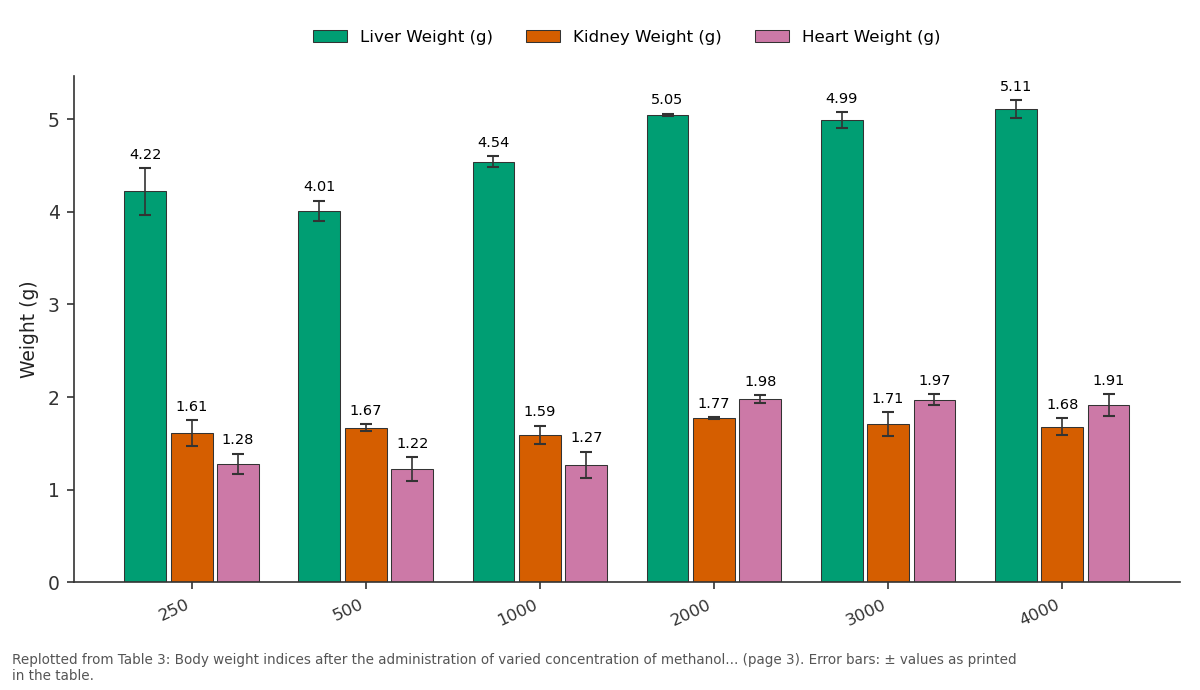
Liver Weight (g) and Kidney Weight (g) and more: 250 vs 500 vs 1000 vs 2000 vs 3000
Replotted from Table 3 (page 3) of the original paper. Every bar is the paper's own table value.
View source evidence ↗Figures & tables
From the original paper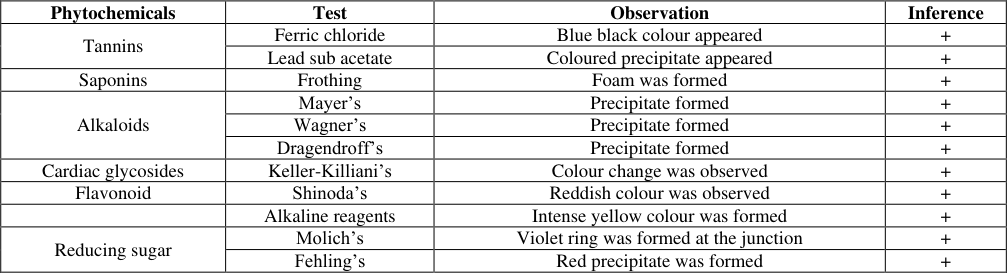 Table 1
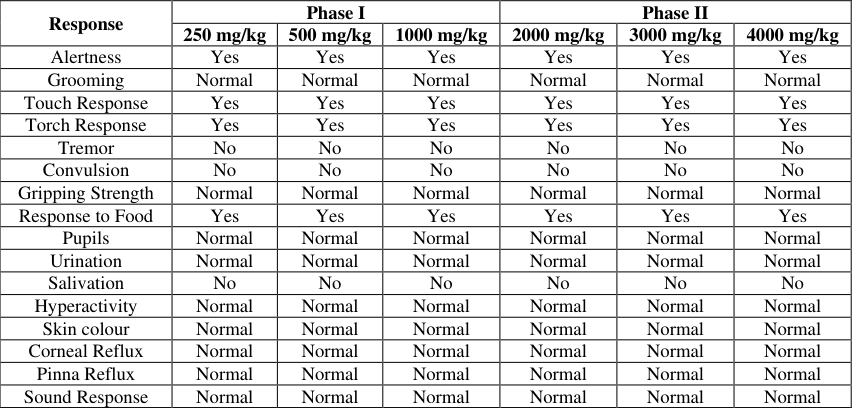 Table 2
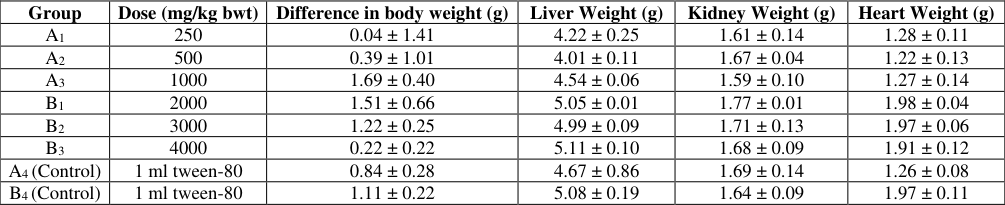 Table 3
Introduction H. barteri have been used by traditional healers in northern
Nigeria for the management of ailments such as, cancer (Kubmarawa et al., 2007) [1] , stomach ache, and vomiting (Rabo and Sanusi, 2001) [2] , anemia and hemorrhoid, malaria, hepatitis and sleeping sickness (Boampong et al., 2013) [3] among others. Plant based traditional medicine has been used all over the world for thousands of years (Tarkang et al., 2012) [4] . The World Health Organization (WHO) estimated that 80% of the world's population relies on traditional healing modalities including herbal medicine for primary health care and wellness (WHO, 2002; Karunamoorthi et al., 2013) [5,6,1] . In spite of all the medicinal relevance of medicinal plants, the knowledge of the extent of adverse effects associated with their use has been a major challenge (Koduru et al., 2006) [7] . Toxicity testing is important in evaluating the safety profile of drugs and herbs intended to be used by mankind for treatment of diverse ailments (Rajalakshmi et al, 2014) [8] . Hence this study is designed to provide information of the safety profile of the methanol leaf extract of the plant.
Materials and methods
Materials and methods
Procurement of plant material and preparation of extract
The leaves of Haematostaphis barteri were collected from Jabo district in Tambuwal Local Government of Sokoto State Nigeria and authenticated by Abdulaziz Sani of Botany Unit, Department of Biological Science, Usmanu Danfodiyo University, Sokoto where a herbarium specimen was deposited. The leaves were washed with running tap water and shade dried until a constant weight was obtained. They were then crushed with the aid of a pestle and mortar to a powdered state after which 350 g of the powdered leaves was weighed and extracted with 2 L of absolute methanol via cold maceration for 72 hours. The crude methanol extract of H. barteri (CMHB) obtained was allowed to evaporate under open air at room temperature. The dried extract was weighed stored in an air tight glass container until use.
Phytochemical screening
Phytochemical screening was conducted on the methanol leaf extract of H. barteri to validate the presence or otherwise of secondary metabolites such as alkaloids, cardiac glycosides, saponins, tannins, streroids, anthraquinones among others using standard methods as described by Stahl [9] and Trease and Evans [10] .
Animal's procurment
Wistar adult non-pregnant albino rats of both sexes were acquired from Animal House, Department of Biochemistry, Usmanu Danfodiyo University Sokoto. The weights of the rats were between 120-150g. The rats were kept under normal laboratory conditions with access to food and water. The animals were randomly selected, marked to allow individual identification and kept in their cages for 14 days prior to the experiment in order to allow for acclimatization to the laboratory conditions. The animals were housed in improvised plastic cages with sawdust litter at room temperature. Adequate lighting was maintained to ensure 12 hours of light and 12 hours of dark for each 24 hours experimental period. Each cage was identified by a card stating the cage number, number and weight of the animals, test substance code, administration route and dose per animal. The animals were fed with standard laboratory feeds and clean water during the experimental period. Animals were used in compliance with the National Institute of Health Guidelines for the Care and Use of Laboratory Animals.
Acute Toxicity Study
Prior to the experiment, the animals were fasted overnight but had free access to water ad libitum. The CMHB extract was administered intra-peritoneally. The procedure was divided into 2 phases. The first phase had 15 rats sorted into groups A 1 , A 2 and A 3 with 5 rats in each group which received 250, 500 and 1000 mg/kg body weight of the CMHB extract respectively. The second phase had 3 groups B 1 , B 2 and B 3 with 5 rats in each group receiving 2000, 3000 and 4000 mg/kg body weight of the CMHB extract respectively. Groups A 4 and B 4 the control groups received 1 ml of tween-80 each the control vehicle for the extract preparation. The median lethal dose (LD 50 ) was calculated using the following formula: LD 50 =√Minimal lethal dose × maximal survival dose The animals were observed for clinical signs, morbidity and mortality at regular interval of 4 hours on the first day and thereafter daily for 14 days for any sign of delayed toxicity and the weight loss or gain was determined at the end of the 14 th day (Lorke 1983) [11] . Body weights were taken before extract administration and after 14 days duration. Animals that survived were exposed to chloroform anesthesia via inhalation for extraction of the kidney, heart and liver.
Statistical Analysis
The SPSS (Statistical Package for Social Sciences) software packages version 16 were used for statistical analysis. Results were presented as mean and standard error (Mean ± S.E). The statistical significance between the control and each of the treated groups was determined by Dennett's ttest after one-way ANOVA. The level of significance was set at P < 0.05.
Results and Discussion
Results and Discussion
Percentage yield and phytochemical screening
The percentage yield of the crude methanol extract was found to be 4.77%. The phytochemical screening revealed the presence of important phytoconstituents presented in Table 1. Phytochemical screening of methanol leaf extract of H. barteri revealed the presence of some important secondary metabolites which might be responsible for its divese pharmacological activities.
| Phytochemicals | Test | Observation | Inference |
|---|---|---|---|
| Tannins | Ferric chloride | Blue black colour appeared | + |
| Lead sub acetate | Coloured precipitate appeared | + | |
| Saponins | Frothing | Foam was formed | + |
| Alkaloids | Mayer’s | Precipitate formed | + |
| Wagner’s | Precipitate formed | + | |
| Dragendroff’s | Precipitate formed | + | |
| Cardiac glycosides | Keller-Killiani’s | Colour change was observed | + |
| Flavonoid | Shinoda’s | Reddish colour was observed | + |
| Alkaline reagents | Intense yellow colour was formed | + | |
| Reducing sugar | Molich’s | Violet ring was formed at the junction | + |
| Fehling’s | Red precipitate was formed | + |
Table text extracted from the original PDF; superscript letters are shown inline. The original table image is below.
View original table image
General animal behaviour and mortality
Daily administration of the methanol leaf extract of H. barteri for 14 days did not produce observable signs of toxicity as well as mortality. Similarly, there were no changes in the skin, fur and eyes colour as well as appetite during the test period food and water consumption, as well as organ weights as presented in tables 2 and 3. There were no apparent pharmacotoxic signs observed upon the oral administration of the methanol extract of H. barteri. There was no significant weight gain or loss over the test period. A median lethal dose was found to be greater than 4000 mg/kg body weight was observed for the extract and hence may be considered to be safe hence do not exert acute toxicity in the treated animals.
Conclusions
The findings of this study suggest that the methanol leaf extract of H. barteri contains bioactive constituents that are attributed to its diverse pharmacological applications. It also demonstrated that the methanol extract of H. barteri may be relatively safe when administered orally at 4 g/kg. However, a further study is recommended on the toxicological effect of the extract when administered chronically.
Figures and tables from the paper
| Response | Phase I | — | — | Phase II | — | — |
|---|---|---|---|---|---|---|
| 250 mg/kg | 500 mg/kg | 1000 mg/kg | 2000 mg/kg | 3000 mg/kg | 4000 mg/kg | |
| Alertness | Yes | Yes | Yes | Yes | Yes | Yes |
| Grooming | Normal | Normal | Normal | Normal | Normal | Normal |
| Touch Response | Yes | Yes | Yes | Yes | Yes | Yes |
| Torch Response | Yes | Yes | Yes | Yes | Yes | Yes |
| Tremor | No | No | No | No | No | No |
| Convulsion | No | No | No | No | No | No |
| Gripping Strength | Normal | Normal | Normal | Normal | Normal | Normal |
| Response to Food | Yes | Yes | Yes | Yes | Yes | Yes |
| Pupils | Normal | Normal | Normal | Normal | Normal | Normal |
| Urination | Normal | Normal | Normal | Normal | Normal | Normal |
| Salivation | No | No | No | No | No | No |
| Hyperactivity | Normal | Normal | Normal | Normal | Normal | Normal |
| Skin colour | Normal | Normal | Normal | Normal | Normal | Normal |
| Corneal Reflux | Normal | Normal | Normal | Normal | Normal | Normal |
| Pinna Reflux | Normal | Normal | Normal | Normal | Normal | Normal |
| Sound Response | Normal | Normal | Normal | Normal | Normal | Normal |
Table text extracted from the original PDF; superscript letters are shown inline. The original table image is below.
View original table image
| Group | Dose (mg/kg bwt) | Difference in body weight (g) | Liver Weight (g) | Kidney Weight (g) | Heart Weight (g) |
|---|---|---|---|---|---|
| A1 | 250 | 0.04 ± 1.41 | 4.22 ± 0.25 | 1.61 ± 0.14 | 1.28 ± 0.11 |
| A2 | 500 | 0.39 ± 1.01 | 4.01 ± 0.11 | 1.67 ± 0.04 | 1.22 ± 0.13 |
| A3 | 1000 | 1.69 ± 0.40 | 4.54 ± 0.06 | 1.59 ± 0.10 | 1.27 ± 0.14 |
| B1 | 2000 | 1.51 ± 0.66 | 5.05 ± 0.01 | 1.77 ± 0.01 | 1.98 ± 0.04 |
| B2 | 3000 | 1.22 ± 0.25 | 4.99 ± 0.09 | 1.71 ± 0.13 | 1.97 ± 0.06 |
| B3 | 4000 | 0.22 ± 0.22 | 5.11 ± 0.10 | 1.68 ± 0.09 | 1.91 ± 0.12 |
| A4 (Control) | 1 ml tween-80 | 0.84 ± 0.28 | 4.67 ± 0.86 | 1.69 ± 0.14 | 1.26 ± 0.08 |
| B4 (Control) | 1 ml tween-80 | 1.11 ± 0.22 | 5.08 ± 0.19 | 1.64 ± 0.09 | 1.97 ± 0.11 |
Table text extracted from the original PDF; superscript letters are shown inline. The original table image is below.
View original table image
References
11 in the original paper- Kubmarawa D, Ajoku GA, Nwerem NM, Okorie DA. Preliminary Phytochemical and Antimicrobial Screening of 50 Medicinal Plants from Nigeria. African Journal of Biotechnology. 2007; 6(14):1690-1696.
- Rabo ET, Sanusi SS. An Inventory of Medicinal Plants of Nigerian Savannah. Leviathan Books, 2001, 21-24.
- Boampong JN, Akua AK, Elvis OA. In-vivo antiplasmodial and In vitro Antioxidant Properties of Stem Bark Extracts of Haematostaphis barteri. Asian Journal of Tropical Biomedicine. 2013; 5(6):446-450
- Tarkang PA, Agbor GA, Armelle TD, Yamthe TLR, David K, Mengue-Ngadena Y. et al Acute and Subchronic Toxicity Studies of the Aqueous And Ethanol Leaf Extract of Citrus Sinensis (Linnaeus) Osbeck (Prosp.) in Wistar Rats. Der Pharmacia Letter. 2012; 4(5):1619-1629.
- World Health Organization (WHO). Traditional Medicine Strategy 2002-2005 (WHO/EDM/TRM/2002.1). Geneva, Switzerland: World Health Organization, 2002.
- Karunamoorthi K, Jegajeevanram K, Vijayalakshmi J. Traditional medicinal plants: A source of phytotherapeutic modality in resource-constrained health care settings. Journal of Evidence-Based Complementary and Alternative Medicine. 2013; 18(1):67-74.
- Koduru S, Grierson DS, Afolayan AJ. Antimicrobial Activity of Solanium aculaeastrum. Pharmaceutical Biology. 2006; 44(4):283-286.
- Rajalakshmi A, Jayachitra A, Gopal P, Krithiga N. Toxicity Analysis of Different Medicinal Plant Extracts In Swiss Albino Mice. Pharmacology and Toxicology Research. 2014; 1(2):1-6.
- Stalh E. Drug analysis by chromatography and microscopy. A Practical Supplement to Pharmacopoeias. (1st ed.). Ann Arbor, Michigan, 1973, 21-24.
- Trease EA, Evans WC. Pharmacognosy. (11th ed.). Churchill Livingstone Harcourt Health Service, London, 1978, 34.
- Lorke D. A new approach to practical acute toxicity testing. Archives of Toxicology. 1983; 54:275-287.