
Research article · 2019 · Full text
International Journal of Advanced Chemistry ResearchPhytochemical Constituents of Pleurotus ostreatus
Volume 1(2) · Pages 14–16 · DOI: 10.33545/26646781.2019.v1.i2a.10 ↗
Research areasFungal Biology and ApplicationsChemical synthesis and alkaloids
Abstract
Author-writtenThe chromatographic separation of the dichloromethane extract of Pleurotus ostreatus, fatty acid derivatives like trans-4-acetoxy-5-hydroxy-5-pentadecanoyl-2-cyclopenten-1-one and trans-4-acetoxy-5-hydroxy-5-(1-acetoxypentadecyl)-2-cyclopenten-1-one were isolated. The structures of these compounds have been determined by 1H, 13C, DEPT-135 NMR and GC-MS spectral data.
Summary
Source-checkedPlain-language reading of the full paper, prepared with AI and checked against the text. Each point links to the authors' own words.
Why it matters
- Mushrooms are recognized for having both nutritional and medicinal value. View evidence ↗
- The FAO recommends edible mushrooms as a protein source for developing countries facing serious malnutrition. View evidence ↗
- On a dry weight basis, mushrooms contain 19-35% protein, which is higher than rice (7.3%) and wheat (13.2%). View evidence ↗
The question
- The study aims to isolate and determine the chemical structures of two fatty acid derivatives from the oyster mushroom (Pleurotus ostreatus). View evidence ↗
What they did
- The fruit bodies of Pleurotus ostreatus were collected from the National Mushroom Development and Extend Center in Savar, Dhaka district. View evidence ↗
- A 913g sample of powdered mushroom was extracted using a soxhlet apparatus with n-hexane and then dichloromethane. View evidence ↗
- The resulting 0.67g of dichloromethane extract was processed using vacuum liquid chromatography (VLC) on silica gel. View evidence ↗
- Structural analysis was performed using UV, IR, and 400 MHz 1H- and 13C-NMR spectroscopy. View evidence ↗
What they found
- Compound 1 was isolated as a reddish solid with an Rf value of 0.66. View evidence ↗
- Compound 2 was isolated as a reddish solid with an Rf value of 0.45. View evidence ↗
- Mass spectroscopic analysis determined the molecular ion of Compound 1 to be m/z 415. View evidence ↗
- Mass spectroscopic analysis determined the molecular ion of Compound 2 to be m/z 270. View evidence ↗
What it means
- The authors concluded that the isolated compounds are trans-4-acetoxy-5-hydroxy-5-pentadecanoyl-2-cyclopenten-1-one (Compound 1) and trans-4-acetoxy-5-hydroxy-5-(1-acetoxypentadecyl)-2-cyclopenten-1-one (Compound 2). View evidence ↗
Figures & tables
From the original paper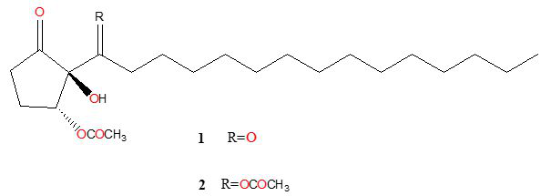 Figure 1
Introduction
Mushrooms are one type of fungi. In Bangladesh it grows wild all over the country under favorable climatic conditions. Most of the mushrooms have nutritional and medicinal [1,2,3,4] value. FAO has recommended [5] edible mushroom as a source of protein nutrition of developing countries where malnutrition is a serious problem. Mushrooms contain 19-35% proteins [6] on dry weight basis as compared to 7.3% in rice, 13.2% in wheat, and 25.2% in milk. Mushroom contains all the nine essential amino acids to a considerable amount. Oyster mushroom (Pleurotus ostreatus) belongs to the Pleurotaceae family, is an edible mushroom used as nutritious and delicious food. Now-days it is cultivated in many places of the country. It was reported [6] that Pleurotus ostreatus rich in protein and as well as medicinal importance. In this study, is described the isolation and structure elucidation of two fatty acid derivatives.
Materials and methods 2.1 General Experimental Section
Freshly distilled solvents were used for extraction, isolation and purification. Evaporations were performed under reduced pressure on a Buchii rotary evaporator. Melting point was determined on an electrochemical micro-melting point apparatus. The UV, IR (KBr) spectra were recorded on a Shimadzu UV-168A and Shimadzu IR-470A spectrophotometer, respectively. The 1 H-and 13 C-NMR spectra were taken in duterated methanol (CD 3 OD) with TMS as an internal standard by using a highresolution 400 MHz spectrometer.
Plant Material
The fruit body of mushroom "Pleurotus ostreatus" has been collected from the National Mushroom Development and Extend Center, Savar of Dhaka district and these were identified from the department of Botany, Dhaka University.
Extraction and Isolation of compound 1 & 2
The fruit body of mushroom was dried under mild sunlight and then at 400 C in an oven. Afterwards the mushrooms were powdered in a grinding machine (~ 200 mesh). The powdered Mushroom sample (913g) was successively and exhaustively extracted in a soxhlet apparatus with n-hexane followed by dichloromethane. The dichloromethane extract was concentrated (0.67g) and subjected to vacuum liquid chromatography (VLC) over TLC grade silica gel (60, P 254 ). The column was eluted initially with n-hexane followed by the mixture of n-hexane and dichloromethane of increasing amount of dichloromethane and finally with methanol. These elutes were collected in a series of test tubes with 25 ml in each fraction. Based on the similar behavior after monitoring each fraction by TLC these elutes were combined to yield eight different fractions as F 1 , F 2 , F 3 , F 4 , F 5 , F 6 , F 7 and F 8 . The fractions (F 1 -F 8 ) were concentrated and allowed to stand at room temperature for several days. Precipitated was obtained from the fraction F 6 and it was washed with petroleum ether followed by chloroform and dichloromethane successively. After dissolving the solid particles in methanol that was applied in TLC micro glass slide under different solvent systems and viewed in an iodine chamber. In a particular solvent system where the ratio of dichloromethane and methanol was 9:1 two bright prominent spot was detected. For further purification the solid was applied to column over column grade silica gel (kiesel gel 60, mesh 70-230). The column was eluted with mixture of dicholoromethane and methanol by gradual increasing the polarity of the mixture. The eluents were collected in an amount of about 5 ml in a series of test tubes. Based on the similar behavior after monitoring each fraction by TLC these elutes were combined to yield six different fractions. All these fractions (B 1 -B 6 ) were concentrated and allowed to stand at room temperature for several days. A reddish solid was obtained from the subfractions B 3 (75.2 mg) and B 6 ( 72.5 mg). These crystals were washed separately with the solvent dichloromethane and the solutions were kept at room temperature in two separate vials for recrystallization. Reddish solid precipitated were obtained in both the cases and these compounds were designated as B 3 and B 6 , respectively. After dissolving the crystals in dichloromethane in each cases that was applied in TLC micro glass slide in the solvent systems dichloromethane: methanol where the ratio is 95 : 05. In both the cases a single spot was detected when viewed in an iodine chamber. The spot of B 3 as the compound 1 appears as violet color when vanillin-sulphuric acid reagent was spraying on the applied TLC plate followed by heating at 110 o C in an electric oven with the R f value of 0.66 where in case of B 6 as compound 2 the color of the spot was appeared as black under same condition with R f value of 0.45. Compound 1: Reddish solid, R f value of 0.66; IR (KBr) cm -1 : 3500-3600, 2987, 1710, 1637, 1421, 1363, and 720; 1
Results & Discussion
The thin layer chromatographic examination of the isolated compound 1 from the dichloromethane extract of the Pleurotus ostreatus followed by successive chromatographic separation like VLC and adsorption column chromatography showed as violet color when vanillin-sulphuric acid reagent was spraying on the applied TLC plate followed by heating at 110 o C in an electric oven with the R f value of 0.66. The compound 1 was obtained as reddish solid. Its IR spectrum showed [7] an absorption peak at (3600-3500) cm -1 was assignable to a hydroxyl group (-OH) whereas absorption at 2987, and 1363 cm -1 were assigned due to the presence of aliphatic C-H stretching of-CH 3 and >CHgroups, respectively. A single absorption band at 1637 cm -1 was demonstrated for C=C groups. The absorption peaks at 1421 cm - 1 was suggestive for -CH 2group. The absorption band at 1710 cm -1 was suggestive for >C=O stretching of the carbonyl group. The other absorption peaks at 720 cm -1 was the indicative of the long chain of hydrocarbons. The proton NMR study of the isolated compound 1 showed [8] a downfield doublet of doublet at δ 7.420 and 7.250 ppm which was suggestive of the presence of olefinic proton at (C-2 and C-3), respectively. The doubletdoublet at δ 5.69 ppm was assigned for the proton at C-4. A broad band multiple at δ 4.06-4.14 ppm was suggestive of an oxymethine proton at C-5. The singlet at δ 2.034 ppm was assigned for the proton of acetoxy group at C-4. The multiplet at δ 1.62 and triplet at δ 0.876 ppm were assigned for the methelene proton at C-8 and methyl proton at C-20, respectively. The chemical shift at δ 1.245 to 1.320 ppm was appearance as multiplet for the methelene proton that linked from C-9 and C-19 positions. The resonance at δ 2.73 and 2.308 ppm were assigned for the protons linked to C-7A and C-7B, respectively. The 13 C-NMR spectrum of the isolated compound 1 revealed [8,9] the presence of 22 carbons. The chemical shift at δ 14.05 ppm was assigned to a methyl carbon at position C-20. The signals at δ 22.06, 22.54, 22.68, 24.67, 25.47, 27.39, 28.87, 29.04, 29.28, 29.69, 31.51, 31.70 and at 33.57 ppm were assigned for the methylene carbons at the positions 19, 18, 17, 16, 15, 14, 13, 12, 11, 10, 9, 8 and 7, respectively. The signal for the chemical shifts at δ 124.54 (C-2) and 133.82 ppm (C-3) were assigned for the C=C between the carbons at position 2 and 3. The resonance at δ 21.11 ppm was assigned for acetoxy methyl carbon attached to C-4. The resonance at δ 73.66 ppm was appropriate for the secondary carbon at position 4 while the chemical shift at δ 77.35 ppm was assigned for the quaternary carbon at position 5. The mass spectroscopic analysis of the compound 1 assigned the molecular ion of the compound m/z is 415, however other peaks could not be explained. The thin layer chromatographic examination of the isolated compound 2 from the dichloromethane extract of the oyster mushroom followed by successive chromatographic separation like VLC and adsorption column chromatography showed as black color when vanillinsulphuric acid reagent was spraying on the applied TLC plate followed by heating at 110 o C in an electric oven with the R f value of 0.45. The compound was obtained as reddish solid. Its IR spectrum showed [7] an absorption band at 3400 cm -1 was assignable to a hydroxyl group (-OH) whereas absorption band at 2929, and 1359cm -1 were assigned due to the presence of aliphatic C-H stretching of-CH 3 and >CH-groups, respectively. A single absorption band at 1637 cm -1 was demonstrated for the presence of C=C groups. The absorption peaks at 1425 cm -1 was suggestive for -CH 2group. The absorption band at 1710 cm -1 was suggestive for >C=O stretching of the carbonyl group. The other absorption peaks at 720 cm -1 was the indicative of the long chain of hydrocarbons. The proton NMR study of the isolated compound 2 showed [8] a downfield chemical chemical shift at δ 5.58 and 7.25 ppm which were suggestive [9] of the presence of olefinic proton at (C-2 and C-3), respectively. The chemical shift displayed at δ 5.17 ppm was assigned for the proton at C-6. A resonance at δ 3.31 ppm was suggestive of an oxymethine proton at C-5. The resonances at δ 2.16 and 2.03 ppm was assigned for the proton of the acetoxy groups that linked at C-4 and C-6, respectively. The multiplet at δ 1.62 and triplet at δ 0.87 ppm were assigned for the methelene proton at C-7 and methyl proton at C-20, respectively. The chemical shift at δ 1.20 to 1.47 ppm was appearance as multiplet for the methelene protons that linked from C-8 to C-19 positions. The 13 C-NMR spectrum of the isolated compound 2 revealed [8,9] the presence of 24 carbons. The chemical shift at δ 14.04 ppm was assigned to a methyl carbon at position C-20.
Acknowledgement
AcknowledgmentsThe authors are grateful to the Department of Chemistry, University of Dhaka and Atomic Energy Centre, Dhaka, Bangladesh for their financial support.
Figures and tables from the paper
References
9 in the original paper- Marmion VJ et.al. The Death of Claudius, the Royal Society of Medicine, 2002.
- Periasamy K. Novel Antibacterial Compounds Obtained from Some Edible Mushrooms, Int. J. Med. Mush., 2005; 7: 443-444.
- Bobeq P, Galbavy S. Hypocholesteremic and Antiatherogenic Effect of Oyster Mushroom (Pleurotus ostreatus) in Rabbit, Nahrung, 1999; 43: 339-342.
- Wasser SP. Medicinal Mushrooms as a Source of Antitumor and Immunomodulating Polysaccharides, Appl. Microbial. Biotechnol., 2002; 60: 258-274.
- Mushrooms by Country. http:/www.fao.org. 7 September, 2008.
- Chang SP, Miles G. Mushrooms, Cultivation, Natural Value, Medicinal Effect and Environmental Impact, CRC Press, 2004.
- Lambert, et al. Spectroscopy of Organic Chemistry, 1987.
- Pavia DL, Lampman GL, and Kriz GS. Introduction to Spectroscopy, 3rd edition, USA, 2001.
- World Intellectual Property Organization. https://www.wipo.int. 10 August, 2018.