
Research article · 2020 · Full text
International Journal of Advanced Chemistry ResearchDensity functional investigation of the adsorption of nitric oxide on palladium clusters (PDN n=1-6)
Volume 2(1) · Pages 05–08 · DOI: 10.33545/26646781.2020.v2.i1a.15 ↗
Research areasNanomaterials for catalytic reactionsInorganic Chemistry and MaterialsNanocluster Synthesis and Applications
Abstract
Author-writtenThe adsorption of nitric oxide molecule on small palladium clusters (Pdn;n=1–6) has been investigated by the density functional theory. The orientations of nitric oxide to get a nitrosyl (-NO) and Isonitrosyl (-ON) ligands were implemented. The most stable palladium clusters have been used as adsorbate. The resulting nitrosyl and Isonitrosyl palladium complexes always chemisorbs in a bent geometry. The nitrosyl complexes showed higher binding energy, charge donation, HOMO-LUMO gap and u(NO) than their isonitrosy counterparts. Looking to the thermodynamic and kinetic stability of the cluster and their interaction with nitric oxide.
Summary
Source-checkedPlain-language reading of the full paper, prepared with AI and checked against the text. Each point links to the authors' own words.
Why it matters
- Removing nitric oxide and carbon monoxide from exhaust gases is a significant scientific challenge driven by the need to eliminate air pollutants. View evidence ↗
- Palladium is considered a promising material for use as a catalyst in various applications. View evidence ↗
- Nitric oxide (NO) is highly reactive due to its singly occupied π* molecular orbital, making its adsorption properties distinct from other diatomic molecules. View evidence ↗
The question
- The study aims to investigate the adsorption of isonitrosyl (-ON) on small palladium clusters and compare these results with previously reported nitrosyl ligands. View evidence ↗
What they did
- The researchers used density functional theory (DFT) to investigate the adsorption of nitric oxide on palladium clusters containing 1 to 6 atoms. View evidence ↗
- All calculations were performed using the B3PW91 exchange and correlation functional. View evidence ↗
- Charge decomposition analysis (CDA) was used to estimate charge donation and back-donation between the clusters and nitric oxide fragments. View evidence ↗
What they found
- Both nitrosyl and isonitrosyl palladium complexes consistently chemisorb in a bent geometry. View evidence ↗
- Nitrosyl complexes exhibit higher binding energy compared to isonitrosyl complexes. View evidence ↗
- The computed NO bond length of 1.159 Å aligns closely with the experimental value of 1.153 Å. View evidence ↗
- Nitrosyl complexes show larger charge donation, charge transfer, and HOMO-LUMO gaps than isonitrosyl complexes, while back-donation remains similar for both. View evidence ↗
- Nitrosyl complexes exhibit higher NO stretching frequencies than their corresponding isonitrosyl complexes. View evidence ↗
- In nitrosyl complexes, spin density values decrease gradually as the size of the palladium cluster increases. View evidence ↗
- The Pd6 cluster showed the highest Root-Mean-Square-Distance (RMSD) of 0.086 between its nitrosyl and isonitrosyl forms. View evidence ↗
What it means
- The authors concluded that a linear relationship exists between the NO stretching frequencies and the spin density differences of the complexes. View evidence ↗
Visual summary
3 visualsIllustrations explain the paper; charts are replotted from the paper's own table values.
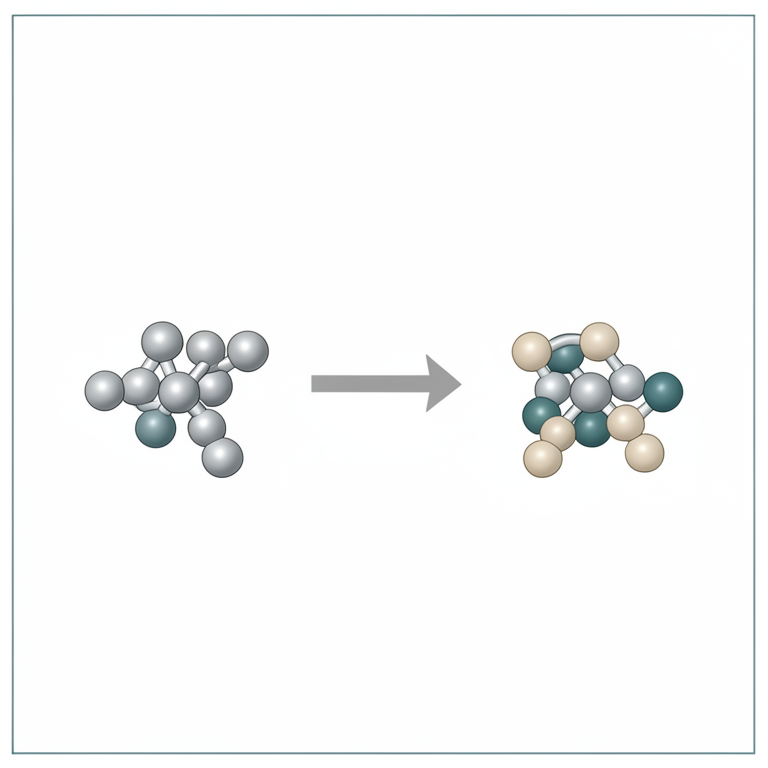
Adsorption Geometry Comparison
AI-generated conceptual illustration (Palladium clusters and nitric oxide molecules). It explains the idea and does not show study data.
View source evidence ↗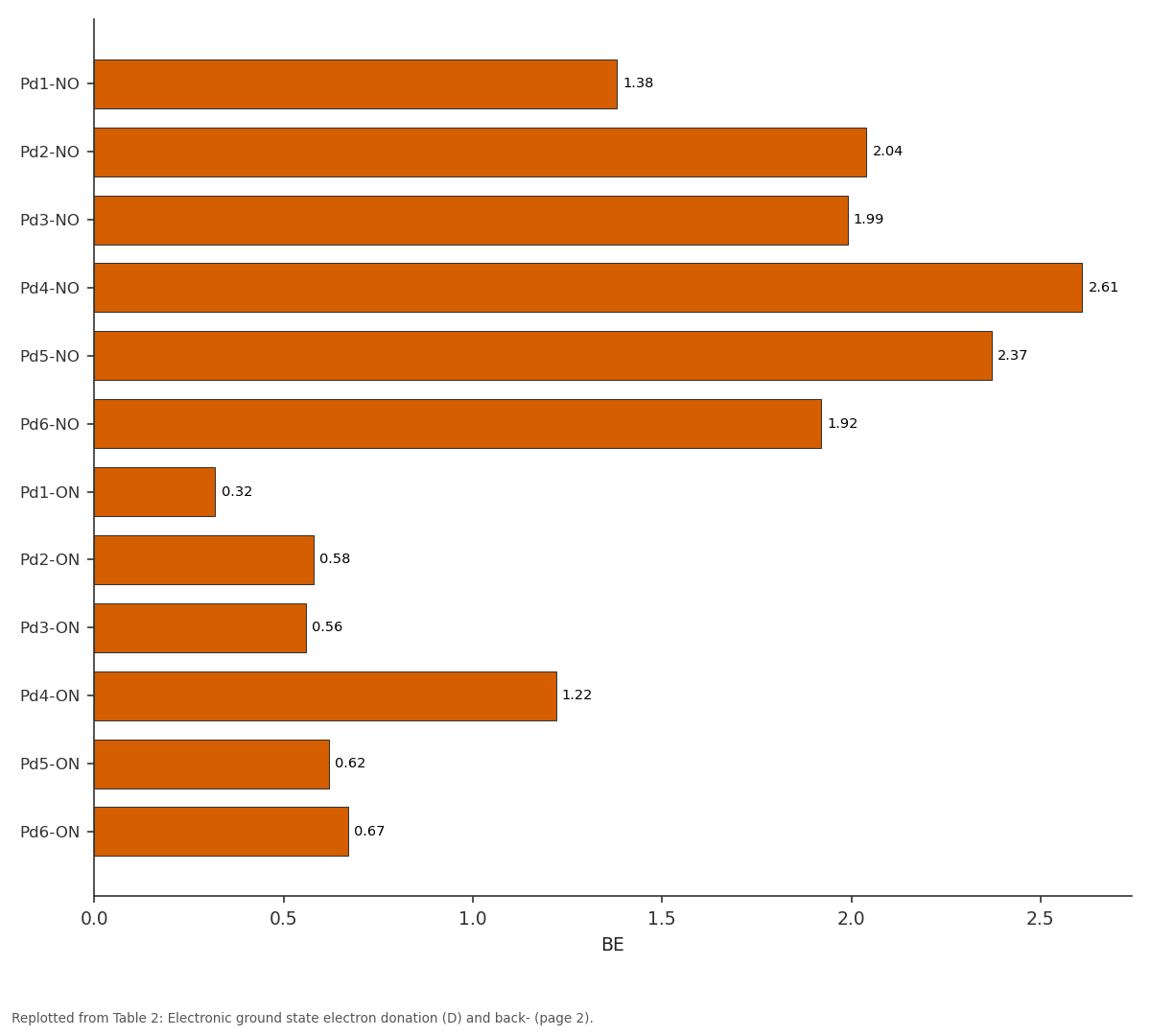
BE: Pd1-NO vs Pd2-NO vs Pd3-NO vs Pd4-NO vs Pd5-NO
Replotted from Table 2 (page 2) of the original paper. Every bar is the paper's own table value.
View source evidence ↗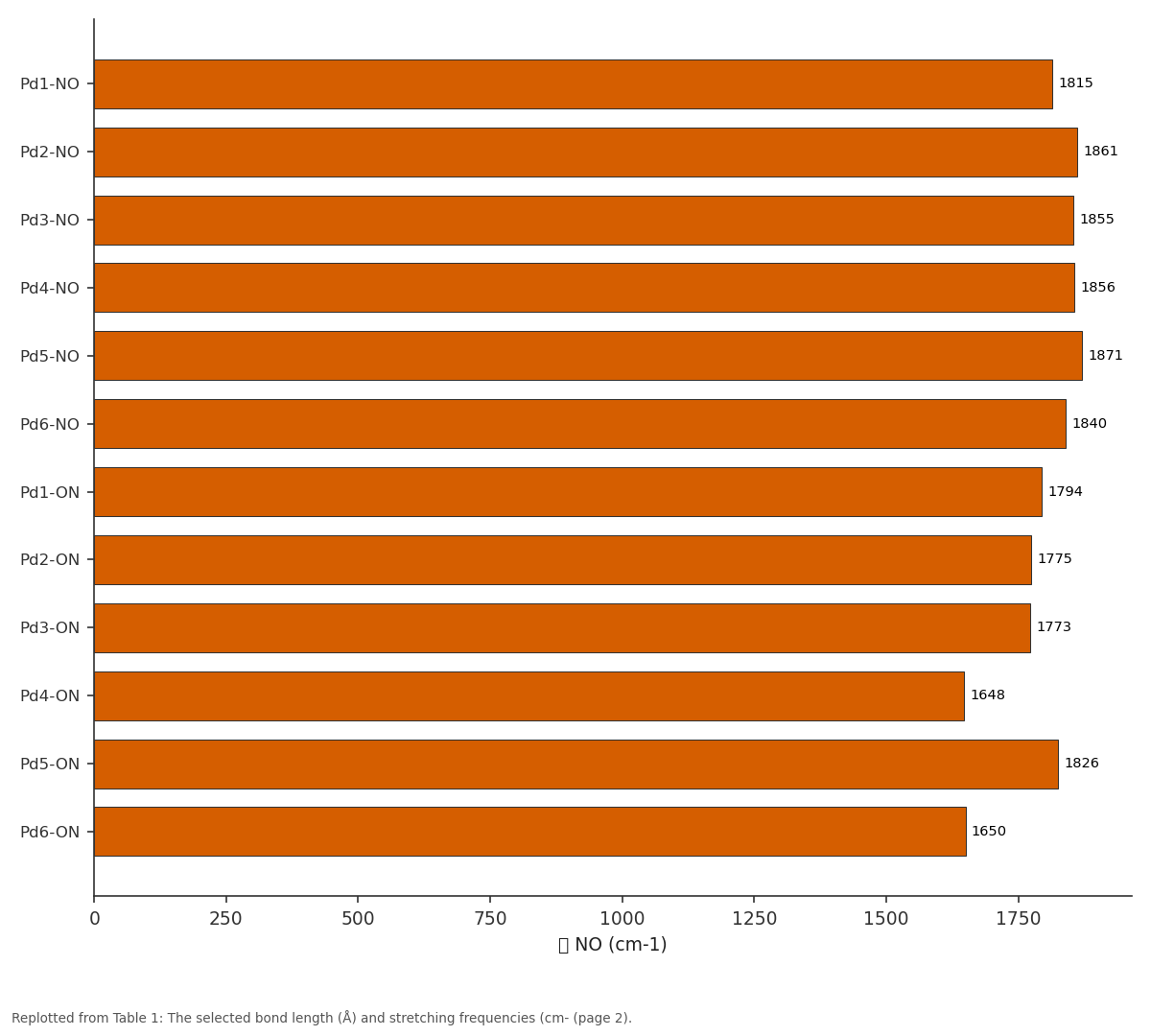
NO: Pd1-NO vs Pd2-NO vs Pd3-NO vs Pd4-NO vs Pd5-NO
Replotted from Table 1 (page 2) of the original paper. Every bar is the paper's own table value.
View source evidence ↗Figures & tables
From the original paper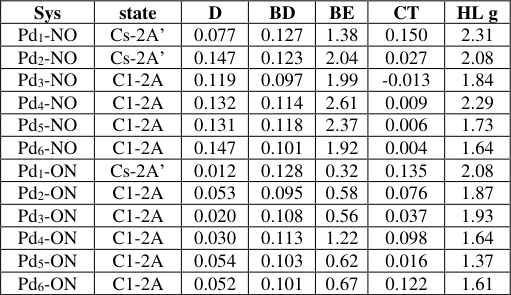 Table 2
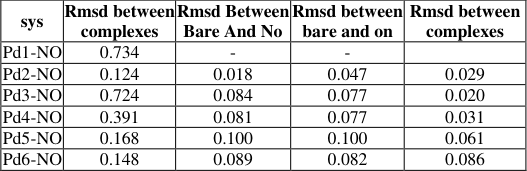 Table 3
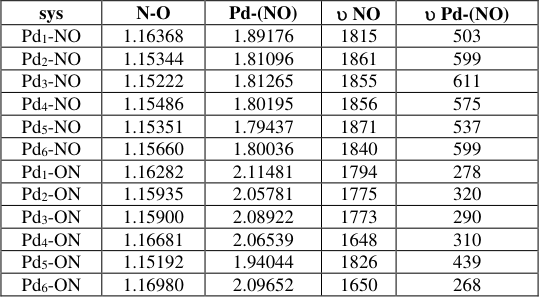 Table 1
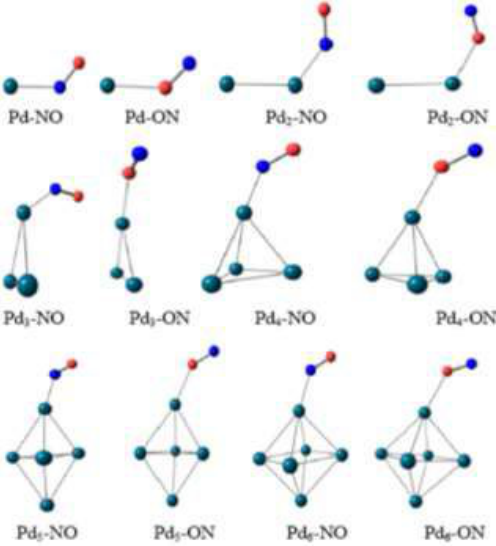 Figure 1
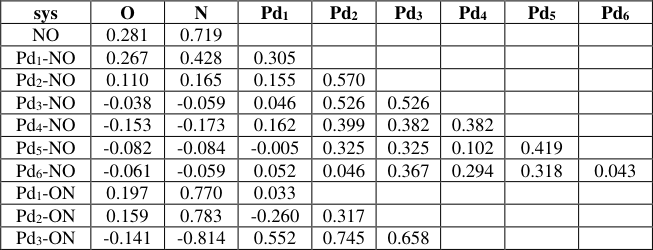 Table 4
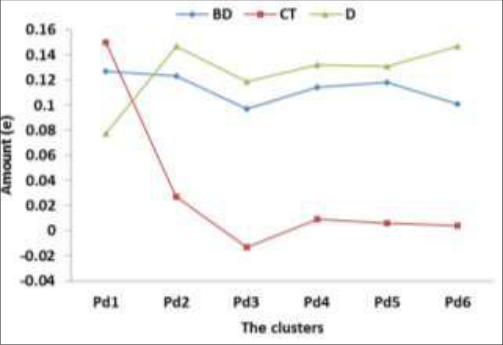 Figure 1
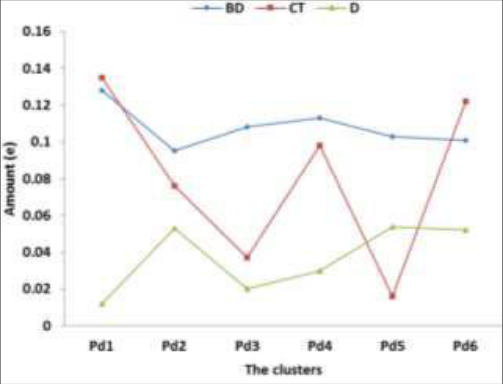 Figure 4
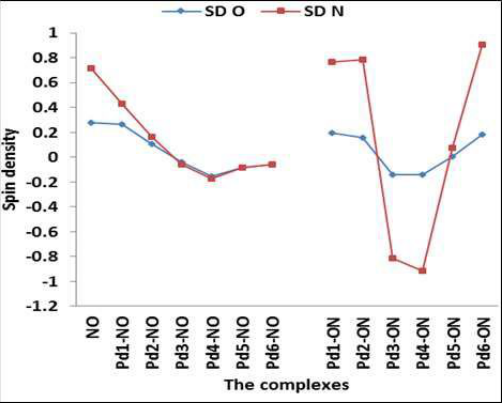 Figure 4
Introduction
The need to eliminate air pollutants prompted a series of theoretical and experimental studies to identify potential decontamination mechanisms, especially for Nitric oxide uptake and reduction and the removal of nitric oxide and carbon monoxide from exhaust gases is an important scientific challenge [1] . Nano clusters such as clusters of transition metals of group 10 (Ni, Pd, Pt), offer unique physical and chemical behavior, with the possibility of fine-tuning size and structures; palladium has a greater control over chemical properties and better ionization energy, has magnetic properties, facilitates the study of spectral properties and has better binding energies than the other metals in its group (Ni, Pt, Pd), and the stability of palladium structures is high at different temperatures [2][3] . Palladium in particular, is a promising material as catalyst in various applications [2][3][4][5][6] . Previous studies have indicated to the importance of palladium clusters during the adsorption of nitric oxide, which transforms triple bonds to double bonds [4,6] . The nitric oxide adsorption on small palladium clusters in the framework of the density functional theory (DFT) has been considered [4] . This method is based on the determination of the electronic density and is able to predict numerous properties related with the reactivity of such systems. Early theoretical works dealing with NO adsorption on palladium were reviewed by Whitten and Yang [5] . The magnetic and the symmetries of the clusters varies with the direction of the magnetization, even for a 3d metal such as Ni, the change in the magnetic symmetry leads to small geometric distortions of the cluster structure, which are even more pronounced for the 4d palladium metal; the experimental detection of the exact geometric structure of clusters is still a hard task, structures and cohesive energies of clusters cannot be obtained directly from gas phase or molecular beam experiments [7][8][9][10] . Theoretically, the adsorption of NO (-NO, -O and -N), as well as the possible spontaneous dissociation of NO on the small cluster of Pd4 has been considered [6,9] . Although Pd is less reactive in NO reduction, it could be a good alternative to Rh due to low cost compared to Rh, making Pd (especially the ones supported on oxide surface) a most industrially preferable catalyst [9] . It has been documented that theoretical investigations play an important role in cluster studies; it is possible to make effective theoretical predictions using density functional theory (DFT), the investigation showed that the most stable geometry of Pd4 is a regular tetrahedron with Td symmetry [9,10] . Nitric oxide (NO) is a hetero-nuclear diatomic molecule. The NO molecule has a singly occupied π* molecular orbital, therefore, it is more reactive and the chemical properties of adsorbed NO are quite different from other diatomic molecules [9][10][11][12][13] . The σ-donor and πacceptor interaction between nitric oxide and metal are well recognized [14][15][16] . The aim of this work is to investigate the isonitrosyl (-ON) adsorption on small palladium clusters and compare it with previously reported nitrosyl ligand [6,9] . We are going to prove the results of the previous experimental and theoretical studies to justify our methodology. The adsorption energy and charge transfer, charge donation and back-donation when nitric oxide interacts with palladium clusters are of interest. Finally we are going to look for any correlation between the electronic properties under consideration.
The methodology Section
The Gaussian 09 package [17] was used for the calculations. The B3PW91 exchange and correlation functional were used for all the calculations in the current investigation [18] . Copper was described with the [6s5p3d] SDD valence basis set and the quasirelativistic ECP10MWB effective core potential [19] , while Nitrogen and oxygen atoms were described using the 6-311++G (d,p) basis set. Full geometry optimization was carried out in each case and stationary points were confirmed to be genuine minima by harmonic vibrational frequencies analysis. In order to gain a deeper understanding of the chemical bonds evolution, Charge decomposition analysis (CDA) [20] was implemented to estimate the charge donation and back-donation between the copper cluster and nitric oxide fragments in complexes. The Multi wfn software [21] was used, along with the optimized geometry generated in the quantum-mechanical calculations.
Results and Discussion
Results and Discussion
Geometries and energetics
To study the adsorption of nitric oxide on neutral palladium clusters (n=1-6), we first optimized the geometries of all neutral clusters to get the lowest energy structure. Excluding palladium monomer the triplet state are the most stable state for Pd2 to Pd5. The singlet state is lower in energy than the triplet state for palladium monomer. The Structures of the nitrosyl and isonitrosyl palladium complexes are given in Figure 1. The adsorption of nitric oxide molecule can take place via nitrogen end atom or oxygen end atom. These two different orientations of nitric oxide are showed a significant change in some properties, for instance, the NO stretching frequencies in nitrosyl complexes are showed higher values than their corresponding isonitrosyl complexes Table 1. Furthermore the binding energies of O-end atom complexes are smaller than their N-end atom counterparts Table 2. The effect of the NO orientation on the palladium clusters structures once more noted for example, the Pd6 structure is compared using Root-Mean-Square-Distances (RMSDs), the difference of the Pd6 structures in the Pd6-NO and Pd6-ON is 0.086, which is corresponding to the highest RMSD among the clusters of the complexes Table 3. Moreover, the structure of the Pd6 bare cluster is the most affected after the interaction with nitrosyl and isonitrosyl since the RMSD is noted as 0.089 and 0.082 respectively in comparison with Pd6 bare cluster Table 3. As expected the smallest bare cluster Pd2 is almost unaffected by the interaction since the RMSD is 0.018 and 0.047 attributed to Pd2-NO and Pd2-ON respectively.
| sys | N-O | Pd-(NO) | NO | Pd-(NO) |
|---|---|---|---|---|
| Pd1-NO | 1.16368 | 1.89176 | 1815 | 503 |
| Pd2-NO | 1.15344 | 1.81096 | 1861 | 599 |
| Pd3-NO | 1.15222 | 1.81265 | 1855 | 611 |
| Pd4-NO | 1.15486 | 1.80195 | 1856 | 575 |
| Pd5-NO | 1.15351 | 1.79437 | 1871 | 537 |
| Pd6-NO | 1.15660 | 1.80036 | 1840 | 599 |
| Pd1-ON | 1.16282 | 2.11481 | 1794 | 278 |
| Pd2-ON | 1.15935 | 2.05781 | 1775 | 320 |
| Pd3-ON | 1.15900 | 2.08922 | 1773 | 290 |
| Pd4-ON | 1.16681 | 2.06539 | 1648 | 310 |
| Pd5-ON | 1.15192 | 1.94044 | 1826 | 439 |
| Pd6-ON | 1.16980 | 2.09652 | 1650 | 268 |
Table text extracted from the original PDF; superscript letters are shown inline. The original table image is below.
View original table image
| sys | Rmsd between complexes | Rmsd Between Bare And No | Rmsd between bare and on | Rmsd between complexes |
|---|---|---|---|---|
| Pd1-NO | 0.734 | - | - | |
| Pd2-NO | 0.124 | 0.018 | 0.047 | 0.029 |
| Pd3-NO | 0.724 | 0.084 | 0.077 | 0.020 |
| Pd4-NO | 0.391 | 0.081 | 0.077 | 0.031 |
| Pd5-NO | 0.168 | 0.100 | 0.100 | 0.061 |
| Pd6-NO | 0.148 | 0.089 | 0.082 | 0.086 |
Table text extracted from the original PDF; superscript letters are shown inline. The original table image is below.
View original table image
| Sys | state | D | BD | BE | CT | HL g |
|---|---|---|---|---|---|---|
| Pd1-NO | Cs-2A’ | 0.077 | 0.127 | 1.38 | 0.150 | 2.31 |
| Pd2-NO | Cs-2A’ | 0.147 | 0.123 | 2.04 | 0.027 | 2.08 |
| Pd3-NO | C1-2A | 0.119 | 0.097 | 1.99 | -0.013 | 1.84 |
| Pd4-NO | C1-2A | 0.132 | 0.114 | 2.61 | 0.009 | 2.29 |
| Pd5-NO | C1-2A | 0.131 | 0.118 | 2.37 | 0.006 | 1.73 |
| Pd6-NO | C1-2A | 0.147 | 0.101 | 1.92 | 0.004 | 1.64 |
| Pd1-ON | Cs-2A’ | 0.012 | 0.128 | 0.32 | 0.135 | 2.08 |
| Pd2-ON | C1-2A | 0.053 | 0.095 | 0.58 | 0.076 | 1.87 |
| Pd3-ON | C1-2A | 0.020 | 0.108 | 0.56 | 0.037 | 1.93 |
| Pd4-ON | C1-2A | 0.030 | 0.113 | 1.22 | 0.098 | 1.64 |
| Pd5-ON | C1-2A | 0.054 | 0.103 | 0.62 | 0.016 | 1.37 |
| Pd6-ON | C1-2A | 0.052 | 0.101 | 0.67 | 0.122 | 1.61 |
Table text extracted from the original PDF; superscript letters are shown inline. The original table image is below.
View original table image
The computed bond length of NO is 1.159Å at 6-311++G (d, p) level of theory which is in agreement with the experimental value of 1.153Å [22] . The ground state valence electronic configuration of NO is (1) 2 (2*) 2 (1) 4 (3) 2 (2*) 1 . Obviously the HOMO ((2*) 1 ) has one electron with no bonding character, this means that the NO molecule can be consider a potential Lewis base. Recently the molecular orbital and spin density distribution of nitric oxide have been investigated [23] , the study showed the spin density of 0.719 and 0.281 au for the nitrogen and oxygen atom respectively. This result is identical with the current values of Table 4. The both orientation of NO molecule always chemisorbs in a bent geometry (Figure 1), this bent structure is related to the symmetry and the shape of (2*) 1 orbital of NO molecule this phenomena is interpreted previously [24] . In these bent complexes a clear effect has been noted on the structure of Pd1-Pd6 clusters.
| sys | O | N | Pd1 | Pd2 | Pd3 | Pd4 | Pd5 | Pd6 |
|---|---|---|---|---|---|---|---|---|
| NO | 0.281 | 0.719 | ||||||
| Pd1-NO | 0.267 | 0.428 | 0.305 | |||||
| Pd2-NO | 0.110 | 0.165 | 0.155 | 0.570 | ||||
| Pd3-NO | -0.038 | -0.059 | 0.046 | 0.526 | 0.526 | |||
| Pd4-NO | -0.153 | -0.173 | 0.162 | 0.399 | 0.382 | 0.382 | ||
| Pd5-NO | -0.082 | -0.084 | -0.005 | 0.325 | 0.325 | 0.102 | 0.419 | |
| Pd6-NO | -0.061 | -0.059 | 0.052 | 0.046 | 0.367 | 0.294 | 0.318 | 0.043 |
| Pd1-ON | 0.197 | 0.770 | 0.033 | |||||
| Pd2-ON | 0.159 | 0.783 | -0.260 | 0.317 | ||||
| Pd3-ON | -0.141 | -0.814 | 0.552 | 0.745 | 0.658 |
Table text extracted from the original PDF; superscript letters are shown inline. The original table image is below.
View original table image
Our calculations show that NO adsorbs on an isolated Pd atom in a bent geometry, with a Pd-N-O angle of 129.5•.The N-O bondlength is stretched to 1.164Å, and this is reflected in a red-shift of the harmonic N-O stretching frequency from 2009 cm -1 to 1815 cm -1 and finally 239 cm-1 and 503 cm-1 attributed to Bending mode of Pd-N-O and Pd-N stretching respectively. These values are in good agreement with the experimental values [25] . The calculations of the binding energy demonstrate that the nitrosyl complexes have higher values than their corresponding isonitrosyl Table 2. The N-O bond length calculations showed that the nitrosyl complexes have lower N-O bond length than their isonitrosyl counterparts which are in the same trend as the binding energies, for example the bond length elongates from 1.145 Å to 1.164 Å and 1.163 Å, upon nitrosyl and isonitrosyl adsorption on palladium monomer (Pd-(NO)) respectively.
Similarly, the analysis of (NO) stretching frequencies showed that the nitrosyl complexes exhibit a higher (NO) than their corresponding isonitrosyl complexes. This increase in the N-O bonds after adsorption on palladium clusters indicates the catalytic activation properties.
The charge transfer values of the complexes are listed in Table 2, Figures 2,3. The strong adsorption on the palladium clusters is accompanied by the charge transfer from/to the adsorbate. The additional of the positive or negative charge on the palladium clusters can considerably promote their catalytic activity. The analysis of charge transfer showed that there is a considerable amount of charge transferred from the metal clusters to the nitric oxide ligands furthermore, the nitrosyl complexes exhibited larger charge transfer than their isonitrosyl counterparts. The calculations revealed that the nitrosyl complexes have higher charge donation than the isonitrosyl ones, the back donations are very much similar for the complexes in the both series. Similar trend have been realized for charge transfer subsequently similar charge transfer are noted for nitrosyl complexes and isonitrosyl. For example, the values 0.150e and -0.135e are measured for Pd1-NO and Pd1-ON complexes respectively. It is well documented that the HOMO-LUMO gap reflects the stability of the molecular structure; a large HOMO-LUMO gap is a mark of the chemical stability. The following values of 2.31, 2.08, 1.84, 2.29, 1.73, 1.64 eV are extracted as the HOMO-LUMO gaps for the nitrosyl complexes from Pd1-NO to Pd6-NO respectively. The corresponding isonitrosyl complexes showed lower HOMO-LUMO gap values than their nitrosyl counterparts. The spin density is distributed evenly for the terminal palladium atoms and decreased upon constraint could be rationalized by John Teller distortion, which can be seen starting from Pd3-NO complex Table 4, Figure 4. The spin density values decreased from 0.526 to 0.046. The spin density for the Pd2-NO distributed equally on the palladium atoms whereas in Pd2-ON structure a different spin distribution has been noted. The spin density of the binding palladium atoms in the complexes showed lower value in the isonitrosyl complexes than their nitrosyl counterparts excluding Pd3 and Pd4 complexes. The spin density of the free and bonded nitric oxide ligand is examined Table 4 and Figure 5. The spin density values in nitrosyl complexes decrease gradually as the size of the cluster increase while the isonitrosyl complexes showed huge difference in spin density this indicated a limited delocalization of the spin density from the oxygen lone pairs through the O-Pd bond.
Conclusion
The study revealed that the nitrosyl complexes possessed higher binding energy than their isonitrosyl counterparts. The adsorption leads to significant odd-even (number of Pd atoms) variation of the spin density differences. There is a linear relationship between the spin density differences and the NO stretching frequencies for the complexes. In looking in to the spin distribution of nitrogen and oxygen of the complexes a huge change in nitrogen distribution is noted in comparison between the nitrosyl and isonitrosyl complexes. The NO stretching frequencies in nitrosyl complexes are showed higher values than their corresponding isonitrosyl complexes. The both orientation of NO molecule always chemisorbs in a bent geometry and the harmonic N-O stretching attributed to bending mode of Pd-N-O and Pd-N stretching respectively. The nitrosyl complexes exhibited larger HOMO-LUMO gap, charge transfer and charge donation than their isonitrosyl counterparts, the back donations are very much similar for the complexes in the both series. The spin density values in nitrosyl complexes decrease gradually as the size of the cluster increase.
References
19 in the original paper- Venezia AM, Liotta LF, Deganello G, Terreros P, Pen MA, JL G Fierro, et al. Langmuir. 1999; 15:1176-1181.
- Kalita B, Deka Rh. Catal J. Soc. India. 2006; 5:110-120.
- Lacaze-Dufaure C, Roques J, Mijoule C, Sicilia E, Russo N, Alexiev V, Mineva T, et al. J. Molecular Catalysis. 2011; 341:28-34.
- Whitten JL, Yang H. Surface Science Reports. 1996; 24(5557):59-124.
- Bertin V, del Angel G, Mora MA, Poulain E, Olvera O, López-Rendón R. J. Mex. Chem. Soc. 2008; 52(1):93-98.
- Błonski P, Hafner J, J. Phys. Condens. Matter. 2011; 23:136001.
- Böyükataa M, Belchior JC, CCACAA. 2008; 2:289-297.
- Begum P, Pakiza B, International Journal of Quantum Chemistry. 2015, 837-845.
- Manuel J, Pérez K. Somasundram V, Termath NC Handy. Surface science. 1997; 380(1):83-90.
- Grybosa R, Benco L, Bučko T, Hafnerb J, J. chem. Phys. 2009; 130:104503.
- Srivastava RK, Hall RE, Lani BW, Journal of the Air & Waste Management Association. 2005; 55:1367-1388.
- Myers AL, Belfort G. Elsevier sciences, 1993, 206-433.
- Loffreda D, Delbecq F, Simon D, Sautet P, J. Chem. Phys. 2001; 115:8101.
- Johnston RL. "Atomic and Molecular Clusters", Taylor and Francis, London, ISBN 9781420055771, 2002.
- Frisch MJ. Gaussian 09, Revision D.01.Gaussian, Inc., Wallingford CT, 2013.
- Perdew JP, Chevary JA, Vosko SH, Jackson KA, Pederson MR, Singh DJ, et al. Phys. Rev. B. 1992; 46:6671-6687.
- Dolg M, Wedig U, Stoll H, Preuss H. J. Chem. Phys. 1987; 86:866-872.
- Huber KP, Herzberg G. Van Nostrand New York, (1979). (Experimental bond length of NO), 1979.
- Michael D, Mingos P. "Nitrosyl Complexes in Inorganic Chemistry, Biochemistry and Medicine II", Springer ISBN 978-3-642-41159-5, 2014.
Cited by 7
From OpenAlex, OpenCitations and reference lists read by Scinovex
- Influence of the metal − support and metal − metal interactions on Pd nucleation and NO adsorption in a Pd4/γ-Al2O3 (110D) model ↗
Letícia Maia Prates, José Walkimar de M. Carneiro, Maurício T. M. Cruz · Journal of Molecular Modeling · 2022
❝ 5PDF - In vitro adaptogenic profiling of some tree bark extracts for free radical scavenging activity against oxidative stress ↗
Sunita Jain, Rajani Jha · Journal of Medicinal Plants Studies · 2022
Free radicals are generated through various physiological processes in living organisms. Once generated, they can react with other biomolecules and either hinder or deviate normal metabolic activities. The present study was carried to evaluate the efficacy of tree barks of Ailanthus excelsa, Anogeissus latifolia, Diospyros melanoxylon, Gmelina arborea, Holoptelea integrifolia, Oroxylum indicum, Sterculia urens and Tamarindus indica to quench hydroxyl
- Phytochemical constituents and free radical scavenging activity of fresh and dried samples of Curculigo pilosa (Schum. & Thonn.) Engl. (Hypoxidaceae) ↗
Olubunmi Josephine Sharaibi, Rakesh Kumar Joshi, Sharaibi Olubunmi, Makinde, Omoteso K Oluwa · International Journal of Pharmacognosy and Life Science · 2020
Curculigo pilosa (Schum. & Thonn) Engl. is a tropical African flowering plant belonging to the family Hypoxidaceae. It is a highly valued medicinal plant used in traditional medicine to treat constipation, impotence, limb limpness, arthritis, knee joints, and watery diarrhea. It is also used as a potent immunomodulator and aphrodisiac. The aim of this study is to evaluate the phytochemical
- Evaluation the effect of sildenafil on nitric oxide secretion and improvement of endometrial receptivity in fresh ICSI cycles ↗
Rabab Alwan Taher, Shereen Abdulhussien Kzar Al-Essami, Batool Hussein Kadhim · International Journal of Pharmacognosy and Pharmaceutical Sciences · 2022
Introduction: Endometrial receptivity is a chain of events that promotes embryo implantation and is regulated by a variety of substances, such as cytokines, growth factors, and steroid hormones. The study's objective is to assess how vaginally delivered sildenafil in ICSI patients affects pregnancy outcome, endometrial thickness, subendometrial resistance index, and pulsatility index. Methods: The sixty women who participated in this
- Ameliorative effects of osteopontin on sperm morphology of frozen thawed buffalo semen treated with sodium nitroprusside ↗
Visakh Viswam, K. Loganathasamy, V. S. Gomathy, D. Reena · Journal of Entomology and Zoology Studies · 2020
The present experiment was conducted to study the ameliorative effects of exogenous supplementation of osteopontin (ONP) on sperm morphology of frozen thawed buffalo semen treated with sodium nitroprusside (SNP), a nitric oxide (NO) donor. Buffalo semen straws from 8 ejaculates in 6 bulls were procured from Central Frozen Semen Production and Training Institute, Hessarghatta, Banglore and stored at Semen Bank,
- Study of effect of beetroot juice in muscle damage recovery during anaerobic exercise with reference to unani system of medicine ↗
Rishi Kumar, Ehtesham-ul-Haq, Dr. Kalimullah, Dr. Yusuf Jamal · International Journal of Unani and Integrative Medicine · 2023
The purpose of this review is to evaluate the effect of beetroot juice in muscle damage recovery during anaerobic exercise in unani medicine because unani medicine claims that beetroot juice is Muhalil-e-waram and the term Muhalil-e-waram means to reduce the inflammation and to reduce the swelling. And according to modern science, beetroot juice is antioxidant and anti- inflammatory food because…
❝ 0PDF - Exploring the interaction of nitric oxide with palladium clusters ↗
Geoffroy N Ebelegi, Edwige Odoh · International Journal of Chemical Research and Development · 2022
This review paper synthesizes existing research on the interaction of nitric oxide (NO) with palladium (Pd) clusters, primarily focusing on insights gained through density functional theory (DFT) studies. The interaction between NO and Pd clusters is crucial for understanding and enhancing the catalytic efficiency of Pd-based materials in various environmental and industrial applications. This review delves into the structural, electronic,