
Research article · 2020 · Full text
International Journal of Advanced Chemistry ResearchStructural and electronic properties of nanoparticle: density functional study of small palladium clusters (pdn n=1-6)
Volume 2(1) · Pages 09–12 · DOI: 10.33545/26646781.2020.v2.i1a.16 ↗
Research areasCatalytic Processes in Materials ScienceNanocluster Synthesis and ApplicationsQuantum Dots Synthesis And Properties
Abstract
Author-writtenStructure and relative stability of Pdn clusters for n=1–6 were investigated using density functional methods at the B3PW91 level of theory. The structures of the optimized Palladium clusters were investigated and the results are compared with the available experimental values. Stability of the clusters was determined from their relative energy values, binding energies, HOMO-LUMO gap and electronic properties. The binding energy per atom also increases with cluster size. The study revealed that Pd4 and Pd6 are relatively more stable than their neighboring clusters. The most stable isomer for all clusters under investigation is the triplet. The Pd4 and Pd5 showed different Pd-Pd bond lengths due to Jahn-Teller distortion. Stability function and atom addition energy change predict that Pd4, and Pd6 are relatively more stable than their neighboring clusters. Electron affinity (EA), Ionization potential (IP) and electronegativity values suggest that larger clusters have stronger tendency to accept electrons, thereby supporting the relative stability of Pd4 and Pd6. Finally, Collision diameter increases as the cluster size increases.
Summary
Source-checkedPlain-language reading of the full paper, prepared with AI and checked against the text. Each point links to the authors' own words.
Why it matters
- Nanoparticles exhibit physical and chemical properties that differ significantly from their bulk material counterparts. View evidence ↗
- Palladium catalysts are important for various reactions, particularly for removing contaminants from vehicle emissions. View evidence ↗
- The high surface-area-to-volume ratio of d-metal clusters alters their electronic structures, making them attractive for catalysis. View evidence ↗
The question
- The study aims to model palladium clusters to investigate their structural properties, binding energy, ionization potentials, collision diameter, volume, and stretching frequency. View evidence ↗
What they did
- The researchers used density functional theory (DFT) at the B3PW91 level to investigate the structure and stability of palladium clusters containing 1 to 6 atoms. View evidence ↗
- Calculations were performed using the Gaussian 09 package with the SDD valence basis set. View evidence ↗
- The study employed full geometry optimization without symmetry restrictions and confirmed stationary points as genuine minima via harmonic vibrational frequency calculations. View evidence ↗
What they found
- For all clusters studied, the triplet state was found to be the most stable isomer. View evidence ↗
- Pd4 exhibited the highest bond dissociation energy (2.40 eV) among clusters larger than Pd2, along with a high HOMO-LUMO gap of 1.78 eV. View evidence ↗
- Jahn-Teller distortion caused varying Pd-Pd bond lengths in Pd4 and Pd5 clusters. View evidence ↗
- The collision diameter of the palladium clusters increases as the size of the cluster increases. View evidence ↗
- Chemical hardness decreases as cluster size increases, indicating that larger clusters are more susceptible to electronic structure changes. View evidence ↗
- Calculations indicate that binding energies increase with cluster size, while bond energies decrease. View evidence ↗
What it means
- The authors conclude that Pd4 is the electronically most stable cluster, identifying it as a 'magic-number' cluster. View evidence ↗
- Based on electron affinity, ionization potential, and electronegativity, the authors conclude that larger clusters have a stronger tendency to accept electrons. View evidence ↗
Visual summary
3 visualsIllustrations explain the paper; charts are replotted from the paper's own table values.
Cluster Size vs Collision Diameter
AI-generated conceptual illustration (palladium clusters of 1 to 6 atoms). It explains the idea and does not show study data.
View source evidence ↗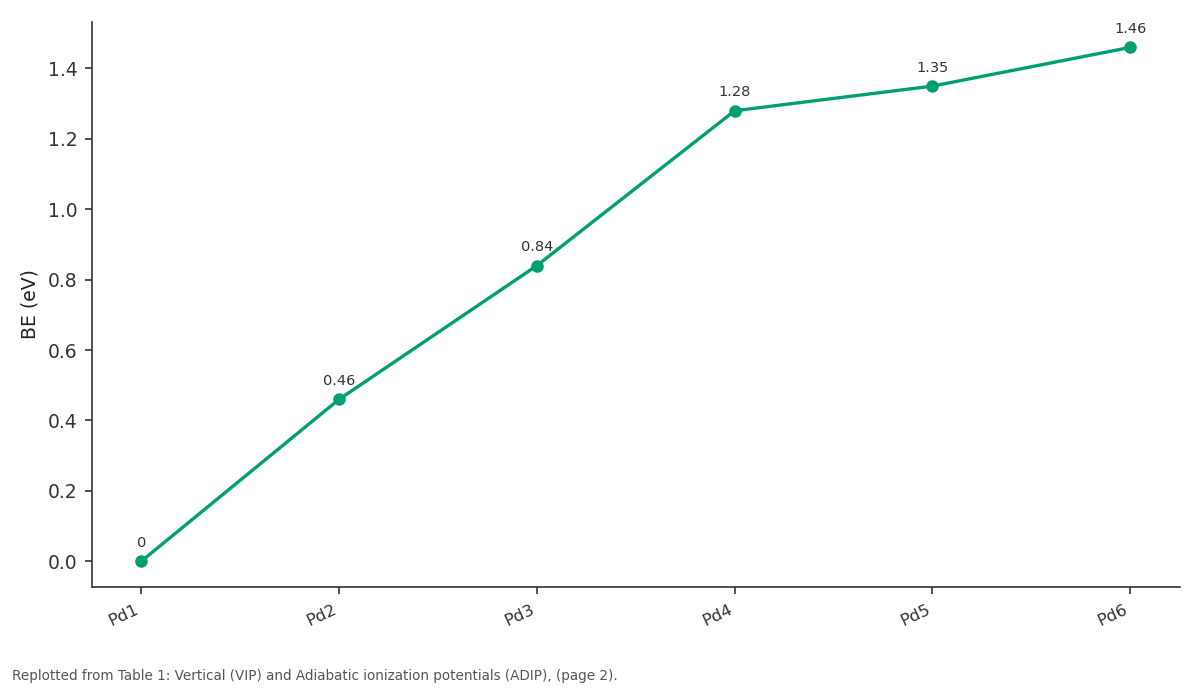
BE: Pd1 vs Pd2 vs Pd3 vs Pd4 vs Pd5
Replotted from Table 1 (page 2) of the original paper. Every bar is the paper's own table value.
View source evidence ↗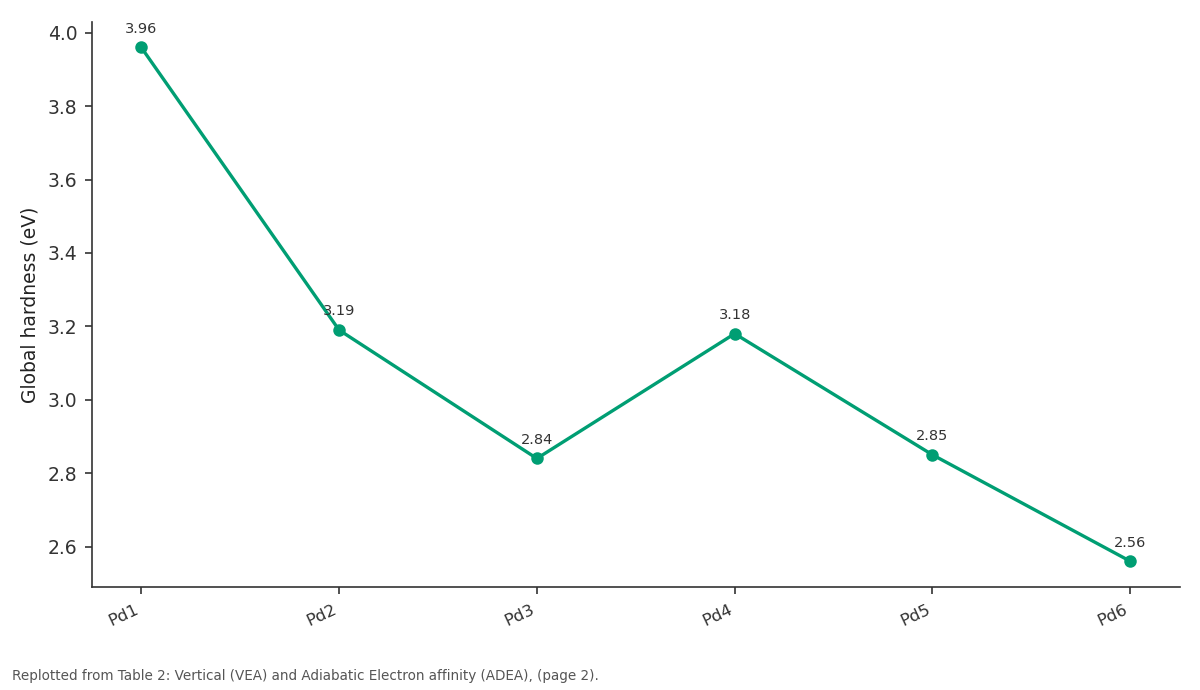
Global hardness: Pd1 vs Pd2 vs Pd3 vs Pd4 vs Pd5
Replotted from Table 2 (page 2) of the original paper. Every bar is the paper's own table value.
View source evidence ↗Figures & tables
From the original paper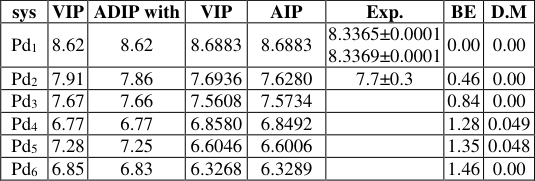 Table 1
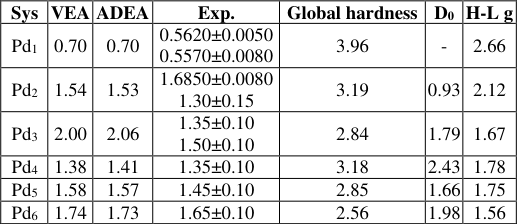 Table 2
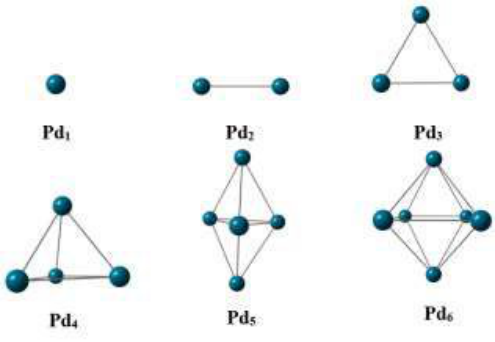 Figure 1
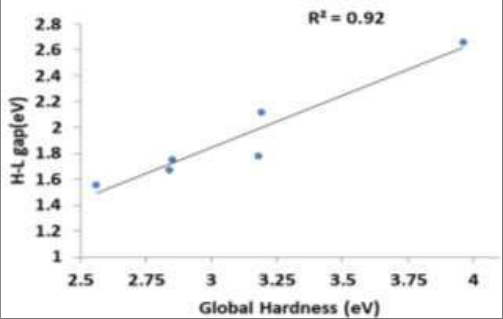 Figure 3
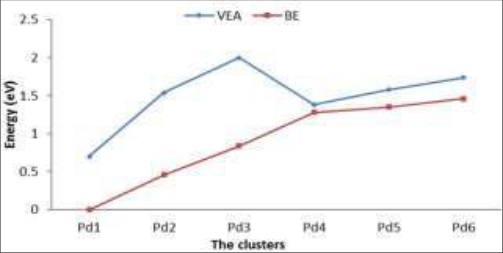 Figure 2
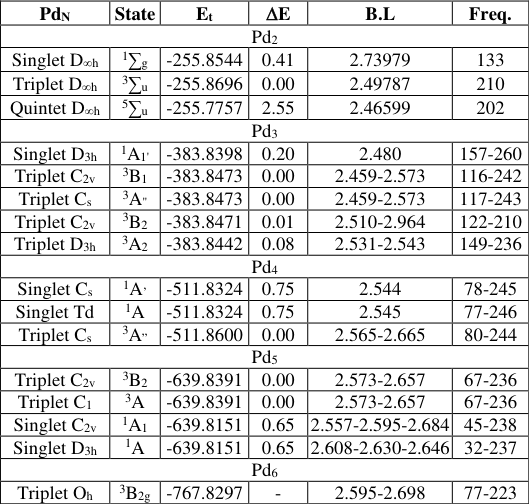 Table 3
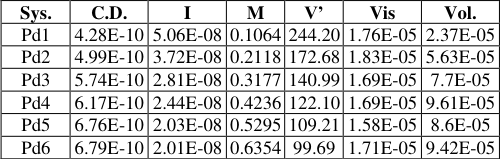 Table 4
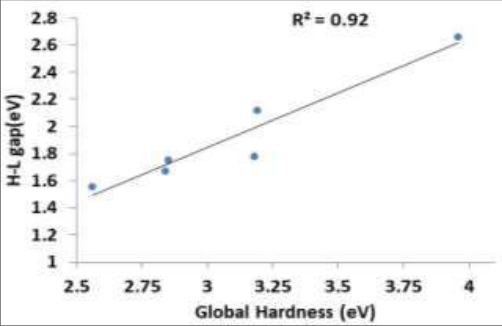 Figure 3
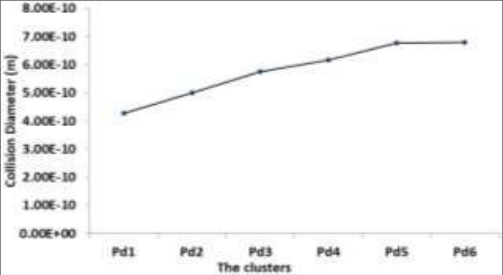 Figure 4
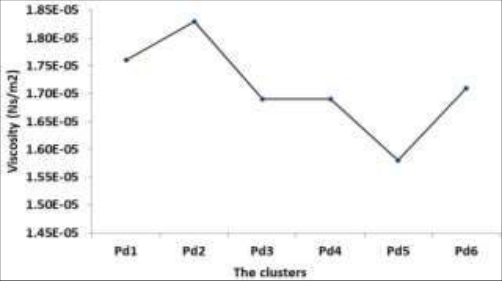 Figure 5
Introduction
Atomic or molecular clusters are those nanoparticles which are aggregates of identical or different atoms or molecules ranging from a few to many millions. They constitute a separate class of materials in between the bulk on one hand and the molecular state on the other. In nanoparticles the chemical, optical, electrical, physical, and magnetic properties can be significantly different from the respective bulk materials. For example, while bulk gold appears yellow in color, nanosized gold particles appear in red, or while bulk gold does not react with oxygen, gold clusters do. Thus, materials that are commonly chemically inert in bulk can become catalytically active [1,5] Palladium catalysts are being widely used to perform many important reactions, and their study has been increased in the last decades due to the current need to eliminate some contaminants coming from vehicle emissions [6] . Nano clusters such as clusters of transition metals of group 10 (Ni, Pd, Pt), offer unique physical and chemical behavior, with the possibility of fine-tuning size and structures [6,7] . The high surface area to volume ratio significant change values in the electronic structures which are important features of the clusters and also it makes ultrafine dispersed d-metal clusters attractive for catalytic applications [6,8] . Previous studies have pointed to the importance of palladium clusters during the adsorption of nitric oxide which transforms triple bonds to double bonds [9,10] . Palladium has better magnetic, ionization energy and binding energies than the other metals in its group (Ni, Pt, Pd) and at different temperature the palladium structures exhibited high stability in comparison with rest of the group [7] . Theoretical calculations can help in determining the equilibrium geometries of these clusters and can complement the experimental studies [8,9] . magnetic and the point group of the clusters [Ni, Pd, Pt] varies with the direction of the magnetization, which are even more pronounced for the 4d palladium metal [11] . Previous investigation showed that the most stable geometry of Pd4 is a regular tetrahedron with Td symmetry [11,12] . The aim of the present work is to model a system for palladium clusters and investigate some properties in particular, structural properties, binding energy, vertical; adiabatic ionization potential, collision diameter, volume and stretching frequency.
Computational Details
The calculations were carried out using Gaussian 09 package [13] . The B3PW91 exchange and correlation functional [14,15] were used with the SDD [16] valence basis set for all the calculations in this study Full geometry optimization with no symmetry restrictions were carried out in each case and stationary points were confirmed to be genuine minima by analytic calculation of their harmonic vibrational frequencies.
Results and discussion
The Justification of methodology employed in the present work was recognized by comparing the structural and electronic data of palladium clusters calculated at theoretical level with that obtained by experimental studies [17] , Figure 1. And Table 1,2. The results show that for palladium atom, singlet state is the lowest energy state with 0.83 eV lower in energy than the triplet state. This value is in excellent agreement with the experimental value of 0.82eV [18] and superior to the previous theoretical values [19, 20] . The lowest energy structure of palladium dimer (Pd2) is a triplet state ( 3 ∑u) is with a symmetric point group of Dh in agreement with other studies [17,19,20] . The singlet state ( 1 ∑g) is lies 0.41 eV higher in energy than the triplet state. The possible structures of the palladium dimer with different multiplicity are listed in Table 3. The bond length of this structure is found to be 2.497Å, which better than the previous theoretical results of 2.53Å and 2.559Å obtained from reference [19,20] since the experimental value is 2.48Å [12] . Finally, the dissociation energy, electron affinity and stretching frequency of Pd2 are in excellent agreement with the experimental values. symmetry with ground state of 3 B1, while the linear structure corresponds to a transition state. As for dimers, triplet states are located below the singlet states. The difference in energy with the singlet state is about 0.20 eV. Another two triplet are located with C2v and D3h symmetry which also above the minima by 0.01 and 0.08 eV respectively. These trends are also in good agreements with previous works [22,24] . It should be noted that a series of similar structures relatively close in energy corresponding to different electronic states have been identified but we do not go into details of these different electronic states Table 3. The triplet D3h state shifts to a distorted C2v geometry (64.9°for the apex angle) due to a Jahn-Teller effect. The electronic ground state is 3 B2, as confirmed previously [17] . This electronic asymmetry is reflected in structural parameters by introducing a bond length longer at the base (2.96Å) than the sides of isosceles triangle (2.51Å). The VIP of the trimer cluster is 7.67 eV which are comparable with the value of 7.56 eV reported previously [25] . Finally, the VEA of Pd3 cluster is calculated as 2.00 eV which identical with the value of 2.02 eV [26] . The lowest energy structure of Pd4 cluster is a triplet in Cs state. Above the ground state Cs there are two equal energy structures (0.75 eV) representing the 1 A ' and 1 A electronic states Table 3. The VIP of the Pd4 of 7.16 eV Figure 2, is comparable with the published value of 6.86 eV [25] . The HOMO-LUMO gap results predicted that the Pd4 is the most stable cluster, this fact has been demonstrated previously [25] . Pd4 possesses the highest value of bond dissociation energy (2.40 eV) in the clusters series of >Pd2 and also a high HOMO-LUMO gap of 1.78 eV. The global hardness and dipole of Pd4 are higher than the other clusters. Although binding energy values of Pd5, Pd6 are higher than that of Pd4, their AIP and VIP values are lower. The Pd4 cluster has higher HOMO-LUMO gap, bond dissociation energies, and global hardness. There is a linear relationship between HOMO-LUMO gap and the global hardness Figure 3. These values support Pd4 as a magic cluster, and enhanced stability are hallmarks of magic clusters. Therefore, we can accept Pd4 as the electronically most stable cluster or a magicnumber cluster among the clusters under study. The lowest energy structure of Pd5 cluster is a triplet 3 B2 in C2v symmetry with trigonal bipyramid structure. This triplet 3 B2 shifts to a distorted geometry ((65.48°) for the apex angle of the middle triangle) due to a Jahn-Teller effect and the original D3h is ruined [27] . This distortion is evident since the dipole moment has value of 0.048 D instead of zero. Identical triplet 3 A with equal energy and C1 symmetry is identified. Two identical energies singlet with C2v and D3h are located at 0.65 eV above the ground state ( 3 B2). The VEA of Pd5 is noted at 1.38 eV which in excellent agreement with the experimental value of 1.35±0.1 eV [9,11] . The binding energy is higher than those of lower clusters, and the Pd4 cluster showed lower dissociation energy in comparison with Pd3, Pd4 and Pd6. The Pd6 cluster showed only one stable structure as a triplet 3 B2g state in octahedral symmetry. The value of VEA (1.74 eV) of Pd6 is in agreement with experimental value of 1.65±0.1 eV. The Pd6 cluster showed high dissociation energy (1.98 eV) actually the second in the series after Pd4. The collision diameter of the palladium cluster is increase as the cluster size increases Figure 4, the collision diameter is defined as the distance between the centers of two colliding molecules when at their closest point of approach, the basic relationship between the mean free path and the average velocity is used to calculate the viscosity of the gaseous palladium clusters are given in Figure 5, Table 4. The viscosity of a gas can be thought of as a measure of its resistance to flow. Gas viscosity is only weakly dependent on pressure near atmospheric pressure. The volume of the palladium clusters is calculated using volume keyword in Gaussian package.
| Sys. | C.D. | I | M | V’ | Vis | Vol. |
|---|---|---|---|---|---|---|
| Pd1 | 4.28E-10 | 5.06E-08 | 0.1064 | 244.20 | 1.76E-05 | 2.37E-05 |
| Pd2 | 4.99E-10 | 3.72E-08 | 0.2118 | 172.68 | 1.83E-05 | 5.63E-05 |
| Pd3 | 5.74E-10 | 2.81E-08 | 0.3177 | 140.99 | 1.69E-05 | 7.7E-05 |
| Pd4 | 6.17E-10 | 2.44E-08 | 0.4236 | 122.10 | 1.69E-05 | 9.61E-05 |
| Pd5 | 6.76E-10 | 2.03E-08 | 0.5295 | 109.21 | 1.58E-05 | 8.6E-05 |
| Pd6 | 6.79E-10 | 2.01E-08 | 0.6354 | 99.69 | 1.71E-05 | 9.42E-05 |
Table text extracted from the original PDF; superscript letters are shown inline. The original table image is below.
View original table image
| PdN | State | Et | E | B.L | Freq. |
|---|---|---|---|---|---|
| Pd2 | |||||
| Singlet Dh | 1∑g | -255.8544 | 0.41 | 2.73979 | 133 |
| Triplet Dh | 3∑u | -255.8696 | 0.00 | 2.49787 | 210 |
| Quintet Dh | 5∑u | -255.7757 | 2.55 | 2.46599 | 202 |
| Pd3 | |||||
| Singlet D3h | 1A1' | -383.8398 | 0.20 | 2.480 | 157-260 |
| Triplet C2v | 3B1 | -383.8473 | 0.00 | 2.459-2.573 | 116-242 |
| Triplet Cs | 3A" | -383.8473 | 0.00 | 2.459-2.573 | 117-243 |
| Triplet C2v | 3B2 | -383.8471 | 0.01 | 2.510-2.964 | 122-210 |
| Triplet D3h | 3A2 | -383.8442 | 0.08 | 2.531-2.543 | 149-236 |
| Pd4 | |||||
| Singlet Cs | 1A ’ | -511.8324 | 0.75 | 2.544 | 78-245 |
| Singlet Td | 1A | -511.8324 | 0.75 | 2.545 | 77-246 |
| Triplet Cs | 3A ” | -511.8600 | 0.00 | 2.565-2.665 | 80-244 |
| Pd5 | |||||
| Triplet C2v | 3B2 | -639.8391 | 0.00 | 2.573-2.657 | 67-236 |
| Triplet C1 | 3A | -639.8391 | 0.00 | 2.573-2.657 | 67-236 |
| Singlet C2v | 1A1 | -639.8151 | 0.65 | 2.557-2.595-2.684 | 45-238 |
| Singlet D3h | 1A | -639.8151 | 0.65 | 2.608-2.630-2.646 | 32-237 |
| Pd6 | |||||
| Triplet Oh | 3B2g | -767.8297 | - | 2.595-2.698 | 77-223 |
Table text extracted from the original PDF; superscript letters are shown inline. The original table image is below.
View original table image
| sys | VIP | ADIP with | VIP | AIP | Exp. | BE | D.M |
|---|---|---|---|---|---|---|---|
| Pd1 | 8.62 | 8.62 | 8.6883 | 8.6883 | 8.3365±0.0001 8.3369±0.0001 | 0.00 | 0.00 |
| Pd2 | 7.91 | 7.86 | 7.6936 | 7.6280 | 7.7±0.3 | 0.46 | 0.00 |
| Pd3 | 7.67 | 7.66 | 7.5608 | 7.5734 | 0.84 | 0.00 | |
| Pd4 | 6.77 | 6.77 | 6.8580 | 6.8492 | 1.28 | 0.049 | |
| Pd5 | 7.28 | 7.25 | 6.6046 | 6.6006 | 1.35 | 0.048 | |
| Pd6 | 6.85 | 6.83 | 6.3268 | 6.3289 | 1.46 | 0.00 |
Table text extracted from the original PDF; superscript letters are shown inline. The original table image is below.
View original table image
International Journal of Advanced Chemistry Research
International Journal of Advanced Chemistry Research
Conclusion
The study investigated the properties included binding energy, chemical hardness, electronegativity, polarity, electron affinity and ionization potential of the palladium clusters. The study declares that Pd4 as the electronically most stable among the clusters under study. Chemical reactivity parameters such as EA, IP and electronegativity suggest that larger clusters have stronger tendency to accept electrons. The trend of reactivity parameters mimics the result of the change in energy upon the addition of atom and stability function. All the Palladium clusters are found to be magnetic. The calculation showed that the binding energies increase whereas the bond energies decrease with the cluster size. Chemical hardness is also seen to decrease with cluster size, which suggests that large clusters are more prone to changes in their electronic structure. The results suggest that global hardness is the highest of Pd4 and directly proportional to H-L gap (eV). Magnetic energy differences have been found to be small, such that there is an appreciable probability of finding excited magnetic isomers even at ambient temperatures. Chemical parameters such as EA, EN suggest that larger clusters have stronger tendency to accept electrons. The binding energy and dissociation energy increase with the cluster size, while the dissociation energy decreases for Pd5, possibly due to the geometrical shape and the Jahn-Teller effects.
Figures and tables from the paper
| Sys | VEA | ADEA | Exp. | Global hardness | D0 | H-L g |
|---|---|---|---|---|---|---|
| Pd1 | 0.70 | 0.70 | 0.5620±0.0050 0.5570±0.0080 | 3.96 | - | 2.66 |
| Pd2 | 1.54 | 1.53 | 1.6850±0.0080 1.30±0.15 | 3.19 | 0.93 | 2.12 |
| Pd3 | 2.00 | 2.06 | 1.35±0.10 1.50±0.10 | 2.84 | 1.79 | 1.67 |
| Pd4 | 1.38 | 1.41 | 1.35±0.10 | 3.18 | 2.43 | 1.78 |
| Pd5 | 1.58 | 1.57 | 1.45±0.10 | 2.85 | 1.66 | 1.75 |
| Pd6 | 1.74 | 1.73 | 1.65±0.10 | 2.56 | 1.98 | 1.56 |
Table text extracted from the original PDF; superscript letters are shown inline. The original table image is below.
View original table image
References
20 in the original paper- Haberland H. Clusters of atoms and molecules: theory, experiment, and clusters of atoms, 1st Ed. Springer Science & Business Media. H, 2013, 52.
- Schmid G. Nanoparticles: from theory to application, 1st Ed. John Wiley & Sons, 2011.
- Manikandan K, Santhanam A, Venkatesan R, J Chem. Pharm. Res. 2018; 10(3):85-96.
- Hamouda RA, Yousuf WE, Abdeen EE, Mohamed A. J Chem. Pharm. Res. 2019; 11(7):1-12.
- Bulumoni K, Deka RC. Bull. Catal. Soc. India. 2006; 5(3):110-120.
- Lacaze-Dufaure C, Roques J, Mijoule C, Sicilia E, Russo N, Alexiev V, Mineva TJ. Mol. Catal, 2011, 341:28-34.
- Bertin V, Angel G, Mora MA, Poulain E. J Mex. Chem. Soc. 2008; 52(1):93-98.
- Blonski P, Hafner J. J Phys. Condense. Matter. 2011; 23(13)136001.
- Boyukata M, Belchior JC. Croatica Chemica Acta. 2008; 81:289-297.
- Frisch MJ, et al., Gaussian 09, Revision D.01.Gaussian, Inc., Wallingford CT, 2013.
- Perdew JP, Chevary JA, Vosko SH, Jackson KA, Pederson MR, Singh DJ, et al. Phys. Rev. B. 1992; 46:6671-6687.
- Dolg M, Wedig U, Stoll H, Preuss H. J Chem. Phys. 1987; 86:866-872.
- R, Benco L, Bučko T, Hafne J. J Chem. Phys. 2009; 130:104503.
- Valerio G, Toulhoat H. J Phys. Chem, 1996, 100:10827. 20. Seminario JM, Zacarias AG, Castro M. J Quantum Chem, 1997; 61:515.
- Gadjos M, Hafner J, Eichler A. J Phys. Condense. Matte, 2005; 18:41.
- Moseler M, Hakkinen H, Barnett RN, Landman U. Phys. Rev. Lett. 2001; 86:2545-2548.
- Zacarias G, Castro M, Tour M, Seminario M. J Phys. Chem. 1999; 103:7692-7700.
- Nava P, Sierka M, Ahlrichs R. Phys. Chem. Chem. Phys. 2003; 5:3372-3381.
- Giannakakis G, Flytzani-Stephanopoulos M, Sykes EC. Chem. Res. 2019; 52(1):237-247.
- Ma L, Wang J, Wang G. Eur. Phys. J D. 2013; 67:6-14.