
Research article · 2021 · Full text
International Journal of Advanced Chemistry ResearchTitanium/chitosan composites as photocatalysts in textile dyes removal
Volume 3(1) · Pages 11–15 · DOI: 10.33545/26646781.2021.v3.i1a.29 ↗
Research areasAdvanced Nanomaterials in Catalysis
Abstract
Author-writtenRecently, TiO2/CS composites have attracted the attention of many scientific researchers because of their interesting technological properties and applications. This review describes some typically reported composites of TiO2/CS and modified TiO2/CS which exhibited high photocatalytic activity for removal of textile dyes in the wastewater treatment.
Summary
Source-checkedPlain-language reading of the full paper, prepared with AI and checked against the text. Each point links to the authors' own words.
Why it matters
- Textile wastewater is a significant source of water pollution due to the presence of dyes and pigments. View evidence ↗
- Many textile dyes are toxic organic compounds that resist biodegradation and can cause serious health issues in humans, including cancer. View evidence ↗
- Titanium dioxide (TiO2) is a preferred photocatalyst for environmental remediation because it is cost-effective, non-toxic, chemically stable, and highly active. View evidence ↗
- Chitosan (CS) is a biodegradable and biocompatible natural biopolymer composed of d-glucosamine and N-acetyl-d-glucosamine. View evidence ↗
The question
- The objective of this review is to summarize recent research on TiO2/CS and modified TiO2/CS composites used as photocatalysts for treating textile wastewater. View evidence ↗
What they did
- In these composites, chitosan serves as a solid substrate to retain TiO2, which improves the overall physical, mechanical, and biological properties of the material. View evidence ↗
What they found
- Among various weight ratios, the TiO2/CS (75:25) nanocomposite demonstrated the highest degradation efficiency against methyl orange (MO) dye. View evidence ↗
- Methylene Blue (MB) photodegradation using TiO2/CS reached up to 91%, with efficiency increasing as the chitosan content increased. View evidence ↗
- TiO2/CS composites have been shown to achieve complete degradation of methyl orange (MO) within 90 minutes of UV exposure. View evidence ↗
- Increasing the calcination temperature reduces the photocatalytic activity of TiO2/CS due to the thermal degradation of the chitosan. View evidence ↗
- A modified composite achieved 99.1% decolorization of MO under real solar light after 300 minutes, maintaining 89% of its initial rate after five cycles. View evidence ↗
- Using 0.5 g/L of a TiO2/ZnO/CS nanocomposite thin film resulted in over 97% decolorization of MO solution under simulated solar irradiation. View evidence ↗
- A TiO2/CS/rGO composite with 1.0 wt% rGO achieved 97% MO degradation; however, rGO levels above 1.0 wt% decreased activity by reducing the surface area. View evidence ↗
- A chitosan-vanadium-titanium-magnetite (CS-VTM-0.5) composite achieved a 99.1% removal efficiency for Congo red dyes when the dose exceeded 2.0 g/L. View evidence ↗
What it means
- The authors conclude that combining TiO2 with a chitosan matrix effectively enhances the physical, mechanical, biological, and photocatalytic properties of both materials. View evidence ↗
- TiO2/CS and its modified versions are recommended as potential materials for industrial wastewater treatment and biomedical environmental remediation. View evidence ↗
- The authors state that further research is needed to standardize preparation methods to optimize photocatalytic ability, economic efficiency, and reuse longevity. View evidence ↗
Visual summary
1 visualsIllustrations explain the paper; they do not show study data.
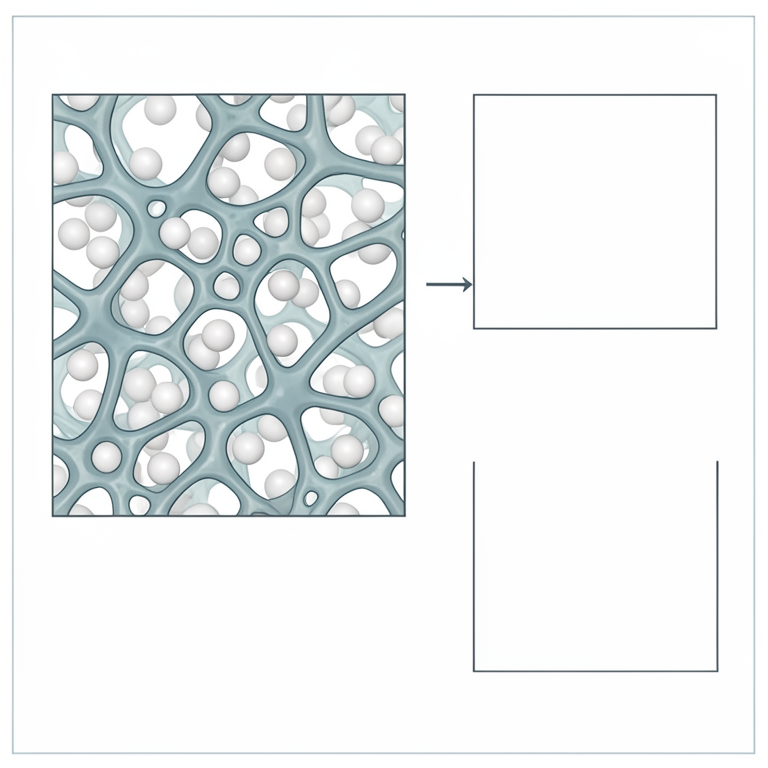
Composite Structure Concept
AI-generated conceptual illustration (titanium dioxide nanoparticles embedded in a chitosan biopolymer matrix). It explains the idea and does not show study data.
View source evidence ↗Figures & tables
From the original paper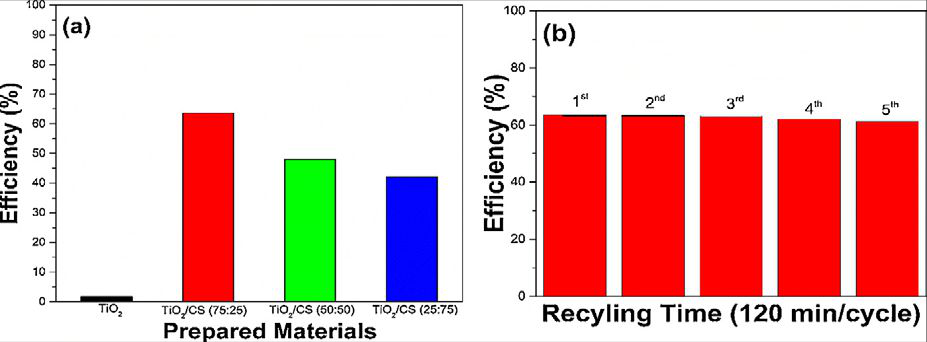 Figure 1
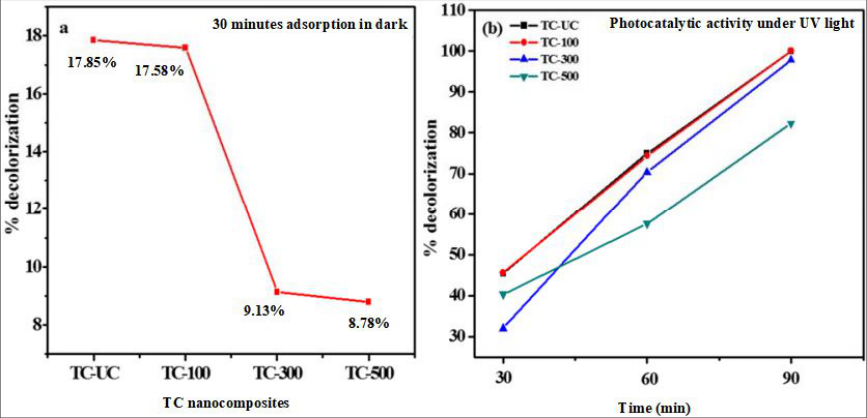 Figure 2
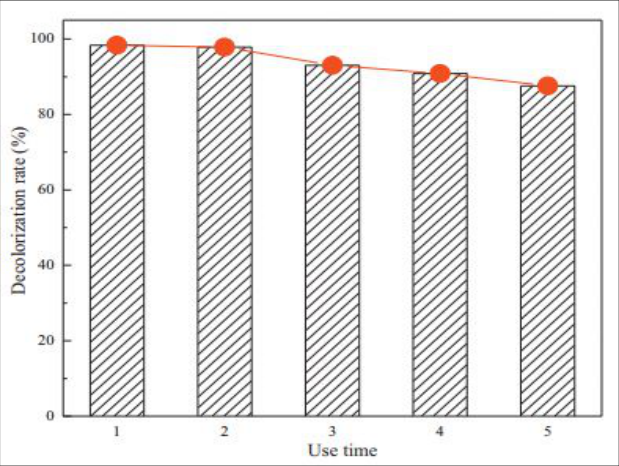 Figure 3
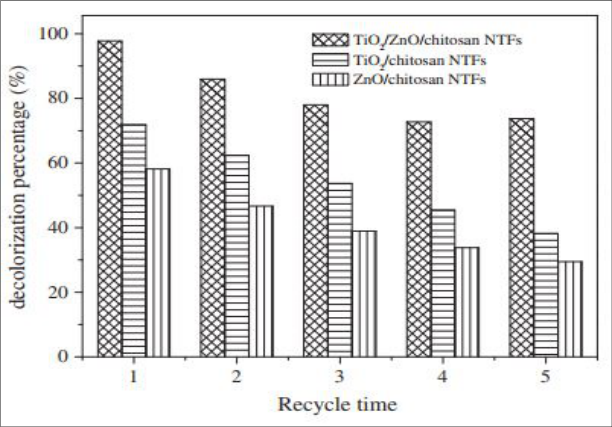 Figure 4
Introduction
Textile wastewater contains dyes and pigments that are the main cause of pollution water contamination in many previous kinds of research. Most dyes and pigments are organic toxic compounds with rather poor biodegradability [1] . Some of them partially decompose after entering the environment. These toxic substances may cause health effects in humans who are exposed over long periods [2,4] . Dangerous disease must be mentioned as cancer [5] . Therefore, the removal of dyes and pigments from textile wastewater is a critical issue and pays much more attention to researchers on the remediation of these pollutants. Several methods have been used to remove dyes and pigments out of the water environment such as the physico chemical method, biomethod, and chemical method [6,8] . Among them, the photo catalyst method is widely used and becomes potential; especially the semiconductor Titanium dioxide (TiO 2 ) [9,12] . Titanium dioxide (TiO 2 ) has been widely applied as a photo catalyst in many environmental and energy applications because of its efficient photo activity, high chemical stability, low cost, and non-toxic to the environment and humans. The semiconductor TiO 2 decomposes effectively organic contaminants, purifying water, cleaning the air, water splitting for hydrogen production, surface self-cleaning, antibacterial, and strong oxidation ability. After irradiation by UV light, the electron is excited from the valence band (VB) to the conduction band (CB). Electronic transition causes the formation of a pair in particles, consisting of the hole (h vb + ) and electron (e cb -). The reaction of these photo generated holes species with water at the particle's surface leads to produce activated hydroxyl radicals (HO • ) and directly oxidate dyes into their oxidation products [13] . Currently, the small size of TiO 2 in the mixture of rutile, anatase, or mixture of anatase, rutile, brookite was studied and applied in many scientific fields such as solar cells, fabrication photochemical agent to synthesize organic compounds, self-cleaning paint, production of electronic devices and sensor in sterilization field. A new application of nano TiO 2 is mainly based on its redox stability. Because of high catalyst activity and non-toxic properties, TiO 2 material is one of the best materials to tackle many serious problems as well as challenges from environmental pollution. However, TiO 2 semiconductor remains some limitations. Due to its small size, TiO 2 is difficult to hold back in the material. Thus, it needs a substrate to retain TiO 2 in the material for long use. Additionally, rapid recombination of electrons and holes leads to a decrease in the efficiency of the photo catalytic [14] . On the other hand, chitosan (CS) is a natural biopolymer (linear polysaccharide composed of β-(1-4)linked d-glucosamine (deacetylated unit) and N-acetyl-d-glucosamine (acetylated unit), that has biodegradable and biocompatible properties [15] . Commercially, chitosan is produced by deacetylation of chitin, which is the structural element in the exoskeleton of crustaceans (such as crabs, and shrimp). Chitosan possesses interesting properties including the ability to form film for food and pharmaceutical applications such as packaging material, or drugeluting carrier [15,17] . Additionally, chitosan can also be used as an absorption material due to its absorptive capacity to remove heavy metal and polluted organic compounds as dyes and pigments [18] . It is compatible with several organic and inorganic compounds because of the presence of amino and hydroxyl functional groups in its molecular structure. In the combination with TiO 2 , CS acts as a solid substrate to keep TiO 2 inside the material; therefore, it can enhance the mechanical, physical, and biological properties of this polymer [16,19] , giving them a great potential for food, pharmaceutical or biomedical, and environmental applications. This paper summarizes some recent works of chitosan/TiO 2 composites and modified chitosan/TiO 2 composites as photo catalysts for textile waste-water treatment. TiO2/Chitosan composite, modified TiO2/chitosan composites and their photo catalytic activity TiO2/Chitosan composites TiO 2 is a semiconductor and normally exists in 3 basic forms: Rutile, anatase, and brookite. The most common forms are anatase and rutile. The bandgap energy of rutile is 3.02 eV while that of anatase is 3.23 eV. The density of rutile is 4.2 g/cm 3 while the density of anatase is 3.9 g/cm [3] . Anatase can be converted to rutile by heating up to 700 o C. [20] International Journal of Advanced Chemistry Research TiO 2 /chitosan has an excellent photo catalytic degradation Efficiency against methyl orange (MO) dye due to its good crystallinity and lowering band gap [21] . In this work, the different weight ratios of TiO 2 and CS (72:25, 50:50, 25:75) nano composites were prepared and checked for these photo catalytic activities. The results indicated that nano composites TiO 2 /CS (75:25) material showing greater degradability efficiency against MO dye. Moreover, the recycling outcome of TiO 2 /CS (75:25) displayed a strong and stable performance (Figure 1). + [22] . Two different weight ratios of TiO 2 /CS composite materials were synthesized and the material photo degradation properties were evaluated. MB photo degradation on both TiO 2 /CS was relatively high (91% and 41% for 2 types of TiO 2 /CS), and increased with chitosan content. For BP, it is highlighted that the process in the darkness resulted in high photo degradability capacity than in the UV-light presence.
In the research of Saba Afzal et al. 23 TiO 2 /CS exhibited a complete degradation of MO within 90 min of UV exposure. The effect of calcination on the physicochemical and adsorptionphoto decolorization properties of TiO 2 /CS was investigated. The photo catalytic activity decreased when the calcination temperature increased, because of the thermal degradation of CS (Figure 2). Adsorption-photo decolorization studies of prepared TiO2/CS. Reproduced from Saba Afzal et al [23] .
In the study of Qiang Li et al. [24] the degradation of MO can be achieved to 90% by TiO 2 /CS composite. This result is a consequence of the effects of both CS and TiO 2 .
Modified TiO2/Chitosan composites
Zhu et al. mentioned that CdS nanocrystals deposited on TiO 2 /CS composite could decolorize MO solution up to 99.1% after real solar light irradiated for 300 min. The composite could be used repeatedly and the decolorization rate still maintains at 89% of the initial decolorization rate after 5 batch reactions (Figure 3) [25] .
Fig 3:
Cycling runs of MO decolorization in the presence of CdS/TiO2/CS. Reproduced from Huayue Zhu et al [25] .
Huayue et al. [26] also reported the TiO 2 /ZnO/CS nanocomposite thin films with high photo catalytic activity under simulated solar irradiation. Over 97% of MO solution was decolorized with 0.5 g L -1 of the photo catalyst. The authors illustrated that the introduction of ZnO and TiO 2 in nanocomposite photo catalyst is beneficial in improving the charge separation and the response to visible light. Recycling were carried out to check photo catalytic stability. The decolorization (%) of MO in the presence of TiO 2 /ZnO/CS is much higher than those in the presence of TiO 2 /CS, ZnO/CS (Figure 4). Meanwhile, it is reported that a novel composite TiO 2 /CS/reduced graphene oxide (rGO) with 1.0 wt% of rGO exhibited an excellent photo catalytic degradation of MO (97%) [27] . The results in this research also showed that if the rGO contents above 1.0 wt% lead to the decrease of the photo catalytic activity due to reduction of surface area. A novel thioureamodified ion-imprinted TiO 2 /CS composite was fabricated for the removal of cadmium and 2, 4-dichlorophenol [28] . The degradation efficiency for 2, 4-DCP was reached 98%. The author proposed that the major decomposition route of 2, 4-DCP is related to the reductive dechlorination and reaction with hydroxyl radicals. Recently, Wei Zhang et al [29] . Reported novel chitosan (CS) -vanadium-titanium-magnetite (VTM) composite as a superior adsorbent for Congo red dyes treatment. The optimal adsorption performance was achieved for CS-VTM-0.5 composite (a mass ratio of 0.5 between CS and VTM). The adsorption process was described by the Langmuir isotherm model, and the maximum adsorption capacity was 90.9 mg/g. The removal efficiency was 99.1% when the dose of CS-VTM-0.5 was greater than 2.0 g/L. Novel CS-VTM could be a promising and environmentally friendly adsorbent for the highly efficient and effective removal of organic dyes.
Previous scientific researches demonstrated that composites of TiO 2 /CS and modified composite of TiO 2 /CS become attractive materials with high photo catalytic performance, low-cost, reusable, and environmentally friendly for removal of inorganic dyes.
Conclusion
Evidence shows that the combination of TiO 2 and Chitosan matrix is an efficient method to enhance the mechanical, physical, photo catalytic, and biological properties of both compounds. TiO 2 /CS and modified TiO 2 /CS have become an active research area for biomedical environment remediation applications and; therefore, they are potential for wastewater treatment in the textile industry as well as for industrial applications. However, the researcher needs to pay more attention to the preparation method to standardize, further develop and modify TiO 2 /CS composite to achieve high photo catalytic ability, long reuse time, and economic efficiency.
References
29 in the original paper- Porter JJ, Snider EH. Biodegradability Textile Chemicals, 2013:48(9):2198-2210.
- Esancy JF, Freeman HS, Claxton LD. The Effect of Alkoxy Substituents on the Mutagenicity of Some Aminoazobenzene Dyes and Their Reductive-Cleavage Products. Mutat. Res. Genet. Toxicol,1990:238(1):1-22. https://doi.org/10.1016/0165-1110(90)90036-B.
- Akarslan F, Demiralay H. Effects of Textile Materials Harmful to Human Health. Acta Phys. Pol. A,2015:128(2):407-408. https://doi.org/10.12693/APhysPolA.128.B-407.
- Busk L, Ahlborg UG. Retinoids as Inhibitors of OrthoAminoazotoluene-Induced Mutagenesis in the Salmonella/Liver Microsome Test. Mutat. Res. Lett, 1982:104(4-5):225-231. https://doi.org/10.1016/01657992(82)90148-8.
- Zdislaw M, Bolt H, Brockmann W. Tumors of the Urinary Bladder in Painters : Am. J. Ind. Med,1991:19:705-713.
- Lin SH, Chen ML. Treatment of Textile Wastewater ByChemical Methods for Reuse. Water Res,1997:31(4):868876. https://doi.org/10.1016/S0043-1354(96)00318-1.
- Bhatia D, Sharma NR, Singh J, Kanwar RS. Biological Methods for Textile Dye Removal from Wastewater: A Review. Crit. Rev. Environ. Sci. Technol,2017:47(19):18361876. https://doi.org/10.1080/10643389.2017.1393263.
- Donkadokula NY, Kola AK, Naz I, Saroj D. A Review on Advanced Physico-Chemical and Biological Textile Dye Wastewater Treatment Techniques. Rev. Environ. Sci. Biotechnol,2020:19(3):543-560. https://doi.org/10.1007/s11157-020-09543-z.
- Lazar MA, Varghese S, Nair SS. Photocatalytic Water Treatment by Titanium Dioxide: Recent Updates 2012, 2. https://doi.org/10.3390/catal2040572.
- Han F, Kambala VSR, Srinivasan M, Rajarathnam D, Naidu R. Tailored Titanium Dioxide Photo catalysts for the Degradation of Organic Dyes in Wastewater Treatment: A Review. Appl. Catal. A Gen, 2009:359(1-2):25-40. https://doi.org/10.1016/j.apcata.2009.02.043.
- Davis RJ, Gainer JL, O'Neal G, Wu I-W. Photo catalytic Decolorization of Wastewater Dyes. Water Environ. Res,1994:66(1):50-53. https://doi.org/10.2175/wer.66.1.8.
- Jain R, Shrivastava M. Photo catalytic Removal of Hazardous Dye Cyanosine from Industrial Waste Using Titanium Dioxide. J. Hazard. Mater,2008:152(1):216-220. https://doi. org/10.1016/j.jhazmat,2007:06:119.
- Matsunaga T, Tomoda R, Nakajima T, Wake H. Photo electrochemical Sterilization of Microbial Cells by Semiconductor Powders (Sterilization; Semiconductor; Saccharomyces Cereoisiae; Coenzyme A). FEMS Microbiol. Lett,1985:29:211-214.
- Akpan UG, Hameed BH. Parameters Affecting the Photo catalytic Degradation of Dyes Using TiO2-Based Photo catalysts: A Review. J. Hazard. Mater,2009:170(2-3):520529. https://doi.org/10.1016/j.jhazmat.2009.05.039.
- Dedloff MR, Effler CS, Holban AM, Gestal MC. Use of Biopolymers in Mucosally-Administered Vaccinations for Respiratory Disease. Materials (Basel),2019:12(15):1-12. https://doi.org/10.3390/ma12152445.
- Kaewklin, P.; Siripatrawan, U.; Suwanagul, A.; Lee, Y. S. Active Packaging from Chitosan-Titanium Dioxide Nanocomposite Film for Prolonging Storage Life of Tomato Fruit. Int. J. Biol. Macromol. 2018, 112, 523-529. https://doi.org/10.1016/j.ijbiomac.2018.01.124.
- Xiao G, Zhang X, Zhang W, Zhang S, Su H, Tan T. VisibleLight-Mediated Synergistic Photocatalytic Antimicrobial Effects and Mechanism of Ag-Nanoparticles@chitosanTiO2 Organic-Inorganic Composites for Water Disinfection. Appl. Catal. B Environ,2015:170-171:255-262. https://doi. org/10.1016/j.apcatb.2015.01.042.
- Pal P, Pal A. Dye Removal Using Waste Beads: Efficient Utilization of Surface-Modified Chitosan Beads Generated after Lead Adsorption Process. J. Water Process Eng, 2019. https://doi.org/10.1016/j.jwpe.2019.100882.
- El-Wakil NA, Hassan EA, Abou-Zeid RE, Dufresne A. Development of Wheat Gluten/Nanocellulose/Titanium Dioxide Nanocomposites for Active Food Packaging. Carbohydr. Polym, 2015:124:337-346. https://doi.org/10. 1016/j.carbpol.2015.01.076.
- Bickley RI, Gonzalez-Carreno T, Lees JS, Palmisano L, Tilley RJD. A Structural Investigation of Titanium Dioxide Photo catalysts. J. Solid State Chem,1991:92(1):178-190. https://doi.org/10.1016/0022-4596(91)90255-G.
- Saravanan R, Aviles J, Gracia F, Mosquera E, Gupta VK. Crystallinity and Lowering Band Gap Induced Visible Light Photo catalytic Activity of TiO2/CS (Chitosan) Nanocomposites. Int. J. Biol. Macromol, 2018:109:12391245. https://doi.org/10.1016/j.ijbiomac.2017.11.125.
- Zubieta CE, Messina PV, Luengo C, Dennehy M, Pieroni O, Schulz PC. Reactive Dyes Remotion by Porous TiO2Chitosan Materials. J. Hazard. Mater,2008:152(2):765-777. https://doi.org/10.1016/j.jhazmat.2007.07.043.
- Afzal S, Samsudin EM, Mun LK, Julkapli NM, Hamid SB. A. Room Temperature Synthesis of TiO2 Supported Chitosan Photocatalyst: Study on Physicochemical and Adsorption Photo-Decolorization Properties. Mater. Res. Bull, 2017:86:24-29. https://doi.org/10.1016/j.materresbull. 2016.09.028.
- Li Q, Su H, Tan T. Synthesis of Ion-Imprinted ChitosanTiO2 Adsorbent and Its Multi-Functional Performances. Biochem. Eng. J,2008:38(2):212-218. https://doi.org/10. 1016/j.bej.2007.07.007.
- Zhu H, Jiang R, Xiao L, Liu L, Cao C, Zeng G. CdS Nanocrystals/TiO 2 /Crosslinked Chitosan Composite: Facile Preparation, Characterization and AdsorptionPhotocatalytic Properties. Appl. Surf. Sci,2013:273:661669. https://doi.org/10.1016/j.apsusc.2013.02.106.
- Zhu H, Jiang R, Fu Y, Guan Y, Yao J, Xiao L et al. Effective Photocatalytic Decolorization of Methyl Orange Utilizing TiO 2/ZnO/Chitosan Nanocomposite Films under Simulated Solar Irradiation. Desalination,2012:286:41-48. https://doi. org/10.1016/j.desal.2011.10.036.
- Chen C, Zhang Y, Zeng J, Zhang F, Zhou K, Bowen CR et al. Aligned Macroporous TiO 2 /Chitosan/Reduced Graphene Oxide (RGO) Composites for Photocatalytic Applications. Appl. Surf. Sci,2017:424:170-176. https:// doi.org/10.1016/j.apsusc.2017.02.137.
- Chen A, Zeng G, Chen G, Hu X, Yan M, Guan S et al. Novel Thiourea-Modified Magnetic Ion-Imprinted Chitosan/TiO 2 Composite for Simultaneous Removal of Cadmium and 2,4Dichlorophenol. Chem. Eng. J,2012:191:85-94. https:// doi.org/10.1016/j.cej.2012.02.071.
- Zhang W, Lan Y, Ma M, Chai S, Zuo Q, Kim KH et al. A Novel Chitosan-Vanadium-Titanium-Magnetite Composite as a Superior Adsorbent for Organic Dyes in Wastewater. Environ. Int, 2020. 105798. https://doi.org/10.1016/j.envint. 2020.105798.