
Research article · 2022 · Full text
International Journal of Advanced Chemistry ResearchConstraints faced by BT cotton growers in adoption of drip irrigation system and its management practices in Parbhani district of Maharashtra
Volume 4(1) · Pages 95–97 · DOI: 10.33545/26646781.2022.v4.i1a.128 ↗
Research areasAgricultural Economics and Practices
Abstract
Author-writtenThe present study was conducted in Parbhani District of Marathwada region of Maharashtra to find out the various constraints faced by BT cotton growers in adoption of drip irrigation system and its management practices and also seeking suggestions given by BT cotton growers to overcome the constraints. A total number of 120 respondents were selected through purposive sampling from three blocks namely Sailu, Pathri and Jintur. Descriptive research design was followed for the study. Result of the study shows that the constraints faced by Bt cotton growers in adoption of drip irrigation system were lack of funds and financial resources (91.60 percent), lack of knowledge about drip irrigation (82.5 percent) and non- availability of inputs in time (75 percent) followed by problem of small land holding and fragmented land holding (69.16 percent), low literacy rate (61.67 percent), lack of technical guidance (58.34 percent) and lack of access to weather forecasting technology were also reported by considerable number of respondents. While, problem of high initial cost of drip unit, non-availability of subsidies in proper time, inadequate supply of electricity and problem of incomplete knowledge about drip irrigation were considered as minor constraints by the respondents. Suggestions given by majority of the respondents that cost of drip irrigation should be less; there should be regular visit of dealers or suppliers for supervision and evaluation of drip irrigation system, regular guidance and after sale service for maintenance from dealers.
Summary
Source-checkedPlain-language reading of the full paper, prepared with AI and checked against the text. Each point links to the authors' own words.
Why it matters
- Cotton is a critical cash crop and fiber source that significantly impacts India's agricultural and industrial economies. View evidence ↗
- BT cotton was developed as a biotechnological solution to reduce yield losses from bollworms and decrease the environmental pollution and costs associated with insecticides. View evidence ↗
- Drip irrigation is a micro-irrigation method used to conserve water and increase crop productivity. View evidence ↗
The question
- The study aimed to identify the constraints BT cotton growers in the Parbhani District of Maharashtra face when adopting drip irrigation and to collect their suggestions for overcoming these barriers. View evidence ↗
What they did
- The researchers employed a descriptive research design to characterize the phenomena being studied. View evidence ↗
- A sample of 120 farmers was selected via purposive sampling from ten respondents in each of twelve villages across the Sailu, Jintur, and Pathri talukas. View evidence ↗
- Primary data was gathered using a structured personal interview schedule. View evidence ↗
- Data analysis was performed using frequency distribution, percentage analysis, and rank scoring. View evidence ↗
What they found
- The most significant constraint reported by 91.60% of respondents was a lack of funds and financial resources. View evidence ↗
- Other major constraints included a lack of knowledge about drip irrigation (82.5%), non-availability of inputs in time (75%), and a lack of training (70.83%). View evidence ↗
- Considerable numbers of farmers reported issues with small or fragmented land holdings (69.16%), low literacy rates (61.67%), lack of technical guidance (58.34%), and limited access to weather forecasting (52.50%). View evidence ↗
- Minor constraints included high initial costs (50%), untimely subsidies (46.67%), inadequate electricity supply (41.66%), and incomplete knowledge (37.5%). View evidence ↗
- Respondents suggested reducing the cost of drip irrigation (72.50%), increasing regular dealer visits for supervision (70.00%), and improving after-sale maintenance services (66.67%). View evidence ↗
- Additional suggestions included guidance from experts (65.83%), local availability of affordable spare parts (63.33%), and skill-improving training (62.50%). View evidence ↗
What it means
- The authors conclude that BT cotton growers face a variety of social, technical, and personal constraints that hinder the adoption of drip irrigation. View evidence ↗
Visual summary
3 visualsIllustrations explain the paper; charts are replotted from the paper's own table values.
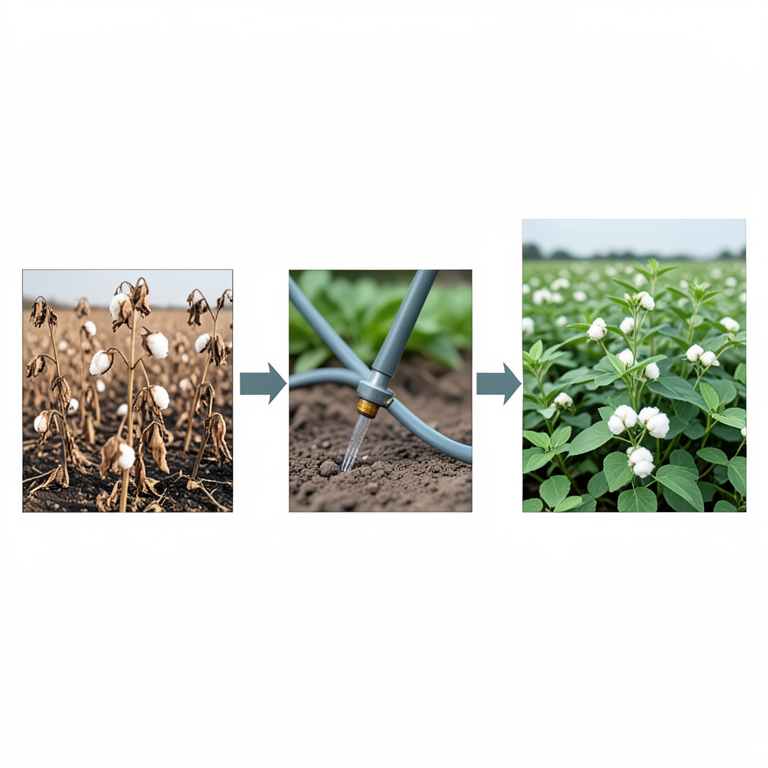
Hierarchy of Constraints
AI-generated conceptual illustration (BT cotton plants in a field with a drip irrigation system). It explains the idea and does not show study data.
View source evidence ↗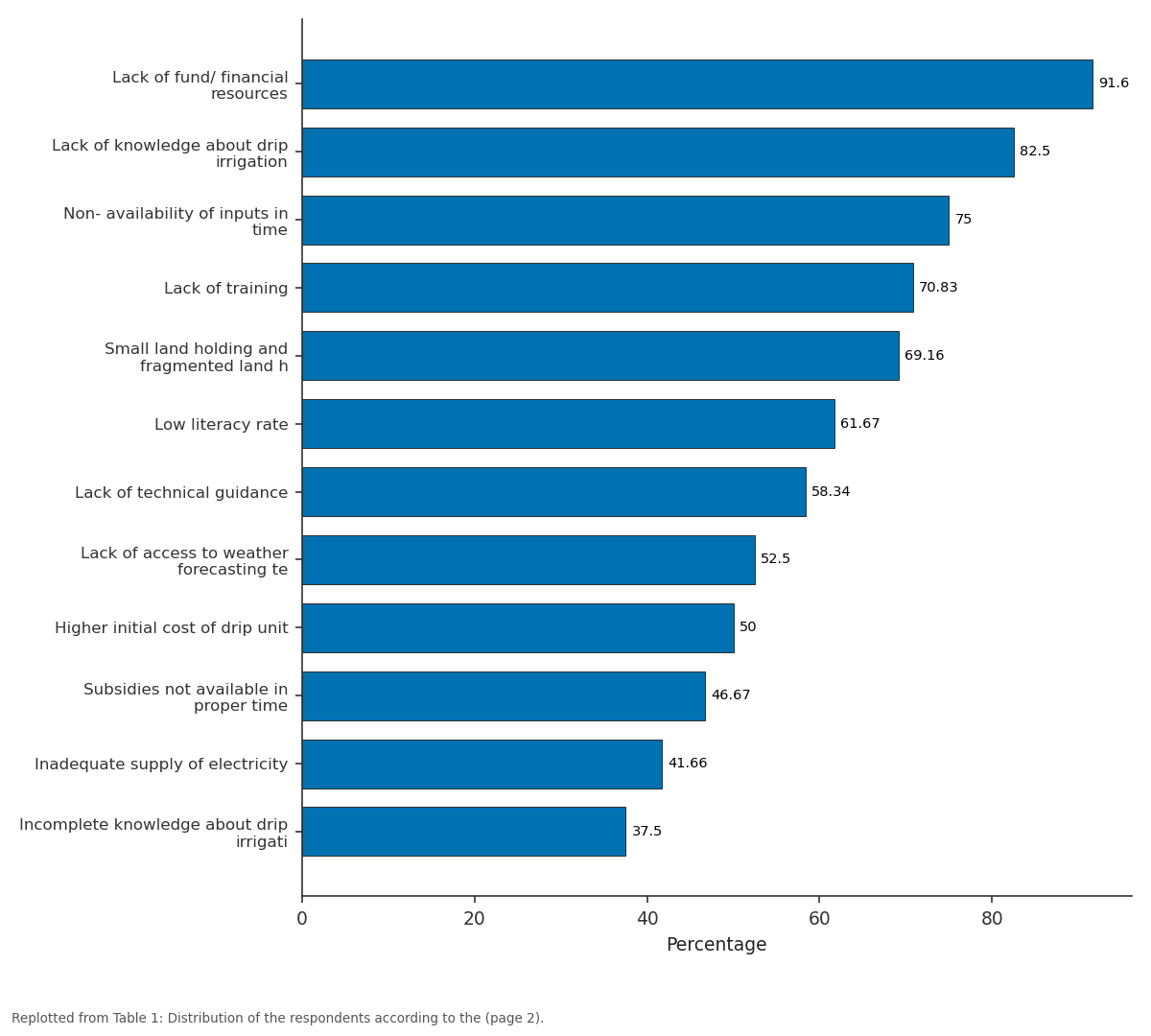
Percentage: Lack of fund/ financial... vs Lack of knowledge about... vs Non- availability of... vs Lack of training vs Small land holding and...
Replotted from Table 1 (page 2) of the original paper. Every bar is the paper's own table value.
View source evidence ↗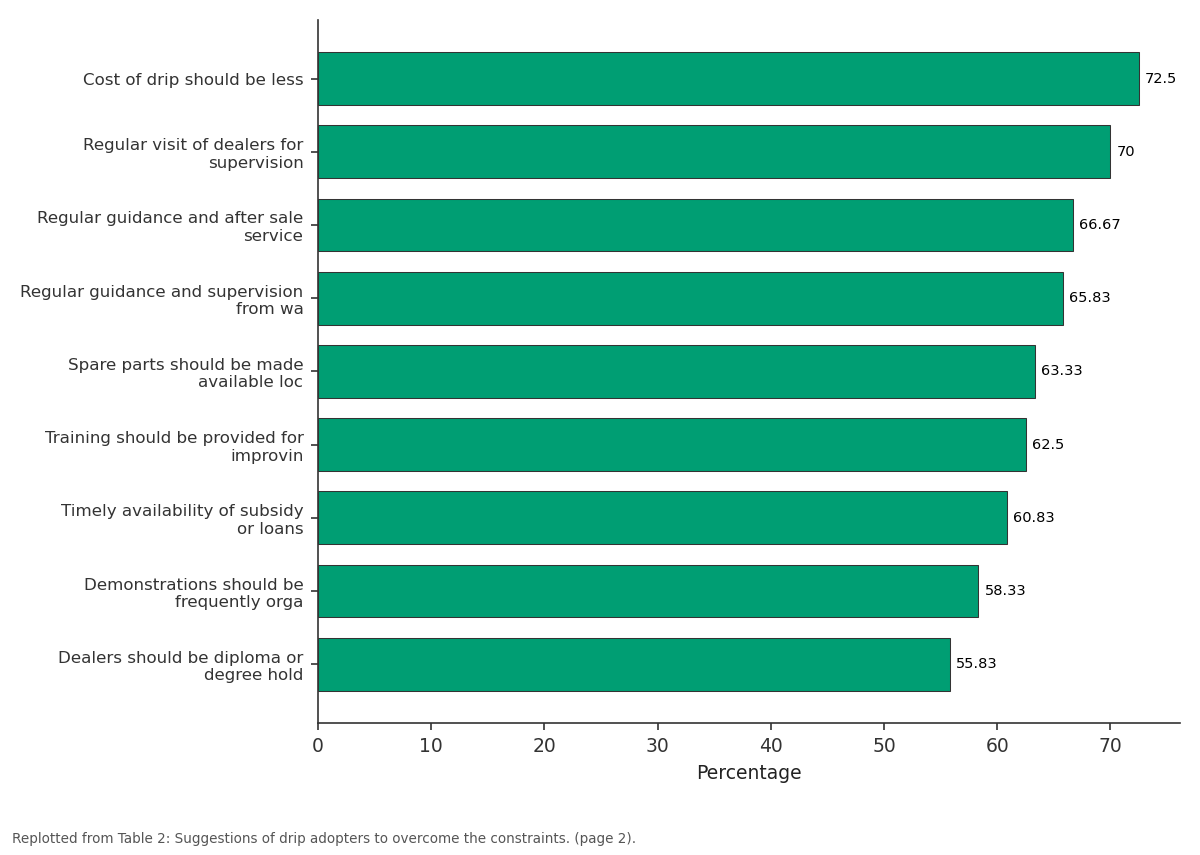
Percentage: Cost of drip should be... vs Regular visit of... vs Regular guidance and... vs Regular guidance and... vs Spare parts should be...
Replotted from Table 2 (page 2) of the original paper. Every bar is the paper's own table value.
View source evidence ↗Figures & tables
From the original paper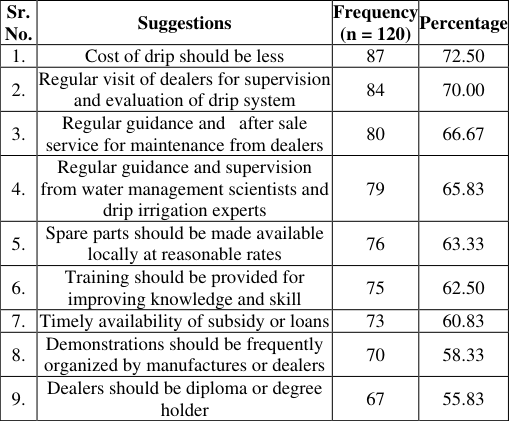 Table 2
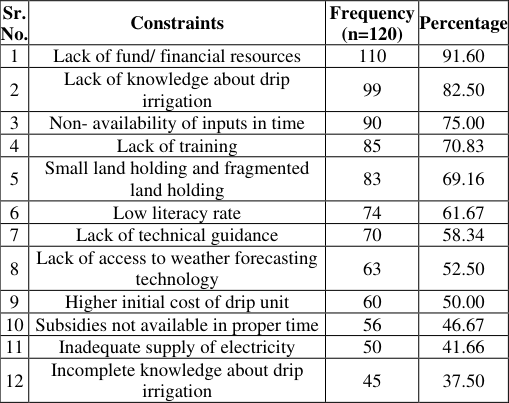 Table 1
Introduction
Cotton is one of the most important fibber and a cash crop of India and plays a dominant role in the industrial and agricultural economy of the country. Cotton is cultivated in about 60 countries of the world. Amongst, India occupies largest area (9.3 m. ha.) under cotton. The economic loss in cotton through pests is serious concern. The bollworm complex causes significant yield losses, further the harmful effects of the insecticides lead to environmental pollution and more specifically increases the cost of cultivation. In this context application of biotechnology was seen as a solution and thus, the efforts were taken that resulted in developing BT cotton (Rajput and Chinchmalatpure, 2016) [7] . BT cotton genetically engineered with BT (Bacillus thuringensis), a biotoxin which comes from soil bacterium. BT which isolated from soil in 1911, has been available to farmers as an organic pesticide since 1930 (Ashok, 2006) [1] . BT cotton offers protection from bollworms right from early days of crop, leading to a healthy crop, better boll retention, greater harvest and more profit. The area under BT cotton is constantly increasing in all the states of the country since its induction. The major states growing BT cotton in 2006, in order of hectarage, were Maharashtra (1.840 million ha representing 48 percent of all BT cotton in India in 2006) followed by Andhra Pradesh (830,000 ha or 22 percent), Gujarat (470,000 ha or 12 percent), Madhya Pradesh (310,000 ha or 8 percent) and 215,000 ha (6 percent) in Northern Zone and the balance in Karnataka and Tamil Nadu and other states (James 2006) [4] .
Drip irrigation is a type of micro irrigation, which plays a major role in water conservation and increasing the productivity of the crops by utilizing every single drop of water. Drip irrigation is an advanced system which will irrigate the crop directly through water with the help of motor and PVC pipes. Unlike the traditional irrigation methods, drip irrigation makes sure the water reaches till the root of the plant (Kaarthikeyan and Suresh, 2019) [5] .
Cotton is highly water sensitive crop so adoption of drip irrigation system is highly beneficial for the crop. Drip irrigation system has the potential to increase the productivity of cotton and efficiently addressing the issue of water scarcity. Cultivation of BT cotton crop provides high economic returns to the farmers, but on the other hand there are many risks involved in it. The production of BT cotton also needs costly inputs in terms of seeds, fertilizers and pesticides. If not taken care properly, it may lead to negative outcomes as a result. It is also highly sensitive crop to water and some diseases and pests. It is known to be a risky crop considering natural hazard. The farmers are always facing some problems in adoption of new technologies. So, the purpose of this research work is to find the constraints faced by BT cotton growers in adoption of drip irrigation system and its management practices and also seeking their suggestion that.
Research Methodology
Descriptive research design was followed for the study as it describes the characteristics or phenomena that are being studied. The present study was conducted in Parbhani district of the Marathwada region of Maharashtra because large number of farmers is BT Cotton grower in the district. Sailu, Jintur and Pathri talukas were selected by purposive sampling as they have highest area under drip irrigation in BT Cotton. From the selected block, twelve villages were selected purposively based on the fact that area highest hectare under BT cotton crop. Ten respondents from each village were selected through purposive sampling technique thus, a total number of 120 farmers constitute the sample size. Structured interview schedule was used for collection of data from respondents. Primary data was collected with the help of personal interview schedule with specially focused objectives for the study. Secondary data was collected from library, journal, book and other materials related to study. The entire data further transformed into score for tabulation and subjected to appropriate statistical methods like frequency distribution, percentage analysis and rank scoring. [6] .
Results and Discussion
Results and Discussion
Conclusion
It is concluded from the above findings that there are many social, technical and personal constraints were there in adoption of drip irrigation system faced by BT cotton growers. Some of the major constraints were lack of funds and financial resources, lack of knowledge about drip irrigation and non-availability of inputs in time which were reported by many respondents. Problem of small land holding and fragmented land holding, low literacy rate, lack of technical guidance and lack of access to weather forecasting technology were also reported by considerable number of respondents. While, problem of high initial cost of drip unit, non-availability of subsidies in proper time, inadequate supply of electricity and problem of incomplete knowledge about drip irrigation were considered as minor constraints by the respondents. It is suggested by majority of the respondents that cost of drip irrigation should be less there should be regular visit of dealers or suppliers for supervision and evaluation of drip irrigation system, regular guidance and sale service for maintenance from dealers.
Figures and tables from the paper
| Sr. No. | Suggestions | Frequency (n = 120) | Percentage |
|---|---|---|---|
| 1. | Cost of drip should be less | 87 | 72.50 |
| 2. | Regular visit of dealers for supervision and evaluation of drip system | 84 | 70.00 |
| 3. | Regular guidance and after sale service for maintenance from dealers | 80 | 66.67 |
| 4. | Regular guidance and supervision from water management scientists and drip irrigation experts | 79 | 65.83 |
| 5. | Spare parts should be made available locally at reasonable rates | 76 | 63.33 |
| 6. | Training should be provided for improving knowledge and skill | 75 | 62.50 |
| 7. | Timely availability of subsidy or loans | 73 | 60.83 |
| 8. | Demonstrations should be frequently organized by manufactures or dealers | 70 | 58.33 |
| 9. | Dealers should be diploma or degree holder | 67 | 55.83 |
Table text extracted from the original PDF; superscript letters are shown inline. The original table image is below.
View original table image
| Sr. No. | Constraints | Frequency (n=120) | Percentage |
|---|---|---|---|
| 1 | Lack of fund/ financial resources | 110 | 91.60 |
| 2 | Lack of knowledge about drip irrigation | 99 | 82.50 |
| 3 | Non- availability of inputs in time | 90 | 75.00 |
| 4 | Lack of training | 85 | 70.83 |
| 5 | Small land holding and fragmented land holding | 83 | 69.16 |
| 6 | Low literacy rate | 74 | 61.67 |
| 7 | Lack of technical guidance | 70 | 58.34 |
| 8 | Lack of access to weather forecasting technology | 63 | 52.50 |
| 9 | Higher initial cost of drip unit | 60 | 50.00 |
| 10 | Subsidies not available in proper time | 56 | 46.67 |
| 11 | Inadequate supply of electricity | 50 | 41.66 |
| 12 | Incomplete knowledge about drip irrigation | 45 | 37.50 |
Table text extracted from the original PDF; superscript letters are shown inline. The original table image is below.
View original table image
References
4 in the original paper- Ashok K. Ecological Modernization and the Gene revolution. The Case Study of BT cotton in India. Capitalism Nature Socialism. 2006 December;17:4.
- Karthikeyan GM, Suresh A. A Study on Understanding the Adoption of Water Saving Technology: A Case Study of Drip Irrigation. International Journal of Recent Technology and Engineering. 2019;7(6):1123-1130.
- Rajput H, Chinchmalatpure U. Knowledge and Adoption of BT Cotton Cultivation Practices. Indian Journal of Extension Education. 2016;52(1&2):121123.
- Verma HL, Sharma SK. Adoption of Drip Irrigation system by the farmers in Bikaner District of Rajasthan. International Journal of Current Microbiology and Applied Sciences. 2020;9(3):2231-2335.
Cited by 1
From OpenAlex, OpenCitations and reference lists read by Scinovex
- Adoption of Integrated Pest Management Technologies in Controlling Pink Bollworm by Cotton Growers in Nagpur District of Maharashtra, India ↗
Ruchita P. Dupare, Syed H. Mazhar · Asian Journal of Agricultural Extension Economics & Sociology · 2023
The present study was conducted in Nagpur district of Vidarbha region of Maharashtra state. The study was taken up in Umred and Nagpur rural talukas of Nagpur district. 10 respondents were selected from 12 villages of these talukas which constitutes total number of 120 respondents. The findings of the research revealed the adoption level of Integrated Pest Management (IPM) technologies…
❝ 0PDF