
Research article · 2022 · Full text
International Journal of Advanced Chemistry ResearchOptimization of age of seedling and spacing for transplanting basmati rice Pusa Basmati 1509 (Oryza Sativa L.) on raised beds
Volume 4(2) · Pages 54–57 · DOI: 10.33545/26646781.2022.v4.i2a.82 ↗
Research areasRice Cultivation and Yield ImprovementAgricultural Science and FertilizationCrop Yield and Soil Fertility
Abstract
Author-writtenThe field experiment entitled “Optimization of age of seedling and spacing of basmati rice pusa basmati 1509 (Oryza sativa L.) on raised beds” was conducted at students’ research farm, Khalsa College, Amritsar during kharif season of 2020-21. The soil of the experimental field was categorized as sandy loam. The soil tested medium in organic carbon and in available Nitrogen (N), high in available phosphorus (P) and in potassium (K). The values of pH and electrical conductivity were within the normal range. The field experiment was conducted in split-plot design with three different age of seedling viz. 14,21,28 days in main plots while the three spacing viz. 30cm×10cm, 30cm×15cm, 30cm×20cm in sub plots with three replications on raised beds. The results showed that 14 days old seedling registered highest final plant height, dry matter accumulation, number of tillers m-2, 1000 grain weight, maximum grain yield (44.7q ha-1) and straw yield (94.9 q ha-1) and it was higher than 28 days old seedling. In spacing 30cm×10cm spacing resulted in more number of plants, LAI, DMA, straw yield (94.9 q ha-1) and this treatment registered more yield (43.8 q ha-1) over 30cm×15cm and 30cm×20cm spacings.
Summary
Source-checkedPlain-language reading of the full paper, prepared with AI and checked against the text. Each point links to the authors' own words.
Why it matters
- Rice is the primary cereal crop globally. View evidence ↗
- Rice production is highly water-intensive, consuming over 50% of available irrigation water. View evidence ↗
- There is a critical need for water-efficient rice production methods that maintain yield potential. View evidence ↗
The question
- The study aimed to optimize the seedling age and planting spacing for Pusa Basmati 1509 rice grown on raised beds. View evidence ↗
What they did
- Fertilization consisted of 135 kg urea per hectare, applied in three equal splits at 3, 6, and 9 weeks after sowing. View evidence ↗
What they found
- Younger seedlings (14 days) produced the most productive tillers per plant (12.2), compared to 10.7 for 21-day seedlings and 9.1 for 28-day seedlings. View evidence ↗
- Wider spacing (30x20 cm) resulted in the highest number of effective tillers per plant (13.4), while narrow spacing (30x10 cm) resulted in the lowest (8.4). View evidence ↗
- The highest grain yield was achieved with 14-day-old seedlings (44.7 q ha-1), while the lowest yield occurred with 28-day-old seedlings (38.2 q ha-1). View evidence ↗
- The highest grain yield by spacing was found at 30x10 cm (43.8 q ha-1), which was significantly higher than the yield at 30x20 cm (40.3 q ha-1). View evidence ↗
- Straw yield was highest for 14-day-old seedlings (94.9 q ha-1) and lowest for 28-day-old seedlings (85.1 q ha-1). View evidence ↗
- Biological yield was highest at 30x10 cm spacing (138.7 q ha-1) and lowest at 30x20 cm spacing (126.3 q ha-1). View evidence ↗
- Gross returns were highest for 14-day-old seedlings and for the 30x10 cm spacing. View evidence ↗
Visual summary
3 visualsIllustrations explain the paper; charts are replotted from the paper's own table values.
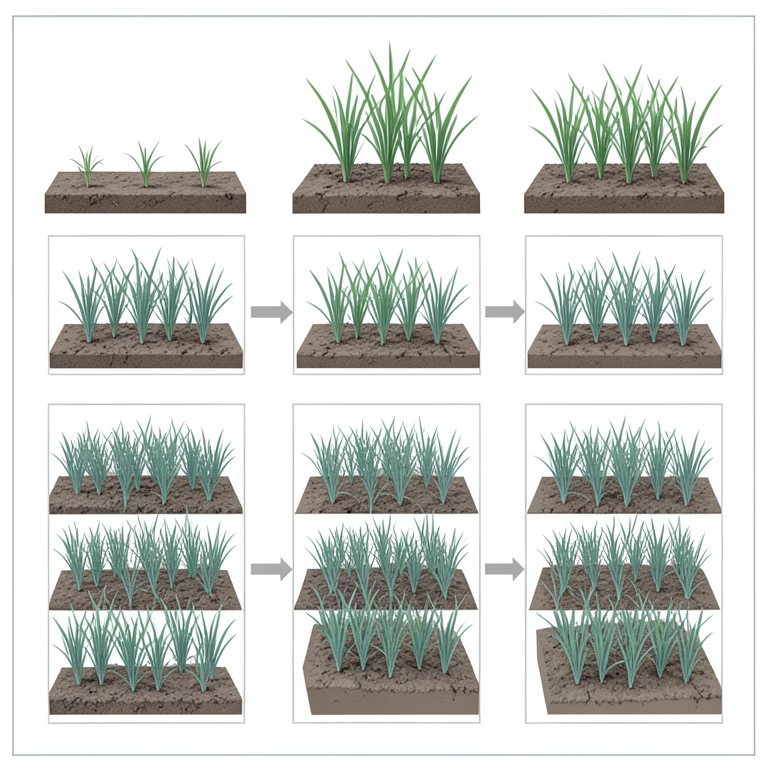
Experimental Layout
AI-generated conceptual illustration (Pusa Basmati 1509 rice seedlings on raised beds). It explains the idea and does not show study data.
View source evidence ↗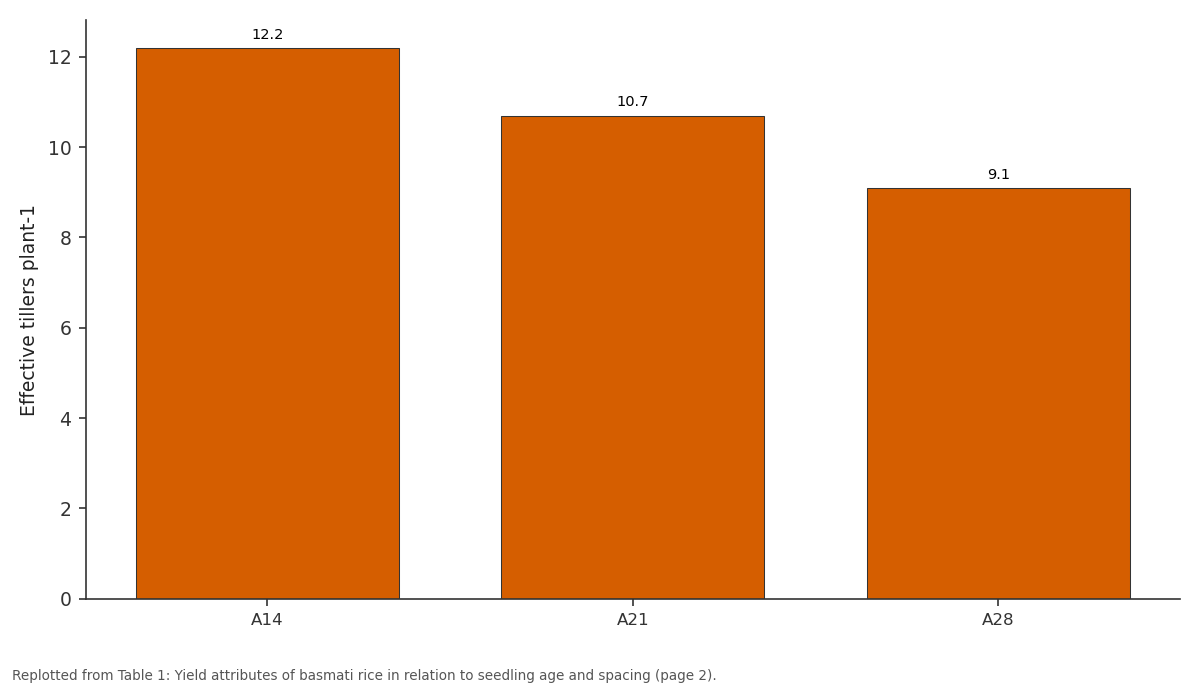
Yield contributing characters / Effective...: A14 vs A21 vs A28
Replotted from Table 1 (page 2) of the original paper. Every bar is the paper's own table value.
View source evidence ↗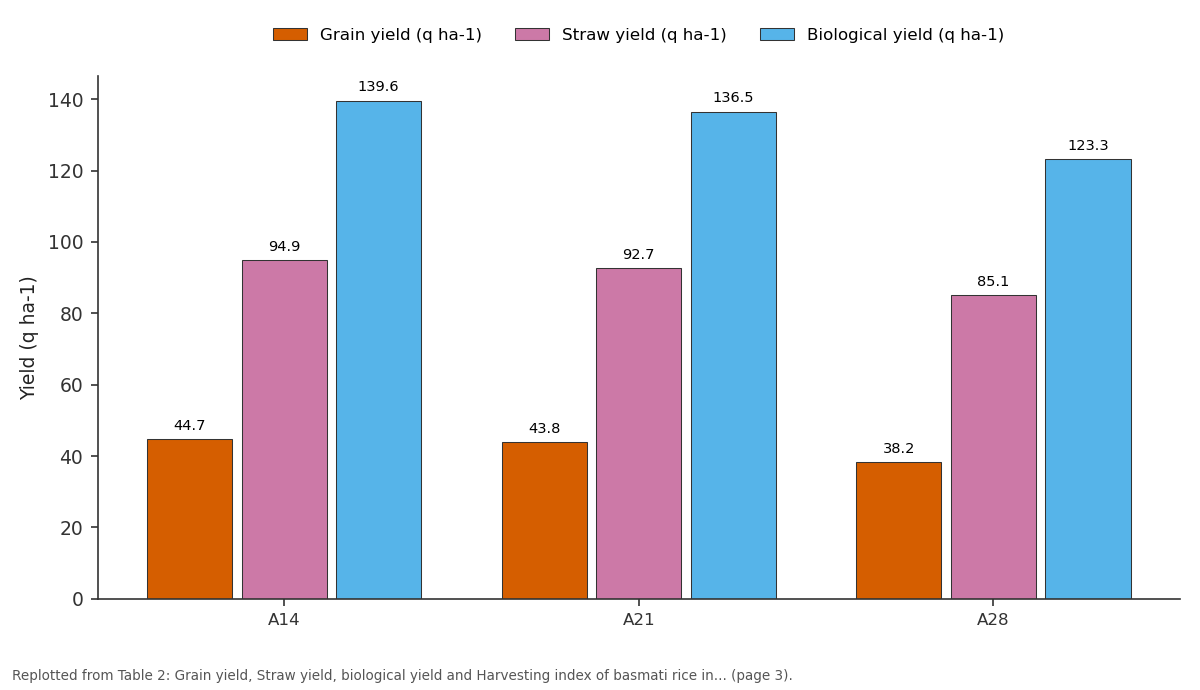
Grain yield (q ha-1) and Straw yield (q ha-1) and more: A14 vs A21 vs A28
Replotted from Table 2 (page 3) of the original paper. Every bar is the paper's own table value.
View source evidence ↗Figures & tables
From the original paper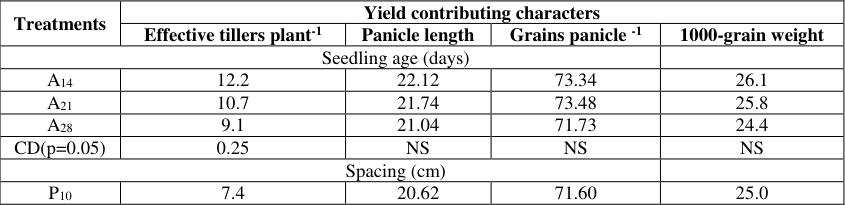 Table 1
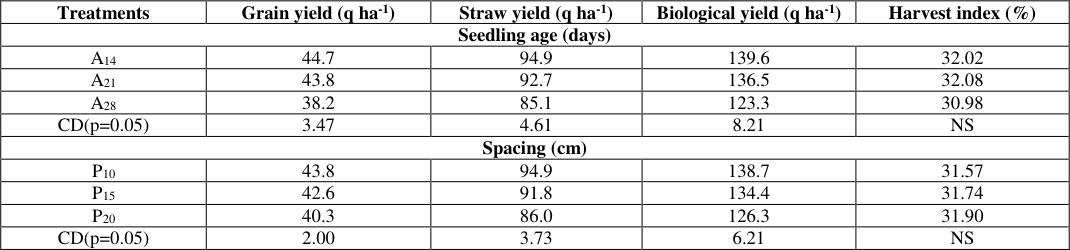 Table 2
 Table 3
Introduction
Rice (Oryza sativa L.) is the main cereal crop of the world. It belongs to the Poaceae family of grasses and the Oryzoideae subfamily. Rice occupied an area of 44 million hectares with a production of 117.47 million tonne in India (Anon, 2020) [1] . The rice growing area in Punjab is 31.03 lakh hectares with a production of 191.36 lakh tonne (Anon, 2020) [1] . In rice growing area basmati rice (Oryza sativa) occupies a special status in the cultivation of rice because of it unique characters, that is, extra long thin grain, the excessive stretching along the cooking, the soft and fluffy cooked rice, and the pleasant aroma that together determine the uniqueness of the basmati rice. Rice cultivation demand huge amount of water. It was estimated that more than 50 percent of total irrigation water available was used for rice cultivation. There is a need to develop/search for alternate methods of rice production which requires less water without affecting the yield potential of the varieties (Laulanie, 1993) [8] . In raised bed transplanting methods we can enhanced productivity by suitably modifying certain management practices such as controlled supply of water, planting of younger seedlings and providing wider spacing. Plant geometry plays an important role in yield maximization of rice. Plant geometry depends on various factors such as plant type, season, spacing and age of seedlings. Optimum plant density ensures the plants to grow properly with their aerial and underground parts by utilizing more solar radiation and soil nutrients and the age of seedlings at the time of transplantation is an important factor for the uniform establishment of rice (Paddalia,1981) as farmers are not aware of these factors. The total number of productive tillers per plant in rice cultivation is an important factor contributing to yield. The age of the seedlings has a marked effect on the tillering process of rice (Khakwani et al., 2005) [7]
Materials and Methods
The study was carried out at Student's Research farm of P.G. Department of Agriculture, Khalsa College Amritsar, during kharif season 2020-2021. The soil of the experimental field was categorized as sandy loam. The soil tested medium in organic carbon, available nitrogen (N) and available phosphorus (P). However, potassium (K) status was high. The soil pH and electrical conductivity values were within the normal range. The field experiment was conducted in split plot design having 9 treatments with 3 replications. There are three different age of seedling viz. A1(14 days old seedling), A2(21 days old seedling) and A3 (28 days old seedling) in main plots while there are three spacing viz. P1(30cm×10cm), P2(30cm×15cm), P3 (30cm×20cm) in sub plots on raised beds. Recommended dose of fertilizers (135 kg urea ha -1 ) were applied to the crop in three equal split 3, 6 and 9 weeks after sowing. Irrigations were given at weekly interval and as per requirement (when there is rainfall). Harvesting was done manually with sickle. All data on growth, yield and yield component were measured from the central areas of each plot. Statistical analysis of the data recorded was done as per randomized block design using CPCS-1 software developed by PAU, Ludhiana. The comparisons were made at five per cent level of significance.
Results and Discussion
Results and Discussion
Yield contributing characters Effective tillers
Seedling age are significantly affected the effective tillers plant -1 . Data in table 1 show that the number of productive tillers plant -1 (12.2) were produced by 14 days old seedling which are higher than 21 days old seedling (10.7) and lowest number of productive tillers plant -1 were recorded in 28 days old seedling (9.1). The most probable reason for higher effective tiller production by younger seedlings may be quick establishment of plant and more effective use of light, nutrient and space etc. Similar result was founded by Sohel et al., (2009). Spacing also had significant effect on number of effective tillers plant -1 . The results revealed that wider spacing performed better as compared to lower spacing. The highest number of effective tillers plant -1 (13.4) were produced when the crop were transplanted at 30cm x 20 cm plant spacing. The lowest number of effective tillers plant -1 (8.4) was observed in narrow spacing 30 cm x 10 cm. In the wider row vigorous plants, spacing, the with particularly higher tillering ability might have produced more photosynthates than the less vigorous plants with the closer spacing. In addition plants did not get proper nutrition due to nutrient competition in closer plant spacing. The result was in conformity with those of Uddin et al., (2010) [13] .
| Treatments | Yield contributing characters | — | — | — |
|---|---|---|---|---|
| Effective tillers plant-1 | Panicle length | Grains panicle -1 | 1000-grain weight | |
| Seedling age (days) | ||||
| A14 | 12.2 | 22.12 | 73.34 | 26.1 |
| A21 | 10.7 | 21.74 | 73.48 | 25.8 |
| A28 | 9.1 | 21.04 | 71.73 | 24.4 |
| CD(p=0.05) | 0.25 | NS | NS | NS |
| Spacing (cm) | ||||
| P10 | 7.4 | 20.62 | 71.60 | 25.0 |
Table text extracted from the original PDF; superscript letters are shown inline. The original table image is below.
View original table image
Panicle length
Data showed seedling age had no significant effect on panicle length. However, maximum panicle length (22.12 cm) was recorded in 14 days old seedling followed by 21 days seedlings (21.74 cm) and minimum panicle length (21.04) recorded in 28 days old seedling. Similar result was found by Ali et al. (2013). The effect of plant spacing has a non-significant difference on panicle length. It was revealed that the panicle length was longest (22.34 cm) at 30 x 20 cm spacing which is higher then 30×15 cm spacing (21.99 cm) and the shortest (20.62 cm) panicle was found from 30 x 10 cm spacing. Wider spacing produced the longest panicle than closer spacing. Alam et al., (2012) [2] also reported the similar result that wider spacing produced the longest panicle than closer spacing.
Grains panicle -1
The grains are fertilized, fully ripened ovule of spikelet in a panicle that ultimately contribute to the grain yield. The grains per panicle is one of the important yield determinants which were greatly influenced by age of seedling. Data in table 2 showed that age of seedling show non-significant result on grains panicle -1 . Maximum grains panicle -1 recorded in 14 days old seedling (73.34) and minimum grains panicle -1 recorded in 28 days old seedling (71.73). The increased number of grains panicle -1 might be dew to better utilization of growth resources and higher tiller production per unit area. Similar results were founded by Singh and Singh (2009). Spacing show non-significant result on grains panicle -1 . Results showed that the highest number of grains panicle -1 (73.94) was observed in 30×20 cm spacing while lowest number of grains panicle -1 (71.60) in 30 ×10 cm spacing. Reduction in the number of grains panicle -1 under closer spacing might be due to increased number of plants per unit area. This increased number of plants per unit area exerted competition among plants for nutrients and light that might have caused lower crop growth rate with consequently a reduction in the number of filled grains panicle which was supported by Sarker et al., (2002). 1000 grains weight 1000 grains weight is an important character which determines the yield per hectare. Data in table 2 showed that age of seedling had non-significant effect on 1000 grain weight. However highest weight was recorded in 14 days old seedling (26.1 g) and lowest weight recorded in 28 days old seedling (24.4 g). 1000 grains weight was also non significantly affected by spacing. However the results showed that with the increase in spacing the 1000 grains weight also increased. The highest thousand grain weight (26.2 g) was produced when the crop was transplanted at 30 x 20 cm spacing. The lowest thousand grain weight (25.0 g) was observed in closest spacing 30 x 10 cm. Higher plant population was noted in narrow spacing than other spacing and this higher plant population was accompanied by strong inter and intra-row competition that might have caused reduction in thousand grains weight of rice crop. Similar result was founded by Biswas et al., (2015) [14] . The interaction effect between age of seedling and spacing on yield contributing characters was non-significant.
| Treatments | Grain yield (q ha-1) | Straw yield (q ha-1) | Biological yield (q ha-1) | Harvest index (%) |
|---|---|---|---|---|
| Seedling age (days) | ||||
| A14 | 44.7 | 94.9 | 139.6 | 32.02 |
| A21 | 43.8 | 92.7 | 136.5 | 32.08 |
| A28 | 38.2 | 85.1 | 123.3 | 30.98 |
| CD(p=0.05) | 3.47 | 4.61 | 8.21 | NS |
| Spacing (cm) | ||||
| P10 | 43.8 | 94.9 | 138.7 | 31.57 |
| P15 | 42.6 | 91.8 | 134.4 | 31.74 |
| P20 | 40.3 | 86.0 | 126.3 | 31.90 |
| CD(p=0.05) | 2.00 | 3.73 | 6.21 | NS |
Table text extracted from the original PDF; superscript letters are shown inline. The original table image is below.
View original table image
Grain yield
Age of seedling played an important role in regulating the grain yield of basmati rice. Result in table 2 showed that grain yield declined with increase in seedling age. Highest grain yield of 44.7 q ha -1 recorded at younger age (14 days) followed by 21 days old seedling (43.8q ha -1 ) which is at par with 14 days old seedling. Lowest grain yield recorded at 28 days old seedling (38.2 q ha -1 ). Higher grain yield of younger seedling might be due to vigorous and healthy growth, development and of more productive tillers as compared to older seedling. Similar result was recorded by Salem et al., (2011) [11] . Spacing is also one of the main factor for higher grain yield. In 30×10 cm spacing higher yield recorded (43.8q ha -1 ) which is significantly at par with 30×15 cm spacing (42.6 q ha -1 ) and lower yield was recorded in 30×20cm spacing (40.3 q ha -1 ). This might be due to more number of plants, more LAI, more light interception. Similar result was founded by Haque et al., (2002). The interaction effect between age of seedling and spacing on grains yield was non-significant.
Straw yield
Data showed that highest straw yield (94.9 q ha -1 ) was produced 14 days old seedling which was significantly different from 28 days old seedling (85.1q ha -1 ) and significantly at par with 21 days old seedling (92.7 q ha -1 ). Increase in straw yield with younger seedlings may be due to more number of tillers and higher plant height. These results are in conformity with Pramanik and Bera (2013) [10] who reported that with increase in seedling age, straw yield reduced and younger seedling age (10 days) produced higher straw yield compared to older seedlings. Spacing also had a marked effect on the straw yield of basmati rice and it significantly affected the straw yield. Result showed in table 4.6 that highest straw yield (94.9 q ha -1 ) was produced in 30×10 cm spacing which was significantly higher than 30×20 cm spacing (86.0 q ha -1 ) and significantly at par with 30× 15 cm spacing (91.8 q ha -1 ). Higher straw yield at closer spacing may be due to higher plant population per unit area. Similar result was founded by Fayaz et al., (2015). The interaction effect between age of seedling and spacing on straw yield was non-significant.
Biological yield
Data presented in Table 2 indicated that different age of seedlings significantly influenced the biological yield. 14 days old seedling recorded higher biological yield (139.6 q ha -1 ) which is at par with 21 days old seedling and lower biological yield was recorded in 28 days old seedling (123.3 q ha -1 ). Higher biological yield at younger seedling due to higher grain and straw yield. Plant spacing also significantly influenced the biological yield. 30×10 cm spacing recorded higher biological yield (138.7 q ha -1 ) which is at par with 30×15 cm spacing and lower biological yield was recorded in 30×20 cm spacing (126.3 q ha -1 ). Higher biological yield at dense spacing due to higher grain and straw yield. The interaction effect between age of seedling and spacing on biological yield was non-significant.
Harvesting Index (HI)
The harvesting index expressed as percentage determines the percentage ratio of economical yield (grain yield) to biological yield. Data in table show that age of seedling had non-significant effect on harvesting index. However highest harvesting index were recorded in 28 days old seedlings (32.98). Similarly spacing show non-significant effect on harvesting index. However highest harvesting effect recorded in 30×20 cm spacing (31.90). The interaction effect between age of seedling and spacing on grains panicle -1 was non-significant.
Treatments
Grain yield (q ha -1 ) Straw yield (q ha -1 ) Biological yield (q ha
Economics Total cost of cultivation
Total cost of cultivation is the sum of common cost of cultivation and variable cost of cultivation. The data of total cost of cultivation of all the treatments was calculated. Total cost of cultivation was highest in 28 days old seedling followed by 14 and 20 days old seedling. Among the different spacings total cost of cultivation was highest in 30× 10 cm spacing followed by 30× 15 and 30× 20 cm spacings. This was due to higher number of seedling per unit area. Fayaz et al. (2015) also found similar results.
Gross returns: Gross returns include the cost of cultivation and net returns obtained from the crop. In other words, the combination of input and output in monetary form is known as gross returns. The gross returns were highest in 14 days old seedling followed by 21 and 28 days old seedling. Among the different spacings higher gross returns were recorded in 30 x 10 cm followed by 30 x 15cm and 30 x 20 cm spacing respectively.
Net Returns
The net returns are the important monetary parameter for the feasibility and adoption of the crop in agriculture. The net returns were highest in14 days old seedling followed by 21 and 28 days old seedling. Among the different spacings higher net returns were recorded in 30 x 10 cm followed by 30 x 15cm and 30 x 20 cm spacing respectively.
Benefit cost ratio
Benefit cost ratio can be obtained by dividing gross returns with total cost of cultivation of particular system. Benefit cost ratio was found maximum in14 days old seedling followed by 21 and 28 days old seedling. Among the different spacings higher benefit cost ratio were recorded in 30 x 10 cm followed by 30 x 15cm and 30 x 20 cm spacing respectively.
Conclusion
On the basis of present investigation, it may be concluded that at different seedling ages 14 days old seedling when used for transplanting on raised beds showed superiority over other seedling ages. Similarly in case of spacing 30×10 cm showed superiority over other spacings. So, 14 days old seedling with 30×10 cm spacing comes out to be the best combination which can be proposed to the farmers for improving productivity and profitability of Pusa basmati-1509 on raised beds in Punjab.
Figures and tables from the paper
| Treatments | Gross return (Rs/ha) | Total cost (Rs/ha) | Net return (Rs/ha) | B: C |
|---|---|---|---|---|
| Seedling age (days) | ||||
| A14 | 89400 | 25665 | 63735 | 2.48 |
| A21 | 87600 | 25865 | 61735 | 2.38 |
| A28 | 76400 | 26065 | 50335 | 1.93 |
| Spacing (cm) | ||||
| P10 | 87600 | 26128 | 61472 | 2.35 |
| P15 | 85200 | 25877 | 59323 | 2.29 |
| P20 | 80600 | 25590 | 55010 | 2.14 |
Table text extracted from the original PDF; superscript letters are shown inline. The original table image is below.
View original table image
References
13 in the original paper- Anonymous. Package and Practices of kharif Crops from Punjab Agriculture University, Ludhiana, 2020.
- Alam MS, Baki MA, Sultana MS, Ali KJ, Islam MS. Effect of variety, spacing and number of seedlings per hill on the yield potentials of transplant. 2012;2:10-15.
- Ali HS, Hasan MA, Sikder, Islam MR, Hafiz MHR. Effect of seeding age and water management on performance of Boro rice (Oryza sativa L.), The Agriculturists. 2013;11(2):28-37.
- Tehulie NS, Misgan T. Review on the effects of nitrogen fertilizer rates on growth, yield components and yield of potato (Solanum tuberosum L.). Int. J Res Agron. 2019;2(2):51-56. DOI: 10.33545/2618060X.2019.v2.i2a.68
- Fayaz A, Singh P, Qayoom S, Ahmad L, Lone B, Singh L, Singh KN. Influence of different dates of sowing and spacings on growth and yield of scented rice cv. Pusa Sugandh 3 under temperate conditions of Kashmir. Journal of Cereals and Oilseeds. 2013;6(4):20-23.
- Haque D. Effect of Madagascar technique of younger seedling and wider spacing on growth and yield of Boro rice. M Sc. Thesis, Department of Agronomy, Bangladesh Agriculture University, 2013.
- Khakwani AA, Shiraishi M, Zubair M, Baloch MS, Naveed K, Awan I. Effect of seedling age and water depth on the morphological and physiological aspects of transplanted rice at high temperature. Journal of Zhejiang University of Science and Technology. 2005;6 (5):389-395.
- Laulanie H. Le systeme de agriculture intensive malagache. Tropical farming (Brussels). 1993;11:104114.
- Paddalia CR. Effect of the age of the seedlings on the growth and yield of transplanted rice (Oryza Sativa). 1981;18:165-67.
- Paramanik K, Bera AK. Effect of seedling and nitrogen fertilizer on growth, chlorophyll content, yield and economics of hybrid rice (Oryza sativa L.) International Journal of Agronomy and Plant Production. 2013;45:3849-3499.
- Salem AKM, Elkhoky WM, Abou-khalifa AB, Ceesay M. Effect of nitrogen fertilizer and seedling age on inbred and hybrid rice varieties. American-Eurasian Journal of Agriculture & Environ Science. 2011;5:640646.
- Uddin M. Effect of spacing on morpho-physiological response of different aman rice cultivars under coastal high land ecosystem. Indian Journal of Agricultural Research, 2010, 44(4).
- Biswas KK, Hussain I, Abuyusuf ASM, Hassan MDZ, Jannat NA. Hill spacing and number of seedlings per hill on the yield of t. Aman rice (var. BRRI dhan52) in the tidal ecosystem. American Research Thoughts. 2015;1(11):2392-876.