
Research article · 2023 · Full text
International Journal of Agriculture and NutritionEffect of organic fertilizer of chicken manure and type of organic mulch on growth and yield of zucchini (Cucurbita pepo L.)
Volume 5(1) · Pages 91–95 · DOI: 10.33545/26646064.2023.v5.i1b.102 ↗
Research areasShallot Cultivation and AnalysisPlant Growth and Agriculture Techniques
Abstract
Author-writtenThe Experiment was carried out at the AICAT Beasu Viqueque Horticulture Center from June to August 2022, to determine the effect of the use of chicken manure organic fertilizer and organic mulch on the growth and yield of Zucchini. The experiment was arranged in a randomized complete block design consisting of two factors and three replications. The first factor is chicken manure with 3 levels of treatments and the Second factor is organic mulch with 3 levels of treatments. The result showed that the organic fertilizer as well as mulch significantly affected plant height and diameter of the stem, all yield and yield components. However, no indicated interaction between organic fertilizer and mulching was observed at the parameters of growth and yield. The yield per hectare of zucchini showed that the highest in the treatment of cow manure was 10 t h-1 about 75.87 t h-1 and the lowest is on without cow manure about 40.58 t h-1. On the other hand, the higher yield per hectare on organic mulch is rice straw and lower without mulch about 63.11 t h-1 and 39.73 t h-1s.
Summary
Source-checkedPlain-language reading of the full paper, prepared with AI and checked against the text. Each point links to the authors' own words.
Why it matters
- Zucchini is a globally important vegetable commodity, including in Timor-Leste. View evidence ↗
- Zucchini is nutritionally valuable, containing carotenoids that may protect against various diseases. View evidence ↗
- Effective technology is needed to increase zucchini production in Timor-Leste. View evidence ↗
The question
- The study aimed to determine how the application of organic matter and mulching affects the growth and yield of zucchini. View evidence ↗
What they did
- The research was conducted from June to August 2022 in Viqueque, Timor Leste, at an altitude of 55 meters. View evidence ↗
- The trial used a 3x3 factorial randomized design with a total of 27 plots. View evidence ↗
- The second factor was organic mulch, with three levels: no mulch, rice straw, and reed grass. View evidence ↗
What they found
- Higher doses of chicken manure (10 t h-1) resulted in the greatest plant height (17.19 cm), compared to 5 t h-1 (12.68 cm) and no manure (8.38 cm). View evidence ↗
- Rice straw mulch produced the highest plant height (13.71 cm), followed by reed mulch (12.97 cm) and no mulch (11.58 cm). View evidence ↗
- Reed grass mulch resulted in the largest stem diameter (10.2 cm), compared to rice straw (9.76 cm) and no mulch (7.34 cm). View evidence ↗
- Chicken manure at 10 t/h significantly increased the number of fruits (6.44), fruit diameter (19.78 cm), and fruit weight (1.99 kg) compared to no manure. View evidence ↗
- Reed grass mulch achieved the highest number of fruits (5.66) and fruit diameter (17.11 cm) compared to no mulch. View evidence ↗
- Reed grass mulch produced a yield of 60.11 t/h, which was higher than no mulch (39.73 t h-1). View evidence ↗
What it means
- The authors concluded that both chicken manure organic fertilizer and organic mulch positively affect the growth and yield of zucchini. View evidence ↗
- The authors recommend using 10 t h-1 of chicken manure and reed grass mulch to maximize zucchini yield. View evidence ↗
Visual summary
3 visualsIllustrations explain the paper; charts are replotted from the paper's own table values.
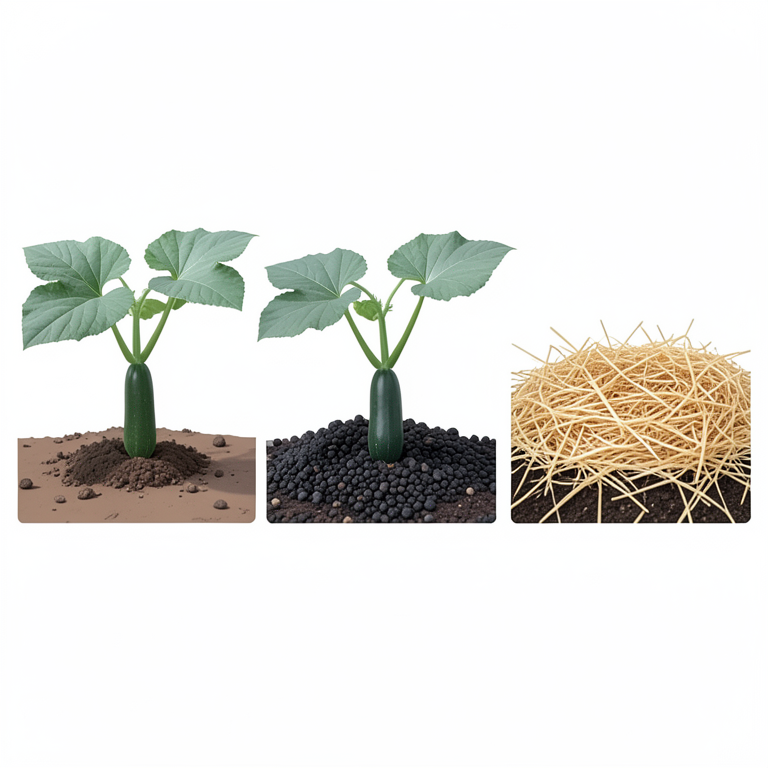
Experimental Factors
AI-generated conceptual illustration (zucchini plants (Cucurbita pepo L.)). It explains the idea and does not show study data.
View source evidence ↗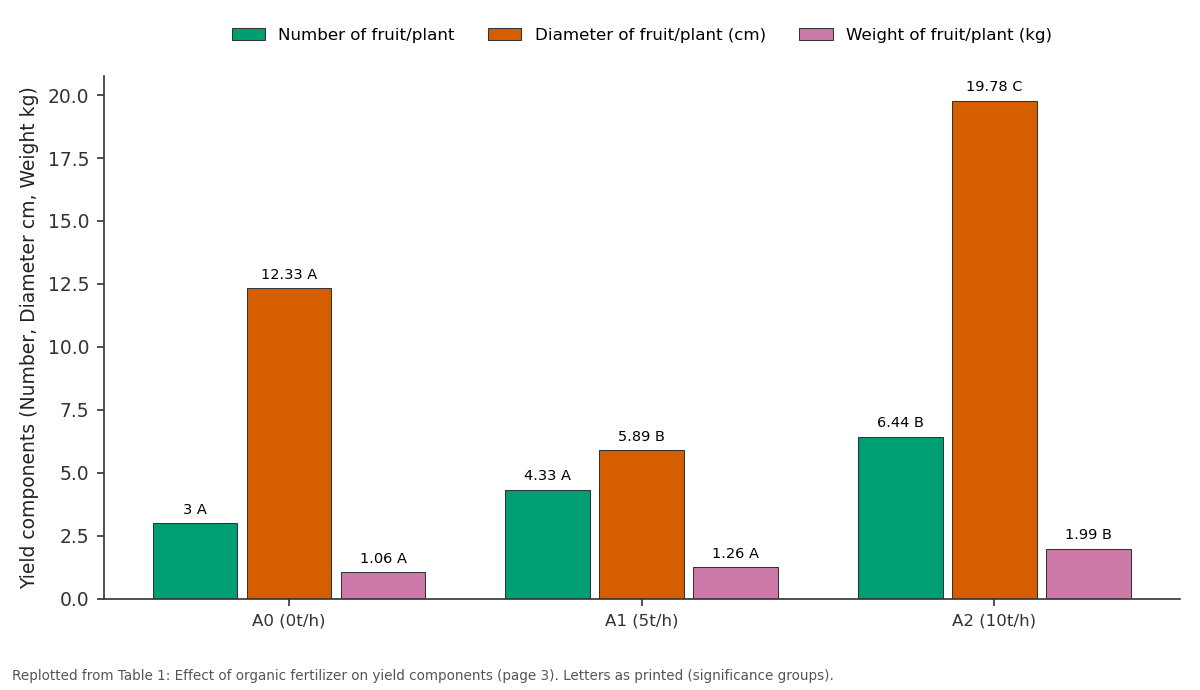
Number of fruit/plant and Diameter of fruit/plant (cm) and more: A0 (0t/h) vs A1 (5t/h) vs A2 (10t/h)
Replotted from Table 1 (page 3) of the original paper. Every bar is the paper's own table value.
View source evidence ↗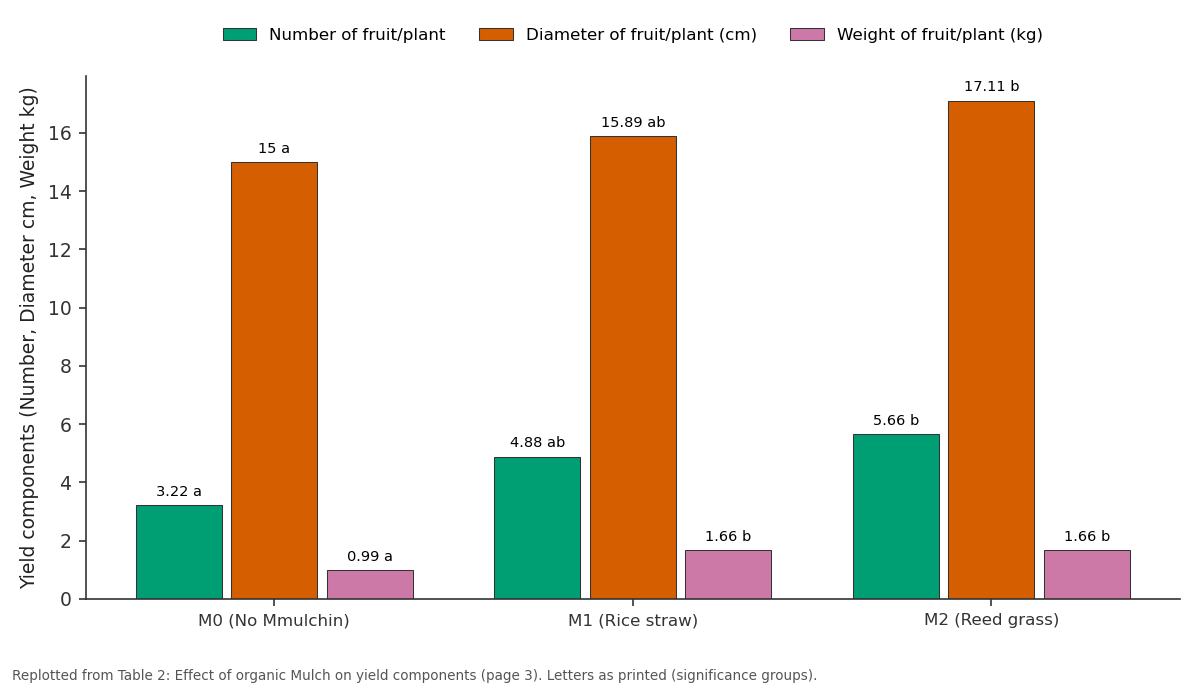
Number of fruit/plant and Diameter of fruit/plant (cm) and more: M0 (No Mmulchin) vs M1 (Rice straw) vs M2 (Reed grass)
Replotted from Table 2 (page 3) of the original paper. Every bar is the paper's own table value.
View source evidence ↗Figures & tables
From the original paper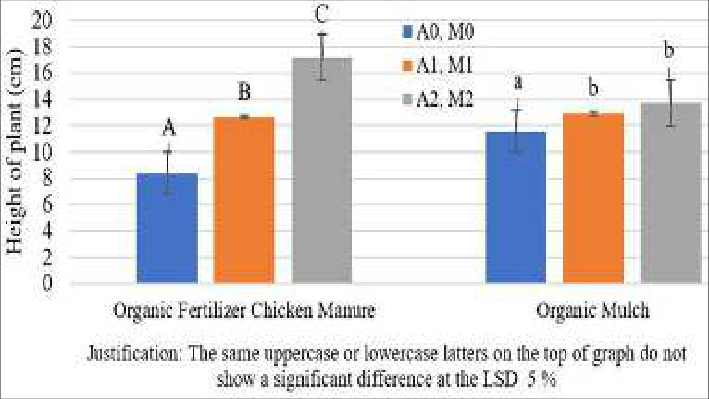 Figure 1
 Table 1
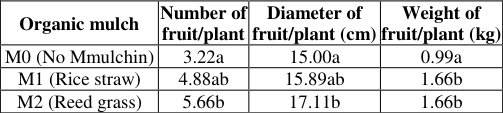 Table 2
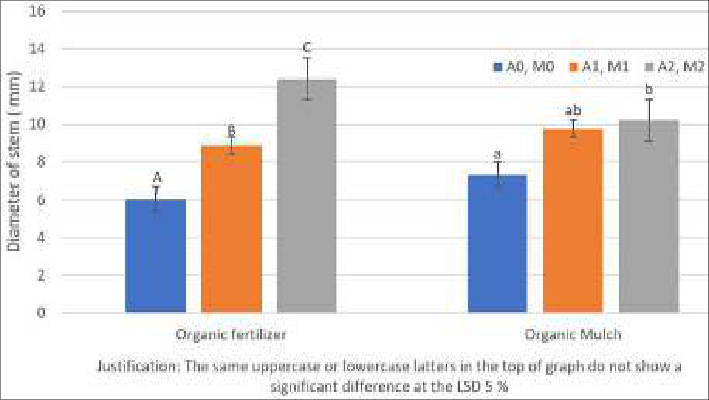 Figure 2
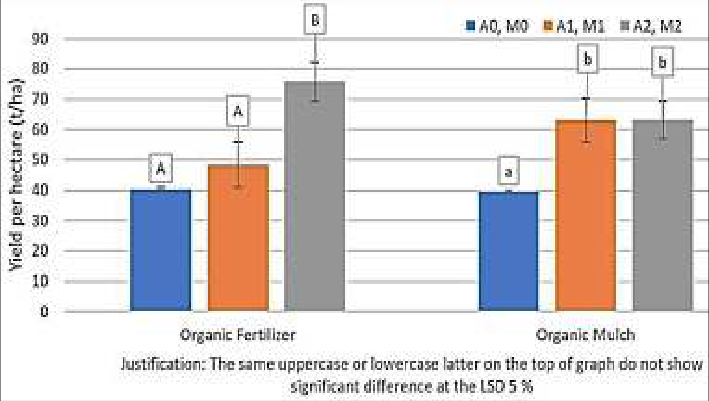 Figure 3
Introduction
Zucchini (Cucurbita pepo L.) is a horticultural plant belonging to the Cucurbitaceae family with the category of vegetables. The zucchini plant is an important commodity in the world including Timor-Leste. Majority people cultivate and consume zucchini plants as pumpkins. Zucchini plants could use their fruits, leaves, and flowers for vegetables. Zucchini plants contain high nutrition and carotenoid substances that serve to protect the eyes from cataracts, cancer, heart, diabetes, kidney, fever and diarrhea (Jeheskiel, 2021) [3] . The nutritional content of zucchini per 100 grams contains 27.00 calories, carbohydrates 1.20 g, protein 1.00 grams, calcium 22 mg, vitamin A 1600 si, B1 0.16 mg, vitamin B1 0.16 mg, vitamin B2 0.25 mg, vitamin C 9 mg, water 91.4% (Kusumiyati et al., 2019) [4] . Zucchini plants in Timor-Leste are still rare and there is no data showing yield productivity, but the productivity of zucchini products in neighboring countries such as Indonesia is up to 20 t h -1 . Organic fertilizer is a fertilizer composed of living matter, such as weathering the remains of plants, animals, and humans. Organic fertilizers can be solid or liquid which are used to improve the physical, chemical, and biological properties of the soil. Sources of organic matter can be compost, green manure, manure, crop residues such as straw, stash boxes, livestock waste, industrial waste that uses agricultural materials, and municipal waste. Land use in increasing crop yields is faced with constraints on its chemical, physical and biological properties. To overcome this by applying organic fertilizers that are able to improve the chemical, physical and biological properties of the soil. Organic mulch is organic matter consisting of plant residues (Rice litter, sawdust, corn stalks), pruning from fence plants, leaves and plant twigs that will be able to improve fertility, structure and will indirectly maintain soil aggregation and porosity, which means it will maintain the capacity of the soil to hold water porosity, which means it will maintain the capacity of the soil to hold water. Some studies report that plant biomass such as rice straw, plant litter. Cultivation of zucchini plants is still very limited, therefore need to pay attention due to the economic value is quite high. To increase the production of zucchini plants in Timor Leste, it is necessary to make efforts to use effective technology.
One of the technologies that can increase zucchini production is to use organic fertilizers, especially chicken manure. In addition to organic fertilizers, the technology that needs to be used is the use of organic mulch so that evaporation can be suppressed, maintain soil moisture and suppress weed growth. The general objectives of this study are to know the application of organic matter and mulching on growth and yield of Zucchini. Thus, the specific objectives are to find out the effect of chicken manure organic fertilizer on the growth and yield of zucchini, effect of organic mulch on the growth and yield of zucchini.
Research Methodology
This research was carried out from June to August 2022 in Uma Uain village, Viqueque district, Viqueque regency, Timor Leste, with an altitude of 55 meters from sea level and a southern latitude (LS) 8o1'26" and Longitude East (LE) 126o 21' 52". This field trial used a randomized design of a 3 x 3 factorial group with three treatments with a total of 27 plots. The first factor is chicken coop organic fertilizer with 3 levels of treatment, namely: No chicken manure (A0), Chicken manure dose 5 tons per hectare (A1), Chicken manure 10 tons per hectare. The second factor is organic mulch consisting of 3 treatment levels: No mulch (M0), Rice straw organic mulch (M1), and reed grass organic mulch (M2). The materials and tools used in this study consisted of zucchini seeds, chicken manure fertilizer, organic mulch of rice straw and reed grass, in addition to equipment for tillage and maintenance, equipment used for variable measurements such as GPS, altimeter, calipers, pH meters, thermometers, ovens, tape meters.
Results and Discussion
The factors of organic fertilizer of chicken manure and organic mulch in figure 1 show that there is a significant influence on plant height. The treatment of chicken manure 10 t h -1 differs in influence from the application of 5 t h -1 of chicken manure and without the application of chicken manure. From these results, it can be said that the application of chicken manure with a higher dose (10 t h -1 ) provides faster growth with a value of 17.19 cm than at a lower dose (5 t h -1 ) of 12.68 cm or without the application of chicken manure with a value of 8.38 cm. With the appropriate dose of chicken manure, the physical, chemical, and biological properties of the soil become better and improve the physical structure of the soil. Good structurization causes the roots of the plant to develop perfectly, added that the physical properties of the soil are good, the roots will develop deeper so that the absorption of nutrients and water needed by plants is also better which in turn will increase plant productivity such as plant growth. Applying manure can improve soil structure as well as increase the availability of nutrients and the growth of microorganisms.
Fig 1: Effect of organic fertilizer and organic mulch on plant height
The application of organic mulch of rice straw and reeds grass is different from without mulching. However, there is no difference in influence between the organic mulch of reeds and rice straw (Figure 1). The results were shown in the rice straw treatment (13.71 cm) followed by the reed mulch treatment (12.97 cm) and lower in the no-mulch treatment (11.58 cm). One technique of microclimate modification is to use mulch. The use of rice straw and reed leaves as mulch is a potential alternative that can improve soil aeration, maintain soil moisture so that plant roots develop well and increase the area of root absorption in contact with the soil, which because of which plant absorption of nutrients becomes more optimal. Mulyono (2015) [7] added that good organic mulch could be maintain soil moisture and suppress weed growth as much as possible so that plant roots develop well and increase the area of root absorption in contact with the soil, which as a result of which plant absorption of nutrients becomes more optimal. Mulyono (2015) [7] added that good organic mulch could be maintain soil moisture and suppress weed growth as much as possible so that nutrients well absorbed by roots. The treatment of the chicken manure has a noticeable effect on the diameter of the stem. The application of organic chicken manure of 10 t h -1 has a different effect from the application of organic chicken manure of 5 t h -1 or without the application of chicken manure on the diameter of the stem (Figure 2). The difference in influence also occurs between the application of 5 t h -1 chicken manure and without the applying of chicken manure. The result shows that plants need more organic fertilizer so that the soil structure and texture become better, and the nutrients needed become available for plant absorption. Fertilization with manure is an effort made to overcome nutrient deficiencies, especially nitrogen (N), phosphorus (P), and potassium (K) which are macronutrients that play an important role in plant growth and yield. Subroto (2009) [9] , reveals that utilization of organic matter chicken manure as a supplier of soil nutrients and increase water retention, if the groundwater content increases, the process of breaking down organic matter will produce many organic acids. Organic acids can urge phosphates bound by Fe and Al so that phosphates can be released and available to plants. Ismaeil et al. (2012) [3] argue that applying chicken manure at higher doses can increase plant growth compared to applying lower doses of chicken manure. The result show on figure 2 that the application of organic mulch has effect on the diameter of the stem. Mulching reeds grass has significant different results with without apply of mulching, however there is no significant difference with apply of organic mulching of rice straw. Mulching reeds grass has a better effect on the diameter of the stem, which is 10.2 cm compared to mulching rice straw, which is 9.76 cm and without mulching 7.34 cm. The aims of applying Mulch are to maintain soil moisture content, suppress weeds growth and hold the soil surface from sunlight and provide organic matter in long term. The application of chicken manure has a significant effect on the yield component (Table 1). The application of chicken manure of 10 t h -1 is different effected from the applying of chicken manure of 5 t h -1 or without chicken manure on the number of fruits per plant and the weight of fruits per plant. In the fruit diameter, it could be seen (table 1) that there is a difference influence between the application of manure 10 t/h, 5 t h -1 as well as without chicken manure. The difference effect between the application of chicken manure 10 t/h with 5 t h -1 reached a percentage of 32.76% and without chicken manure was 53.42% on the number of fruits per plant. In fruit weight per plant, the difference influence between the application of chicken manure fertilizer 10 t h -1 with the application of chicken manure 5 t h -1 and without the application of chicken manure is 36.68% and 46.73% respectively. Conversely, the difference in the effect that occurred on the diameter of the fruit between the application of chicken manure 10 t h -1 with 5 t h -1 was 19.67%, 10 t/h and without chicken manure was 37.46% and between 5 t h -1 with no applying of chicken manure reached 22.40%. It could be said that the suitability of using organic matter of chicken manure as a supplier of soil nutrients and increasing water retention. Thus, the addition of chicken manure has a positive effect on acidic soils with low organic matter content due to the organic fertilizers can increase the levels of P, K, Ca, and Mg available (Ismaeil et al. (2012) [3] . Raihan (2000) [8] revealed that if the groundwater content increases, the process of remodelling organic matter will produce many organic acids, anions of organic acids can urge phosphates bound by Fe and Al so that phosphates can be released and available to plants. Organic mulching has a significant effect on the number of fruits per plant, fruit diameter per plant and fruit weight per plant (table 2). Mulching reed grass differs from no mulching, however there were no noticeable difference with mulching rice straw on the number of fruits, fruit diameter as well as fruit weight per plant. The percentage difference between mulching reeds grass and without mulching was 43.11% in number of fruits, 12.33% in fruit diameter and 40.36% in fruit weight per plant, respectively. From the difference in the effect between the application of organic mulch of reed grass, rice straw with no mulching on the number of fruits, the diameter of the fruit and the weight of the fruit per plant shows that the use of mulch can provide benefits consisting of, maintaining soil moisture, minimizing soil temperature fluctuations so as to benefit the root surface and soil microorganisms save water use and reduce dryness on the land surface, suppress weed growth and disease and increase the content of organic matter in the soil, reduce the rate of soil erosion both due to collisions of rain grains and surface flow. According to Assagaf (2019) [1] , mulching aims to maintain soil moisture, maintain organic matter content, suppress weed growth, minimize water loss and increase water absorption by the soil. The mulch given is in the form of organic mulch derived from reeds grass and rice straw. The application of chicken manure and organic mulch has a significant effect on yield per hectare. The application of chicken manure 10 t h -1 is different from the effect of chicken manure 5 t h -1 or without chicken manure. However, there was no difference in the effect between applying 5 t h -1 chicken manure and no chicken manure on yield per hectare (figure 3). The real effect of applying chicken manure 10 t h - 1 with a yield of 75.87 t h -1 is the maximum yield and different effect with 5 t h -1 with a yield of 48.42 t h -1 and without manure with a yield of 40.58 t h -1 . This indicates that plants need an amount of organic fertilizer that suits the needs of plants. Applying sufficient manure will improve the physical, chemical, and biological properties of the soil so that plant roots can absorb nutrients in the soil properly. Manure can increase pH, C-organic levels and increase the availability of nitrogen, phosphorus, potassium and microelements for plants (Sompotan, 2013) [11] . Thus the quality and type of organic matter used, will affect the speed and level of nutrient availability in the soil. Fertilization with manure is an effort made to overcome nutrient deficiencies, especially nitrogen (N), phosphorus (P), and potassium (K) which are macronutrients that play an important role in plant growth and production. The availability of N, P, and K in the soil is the most limiting factor for obtaining maximum growth and yield from cultivated plants.
| Organic mulch | Number of fruit/plant | Diameter of fruit/plant (cm) | Weight of fruit/plant (kg) |
|---|---|---|---|
| M0 (No Mmulchin) | 3.22a | 15.00a | 0.99a |
| M1 (Rice straw) | 4.88ab | 15.89ab | 1.66b |
| M2 (Reed grass) | 5.66b | 17.11b | 1.66b |
Table text extracted from the original PDF; superscript letters are shown inline. The original table image is below.
View original table image
| Organic fertilizer chicken manure | Number of fruit/plant | Diameter of fruit/plant (cm) | Weight of fruit/plant (kg) |
|---|---|---|---|
| A0 (0t/h) | 3.00A | 12.33A | 1.06A |
| A1 (5t/h) | 4.33A | 5.89B | 1.26A |
| A2 (10t/h) | 6.44B | 19.78C | 1.99B |
Table text extracted from the original PDF; superscript letters are shown inline. The original table image is below.
View original table image
The application of organic mulch has a significant effect on the yield per hectare (Figure 3). The use of organic reed mulch gives a different effect than without using mulch, but there is no difference in effect by using 5 t h -1 rice straw mulch. The use of organic reeds mulch produces a yield per hectare of 60.11 t/h, 60.02 t -1 h of rice straw mulch and the lowest yield on no mulch of 39.73 t h -1 . Organic mulch is organic matter consisting of plant and animal residues that will be able to improve fertility, structure and will indirectly maintain soil aggregation and porosity, which means it will maintain the capacity of the soil to hold water. The significant result of applying reeds mulch is thought to be because reed mulch is a material with a high C/N value and a lot of cellulose content so that during plant growth it has not been decomposed. Ayeni et al. (2010) [2] explained that the reed leaves contain tannins, saponins, flavonoids, terpenoids and phenols, in the presence of phenols resulting in inhibition of cytokinin growth hormone activity, this inhibition results in disruption of division in the shoot meristem and the height of weed plants becomes abnormal, thus competition is minimized so that plants can grow and develop normally. In addition, Assagaf (2019) [1] , revealed that reed mulch is thought to affect the availability of water in the soil to dissolve nutrients, improve soil aeration, maintain soil moisture so that plant roots develop well and increase the area of root absorption in contact with the soil, which as a result of which plant absorption of nutrients becomes more optimal (Wiliardi 2013) [10] . Mahmud (2019) [6] , added that straw mulch has the same function, namely, to suppress weed growth, maintain soil aggregates from rainwater blows, minimize soil surface erosion, prevent water evaporation, and protect the soil from sun exposure. It can also help improve soil physical properties, especially soil structure, thereby improving the stability of soil aggregates.
Conclusion and Recommendation 4.1 Conclusion
According to the results and discussion obtained, concluded that applying of organic fertilizer of chicken manure as well as organic mulch has effect on plant growth and yield of Zucchini. Applying chicken manure of 10 t h -1 obtained better results compared to 5 t h -1 and without manure. The occurrence of this due to chicken manure being one of the organic materials that serves to improve the physical, chemical and biological properties of the soil so that plant plants can absorb nutrients properly. While the use of reed grass mulch obtained better results than the use of rice straw mulch and without mulch. This shows that reed mulch is a ground cover material whose decomposition process takes a certain amount of time to maintain soil moisture and suppress weed growth.
Recommendation
To increase the yield of zucchini plants maximally, it is necessary to add chicken manure at a dose of 10 t h -1 . In addition, applying reed grass mulch as an alternative in increasing the yield of zucchini.
References
7 in the original paper- Assagaf SAR. Effect of Deer Mulching and NPK Phonska Fertilizer on Growth and Production of Tomato Plant (Solanum lycopersicum) University of Iqra Buru Fakulty of Agriculture and Forestry, Agro technology Program Study. Namlea, Indonesia. 2019;2(1):40-46. http://www.jurnal.ummu.ac.id/index.php/BIOSAINSTE K Journal BIOSAINSTEK.
- Ayeni KEY. Phytochemical Secreening of Three Medical Plants Neen Leaf (Azadirachta indica), Hibiscus Leaf (Hibiscus rosa sinensis) and Spear Grass Leaf (Imperata cylindrical). Continental Journal Pharmaceutical Sciences. 2010;4:47-50.
- Ismaeil FM, Abusuwar AO, Naim AM. Influence of chicken manure on growth and yield of forage sorghum (Sorghum bicolor L. Moench). International Journal of Agriculture and Foresty. 2012;2(2):56-60.
- Mukhlis MA. Increased of Rice Production (Oryza sativa L.) by Various of Mulchc and Varieties on System of Rice Intensification (SRI) Method. Journal Agrohita. 2019;3(1):12.
- Mulyono. Effect of used deer mulch, Kenikir and Kirinyu on the growth and Yield of Onion in Mediteran on Rainy Season. Planta Tropika Journal of Agro Science Study Program of Agro-technology, Agriculture Faculty, University of Muhammadiyah Yogyakarta. 2015;3(2):91-95.
- Raihan HS. Fertilization NPK and Amelioration Dry Area Sulfate Acid Baze on Value of Soil Test for Corn Plant. Agriculture Science. 2000;9(1):20-28.
- Sompotan S. Hasil tanaman sawi (Brassica juncea L.) Terhadap Pemupukan Organik Dan Anorganik. Geosains. 2013;5(2):14-17.
Cited by 5
From OpenAlex, OpenCitations and reference lists read by Scinovex
- Enhancing soybean growth and yield: Investigating the effects of different molybdenum levels combined with organic and inorganic fertilizers ↗
Md. Sajjad Hossain, Md. Daraj Uddin Prodhan, Mohammad Mahmudul Hasan · Journal of Pharmacognosy and Phytochemistry · 2024
The study at Sher-e-Bangla Agricultural University (Nov 2022 to Mar 2023) evaluated the impact of varying molybdenum levels, organic, and inorganic fertilizers on soybean growth and yield using a Randomized Complete Block Design (RCBD) with three replications. Results showed significant nutrient management effects on all parameters except the harvest index for BARI soybean 6. The best results were achieved with
- Effect of different micronutrients on the quality attributes in zucchini (Cucurbita pepo L.) under Telangana condition
Pasham Maneela, A Mamatha, J Cheena, S. B. Mallesh, S Praneeth Kumar · International Journal of Research in Agronomy · 2024
This study investigated the impact of foliar-applied micronutrients (boron, zinc, and manganese) on the quality attributes of zucchini. The experiment, conducted during the 2023-24 Rabi season, a randomized block design with 12 treatments and three replications. Results showed significant improvements in total soluble solids (TSS), fiber content and fruit firmness due to micronutrient application. The treatment T10 - Boron (B) @ 20 ppm + Zinc (Zn) @ 15 ppm + Manganese (Mn) @ 20 ppm yielded the highest TSS (2.95 ⁰Brix), fiber content (0.72%) and fruit firmness (10.06 kg/cm²). These values were
- Effect of organic and inorganic mulch material on different varieties of potato (Solanum tuberosum L.) in foot hills of Uttarakhand
Vaishali Belwal, Rajani Rajani, Neha Joshi, Vandana Bhakuni, Jeet Ram · International Journal of Agriculture Extension and Social Development · 2025
A field experiment was conducted to evaluate the effect of organic and inorganic mulch material on different varieties of potato (Solanum tuberosum L.) in foot hills of Uttarakhand. Four varieties (Gola, Kufri Badshah, Kufri Chandramukhi and Kufri Sindhuri) and three mulch levels (inorganic mulch, organic mulch and control) were analyzed in split plot design. Significantly higher plant height and number of shoots and economics was recorded under the variety V2 (Kufri Badshah). Whereas in case of yield parameters, there is no significant difference was found. Mulch significantly affected the gr
- Nutritional benefits and health effects of cucumbers ↗
Priyanka Saini · Acta Entomology and Zoology · 2025
Cucumbers (Cucumis sativus) are widely consumed vegetables known for their high water content, refreshing taste, and nutritional value. This paper reviews the nutritional composition and health effects of cucumbers, highlighting their role in hydration, weight management, and digestive health. Cucumbers provide essential micronutrients such as vitamin K, vitamin C, potassium, and magnesium, alongside bioactive phytochemicals including flavonoids, tannins, and cucurbitacins.
- A review on recent biological and chemical worth of Neem (Azadirachta indica A. Juss) ↗
Vijay K. Shukla, Richa Mishra, Narendra B. Shakya, Nutan Shukla · Journal of Advances in Microbiology Research · 2025
Neem (Azadirachta indica), a useful multipurpose tree species, is a member of the Meliaceae family. Indians have revered Neem for millennia for its use in organic fertilizers, medicines, and pesticides, among other everyday necessities. Neem oil is used to treat worm infections, stomach ulcers and other conditions. Mulch and fertilizer made from Neem leaves and twigs have shown to be