
Research article · 2020 · Full text
International Journal of Biology SciencesSome somatic indices of Clarotes laticeps from lower river Benue, Makurdi, Nigeria
Volume 2(2) · Pages 18–22 · DOI: 10.33545/26649926.2020.v2.i2a.48 ↗
Research areasFish Biology and Ecology Studies
Abstract
Author-writtenThe condition factor, Gonado-somatic index and Hepatosomatic index of Clarotes laticeps from Lower River Benue were determined using 157 samples from the catches of the fishermen within Abinsi and Wadata Axis of the river in Makurdi, Nigeria. The highest condition factor and hepato-somatic index of 1.2956±0.07 and 4.1799±0.49 respectively were recorded in January while the highest gonado-somatic index of 0.9725±0.12 was recorded in August. The least condition factor, gonado-somatic index and hepato-somatic index of 0.9995±0.04, 0.2738±0.03 and 1.4227±0.23 were recorded in August, December and September respectively. It was also observed that both the male and female Clarotes laticeps from Lower River Benue are in good condition at 1.22±0.03 while the female had higher Gonado-somatic index and hepato-somatic index (0.3830±0.02 and 2.94±0.22 respectively) than male with 0.2664±0.37 and 2.78±0.21 respectively. There were significant differences in the parameters across the months of sampling but relatively insignificant between the sexes. The correlation coefficients shows significant inverse relationship between the condition factor and both the gonado-somatic index and hepato-somatic index but significant direct relationship between the gonado-somatic index and the hepato-somatic index. It was concluded that Clarotes laticeps in Lower River Benue is in good condition.
Summary
Source-checkedPlain-language reading of the full paper, prepared with AI and checked against the text. Each point links to the authors' own words.
Why it matters
- Somatic indices, such as the condition factor, hepatosomatic index, and gonadosomatic index, are used to provide information on the general health and well-being of fish. View evidence ↗
- Understanding the reproductive biology of fish is critical for managing fisheries and evaluating the commercial potential of fish stocks. View evidence ↗
- Clarotes laticeps is a freshwater ray-finned fish from the Claroteidae family that lives in various water bodies, including rivers and swamps. View evidence ↗
The question
- The study aimed to determine the condition factor, gonado-somatic index, and hepatosomatic index of Clarotes laticeps in the Lower River Benue. View evidence ↗
What they did
- The researchers collected 157 samples of Clarotes laticeps from the Wadata landing site and the Abinsi-Wadata axis of the Lower River Benue in Makurdi, Nigeria. View evidence ↗
- Sampling was conducted monthly from August 2014 to January 2015 using traps, cast nets, and hooks and lines. View evidence ↗
- The study measured the Gonado-Somatic Index (GSI), Hepatosomatic Index (HSI), and Condition Factor (K) using established biological formulas. View evidence ↗
What they found
- The highest mean condition factor was 1.2956±0.07 in January, while the lowest was 0.9995±0.04 in August. View evidence ↗
- Both male and female fish showed the same level of wellness, with a mean condition factor of 1.22±0.04 for males and 1.22±0.03 for females. View evidence ↗
- Significant positive correlations were found between the month and both the condition factor and hepatosomatic index, as well as between the hepatosomatic and gonadosomatic indices. View evidence ↗
What it means
- The authors concluded that Clarotes laticeps in the Lower River Benue is in good condition. View evidence ↗
- Based on the gonadosomatic indices, the authors inferred that Clarotes laticeps in this region breeds around August and September. View evidence ↗
Visual summary
1 visualsIllustrations explain the paper; they do not show study data.
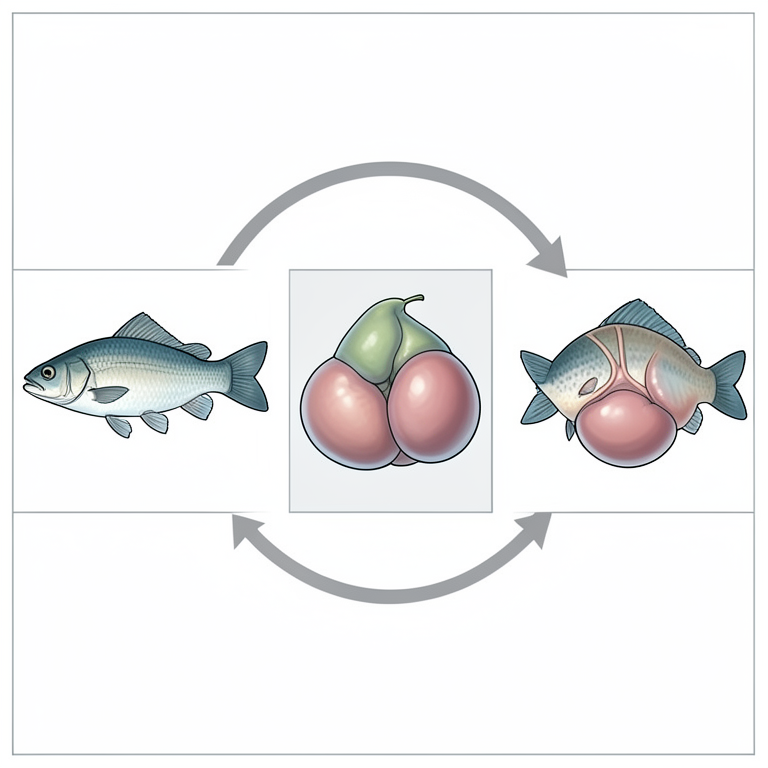
Seasonal Breeding Cycle
AI-generated conceptual illustration (Clarotes laticeps (African catfish)). It explains the idea and does not show study data.
View source evidence ↗Figures & tables
From the original paper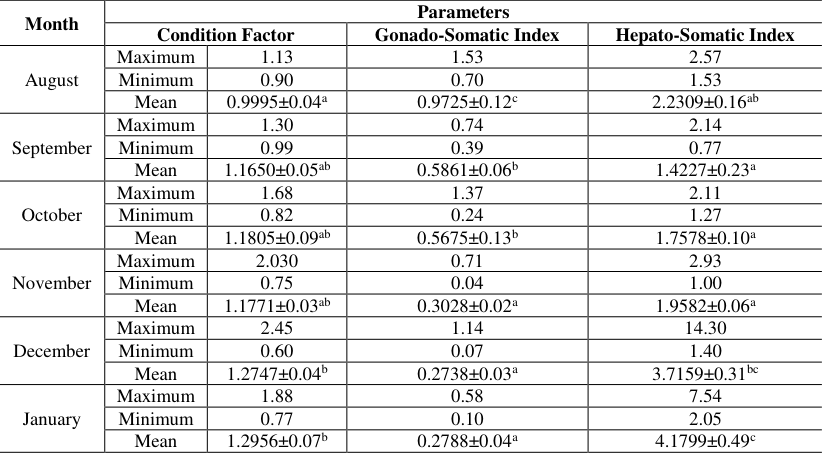 Table 1
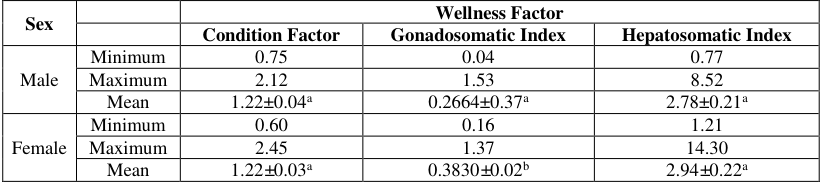 Table 2
 Table 3
Introduction
Fish leaves in an environment that is highly predisposed to various forms of factors that affect their well being. Such factors may include food availability, pollution and predation. Thus, the need to regularly examine the variations in the indices of health and wellbeing of the various species of fish in different bodies of water. Analyses of Condition Factor, Hepatosomatic index and Gonadosomatic index of fish could offer information on the general health condition of the organisms. Somatic (body) conditions that are often used in fish biology during field research are the Hepatosomatic index to identify possible liver diseases, the Gonadosomatic index to determine the reproductive development and the condition factor to assess the general condition of fish (Van der Oost et al., 2003) [34] . This is because they are inexpensive, non-lethal alternatives to proximate analysis of tissues (Craig et al., 2005) [8] . Also, Ekanem (2000) [10] and Allison et al. (2008) [3] has affirmed that condition factor and gonadosomatic index are two reliable somatic indices that can be used to determine the spawning periods in tropical fishes. Condition factor is an index of the degree of fatness or well being of a species which may be used to determine the reproductive time of fish without sacrificing the fish (Haruna and Bichi, 2005; Arellano-Martinez and Ceballosvazquez, 2001) [19,4] . A high condition factor reflects good environmental quality; while a low condition factor reflects poor environmental quality. Condition factors of different tropical fish species based on size, sex, maturity stages as well as seasons have been investigated and reported by different authors such as Saliu (2001) [30] and Lizama et al. (2002) [28] . Knowledge on reproductive biology of fish is essential for evaluating the commercial potentialities of its stock, life history, culture practice and management of its fishery (Islam et al., 2012) [2] . Reproductive potential of a population is one of the basic exigencies to designate the individuals of that population in respect to their gonadal conditions (Akter et al., 2012) [2] . One of the most reliable methods of the determination of the reproductive potentials of fish is the examination of the Gonado-Somatic Index.
Gonado-Somatic Index (GSI) is the ratio of gonad weight to body weight used to estimate reproductive condition. Reproduction is the most critical stage in the life cycle of a species, which determines its survival. GSI is generally indicative of reproductive success (and general water quality). Hepatosomatic Index (HSI) is defined as the ratio of liver weight to body weight. It provides an indication on status of energy reserve in an animal. In a poor environment, fish usually have a smaller liver (with less energy reserved in the liver). HSI has been reported to decrease in fish exposed to high concentrations of cadmium and zinc. The liver also serves as the main and important detoxifying organ in fish that is essential for both the metabolism and the excretion of toxic substances in the body (van Dyk et al., 2007) [35] and several categories of hepatocellular pathology are now regarded as reliable biomarkers of toxic injury and representative of biological endpoints of contaminant exposure (Stentiford et al., 2003; Feist et al., 2004; ICES, 2006) [32,14] . Clarotes laticeps is a freshwater, ray-finned (Actinopterygii) fish and a member of the family Claroteidae that inhabits water column and bottom (demersal) waters of swamps, streams, rivers and lakes (Idodo-Umeh, 2003) [22] . It is mostly found in African water bodies such as Rivers Niger, Benue, Nile and Lakes Volta and Chad (Baensch and Riehl, 1991; Eccles, 1992) [7,9] . It is a seasonal fish but found in abundance in the rainy season, feeding on crustaceans, insects, mollusks and small fish (Idodo-Umeh, 2003; Azeroual et al., 2010) [5,22] . Juveniles of Clarotes laticeps are usually common in the catches of artisanal fishermen around Benue River from December (Eccles, 1992) [9] and this marks the beginning of the recruitment process in the fishery. A specimen of Clarotes laticeps weighing up to 10kg and having up to 80cm standard length has been reported by Ita (1984) [24] and Lewis (1974) [27] . Despite been a commercial fish, Clarotes laticeps has a status of Least Concerned (LC) and Harmless to human on the International Union of Conservation of Nature (IUCN) Red List (Azeroual et al., 2010; IUCN, 2014) [5] . It has a phylogenetic Diversity Index (PD50) of 0.7500 of which the normal range is usually from 0.5 (low) to 2.0 (high) (Faith et al., 2004) [12] .
Materials and Methods Study Locations, Sample Collection and Identification
One hundred and fifty seven (157) Samples of Clarotes laticeps were collected from Wadata landing site in Makurdi, Benue state as well as from the catches of the fishermen operating between Abinsi and Wadata axis of Lower River Benue in Makurdi, Benue State. Samples were collected on monthly basis from August, 2014 to January, 2015 from the catches of fishermen using Traps, Cast Nets as well as Hooks and Line in River Benue. The samples were transported to the laboratory in plastic containers with open tops. Identification of fish samples was carried out using fish identification guides by Froese and Pauly (2015) [15] , Babatunde and Raji (2014) [6] and Idodo Umeh (2004). Laboratory analysis were carried out at the General Purpose Laboratory of the Department of Fisheries and Aquaculture, University of Agriculture, Makurdi, Benue State.
Experimental Procedures
The various weights and length measurements involved were taken using Electronic balance (Model HC-D) and graded meter rule respectively while the experiments involved in the research were carried out according to the procedures stated below. Determination of Gonado-Somatic Index (GSI) Determination of maturity stages of gonads of fish by visual examination using maturity keys lacks precision because it relies upon subjective judgment. The Gonado-Somatic Index was measured as follows:
(Schaefer and Orange 1956) [31] .
Determination of Hepatosomatic Index (HIS)
The fish liver were carefully detached from the gut of the fish and weighed to the nearest 0.01g. The Hepatosomatic index was then determined using the following formular;
Determination of Condition Factor
The condition factor which shows the degree of well-being of the fish in their habitat was determined by using the equation:
(Gomiero and Braga, 2005) [18] .
Where by "K" is the Condition Factor "W" is the Total Body Weight of the fish in gram (g) "L" is the Total Length of the fish in centimeters (cm)
Results
Table 1 shows the mean condition indices of Clarotes laticeps from Lower River Benue. The maximum mean condition factor of 1.1805±0.09 and minimum of 0.9995±0.04 were recorded in October and August respectively, ranging from 0.60 to 2.45. Maximum mean Gonadosomatic Index of 0.9725±0.12 and minimum of 0.2738±0.03 were recorded in August and December respectively with a range of 0.04-1.53. The Hepatosomatic Index had the highest value of 4.1799±0.49 and lowest value of 1.4227±0.23 in January and September respectively, ranging from 0.77 to 14.30. Table 2 shows the mean condition indices of the two sexes of Clarotes laticeps from Lower River Benue. Both the male and female show the same level of wellness, having condition factor of 1.22±0.03 while the female has the highest Gonadosomatic and Hepatosomatic indices of 0.3830±0.02 and 2.94±0.22 respectively. Table 3 shows the correlation coefficients of some selected parameters of Clarotes laticeps from Lower River Benue. Significant positive correlation exists between month and sex, month and condition factor, month and hepato-somatic index, total length and total body weight, sex and gonadosomatic index as well as hepato-somatic index and gonadosomatic index. However, significant negative correlation exists between month and total length, month and total body International Journal of Biology Sciences https://www.biologyjournal.net/ weight, month and gonado-somatic index, sex and total body weight, total length and condition factor, total length and hepato-somatic index, total body weight and hepato-somatic index, condition factor and Hepatosomatic index as well as condition factor and gonado-somatic index. *Correlation is significant at 0.05 "P" level
| — | Month | Sex | Total Length | Total Body Weight | Condition Factor | Hepato-Somatic Index | Gonado-Somatic Index |
|---|---|---|---|---|---|---|---|
| Month | 1 | ||||||
| Sex | 0.168* | 1 | |||||
| Total Length | -0.506* | 0.056 | 1 | ||||
| Total Body Weight | -0.430* | -0.018 | 0.862* | 1 | |||
| Condition Factor | 0.209* | 0.002 | -0.199* | 0.094 | 1 | ||
| Hepato-Somatic Index | 0.391* | 0.041 | -0.680* | -0.545* | -0.201* | 1 | |
| Gonado-Somatic Index | -0.518* | 0.229* | -0.027 | -0.016 | -0.263* | 0.211* | 1 |
Table text extracted from the original PDF; superscript letters are shown inline. The original table image is below.
View original table image
| Sex | — | Wellness Factor | — | — |
|---|---|---|---|---|
| Condition Factor | Gonadosomatic Index | Hepatosomatic Index | ||
| Male | Minimum | 0.75 | 0.04 | 0.77 |
| Maximum | 2.12 | 1.53 | 8.52 | |
| Mean | 1.22±0.04a | 0.2664±0.37a | 2.78±0.21a | |
| Female | Minimum | 0.60 | 0.16 | 1.21 |
| Maximum | 2.45 | 1.37 | 14.30 | |
| Mean | 1.22±0.03a | 0.3830±0.02b | 2.94±0.22a |
Table text extracted from the original PDF; superscript letters are shown inline. The original table image is below.
View original table image
| Month | Parameters | — | — | — |
|---|---|---|---|---|
| Condition Factor | Gonado-Somatic Index | Hepato-Somatic Index | ||
| August | Maximum | 1.13 | 1.53 | 2.57 |
| Minimum | 0.90 | 0.70 | 1.53 | |
| Mean | 0.9995±0.04a | 0.9725±0.12c | 2.2309±0.16ab | |
| September | Maximum | 1.30 | 0.74 | 2.14 |
| Minimum | 0.99 | 0.39 | 0.77 | |
| Mean | 1.1650±0.05ab | 0.5861±0.06b | 1.4227±0.23a | |
| October | Maximum | 1.68 | 1.37 | 2.11 |
| Minimum | 0.82 | 0.24 | 1.27 | |
| Mean | 1.1805±0.09ab | 0.5675±0.13b | 1.7578±0.10a | |
| November | Maximum | 2.030 | 0.71 | 2.93 |
| Minimum | 0.75 | 0.04 | 1.00 | |
| Mean | 1.1771±0.03ab | 0.3028±0.02a | 1.9582±0.06a | |
| December | Maximum | 2.45 | 1.14 | 14.30 |
| Minimum | 0.60 | 0.07 | 1.40 | |
| Mean | 1.2747±0.04b | 0.2738±0.03a | 3.7159±0.31bc | |
| January | Maximum | 1.88 | 0.58 | 7.54 |
| Minimum | 0.77 | 0.10 | 2.05 | |
| Mean | 1.2956±0.07b | 0.2788±0.04a | 4.1799±0.49c |
Table text extracted from the original PDF; superscript letters are shown inline. The original table image is below.
View original table image
Discussion
The highest condition factor was recorded in January while the least was recorded in August. Also, a nearly increasing trend in the condition factor was observed from September to January. The high condition factor in January could have resulted from a lot of factors among which is less pollution from run-offs into the river. This was because there was no rainfall at this period which could have brought different impurities from different non-point pollution sources into the river. Also, in the months of December and January were the least Gonadosomatic Indices recorded which signifies low or no reproductive activities in the community of Clarotes laticeps in Lower River Benue. This could have had effect on the condition factor of the species as the condition factor of fish increases during the period when the fish is not involved in any reproductive activities. This could also be confirmed in the month of August when the least condition factor and the highest Gonadosomatic Index were recorded. It could therefore be inferred that Clarotes laticeps from Lower River Benue breed around the months of August and September as the Gonadosomatic Indices recorded in these months are closer to one (1) while the month of January could be described as the off breeding month. This knowledge of the Gonadosomatic index favours Clarotes laticeps as an aquaculture candidate as stressed by Ghanbahadur and Ghanbahadur (2012) [16] . The declining trend of observed in the gonadosomattic index of this species shows that it does not breed from the month of September to January. These months could be described as the post spawning and preparatory phases of breeding in the fish as pointed out by Quyyam and Quasim (1961) [29] as well as Ghanbahadur and Ghanbahadur (2012) [16] in their observations on the Gonadosomatic indices of Ophiocephalus puntatus and Cyprinus carpio. However, the sharp decline observed in this study between the month of August and September gives an indication that August might have marked the end of spawning period in Clarotes laticeps in Lower River Benue. This is similar to the findings of Ekokotu and Olele (2014) [11] who observed the condition factor and the Gonadosomatic index of Clarotes laticeps in Lower River Niger to reach the peak values of 2.81 and 11.86 respectively in August but dropped to 2.05 and 0.75, respectively, in October. However, the suspected breeding season in this study can only be said to fall within the breeding period of April to November stated by Azeroual et al., (2010) [5] . Also, as seen in the Hepatosomatic Indices recorded in the months of sampling, the fish were able to store more food in the increasing trend from the month of September towards the month of January, with the highest Hepatosomatic Index recorded in January. This can be explained in line with the findings of Lenhardt et al. (2009) [26] who discovered seasonal variation in the Hepatosomatic index of Sterlet (Acipenser ruthenus), ranging between 1.14 and 6.67 due to variation in food availability throughout the year and as confirmed by Yang and Baumann (2006) [36] who stated that Hepatosomatic index depends on seasonal cycle that affects food availability. Availability of more food for storage could have resulted from less utilisation of food on other activities such as reproduction because reproduction in animals has been seen as one of the metabolic activities that takes higher percentage of energy. Another factor that could be responsible for the variation in the Hepatosomatic index of the fish is pollution and stress as shown by Ada (2013) [1] while monitoring the Gonado-hepato-somatic index of Oreochromis niloticus exposed to some herbicides as well as Tilak et al. (2007) [33] . The inverse relationship observed between the Gonadosomatic index and the Hepatosomatic index of Clarotes laticeps was earlier pointed out by Gomex-Marquez et al. (2003) [17] when it was noted that hepatosomatic index has an inverse relationship with gonadosomatic index in Oreochromis niloticus. The equal mean condition factors observed between the male and female Clarotes laticeps shows that food and other environmental conditions are all available to the male and female equally. Also, higher Gonadosomatic Index shows that the female gets ripped sexually earlier than the male counterpart. This is in conformity with the findings of Fawole and Arawono (2000) [13] who observed the gonadosomatic index of Sarotherodon galilaeus in Ile-Ife, Nigeria to be 0.33± 0.21 for males and 1.88±1.01 for females. The higher Hepatosomatic Index observed in the female also buttress the fact that the female need to store more food to cater for the energy needed for development of eggs and ovulation.
References
21 in the original paper- Ada. Ganado-hepato-somatic index of Oreochromis niloticus sub adults exposed to some herbicides, International Journal of Aquaculture. 2013;3(11):49-54. doi: 10.5376/ija.2013. 03.0011
- Akter H, Islam MR, Belal Hossain M. Fecundity and gonado-somatic index (GSI) of Corsula, Rhinomugil corsula Hamilton, 1822 (Family: Mugilidae) from the Lower Meghna River Estuary, Bangladesh. Global Veterinaria. 2012;9(2):129-132.
- Allison ME, Sikoki FD, Vincent-Abu IF. Fecundity, Sex ratio, maturity stages, size at first maturity, breeding and spawning of Parailia pellucid (Boulenger, 1901) in the lower Nun River, Niger Delta, Nigeria. Caderno de pesquisa Serie Biologia. 2008;20(2):31-40.
- Arellano-Martinez M, Ceballosvazquez BP. Reproductive activity and condition index of Holocanthus passer (Teleostei: Pomacanthidae) in the Gulf of California, Mexico, Revita Biologia Trop. 2001;49:939-943.
- Azeroual A, Entsua-Mensah M, Getahun A, Lalèyè P. Clarotes laticeps. In: IUCN 2013. IUCN Red List of Threatened Species. Version 2013.1. 2010. <http://www.iucnredlist.org/>
- Babatunde DO, Raji A. Field guides to Nigerian Freshwater Fishes. Revised Edition. 2014. ISBN 97834760: 0-9.
- Baensch HA, Riehl R. Aquarien atlas. Bd. 3. Melle: Mergus, Verlag für Natur-und Heimtierkunde, Germany. 1991, 1104.
- Craig JM, Thomas MV, Nichols SJ. Length-weight relationship and a relative condition factor equation for lake sturgeon (Acipenser fulvescens) from the St Clair River system (Michigan, USA). Journal of Applied Ichthyology. 2005;21:81-85.
- Eccles DH. FAO species identification sheets for fishery purposes. Field guide to the freshwater, 1992. fishes of Tanzania. Prepared and published with the support of the United Nations Development Programme (project URT/87/016). FAO, Rome. 145p.
- Ekanem SB. Some reproductive aspects of Chrysichyes nigrodigitatus (Lacepede) from Cross River, Nigeria, Naga Iclarms Quartely. 2000;23:24-28.
- Ekokotu PA, Olele NF. Cycle of gonad maturation, condition index and spawning of Clarotes laticeps (Claroteidae) in the Lower River Niger. International Journal of Fisheries and Aquatic Studies. 2014;1(6):144-150.
- Faith DP, Reid CAM, Hunter J. Integrating phylogenetic diversity, complementarity, and endemism for conservation assessment, Conservation Biology . 2004;18(1):255-261.
- Fawole OO, Arawono GAO. Fecundity of Sarotherodon galilaeus (Pisces: Cichlidae) in the Opa Reservoir, Ile-Ife, Nigeria, Revista de Biologia Tropical. 2000;48(1):1-4.
- Feist SW, Lang T, Stentiford GD, Köhler A. The use of liver pathology of the European flatfish, dab (Limanda limanda L.) and flounder (Platichthys flesus L.) for monitoring biological effects of contaminants. ICES Techniques in Marine Environmental Science. 2004:28:47.
- Froese R, Pauly D. Editors. Fish Base. World Wide Web electronic publication. www.fishbase.org, (02/2015 ) 2015.
- Ghanbahadur AG, Ghanbahadur GR. Study Of Gonadosomatic Index of fresh water fish Cyprinus carpio, 2012. www.sciencejournal.in Retrieved 27/3/2013.
- Stentiford GD, Longshaw M, Lyons BP, Jones GJ, Green M, Feist SW. Histopathological biomarkers in estuarine fish species for the assessment of biological effects of contaminants. Marine Environmental Research. 2003;55(2):137-159.
- Tilak KS, Veeraiah K, Thathaji PB, Butchiram MS. Toxicity studies of butachlor to fresh water fish, Channa puntata (Bloch), Journal of Environmental Biology. 2007;28(2):485-487. PMid:17929770
- Van der Oost R, Beyer J, Vermeulen NPE. Fish bioaccumulation and biomarkers in environmental risk assessment: A review. Environmental Toxicology and Pharmacology. 2003;13:57-149.
- Van Dyk JC, Pieterse GM, van Vuren JHJ. Histological changes in the liver of Oreochromis mossambicus (Cichlidae) after exposure to cadmium and zinc. Ecotoxology and Environmental Safety. 2007;66:432440.
- Yang X, Baumann PC. Biliary PAH metabolites and the hepatosomatic index of brown bullheads from Lake Erie tributaries. Ecological Indicators. 2006;6:567-574.