
Research article · 2019 · Full text
International Journal of Agriculture and NutritionPerceived relevance of extension methods used to disseminate faro-44 rice variety to rice farmers in Kogi state, Nigeria
Volume 1(1) · Pages 19–21 · DOI: 10.33545/26646064.2019.v1.i1a.4 ↗
Research areasAgricultural Innovations and Practices
Abstract
Author-writtenThis study examined the perception of farmers as regards the relevance of extension methods used to disseminate FARO-44 rice variety in Ibaji local Government Area of Kogi state, Nigeria. Objectives were to; determine the method used to disseminate FARO-44 rice variety and examine the level of adoption of FARO-44 rice variety. Random sampling technique was used in the selection of a total of 120 respondents for the study. Data collected were analyzed using descriptive statistics and mean score. Result demonstration was found to be the most reliable method used to disseminate Faro-44 rice variety, with frequency of 65% and a mean score of 2.43. The study shows that majority of the respondents (99.2%) were aware of FARO-44 rice variety. Results from the study also revealed that, the adoption rate of Faro-44 rice variety by the farmers was high at 73%. The result also shows that the Extension Agents in the study area used mostly the result demonstration method in disseminating the FARO-44 rice variety to the farmers in the study area. This study, therefore recommends that, extension agents should be encouraged to sustain and improve on the use of result demonstration method in disseminating all new technologies and innovation as this study has shown that, the method is very reliable and capable of increasing and sustaining adoption rate of new technologies among other teaching methods in the study area.
Summary
Source-checkedPlain-language reading of the full paper, prepared with AI and checked against the text. Each point links to the authors' own words.
Why it matters
- Rice is a critical global staple food, serving as the primary food source for approximately half of the world's population. View evidence ↗
- Nigeria faces a gap between rising domestic rice consumption and insufficient local production, leading to a heavy reliance on imports. View evidence ↗
- The FARO-44 rice variety is a hybrid designed for Nigerian farmers, offering benefits such as higher yields, blast resistance, and early maturity within 110 to 120 days. View evidence ↗
The question
- The study aimed to identify the extension methods used to disseminate FARO-44 rice and determine the extent to which farmers adopted the variety. View evidence ↗
What they did
- The researchers used a three-stage purposive random sampling method to select 120 farmers from Zone D of Kogi State, Nigeria. View evidence ↗
- Data was gathered via structured questionnaires and analyzed using frequency distributions, percentages, and mean scores. View evidence ↗
- The reliability of extension methods was measured using a three-point Likert scale, where 3 represented 'most reliable' and 1 represented 'not reliable'. View evidence ↗
What they found
- Result demonstration was identified as the most reliable dissemination method, with a mean score of 2.43 and a frequency of 65%. View evidence ↗
- Awareness of the FARO-44 variety was nearly universal, with 99.2% of respondents having heard of it. View evidence ↗
- The adoption of FARO-44 was high, with 99.2% of respondents using it on their land, though the specific adoption rate was reported as 73%. View evidence ↗
- Usage duration varied, with 45.0% of farmers using the variety for over 7 years, 37.5% for 6 years, and 17.5% for 5 years or less. View evidence ↗
What it means
- The authors recommend that extension agents continue and improve the use of result demonstrations, as it is the most effective method for increasing and sustaining the adoption of new technologies in the region. View evidence ↗
Visual summary
2 visualsIllustrations explain the paper; charts are replotted from the paper's own table values.
Extension Method to Adoption Flow
AI-generated conceptual illustration (FARO-44 rice plants). It explains the idea and does not show study data.
View source evidence ↗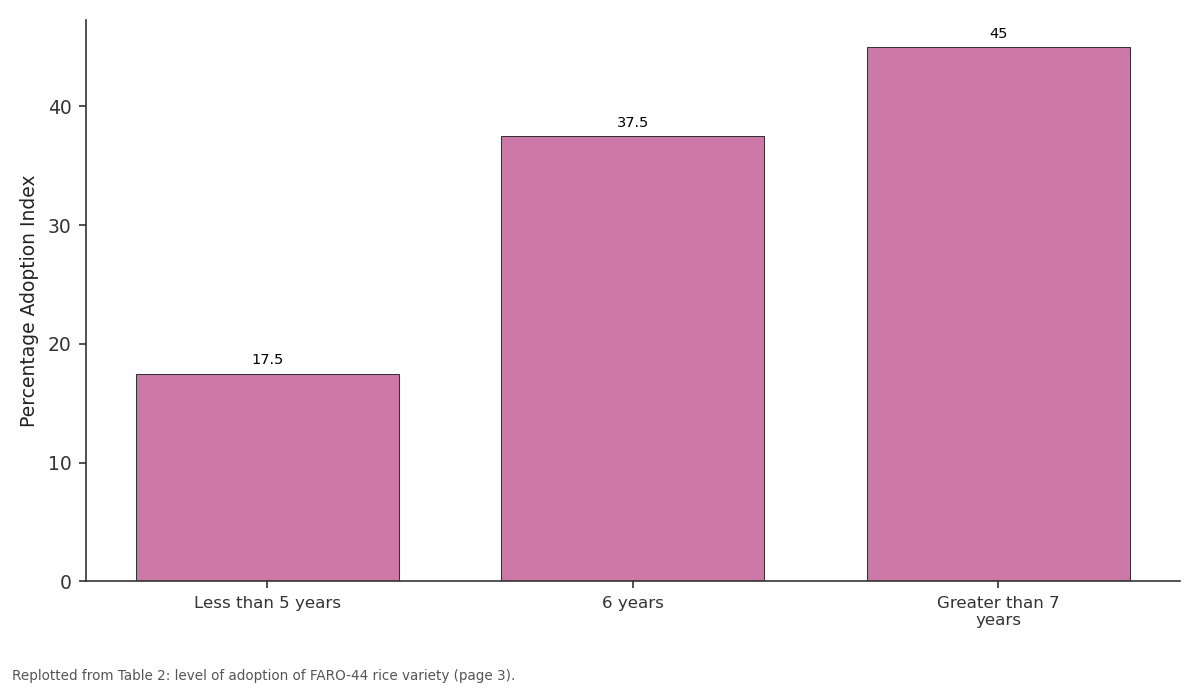
Percentage Adoption Index: Less than 5 years vs 6 years vs Greater than 7 years
Replotted from Table 2 (page 3) of the original paper. Every bar is the paper's own table value.
View source evidence ↗Figures & tables
From the original paper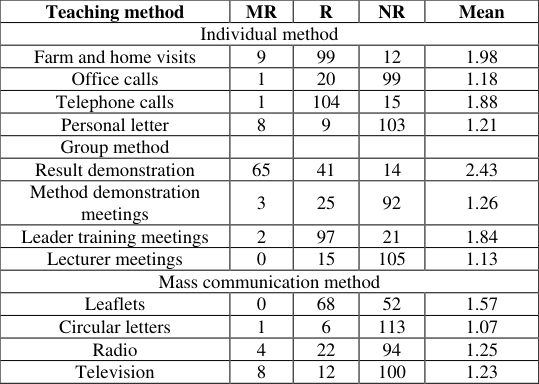 Table 1
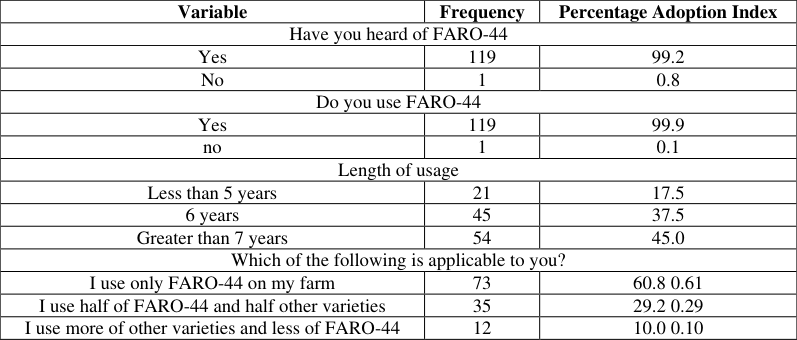 Table 2
Introduction
Rice (Oryza sativa) is a staple food in many countries of Africa and other parts of the world. This is the most important staple food for about half of the human race (Imolehim and Wada, 2000). Saka and Lawal (2009) [10] classified rice as the most important food depended upon by over 50 percent of the World population for about 80 percent of their food need. Due to the growing importance of the crop, Food and Agricultural Organization (2001) [5] estimated that annual rice production should be increased from 586 million metric tons in 2001 to meet the projected global demand of about 756 million metric tons by 2030. Research has shown that production and processing technologies have not been able to meet the increasing demand for rice (FAO, 2001) [5] . In the West African sub region, Nigeria has experienced a well-established growing demand for rice caused by rising per capita consumption and consequently the insufficient domestic production had to be complemented with enormous import both in quantity and value at various times (Saka and Lawal, 2009) [10] . According to United State Agency for International Development (USAID,2010) [11] , Nigeria's rice sub sector is dominated by weak and insufficient producermarket linkage due to poor infrastructure and limited efficiency of distribution network which has resulted in low productivity and participation of farmers in the rice field. In order to reduce the rate of rice importation, Saka and Lawal (2009) [10] were of the opinion that disseminating knowledge on improved varieties and other modern inputs as a composite package to rice farmers is very important. Negash (2007) [8] defined adoption as the integration of an innovation into farmers' normal farming activities over an extended period of time. More so, adoption is not a permanent behavior, this implies that an individual may decide to discontinue the use of an innovation for a variety of personal, institutional, and social reasons, one of which might be the availability of another practice that is better in satisfying farmers' need. Nwite, Igwe and Wakatsuki (2008) [9] indicated that the adoption of technologies and improved management practices should lead to substantial yield increase in rice production. Adoption of an innovation within a social system takes place through its adoption by individuals or groups. As a result of this, International Rice Research Institute (IRRI) (1996) opined that new rice varieties that combine higher yield potential with excellent grain quality, resistance to biotic and abiotic stress and input use efficiency are desperately needed to reduce the importation of foreign rice. Kebede (2001) [7] indicated that growth in production can be gained through the use of technologies and allocative efficiencies of farmers in response to the changing techniques and production environment. Hence, adoption of technologies should lead to substantial yield increase. USAID (2010) [11] asserted that Nigerian market recommends the following improved varieties based on the demonstrated evidence of high yield by research institutes and the outcome of project intervention in the previous years; lowland rain-fed and irrigated rice -FARO 44 (sippi 692033) and FARO 52 (WITA -4). Upland varieties are FARO-46 (ITA 150) and FARO 55 (Nerica-1). FARO means Federal Agriculture Research Oryza. It originated from Taiwan and has national code as NGOs-9144. According to National Centre for Genetic Resources and Biotechnology (NCGRBC) (2009), FARO-44 was released and registered in the year 1990 and 1991. However, FARO-44 was developed by the following institutes: West Africa Rice Development Association (WARDA), International Institute of Tropical Agriculture (IITA) and National Cereal Research Institute (NCRI). FARO 44 (Sippi 692033) is an interspecific hybrid between the local African rice and Taiwan rice which brings new opportunities for farmers in Nigeria. FARO 44 variety has unique characteristics such as early maturity(110 -120 days) earlier than traditional varieties, higher yield, tolerant to some stresses, resistant to blast, long grain etc (Dontsop et al 2011) [2] . Onimawo et al (2010) indicated that FARO 44 and 52 are medicinal for dietary management of diabetes due to their low glycemic indices when compared to other varieties. Therefore, to increase the competitiveness of Nigerian rice producers, FARO 44 (sippi) was introduced to farmers due to its early maturity and good quality grain. Since independence in 1960, programme implementation aimed at small holder farmers' socio-economic improvement as well rural community development has been on the front burner of every national discuss by successive governments (Ebenehi et al 2012) [3] . The researcher has observed that there is a synergy between the Federal Government, State Governments, and several organizations, and institutions, agencies with extension agents in the execution of programmes directed at altering the skills, attitude and knowledge of the rural dwellers in the rural areas who are mostly farmers. The fore-going is consistent with the definition of agricultural extension which is helping the farmers to help themselves. Therefore strategies and tools for improving local access to hightech agro-based and new innovations are sure pre-requisite to improving the standard of living, ensuring food security and reducing vulnerability. In addressing the above, there is the dare need to identify wide range of approaches and methodologies in developing strategies for diffusing innovations gotten from the research institutes, also identifying the communication or method of delivery that widened access by all and sundry to new innovations (Agbamu 1998) [1] . FARO-44 is a variety of rice that was introduced to farmers in the locality along with other technologies and needed innovation by the extension agents in the study area. The variety has been out for quite some time now. It is on the strength of this that this research seeks to: ascertain the extension method used by the Extension Agents in the study area to disseminate the improved rice varieties and its associated practices and to determine the level of adoption of the recommended practices by the Extension Agents in relation to the FARO-44 rice variety.
Methodology
The study area for this research is Kogi State. The state was created in 1991 from parts of Kwara and Benue states. There are three main ethnic groups and languages: Igala, Ebira, and Okun with other minor ethnic groups such as Bassa, Nupe, Gwari, Kakanda, Oworo Ogori, Magongo, Idoma and the Eggans. Kogi State is popularly called the Confluence State because the confluence of Rivers Niger and River Benue at its capital in Lokoja, which was the first administrative capital of modern-day Nigeria. It has an estimated population of (3,314,043) 137, 8641,888 million people projected to 2019 using the growth rate index of 3.2 (National Population Commission, 2006), with an area measured at 29,833 km 2 . Geographically, Kogi State is located at 7°30′N 6°42′E of the equator. Agriculture is the mainstay of the economy, Kogi State has four agricultural zones namely: zones A, with headquarter at Aiyetoro, B, has its headquarter at Dekina, C has it's headquarter at Okene and D has it's headquarter at Alloma and there are many Farm produce from the state notably palm oil, cashew, groundnuts, maize, cassava, yam, rice and melon. Mineral resources include coal, limestone, iron, petroleum and tin. A 3-stage purposive random sampling technique was used in selecting the respondents for this study. Zone D was purposely selected, firstly one extension block was purposively selected based on prominence and dominance of rice cultivation. Secondly, eight extension cells were randomly selected from the extension block, thirdly, fifteen (15) respondents/farmers were randomly selected from each, making a total of 120 respondents/Farmers. Data was collected through a structured questionnaire. In analyzing the data, inferential statistics was adopted. This involve the use of frequency distribution, percentages and mean score. The teaching method used to disseminate FARO-44 technology in Kogi State was achieved using a three point Likert-type scale. Model Specification: Most reliable =3, Reliable = 2, Not reliable=1
Results and Discussion
Table 1 shows that the major teaching methods from the survey in mean score shows that result demonstration (M2.43) is the most reliable teaching method used to disseminate FARO-44 rice production technologies. Followed by farm and home visits (M1.98), then telephone calls (M1.88), and finally, leader training meetings (M1.84). Farmers who are members of any agricultural organization have opportunity to learn new ideas about agro inputs, and improve their level of adoption. Table 2 shows that, majority (99.2%) of the respondents heard about FARO-44 rice variety, while only (0.8%) had no idea about the variety. Similarly, (99.2%) of the respondents used FARO-44 rice variety on their farm land. Furthermore, (45.0%) of the respondents have been using FARO-44 for more than 7 years, (37.5%) within the last 6 years, while (17.5%) have been using it in not more than 5 years. These-survey also shows that majority of the respondents (60.8%) use only FARO-44 rice variety on their farm land, (29.2%) use half of FARO-44 and half other varieties, while (10.0%) use more of other varieties and less of FARO-44 rice variety.
| Variable | Frequency | Percentage Adoption Index |
|---|---|---|
| Have you heard of FARO-44 | ||
| Yes | 119 | 99.2 |
| No | 1 | 0.8 |
| Do you use FARO-44 | ||
| Yes | 119 | 99.9 |
| no | 1 | 0.1 |
| Length of usage | ||
| Less than 5 years | 21 | 17.5 |
| 6 years | 45 | 37.5 |
| Greater than 7 years | 54 | 45.0 |
| Which of the following is applicable to you? | ||
| I use only FARO-44 on my farm | 73 | 60.8 0.61 |
| I use half of FARO-44 and half other varieties | 35 | 29.2 0.29 |
| I use more of other varieties and less of FARO-44 | 12 | 10.0 0.10 |
Table text extracted from the original PDF; superscript letters are shown inline. The original table image is below.
View original table image
| Teaching method | MR | R | NR | Mean |
|---|---|---|---|---|
| Individual method | ||||
| Farm and home visits | 9 | 99 | 12 | 1.98 |
| Office calls | 1 | 20 | 99 | 1.18 |
| Telephone calls | 1 | 104 | 15 | 1.88 |
| Personal letter | 8 | 9 | 103 | 1.21 |
| Group method | ||||
| Result demonstration | 65 | 41 | 14 | 2.43 |
| Method demonstration meetings | 3 | 25 | 92 | 1.26 |
| Leader training meetings | 2 | 97 | 21 | 1.84 |
| Lecturer meetings | 0 | 15 | 105 | 1.13 |
| Mass communication method | ||||
| Leaflets | 0 | 68 | 52 | 1.57 |
| Circular letters | 1 | 6 | 113 | 1.07 |
| Radio | 4 | 22 | 94 | 1.25 |
| Television | 8 | 12 | 100 | 1.23 |
Table text extracted from the original PDF; superscript letters are shown inline. The original table image is below.
View original table image
Conclusions and Recommendations
Based on the findings of this study, the major teaching method from the survey shows that result demonstration with mean score (M2.43) is the most reliable teaching method used to disseminate FARO-44 rice production technologies and it has been adopted and been in use for more than seven (7) years. With regards to the extent of adoption of FARO-44 rice production technologies. These study shows that majority of the respondents (99.2%) were aware of FARO-44 rice variety which indicates that the adoption rate of FARO-44 rice production technologies was high. It is therefore recommended that: Extension Agents should be encouraged to sustain and improve on the use of result demonstration method in disseminating all new technology and innovation as this study has shown that it is most reliable and capable of increasing and sustaining adoption rate of new technologies among other teaching methods in the study area.
References
11 in the original paper- Agbamu JU. Categorization of prospective adopters and the implications for planning extension communication strategies. Journal of Agricultural and Rural Development. 1998; 6(1):8-16.
- Dontsop NP, Diagne A, Okoruwa VO, Ojehomom V. Impact of improved Rice technology on income and poverty among Rice farming Household in Nigeria: A Contributed Paper prepared for the 25th conference of the Centre for the Studies of African Economic (SAT) St. Catherine Collage, university of Oxford, UK, 2011, 20-22.
- Ebenehi ONM, Saddiq O, Oyinbo AA, Muhammad JO. Impact of the National Poverty Eradication Programme (NAPEP) on Rural Livelihood: In Kogi State, Nigeria, Journal of science, Usman Danfodiyo University Zaria, Sokoto, 2012.
- FAO. Farming systems and poverty: improving farmers' livelihoods in a change world. Rome: Food and agricultural organization, 1999.
- FAO. Farming systems and poverty: improving farmers' livelihoods in a change world. Rome: Food and agricultural organization, 2001.
- Imolehin ED, Wada AC. Meeting the Rice Production and Consumption demand of Nigeria with improved Technologies. National Cereal Research Institute, Badeggi, P.M.B 8, Niger State, Nigeria, 2000, 1-11.
- Kebede TA. Farm household technical efficiency. A stochastic frontier analysis: An M.sc thesis submitted to the department of Economics and social sciences. Agricultural University of Norway, 2001, 1-66.
- Negash R. Determinants of Adoption of improved Haricot Bean production Package in Naba Special Woreda, Southern Ethiopia. An M.Sc. Thesis Submitted to the, 2007.
- Nwite JC, Igwe CA, Wakatsuki T. Evaluation of Sawah rice Management system in Inland Valley in south -eastern Nigeria, Soil Chemical Properties and Yield. Paddy Water Enviroment. 2008; 6(3):299-307.
- Saka JO, Lawal BO. Determinants of adoption and productivity of improved rice varieties in south western Nigeria. African Journal of Biotechnology. 2009; 8(19):4923-4932.
- United State Agency for International Development (USAID). Improved packages of practices for rice production, 2010, 1-22.
Cited by 3
From OpenAlex, OpenCitations and reference lists read by Scinovex
- Understanding the Nexus of Extension Teaching Methods and Adoption of Improved Agricultural Production Technologies: Empirical Evidence from Cowpea Farmers in Kogi State, Nigeria ↗
Adejo Patrick Emmanuel, Shaibu Damilola Omojola, U Shaibu · Tekirdağ Ziraat Fakültesi Dergisi · 2025
This study assessed the nexus of extension teaching methods and the adoption of improved production technologies. A three-staged sampling technique was adopted in selecting two hundred (200) cowpea farmers. Primary data obtained using the Kobocollect toolbox was analyzed with adoption score/index and ordered probit regression model. Findings from this study showed that 79 % of the respondents were males while…
❝ 1PDF - Factors Influencing the Adoption FARO-44 Rice among Smallholder Farmers in Anambra State, Nigeria ↗
Akaninyene Obot, Okeke C, Chilaka Precious, Festus Ifeanyi Onuoha · Canadian Journal of Agriculture and Crops · 2022
This study examined the factors determining the adoption of FARO-44 rice variety among smallholder farmers in Anambra State, Nigeria. A multi-stage sampling technique was employed in selecting the 175 respondents for the study. Primary data were collected with the use of a semi-structured questionnaire. Data was analyzed using descriptive statistics and regression model. The result revealed that majority of the…
❝ 1PDF - Emerging aquaculture technologies and biological interventions for improving fish growth, immunity, digestibility and production efficiency ↗
Abubakar Sadiq Adamu, Mohamed Abdi Mohamed, Dahir Mohamed Mohamud, Alhassan Abdullahi · International Journal of Fisheries and Aquatic Studies · 2026
Aquaculture has played a pivotal role in the global development and increase in agricultural productivity. Hence, the emergence and application of biological and technological innovations in this sector are crucial for solving food security obstacles, alleviating poverty, and providing enough quality protein to meet the growing population, especially in developing nations. Recent innovations such as recirculating aquaculture systems (RAS), aquaponics,