
Research article · 2019 · Full text
International Journal of Agriculture and NutritionEducation delivery methods and constraints influencing professional competencies of agricultural extension officers in Oyo and Ogun states, Nigeria
Volume 1(2) · Pages 01–07 · DOI: 10.33545/26646064.2019.v1.i2a.5 ↗
Research areasAgricultural Innovations and PracticesAgriculture and Rural Development Research
Abstract
Author-writtenThe study focused on education delivery methods and constraints influencing the professional competencies of extension officers in Oyo and Ogun states Nigeria. Simple random sampling procedure was used in selecting 84 extension officers from the study areas of which 80 of them completed and returned their questionnaires for analysis. Data were analysed using descriptive (percentage, mean) and inferential (PPMC, Multiple regression) statistics. The mean age of respondents was 46 years and the majority (65.0%) of them were male. Also most of them were; married (95.0%), had household size of 5-6 persons (53.8%) and had 9-16 years of job experience (40%). All the respondents had attained tertiary education with 47.5% of them at HND level. The most effective education strategy was FNT/MTRM ( =1.91) while the least effective was job shadowing ( =0.73). During in-service training (45.7%) was the most preferred period to acquire extension competencies, organisational management ( =19.70) was the most possessed competency while lack of funds ( =1.77) was the most severe constraint to acquiring competency. Education strategies explained about 51.7% of variance in the extension worker’s level of competence with short-term course/seminars (1-2 weeks) conducted at zonal level as the major predictor. It was recommended that the ADPs should adopt short-term courses/workshop held at zonal level as a major training method and also improve on the methodology used during FNT/MTRM to enhance competency development.
Summary
Source-checkedPlain-language reading of the full paper, prepared with AI and checked against the text. Each point links to the authors' own words.
Why it matters
- Agricultural Development Programmes (ADPs) in Nigeria aim to enhance the productivity, income, and overall well-being of small-scale farmers. View evidence ↗
- Professional competencies are critical for extension officers to perform their duties effectively and achieve the desired results for their clients. View evidence ↗
- A lack of subject matter knowledge can lead to a loss of confidence in extension workers when they interact with farmers. View evidence ↗
The question
- The study aimed to identify the education strategies and constraints that influence how extension officers acquire professional competencies. View evidence ↗
What they did
- The research used simple random sampling to select two agricultural zones from each of the two states: Oyo (Ibadan/Ibarapa and Oyo zones) and Ogun (Abeokuta and Ijebu zones). View evidence ↗
- The study interviewed all extension officers in the selected zones, totaling 84 respondents (27 from Ibadan/Ibarapa, 11 from Oyo, 28 from Abeokuta, and 18 from Ijebu). View evidence ↗
- The researchers used descriptive statistics (frequency, percentages, mean) for general objectives and PPMC and Multiple Regression analysis to test their hypotheses. View evidence ↗
What they found
- Fortnight training (FNT)/monthly technology review meetings (MTRM) were rated as the most effective delivery method (mean=1.91), while job shadowing was the least effective (mean=0.73). View evidence ↗
- In-service training was the most preferred period for acquiring competencies (45.7%), followed by induction training (22.8%). View evidence ↗
- The most possessed competency was organizational management (mean=19.70), while the least possessed was information communication technology (mean=13.64). View evidence ↗
- Lack of funding was identified as the most severe constraint to acquiring competency (mean=1.77), followed by increased personal costs (mean=1.47). View evidence ↗
- Education strategies explained 51.7% of the variance in the extension workers' level of competence, a result that was statistically significant (p=0.003). View evidence ↗
- There is a significant negative relationship (r=-0.292, p=0.009) between the severity of constraints and the competency level of the officers. View evidence ↗
What it means
- The authors recommend that ADPs organize annual in-service training programs to improve the competency levels of extension officers across all areas. View evidence ↗
- The authors suggest adopting short-term zonal workshops as a primary training method and improving the methodology of FNT/MTRM. View evidence ↗
Visual summary
3 visualsIllustrations explain the paper; charts are replotted from the paper's own table values.
Impact of Constraints on Competency
AI-generated conceptual illustration (Agricultural extension officers in rural Nigerian farmland). It explains the idea and does not show study data.
View source evidence ↗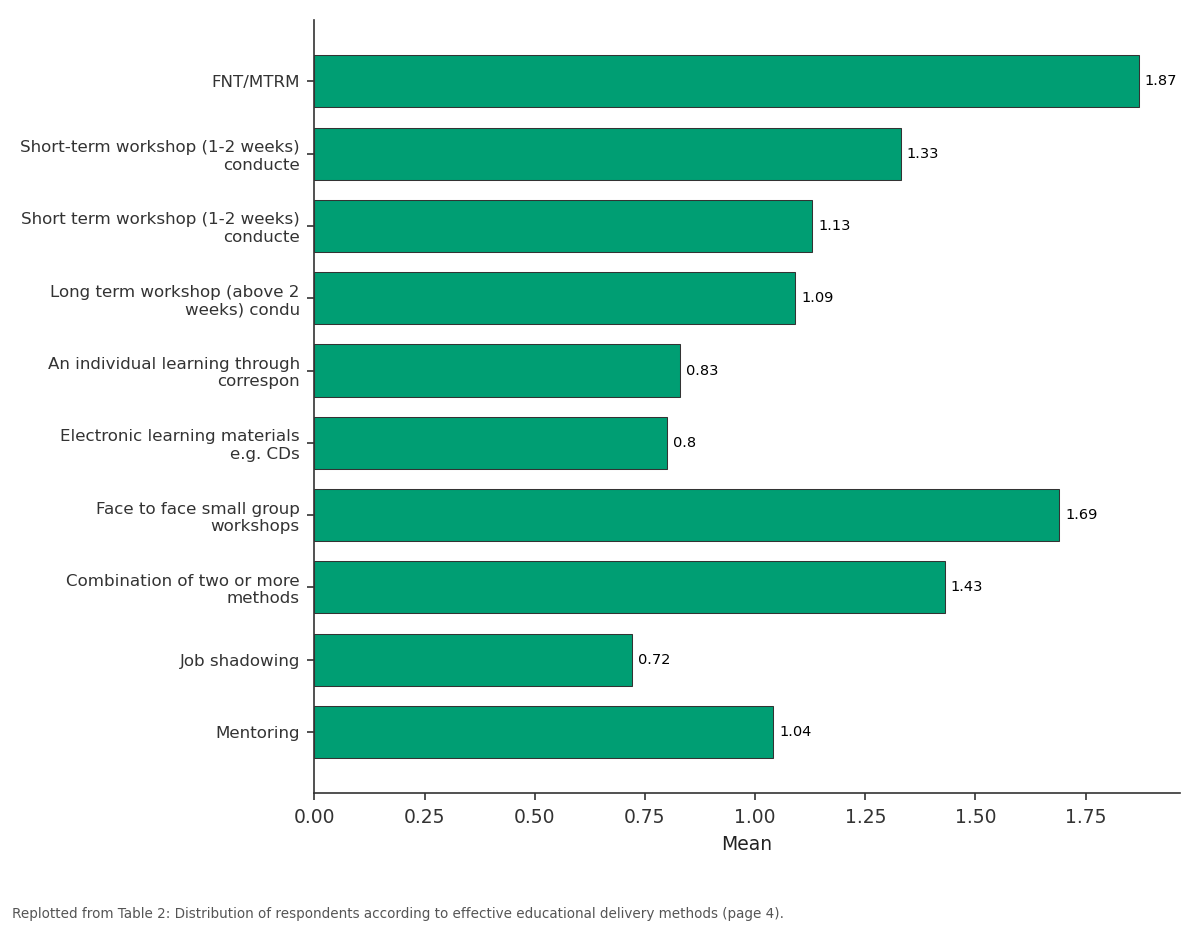
Ogun Mean: FNT/MTRM vs Short-term workshop... vs Short term workshop... vs Long term workshop... vs An individual learning...
Replotted from Table 2 (page 4) of the original paper. Every bar is the paper's own table value.
View source evidence ↗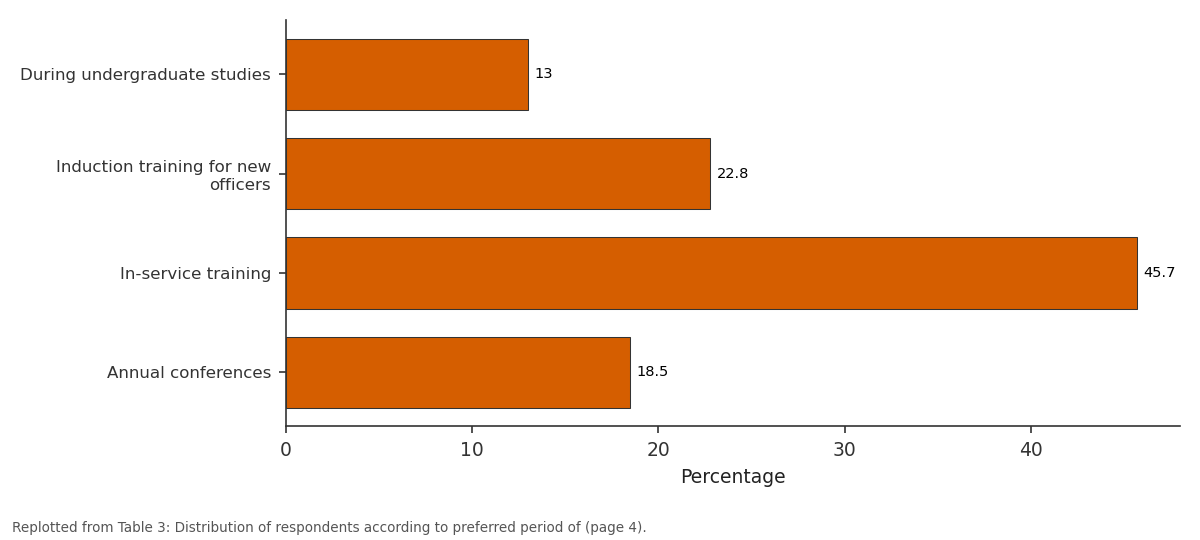
Percentage: During undergraduate... vs Induction training for... vs In-service training vs Annual conferences
Replotted from Table 3 (page 4) of the original paper. Every bar is the paper's own table value.
View source evidence ↗Figures & tables
From the original paper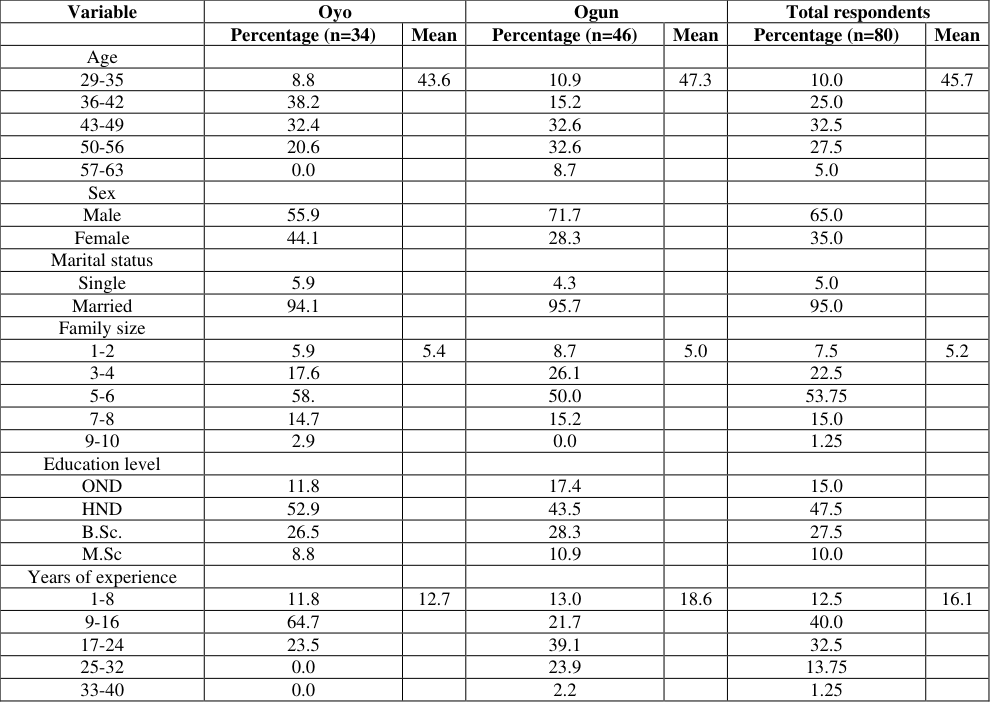 Table 1
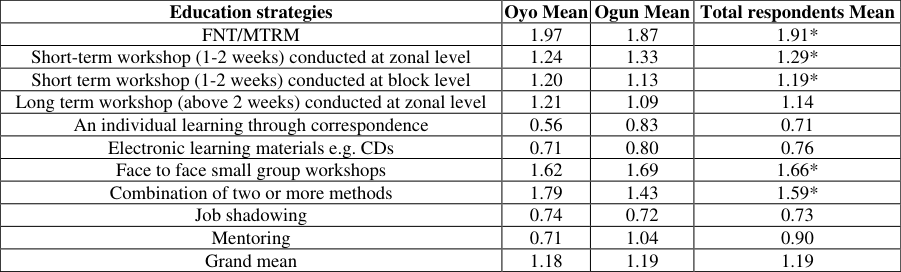 Table 2
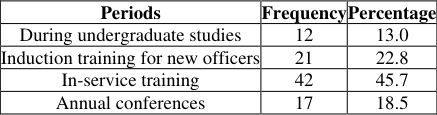 Table 3
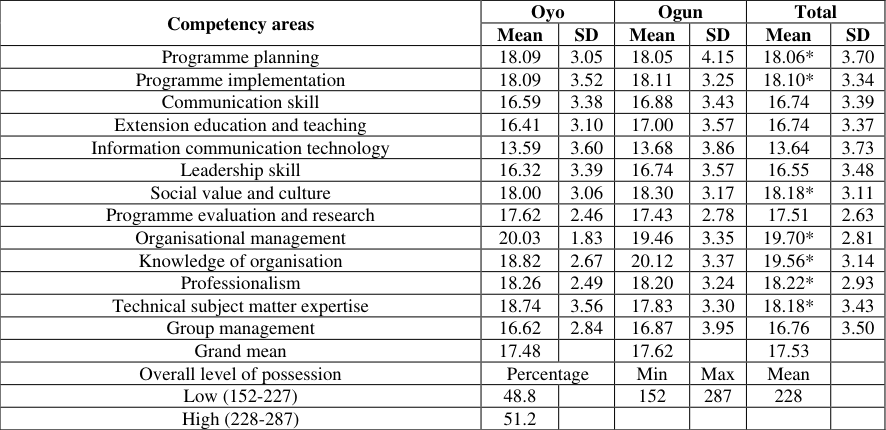 Table 4
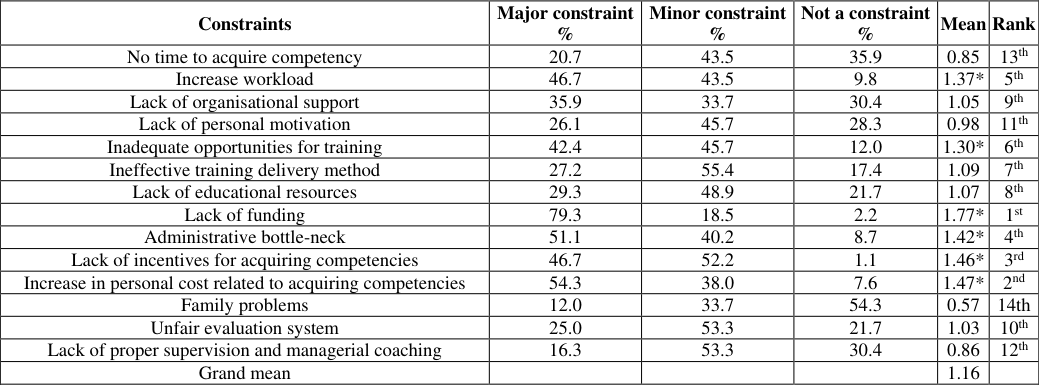 Table 5
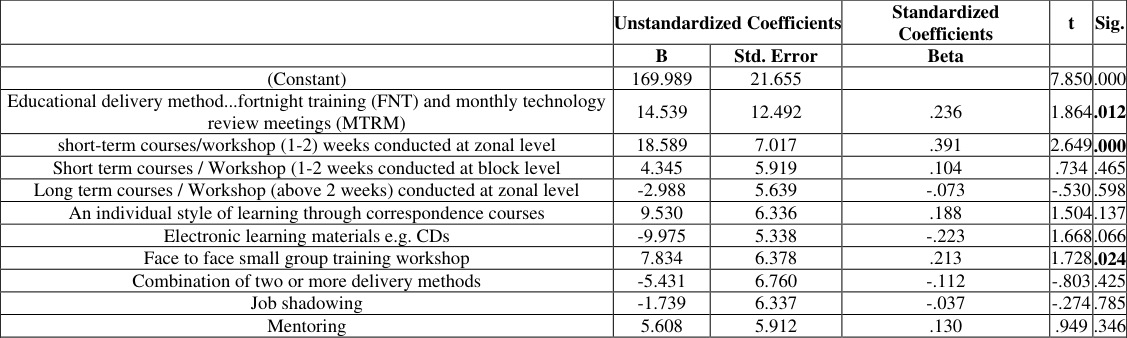 Table 6
Introduction
The Agricultural Development Programmes (ADPs) are currently responsible for carrying out the bulk of agricultural extension activities in the states of Nigeria as well as in the Federal Capital Territory, Abuja. The main aim of the ADPs is to improve the agricultural productivity, income, and general well-being of small scale farmers who are the main focus of all agricultural development projects in Nigeria. Agricultural extension can be broadly defined as all systems that facilitate access of farmers and other clientele to knowledge, information and technologies; facilitate their interaction with partners in research, education, agri-business, other relevant institutions and value-chain actors and assist them to develop their own technical, organisational and management skills and practices (Christoplos 2010) [1] . It is evident from the above definition that agricultural extension contributes to improving the welfare of farmers and other stakeholders and also strengthens the farmer's capacity to innovate by providing access to knowledge and information (Suvedi and Ghimire 2015) [13] . On the other hand, agricultural extension officers are personnel who are responsible for meeting the goals of extension services under the ADPs. It is important to note that extension service is not just about men from public/private sector agricultural agencies riding around on motorcycles talking to farmers as generally premised, though this stereotype assertion still describes a significant proportion of extension agent's role. According to Suvedi and Ghimire (2015) [13] , the role of extension today goes beyond technology transfer to facilitation; beyond training to learning and includes assisting farmers to form groups, dealing with marketing issues, addressing public interest issues in rural areas such as resource conservation, health, monitoring of food security and agricultural production, food safety, nutrition, family education, youth development and partnering with a broad range of service providers and other agencies in rural development. These roles have led to increasing emphasis on the development of core competencies which are necessary for the extension personnel to perform at maximum and produce expected results. Nwaogu and Akinbile (2018) [9] described competency as an individual's knowledge, skill, abilities and behaviour which are necessary to effectively perform a specific task and achieve desirable results. It is a combination of skills, job attitude, motives, knowledge, trait and values which are reflected in job behaviour that can be observed, measured and evaluated. In the context of agricultural extension work, competencies refer to extension workers' skills and knowledge (e.g. human development, leadership development, communication and program development skills), which are necessary to successfully perform extension tasks. Professional competencies are essential to perform jobs well, and most organisations expect their employees to use certain professional tools to help their clients and achieve excellent results. Competencies of extension officers lead to effectiveness in extension organisation which is a product the organisation's ability to attain and efficiently use existing resources to achieve its goals. For extension officers to function effectively in the present world of increasing globalisation and modernisation, they need to master changing technologies and make use of large volume of available information. In line with this context, the competencies that agricultural extension officers need to meet their goals have become more complex, requiring more than the mastery of certain narrowly defined skills. As such, there is also a need to identify and adopt appropriate and effective training methods as well as devising means to reduce constraints in order to enhance the competency level of extension officers. The discussion on educational strategies to enhance competency acquisition and constraints that limits competency improvement will contribute to the understanding of how the different concepts of training methods may create or not a conducive environment for competency improvement. Learning outcomes are essentially evidence of having acquired competencies. They attest to the effectiveness of an education strategy in delivering quality training and effective learning. The success of extension workers depend on the type and intensity of various education methods and techniques used during their training sessions; how they in turn educate farmers in order to persuade them to adopt new technologies and their ability to apply extension philosophy and principles effectively. Inadequate knowledge of subject matter usually makes the agricultural extension workers to lose confidence when facing farmers. Therefore, to be effective, such staff must have practical knowledge and training in all aspects of agriculture as well as in marketing, psychology, rural sociology and human relation in order to influence rural farm families. All these are essential tools that would enable them to work successfully with the farmers and rural households and cooperate harmoniously with representative of other agencies as well as playing a leading role in identifying and implementing rural development programmes. To achieve these, periodic in-service training as well as attendant to conferences, workshops and seminars will play a vital role in bridging the gap between the expected and actual levels of competencies. There are sporadic studies on criticism that extension was not being able to perform the necessary changes in the rural communities (Sallam and Akram, 2005) [10] . However, only little empirical literature exists on effective education strategies and constraints that influence extension officers' competencies in the study area. This has made it necessary to access the level of competencies of extension workers and how some educational strategies and constraints influence these competencies. In a study by Lakai, Jayaratne, Moore, and Kistler (2012) [6] , they found that extension agents perceived in-service training as the best opportunity to develop their core competencies while Solomon (2010) [12] discovered that FNT and MTRM were the predominant education methods at the ADPs for training the extension officers in Kogi state Nigeria. However, little is known about the effect of different training methods on competency levels. Understanding the best period to acquire competency and adopting an effective education strategy is necessary for effective learning and competency improvement. The need for continuous training of extension officers cannot be overemphasized. Wallace and Howell (2000) [14] pointed out that the training given to extension officers is usually inadequate and therefore should be a continuous process. They stressed that most training efforts are concentrated on the pre-service training, which is often too theoretical and provides little opportunity to practice what has been learned in real situation. Therefore, if little attention is given to continuous in-service training, the extension officers will be outdated and may not be competent enough to face the present day challenges on their job. These competencies can be acquired in various ways including formal and informal education, induction courses, in-service training, refresher courses, seminars, workshops and conferences. As a result of the Unified Agricultural Extension System (UAES), the extension officers in in the study area have a lot of responsibilities in attending to the needs of their numerous clienteles in various remote communities and as such needs to constantly update their skills through effective training. It is against this backdrop that the study was carried out to identify the education strategies and constraints that influence the acquisition of competencies by extension officers so that appropriate recommendations can be made to enable ADPs plan effectively. The specific objectives of the study were to; 1. describe the personal characteristics of the respondents. 2. identify effective education methods for developing competencies of extension officers 3. identify the most preferred period to acquire competencies in extension service 1. determine the level of competency possessed by respondents and 2. identify the constraints that limit the acquisition needed competencies Hypotheses H 0 1 : There is no significant contribution of the education delivery methods to the competency level of extension agents. H 0 2 : There is no significant relationship between the perceived constraints and competency level of extension agents.
Methodology
The study was carried out in Oyo and Ogun state ADPs. The population of the study consisted of all the frontline extension officers working under the ADPs in the two states. Simple random sampling procedure was employed to select two (50%) agricultural zones from each of the states. Ibadan/Ibarapa and Oyo zones were selected from Oyo state while Abeokuta and Ijebu zones were selected from Ogun state. Then all the extension agents (EAs) and block extension agents (BEAs) in the selected zones served as respondents. The decision to use 100% of extension officers in the selected zones was due to the few number of extension officers in the zones as at the time the research; they includes 27 from Ibadan/Ibarapa, 11 from Oyo, 28 from Abeokuta and 18 from Ijebu which made up the 84 respondents interviewed during the study. Data were collected from primary source through a structured questionnaire administered to the selected extension officers. However, only 80 duly completed questionnaires were returned for data analysis which gives a response rate of 95%.
Measurement of variables
Respondents were asked to indicate their perceived level of effectiveness of selected education strategies in helping extension officers acquire competencies. A 3 point rating scale of highly effective (HE) =2, moderately effective (ME) =1, and not effective (NE) =0 were used. The grand mean was calculated and used as a benchmark to categorise the methods as effective or not effective. Then respondents were asked to indicate the most preferred period to acquire competencies in extension service from the following options. During undergraduate studies =1, Induction training for new officers =2, In-service training =3, Annual conferences =4. The percentage of the responses were calculated and used to identify the most preferred period.
Respondents were also required to indicate their level of possession of each of the 13 competency areas provided on a five point rating scale of Very high (VH) =5, High (H) =4, Moderate (M) =3, Low (L) =2 and very low (VL) =1. The total scores of the items under each of the competency area were calculated and their mean determined. The grand mean was computed and used to categorise the level of possession of competencies as high or low. Finally respondents were asked to indicate the level of severity of constraints from the list provided. A 3 point rating scale was used which includes; major constraint=2, minor constraint=2, not a constraint=0. Grand mean was determined and used to categorise the constraints as minor or major. Descriptive statistics like frequency, percentages and mean were used to describe the objectives of the study while PPMC and Multiple Regression analysis were used to test hypotheses of the study.
Results and Discussion Personal characteristics of respondents
Table 1 shows that the mean age of respondents was 46 years. The result is consistent with the findings of Yakubu, Abubakar, Atala and Muhammed (2013) [15] that majority of extension agents in Kano state were within the age of 41-50 years. This means that majority of the extension officers are young and as such competencies acquired through training can still be utilised for effective service delivery at the ADPs for at least 15 years.
| Variable | Oyo | — | Ogun | — | Total respondents | — |
|---|---|---|---|---|---|---|
| Percentage (n=34) | Mean | Percentage (n=46) | Mean | Percentage (n=80) | Mean | |
| Age | ||||||
| 29-35 | 8.8 | 43.6 | 10.9 | 47.3 | 10.0 | 45.7 |
| 36-42 | 38.2 | 15.2 | 25.0 | |||
| 43-49 | 32.4 | 32.6 | 32.5 | |||
| 50-56 | 20.6 | 32.6 | 27.5 | |||
| 57-63 | 0.0 | 8.7 | 5.0 | |||
| Sex | ||||||
| Male | 55.9 | 71.7 | 65.0 | |||
| Female | 44.1 | 28.3 | 35.0 | |||
| Marital status | ||||||
| Single | 5.9 | 4.3 | 5.0 | |||
| Married | 94.1 | 95.7 | 95.0 | |||
| Family size | ||||||
| 1-2 | 5.9 | 5.4 | 8.7 | 5.0 | 7.5 | 5.2 |
| 3-4 | 17.6 | 26.1 | 22.5 | |||
| 5-6 | 58. | 50.0 | 53.75 | |||
| 7-8 | 14.7 | 15.2 | 15.0 | |||
| 9-10 | 2.9 | 0.0 | 1.25 | |||
| Education level | ||||||
| OND | 11.8 | 17.4 | 15.0 | |||
| HND | 52.9 | 43.5 | 47.5 | |||
| B.Sc. | 26.5 | 28.3 | 27.5 | |||
| M.Sc | 8.8 | 10.9 | 10.0 | |||
| Years of experience | ||||||
| 1-8 | 11.8 | 12.7 | 13.0 | 18.6 | 12.5 | 16.1 |
| 9-16 | 64.7 | 21.7 | 40.0 | |||
| 17-24 | 23.5 | 39.1 | 32.5 | |||
| 25-32 | 0.0 | 23.9 | 13.75 | |||
| 33-40 | 0.0 | 2.2 | 1.25 |
Table text extracted from the original PDF; superscript letters are shown inline. The original table image is below.
View original table image
Also, the majority (65.0%) of the respondents were male which indicates that the extension agents were predominantly males. This result agrees with Kehinde and Ayobami (2015) [4] that majority of the extension agents in Oyo state were male and this shows a serious gender imbalance in the ADPs. It may be connected with gender disparity found in the public service in Nigeria. It further implies that selection of staff for training and competency development in the ADPs may be gender biased. The findings further reveals that the majority (95.0%) of the respondents were married with a mean household size of 5 persons. This implies that the extension agents have family responsibilities which might negatively affect their ability to enroll in training for personal competency development. All the respondents had attained one form of tertiary education or the other with the majority (47.5%) of them at HND level. This corroborates with Isiaka, Lawal-Adebowale and Oyekunle (2009) [3] that extension personnel in Lagos and Ogun states were highly educated. It implies that education, which is a means of acquiring competency for effective service delivery is a requirement for employing extension officers in the area. The mean years of working experience of extension officers was 16 years. This suggests that respondents may have acquired a lot of experience on the job. However, many years of experience may not be a guarantee for competency, therefore acquiring more competencies through continuous training will enable them strengthen their commitment and also function effectively in their respective service areas. Effective education delivery method Table 2 shows that fortnight training (FNT)/monthly technology review meetings (MTRM) (𝑥̅ =1.91) was perceived as the most effective education delivery method used by the extension agents, followed by face to face small group training workshop (𝑥̅ =1.66) and combination of two or more methods (𝑥̅ =1.56), while job shadowing (𝑥̅ =0.73) was the least effective. The high rating of FNT/MTRM may be due to the fact that they are the most frequently used training methods at the ADPs for effective dissemination of innovation to farmers (Solomon 2010) [12] . On the other hand, the low rating of job shadowing might be as a result of not been frequently utilised, poor information sharing and lack of motivation; during job shadowing, some professionals may find it difficult to share all the information and experiences they have gathered to the learner/observer. Furthermore, motivation is always essential towards getting success in job shadowing. If a learner is less motivated in the job they are practicing, it will have an adverse effect on the learning process as they could lose focus and miss important details regarding the job. Lakai (2010) [5] also identified face-to-face small group workshop as the most effective education delivery method and job shadowing as the least effective in updating the competency of extension agents. The effectiveness of educational strategies utilised during training of extension agents will determine the level of competency acquisition, therefore ADPs should diversify on the use of education delivery methods by improving on the strategies used during FNT/MTRM and then adopting other effective methods to spice up the interest of the extension officers in the learning process
| Education strategies | Oyo Mean | Ogun Mean | Total respondents Mean |
|---|---|---|---|
| FNT/MTRM | 1.97 | 1.87 | 1.91* |
| Short-term workshop (1-2 weeks) conducted at zonal level | 1.24 | 1.33 | 1.29* |
| Short term workshop (1-2 weeks) conducted at block level | 1.20 | 1.13 | 1.19* |
| Long term workshop (above 2 weeks) conducted at zonal level | 1.21 | 1.09 | 1.14 |
| An individual learning through correspondence | 0.56 | 0.83 | 0.71 |
| Electronic learning materials e.g. CDs | 0.71 | 0.80 | 0.76 |
| Face to face small group workshops | 1.62 | 1.69 | 1.66* |
| Combination of two or more methods | 1.79 | 1.43 | 1.59* |
| Job shadowing | 0.74 | 0.72 | 0.73 |
| Mentoring | 0.71 | 1.04 | 0.90 |
| Grand mean | 1.18 | 1.19 | 1.19 |
Table text extracted from the original PDF; superscript letters are shown inline. The original table image is below.
View original table image
Most preferred period to acquire competencies for extension service delivery
Table 3 shows that more (45.7%) respondents indicated during in-service training as the most preferred period to acquire competencies, followed by during induction training for new officers (22.8%). This result agrees with Lakai (2010) [5] that inservice training and new extension agents' training are the two most preferred periods to acquire important extension competencies. The result implies that in-service training can be used to bridge the competency gap existing among extension employees. This is premised on the fact that in-service training is a problem-centered, learner oriented, and time bound series of activities which provides the opportunity to develop a sense of purpose, broaden perception and mastery of techniques. Wallace and Howell (2000) [14] pointed out the importance of in-service training, stressing that the formal education provided by public schools, colleges and universities may establish excellent foundation but do not develop the special knowledge and skills requisite in most professional jobs thus further training is inevitable for maximum performance.
| Periods | Frequency | Percentage |
|---|---|---|
| During undergraduate studies | 12 | 13.0 |
| Induction training for new officers | 21 | 22.8 |
| In-service training | 42 | 45.7 |
| Annual conferences | 17 | 18.5 |
Table text extracted from the original PDF; superscript letters are shown inline. The original table image is below.
View original table image
Competencies possessed by extension officers
The result in Table 4 reveals that the extension officers had high level of competency in seven out of the 13 competencies. Organisational management was the most possessed competency (𝑥̅ =19.70) followed by knowledge of organisation (𝑥̅ =19.56) and professionalism ( 𝑥̅ =18.22) while the least possessed competencies were information communication technology (𝑥̅ =13.64) and leadership (𝑥̅ =16.55). It was observed that most of the competencies the extension officers considered highly important were also possessed by them at high level and vice versa. It therefore means that priority should be given to those competencies they considered important during training programmes. This supports the assertion by Moore and Rudd (2005) that leadership training programs for extension officers should be based on the skills they themselves perceive to be the most important. The grand mean for each of the states reveals that the competency level of extension officers from Ogun is higher (𝑥̅ =17.62) than those form Oyo (𝑥̅ =17.48), while the overall competency level reveals that more (51.2%) of the extension officers possessed high level of competency. This implies that competency level of the extension officers is slightly above average and therefore needs to be updated. If the advantages of possessing competencies are maximized in service delivery, it will improve the performance of extension officers. However, constant development of personal and organisational skills is paramount for frontline extension personnel because they are confronted with varying problems and emerging roles in the course of discharging their duties.
| Competency areas | Oyo | — | Ogun | — | Total | — |
|---|---|---|---|---|---|---|
| Mean | SD | Mean | SD | Mean | SD | |
| Programme planning | 18.09 | 3.05 | 18.05 | 4.15 | 18.06* | 3.70 |
| Programme implementation | 18.09 | 3.52 | 18.11 | 3.25 | 18.10* | 3.34 |
| Communication skill | 16.59 | 3.38 | 16.88 | 3.43 | 16.74 | 3.39 |
| Extension education and teaching | 16.41 | 3.10 | 17.00 | 3.57 | 16.74 | 3.37 |
| Information communication technology | 13.59 | 3.60 | 13.68 | 3.86 | 13.64 | 3.73 |
| Leadership skill | 16.32 | 3.39 | 16.74 | 3.57 | 16.55 | 3.48 |
| Social value and culture | 18.00 | 3.06 | 18.30 | 3.17 | 18.18* | 3.11 |
| Programme evaluation and research | 17.62 | 2.46 | 17.43 | 2.78 | 17.51 | 2.63 |
| Organisational management | 20.03 | 1.83 | 19.46 | 3.35 | 19.70* | 2.81 |
| Knowledge of organisation | 18.82 | 2.67 | 20.12 | 3.37 | 19.56* | 3.14 |
| Professionalism | 18.26 | 2.49 | 18.20 | 3.24 | 18.22* | 2.93 |
| Technical subject matter expertise | 18.74 | 3.56 | 17.83 | 3.30 | 18.18* | 3.43 |
| Group management | 16.62 | 2.84 | 16.87 | 3.95 | 16.76 | 3.50 |
| Grand mean | 17.48 | 17.62 | 17.53 | |||
| Overall level of possession | Percentage | Min | Max | Mean | ||
| Low (152-227) | 48.8 | 152 | 287 | 228 | ||
| High (228-287) | 51.2 |
Table text extracted from the original PDF; superscript letters are shown inline. The original table image is below.
View original table image
Constraints to acquiring competencies
Table 5 shows that out of the 14 constraints, 6 were identified to be major while the remaining 8 were minor constraints. Lack of funding (𝑥̅ =1.77) was the most severe constraint, followed by increased personal costs related to acquiring competencies (𝑥̅ =1.47), lack of incentives for acquiring competencies (𝑥̅ =1.46) and administrative bottle-neck (𝑥̅ =I.42). On the other hand, No time to acquire competency ( 𝑥̅ =0.87) and family problems (𝑥̅ =0.57) were the least severe constraints. The findings supports that of Lakai (2010) [5] that increased work load, lack of funding and increased personal cost related to acquiring competencies were the most severe constraints affecting acquisition of competencies by extension officers in North Carolina cooperative extension. The implication is that these constraints will limit the professional development of extension officers and their effectiveness in extension service delivery. Extension professionals' competency acquisition depends on rewards and barriers. Therefore organizational commitment is needed to identify and acknowledge the competencies that will meet the needs of future clients and reduce the barriers that discourage acquisition of competencies. This implies that extension organisations need to offer incentives and rewards to employees that are vigorously involved in professional development. Even though employees are responsible for their own professional development, the organisational system must provide support to them for learning to take place in their job (Liles and Mustian, 2004).
| Constraints | Major constraint % | Minor constraint % | Not a constraint % | Mean | Rank |
|---|---|---|---|---|---|
| No time to acquire competency | 20.7 | 43.5 | 35.9 | 0.85 | 13th |
| Increase workload | 46.7 | 43.5 | 9.8 | 1.37* | 5th |
| Lack of organisational support | 35.9 | 33.7 | 30.4 | 1.05 | 9th |
| Lack of personal motivation | 26.1 | 45.7 | 28.3 | 0.98 | 11th |
| Inadequate opportunities for training | 42.4 | 45.7 | 12.0 | 1.30* | 6th |
| Ineffective training delivery method | 27.2 | 55.4 | 17.4 | 1.09 | 7th |
| Lack of educational resources | 29.3 | 48.9 | 21.7 | 1.07 | 8th |
| Lack of funding | 79.3 | 18.5 | 2.2 | 1.77* | 1st |
| Administrative bottle-neck | 51.1 | 40.2 | 8.7 | 1.42* | 4th |
| Lack of incentives for acquiring competencies | 46.7 | 52.2 | 1.1 | 1.46* | 3rd |
| Increase in personal cost related to acquiring competencies | 54.3 | 38.0 | 7.6 | 1.47* | 2nd |
| Family problems | 12.0 | 33.7 | 54.3 | 0.57 | 14th |
| Unfair evaluation system | 25.0 | 53.3 | 21.7 | 1.03 | 10th |
| Lack of proper supervision and managerial coaching | 16.3 | 53.3 | 30.4 | 0.86 | 12th |
| Grand mean | 1.16 |
Table text extracted from the original PDF; superscript letters are shown inline. The original table image is below.
View original table image
Relationship between Education Delivery Methods and Competency Level
Table 7 shows the result of multiple regression analysis conducted to examine the contribution of each of the education delivery methods on competency level of extension officers. The R 2 value 0.517 obtained implies that the ten predictors explain about 51.7% of variance in the extension worker's level of competence which was revealed to be statistically significant, F (10, 69,) = 11.571, p=0.003. An inspection of individual predictors reveals that short-term courses/workshop (1-2) weeks conducted at zonal level (ᵦ= 0.391, p = 0.000), FNT/MTRM (ᵦ= 0.236, p=0.012) and face to face small group training workshop (ᵦ= 0.213, p=0.024) were significant predictors of competency level of extension agents. The other predictors were found to be individually statistically insignificant in affecting the competency level of respondents. This result implies that short-term courses/workshop (1-2) weeks conducted at zonal level has the highest unique contribution to the competency of extension agents when the variance explained by all other predictors in the model is controlled.
Correlation analysis between constraints to competency acquisition and competency level
The result of the correlation analysis shows a negative relationship between constraints to acquiring competencies and competency level of respondents (r= -0.292, p=0.009). Thus, the null hypothesis was rejected. This finding implies that these constraints will have an adverse effect on the level of competency of extension officers; it means that an increase in the severity of constraints will result in a decrease in level of competency of extension officers and vice versa. Therefore if competency development must be upheld, extension organisations must adopt measures that will reduce the severity of constraints affecting competency acquisition.
Conclusion and Recommendation
It could be affirmed that the overall level of competency of extension officers in the study area is moderately high; however there are several constraints that affect the acquisition of competencies by extension officers of which lack of funds was the most severe. The FNT/MTRM was perceived to be the most effective education strategy but short-term courses/workshop (1-2) weeks conducted at zonal level was found to be the major predictor in determining the competency of extension officers.
There is need for retraining of extension officers in Oyo and Ogun state ADPs adopting effective education strategies to enable them improve on their current level of competencies for effective and efficient service delivery. Hence, The ADPs in the study area should organise annual in-service training programmes for extension officers to help them improve on their current level of competencies in all the competency areas.
A situation where the government is unable to sponsor such programmes, private donor agencies should be approached for sponsorship.
The ADPs should adopt short-term courses/workshop held at zonal level as a major training method; they should also improve on the methodology used during FNT/MTRM by diversifying on teaching methods, involving highly qualified and experienced instructors and combining two or more effective education strategies to complement each other.
The major constraints that prevent extension officers from acquiring competencies should be properly addressed to ensure that extension officers have opportunities to develop desired competencies. To achieve this, the extension organisations need to offer incentives and rewards to employees that are vigorously involved in professional development. Even though employees may be responsible for their own professional development, the ADP organisational system should provide support to them for learning to take place in their job. On the other hand, state government should release funds to ADPs to enable them plan and carry out training programmes for their staff members. The personnel wages, salaries, leave bonus, promotion arrears, transportation cost should be adequately taken care of. This will encourage and motivate the extension officers and help them maintain the right emotional disposition for effective service delivery.
Figures and tables from the paper
| — | Unstandardized Coefficients | — | Standardized Coefficients | t | Sig. |
|---|---|---|---|---|---|
| B | Std. Error | Beta | |||
| (Constant) | 169.989 | 21.655 | 7.850 | .000 | |
| Educational delivery method...fortnight training (FNT) and monthly technology review meetings (MTRM) | 14.539 | 12.492 | .236 | 1.864 | .012 |
| short-term courses/workshop (1-2) weeks conducted at zonal level | 18.589 | 7.017 | .391 | 2.649 | .000 |
| Short term courses / Workshop (1-2 weeks conducted at block level | 4.345 | 5.919 | .104 | .734 | .465 |
| Long term courses / Workshop (above 2 weeks) conducted at zonal level | -2.988 | 5.639 | -.073 | -.530 | .598 |
| An individual style of learning through correspondence courses | 9.530 | 6.336 | .188 | 1.504 | .137 |
| Electronic learning materials e.g. CDs | -9.975 | 5.338 | -.223 | 1.668 | .066 |
| Face to face small group training workshop | 7.834 | 6.378 | .213 | 1.728 | .024 |
| Combination of two or more delivery methods | -5.431 | 6.760 | -.112 | -.803 | .425 |
| Job shadowing | -1.739 | 6.337 | -.037 | -.274 | .785 |
| Mentoring | 5.608 | 5.912 | .130 | .949 | .346 |
Table text extracted from the original PDF; superscript letters are shown inline. The original table image is below.
View original table image
References
14 in the original paper- Christoplos I. Mobilizing the potential of rural and agricultural extension. Rome, Italy, 2010.
- Isiaka BT, Lawal Adebowale OA, Oyekunle O. Agricultural extension agents' awareness of ICT potentials and training needs on usage for improved extension service delivery in selected southwest states of Nigeria. Journal of Humanities, Social Science and Creative Arts. 2009; 4(1):18-30
- Kehinde AT, Ayobami AL. Training needs assessment on the use of social media among extension agents in Oyo state Nigeria. Journal of Agricultural informatics. 2015; 6(1):100111
- Unpublished M.Sc Project in the Department of Extension Education, North Carolina State University, 2010.
- Lakai D, Jayaratne KSU, Moore GE, Kistler MJ. Barriers and effective educational strategies to develop extension agents' professional competencies. Journal of Extension. 2012; 50(4):4RIB1. Retrieved February 15, 2017 from http://www.joe.org/joe/2012august/rb1p.shtml
- Liles RT, Mustian RD. Core competencies: A system approach for training and organisational development in extension. The Journal of Agricultural Education and Extension. 2004; 10(2):77-82.
- Moore LL, Rudd RD. Leadership skills and competencies for extension state Directors and Administrators. Journal of Agricultural Education. 2005; 45(3):22-33.
- Nwaogu FK, Akinbile LA. Competencies of Agricultural Development Programme Personnel in Extension Service Delivery in Oyo and Ogun States, Nigeria. Journal of Agricultural Extension. 2018; 22(3):40-52.
- Sallam M, Akram B. Agricultural extension situation in Dhamar province". Dhamar Rural Development Project, Ministry of Agriculture and Irrigation, Yemen, 2005.
- Shinn G, Smith K. Anticipating roles of the Cooperative Extension Service in 2010: A Delphi technique involving agricultural and natural resource agents and family and consumer science agents in Texas. Paper presented at the Proceedings of the 26th Annual National Agricultural Education Research Conference, Florida, 1999.
- Solomon JF. Assessment of emerging roles and training needs of extension personnel in Kogi state ADP. (Unpublished M.Sc thesis) University of Nigeria Nsuka, 2010.
- Suvedi M, Ghimire R. How competent are Agricultural Extension Agents and Extension Educators in Nepal, 2015. Retrieved November 23, 2017 from http://www.oired.vt.edu/innovate/wp
- Wallace JT, Howell J. Training and visit extension of modern times. AAU occasional Paper No. 12. London Oversea Developing Institute, 2000.
- Yakubu DH, Abubakar BZ, Atala TK, Muhammed AA. Use of information and communication technologies among extension agents in Kano State, Nigeria. Journal of Agricultural Extension. 2013; 17(1):162-173.