
Research article · 2019 · Full text
International Journal of Agriculture and NutritionNutraceuticals: One more step towards good health
Volume 1(3) · Pages 01–02 · DOI: 10.33545/26646064.2019.v1.i3a.12 ↗
Research areasNutrition, Genetics, and DiseaseConsumer Attitudes and Food Labeling
Abstract
Author-writtenThe term "nutraceutical" is used to describe any food, or part of a food supplements, that offers a medical or health benefit beyond simple nutrition. They play significant role in modifying and maintaining normal physiological function that is required for today’s busy and stressful life style. The principal reasons for the growth of the nutraceutical market worldwide are the current population and their health trends. The food products used as nutraceuticals can be categorized as dietary fibre, prebiotics, probiotics, polyunsaturated fatty acids, antioxidants and other different types of herbal/ natural or functional foods. These nutraceuticals help in countering some of the serious health problems such as obesity, cardiovascular diseases, cancer, osteoporosis, arthritis, diabetes, atherosclerosis etc. Thus, nutraceutical has lead to the new era of health protector in which the food and pharmaceutical industries has become a research oriented sector.
Summary
Source-checkedPlain-language reading of the full paper, prepared with AI and checked against the text. Each point links to the authors' own words.
Why it matters
- There is a growing preference for nutraceuticals over synthetic allopathic medicines because the latter are often expensive and have many side effects. View evidence ↗
- Nutraceuticals are important for maintaining normal physiological functions in the context of modern, stressful lifestyles. View evidence ↗
The question
- The paper aims to categorize and describe the various types of food products used as nutraceuticals, including antioxidants, probiotics, and dietary fibers. View evidence ↗
- The review examines how nutraceuticals can be used to counter serious health conditions like cancer, diabetes, and cardiovascular diseases. View evidence ↗
What they did
- The author reviews nutraceuticals of both plant and animal origin to identify opportunities for the food and pharmaceutical industries. View evidence ↗
- The paper utilizes a summary table to map specific phytochemicals to their natural sources and their respective roles in disease prevention. View evidence ↗
What they found
- In India, approximately 80% of the population relies on nutraceuticals for their primary healthcare. View evidence ↗
- The Indian nutraceutical market was valued at US $ 2 Billion in 2012, representing about 1.5% of the global nutritional industry. View evidence ↗
- The US nutraceutical market was projected to reach USD 96 billion by 2022, growing at a compound annual growth rate (CAGR) of 6%. View evidence ↗
- The United States was expected to lead the global functional food market by 2022, with a projected CAGR of 8.8%. View evidence ↗
- Approximately 47% of the Japanese population uses nutraceuticals, a trend attributed to an aging population. View evidence ↗
- Research and development in nutraceuticals is widespread, involving 90% of biotech firms, 55% of food firms, and 36% of pharmaceutical firms. View evidence ↗
- Allicin, found in garlic and onion, provides multiple benefits including antibacterial, anticancer, and neuroprotective effects. View evidence ↗
- Resveratrol, sourced from dark grapes, berries, peanuts, and raisins, helps lower total serum cholesterol and increase HDL. View evidence ↗
What it means
- The author concludes that the role of nutraceuticals in curing and preventing various diseases is certain. View evidence ↗
- The author recommends developing better-characterized and research-proven products to increase consumer confidence. View evidence ↗
- The author states that long-term clinical research is still required to scientifically validate the role of nutraceuticals in treating different diseases. View evidence ↗
Visual summary
1 visualsIllustrations explain the paper; they do not show study data.
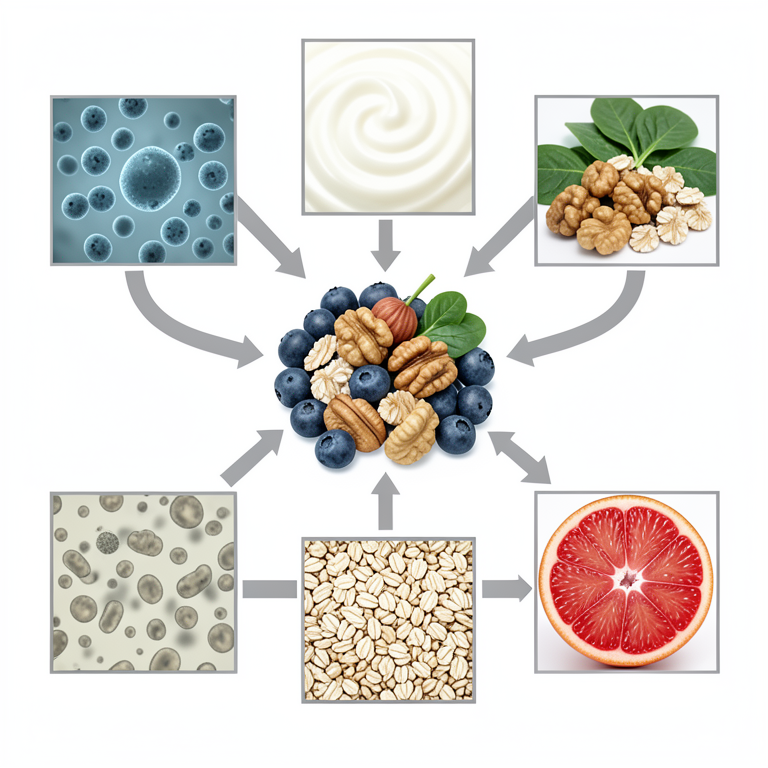
Nutraceutical Classification
AI-generated conceptual illustration (Assorted whole foods including blueberries, walnuts, yogurt, oats, and green leafy vegetables). It explains the idea and does not show study data.
View source evidence ↗Figures & tables
From the original paper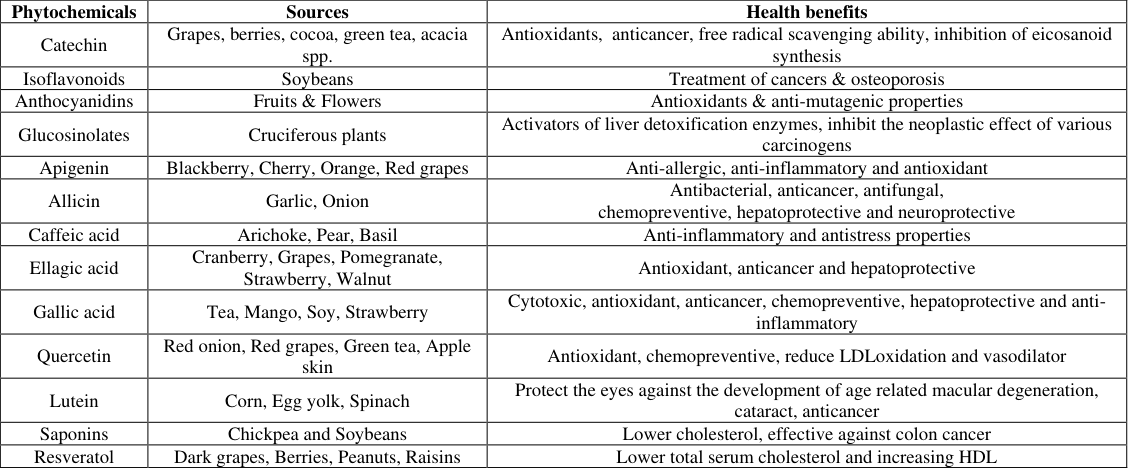 Table 1
Introduction
With the modern and competitive lifestyle and ever increasing stressful conditions, all types of diseases are becoming a big issue for human health. Due to high cost and many side effects of synthetic allopathic medicines, more and more people are now inclining towards use of herbal/natural products (nutraceuticals). Around 80% of population in India depends on nutraceuticals for their primary health care [1]. The term nutraceutical is derived from the words ‘nutrition’ and ‘pharmaceutical’.
Thus, nutraceutical is a food or a part of the food which exerts a curative Table 1: Phytochemicals of nutraceuticals importance, their sources and role in the prevention of diseases Phytochemicals Sources Health benefits Catechin Grapes, berries, cocoa, green tea, acacia spp. Antioxidants, anticancer, free radical scavenging ability, inhibition of eicosanoid synthesis Isoflavonoids Soybeans Treatment of cancers & osteoporosis Anthocyanidins Fruits & Flowers Antioxidants & anti-mutagenic properties Glucosinolates Cruciferous plants Activators of liver detoxification enzymes, inhibit the neoplastic effect of various carcinogens Apigenin Blackberry, Cherry, Orange, Red grapes Anti-allergic, anti-inflammatory and antioxidant Allicin Garlic, Onion Antibacterial, anticancer, antifungal, chemopreventive, hepatoprotective and neuroprotective Caffeic acid Arichoke, Pear, Basil Anti-inflammatory and antistress properties Ellagic acid Cranberry, Grapes, Pomegranate, Strawberry, Walnut Antioxidant, anticancer and hepatoprotective Gallic acid Tea, Mango, Soy, Strawberry Cytotoxic, antioxidant, anticancer, chemopreventive, hepatoprotective and anti- inflammatory Quercetin Red onion, Red grapes, Green tea, Apple skin Antioxidant, chemopreventive, reduce LDLoxidation and vasodilator Lutein Corn, Egg yolk, Spinach Protect the eyes against the development of age related macular degeneration, cataract, anticancer Saponins Chickpea and Soybeans Lower cholesterol, effective against colon cancer Resveratol Dark grapes, Berries, Peanuts, Raisins Lower total serum cholesterol and increasing HDL Current global market trend Nutraceuticals may be divided into herbal/natural products, dietary supplements and functional foods. The report of business research and consulting firm revealed that functional food will be best ever growing class followed by dietary supplements. The world nutraceutical market is motivated chiefly by 1 and beverage industries, research and markets.
| Phytochemicals | Sources | Health benefits |
|---|---|---|
| Catechin | Grapes, berries, cocoa, green tea, acacia spp. | Antioxidants, anticancer, free radical scavenging ability, inhibition of eicosanoid synthesis |
| Isoflavonoids | Soybeans | Treatment of cancers & osteoporosis |
| Anthocyanidins | Fruits & Flowers | Antioxidants & anti-mutagenic properties |
| Glucosinolates | Cruciferous plants | Activators of liver detoxification enzymes, inhibit the neoplastic effect of various carcinogens |
| Apigenin | Blackberry, Cherry, Orange, Red grapes | Anti-allergic, anti-inflammatory and antioxidant |
| Allicin | Garlic, Onion | Antibacterial, anticancer, antifungal, chemopreventive, hepatoprotective and neuroprotective |
| Caffeic acid | Arichoke, Pear, Basil | Anti-inflammatory and antistress properties |
| Ellagic acid | Cranberry, Grapes, Pomegranate, Strawberry, Walnut | Antioxidant, anticancer and hepatoprotective |
| Gallic acid | Tea, Mango, Soy, Strawberry | Cytotoxic, antioxidant, anticancer, chemopreventive, hepatoprotective and anti- inflammatory |
| Quercetin | Red onion, Red grapes, Green tea, Apple skin | Antioxidant, chemopreventive, reduce LDLoxidation and vasodilator |
| Lutein | Corn, Egg yolk, Spinach | Protect the eyes against the development of age related macular degeneration, cataract, anticancer |
| Saponins | Chickpea and Soybeans | Lower cholesterol, effective against colon cancer |
| Resveratol | Dark grapes, Berries, Peanuts, Raisins | Lower total serum cholesterol and increasing HDL |
Table text extracted from the original PDF; superscript letters are shown inline. The original table image is below.
View original table image
DUBLIN, 2017. pharmaceuticals in the form of vitamins and mineral as food supplements. In 2012, nutraceutical market in India was estimated at US $ 2 Billion, roughly 1.5 percent of the global nutritional industry [4]. In present day scenario, Indian market is attempting to incorporate herbal ingredients into the nutraceutical products. Rising consumption of dietary supplements among the baby boomer generation and booming food and beverages market is driving the US nutraceutical market that is expected to reach USD 96 billion by 2022, at a 6% CAGR (Compound annual growth rate).
The United States is still expected to dominate functional food market globally by 2022, with an expected CAGR of 8.8% [5]. This is followed by Asia-Pacific. 47% of the Japanese population consumes nutraceutical products, which can be contributed to the growing aging population. Germany, Netherlands and Sweden have emerged as the key nutraceutical innovation hubs in Europe, while the United Kingdom and Spain have emerged as the key test markets for new products, with the European consumers demanding energy providing products that promote healthy teeth, strong bones, prevent digestive health issues, boost immune system and lower cholesterol. Today, 55% of food, 36% of pharmaceutical and 90% of biotech firms are actively involved in research and development of nutraceutical products.
Conclusion
Response of nutraceuticals varies from person to person. Individual’s susceptibility to any particular disease depends on the environmental factors and lifestyle. But the role of nutraceuticals in prevention and cure of various diseases is beyond any doubt. It will be governed by purity, safety and high efficacy without compromising any alteration in human health.
Information available presently on nutraceuticals poses a challenge for food technologist, physician and nutritionist as for as its efficacy and purity are concerned. Long term clinical research is needed to scientifically validate their role in different diseases. We believe that development of nutraceuticals with distinctive genetic and ecotype traits has the potential to deliver unique products to the world at large. Development of better characterized and research proven products will help enhance consumer confidence in nutraceutical and functional food products.
References
5 in the original paper- Gupta R, Gupta A, Singh RL. Hepatoprotective activities of Triphala and its constituents. International Journal of Pharma Research & Review. 2015; 4:34-55.
- Israel O, Auguster O, Edith OA. Antioxidant and antimicrobial activities of polyphenols from ethnomedicinal plants of Nigeria. African Journal of Biotechnology. 2010; 9:2289-2293.
- Pandey M, Verma RK, Saraf SA. Nutraceuticals: new era of medicine and health. Asian Journal of Pharmaceutical and Clinical Research. 2010; 3:1-15.
- Kulkarni S. A brief report on Nutraceutical products in India. Corporate Crystal India Pvt. Ltd. 2013:2-6.
- Global Nutraceuticals Market Report: 2017. Research and Markets has announced the addition of the nutraceutical to their offering. Analysis of the multi-billion functional food 2