
Research article · 2019 · Full text
International Journal of Agriculture and NutritionA comprehensive study on ecophysiological responses to stresses in plants
Volume 1(4) · Pages 41–48 · DOI: 10.33545/26646064.2019.v1.i4a.77 ↗
Research areasLeaf Properties and Growth Measurement
Abstract
Author-writtenPlants are subjected to a variety of environmental stresses, which reduces and limits agricultural crop productivity. Environmental stresses that affect plants are of two types: biotic and abiotic stresses. Abiotic stress includes temperature, ultraviolet radiation, salinity, floods, drought, heavy metals, etc., which results in the loss of important crop plants globally, while biotic stress refers to damage caused by insects, herbivores, nematodes, fungi, bacteria, or weeds. Stress (abiotic and biotic) factors reflect and specify the plant morphology and called as “stress” and have negative effect(s) on growth, development, quality, quantity and can reduce average plant productivity by 65 to 87%, depending on the plants and stage(s) and also give various permanent or temporary damage(s) according to length of exposed period, violence/density, developmental stage, age, etc. Researches have revealed that despite the advanced technology levels the fundamental basis of stress have not been understood comprehensively. Firstly taken response(s) has/have not yet fully understood and secondly any “resistance” or “tolerance level of a variety/species” because of their complex structure(s). But, this point is clear that with the help or assistance of “multi-disciplinary” approaches, it will be able to get promising result (s) in near future. This review focuses some of the ecophysiological responses of plants to biotic and abiotic stresses.
Summary
Source-checkedPlain-language reading of the full paper, prepared with AI and checked against the text. Each point links to the authors' own words.
Why it matters
- Environmental stresses are a critical issue because they limit the productivity of agricultural crops. View evidence ↗
- Plant stresses are categorized into two main types: abiotic (physical environment) and biotic (biological agents). View evidence ↗
- Depending on the plant species and its developmental stage, these stresses can reduce average productivity by 65% to 87%. View evidence ↗
The question
- The aim of this review is to examine the ecophysiological responses of plants when subjected to biotic and abiotic stresses. View evidence ↗
What they did
- The author conducted a comprehensive review of existing literature to evaluate general ecophysiological responses in cultivated plants. View evidence ↗
What they found
- Under water stress, plants produce abscisic acid (ABA), which reduces water loss and increases root water usage. View evidence ↗
- Plants responding to salt stress may increase the ratio of potassium (K+) or calcium (Ca+2) relative to sodium (Na+1). View evidence ↗
- Most plant cultivars develop normally between 15°C and 45°C, with temperatures outside this range negatively affecting growth. View evidence ↗
- Increased UV-B radiation leads to a significant decrease in the total biomass of rice plants. View evidence ↗
- Rust diseases (Puccinia spp.) can cause annual dry matter losses ranging from 0% to 80% in wheat production. View evidence ↗
- Many abiotic stresses lead to the formation of Reactive Oxygen Species (ROS), which can damage or kill plant cells. View evidence ↗
What it means
- The author concludes that multi-disciplinary approaches are necessary to achieve promising results in understanding and managing plant stress. View evidence ↗
- A major limitation in agricultural production is the current limited knowledge regarding stress-associated metabolism factors. View evidence ↗
Visual summary
1 visualsIllustrations explain the paper; they do not show study data.
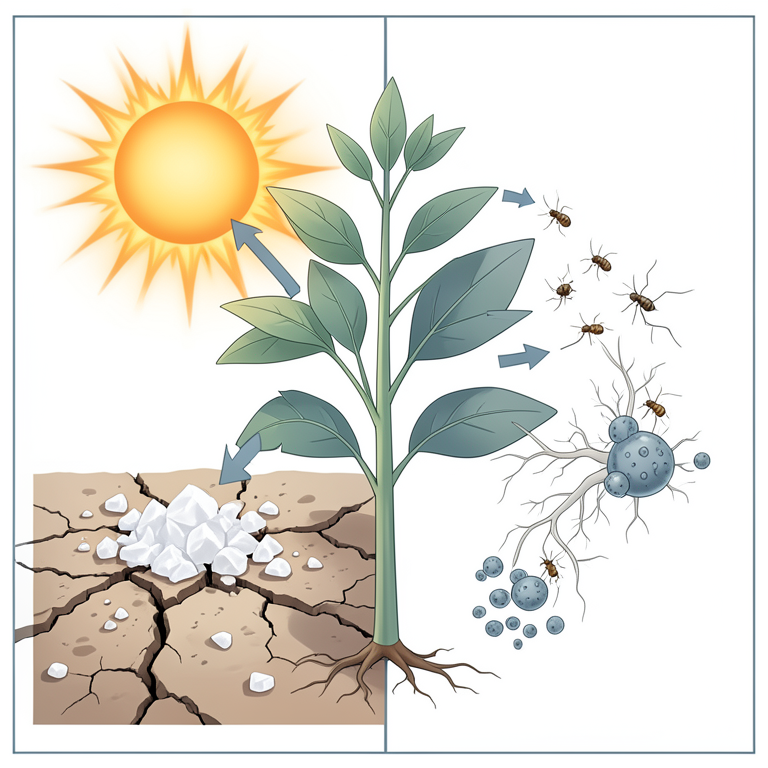
Classification of Plant Stresses
AI-generated conceptual illustration (Arabidopsis thaliana plants). It explains the idea and does not show study data.
View source evidence ↗Figures & tables
From the original paper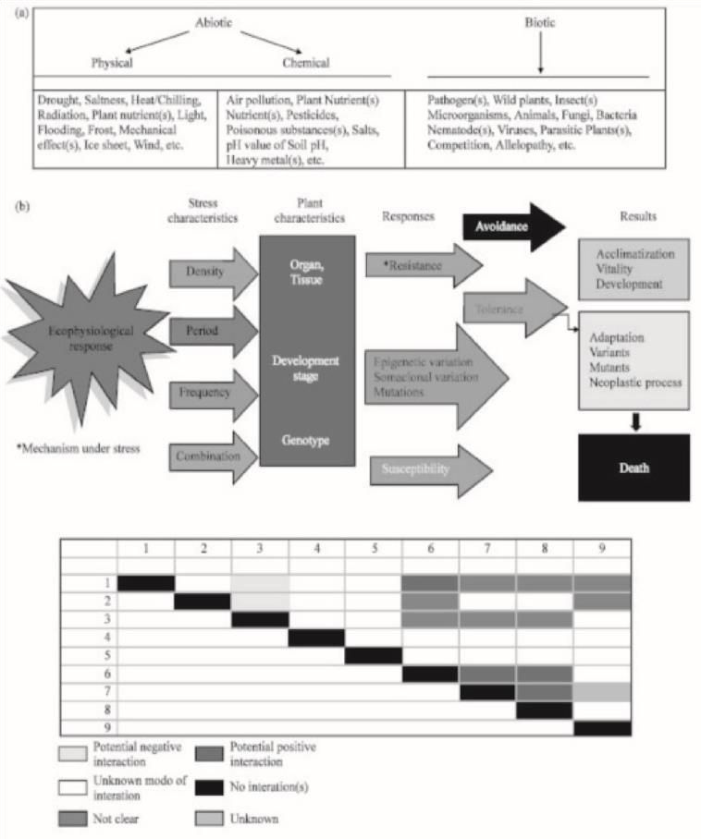 Figure 2
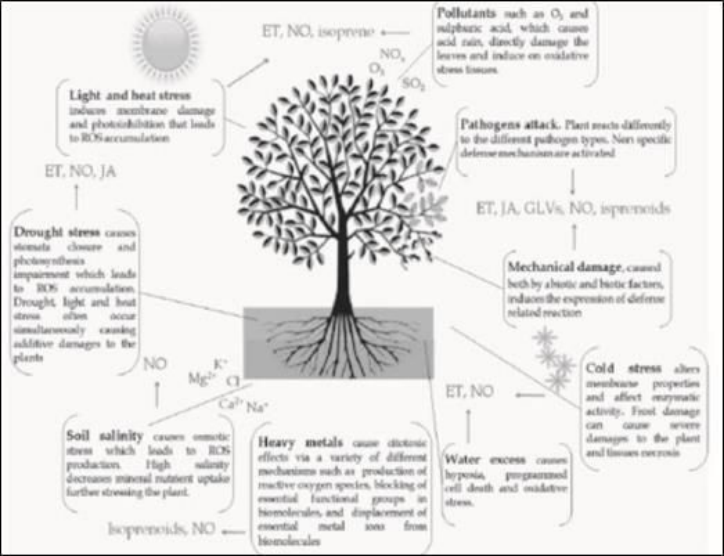 Figure 1
Introduction
World population is expected to reach about (7.6-8.0) billion by the end of this century; lowness of the agricultural productivity is not increasing at a required rate to keep up with the global food demand, possible water shortages, depleting soil fertility and the various stresses are constitute of this handicap (Shanker and Venkateswarlu, 2011). As known, plants show wider physiological and ecophysiological response(s), functional diversity, growth rates, productivity, population and community dynamics at different scales (Ackerly et al., 2000) [1] . When they are subject to less ideal than sub-optimal growing conditions, considered being under stress and these stresses directly effect production and yield level. These environmental conditions such as water-logging, drought and high/low temperatures, excessive/extreme soil salinity, inadequate mineral content of soil, phytotoxic compounds (such as ozone, etc.), also cause damage to plant growth and productivity (Fig. 1,2). Measuring the plant stress is very useful for many reasons. For example, the effect of different amounts of herbicides and pesticides on plant health and growth are very valuable and can be used to reduce of them. Due to sessile organisms, plants are always open to low/high temperature, salinity, drought, flood, oxidative (stress), air pollution/heavy metal poisoning, etc. solely or combinations and their consequences (Fig. 1). In general, one may categorize stresses as biotic, those caused by biological agents, such as biotic and abiotic those brought about by the physical environments, such as too much or too little water, inadequate or excess minerals in the soil, heat, radiations etc. (Leung, 2008). Plants are unable to dislocate in its own environmental therefore they have to cope with various stresses with internal mechanism(s) for the "tolerance" and/or "resistance". Since, they have developed various adaptation (such as hairness, waxiness, thornyness) mechanisms to provide (resistance) or (tolerance) against them. So, carry out stress breeding programs in problem environments are very important (Blum and Jordan, 1985) [9] . But this is open that all of the above mentioned stress factors are responsible for shifting physiological and biochemical events from in terms of the various. anomalous growth regulators, promoters, transcription regulators, Ca+2 and Na+1 ions uptake and balance, etc. in any organism (Doubnerova and Ryslava, 2011) [16] . As a physically term, "stress" is an applied mechanical force to object in a unit area; but, as a biologically, it is varying response(s) depend(s) on the size of force (Chinnusamy et al., 2007) [12] . According to Ashraf and Harris (2004) [6] , an environmental factor that limits crop productivity or destroys obtained biomass is referred to as a "stress" or "disturbance". These responses appear at anywhere at any time and any stage of the plant's life cycle as water capacity osmotic/ turgor pressure, ion capacity and balance, etc. Plant stress response(s) to stress factors (Fig. 1) have/has been widely studied up to now and was founded that environmental stresses trigger simultaneous up-and down-regulation of a large number of genes through a close control of genetic behavior (transcription) (Gençtan, 2012) and different chemical compounds. For example, order of the Dicotyledoneae, Cactaceae, Chenopodiaceae and Aizoaceae families are rich in the plants to the habitat tolerance adaptation (and also to harsh climates). In out of (22/12) plants. [7] ; Sunkar, 2010; Doubnerova and Ryslava, 2011) [7, 16] "habitat tolerance" is being governed by "Anthocyanin" and, in (10) plants also, is being managed by "Betalains", "Tertiary and Quaternary Amines" and "Sülfonilium" or "Polyol" (Hanson et al., 1994) and related responsible genes. The C4 and "Crassulacean" acid metabolism group plants (CAM) are common at the places where the water is scarcely. The most significant example of this is a "Craterostigma panfagineum Hochst plant".
This one is also known to be one of the most tolerant plants to excessive dryness conditions within the top (100) cultivated plants (Bohnert et al., 1995) [10] in the world and it exploits from the carbohydrates' (CHs) under the stresses (Chinnusamy et al.,
2007) [12] in its stem. In the well-watered plants, convert of the "2Octulase" to "Sucrose" is a common behavior in the many plants' leaves during the dryness conditions or loss of the water content (Doubnerova and Ryslava, 2011) [16] . [12] . As known, stress factor(s) reduce(s) agricultural plant yield(s) approximately 65, 0% or more and plants usually affect adversely (Doubnerova and Ryslava, 2011) [16] , in a polygenic inheritance (Popelka et al., 2004) with poorly understood response(s) (Chinnusamy et al., 2007) [12] . When plants look suffer from/sick/appear to be under attack by insects, etc. the symptoms which are seen actually a sign that the plant is being (or may be) stressed by environmental factors and related ecophysiological responses (Fig. 1). In this study, ecophysiological responses to stresses of some cultivated plants' will be evaluated generally and possible result(s) will be mentioned.
Several abiotic stresses with their ecophysiological responses
Water/Drought Stress: When the water lossing occurred in the plant, first of all, its turgor pressure suddenly drops. Stresses have negative effects on cell growth, causes separation of membrane proteins and decreases the chlorophyll content and losses of germination capability (Jaleel et al., 2009). Genetic mechanism of the water or drought stress have not been known properly and clearly in the plant (Gutschick, 1999) [24] , but, it is widely thinking that "escape" or "tolerance" is "dominant" in [12] and closing the stomata during transpiration (Blum and Jordan, 1985) [9] . By doing this, ABA prevents the water lossing, slows down the development of apical organ(s), allows increase of the water usage by roots and to give more chance to find out water in the soil. As known, water drought/waterlogging caused water stress induced not only shows several ecophysiological and biochemical responses associated with general reduction in size but also exhibits characteristic modifications in structure; particularly in the leaves (Gençtan, 2012). This type stress reduces number of grain at preanthesis stage and largeness (especially for Q gene) of numerous morphological and domestication-related traits such as plant height, flowering time, leaf morphology, structural deformation(s) at spike in wheat (Triticum spp.) (Farooq et al., 2011), pod number and relevant yield components per unit area decreases in soybean (Glycine max Merril), 100-seed weight reduces in sunflower (Helianthus annuus L.), yield level per plant decreases in corn (Zea mays L.), damage(s) between the grain filling and anthesis stage in beans (Phaseolus vulgaris L.), in chickpea (Cicer arietinum L.) and in parsley (Petrosellinum spp.) (Webber et al., 2008). Under these circumstances, nearly all cultivated plants were developed important protective and resistancy mechanism(s) against to this stress in both top-soil and sub-soil horizons. Especially, at the pre-drought and/or after rains, rapid maturation and water loss reduction are important topics that-to be able to avoid from the negative effect(s) of this phenomenanearly all plants under these threat(s) have developed "a deep and radicilous root system" with the main aim of to save or keep the water availability for their development during vegetation period. Protective and xerophytic structures such as hairness, acanthaceous, waxiness, etc. in plants have an important place in terms of the (stress) resistance strategy (Shepherd and Griffiths, 2006). Under this stress, the plants excrete ABA, amino acid(s), proline and prolamins, quaternar amino acids, glycine betaine, mannitol, sorbitol, raffinose, trelose, H2O2, ascorbat, a-tocopherols, etc. compounds (Hussain et al., 2011) [27] . Similarly, brief exposure of the plants to high temperatures during the grain set and filling stage; senescence can accelerate, grain formation processes slow down and (finally) yield level reduce (Porporato et al., 2003). The amount of photosynthetic pigments in the plants and reducing the photosynthetic efficiency in the leaves under the drought stress are decreased of the yield level and imbalances happens between available CO2 and turgor pressure (Mittler, 2006). It was found that there are a close correlation between "drought resistance" and "dehydrated accumulation" in the wheat under the stress conditions and was found that many genes responsible from these processes (Hussain et al., 2011) [27] . Waterlogged soils adversely effect the growth of plants not adapted to wet land conditions, also salinity effects the growth and water content of some plants (Gaber, 2003). So, the strategies for surviving and growth of the plants under water stress, divide into two main groups as "The morphologics" and "The physiologics". The morphologics are: Descending deeper root system than those of the morphological forms as narrowing of the leaf and stem surface; curling or rolling of the leaves, hairness in stem; increase in thickness of a the cuticle/wax layer, deeply embeding of the stomata, the leaf shedding, to do photosynthesis of stem or other parts (Farooq et [, 12] .
Salt Stress: According to statistics, there are approximately 397 mil ha under salinity; 5,762.9 mil ha under the drought (Ashraf and Foolad, 2007) [7] , 434 mil ha are also under alkalinity in the world (FAO, 2011). Alkaline soils are usually categorized by low availability of plant nutrients, high concentrations of HCO [20] . Whereas, high temperature accelerates and encourages the development and growing, causes the reduction of enzyme activity and digests the proteins, provokes the cell structure and changes their functions; but, its genetical pathway and mechanism(s) is/are still unknown and a mysterious. However, it was discovered that there are some of special proteins (such as heat shock proteins -HSPs-, etc. (Burke et al., 1976)) which produced and play important role in the plants life (Chinnusamy et al., 2007) [12] . Similarly, seeds and dormant buds can earn an "endogenous tolerance to desiccation" and "cryogenic temperature stresses" against to very low heat (temperature) stress (Volk, 2010). According to researches, in the wheat and other cool season cereals, during the reproductive and grain filling stages, due to performing of pollination, partially heading and seed setting events, should not to be "heat (temperature) stress". The optimum temperature degree varies (12-22)°C for the wheat at anthesis and the grain filling stages and if exposures to temperatures out of above, heat stress can easily and significantly reduce of the grain yield (Farooq et al., 2011). And this finding is being added that during the acclimation period to heat (temperature) stress are reversible, but if the stress conditions(s) is/are too great, irreversible changes happen(s) and these formations may be cause to the plant death (Saleh et al., 2007). [12] . But, if the temperature falls not sharply, step-wise or gradually, a progressive reduction of the cell water happens in the plants, so they do not easily damage or invulnerable from the frost and that time, they have become a "cold tolerance" (Thakur et al., 2010).
Cold
Freezing Stress: It arises when the below 0°C, but main reason of this stress is "cell water freezing". At that temperature, nearly whole metabolic events slow down and all vital functions come to stop point in the cells. The cell water goes to intracellular apertures and begins to freeze, osmotic pressure balance disorders, organism loss of its water (Zhu et al., 1997). If the freezing stress has just started, does not freeze all the water content of cells and does not give heavy damages; but if it continues, whole water content freezes and ice crystals occur. Afterwards, crystals tear and blast membranes and cause the plant death (Sunkar, 2010). But, due to unknown reasons (for now), the ice crystal formations do not to be happen in some plants because they carry some "sugar molecule(s)" and these chemicals increasing the producing of "antifreeze" or "water freezing retarder" compounds such as simple sugars, glycol, proline, etc. (Chinnusamy et al., 2007) [12] .
Light Stress: Basically reason of this stress is "day light". The light plays a critical role in regulating plant growth and development through the modulation of expression levels of light-responsive genes that regulate developmental and seed germination, seedlings photomorphogenesis, chloroplast development and orientation, photodinesis, stem growth, pigment biosynthesis, flowering and senescence (Shanker and Venkateswarlu, 2011). From them, "photosynthesis" is the most sensitive physiological process and has many important ecophysiological responses to elevated temperature (Farooq et al., 2011). Photosynthetic activity and metabolic functions of the plant are very affected from this when the density or norm is low. Therefore, behaviors of shadow and sun light (plenty light) plants are different from each other and another light traits (such as wavelength, density, etc.) are effective.
The plants utilize the light as their primary source of energy converting light to usable chemical energy through "photosynthesis" and is an essential prerequisite for chlorophyll biosynthesis and chloroplast development; events that do not take place in darkness (Shanker and Venkateswarlu, 2011). Amount of chlorophyll in the plants grown under the sun light (plenty light) is less than the plants grown under the shadow plants and, when they placed to shadow, firstly, they expand and thinner their leafs and reduce the production of CHs production in these organs. But this time, respiration process slows down and less amount of nutrient(s) go(es) to the roots. However, in them (grown under the sun light-plenty light), the leaves are thicker (esp. under extreme lights), photosynthesis rate increases, respiration ratio accelerates and the leaves are covered with a waxy/ cuticle layer(s).
If the shadow plants put under the sun light (plenty light), their photosynthetic activities accelerate, but, due to oxygen radicals not to be removed from the leaves (for example H2O2), other free radicals can be easily react with each other and emerges some "toxic compounds" and finally caused the death (Kotak et al., 2007). Elevated UV radiation has pleiotropic effects on the plant development, morphology and ecophysiology. Generally, morphological consequences of the UV supplemented whitelight treatment in the plants are growth reducing, leaves thickening and covering the wax/cuticular layers (Saleh et al., 2007). The rice plant showed a significant decrease in total biomass with increased (UV-B) radiation; chlorophyll (a) and (b) contents of the bean leaves dropped after the (UV-B) stress (Saleh et al., 2007) and (UV-A, B) rays break the proteins' disulfide bonds of the DNAs in organisms.
Flooding and Submergence Stress: Due to overflow of rivers or excessive rain, "water" does not enter to the soil, so the O2 infiltration to the soil is impossible or to stop, than, cultivated plants do not respirate and go to die. But, the rice is usually thought of as being highly tolerant of flooded conditions (Visser et al., 2003). The rice is a unique plant that only cultivates under the Water in the world due to special root structure can take dissolved 02 in the water. The plants under flooding and submergence stress growth adversely affected and end product of photosynthesis' amount (yield level) decreases. O2 level run off in these soils between (1, 0-2,0) hours; then, anaerobic respiration begins. In the cell, (Fe), (Mn), (H2S), sulfides, lactic acid, butyric acid(s) activated and they reach to toxic level; protein synthesis decreases, mitochondria damages; division and elongation of the cells slow down, ion transmission negatively affects; stomata closes, the leaves lose their turgor pressure than the plant(s) die(s) (Sunkar, 2010).
Disease Stress: Disease factor(s) enter(s) from the leaves, stomata and scratch(es) that caused to "infection". If the plant is susceptible and pathogeneity level is high, when the other conditions (disease triangle factors, etc.) are optimum can be cause "epidemy/ies" at the level of local, national or international scale(s). It was reported that there is 0 to 80% dry matter losses occurs each year due to the rust (Puccinia spp.) diseases in wheat (Triticum spp.) production (Ulukan, 1998 [16] and, it is reported that oxidative stress is being increased with the aging in plants before anthesis (Munne-Bosch and Alegre, 2002); decreased rates of photosynthesis, leaf injury, reduced growth of shoots and roots; accelerated flowering and reducing yield. On the other hand, alters ion transport, increasing membrane permeability, inhibiting H+-pump activity, collapsing the membran potential and activity, increasing Ca +2 uptake from apoplasm and oxidative damage(s) can be mentioned as ozone damages.
Air Pollution and Heavy Metal Stresses:
The main sources are soil and water originated toxic substances. They can identified as industrial, home and agricultural wastes, fossil fuels, SO 2 , N 2 O, NO, NO 2 , O 3 and H 2 S gases. Researches reported that various pollutant effects' could be change on the same plant (Rudorff et al., 1996). Another one is heavy metal stress. They contain some toxic elements such as Zn, Pb, Ni, Co, Cr, Cu, Mn, Cd, Se, Sb, As and Al and starts over their specific/lethal dose(s). It is interesting that the heavy metals have biological importance in the plant development and growth, where they play key roles affecting cellular processes such as homeostasis and photosynthesis (Despres and Goloubinffi, 2007) and inhibit the root development and cell division. Particularly, Al +3 could be easily react with in the plant cell wall, nucleus, etc. at the acid soils (Doubnerova and Ryslava, 2011) [6] . In general, damages arisen during the "electron transferring" stage in the photosynthesis; block the vital enzyme(s) processing in the organism to a certain extent, inconvenience(s) emerge(s) in the meeting of energy requirement(s) and reduce(s) the quality components (Volk, 2010).
Discussion
Today, due to knowledge limitations on the stresses, to better understand of plants ecophysiological responses' are very important and basic. Particularly, to be able to do this evaluation in the light of increasing interesting(s) for the stressors or stress factor(s) like salinity, drought, flooding, heavy metal, temperature extremes, high-light intensities, (UV-A, B) radiation, herbicides, ozone, etc. are very valuable particularly at the problem areas (Hasanuzzaman et al., 2010). Likewise, (esp. in abiotic stresses) the stresses are an integral part of "climate change," with their complex structure and have unpredictable impacts under the any environmental conditions and this point is verified by Ahmad and Prasad (2012). Changes in processes regulates by GSH (Glutathionine) concentration and/or redox status are considered to be important in the adaptive mechanisms of plants exposed to stressful environmental conditions and increase in protein turnover in plants may also be a non-specific response which is known to be induced by a variety of stresses including metals, temperature and air pollutants (Jordan, 1996). If stress topic examine as genetically, it is obvious that hundreds of genes respond to any specific stress and their products may or may not have a role in adaptation to stress; but, its the ecophysiological role of most of them are yet unknown (Munne-Bosch and Alegre, 2002). Stress studies in the plants have some difficulties that they can be mentioned like this and they have to solve: First, their action or pathway mechanism(s) is/are very complex; second, they give generally unexpected results due to interactions with internal and external factors and stress(es); third, as a disadvantage, our knowledge on stress-associated metabolism factors are rather limited (for the time being) and usually, this limitation(s) play(s) a major gap or key role for the agricultural production(s) (Anonymous, 2012). But this is a strongly possibity that with the aid and collaboration of special technical techniques and tools such as DNA technology, proteome analysis, photo-acoustic spectroscopy, etc. (Roy et al., 2011) and other biological science(s), important promising result(s) will be realized and they can be able to put into practice in near future.
Figures and tables from the paper
References
25 in the original paper- Ackerly DD, Dudley SA, Sultan SE, Schmitt J, Coleman SJ, et al. The evolution of plant ecophysiology traits: Recent advances and future directions. Bioscience. 2000;50:979-995.
- Aina OO, Dixon AGO, Akinrinde EA. Effect of soil moisture stress on growth and yield of cassava in Nigeria. Pak. J Biol. Sci. 2007;10:3085-3090.
- Saleh AAH, Abdel-Kader DZ, El Elish AM. Role of heat shock and salicylic acid in antioxidant homeostasis in Mungbean (Vigna radiata L.) plant subjected to heat stress. Am. J Plant Physiol. 2007;2:344-355.
- Ashraf M, Harris PJC. Potential biochemical indicators of salinity tolerance in plants. Plant Sci. 2004;166:3-16.
- Ashraf M, Foolad MR. Roles of glycine betaine and proline in improving plant abiotic stress resistance. Environ. Exp. Bot. 2007;59:206-216.
- Rudorff BF, Mulchi CL, Lee EH, Rowland R, Pausch R. Effects of enhanced O3 and CO 2 enrichment on plant characteristics in wheat and corn. Environ. Pollut. 1996;94:53-60.
- Blum A, Jordan WR. Breeding crop varieties for stress environments. Crit. Rev. Plant Sci. 1985;2:199-238.
- Bohnert HJ, Nelson DE, Jensen RG. Adaptations to environmental stresses. Plant Cell. 1995;7:1099-1111.
- Burke MJ, Gusta LV, Quamme HA, Weiser CJ, Li PH. Freezing and injury in plants. Annu. Rev. Plant Physiol. 1976;27:507-528.
- Chinnusamy V, Zhu J, Zhu JK. Cold stress regulation of gene expression in plants. Trends Plant Sci. 2007;12:444451.
- Despres B, Goloubinffi I. Plant responses to stress: Role of molecular chaperones. Encycl. Plant Crop Sci. 2007;330:1002-1005.
- Dita MA, Rispail N, Prats E, Rubiales D, Singh KB. Biotechnology approaches to overcome biotic and abiotic stress constraints in legumes. Euphytica. 2006;147:1-24.
- Ehsanpour AA, Razavizadeh R. Effect of UV-C radiation on drought tolerance of alfalfa (Medicago sativa) callus. Pak. J Biol. Sci. 2005;8:1221-1224.
- Farooq M, Bramley H, Palta JA, Siddique KHM. Heat stress in wheat during reproductive and grain-filling phases. Crit. Rev. Plant Sci. 2011;30:491-507.
- Wang Y, Frei M. Stressed food-the impact of abiotic environmental stresses on crop quality. Agric. Ecosyst. Environ. 2011;141:271-286.
- Genctan T. Tarimsal Ekoloji. [Agricultural Ecology]. University of Namik Kemal Publishing, Tekirdag, Turkey; c 2012. p. 353.
- Gaber AM. Response of water stressed Vigna sinensis plants to application of IAA and/or oxalic acid. Pak. J Biol. Sci. 2003;6:514-524.
- Gutschick VP. Research reviews: Biotic and abiotic consequences of differences in leaf structure. New Phytol. 1999;143:3-18.
- Hanson AD, Rathinasabapthi B, Rivoal D, Burnet M, Dillon MO, Gage DA. Osmoprotective compounds in the plumbaginaceae: A natural experiment in metabolic engineering of stress tolerance. Proc. Natl. Acad. Sci. USA. 1994;91:306-310.
- Hasanuzzaman M, Hossain MA, Fujita M. Physiological and biochemical mechanisms of nitric oxide induced abiotic stress tolerance in plants. Am. J Plant Physiol. 2010;5:295-324.
- Hussain SS, Ali M, Ahmad M, Siddique KHM. Polyamine: Natural and engineered abiotic and biotic stress tolerance in plants. Biotechnol. Adv. 2011;29:300-311.
- IRRI. Programme report for 1997. International Rice Research Institute, The Philippines; c1998.
- Iglesias DJ, Calatayud A, Barreno E, Primo-Millo E, Talon M. Responses of citrus plants to ozone: Leaf biochemistry, antioxidant mechanisms and lipid peroxidation. Plant Physiol. Biochem. 2006;44:125-131.
- Jaleel CA, Manivannan P, Wahid A, Farooq M, Al-Juburi HJ, Somasundaram R, et al. Drought stress in plants: A review on morphological characteristics and pigments composition. Int. J Agric. Biol. 2009;11:100-105.
- Jordan BR. The effects of ultraviolet-B radiation on plants: A molecular perspective. Adv. Bot. Res. 1996;22:97-162.