
Research article · 2020 · Full text
International Journal of Agriculture and NutritionPerformance of pearl millet [Pennisetumglaucum (L.)R. Br.] varieties intercropped with cowpea varieties as affected by planting dates in Nigerian Sudan savanna
Volume 2(1) · Pages 29–35 · DOI: 10.33545/26646064.2020.v2.i1a.28 ↗
Research areasAgronomic Practices and Intercropping SystemsAgricultural pest management studies
Abstract
Author-writtenField experiments were conducted in 2015 and 2016 rainy seasons at the Teaching and Research Farm of the Department of Crop Production, University of Maiduguri, Maiduguri (11047N; 12016E) to study the performance of pearl millet varieties (Pennisetum glaucum) (L.) R. Br.) intercropped with cowpea (Cowpea Vigna unguiculata (L.) Walp) varieties under different planting dates. The treatments consisted of three pearl millet varieties: ZATIP, SOSAT-C-88 and LACRI-9702-IC, two cowpea varieties: Borno Brown and SAMPEA 11 and four planting dates: 0 weeks after planting millet (WAPM), 1 WAPM, 2 WAPM and 3 WAPM. The experimental design was Split-Split plot with the pearl millet varieties allocated to the main plots, cowpea varieties assigned to the sub-plots and planting date assigned to the sub- sub plots in 1:1 alternate row arrangement, and replicated three times. The results showed that in 2015, 2016 and the combined mean, number of tillers/plants, harvest index and grain yield/hectare were significantly greater for SOSAT-C-88 than ZATIP or LACRI-9702-IC. Plant height, panicle were significantly greater for ZATIP, while, yield/hectare were significantly greater for Borno Brown than SAMPEA 11 variety. Delaying planting date by three weeks after planting the millet component decreased grain yield and fodder yield in cowpea. The land equivalent ratio of pearl millet and cowpea variety showed that, higher partial land equivalent ratio were produced by SOSAT-C-88 + Borno Brown. The partial land equivalent ratio of pearl millet variety for straw yield and grain yield advantages were higher for LACRI-9702-IC + cowpea intercrop. From this study, the millet variety SOSAT-C-88 intercropped with cowpea variety Borno Brown is ideal for both staple grain and cash returns from the system in the Sudan Savanna of Nigeria.
Summary
Source-checkedPlain-language reading of the full paper, prepared with AI and checked against the text. Each point links to the authors' own words.
Why it matters
- Intercropping pearl millet with cowpea is commonly used by subsistence farmers to maximize limited land use and improve food security. View evidence ↗
- Pearl millet is a globally significant cereal with 35.6 million hectares of cultivation, while cowpea is a versatile food legume grown across various tropical and subtropical latitudes. View evidence ↗
- Improving the productivity of these intercrops depends largely on selecting the appropriate genotype for the cowpea component. View evidence ↗
The question
- The study aimed to evaluate how different pearl millet and cowpea varieties, and their respective planting dates, affect the performance of the intercrop system. View evidence ↗
What they did
- The research was conducted over the 2015 and 2016 rain-fed seasons at the University of Maiduguri's research farm in Nigeria. View evidence ↗
- The study tested three pearl millet varieties (ZATIP, SOSAT-C-88, LACRI-9702-IC), two cowpea varieties (Borno Brown, SAMPEA 11), and four planting dates (0, 1, 2, and 3 weeks after planting millet). View evidence ↗
- A split-split plot design with three replications was used, featuring a 1:1 alternate row arrangement of the crops. View evidence ↗
What they found
- Across both years and the combined mean, the SOSAT-C-88 millet variety significantly outperformed ZATIP and LACRI-9702-IC in terms of grain yield per hectare, harvest index, and number of tillers per plant. View evidence ↗
- The ZATIP variety produced significantly greater plant height and panicle size compared to the other millet varieties. View evidence ↗
- Regarding the cowpea component, the Borno Brown variety achieved a significantly higher yield per hectare than the SAMPEA 11 variety. View evidence ↗
- Delaying the planting of cowpea by three weeks after the millet was sown led to a decrease in both the grain and fodder yields of the cowpea. View evidence ↗
- The combination of SOSAT-C-88 millet and Borno Brown cowpea produced the highest partial land equivalent ratio. View evidence ↗
- The highest monetary advantage was achieved by SOSAT-C-88 combined with SAMPEA 11 in 2015 and the combined mean, while the SOSAT-C-88 and Borno Brown combination was most advantageous in 2016. View evidence ↗
What it means
- The authors conclude that intercropping SOSAT-C-88 millet with Borno Brown cowpea is the ideal system for maximizing both staple grain production and cash returns in the Nigerian Sudan Savanna. View evidence ↗
- The authors note that results were influenced by environmental variations, specifically low precipitation and high temperatures in 2015 compared to 2016. View evidence ↗
Visual summary
2 visualsIllustrations explain the paper; charts are replotted from the paper's own table values.
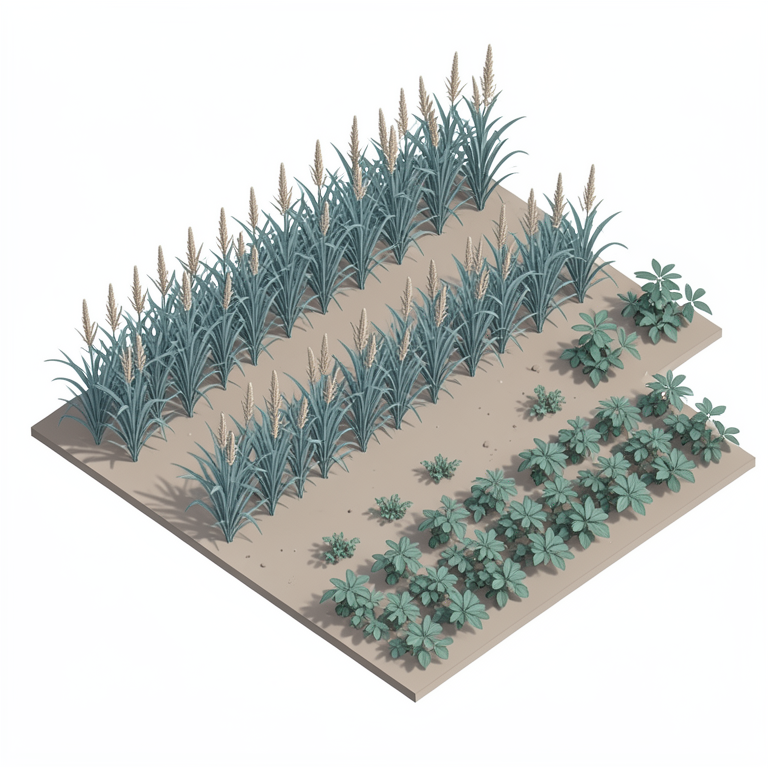
Intercropping Layout
AI-generated conceptual illustration (pearl millet and cowpea plants in a field). It explains the idea and does not show study data.
View source evidence ↗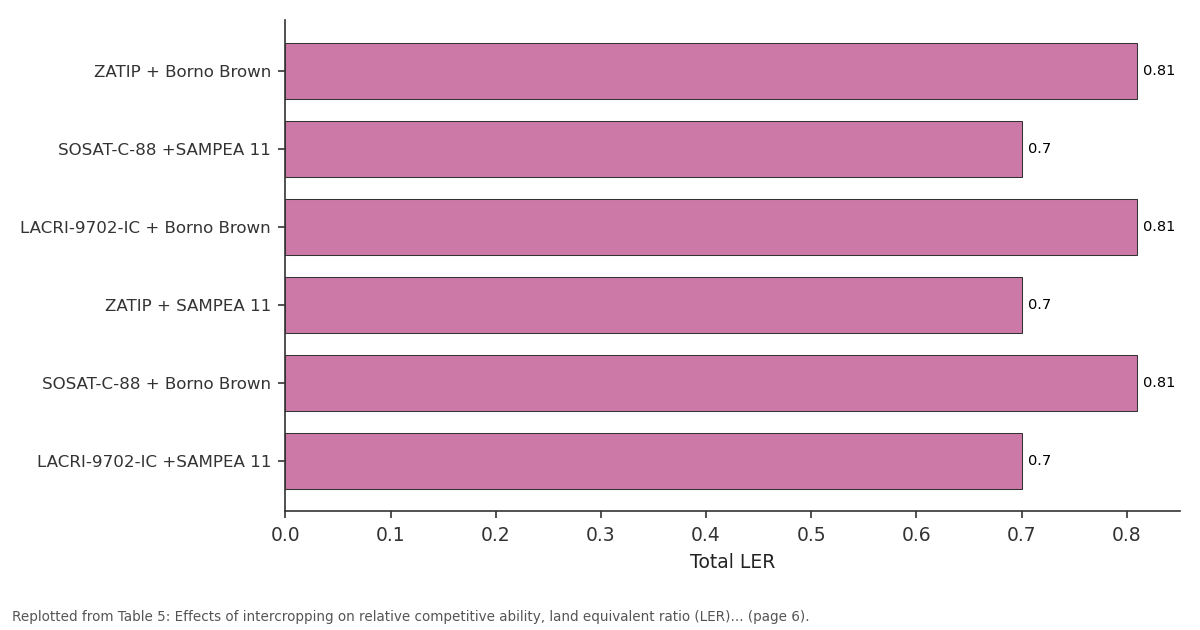
RCA Cowpea: ZATIP + Borno Brown vs SOSAT-C-88 +SAMPEA 11 vs LACRI-9702-IC + Borno... vs ZATIP + SAMPEA 11 vs SOSAT-C-88 + Borno Brown
Replotted from Table 5 (page 6) of the original paper. Every bar is the paper's own table value.
View source evidence ↗Figures & tables
From the original paper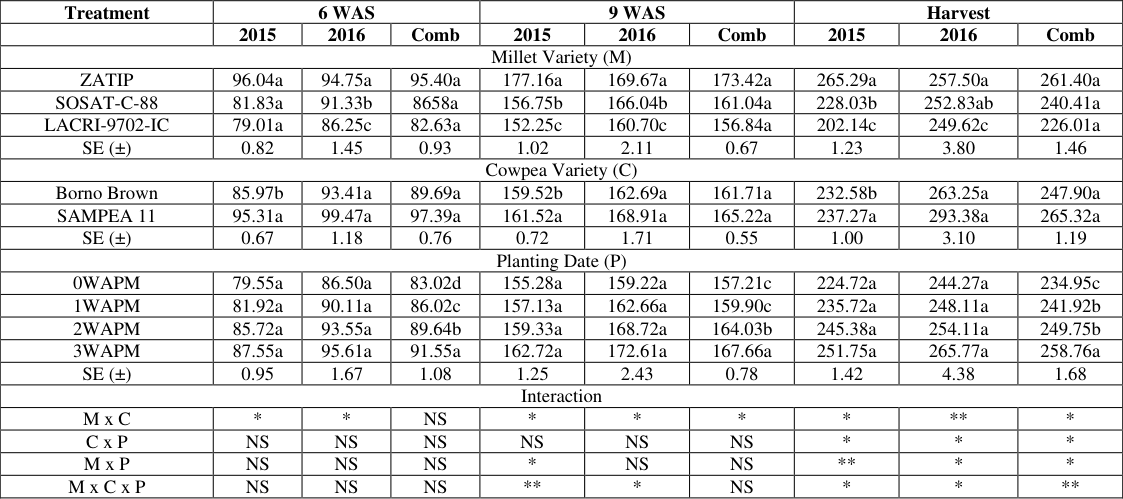 Table 1
 Table 2
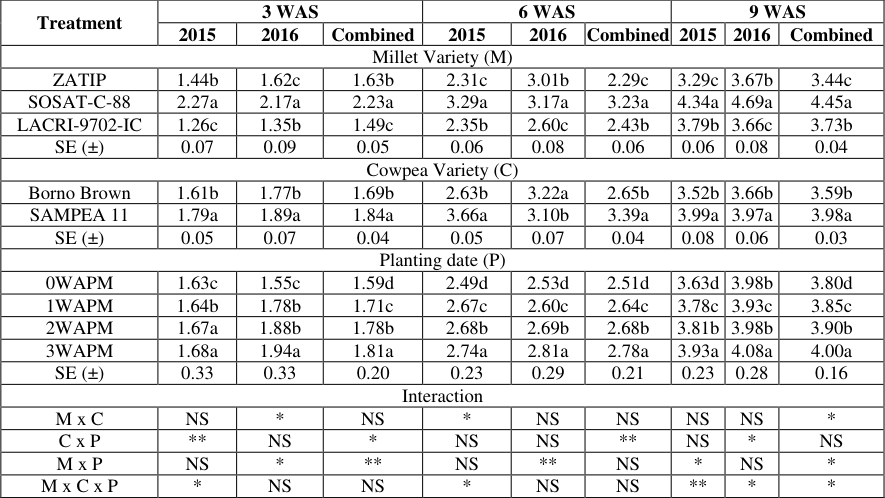 Table 3
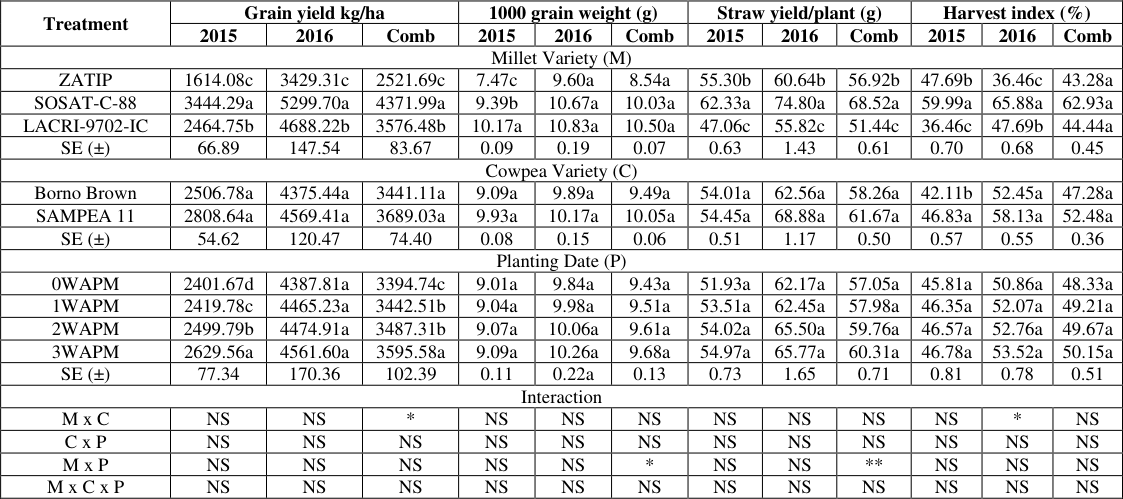 Table 4
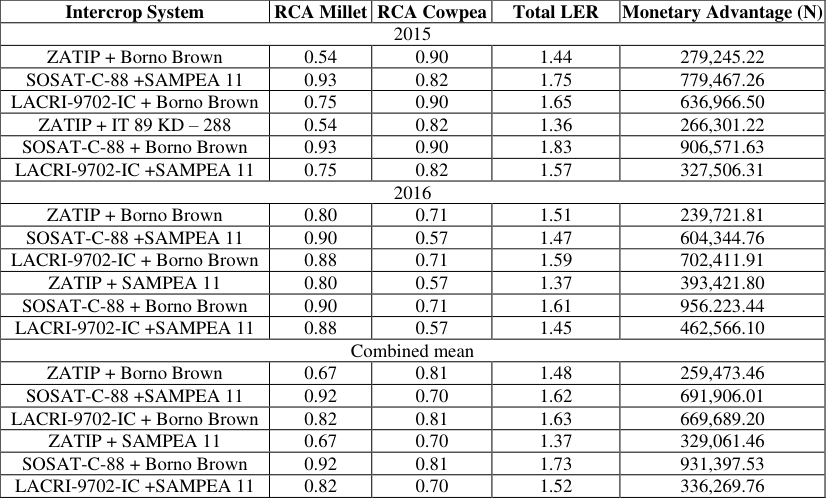 Table 5
Introduction
In West Africa, cereals such as millet and sorghum are traditionally intercropped with cowpea. Pearl millet + cowpea intercrop has most frequently been used in multiple cropping research due to their ability to efficiently use environmental resources (Subbarao et el., 2006) [25] . Intercropping pearl millet with cowpea is a predominant feature in cropping systems as a means of maximizing the use of limited lands and also for food security to the subsistence farmers (Bhupinder et al., 2013) [3] . Previous studies have indicated that millet + cowpea combination is an important cropping system in the Sudan savanna of Nigeria (Ntare, 1990) [12] . Under the indigenous system, farmers use local varieties of pearl millet which are tall, late maturing and photoperiod sensitive, producing panicle at the end of the rainy season (Remison, 2005a). Studies have shown that improving the productivity of millet + cowpea intercrop lies in improving the performance of the cowpea component which among others is the choice of the appropriate genotype (Ntare and Williams, 1992, Reddy and Oumara, 1985) [13,20] . When choosing crop combinations specific variety characteristics need to be considered in conjunction with important management practices (Anaso et al., 1998, Dugje and Odo, 2003) [2,5] . Varietal selection for improving intercrop performance is dependent on the objectives of the system especially in the semi-arid zone of Nigeria. Varietal selection of pearl millet and planting configuration of legumes combination are important management practices that may avail desirable grain yield (Smith and Francis, 1986; Dugje and Odo, 2006a) [6] . An important consideration in millet + legume intercropping is the choice of appropriate crop varieties. In millet + cowpea intercropping in the Sudan Savanna, early maturing improved millet varieties have been shown to yield higher grains than late maturing types (Agboola and Eniola, 2000) [1] . Olufajo and Singh (2009) [14] , reported that available growth resources over time and space in early improved millet variety account for the success of both vegetative and reproductive characters of pearl millet. Mohammed et al., 2008 [11] reported that, performance of pearl millet in mixture with cowpea is somewhat complex because the maximum yield to be obtained will depend on many factors including varieties, cropping systems and environmental conditions. Pearl Millet [Pennisetum glaucum (L.) R. Br.] is widely cultivated with 35.6 million hectares devoted to the crop worldwide (Spencer and Sivakumar, 2009). It is one of the most important cereal crop with 12 million hectares sown and 9.6 million tons produced annually in West Africa including Nigeria, important cereal and legume crops (Ikwelle, 2005) [2] after sorghum and groundnut. Some 8 million hectares of cowpea are grown in West Africa, especially in Nigeria, Burkina Faso, Mali, and Senegal. Pearl millet + cowpea intercrop is one of the commonest combination of crops in Semi-arid Zone of Nigeria and it is typical of many combinations throughout the world where a rapidgrowing, early maturing crop is grown with a slower growing, and late maturing crop.
Materials and Methods
The experiment was conducted during 2015 and 2016 rain-fed cropping seasons at the Teaching and Research Farm, Department of Crop Production Faculty of Agriculture, University of Maiduguri. The experimental site was located between latitude 11 0 47 1 N and 56 00 1 N, and longitude 03 0 12 1 and 16 0 E and altitude of 345 m above sea level, in the northern fringes of the Sudan savanna belt of Nigeria. The treatments consisted of three improved pearl millet varieties: (ZATIP, SOSAT-C-88 and LACRI-9702-IC) intercropped with two cowpea varieties: (Borno Brown and SAMPEA 11) and four planting dates: (simultaneous, one week, two weeks and three weeks after planting the millet WASM) in 2015 and 2016. The pearl millet was grown at (3) three plants/stand, while the cowpea were grown at 2 plants/stand (Dugje et al., 2009) [7] . The experimental design was split-split plot with pearl millet varieties assigned to the main-plot, cowpea varieties assigned to the sub-plot and planting date assigned to the sub-sub plots, which were replicated three times. The sub-plot size was 3.0 x 5.0 m (15.0 m 2 ). An alley of 2.0 m was allowed between the replicates, while 1.0 m and 0.50 m alley was allowed between the main plots and sub-plot, respectively. The pearl millet varieties were sown at 90 cm x 50 cm on 5 th July each year while each cowpea variety was intercropped into the pearl millet at a distance 45cm from the pearl millet row and 50cm within the row at each planting dates: simultaneous planting date (0), 1 week after planting date, 2 weeks after planting date, 3 weeks after planting date and 4 Weeks after planting millet (WAPM).The cowpea varieties were planted into the pearl millet variety. Data collected from the experiment were subjected to two-way Analysis of variance (ANOVA). Both the year wise and combined years' analysis was run using a Computer Software, Statistix Version 8.0 (Statistix, 2005) [24] . Differences between treatments means were compared using Duncan ' s multiple Range Text (DMRT) at 5% level of probability.
Results
The effect of pearl millet variety, cowpea variety, planting date and their interaction on pearl millet plant height at different ages in 2015 showed that, there was no significant effect of millet variety on the pearl millet plant height at 6 WAS (Table 1). Pearl millet plant height was relatively taller for ZATIP and SOSAT-C-88 compared to LACRI-9702-IC at 6 WAS. At 9 WAS and harvest ZATIP variety maintained its superiority in plant heights which were significantly (P<0.05) taller than SOSAT-C-88 and LACRI-9702-IC. Among the pearl millet variety lower plant height was produced by LACRI-9702-IC compared to SOSAT-C-88 and ZATIP (Table 1). Among the two cowpea variety intercrops, greater pearl millet plant height was observed when the later was grown in association with cowpea variety SAMPEA 11 than Borno Brown at 6 WAS in 2015 cropping season. Similar trend was observed at 9 WAS when pearl millet plant height was significantly (P<0.05) taller when grown in association with the cowpea variety SAMPEA 11 than when intercropped with Borno Brown. There was no significant effect of planting date on the pearl millet plant height, however, relatively taller plant height was produced at 3 weeks after planting millet (WAPM) compared to the other planting dates. The interaction of millet variety x cowpea variety (M x C) was significant at 6 and 9 WAS and at harvest. Also, the interaction of cowpea variety x planting date (C x P), millet variety x planting date (M x P) and the three-way interaction between millet variety x cowpea variety x planting date (M x C x P) were significant at harvest in the 2015. In 2016, significantly (P<0.05) greater plant heights for pearl millet were produced by ZATIP and SOSAT-C-88 compared to LACRI-9702-IC at 6, 9 WAS and at harvest (Table 1). There was no significant effect of cowpea variety on pearl millet plant height at 6, 9 WAS and at harvest in 2016. Relatively taller plant height was observed for the pearl millet when grown in association with SAMPEA 11 compared to Borno Brown (Table 1). Taller plant height was produced at 3 WAPM compared to 0 WAPM or 1 WAPM in 2016. The interaction of millet variety x cowpea variety was significant at 6, 9 WAS and at harvest. The interaction of cowpea variety x planting date, millet variety x planting date, and millet variety x cowpea variety x planting date were significant at harvest in 2016. For the combined mean, plant height of pearl millet was not significantly (P>0.05) affected by the millet variety and cowpea variety at each growth stage. However at 6, 9 WAS and harvest pearl millet variety ZATIP relatively produced taller plant heights compared to SOSAT-C-88 or LACRI-9702-IC. LACRI-9702-IC produced relatively shorter plant height at all the growth stages for the combined mean. Planting cowpea at 2 or 3 WAPM significantly produced (P<0.05) taller plants compared to 0 or 1 WAPM at 6, 9 WAS and at harvest for the combined mean. There was no significant millet variety x cowpea variety interaction at 6 WAS, but the interaction was significant at 9 WAS and at harvest for the combined mean. Millet variety x cowpea variety, cowpea variety x planting date and millet variety x planting date interactions were significant at harvest. Similarly, the threeway interaction of millet variety x cowpea variety x planting date was significant at harvest for the combined mean (Table 1). The interaction between millet variety x cowpea variety on millet plant height at different ages were statistically significant in 2015, 2016 and the combined mean (Table 2). In 2015 at 6, 9WAS and harvest, the variety ZATIP x Borno Brown interaction significantly (P<0.05) produced the tallest plants. LACRI-9702-IC x SAMPEA 11 interaction significantly (P<0.05) produced shorter plants than the SOSAT-C-88. In 2016, the interaction between ZATIP x SAMPEA 11 produced significantly (P<0.01) superior plant height at 6 and 9WAS. Also ZATIP x Borno Brown had superior (P<0.01) plant heights at 6 and 9WAS compared to LACRI-9702-IC x SAMPEA 11or Borno Brown at all the ages of the pearl millet plant height. The plant height of SOSAT-C-88 x Borno Brown or SAMPEA 11 were taller than the LACRI-9702-IC (Table 2). For the combined mean at 9 WAS and at harvest, ZATIP x Borno Brown or SAMPEA 11 significantly (P<0.001) produced the tallest plants compared to the other treatments. Lower pearl millet plant height was produced by LACRI-9702-IC irrespective of the cowpea variety interaction. Number of tillers per plant in millet variety was not influenced by cowpea variety or planting date in both the years and the combined mean (Table 3). Similarly, there was significant difference among the pearl millet varieties in the expression of number of tillers per plant at 3,6 and 9 WAS in 2015. Number of tillers/plants was slightly higher for SOSAT-C-88 compared to ZATIP and LACRI-9702-IC that had lower number of tiller per plant at 3, 6 and 9 WAS. Values were greater for SOSAT-C-88, while ZATIP and LACRI had lower number of tillers per plant. Number of tillers per plant was slightly higher when pearl millet was grown in association with cowpea variety SAMPEA 11 than Borno Brown at 3, 6, and 9 WAS in 2015. The results showed that, planting date had no significant effect on millet number of tillers per plant at 3, 6 and 9 WAS in 2015. Also number of tillers were greater for millet at 3 WAPM or 2 WAPM compared to the two planting dates. Pearl millet produced lower number of the tillers when cowpea was introduced at the 0 WAPM at 3, 6 and 9 WAS in 2015 cropping season (Table 3). There was significant interaction for number of tillers per plant at 3, 6 and 9 WAS during the 2015 cropping season. In 2016, number of tillers was greater for SOSAT-C-88, while the ZATIP and LACRI-9702 IC produced lower number of tillers per plant at 3, 6 and 9 WAS when averaged over both the years. Number of tillers per plant was slightly higher when the pearl millet was grown in association cowpea variety SAMPEA 11 compared to Borno Brown at 3, 6, and 9 WAS in 2016. Tillers was higher when the cowpea variety planted at 3 WAPM compared to 0 or 1 WAPM at 3, 6 and 9 WAPM during 2016 cropping season. Interaction effect between millet variety x cowpea variety x planting date on millet number of tillers were statistically significant at 3, 6 and 9 WAS in 2016. For the combined mean, cowpea variety and planting date did not influence pearl millet number of tillers per plant at 3, 6 and 9 WAS for the combined mean. SOSAT-C-88 produced significantly higher number of tillers per plant compared to ZATIP or LACRI-8702-IC variety. Relatively lower tillers were produced at ZATIP and LACRI-9702-IC at 3, 6, and 9 WAS during the combined mean. Among the cowpea variety SAMPEA 11 produced greater number of tillers for the pearl millet variety compared to Borno Brown variety. that produced lower tillers for the pearl millet. When the cowpea was planted at 3 WAPM pearl millet resulted to higher number of tillers in the pearl millet variety compared to either 0 or 1 WASM at 3, 6 and 9 WAS for the combined mean. Similarly, there was significant interaction between the millet variety x cowpea variety, cowpea variety x planting date, millet variety x planting date and the three-way interaction between millet variety x cowpea variety x planting date at 3, 6 and 9 WAS on tillers for the combined mean (Table 3) Pearl millet grain yield were generally greater in 2016 than 2015 (Table 4). The effect of pearl millet variety showed that, grain yield per hectare was significantly (P<0.05) greater for SOSAT-C-88 than for ZATIP or LACRI-9702-IC in 2015. The promising varieties in 2015 were SOSAT-C-88 and LACRI-9702-1C. There was, no significant effect of cowpea varieties on millet grain yield in 2015 cropping season. Millet intercropped with SAMPEA 11 produced relatively higher grain yield compared to Borno Brown. Planting date significantly (P<0.05) influenced grain yield of millet in 2015 cropping season. Planting 3 or 2 WAPM significantly (P<0.05) realized greater grain yield for pearl millet than simultaneous planting of the millet crop component In 2016 cropping season, pearl millet grain yield was significantly (P<0.05) higher for SOSAT-C-88 compared to LACRI -9702-1C or ZATIP. The most promising variety after SOSAT-C-88 was LACRI-9702-1C, which produced significantly greater in grain yield compared to ZATIP variety. There was relative increase in millet grain yield in 2016 when millet was intercropped with SAMPEA 11 compared to Borno Brown. Pearl millet grown with cowpea at 3 WAPM produced relatively higher millet grain yield compared to the three planting date. The 0 WAPM produced lowest millet grain yield compared to 1 WAPM and 2 WAPM. For the combined mean, grain yield per hectare was significantly (P<0.05) greater for SOSAT-C-88 compared to ZATIP. However values for LACRI-9702-IC was significantly lower than SOSAT-C-88 but greater than ZATIP (Table 4). Pearl millet grown in association with Borno Brown produced relatively lower millet grain yield compared to SAMPEA 11 in the combined mean. Intercropping cowpea 3 WAPM produced significantly (P<0.05) greater millet grain yield compared to 2 and 1 WAPM. Millet produced lower grain yield at simultaneous planting with (0 WAPM) compared to 3 WAPM. The interaction of millet variety x cowpea variety was statistically significant for the combined mean (Table 4). Grain weight significantly (P<0.001) differed among the pearl millet varieties in 2015 (Table 4). The variety LACRI-9702-IC significantly (P<0.001) produced superior 1000 grain weight, on the other hand, ZATIP produced significantly lower grain weight compared to SOSAT -C-88 variety. Slightly higher 1000 grain weight was observed for millet intercropped with SAMPEA 11 compared to Borno Brown. planting date had no significant effect on millet 1000 grain weight in 2015. Relatively higher gra in weight was produced at 3 WAPM compared to 0, 1 or 2 WAPM (Table 4). Although there was no significant difference, lower grain weight for the pearl millet was produced by ZATIP in 2016. The Variety LACRI-9702-IC produced relatively heavier 1000 grain weight than the other varieties. Pearl millet grown in mixture with cowpea variety SAMPEA 11 produced heavier grains than Borno Brown. Also planting date produced higher millet grain weight at 2 and 3 WAPM compared to 1 or 0 WAPM. For the combined mean, pearl millet variety ZATIP relatively produced lower grain weight compared to SOSAT-C-88 or LACRI-9702-IC. Relatively lower 1000 grain weight for the pearl millet was observed in association with Borno Brown compared to SAMPEA 11 in the combined mean. Similarly planting cowpea 3 WAPM produced higher grain weight than the other planting dates. Lower grain weight was observed at simultaneous planting of cowpea with millet (0 WAPM). The interaction of millet variety x planting date on millet 1000 grain weight was statistically significant (P<0.05) in the combined mean (Table 4). There was significant difference among the pearl millet varieties on straw yield/plant in 2015 cropping season. SOSAT-C-88 produced significantly (P<0.05) higher straw yield/plant compared to ZATIP. The highest straw yield was observed for SOSAT-C-88. No significant effect of cowpea variety on the straw yield of pearl millet was observed. Millet intercropped with SAMPEA 11 relatively produced higher straw yield per plant compared to Borno Brown. Similarly, there was no significant effect of the planting date on the millet straw yield. Among the planting dates millet straw yield was relatively higher at the 3 or 2 WAPM compared to 0 or 1 WAPM. Millet grown simultaneously with cowpea (0 WAPM) and 1WAPM produced relatively lower straw yield in 2015 cropping season. In 2016, similar trends to 2015 was observed when SOSAT-C-88 produced significantly (P<0.01) greater straw yield/plant compared to the other varieties. ZATIP produced significantly (P<0.01) greater straw yield than LACRI-9702-IC. Also pearl millet intercropped with Borno Brown produced relatively lower straw yield compared to SAMPEA 11 variety, Lower straw yield was produced at the 0 WAPM compared to 1, 2 and 3 WAPM planting dates. Similarly, 3 WAPM produced higher straw yield compared to 0 WAPM 2016 cropping season. The results for the combined mean of the two cropping seasons showed that, pearl millet variety SOSAT-C-88 produced significantly (P<0.05) greater straw yield compared to ZATIP variety. The variety LACRI-9702-IC produced significantly (P<0.05) the lowest straw yield than ZATIP or SOSAT-C-88. Pearl millet grown in association with SAMPEA 11 produced higher straw yield compared to Borno Brown in the combined mean. There was no significant effect of planting date on pearl millet straw yield per plant, however, relatively greater straw yield was observed at 3 WAPM compared to 2 WAPM. Among the planting dates, 0 WAPM produced relatively lower straw yield compared to other planting date. There was significant difference among the pearl millet varieties on pearl millet harvest index (Table 4). SOSAT-C-88 significantly (P<0.01) produced greater harvest index than, ZATIP or LACRI-9702-IC. However, there was no significant effect of cowpea varieties on pearl millet harvest index in 2015 cropping season. Higher harvest index was observed for pearl millet grown in association with SAMPEA 11 than Borno Brown. Relatively higher harvest index for pearl millet was produced at the 3 or 2 WAPM compared to 0 or 1 WAPM. The lower millet harvest index was produced at 0 WAPM in 2015 cropping season. There was significant difference among the pearl millet varieties with ZATIP producing lower harvest index than SOSAT-C-88 or LACRI-9702-IC in 2016 cropping season. However, harvest index was significantly (P<0.01) greater for SOSAT-C-88 compared to LACRI-9702-IC (Table 4). There was no significant effect of cowpea variety on millet harvest index in 2016, however, relatively higher harvest index was produced in association with SAMPEA 11 compared to Borno Brown. Also, higher harvest index was observed at 3 WAPM compared to 2 WAPM sowing date. The 0 WAPM produced lower harvest index when compared to 1 WAPM. There was no significant difference in harvest index, among the pearl millet varieties in the combined mean. SOSAT-C-88 produced relatively higher harvest index compared to LACRI-9702-IC or ZATIP. Relatively higher millet harvest index was observed when millet was intercropped with cowpea variety SAMPEA 11 than Borno Brown. The effect of planting date showed that, 3 WASM produced higher harvest index compared to 0, 1 or 2 WASM. The relative competitive ability was higher for SOSAT-C-88 than either of the two cowpea varieties in 2015 (Table 5). The situation was similar in 2016, when SOSAT-C-88 had higher competitive abilities compared to cowpea varieties. For the combined mean, the relative competitive ability was also higher for SOSAT-C-88 compared to ZATIP intercrop with the cowpea components. In similar trend with cowpea varieties on relative competitive ability, Borno Brown had higher competitive ability compared to ZATIP in 2015 and for the combined mean. The land equivalent ratio of pearl millet variety + cowpea variety was higher for SOSAT-C-88 in combination with Borno Brown intercrop compared to other treatments in 2015, 2016 and the combined mean (Table 5). Similarly, in both years LACRI-9702-IC + cowpea intercrop had greater land equivalent ratio compared to ZATIP + cowpea intercrop that had lower land equivalent ratio in 2015, 2016 and the combined mean. The monetary advantage from the pearl millet variety + cowpea variety intercrop was greater for SOSAT-C-88 in combination with cowpea variety SAMPEA 11 in 2015 and the combined mean while SOSAT-C-88 and Borno Brown had greater advantage in 2016 (Table 5) The values of monetary advantage ranged from N304,344.76 to N 986,223.44 for SOSAT-C-88 and N227,506.31 to N905,411.91 for LACRI-9702-IC compared to ZATIP that had lower values that ranged between N 266,301.22 to N793,421.80 in both the years and the acombined mean.
| Intercrop System | RCA Millet | RCA Cowpea | Total LER | Monetary Advantage (N) |
|---|---|---|---|---|
| 2015 | ||||
| ZATIP + Borno Brown | 0.54 | 0.90 | 1.44 | 279,245.22 |
| SOSAT-C-88 +SAMPEA 11 | 0.93 | 0.82 | 1.75 | 779,467.26 |
| LACRI-9702-IC + Borno Brown | 0.75 | 0.90 | 1.65 | 636,966.50 |
| ZATIP + IT 89 KD – 288 | 0.54 | 0.82 | 1.36 | 266,301.22 |
| SOSAT-C-88 + Borno Brown | 0.93 | 0.90 | 1.83 | 906,571.63 |
| LACRI-9702-IC +SAMPEA 11 | 0.75 | 0.82 | 1.57 | 327,506.31 |
| 2016 | ||||
| ZATIP + Borno Brown | 0.80 | 0.71 | 1.51 | 239,721.81 |
| SOSAT-C-88 +SAMPEA 11 | 0.90 | 0.57 | 1.47 | 604,344.76 |
| LACRI-9702-IC + Borno Brown | 0.88 | 0.71 | 1.59 | 702,411.91 |
| ZATIP + SAMPEA 11 | 0.80 | 0.57 | 1.37 | 393,421.80 |
| SOSAT-C-88 + Borno Brown | 0.90 | 0.71 | 1.61 | 956.223.44 |
| LACRI-9702-IC +SAMPEA 11 | 0.88 | 0.57 | 1.45 | 462,566.10 |
| Combined mean | ||||
| ZATIP + Borno Brown | 0.67 | 0.81 | 1.48 | 259,473.46 |
| SOSAT-C-88 +SAMPEA 11 | 0.92 | 0.70 | 1.62 | 691,906.01 |
| LACRI-9702-IC + Borno Brown | 0.82 | 0.81 | 1.63 | 669,689.20 |
| ZATIP + SAMPEA 11 | 0.67 | 0.70 | 1.37 | 329,061.46 |
| SOSAT-C-88 + Borno Brown | 0.92 | 0.81 | 1.73 | 931,397.53 |
| LACRI-9702-IC +SAMPEA 11 | 0.82 | 0.70 | 1.52 | 336,269.76 |
Table text extracted from the original PDF; superscript letters are shown inline. The original table image is below.
View original table image
| Treatment | Grain yield kg/ha | — | — | 1000 grain weight (g) | — | — | Straw yield/plant (g) | — | — | Harvest index (%) | — | — |
|---|---|---|---|---|---|---|---|---|---|---|---|---|
| 2015 | 2016 | Comb | 2015 | 2016 | Comb | 2015 | 2016 | Comb | 2015 | 2016 | Comb | |
| Millet Variety (M) | ||||||||||||
| ZATIP | 1614.08c | 3429.31c | 2521.69c | 7.47c | 9.60a | 8.54a | 55.30b | 60.64b | 56.92b | 47.69b | 36.46c | 43.28a |
| SOSAT-C-88 | 3444.29a | 5299.70a | 4371.99a | 9.39b | 10.67a | 10.03a | 62.33a | 74.80a | 68.52a | 59.99a | 65.88a | 62.93a |
| LACRI-9702-IC | 2464.75b | 4688.22b | 3576.48b | 10.17a | 10.83a | 10.50a | 47.06c | 55.82c | 51.44c | 36.46c | 47.69b | 44.44a |
| SE (±) | 66.89 | 147.54 | 83.67 | 0.09 | 0.19 | 0.07 | 0.63 | 1.43 | 0.61 | 0.70 | 0.68 | 0.45 |
| Cowpea Variety (C) | ||||||||||||
| Borno Brown | 2506.78a | 4375.44a | 3441.11a | 9.09a | 9.89a | 9.49a | 54.01a | 62.56a | 58.26a | 42.11b | 52.45a | 47.28a |
| SAMPEA 11 | 2808.64a | 4569.41a | 3689.03a | 9.93a | 10.17a | 10.05a | 54.45a | 68.88a | 61.67a | 46.83a | 58.13a | 52.48a |
| SE (±) | 54.62 | 120.47 | 74.40 | 0.08 | 0.15 | 0.06 | 0.51 | 1.17 | 0.50 | 0.57 | 0.55 | 0.36 |
| Planting Date (P) | ||||||||||||
| 0WAPM | 2401.67d | 4387.81a | 3394.74c | 9.01a | 9.84a | 9.43a | 51.93a | 62.17a | 57.05a | 45.81a | 50.86a | 48.33a |
| 1WAPM | 2419.78c | 4465.23a | 3442.51b | 9.04a | 9.98a | 9.51a | 53.51a | 62.45a | 57.98a | 46.35a | 52.07a | 49.21a |
| 2WAPM | 2499.79b | 4474.91a | 3487.31b | 9.07a | 10.06a | 9.61a | 54.02a | 65.50a | 59.76a | 46.57a | 52.76a | 49.67a |
| 3WAPM | 2629.56a | 4561.60a | 3595.58a | 9.09a | 10.26a | 9.68a | 54.97a | 65.77a | 60.31a | 46.78a | 53.52a | 50.15a |
| SE (±) | 77.34 | 170.36 | 102.39 | 0.11 | 0.22a | 0.13 | 0.73 | 1.65 | 0.71 | 0.81 | 0.78 | 0.51 |
| Interaction | ||||||||||||
| M x C | NS | NS | * | NS | NS | NS | NS | NS | NS | NS | * | NS |
| C x P | NS | NS | NS | NS | NS | NS | NS | NS | NS | NS | NS | NS |
| M x P | NS | NS | NS | NS | NS | * | NS | NS | ** | NS | NS | NS |
| M x C x P | NS | NS | NS | NS | NS | NS | NS | NS | NS | NS | NS | NS |
Table text extracted from the original PDF; superscript letters are shown inline. The original table image is below.
View original table image
| Treatment | 3 WAS | — | — | 6 WAS | — | — | 9 WAS | — | — |
|---|---|---|---|---|---|---|---|---|---|
| 2015 | 2016 | Combined | 2015 | 2016 | Combined | 2015 | 2016 | Combined | |
| Millet Variety (M) | |||||||||
| ZATIP | 1.44b | 1.62c | 1.63b | 2.31c | 3.01b | 2.29c | 3.29c | 3.67b | 3.44c |
| SOSAT-C-88 | 2.27a | 2.17a | 2.23a | 3.29a | 3.17a | 3.23a | 4.34a | 4.69a | 4.45a |
| LACRI-9702-IC | 1.26c | 1.35b | 1.49c | 2.35b | 2.60c | 2.43b | 3.79b | 3.66c | 3.73b |
| SE (±) | 0.07 | 0.09 | 0.05 | 0.06 | 0.08 | 0.06 | 0.06 | 0.08 | 0.04 |
| Cowpea Variety (C) | |||||||||
| Borno Brown | 1.61b | 1.77b | 1.69b | 2.63b | 3.22a | 2.65b | 3.52b | 3.66b | 3.59b |
| SAMPEA 11 | 1.79a | 1.89a | 1.84a | 3.66a | 3.10b | 3.39a | 3.99a | 3.97a | 3.98a |
| SE (±) | 0.05 | 0.07 | 0.04 | 0.05 | 0.07 | 0.04 | 0.08 | 0.06 | 0.03 |
| Planting date (P) | |||||||||
| 0WAPM | 1.63c | 1.55c | 1.59d | 2.49d | 2.53d | 2.51d | 3.63d | 3.98b | 3.80d |
| 1WAPM | 1.64b | 1.78b | 1.71c | 2.67c | 2.60c | 2.64c | 3.78c | 3.93c | 3.85c |
| 2WAPM | 1.67a | 1.88b | 1.78b | 2.68b | 2.69b | 2.68b | 3.81b | 3.98b | 3.90b |
| 3WAPM | 1.68a | 1.94a | 1.81a | 2.74a | 2.81a | 2.78a | 3.93a | 4.08a | 4.00a |
| SE (±) | 0.33 | 0.33 | 0.20 | 0.23 | 0.29 | 0.21 | 0.23 | 0.28 | 0.16 |
| Interaction | |||||||||
| M x C | NS | * | NS | * | NS | NS | NS | NS | * |
| C x P | ** | NS | * | NS | NS | ** | NS | * | NS |
| M x P | NS | * | ** | NS | ** | NS | * | NS | * |
| M x C x P | * | NS | NS | * | NS | NS | ** | * | * |
Table text extracted from the original PDF; superscript letters are shown inline. The original table image is below.
View original table image
| Millet variety x Cowpea variety | 2015 2016 Combined 6 WAS 9 WAS Harvest 6 WAS 9 WAS Harvest 9 WAS Harvest | — | — | — | — | — | — | — |
|---|---|---|---|---|---|---|---|---|
| ZATIP x Borno Brown | 97.75a | 179.92a | 267.75a | 99.66a | 175.33a | 281.91a | 177.63a | 274.83a |
| ZATIP x SAMPEA 11 | 94.33b | 174.41ab | 262.83b | 96.58a | 174.50a | 274.25a | 174.46b | 266.54a |
| SOSAT -C -88 x Borno Brown | 82.16c | 162.33b | 225.58d | 86.08b | 173.83a | 277.44a | 168.08.c | 243.00b |
| SOSAT -C- 88 x SAMPEA 11 | 81.92c | 153.17c | 230.58c | 87.00b | 158.58b | 237.58b | 155.87c | 251.51b |
| LACRI -9702- IC x Borno Brown | 78.00d | 153.50 c | 204.47e | 81.66c | 157.58b | 231.96b | 155.54d | 218.22c |
| LACRI-9702 –IC x SAMPEA 11 | 79.67cd | 151.67c | 200.00f | 84.83c | 155.00b | 218.33c | 153.34e | 209.17c |
| SE (±) | 1.66 | 1.25 | 1.74 | 2.05 | 2.98 | 5.37 | 0.95 | 1.51 |
Table text extracted from the original PDF; superscript letters are shown inline. The original table image is below.
View original table image
| Treatment | 6 WAS | — | — | 9 WAS | — | — | Harvest | — | — |
|---|---|---|---|---|---|---|---|---|---|
| 2015 | 2016 | Comb | 2015 | 2016 | Comb | 2015 | 2016 | Comb | |
| Millet Variety (M) | |||||||||
| ZATIP | 96.04a | 94.75a | 95.40a | 177.16a | 169.67a | 173.42a | 265.29a | 257.50a | 261.40a |
| SOSAT-C-88 | 81.83a | 91.33b | 8658a | 156.75b | 166.04b | 161.04a | 228.03b | 252.83ab | 240.41a |
| LACRI-9702-IC | 79.01a | 86.25c | 82.63a | 152.25c | 160.70c | 156.84a | 202.14c | 249.62c | 226.01a |
| SE (±) | 0.82 | 1.45 | 0.93 | 1.02 | 2.11 | 0.67 | 1.23 | 3.80 | 1.46 |
| Cowpea Variety (C) | |||||||||
| Borno Brown | 85.97b | 93.41a | 89.69a | 159.52b | 162.69a | 161.71a | 232.58b | 263.25a | 247.90a |
| SAMPEA 11 | 95.31a | 99.47a | 97.39a | 161.52a | 168.91a | 165.22a | 237.27a | 293.38a | 265.32a |
| SE (±) | 0.67 | 1.18 | 0.76 | 0.72 | 1.71 | 0.55 | 1.00 | 3.10 | 1.19 |
| Planting Date (P) | |||||||||
| 0WAPM | 79.55a | 86.50a | 83.02d | 155.28a | 159.22a | 157.21c | 224.72a | 244.27a | 234.95c |
| 1WAPM | 81.92a | 90.11a | 86.02c | 157.13a | 162.66a | 159.90c | 235.72a | 248.11a | 241.92b |
| 2WAPM | 85.72a | 93.55a | 89.64b | 159.33a | 168.72a | 164.03b | 245.38a | 254.11a | 249.75b |
| 3WAPM | 87.55a | 95.61a | 91.55a | 162.72a | 172.61a | 167.66a | 251.75a | 265.77a | 258.76a |
| SE (±) | 0.95 | 1.67 | 1.08 | 1.25 | 2.43 | 0.78 | 1.42 | 4.38 | 1.68 |
| Interaction | |||||||||
| M x C | * | * | NS | * | * | * | * | ** | * |
| C x P | NS | NS | NS | NS | NS | NS | * | * | * |
| M x P | NS | NS | NS | * | NS | NS | ** | * | * |
| M x C x P | NS | NS | NS | ** | * | NS | * | * | ** |
Table text extracted from the original PDF; superscript letters are shown inline. The original table image is below.
View original table image
Discussion
Intercropping cowpea with pearl millet had no significant effect on plant height, number of leaves/plants, leaf area, number of tiller/plant and days to 50% flowering in both the years and combined analysis. However, sole pearl millet crop, generally expressed superior vegetative characters including, plant height, number of leaves, leaf area, number of tiller/plants, panicle characters and harvest index than millet grown in intercropping with cowpea. The presence of cowpea in the intercropping system reduced the performance of the development characters of pearl millet as the growth resources: nutrients and water most likely affected the performance of the crop components. Reddy and Willey (1981) [19] agreed that variation in rate of vegetative development, final canopy, plant height and rooting characteristics for extraction of nutrients and water were some of the major factors identified for the success of intercrops. Dugje, (2004) [6] reported that presence of groundnut in the pearl millet intercropping reduced the number of fertile tillers, grain yield and harvest index. Low yields was more pronounced in pearl millet variety ZATIP, these low yields and associated variations can be attributed to year. Although the 2015 cropping season had low precipitation, the few torrential rainy days were accumulated between July and August and by the end of September the soil started to dry out due to high temperatures compared to 2016 cropping seasons. Ports. (1990) reported co efficient of variation from fields plots for corn and soybean yields ranging from 2 to 19 % over 10 studies years. SOSAT-C-88 and LACRI-9702-IC had greater vegetative and reproductive characters and flowered earlier than ZATIP variety. The greater photosynthetic capacity of leaf area enhanced greater number of tillers/plant and grain yield. SOSAT-C-88 variety produced greater vegetative and reproductive characters than LACRI-9702-IC. This was shown by greater number of fertile tillers, leaf area, panicle diameter, panicle weight grain yield / plant and number of grains /panicles. Pal and Murari, (1985) [16] reported that the presence of intrinsic genetic character and leaf area were the major determinants of growth and yield components of pearl millet under intercropping. ZATIP variety had the least elaborate vegetative character and produced lower number of tillers/plant and grain yield. The lower vegetative character of these varieties limited grain yield due to minimal dominance and complementary. Olufajo and Singh (2008) [11] , agreed that positive available growth resources over time and space in pearl millet + cowpea intercropping system as the major success of both vegetative and reproductive character of pearl millet. Oluwasimire (2006) reported that improving productivity of pear millet + cowpea intercrop lies in the performance of appropriate variety. Bassi, and Dugje (2016) [5] reported that increase in number of tillers/plants contributed to increase in leaf area, panicle characteristics and grain yield /hectare. The panicle characteristics, grain yield /hectare, number of grains/panicle and harvest index was not favorable for ZATIP intercropped with Cowpea. The lower vegetative and reproductive capacity was the major factor responsible for limited grain yield. Dugje (2004) [4] reported that pearl millet yield component is only reduced if the legume is more intimately mixed with pearl millet intercrop as it may increase root ramification per unit area of the soil occupied by the two crops which enhanced greater extraction of water and competition for nutrients. Singh et al. (2004) [21] reported that, grain yield/ hectare is determined during grain filling period and higher values indicate successful capture of growth resources during the period.
References
24 in the original paper- Agboola AA, Eniola HT. Appropriate technology generation for small scale farmers in Nigeria. Pages 53-61. A Publication of the Nigerian National Farming Systems Research. Network August, 1991; 14-16.
- Anaso AB, Ikwelle MC, Aminu Kano M. Medium-term research plan for pearl millet 1996-2000. Pages 37-40. In: Pearl millet in Nigerian agriculture: production, processing and research priorities (Emechebe, A.M., Ikwelle, M.C., Ajayi, O and Anaso, A.B. (eds), LCRI, Maiduguri, 1998.
- Bhupinder S, Kadini U, Singh B, Usha K. Nodulation and Symbiotic Nitrogen Fixation of cowpea genotypes as affected by Nitrogen. J plant Nutri. 2013; 26(2):463-473.
- Dugje IY. The performance of pearl millet varieties in mixture with groundnut in the Nigerian Sudan savanna. Samaru Journal of Agriculture. Research. 2004; 20:3-17.
- Dugje IY, Odo PE. Effects of planting pattern on the performance of pearl millet-groundnut intercrop in the Sudan Savanna of Nigeria. Nigerian Journal of Experimental and Applied Biology. 2003; 4(2):239-245.
- Dugje IY, Omoigui LO, Ekeleme F, Kamara AY, Ajeigbe H. Farmers Guide to Cowpea Production in West Africa. IITA, Ibadan, Nigeria, 2009, 20 pp.
- FAO. Food and Agriculture Organisation Production Year Book, 2017.
- Ferry EO. Registration of Cowpea of Duocrop, Crop Science. 2009; 22:44-449.
- Ikwelle MC. Pearl Millet in Nigerian Agriculture. Invited paper presented at the National coordinated Research Programme NCRP on pearl millet pre seasonal National Coordination and planning meeting held from 21 st -24 April 2005 at Lake Chad Research Institute, Maiduguri, 2005, pp. 4-7
- Mohammed IB, Olufajo OO, Singh BB. Effect of planting patterns, crop variety and insecticide on the productivity of cowpea-cereal systems. International Institute of Tropical Agriculture (IITA) Ibadan, Nigeria, 2008, pp 278-286.
- Ntare BR. Intercropping morphologically different cowpea with pearl millet in short season environment in the sahel. Experimental Agriculture. 1990; 21(1):541-547.
- Ntare BR, Williams JH. Response of cowpea cultivars to planting pattern and date of sowing in intercrop with pearl millet in Niger. Experimental Agriculture. 1992; 28:41-48.
- Olufajo OO, Singh BB. Improving cowpea and cereal based cropping system in the dry savannas of West Africa. In: Challenges and production, International Institute of Tropical Agriculture (IITA), Ibadan, Nigeria, 2008, pp: 225262.
- Oluwasemire KO, Agboola AA, Bernard OM. Seasonal water use and crop productivity of millet-based cropping systems in the Nigeria Sudan Savanna near Kano. Agricultural Water Management. 2006; 56:207-227.
- Pal VR, Murari K. Length and width measurement for estimating leaf area of grain sorghum. Samara journal of Agricultural Research. 1985; 3:109-112.
- Pierson CL. Agronomic Aspects of Shifting Cultivation and soil conservation in Africa. Agronomy Journal. 2005; 70:275-280.
- Pots MT. Influence of intercropping in warm climates on pests and diseases of potato with special reference to the control, Field Crops Res. 1990; 25:133-144.
- Reddy MS, Willey RW. Growth and resource use studies in an intercrop of pearl millet and cowpea. Field Crops Research. 1981; 4:13-24.
- Reddy KC, Oumara CO. le neibe dans le systems des cultures au Niger. Legume Workshop, 19-22 November, 1985. University of Niamey, Niamey, Niger. Cited by Davis et al. (1994). Journal of Plant Nutrition. 1985 ; 17(6):899-910.
- Singh BB, Ajeigbe HA, Tarawali SA, Fernandez S, Musa A. Improving the production and utilization of cowpea as food and fodder. Field Crops Research. 2004; 84:169-177.
- Smith ME, Francis CA. Breeding for multiple cropping systems. In: Breeding for multiple cropping. Macmillan New York, 1986, pp. 219-249.
- Spencer DSC, Sivakumar MVK. Pearl millet in Africa. In Proceeding of the International Pearl millet workshop. ICRISAT, Patancheru, India, 2009.
- Statistix. Statistical package, version 8.0; Carry U.S.A, 2005.
- Subbarao GV, Renord C, Bationo A, Van-Duivenbroden N, Bielders C. Alternative technologies for sahelian Crop Production systems in West Africa. Recent Advances in management of Arid Ecosystem. Jodtipur: Arid Zone Reserch Association of India, 2006, 121-132.
Cited by 4
From OpenAlex, OpenCitations and reference lists read by Scinovex
- Combining ability and gene action studies for nutritional traits in pearl millet [Pennisetum glaucum (L.) R Br.]
RK Gavali, SH Karvar, SN Kohkade, SD Thorat · International Journal of Advanced Biochemistry Research · 2024
The forty hybrids used in the experiment were produced by a line x tester mating design with four male sterile lines and ten restores serving as parental material. Two hybrids, Aadishakti and Pratap, were used as standard checks. “During the Kharif 2018 season, the parents, hybrids, and two standard checks were evaluated for a total of 12 traits”. Notable variations were noted for each of the twelve characters under investigation. The greatest general combiner for grain yield among the females was determined to be DHLB-787A, which also had noteworthy GCA impacts for eight additional traits. Du
- Effect of nitrogen management and phosphorus levels on growth, yield attributes and yield of summer fodder pearl millet (Pennisetum glaucum L.) varieties
H. N. Chaudhary, Sunil Kumar, KV Chaudhary, RM Patel, Pravina P Solanki · International Journal of Research in Agronomy · 2024
A field experiment, “Effect of nitrogen management and phosphorus levels on summer fodder pearl millet (Pennisetum glaucum L.) Varieties under North Gujarat agro-climatic conditions” was conducted at Agronomy Instructional Farm, Sardarkrushinagar Dantiwada Agricultural University, Sardarkrushinagar during summer season of 2020. The soil of the experimental field was loamy sand in texture. There were twelve treatment combinations consisting two varieties i.e., V1 (GFB 1) and V2 (GFB 4), three levels of nitrogen management i.e., N1 (60 kg N/ha as a basal + 30 kg N/ha after first cut), N2 (60 kg
- High temperature induced biochemical changes in pearl millet genotypes at seedling stage ↗
RC Meena, Supriya Ambawat, C. Tara Satyavathi, Rajbala Meena · International Journal of Chemical Studies · 2021
Thirteen genotypes of Pearl millet (Pennisetum glaucum (L.) R. Br.) selected on the basis of heat tolerance were studied to see changes at biochemical and physiological levels. The plants were initially raised under normal condition in small plastic pots and 20 days old seedling were exposed at (40 °C for 4 hrs, 44 °C for 4 hrs and 46 °C…
❝ 0PDF - Nutritional quality assessment of optimized cereal- based complementary foods fortified with Moringa oleifera ↗
Y Saidu, Isa SA, B Jibrin, A. A. Turaki, Yusuf AB · Journal of Current Research in Food Science · 2021
Childhood malnutrition is a household issue and urgent health challenge in Nigeria. In an attempt to address this challenge, the current study evaluated the effect of optimizing blending ratio of cereals and legumes on nutritional quality, storage stability and determined the most effective blend based on selected nutritional profiles. Optimal design mixture using Nutrisurvey (2007) was used to generate six…
❝ 0PDF