
Research article · 2020 · Full text
International Journal of Agriculture and NutritionAnalysis of adoption of small ruminants’ innovations among small-scale farmers in apa local government area of Benue State, Nigeria
Volume 2(1) · Pages 13–18 · DOI: 10.33545/26646064.2020.v2.i1a.25 ↗
Research areasRangeland Management and Livestock Ecology
Abstract
Author-writtenThe study analyzed adoption of small ruminant innovations among small-scale farmers in Apa Local Government Area of Benue State, Nigeria. Primary data were collected using structured questionnaire administered on 119 respondents selected randomly from five out of eleven council wards. Data collected were analyzed using descriptive statistics. Results revealed that farmers who were age between 21 and 40 years 58.8%, females 55.5%, married 49.6%, had household size of 16 persons and above 28.8%, those who spent 13 years in formal education were 50.4%, those who had experience of less than 10 years in rearing ruminants animals 55.5%, number of animals reared were between 11 and 30 38.7% and for major occupation 37% were farmers. Results on sources of information indicated that radio 26.1%, one of the innovations introduced was deworming 41.2%, innovations adopted 32.8% and problems encountered was lack of veterinary clinic and doctors in the villages 33.6%. It was recommended that veterinary clinics should be located at strategic points in the villages and veterinary doctors posted to it and water should also be provided to the farmers especially during the dry season.
Summary
Source-checkedPlain-language reading of the full paper, prepared with AI and checked against the text. Each point links to the authors' own words.
Why it matters
- Small ruminants like sheep and goats are vital for poverty alleviation among farmers with limited financial resources in developing regions, particularly Africa. View evidence ↗
- Goats are particularly useful because they provide immediate meat and milk, survive in marginal lands, and efficiently convert high-quality forage into milk. View evidence ↗
- The productivity of small ruminants in Nigeria is often low due to factors including poor management systems, lack of knowledge regarding innovations, animal breed, and seasonal changes. View evidence ↗
The question
- The study aimed to analyze how small-scale farmers in the Apa Local Government Area of Benue State, Nigeria, adopt innovations for small ruminants. View evidence ↗
What they did
- The researchers purposively selected five out of eleven council wards (Iga-okpaya, Edikwu 1, Edikwu 2, Ojope, and Oiji) based on high farmer population density. View evidence ↗
- A total of 119 valid questionnaires were collected from farmers who reared small ruminants, selected randomly (20 per ward). View evidence ↗
- Primary data were gathered using structured questionnaires and analyzed through descriptive statistics. View evidence ↗
What they found
- Females represented the majority of the respondents at 55.5%, suggesting they are more involved in rearing small ruminants in the study area. View evidence ↗
- Radio was the most common source of information on innovations (26.1%), followed by farmers' organizations (22.7%). View evidence ↗
- Among the innovations introduced, deworming was the highest priority for 41.2% of respondents. View evidence ↗
- Regular vaccination was the most adopted innovation (32.8%), followed by deworming (26.1%). View evidence ↗
- The most significant problems encountered by farmers were the lack of veterinary clinics and doctors (33.6%) and the incidence of pests and diseases (32.8%). View evidence ↗
What it means
- The authors recommend establishing veterinary clinics at strategic village locations, posting doctors to these clinics, and providing water for farmers during the dry season. View evidence ↗
Visual summary
1 visualsIllustrations explain the paper; charts are replotted from the paper's own table values.
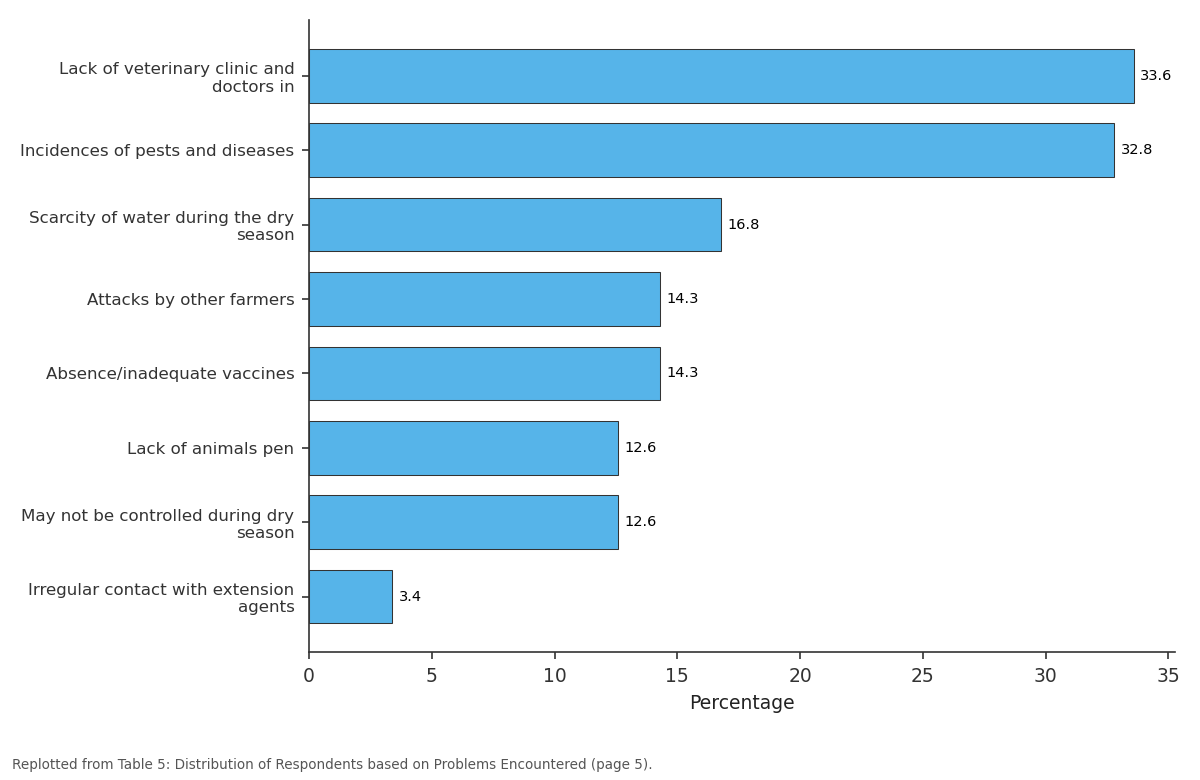
Percentage*: Lack of veterinary... vs Incidences of pests and... vs Scarcity of water... vs Attacks by other farmers vs Absence/inadequate...
Replotted from Table 5 (page 5) of the original paper. Every bar is the paper's own table value.
View source evidence ↗Figures & tables
From the original paper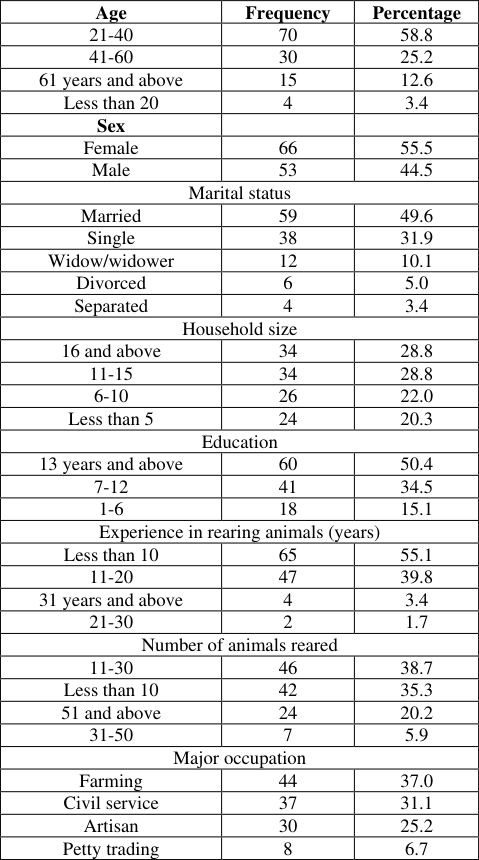 Table 1
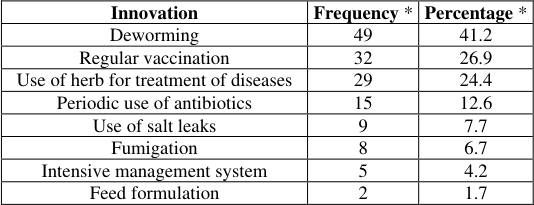 Table 3
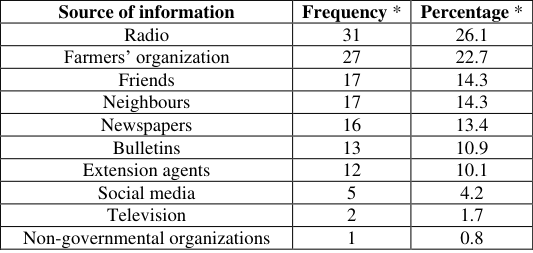 Table 2
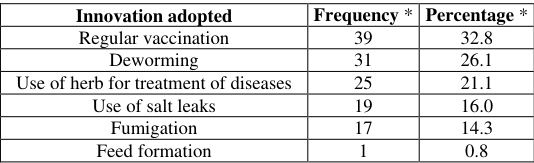 Table 4
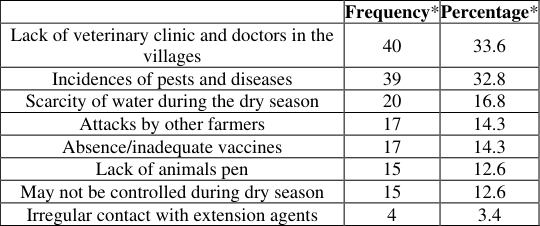 Table 5
Introduction
The Green Revolution mainly concentrated on crop production (rice, wheat and maize). In the livestock production sector, besides the substantial improvements in the poultry and dairy production systems, the development of other livestock technologies were neglected because the returns on crop technology were much higher than those of livestock innovations (De Boer et al., 1992) [6] . Small ruminants are one of the important components of smallholder farming systems. They are kept using a number of different rearing systems such as subsistence in which they are tethered; extensive in which they are allowed to roam and tend for themselves and intensive in which they are confined in a particular place. Small ruminants such as goats and sheep are important sources of meat and cash for farmers worldwide. Most of the rural households own few of them, which are kept both for sale and home consumption. In addition, small ruminants (sheep and goats) have been kept as a source of manure. Most livestock are reared in the far Northern part of Nigeria, few especially goats and sheep are kept by farmers overall Nigeria. According to Fasoyiro and Taiwo (2012) [10] , with a fast-growing population, Nigeria is threatened with the problem of poverty and food insecurity which can be addressed with a more developed animal production sector in addition to other sectors. The average Nigerian consumes far less animal protein than his counterpart in the developed world because the animal production industry is at its infancy stage due to many problems including low per capita income leading to a consumption of less than 9 grams of animal protein per day as compared to over 50 grams per day in developed countries (Grigg 1995 [12,3,17] . Sachan et al. (2012) [21] some countries in the developing world are already considering other approaches to meat production such as in-vitro meat production but in Nigeria animal production is facing numerous problems militating against successful animal production. Sheep and goats are among small livestock kept by farmers with limited financial resources for poverty alleviation in many developing countries especially in Africa. They are unique type of animals and serve as a source of revenue for small holder farmers who cannot afford to maintain large ruminant livestock like cattle (Degen 2006) [7] . According to Elliot et al. (1998) [9] , sheep and goats are animals that are favourites for the poor because they are cheap to manage and they mature early and breed readily, therefore, increase in number quickly. They can reach slaughtering weights early, drought tolerant animals and have small body size and can easily thrive under poor conditions among others. These characteristics make small ruminants such as sheep and goats easy to keep for many people. The contribution of small ruminants to family welfare in Nigeria cannot be overemphasized. Small ruminants are popular among small-scale farmers for several reasons. Firstly, goats can meet the immediate needs of the household for meat and milk. Secondly, they survive well in marginal land and thirdly, they are more efficient in converting high quality forage into milk (Devendra, 2001) [8] . Although small ruminants play an important role in supplying food (protein) and other products to farmers and their families, they are viewed as secondary farm enterprise. Most of them are reared by smallholder farmers who lack of capital. According to Mukherjee and Sivaraj (1991) inefficient resource management, low productivity and uncertainty characterize small ruminants-rearing systems at the village level in Nigeria. Kapa (1994) [13] within extensive regimes, small ruminants usually graze during the day on the communal grounds or dry land adjacent to the village and are then brought back to animal pen at night, these practices are done throughout the year. There is no doubt that this practice has caused different problems to small ruminants' production in Nigeria. For instance, extensive grazing systems may create problems such as uncontrolled breeding management and high mortalities, which may reach about 47 percent at times. Small ruminants are known as multipurpose animals due to their contribution to the farm household welfare. According to Fletcher (1984) [11] ; Rangkuti and Sabrani (1984) [20] , the economic importance of rearing small ruminants to farm families is numerous, some of them include provide milk, meat, fibres and skin, others are income for household needs, manure for crops and job for the farmers' family. Despite the significant role to the economy of farm-households, their productivity tends to decrease over time. Their low level of productivity is influenced by several factors such as, type of management systems practiced, inadequate knowledge on their innovations, the breed of animal and season. Their production in Nigeria has many problems such as a high mortality rate, poor feeding during the dry season, transhumance and poor market facilities just to mention few (Abdulla, 2015) [1] . The contributions of small ruminants to the society include input for crop production, food production, power source, soil fertility, social functions, raw materials for industry, income, saving, fuel and employment. The main feeds of these categories of animals include grasses, tree leaves, shrubs and related plant species. Most of these animals in Nigeria are reared on extensive basis; this system is marked by low productivity compared to other countries in the world where animals are reared extensively, due to poor management practices, recurrent drought, lack of feed and fodder. Livestock are very important to the many subsistence farmers and economic development of the country. They sustain the employment and income of millions of people, provide manure for crop production, contribute draught power and provide year-round flow of essential products like meat and milk (Kapa et al., 2001) [14] . Small ruminants are often slaughtered in honour of a special guest, a visiting friend or relative, for festivities and religious rituals. More importantly, they play a key role in harmonizing relationships between non-household members in rural areas. Because of their small size, sheep and goats provide more convenient sources of meat than cattle. Small ruminant production in general and sheep and goat production in particular has in recent years gained increasing popularity in most developing countries. Apart from the social and economic functions small ruminants play in developing societies, they also provide most of the meat supply for human consumption (Kapa, 1994) [13] . The increasing frequency of climatic change resulting to droughts and environmental degradation is making many farmers to change from rearing other livestock towards focusing more on small ruminants. The social and economic role small ruminant play in Nigerian rural societies is explained in terms of income generation and food security. Livestock production is a viable option to increase household income. They are considered as savings account, especially for women in rural areas. Small ruminants are much easier and quicker to sell than cattle, when cash is needed to meet households' requirements (Kapa et al., 2001) [14] . Small ruminants are very important to the socioeconomic wellbeing of both the rural and urban dwellers; a threat to small ruminants is directly or indirectly a threat to the human beings, several problems including climate change, poor agricultural system practiced in the country, socio-economic characteristics of small-scale farmers, partial or non-adoption of ruminant innovations have affected the production of small ruminants. Most of the small-scale farmers who rear small ruminants practice traditional or extensive management system, the animals are left to roam about especially during the dry season and therefore, it is doubtful if they have adopted innovation practices to improve the quantity and quality of the animals.
Methodology
Benue State lies between longitude 6 0 35ʹ E and 8 0 10ʹ E of the Greenwich Meridian and latitude 6 0 30ʹ N and 8 0 10ʹ N of the equator at an elevation of 97m above sea level in Southern guinea Savannah agro ecological zone. The State has 23 local government areas (LGAs) 423 council wards and three senatorial zones with administrative headquarters at Makurdi (Kughur, 2019) [17] . The State covers landmass of 32,518 Km 2 LGA of Kogi State. The original inhabitants of the LGA are predominantly Idoma and a few Igala and other settlers. The mineral resources found in the LGA include crude oil deposits at Okwiji and salt at Iga-Okpaya. Other mineral resources are kaolin, gypsum, limestone, natural gas and anhydride. The LGA with its headquarters at Ugbokpo has eleven (11) council wards which include Auke, Ugbokpo, Oba, Ojantele/Akpete, Igoro, Edikwu I, Edikwu II, Oiji, Ikobi, Iga and Ofoke. The LGA has a population of about 100,000 people with a population density of about 200,300 persons per sq. Km (Danjuma, 2018) [4] . Two distinct seasons are observed in the area, the rainy season which starts from March to November and the dry season which commences from November to March. The environment is favoured by climate that permits the cultivation of different food crops such as yam, rice, sorghum, soybeans, beniseed, millet, cowpea, groundnut, maize, bambara nut, guava, pineapple, citrus, mangoes, cashew, and cassava pepper (Danjuma, 2018) [4] . The population of the study consisted of all the rural farmers in the LGA. Due to the enormity of the population, five (5) out of eleven (11) council wards were selected purposively because of high intensity of farmers population they included Iga-okpaya, Edikwu 1, Edikwu 2, Ojope and Oiji. In each of the council wards selected, 20 (farmers who reared small ruminants) respondents were selected randomly, thus given a total of 120 respondents, however, 119 questionnaires were returned. Data for the study were collected through primary source using structured questionnaire, data collected were analyzed using descriptive statistics. The finding is in tandem with Kernga (2003) [15] that young farmers are more willing to adopt new innovations than elders because young farmers are more open to innovations, willing to try new technologies and are not averse to risk. Results of sex show that females 55.5% and male 44.5%. Majority (55.5%) of the respondents were females. This means females were more involved in rearing small ruminants in the study area than males. This may be that most males have left the villages for township to look for paid job opportunities. Alternatively, females were more involved in management of the livestock than their males' counterparts. In most rural villages where farmers keep little number of farm animals, ladies are more involved in feeding the animals than men. This is because males are more involved in other activities that would take them out of the village for many days than females. Also males are more involved in farming activities that are drudgery like preparation of heaps and moulding of ridges among others leaving the less tedious farm activities like planting, weeding, winnowing just to mention few for the women. This finding is in contrast to Kughur et al. (2014) [18] that males were more involved in rearing of poultry than females.
Results and Discussion
Results in Table 1 show that married 49.6%, single 31.9%, widow/widower 10.1% , divorced 5% separated 3.4% were marital status of the respondents. A reasonable (49.6%) proportion of the respondents were married. Married people have more responsibilities than those that are not married. This compels married people to venture into ways that can improve their income including rearing of small ruminants to supplement income from other sources. Results in Table 1 show household size of 11-15 28.9%, 16 and above 28.7%, 6-10 21.8% and less than 5 20.2%. A small (28.9%) proportion of the respondents had at least 11 people in their household. This means farmers in the study area had large household size. In the traditional Nigerian culture, having many wives and many children was seen as prestige, this is because wives and children were seen as a source farm labour, today even with the advent of modern society where most people limit their household size to very few people, farmers in the rural areas still feel the large number of people in their household is very beneficial most especially in carrying out farm activities.
| Age | Frequency | Percentage |
|---|---|---|
| 21-40 | 70 | 58.8 |
| 41-60 | 30 | 25.2 |
| 61 years and above | 15 | 12.6 |
| Less than 20 | 4 | 3.4 |
| Sex | ||
| Female | 66 | 55.5 |
| Male | 53 | 44.5 |
| Marital status | ||
| Married | 59 | 49.6 |
| Single | 38 | 31.9 |
| Widow/widower | 12 | 10.1 |
| Divorced | 6 | 5.0 |
| Separated | 4 | 3.4 |
| Household size | ||
| 16 and above | 34 | 28.8 |
| 11-15 | 34 | 28.8 |
| 6-10 | 26 | 22.0 |
| Less than 5 | 24 | 20.3 |
| Education | ||
| 13 years and above | 60 | 50.4 |
| 7-12 | 41 | 34.5 |
| 1-6 | 18 | 15.1 |
| Experience in rearing animals (years) | ||
| Less than 10 | 65 | 55.1 |
| 11-20 | 47 | 39.8 |
| 31 years and above | 4 | 3.4 |
| 21-30 | 2 | 1.7 |
| Number of animals reared | ||
| 11-30 | 46 | 38.7 |
| Less than 10 | 42 | 35.3 |
| 51 and above | 24 | 20.2 |
| 31-50 | 7 | 5.9 |
| Major occupation | ||
| Farming | 44 | 37.0 |
| Civil service | 37 | 31.1 |
| Artisan | 30 | 25.2 |
| Petty trading | 8 | 6.7 |
Table text extracted from the original PDF; superscript letters are shown inline. The original table image is below.
View original table image
Results in Table 1 shows the number of years spent in formal education, 13 years and above 50.4%, 7-12 34.5% and 1-6 15.1%. Majority (50.4%) of the respondents spent at least 13 years in formal education. This means the respondents had acquired certain level of education to at least secondary level. The importance of education in everyday's life cannot be overemphasized, it has ability to widen the horizon of farmers, provide insight to be able to identify the right and wrong among others things. Education has the ability to facilitate adoption of innovations in general and small ruminant in particular as this can improve the quality and quantity of production for the benefit of the farmers. Results in Table 1 show that between 1 and 10 54.6%, 11-20 39.5%, 31 and above 3.4%, and 21-30 1.7% were experience in rearing animals in years. Majority (54.6%) of the respondents had between 1 and 10 years of experience in rearing ruminant animals. This means the farmers had a reasonable number of years in keeping the animals. For farmers to have experience of at least 10 years means the farmers may have experimented on several things and accumulated knowledge in the area such as type of innovations to adopt and practices that can improve the quality of farm animal, practices that are beneficial to the farmers among others. Experience is very important in all aspects of life, another interesting aspect of experience is that it is not sold or bought in the market; it is only acquired on the job. Experience helps farmers in dealing with a number of issues including solving of problems. Experienced farmers should be encouraged to share their wealth of knowledge with inexperience ones. Results in Table 1 show that between 11 and 30 38.7%, less than 10 35.3%, 51 and above 20.2% and 31-50 5.9% were number of ruminant animals kept by the farmers. A small (38.7%) proportion of the respondents kept between 11 and 30 animals. This is an indication that the farmers kept relatively few numbers of animals. Rearing few numbers of animals may be as a result of engagement in other enterprises like crops and poultry productions, and they share their time for all the enterprises they engaged themselves in. Sharing of time and resources among the enterprises by the rural farmers make them jack of all trades but master of none.
Results in Table 1 show that farming 37%, civil service 31.1%, artisan 25.2% and petty trading 6.7% were the major occupation.
A high (37%) proportion of the respondents were farmers. Most people in Nigeria living in the rural areas are farmers except in few cases, where residents of rural areas engage in other ventures, most rural dwellers in Benue State are either part time or fulltime farmers. The finding is similar to Kughur et al. (2019) [17] that most people living in the rural areas in Benue State, Nigeria are fulltime farmers who are engaged in different farm enterprises and more than 60 percent of people in Nigeria are peasant farmers. Results in Table 2 show that radio 26.1%, farmers' organization 22.7%, friends 14.3%, neighbours 14.3%, newspapers 13.4%, bulletins 10.9%, extension agents 10.1%, social media 4.2%, television 1.7% and non-governmental organizations 0.8% were sources of information. A small (26.1%) proportion of the respondents obtained information on small ruminant innovations through radio. Radio is one of the simplest means of disseminating information on agricultural innovations to rural farmers. It is cheap, portable and its signals are available in most rural areas. The presence of at least a radio station in each State capital in Nigeria in addition to some private radio stations have brought listening to news using radio at the doorstep of many rural farmers. This finding is in tandem with Kughur et al. (2016) [18] that the affordability nature of radio has made it to be utilized by many people especially those in the rural areas. Also, some programmes are transmitted in vernaculars which make many farmers who cannot understand English Language to make it a duty to listen to such programmes. Radio should be use to disseminate information on small ruminants innovations to the farmers in the area. Results in Table 3 show that deworming 41.2%, regular vaccination 26.9%, use of herbs for treatment of diseases 24.4%, periodic use of antibiotics 12.6%, addition of salt leaks 7.7%, fumigation 6.2%, intensive management system 4.2% and feed formulation 1.7% were small ruminants' innovations introduced based on priority. A reasonable (41.2%) proportion of the respondents had priority on deworming. This could be attributed to the frequent consumption of organisms that may cause health problems to the animals during the rainy season. Most farmers in the rural areas practice extensive system of rearing animals which allow animals to roam about eating many living organisms that are harmful to them and the most appropriate method of handling such problems is deworming. In order to make animals healthy they are expected to be dewormed at the beginning and the end of every season. Animals are not dewormed are predisposed to attacks by many diseases, deworming is also cheap compare to other practices of keeping animals healthy. Deworming should be encouraged among the farmers who rear animals. Results in Table 4 show that regular vaccination 32.8%, deworming 26.1%, use of herds for treatment of diseases 21.1%, use of salt leaks 16%, fumigation 14.3% and feed formulation 0.8% were innovations that were adopted. A high (32.8%) proportion of the respondents adopted regular vaccination. Regular vaccination was done out of experience by the farmers. The farmers were aware that prevention is better than cure, hence the need to regular vaccination of their animals to prevent outbreaks of diseases. The farmers were also aware that if they wait until the outbreak of diseases, they may loss some of their animals, hence the choice to vaccinate them against killer diseases. The finding confirms Kapa (2001) [13] that small ruminants are very important to the socio-economic wellbeing of both rural and urban dwellers, hence innovations that can improve either quality or quantity of the animals is highly adopted, furthermore, a threat to the small ruminant animals is directly or indirectly a threat to the human beings. Results in Table 5 show that lack of veterinary clinic and doctors in the villages 33.6%, incidences of pests and diseases 32.8%, scarcity of water during the dry season 16.8%, attacks by other farmers 14.3% absence/inadequate vaccines 14.3%, lack of animals pen 12.6%, cannot be controlled during dry season 12.6% and irregular contact by extension agents 3.4% were problems encountered by the respondents. A high (33.6%) proportion of the respondents lack veterinary clinic and doctors. Lack of veterinary clinic and doctors in the rural areas is likely to cause a lot of problems to the farmers. When they have complicated cases of diseases that would have been handled by a veterinarian there would be nobody and nowhere to report to for immediate action. The absence of veterinary clinic and doctors may discourage many farmers from practising animal husbandry as a primary occupation. This is because farmers would have to risk investing in rearing animals.
| — | Frequency* | Percentage* |
|---|---|---|
| Lack of veterinary clinic and doctors in the villages | 40 | 33.6 |
| Incidences of pests and diseases | 39 | 32.8 |
| Scarcity of water during the dry season | 20 | 16.8 |
| Attacks by other farmers | 17 | 14.3 |
| Absence/inadequate vaccines | 17 | 14.3 |
| Lack of animals pen | 15 | 12.6 |
| May not be controlled during dry season | 15 | 12.6 |
| Irregular contact with extension agents | 4 | 3.4 |
Table text extracted from the original PDF; superscript letters are shown inline. The original table image is below.
View original table image
| Innovation adopted | Frequency * | Percentage * |
|---|---|---|
| Regular vaccination | 39 | 32.8 |
| Deworming | 31 | 26.1 |
| Use of herb for treatment of diseases | 25 | 21.1 |
| Use of salt leaks | 19 | 16.0 |
| Fumigation | 17 | 14.3 |
| Feed formation | 1 | 0.8 |
Table text extracted from the original PDF; superscript letters are shown inline. The original table image is below.
View original table image
| Source of information | Frequency * | Percentage * |
|---|---|---|
| Radio | 31 | 26.1 |
| Farmers’ organization | 27 | 22.7 |
| Friends | 17 | 14.3 |
| Neighbours | 17 | 14.3 |
| Newspapers | 16 | 13.4 |
| Bulletins | 13 | 10.9 |
| Extension agents | 12 | 10.1 |
| Social media | 5 | 4.2 |
| Television | 2 | 1.7 |
| Non-governmental organizations | 1 | 0.8 |
Table text extracted from the original PDF; superscript letters are shown inline. The original table image is below.
View original table image
| Innovation | Frequency * | Percentage * |
|---|---|---|
| Deworming | 49 | 41.2 |
| Regular vaccination | 32 | 26.9 |
| Use of herb for treatment of diseases | 29 | 24.4 |
| Periodic use of antibiotics | 15 | 12.6 |
| Use of salt leaks | 9 | 7.7 |
| Fumigation | 8 | 6.7 |
| Intensive management system | 5 | 4.2 |
| Feed formulation | 2 | 1.7 |
Table text extracted from the original PDF; superscript letters are shown inline. The original table image is below.
View original table image
Conclusion and recommendations
Small ruminants are animals that are prolific, have ability to survive in harsh environment, serve as farmers' bank for immediate cash, farmers raise them without spending much, serve several purposes like provision of meat and milk to mention just few. There are many innovations that if adopted can help improve quality and quantity of the animals for farmers' use. The study realized that innovations were introduced to farmers and they adopted few of the innovations including regular vaccination, deworming and use of herbs to treat animal ailments. It is recommended that veterinary clinics should be located at strategic points in the villages and veterinary doctors posted to it and water should also be provided to the farmers especially during the dry season.
References
19 in the original paper- Abdulla AM. Adoption of small ruminants' fattening package in agro-pastoral areas, Dugda, 2015.
- Boland MJ, Rae AN, Vereijken JM, Meuwissen MPM, Fischer ARH, Van Boekel MAJS, et al. The future supply of animal derived protein for human consumption. Trends in Food Science and Technology. 2013; 29(1):62-73.
- Danjuma S. Apa Government of Benue State of Nigeria, 2018. Available at http://benuestate.gov.ng/portfolio. 5. delivery in the SADC region.
- De Boer J, Knipscheer H, Kartamulia I. Constraints to technology transfer for animal science research in Indonesia. In: Livestock services for smallholders: A critical evaluation, Seminar proceedings -Yogyakarta, Indonesia, 1992, 12-15, pp. 357-359.
- Degen AA. Sheep and goats milk in pastoral societies, 2006/ Available at http://www.sciencedirect.com/science?
- Devendra C. Small ruminant: Imperatives for productive enhancement improved livelihoods and rural growth-A review. Asian-Australian Journal of Animal Science. 2001; 14(10):1483-1485.
- Elliot RL, Stout GW, Dejardin EJ, Sithole DS. Agriculture for Southern Africa: A practical approach up to 'O' Level. Bell and Hyman in Association with Academic Books, Zimbabwe, 1998.
- Fasoyiro SB, Taiwo KA. Strategies for Increasing Food Production and Food Security in Nigeria. Journal of Agricultural & Food Information. 2012; 13(4):338-355.
- Fletcher IC. Potential and problems of goat production in Indonesia. In Goat Production and Research in the Tropics, pp. 32-36. Ed. J.W. Copland. Aciar, Series No. 7, 1984.
- Grigg D. The pattern of world protein consumption. Geoforum. 1995; 26(1):1-17. Quarterly Bulletin, Rome.
- Kapa MMJ. Peranan wanita dalam pengembengan ternak kecil di Timor Barat. Research Institute Nusa Cendana University, Kupang. Indonesia, 1994.
- Kapa MMJ, Rola-Rubzen MF, Bent M. An Economic Model of Small Ruminant production in small scale dryland farming systems in West Timor, Indonesia. Paper presented to Australian Agricultural and Resource Economics Society 45th Annual Conference, 22-26 January. Adelaide, Australia, 2001.
- Kernga A. Adoption of small ruminant technologies. Journal of Agricultural Extension. 2003; 38(1):1-11.
- Kughur PG, Daudu S, Onu OE. Factors affecting adoption of poultry innovations by rural farmers in Otukpo local government area of Benue State, Nigeria. International Journal of Livestock Research. 2014; 4(8):14-16. www.ijlr.org. Doi 10.5455/ijlr.20141116060805
- Kughur PG, Iornenge GM, Vihi SK. Assessment of radio and television role in agricultural information transfer among farmers in Katsina-Ala local government area of Benue State, Nigeria. FUW Trends in Science and Technology Journal. 2016; 1(2):442-444. www.ftstjournal.com
- Kughur PG, Agada MO, Naswem AA. Assessment of social media usage among small scale cereal crop farmer in Benue and Nasarawa States, Nigeria. PAT, Publication of Nasarawa State University, Keffi. 2019; 15(1):1-8. Available at www.patnsukjournal. net/currentissue
- Mukherjee TK, Siviraj S. Goat production in Malaysia. Asian Humid Tropics, 2001, 7-14.
- Rangkuti MM, Sabrani B. Goat production in Indonesia: Current status and potential for research. In: Goat Production and Research in the Tropics, pp. 27-31 Ed. J.W. Copland. Aciar, Series No. 7, 1984.
- Sachan N, Singh VP, Verma AK. In Vitro Meat -The start of new era in meat production. International Journal of Livestock Research. 2012; 2(1):38-51.