
Research article · 2020 · Full text
International Journal of Agriculture and NutritionThe nutritional composition and fatty acid profile of African locust bean (Parkia Biglobosa) seed and seed oil
Volume 2(2) · Pages 01–04 · DOI: 10.33545/26646064.2020.v2.i2a.29 ↗
Research areasAfrican Botany and Ecology StudiesBiodiesel Production and ApplicationsFood Chemistry and Fat Analysis
Abstract
Author-writtenThe physicochemical properties of the seed and the fatty acid profile of the seed oil of African locust bean (Parkia biglobosa) have been determined using standard methods of the AOAC. The seed had a moisture content of 9.70% and a dry matter of 90.31%. The crude protein, crude oil, crude fibre and ash contents were 39.74%, 23.70%, 3.55% and 2.77% respectively, while the carbohydrate content was 20.56%. The most abundant fatty acids in the order of abundance were oleic (32.49%), palmitic (24.89%), linoleic (14.42%), stearic (8.16%) and myristic (6.84%). The total unsaturated fatty acids (55.03%) predominated the total saturated (44.97%), while the percentage total poly-unsaturated (37.58%) was greater than that of total mono-unsaturated (17.45%). The significant level of essential fatty acids in the fruit oil is an advantage, bearing in mind that they cannot be produced in the body, but must be supplied from the food consumed for the necessary functions for which they are needed in the body. The linoleic/linolenic ratio of 5.301 butresses the nutritional importance of the seed oil as it fell within the ratio of 5.1 and 10.1 recommended by the WHO/FAO. The good total unsaturated/saturated (or PS) ratio makes the fruit oil nutritionally very useful to be adopted for domestic purposes.
Summary
Source-checkedPlain-language reading of the full paper, prepared with AI and checked against the text. Each point links to the authors' own words.
Why it matters
- Parkia biglobosa, known as the African locust bean, is a multipurpose fruit tree of significant importance across many sub-Saharan African countries. View evidence ↗
- In West African countries like Nigeria, the seeds are used to create a traditional nutritious condiment known as 'irú' through fermentation. View evidence ↗
- The seeds provide a critical source of dietary protein for rural populations in developing countries who may lack access to animal proteins. View evidence ↗
The question
- The study aims to determine the proximate composition and fatty acid content of P. biglobosa seeds, addressing a gap in available information specifically from Nigeria. View evidence ↗
What they did
- Fresh African locust bean seeds were collected from the Obada market in Ipetumodu, South Western Nigeria. View evidence ↗
- Proximate analysis for moisture, ash, crude fat, and crude fibre followed AOAC official methods, with all tests performed in triplicate. View evidence ↗
- Fatty acid analysis was conducted by converting fatty acids to methyl esters and analyzing them via gas chromatography using a PYE Unicam 304 system. View evidence ↗
What they found
- The most prevalent fatty acids in the seed oil were oleic (32.49%), palmitic (24.89%), linoleic (14.42%), and stearic (8.16%). View evidence ↗
- Total unsaturated fatty acids (55.03%) predominated over total saturated fatty acids (44.97%) in the seed oil. View evidence ↗
- Among the unsaturated fatty acids, poly-unsaturated fats (37.58%) were more abundant than mono-unsaturated fats (17.45%). View evidence ↗
- The linoleic/linolenic ratio was 5.301, which falls within the FAO recommended range of 5.1 to 10.1. View evidence ↗
- The oleic/linoleic acid ratio of 2.253 was higher than that of peanut oil (1.48) and garden egg (0.330%), suggesting it may be more useful as a frying oil. View evidence ↗
What it means
- The authors conclude that the seed oil is a nutritionally rich alternative to common vegetable oils for both domestic and industrial use. View evidence ↗
Visual summary
1 visualsIllustrations explain the paper; they do not show study data.
Fatty Acid Distribution
AI-generated conceptual illustration (African locust bean (Parkia biglobosa) seeds and seed oil). It explains the idea and does not show study data.
View source evidence ↗Figures & tables
From the original paper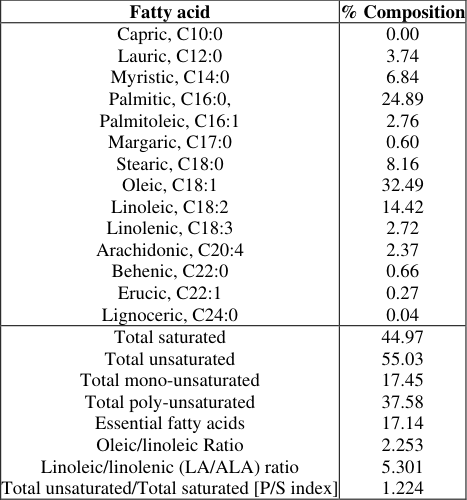 Table 2
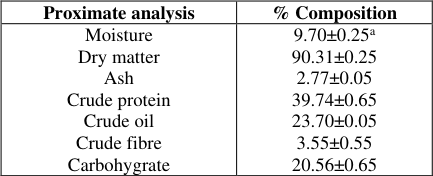 Table 1
Introduction
In Africa many species of trees serve as sources of food and for medicinal purposes to the indigenous people. Some of these trees provide ecological services including microclimate amelioration and soil fertility. They serve as source of income for many poor people in the rural areas. One of these is Parkia biglobosa (African locust bean) tree. Farmers manage and protect this tree for their nuts and fruits. The tree has been used both locally and internationally in drug manufacturing and cosmetics production. Parkia biglobosa, named by after the famous Scottish botanist and surgeon, Mungo Park by Robert Brown, has long been widely recognized as an important indigenous multipurpose fruit tree in many sub-Saharan African countries. It is the source of a natural nutritious condiment in the traditional diet in most West African countries, including Nigeria [1] . The seed is harvested and processed into a fermented product called "irú" in Yoruba Language of South Western Nigeria [2] . In Nigeria, the production of fermented locust bean seed -"iru"has remained a traditional family art practiced in homes, especially in the rural areas [3] . Fermented African locust bean seed, "irú", provides dietary fibre, energy, minerals and vitamins, and also improves sensory properties of food, including the organoleptic characteristics (appearance, aroma and flavour) [4] . The fermentation process converts sugars and other carbohydrates to usable end products. It serves as dietary protein in the rural areas in developing countries, since a sizable percentage of them cannot afford animal protein, except when these animals are caught with trap in their farms. Fermentation of African locust bean seeds also contribute to the removal of anti-nutritional components, increasing the shelf life of storage, reduction of cooking time, detoxification, decrease in the need for refrigeration or other form of food preservation technology, enhancement of nutritional and organoleptic values of the food, improvement in digestibility and improved safety with the absence of toxins [2] . There have been many investigations on the food composition and nutritive values of P. biglobosa seeds but there have been little information on the fatty acid contents, particularly from Nigeria. In view of the outstanding nutritional and traditional uses of P. biglobosa, this study looks into the proximate composition and fatty acid content of P. biglobosa seed.
Materials and method 2.1 Sample collection and preparation
Fresh samples of African locust bean (Parkia biglobosa) seeds were got from Obada market, Ipetumodu via Ile-Ife, South Western Nigeria, identified by a plant Biologist in the Microbiology Department of the authors' Institution above, and then kept in a refridgerator for further analysis.
Proximate analysis
Moisture, ash, crude fat and crude fibre were determined in accordance with the official methods of the Association of Official Analytical Chemists [5] . Moisture content was determined by oven drying of a weighed sample to a constant weight at 105°C. Crude protein content was determined by Kjeldahl method using 6.25 as the conversion constant after the determination of each sample's nitrogen. Crude fat content was determined by Soxhlet method using n-hexane as solvent. The ash content was determined gravimetrically after ignition at 550°C. Carbohydrate content was calculated by difference. All analyses were carried out in triplicates.
Fatty acid analysis
The fatty acids were converted to their methyl esters and the esters analyzed using a PYE Unicam 304 gas chromatograph fitted with a flame ionization detector and PYE Unicam computing integrator. Helium was used as the carrier gas. The column initial temperature was 150°C rising at 5°C/min. to a final temperature of 220°C. The injection port and detector temperatures were maintained at 220°C and 250°C respectively. The peaks were identified by comparing with peaks of standard fatty acid methyl esters under the same operating conditions.
Results and Discussion
Results and Discussion
Proximate Composition
The proximate composition of the seed of African locust bean, Parkia biglobosa, is presented in Table 1. The seed had a low moisture content of 9.70%. This value is comparable to 8.43% reported by Compaore et. al. [6] . With this moisture content, the seeds are able to withstand spoilage for a long time. The seed had a high crude protein content of 39.74%. This value is slightly higher than some other reports of 35.0% by Alabi et al. [7] , 34.3% by Obizoba [8] and 33.50% by Soetan et al [9] . The high protein content, coupled with its cheapness, the ease of availability and the high cost of animal protein, all contribute to the reasons why the seed command a high demand among the inhabitants of West Africa. This is because the interest is shifting towards the cheap and potentially high protein food products for human consumption and livestock feeds, and therefore, P. biglobosa could be used to add protein to a protein-deficient diet. The crude oil content of the seed was 23.70%. This value is higher than 16.86% recorded for the cotyledon by Alabi et al. [10] , but lower than 49.20% recorded by Soetan et al. [9] . The high oil content provides a source of traditional oil for local consumption, thereby, improving the eating quality and the energy contribution to its consumer. It also makes the fruit a potential source of vegetable oil for commercial purposes. The seed had a good crude fibre content of 3.55%. This suggests that it would be an effective item in food to control constipation. The level of the crude fibre in the seed would aid the expansion of the inside walls of the colon, thereby, easing out the passage of waste [9] . The fibre content would help in lowering cholesterol levels in the human body, protecting the heart in the process. It would also help in lowering the risk of coronary heart diseases, hypertension, diabetes, colon and breast cancer, piles and appendicitis [11] . A good fibre content in food is useful for maintaining bulk motility and increasing intestinal peristalsis by surface extension of the food in the intestinal tract. It is also necessary for a healthy condition, curing of nutritional disorders and for food digestion [12] . The carbohydrate content was 20.56%. This is comparable to 20.70% reported by Alabi et. al [10] . The value shows that the seeds are a good source of energy, needed for the biochemical and biological reactions in the body system, and thus promoting growth and development, particularly of the young growing ones.
Fatty acid composition
The fatty acid composition of African locust bean, Parkia biglobosa, seed oil is as presented in Table 2. The most abundant fatty acids were oleic (32.49%), palmitic (24.89%), linoleic (14.42%) and stearic (8.16%). Others of lower but significant concentrations were myristic acid (6.84%), lauric acid (3.74), linolenic acid (2.72%), palmitoleic acid (0.66%), and arachidonic acid (2.37%). Other fatty acids detected were in traces (˂1.00%), including margaric, behenic, erucic, and lignoceric acids. From this result, the seed oil could be regarded as oleic-palmitic oil. The oleic acid content of the seed oil, (32.49%), is higher than 23.85% reported for the same seed from Abuja, Nigeria, by Aremu et. al. [13] and 18.594% reported for the same seed from Akure, also in Nigeria [14] . This agrees with the fact that differences may occur in the chemical composition of the same agricultural product from different locations due to changes in soil type and climatic conditions among other factors [15; 16] . This high level of oleic acid in the seed oil is of great importance as it plays a fundamental role in the prevention of cardiovascular diseases. It is also very important in nervous cell construction [17; 18] . The linoleic acid content of the seed oil, (14.42%), is a little higher than 11.19% reported by Aremu et. al. [13] , but lower than 33.687% reported by Ijarotimi & Keshinro, [14] . Linoleic acid is very important to man as it prevents cardiovascular disorders such as coronary heart diseases and atherosclerosis, and also guides against high blood pressure [19] . It helps to relieve rough and flaky skin by maintaining smooth and moist skin [20; 21] . Linoleic acid derivatives serve as structural components of the plasma membrane and are precursors of some metabolic regulatory compounds. The significant level of linoleic acid and the remarkable level of linolenic acid in the sample are very significant. Both are the two essential fatty acids, which, apart from playing a natural preventive role in cardiovascular diseases, also promote the reduction of both total and high density lipoprotein cholesterol. Inappropriate balance of these fatty acids contributes to various kinds of malfunctioning of the body, while a proper balance maintains and even improves health [22] . The fatty acid, σ-linolenic, also has a unique role it plays in man and its deficiency alters the course of brain development and perturbs the composition and physicochemical properties of brain cell membranes, neurones, oligodendrocytes, and astrocytes. These lead to physicochemical modifications, induce biochemical and physiological perturbations, and result in neurosensory and behavioral upset [23] . It is also used in the biosynthesis of arachidonic acid and thus some prostaglandins. Both arachidonic acid and the prostaglandins are required for cell growth and maintenance [24] . The presence of palmitoleic acid in the sample is significant as it plays an important role in increasing insulin sensitivity by suppressing inflammation. It also inhibits the destruction of insulin-secreting pancreatic beta cells, which makes it useful for a diabetic patient (especially for type 2 diabetes mellitus). The oleic/linoleic acid (O/L) ratio, which is associated with high stability and potentiality of the oil for deep fat frying, was 2.253. This value is comparable to 2.1 reported for raw African locust bean by Aremu et. al. [13] , but higher than 1.48 reported for peanut oil [25] and 0.330% reported for Solanum aethiopicum (garden egg) [26] . Hence African locust bean seed oil may be more useful as a frying oil than the peanut oil commonly found in Nigerian markets. The seed oil gave a linoleic/linolenic ratio of 5.301. This value buttresses its nutritional importance as it fell within the ratio of 5.1 and 10.1 recommended by the FAO [27] . The seed oil also contained higher total unsaturated fatty acids than saturated acids, with a P/S ratio (i. e. total unsaturated/total saturated ratio) of 1.224. This ratio has to do with the detrimental effects of dietary fats. The higher this ratio, the more nutritionally useful the oil is. This is because the severity of arteriosclerosis is closely associated with the proportion of the total energy supplied by saturated and polyunsaturated fats [28] . The ratio here obtained is moderate and may not influence much the other properties of the seed oil. The total saturated fatty acids amounted to 44.97% of all, while the total unsaturated fatty acids added up to 55.03%. Of the unsaturated fatty acids, the mono-unsaturated added up to 17.45% and the poly-unsaturated ones, 37.58%. The high level of poly-unsaturated fatty acids in the sample makes the oil essential in the diet as these fatty acids need to be supplied to the body for the proper functioning of the body system. With the current emphasis on lowering the consumption of saturated fats, minimizing or eliminating trans fats, and increasing mono-and, especially, poly-unsaturated fat intake, the consumption of African locust bean becomes ideal for improving the integrity of cardiovascular system and, thereby, preventing the occurrence of cardiovascular and other nutritionally related diseases [14] . The main saturated fatty acids present, in the order of abundance, were palmitic (24.89%), stearic (8.16%), myristic (6.84%) and lauric (3.74%). Others of much lower concentrations were margaric, behenic and lignoceric acids. These fatty acids serve one useful purpose or the other, making the oil important for our daily needs. Lauric acid is believed to have antimicrobial properties [29] . It can undergo β-oxidation to produce energy and can also be stored in adipose tissues [24] . Myristic acid is used as a raw material in cosmetics production. Palmitic acid is the first fatty acid produced during fatty acid synthesis. From it, longer chain fatty acids can be synthesized [30] . The very low level of behenic acid in the seed oil (0.66%) is an advantage as a high level of it may create difficulty for the digestive enzymes in man and animals [31] .
Conclusion
This study presents data on the proximate composition and fatty acid content of African locust bean (Parkia biglobosa) seed and seed oil. The seed gave a higher concentration of unsaturated fatty acids in comparison with saturated fatty acids. The high level of poly-unsaturated fatty acids makes the seed nutritionally rich and healthy. The high oil content also gives it an advantage for commercial production for domestic and/or industrial purposes. The seed oil can, therefore, serve as an alternative to other common vegetable oils for domestic and/or industrial purposes, thereby giving it a greater market value.
References
31 in the original paper- Hopkins HC, White F. The ecology and chronology of Parkia biglobosa in Africa. Bulletin du Jardin Botanique National de Belgique Bulletin National Plantetuin Belgique. 1984; 54: 225-226.
- Odunfa SA. Dawadawa. Introduction to legume-based fermented foods. CRC Press Inc. Boca Raton, 1985.
- Audu I, Oloso A, Umar B. Development of concentric cylinder locust bean dehuller. Agric. Engineering Int.: the CIGR Jour. Scientific Res. Devt.. 2004, 6(3):345-354.
- Kolapo AL, Popoola TOS, Sanni MO. Evaluation of Biochemical Deterioration of Locust Bean Daddawa and Soybean Daddawa -Two Nigerian Condiments. American Journal of Food Technology. 2007; 2:440-445.
- AOAC. Official Methods of Analysis, Association of Official Analytical Chemist, 19th edition, Washington, D C, 2012.
- Compaore PA, Nikiema PA, Bassole HIN, Savadogo A, Mouecoucou J, Hounhouigan DJ, Traore SA. Chemical composition and anti-oxidative properties of seeds of Moringa oleifera and pulps of Parkia biglobosa and Adansonia digitata commonly used in food fortification in Burkina Faso. Current Research Journal of Biological Sciences. 2011; 3(1):64-72.
- Alabi DA. Parkia biglobosa, an endangered species. Int. Conf. Proceeding on lost crops and trees in Africa. 1993; 3:265 -285.
- Obizoba IC. Fermentation of African locust bean. Text on nutritional quality of plant fruits. 1998.
- Soetan KO, Akinrinde AS, Adisa SB. Comparative studies on the proximate composition, mineral and anti-nutritional factors in the seeds and leaves of African locust bean (Parkia biglobosa). Annals. Food Science and Technology, 2014, 15(1):70-74.
- Alabi DA, Akinsulire OR, Sanyaolu MA. Qualitative determination of chemical and nutritional composition of Parkia biglobosa (Jacq) Benth. Afri. J. Biotech. 2005; 4(8): 812 -815.
- Omale J, Ugwu CE. Comparative studies on the protein and mineral composition of some selected Nigerian vegetables. Afri. J. Fd. Sci. 2011; 5(1):22-25.
- Pereira MA, OʼReilly E, Augustsson K, Fraser GE, Goldbourt U, Heitmann BL, etc. Dietary fibre and risk of coronary heart disease: A pooled analysis of cohort studies. Archives of Int. Med. 2004; 164(4):370-376.
- Aremu, MO, Ibrahim H, Awala EY, Olonisakin A, Oko OJ. Effect of fermentation on fatty acid compositions of African Locust bean and Mesquite bean. J. Chem. Eng. Chem. Res. 2015; 2(10): 817-823.
- Ijarotimi OS, Keshinro OO. Comparison between the amino acid, fatty acid, mineral and nutritional quality of raw, germinated and fermented locust bean (Parkia biglobosa) flour. Acta Sci. Pol., Techn., Aliment. 2012; 11(2):151-165.
- Oyenuga VA. Nigeriaʼs Foods and Feeding Stuffs (3 rd edn). Ibadan University Press, Ibadan, Nigeria, 1968, 37-50.
- Adeyeye A, Ajewole K. Chemical composition and fatty acid profiles of cereals in Nigeria. Food Chemistry. 1992; 25: 41-44.
- Cobertt P. It is time for an oil change. Opportunities for high oleic vegetable oils. Information. 2003; 14:480-481.
- Nasri N, Khalil A, Fady B, Triki S. Fatty acids from seeds of Pinus pinea L. Composition and population profiling. Phytochemistry. 2005; 66:1729-1735.
- Adeyeye A, Akinnuoye GA, Akinyode OA. Proximate composition and fatty acid profile of the seeds of Andrographis paniculata. Am. Jour. Food Sci. & Nutri. Res. 2018; 5(3):71-75.
- Omode AA, Fatoki OS, Olaogun KA. Physicochemical properties of some under-exploited and non-conventional oil seeds. J. Agric. Food Chem. 1995; 43:2850-2853.
- Ariffin AA, Bakar J, Tan CP, Rahaman RA, Karim R, Loi CC. Essential fatty acids of pataya (dragon fruit) seed oil. Food Chemistry. 2009; 114:561-564.
- James HO, Keefe J, Hussam A, Sastre A, David MS, William SH, et al. Effect of omega-3 fatty acids on resting heart rate, heart rate recovery after exercise, and heart rate variability in men with healed myocardial infections and depressed ejection fractions. Am J Cardiol. 2006; 97:1127-1130.
- Bourre JM. Roles of unsaturated fatty acids (especially omega-3 fatty acids) in the brain at various ages and during aging. J. Nutri. Health Aging. 2004; 8(3):163-174.
- Nelson DC, Cox MM. Lehninger Principles of Biochemistry (4th Ed.) W. H. Freeman & Co. New York, 2005.
- Branch WD, Nakayama T, Chinnan MS. Fatty acid variation among US runner type peanut cultivars. J. Am. Oil Chemists Society, 1990, 67:591-596.
- Adeyeye A, Salami Adeniyi IA, Sulaiman WK, Akinyode OA. Proximate composition and fatty acid profile of garden egg (Solanum aethiopicum L) fruit. Int. J. Fd. Sci. & Nutri, 2020; 5(2): 09-13.
- FAO. Fats and oils in human nutrition; Report of a joint FAO/WHO expert consultation. FAO Food and Nutrition Paper 57, FAO. Rome. 1994.
- Adeyeye A, Ayodele OD, Akinnuoye GA. Comparative study of the proximate and fatty acid profiles of Cola nitida, Cola acuminata and Garcinia kola. Am. J. Food Sci. & Nutrition. 2017; 4(6):80-84.
- Muhammad NO, Ajiboye BO. Nutrients composition of Rana galamensis. African J. Food Sci. Technol. 2010; 1(1):027-30.
- Murray RK, Granner DK, Mayer PA, Rodwel VW. In: Harper's Biochemistry. A Lange Medical Book. 20th Edition. McGraw-Hill, 2000.
- Balogun AM, Fetuga, BL. 1985. Fatty acid composition of seed oils of some members of the leguminosae family. Food Chem. 1985; 17(3):175-182.
Cited by 1
From OpenAlex, OpenCitations and reference lists read by Scinovex
- Optimisation of the reaction conditions for biodiesel from Parkia biglobosa oil via transesterification with heterogeneous clay base catalyst ↗
Mohammed Takase, Rogers Kipkoech, Dominic Luckee Miller, Evan Kwami Buami · Fuel Communications · 2023
Transesterification reaction of Parkia biglobosa oil (0.61% w/w free fatty acid and 191.65 (mgKOH/g) saponification value) with methanol to biodiesel using heterogeneous bi-functional Clay-Na 2 CO 3 catalyst was carried out. The bi-functional heterogeneous clay base catalyst was prepared using incipient impregnation method. Following grinding and sieving, the raw clay mineral was soaked in 9 ml Na 2 CO 3…
❝ 19PDF