
Research article · 2020 · Full text
International Journal of Agriculture and NutritionStudies on integrated crop-livestock farming systems: A strategy for dry land and conservation agriculture
Volume 2(1) · Pages 19–22 · DOI: 10.33545/26646064.2020.v2.i1a.26 ↗
Research areasAgricultural Economics and PracticesLivestock Management and Performance ImprovementAgricultural Systems and Practices
Abstract
Author-writtenAgricultural sector is regarded as the key component of the economies of many developing nations, including India. Globally, agriculture accounts for a large share of GDP, it employs a significant proportion of the labour force, represents a major source of foreign exchange earnings, supplies bulk of basic food and provides subsistence and other income to the agriculture dependant growing population in the world. However, the country is facing decline in growth in agriculture relative to other sectors. The agricultural sector grew at a rate of 2.7%, relative to about 10% growth in both the service and industry sector, in the recent times. Agricultural incomes are lower and the rate of growth is slower than incomes in other sectors. This has resulted in persistence of unacceptable levels of hunger, poverty and malnutrition among large section of India’s population. The strong linkages that agriculture has with other economic sectors representing both forward and backward linkages provide significant stimulus for growth and income generation. It is therefore obvious that significant progress in promoting economic growth, reducing poverty and enhancing food security cannot be achieved without developing a sound, effective and vibrant agriculture system that pays concurrent attention to the human potential and productive capacity of the agriculture sector. These in turn will ensure enhanced contribution of agriculture to the overall economic and social development.
Summary
Source-checkedPlain-language reading of the full paper, prepared with AI and checked against the text. Each point links to the authors' own words.
Why it matters
- The agricultural sector is a fundamental driver of the economies in many developing countries, such as India. View evidence ↗
- Agriculture in India has experienced slower growth (2.7%) compared to the service and industry sectors (approximately 10%), contributing to persistent poverty and malnutrition. View evidence ↗
- Unsustainable farming practices have caused soil and forest degradation, leading to lower land productivity and a loss of biodiversity. View evidence ↗
The question
- The paper examines how Conservation Agriculture (CA) and Integrated Farming Systems (IFS) can address the specific challenges faced by smallholder farmers in tropical dryland regions. View evidence ↗
What they did
- The authors conducted a review of existing literature regarding integrated farming systems specifically within dryland contexts. View evidence ↗
- The scope of the review focuses on India, which leads the world in the extent and value of rainfed agricultural produce. View evidence ↗
What they found
- Rainfed agriculture covers two-thirds of India's total cropped area and provides nearly 40% of the national food supply. View evidence ↗
- Rainfed systems are critical for specific crops in India, producing 91% of coarse grains, 90% of pulses, 85% of oilseeds, 65% of cotton, and 55% of rice. View evidence ↗
- In Nagpur, incorporating green manure (GM) supplemented with FYM and subabul loppings increased seed cotton yields by 24%. View evidence ↗
- Rotating crops with legumes can fix between 135 and 488 kg of atmospheric nitrogen per hectare. View evidence ↗
- Cotton requires significantly less nitrogen (52–90 kg N ha⁻¹) when following a grain- and green manure-legume system compared to a non-legume rotation (179 kg N ha⁻¹). View evidence ↗
- Conservation Agriculture (CA) differs from organic farming by permitting the use of synthetic chemicals to manage pests and weeds, especially during transition periods. View evidence ↗
What it means
- The authors conclude that adopting Integrated Farming Systems (IFS) can increase net income and create jobs for resource-poor farmers, promoting sustainable family farming. View evidence ↗
- The authors recommend cultivating rainfed pulse fodders like lucerne, berseem, and cow pea to improve both soil fertility and livestock productivity. View evidence ↗
Visual summary
1 visualsIllustrations explain the paper; they do not show study data.
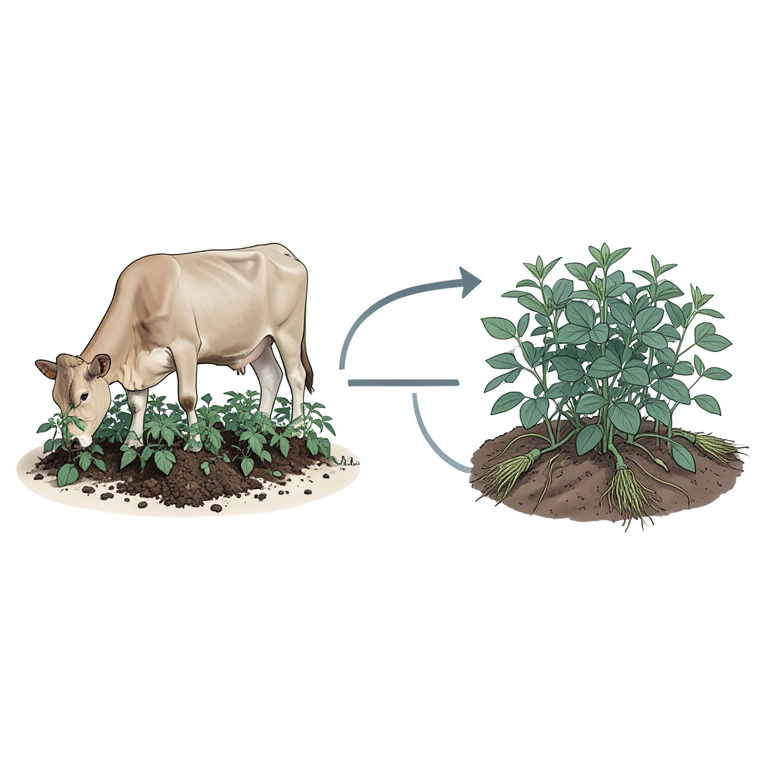
Integrated Farming System Cycle
AI-generated conceptual illustration (cow and legume crops in a dryland field). It explains the idea and does not show study data.
View source evidence ↗Introduction
In recent years, food security, livelihood security, water security as well as natural resources conservation and environment protection have emerged as major issues worldwide. Developing countries struggling to deal with these issues and also have to contend with the dual burden of climate change and globalization. It has been accepted by everyone across the globe that sustainable development is the only way to promote rational utilization of resources and environmental protection without hampering economic growth. Developing countries around the world are promoting sustainable development through sustainable agricultural practices which will help them in addressing socioeconomic as well as environmental issues simultaneously. Within the broad concept of sustainable. India ranks first among the rainfed agricultural countries of the world in terms of both extent and value of produce. Even after achieving the full irrigation potential, nearly 50% of the net cultivated area still remains dependent on rainfall. Rain-fed agriculture supports nearly 40% of India's estimated population.
Rainfed agriculture is practiced in two-thirds of the total cropped area and contributes to nearly 40 per cent of the national food basket. In the Indian context, rainfed agriculture productions systems accounts 55 per cent production of rice, 91 per cent coarse grains, 90 per cent pulses, 85 per cent oilseeds and 65 per cent cotton thereby demonstrating the importance of rainfed agriculture in the country. These regions also account for nearly 50 percent of the total rural workforce and 60 percent of livestock in the country. In these rainfed systems the annual rainfall.
Conservation Agriculture
It has been widely recognized that currently practiced Agricultural cultivation systems in dryland regions are severely affected by many emerging challenges and has been one of the main reasons for the poverty and food insecurity faced by smallholders in most parts of the rural regions in developing countries. Unsustainable agricultural practices has led to exhaustion and degradation of forest and soil resources which in turn has resulted in reduced land productivity, land degradation, and reduction in biodiversity. In order to address such problems facing dryland agriculture systems, Conservation agriculture has been evolved as a concept for addressing specific problems faced by smallholder farming systems in the tropics. There used organic agriculture does not permit the use of synthetic chemicals to produce plant and animal products, relying instead on the management of soil organic matter (SOM) and biological processes. In some parts of the world, farms must be inspected and certified before their food products can be sold as organic, indicating that no synthetic chemicals were used in producing them. But organic farming uses the principles of CA to some extent and one objective similar to CA is to maintain and improve soil health. Unlike organic farming, CA does allow farmers to apply synthetic chemical fertilizers, fungicides, pesticides and herbicides. Many farmers rely on using these to control weed and pest problems, particularly during the early transition years. As soil physical, chemical and biological health improves over time; the use of agrichemicals can be significantly reduced or, in some cases, phased out entirely.
Integrated Farming System in Dry Land
The selection of enterprises must be based on the cardinal principle of minimizing the competition and maximizing the International Journal of Agriculture and Nutrition complementarity between the enterprises. In Uttar Pradesh, it was observed that crop + dairy + goat farming followed by crop + goat farming had the maximum potential (Singh and Sharma, 1987). Similarly, Singh et al. (1988) suggested the integrated farming system with goat and sheep rearing under dry land of Punjab region of India. Integration of dairy + biogas + silviculture for garden land condition and cropping + goat under rainfed situation were the best model for the Western Zone of Tamil Nadu (Rangasamy et al., 1990). Possibility of raising small breeds of livestock and poultry in rainfed uplands of Eastern India when a cereal and grain legume crop formed an integral part of the farming system (Singh et al., 1993a). Kale (1999) and Das (2001) have also reported similar findings. Phengvichith (1998) stated that to realize the potential contribution of livestock in a croplivestock system, appropriate system-oriented technology must be generated on farm to ensure social acceptability and economic viability.
Present Status and Future Prospects
The different farming systems that are existing at present are as 1. Crop -Livestock -Forestry farming system. 2. Crop -Fish -Poultry farming system 3. Crop -Livestock -Poultry -Fisheries farming system. 4. Fodder -Vegetable -Dairy farming system. 5. Integrated Dairy biogas farming system. 6. Rice -Mushroom -Brinjal -Poultry integrated system.
The disappointing results of conventional cropping systems in advancing the productivity of small farms were the driving force in the development of farming systems research. It views the whole farm as a system with the integration of crops, animals, soils, workers, other inputs and environmental influences wherein the farm family attempts to produce outputs within the limitations of its capability and resources and the socio-cultural setting. Development and adoption of integrated farming system will help in productivity enhancement, employment, income generation and nutritional security both for human and livestock. The different components of the system have complementarities with waste products of one component becoming source of food and energy for other components. Considerable research efforts are being made in evolving situation specific integrated farming system. Literature on dry land integrated farming system is reviewed and presented below. Status of small farm holders in India The population of India is increasing at the rate of 1.2%, indicating that it will be the most populous nation in the world by 2025. The increasing population causes fragmentation of land and as a consequence the average land holding of the Indian population has reduced from 2.3 ha in 1970-71 to 1.2 ha in 2010-11. Moreover, the number of marginal farmers with less than 1 ha of cultivated land has increased from 51% to 67% during that period (Table 1). The share of resource-poor community of total farmers has increased from 69.9% to 84.9% within this period. The reducing trend of per capita land holding of the majority farmers is a major concern for food security of the nation in the coming days.
Challenges to Small Holders
In the changing scenario and role of IFS Small farm holders have poor access to land, water, inputs, credit, technology and markets.
In the post-liberalization days, new threats have come up in terms of sustainability of these small holdings. The concept of contract and commercial farming is gradually gaining ground in India. Therefore, the farmers face new challenges in integration of value chains, market volatility, risks and vulnerability besides the effects of liberalization, globalization and climate change14. For efficient use of existing resources and farm by-products, the resource-poor farmers are now encouraged to integrate the crops with non-crop components and land-based vocations with nonland-based enterprises through different types of IFS. The ancillary components in these IFS are characterized by low, In addition, other soil related constraints viz, depletion of SOM, multinutrient deficiencies under intensive agricultural practices, decline in soil health, unsustainable crop productivity and environmental pollution due to imbalanced use of chemical fertilizers has developed renewed interest on use of organic sources of nutrients. On the contrary, use of organics alone may not yield enough to meet the growing demand for cotton. Moreover, similar to fertilizers, competition does exist with regard to its use for other enterprises and its limited availability to fulfill the entire nutrient demands which again justifies for integrated use of fertilizers and manures. 1.
Improving Nutrient Cycling\ Excreta contain several nutrients (including nitrogen, phosphorus and potassium) and organic matter, which are important for maintaining soil structure and fertility. Through its use, production is increased while the risk of soil degradation is reduced.
2.
PROVIDING ENERGY: Excreta is the basis for the production of biogas and energy for household use (e.g. cooking, lighting) or for rural industries (e.g. powering mills and water pumps). Fuel in the form of biogas or dung cakes can replace charcoal and wood.
Green Manure
With the increase in usage of fertilizers and intensification of agriculture, alternative source of organics besides FYM like green manure (GM), crop residues/wastes etc. have been increased. Although N additions through GM is in the range of 30-40 kg ha -1, yet this practice is not prevalent even in rainfed areas because of unavailability of sufficient soil moisture and no direct visual/economic benefits. Although a general trend of yield decline is noticed when a GM crop was grown in situ and incorporated as such because of immobilization factor yet yield increases were observed in many locations following its fortification/enrichment. At Nagpur, seed cotton yield increased to an extent of 24% with in situ GM incorporation when supplemented additionally with subabul loppings and FYM.
Crop Rotation
More often ignored in an INM strategy, crop rotation is a very important tool in sustaining nutrient supply. Legumes in rotation restore soil fertility in more than one way viz, some of the N fixed is left in the soil after harvest, improvement in soil properties, lesser disease and pest problem and better weed control. Legumes rotation can fix atmospheric N to an extent of 135-488 kg ha -1. It is estimated that cotton following a non-legume rotation crop required an application of 179 kg N ha -1, while following the grain-and GM-legume system it required only 90 and 52 kg N ha -1 Non legume crop viz, jowar grain crop was highly remunerative and requires less inputs especially N following a cotton crop. In cotton-sorghum cropping system at Coimbatore T.N.), cotton should be given full dose of NPK while P & K may be skipped to succeeding sorghum crop (Praharaj and Rajendran, 2007). Therefore, effect of INM practices on cropping system is mostly positive.
Crop Residues
The bulk of available crop residues constitute cotton, wheat and mustard in the north, cotton and pigeon pea stalks in central India, and cotton, legume & rice straw in the South. Usually cotton stalks are poor for quality composting because of their high lignin content, wide C/N ratio, low nutrient especially N content causing N immobilization and often allelopathic effect on the applied crop. Therefore, crop residues need to be converted to bio-composts for its effective conversion and utilization by crop plants. Study revealed that incorporation of cotton and wheat residues improved the productivity of these crops at Ludhiana in the North zone since improvements in the soil fertility might stabilize long-term yields. Thus, cotton and wheat crop residues can be safely incorporated as an eco-friendly practice. Since limited application (due to low crop response) of K leads to an accelerated depletion of other nutrients in addition to K in North zone, crop residue incorporation (with high in K) can alleviate these problem here besides improving long-term nutrient balances of cations and restoring SOC. Shredding and incorporation of cotton stalks and wheat straw were again found more suitable.
Conclusion
The above study clearly indicates that instead of mono-cropping or traditional cropping practices, adoption of IFS by the resourcepoor farmers could be of immense help in strengthening their net income as well as creating jobs, thus paving the way for sustainable family farming. Crops cultivated and other components in the IFS should be complementary so that the farming could be profitable and sustainable. In the limited resources, some rainfed pulse fodders, e.g. lucerne, berseem, cow pea should be cultivated, which will increase the productivity of the domesticated animals and soil fertility status as well. Thus IFS enhances farm productivity, nutritional security and net income of the small and marginal land holders, which ultimately reduces poverty. Increasing of net income and employment leads to socioeconomic development of farm families, Sustainable development is the only way to promote rational utilization of resources and environmental protection without hampering economic growth and integrated Farming Systems hold special position as in this system nothing is wasted, the by-product of one system becomes the input for other. India has a considerable livestock, poultry population and crop wastes.
References
33 in the original paper- Acharya, S.S., K.A. Varghese and Diwakar Singh. (1987). Economic aspects of dairy enterprise in an irrigated arid region of Rajasthan. Indian J. Dairy Sci., 40(3): 331-338.
- Aggarwal, R.K. and P. Kumar. (1993). Sustainable productivity through organic manure in arid land ecosystem. In: Proceedings of International Symposium on Environmental degradation, CAZRI, Jodhpur. pp. 21.
- Alam, M.R., R.I. Sarker, M.D. Hossain and M.S. Islam. (2000). Contribution of livestock to small farms in Bangladesh. Asian Australasian J. Anim. Sci., 13(suppl.):339-342.
- Annual report 2001-2001, AICRP on LongTerm Fertilize Experiments to Study Changes in soil quality, crop productivity and sustainability, Indian Institute of Soil Science, Bhopal, p. 68.
- Arvind, R. and K.K. Jain. (1992). Dairying potential in Jalandhar district of Punjab. Indian Dairyman, 44(12): 578583.
- Barik, K.C., D. Mohanty, S.K. Nath, S.K. Sahoo and Laba Soren. (2010). Assessment of integrated farming system for rainfed agro ecosystem in Deogarh district of Orissa. In: Extended summaries of XIX National Symposium on Resource management approaches towards livelihood security, Bengaluru, Karnataka, Dec. 2 -4. pp: 172.
- Basavaraj, H. and N.R. Gangadharappa. (1999). Adoption level and profitability of different combination of farm enterprises in existing farming systems. Mysore J. Agric. Sci., 33(2): 261-266.
- Das, S.K. (2001). Prospect and potentiality for goat farming in north eastern region of India -a review. Agric. Rev., 22(3/4):228-233.
- Deoghare, P.R. (1997). Sustainability of on-farm income and employment through livestock production in Mathura district. Indian J. of Anim. Sci., 67(16): 916-919.
- Deoghare, P.R. and N.K. Bhattacharya. (1993). Economic analysis of goat rearing in the Mathura district of Uttar Pradesh. Indian J. Anim. Sci., 64(12): 1368-1372.
- Devendra, C. (1998). Improvement of small ruminant production systems in rainfed agro-ecological zones of Asia. Ann. Arid Zone, 37(3): 215-232.
- Devendra, C. (2000). Animal production and rainfed agriculture in Asia: Potential opportunities for productivity enhancement. Outlook on Agriculture, 29:161-175.
- Esther Shekinah, D., C. Jayanthi and N. Sankaran. (2005). Physical indicators of sustainability -A farming systems approach for the small farmer in the rainfed vertisols of the Western zone of Tamil Nadu. Journal of Sustainable Agriculture,25(3):43-65.
- Gajja, B.L., T.K. Bhati, L.N. Harsh and M.S. Khan. (1999). Comparitive economics of silvipasture, hortipasture and annual crops on marginal agricultural lands of arid zone of Rajasthan. Ann. Arid Zone, 38(2): 173-180.
- Gupta, P.C., K. Singh and M.A. Akbar. (1994). Developing forage based rations for lactating buffaloes. In: Proceedings of IV World Buffalo Congress. Sao Paulo, Brazil. June 2730, Vol. II. pp. 275-277.
- Jayanthi, C., C. Vennila, K. Nalini and G. Vivek. (2007). Physical indicators -on farm farming system for irrigated uplands
- Jayanthi, C., M. Balusamy, C. Chinnusamy and S. Mythili. (2003). Integrated nutrient supply system of linked components in lowland integrated farming system. Indian J. Agron., 48: 241-246.
- Kadian, V.S., K.P. Singh, S.N. Singh and H. Kumar. (1992). Productivity and economics of intensive crop rotations in arable and mixed farming systems. Haryana J. Agron., 8(2): 116-122.
- Kale, A. (1999). Goat farming -a remunerative enterprise. Intensive Agriculture, 37(3&4): 24-28.
- Nehra, O.P., N. Singh, S.N. Singh, V. Kumar, K.P. Singh and V.S. Kadian. (1992). Comparative studies on economics of various farming systems under semi-arid tracts of Southern Haryana. Indian J. Anim. Prod. Mgmt., 8: 121-124.
- Pandey, R.N. (1988). Contribution of buffaloes to generation of income and employment for the rural households, especially for the small farmers. Indian J. Anim. Production and Management, 4(3/4): 124-132.
- Pandey, R.N. and T.S. Bhogal (1980). Prospects of increasing income and employment on mixed farms. Indian J. Agric.Econ., 35(4): 144-151.
- Praharaj, C.S. and T.P. Rajendran (2007). Long-term quantitative and qualitative changes in cotton (Gossypium hirsutum L.) and soil parameters under cultivars, cropping systems and nutrient management options. Indian Journal of Agricultiural sciences, 77 (4): 280-285.
- Shivani, R.D. Singh, K. Rajan, P.K. Ray and S.S. Singh. (2010). Resource management in vegetable based integrated farming system for marginal farmers of Bihar. In: Extended summaries of XIX National Symposium on Resource management approaches towards livelihood security, Bengaluru, Karnataka, Dec. 2-4. pp: 176.
- Singh, A.K. and J.S. Sharma. (1987). A farming system approach for growth with equity of small farmers. J. Rural Devt.,6(4): 396-405.
- Singh, A.K. and J.S. Sharma. (1987). A farming system approach for growth with equity of small farmers. J. Rural Devt., 6(4): 396-405.
- Singh, H.P., K.L. Sharma, K. Srinivas and B. Venkateswarlu. (2000). Nutrient management strategies for dryland farming. Fertilizer News, 45(5): 43-50.
- Singh, R., N. Singh, S.B. Phogat and U.K. Sharma. (1999). Income and employment potential of different farming systems. HAU J. Res., 29(3/4): 143-145.
- Singh, R.P. (1995). Problems and prospects of dryland agriculture in India. (Ed.) R.P. Singh. Scientific Publishers, Jodhpur.pp. 13-23.
- Singh, S.N., K.P. Singh, N. Singh, V.S. Kandian and S.S. Dahiya. (1988). Employment potentialities of different farming systems. In: Abstract of National seminar on Farming systems for semi-arid tropics. ICAR and Tamil Nadu Agricultural University, Coimbatore. pp.7
- Singh, S.N., K.P. Singh, N. Singh, V.S. Kandian and S.S. Dahiya. (1988). Employment potentialities of different farming systems. In: Abstract of National seminar on Farming systems for semi-arid tropics. ICAR and Tamil Nadu Agricultural University, Coimbatore. pp.7.
- Tillman, G., Schomberg, H., Phatak, S., Timper, P., Olson, D. and Santen-e-van. 2002. Enhancing sustainability in cotton with reduced chemical inputs, cover crops and conservation tillage. In: Proc. 25th Annual Southern Conservation TIllage Conference for Sustainable Agriculture, Auburn, AL, USA, pp. 366-368.
- Venugopalan, M. V. and Pundarikakshudu, R. 1999. Longterm effect of nutrient management and cropping system on cotton yield and soil fertility in rainfed vertisols. Nutr. Cycl. Agroecosys. 55: 159-164.
Cited by 1
From OpenAlex, OpenCitations and reference lists read by Scinovex
- Profile of Gajapati district Tribal and their livelihood through farming systems adoption
Sanju Sahal, Lalichetti Sagar, M. D. Reddy, Ajay Kumar Prusty · International Journal of Agriculture Extension and Social Development · 2024
Odisha is one of the most tribal-dominated states having 9.59 million tribal populations out of out of 41.97 million population of Odisha and more than 47% of tribal people live in rural areas depend on agriculture for their livelihoods. A study was done in Gajapati district to identify different tribal communities live in the district and their lively hoods through adoption of different farming systems. In Gajapati district, there are nine tribal communities (Saora, Tharua, Jatapu, Kandha, Lodha, shabar lodha, Kondadora, Bhuyan, and Sounti) live in seven blocks. These tribes produce paddy (pa