
Research article · 2020 · Full text
International Journal of Agriculture and NutritionEffects of root and tuber expansion programme on the performance of cassava farmer-beneficiaries in Edo State, Nigeria
Volume 2(2) · Pages 05–10 · DOI: 10.33545/26646064.2020.v2.i2a.30 ↗
Research areasCassava research and cyanide
Abstract
Author-writtenThe study assessed effects of Root and Tuber Expansion Programme (RTEP) on the performance of cassava farmer-beneficiaries in Edo State, Nigeria. The population of the study comprised all cassava farmers in Edo State that participated in RTEP. A multi-stage sampling procedure was used to select 120 respondents for the study. Data were collected from primary source through the use of validated interview schedule. Analytical tools used were descriptive statistics and multiple linear regression. Findings show that the RTEP made best achievements in conduct of training/workshop on improved cassava production practices, followed by increase in cassava farmers’ yield and income. The cassava farmer-beneficiaries were fully involved in the programme’s activities such as multiplication of improved cassava varieties and distribution ( = 2.86), extension meetings and field visits ( = 2.81) and lectures organized by extension workers ( =2.77). Socio-economic variables such as age, sex, educational level, farming experience, membership of social organization, extension contact and annual income statistically and significantly influenced level of involvement in the RTEP activities at 5% level. Inadequate fund for start-off, delays in credit/agro-input disbursement, approval of work plans, budgets and procurements, inadequate programme group coverage and gender issue not addressed were major constraints to involvement of the farmers in RTEP. The need for timely and adequate supply of agro-inputs and credits at subsidized rate by the service providers was recommended. This would boost the capabilities of the farmers to start field operations timely, realize more profit, and achieve higher levels of involvement in the RTEP activities.
Summary
Source-checkedPlain-language reading of the full paper, prepared with AI and checked against the text. Each point links to the authors' own words.
Why it matters
- Root and tuber crops are critical for food security in sub-Saharan Africa because they are drought-resistant and provide approximately 20% of the region's caloric intake. View evidence ↗
- These crops are important not only for food but also as industrial raw materials and as a source of income for poor farming households. View evidence ↗
- The Root and Tuber Expansion Programme (RTEP) was created specifically to combat rural poverty and improve food production. View evidence ↗
The question
- The study aimed to evaluate how the RTEP affected the performance of cassava farmers who benefited from the program in Edo State, Nigeria. View evidence ↗
What they did
- The researchers used a multi-stage sampling process to select 120 registered cassava farmers as study participants. View evidence ↗
- Primary data were gathered using a validated interview schedule administered to the respondents. View evidence ↗
- Data analysis was performed using SPSS Version 23, employing mean statistics for involvement and achievements, and multiple linear regression to analyze the influence of socio-economic factors. View evidence ↗
What they found
- Farmers showed high levels of involvement in distributing improved cassava varieties (mean = 2.86), attending extension meetings (mean = 2.81), and attending lectures (mean = 2.77). View evidence ↗
- The analyzed socio-economic variables explained 67.4% of the variation in how farmers participated in RTEP activities. View evidence ↗
What it means
- The authors recommend that service providers ensure the timely and adequate supply of subsidized credits and agro-inputs before the farming season begins. View evidence ↗
- The authors suggest that government and communities improve road and market infrastructure to strengthen the links between producers, processors, and consumers. View evidence ↗
Visual summary
1 visualsIllustrations explain the paper; charts are replotted from the paper's own table values.
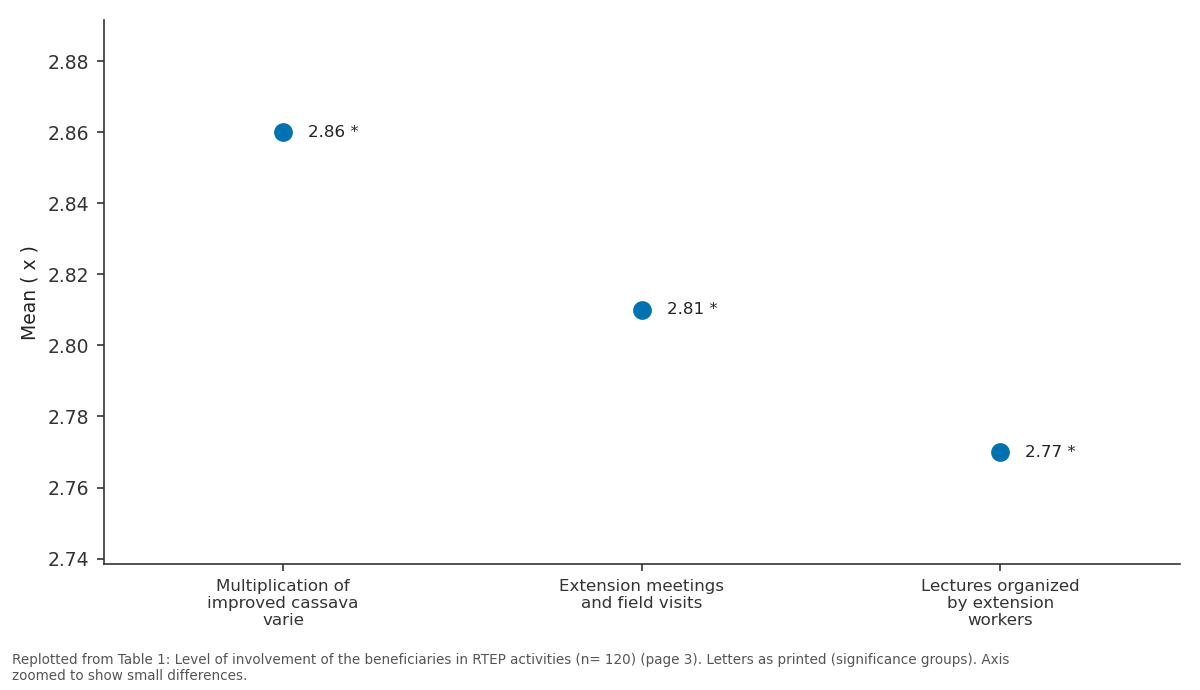
Mean ( x ): Multiplication of... vs Extension meetings and... vs Lectures organized by...
Replotted from Table 1 (page 3) of the original paper. Every bar is the paper's own table value.
View source evidence ↗Figures & tables
From the original paper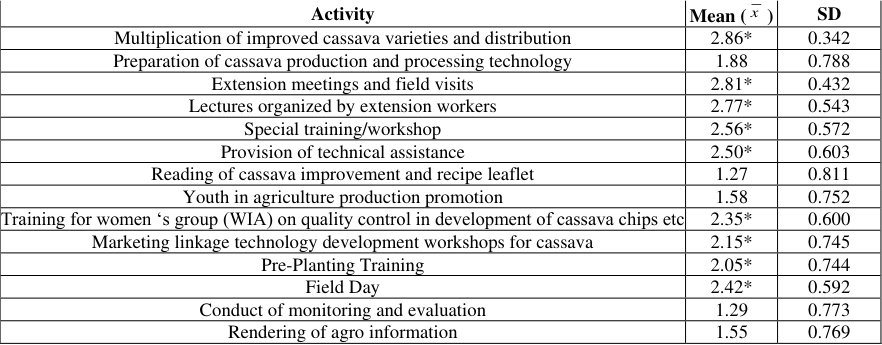 Table 1
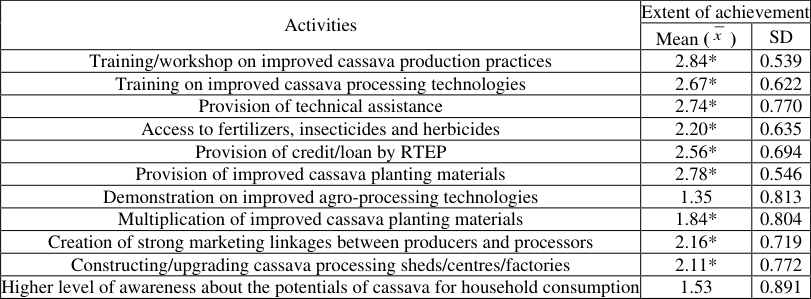 Table 2
 Table 3
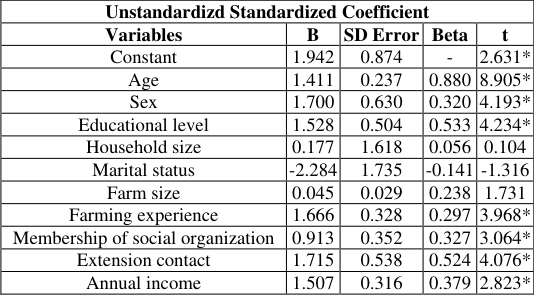 Table 3
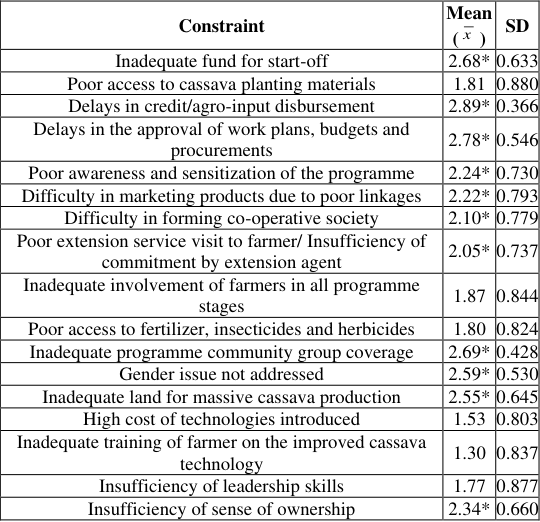 Table 4
Introduction
Modern agricultural production technologies contribute to poverty reduction in terms of enhanced productivity and lower per unit cost of production which raises income of adopting farmers (Menale, Shiferaw and Muricho, 2011) [14] . It follows that inadequate use of modern agricultural technologies not only result in decreasing capacity to meet the food needs of the people, but also creates critical limiting factors to all-year-round cultivation, given that production in sub-Saharan Africa (SSA) countries is largely weather-dependent. Hence, research and adoption of crops having the ability to withstand drought, diseases, improve yield and be cultivated throughout the year is crucial for food security and poverty reduction. Root and tuber crops rank high as drought resistant crops grown all-year-round. They have, therefore, become important staple foods consumed in SSA, accounting for about 20% of calories consumed in the region (Scott, Rosegrant and Ringler, 2000) [25] . The crops also serve as raw materials for agro-based industries in manufacturing products for both rural and urban consumption; and in addition, provide income sources for resource poor farming households (Nwakor, Ifenkwe, Okoye, Onummdu, Anyaegbunam, Ekedo and Onyia, 2011). In Nigeria, various interventions aimed at improving sustainable productivity, farmers' income and the quality of lives of rural households have been made by federal government of Nigeria with collaboration of national and international organizations. The projects and programmes that have been initiated include Root and tuber expansion programme (RTEPS), Nigeria agricultural development fund (NADF), Agricultural credit guarantee scheme (ACGS), Growth enhancement support (GES) scheme, Commercial agriculture development project (CADP), Fadama III project, National programme for food security (NPFS), Presidential initiatives for cassava production and processing into flour, among several others (Okpe, 2010; FAO, 2013) [20,9] . However, despite the perceived success of some of these programmes and projects, Nigeria is yet to attain food sufficiency to feed the teaming population. According to Aref, Marof, and Sarjit (2010) [6] , lack of participation/involvement was a major reason for failure of many development attempts in developing countries; without community participation, there is obviously no partnership; no development and no programme. Major constraints that affect farmers participation and involvement in agricultural projects and programmes as identified by Kgoisiamang and Oladele (2012) [12] and Nxumalo and Oladele, (2013) [12] include unavailability of land, insufficiency of fund to farm productivity, insufficiency to technical knowledge, high input costs, inaccessibility to market, insufficiency of commitment by extension agent, insufficiency of leadership skills, insufficiency of sense of ownership, and farmers' under development or insufficiency in farms infrastructure and human resources. The root and tuber expansion programme (RTEP) was formulated to address issues of food production and rural poverty (RTEP, 2010). At the local farmers' level, the programme aims to achieve economic growth, improve access of the poor to social services and carry out intervention measures to protect the poor and vulnerable groups. At the national level, the programme was designed to achieve food security and stimulate demand for cheaper staple food such as cassava, yam, cocoyam, potato etc. (Adeniyi, 2009) [1] . The first Tri-term Implementation Review (TIR) of the project was conducted in 2004/2005. Based on the TIR recommendation, RTEP was redesigned to be communitydriven, participatory with Rural Enterprise Management (REM), the epic center. In addition, a stakeholder support Fund (SSF), a form of programme has been introduced to address the problem of low investment occasioned by lack of credit in the first triterm. RTEP targets small holders, i.e., those with less than two hectares of land per household (RTEP, 2010). The Root and Tuber Expansion Programme (RTEP) in Edo State had been implemented for over ten (10) years. The several activities that have been implemented among farmers and processors of root and tuber crops, since the effective commencement of the programme in 2002 and final completion date in 2010 (Edo State Agricultural Development Programme (EDADP), 2003; PCD, 2010), include multiplication and distribution of improved planting materials, trainings and demonstration on improved agro-processing technologies. Also, the goal of RTEP was to improve the living conditions, income and food security of smallholder households in the programme areas. The specific objectives were to further raise the level of productivity of the target groups, enhance/improve the processing technologies/techniques and promote the marketing of these commodities (Project Completion Digests (PCD), 2010; Ifeanyi, Atala, Ahmed and Omokoro, 2014) [11] . The study therefore seeks to provide information on the extent to which the RTEP has benefited cassava crop farmers in Edo State toward realizing its mandate.
The main objective of the study was to assess the effects of Root and Tuber Expansion Programme (RTEP) on the performance of cassava farmer-beneficiaries in Edo State, Nigeria. The specific objectives were to: 1. determine the level of cassava farmer-beneficiaries' involvement in RTEP activities; 2. examine the extent of achievement of the programme activities; 3. examine the influence of socio-economic characteristics of the cassava farmer-beneficiaries on the level of involvement in RTEP; and 4. identify constraints to involvement of the cassava farmers in the programme.
Material and Methods
The study was conducted in Edo State, Nigeria. The State lies between longitude 6 0 00 1 and 6 0 45 1 East and latitude 5 0-00 1 and 6 0 30
extension cells/circles were randomly selected from each of the selected extension blocks, giving a total of twelve ( 12) extension cells/circles. Stage III involved collection of the list of registered cassava farmers (prerequisite for benefiting from the project) for each extension blocks and cells from the project's state head office, Benin. From the list, a total of ten ( 10) RTEP registered cassava farmers were randomly selected from the selected 12 extension cells, giving a total of 120 farmers. Thus, the sample size was 120 RTEP registered cassava farmers. Data for the study were collected from primary source through the use of validated interview schedule. The interview schedule contained relevant questions that were divided into sections according to the objectives of the study. The instruments for data collection were validated by two academic staff in the Department of Agricultural Economics and Extension, Chukwuemeka Odumegwu Ojukwu University (COOU). One hundred and twenty (120) interview schedules were administered to the respondents with the help of three trained enumerators from the study area.
The IBM-SPSS Statistics software (Version 23) was used to analyze data. Frequency, percentage and mean score were used to achieve level of cassava farmer-beneficiaries' involvement in RTEP activities (Objective i), cassava farmers' perception of the extent of achievements of the programme (Objective ii) and constraints to involvement of the respondents in the RTEP (Objective iv) were analyzed using mean statistics. Objective iii, influence of socio-economic characteristics of the cassava farmer-beneficiaries on the level of involvement in RTEP, was realized using multiple linear regression analysis.
Results and Discussion
Results and Discussion
Level of involvement of cassava beneficiaries in RTEP activities
Table 1 shows responses of the farmers to the level of involvement in selected RTEP activities. According to the
| Activity | Mean ( x ) | SD |
|---|---|---|
| Multiplication of improved cassava varieties and distribution | 2.86* | 0.342 |
| Preparation of cassava production and processing technology | 1.88 | 0.788 |
| Extension meetings and field visits | 2.81* | 0.432 |
| Lectures organized by extension workers | 2.77* | 0.543 |
| Special training/workshop | 2.56* | 0.572 |
| Provision of technical assistance | 2.50* | 0.603 |
| Reading of cassava improvement and recipe leaflet | 1.27 | 0.811 |
| Youth in agriculture production promotion | 1.58 | 0.752 |
| Training for women ‘s group (WIA) on quality control in development of cassava chips etc | 2.35* | 0.600 |
| Marketing linkage technology development workshops for cassava | 2.15* | 0.745 |
| Pre-Planting Training | 2.05* | 0.744 |
| Field Day | 2.42* | 0.592 |
| Conduct of monitoring and evaluation | 1.29 | 0.773 |
| Rendering of agro information | 1.55 | 0.769 |
Table text extracted from the original PDF; superscript letters are shown inline. The original table image is below.
View original table image
Programme performance: Cassava farmers' perception of the extent of achievements of the programme
Entries in Table 2 show that the respondents agreed that the RTEP achieved the following activities to great extent ( x ≥ 2.00). These activities included: training/workshop on improved cassava production practices ( x =2.84), training on improved cassava processing technologies ( x =2.67), provision of technical assistance ( x =2.74), access to fertilizers, insecticides and herbicides ( x =2.20), provision of credit/loan by RTEP ( x =2.56), provision of improved cassava planting materials ( x =2.78), creation of strong marketing linkages between producers and processors ( x =2.16), constructing/upgrading cassava processing sheds/centres/factories ( x =2.11), promotion of adoption of farming system for maintenance of soil fertility( x = 2.03) and increase in cassava farmers' yield and income ( x = 2.80). The findings imply that majority of the cassava farmerbeneficiaries of RTEP are given adequate training/workshop on improved cassava production practices and cassava processing technologies, provided with technical assistance, credit/loan and improved cassava planting materials. Also, there are increase in farmers' yield and income and constructing/upgrading cassava processing sheds/centres/factories and promotion of adoption of farming system for maintenance of soil fertility, especially the planting of leguminous crops and alley cropping, together with the use of organic and inorganic fertilizers. These findings are in line with Adeola, Adebayo and Oyelere (2008) [2] which reported that all the participating farmers claimed to have access to the inputs distributed by the project. Manyong, Ikpi, Olayemi, Yusuf, Omonona and Idachaba (2003) [13] in the analysis of stakeholders' perception of the performance of Nigeria's Agricultural sector noted that the overall performance of agriculture was rated slightly better than before, and across the zones, access to inputs, high demand for products, availability of transport facilities, availability of raw materials and good economic climate are the main enhancing factors.
| Activities | Extent of achievement | — |
|---|---|---|
| Mean ( x ) | SD | |
| Training/workshop on improved cassava production practices | 2.84* | 0.539 |
| Training on improved cassava processing technologies | 2.67* | 0.622 |
| Provision of technical assistance | 2.74* | 0.770 |
| Access to fertilizers, insecticides and herbicides | 2.20* | 0.635 |
| Provision of credit/loan by RTEP | 2.56* | 0.694 |
| Provision of improved cassava planting materials | 2.78* | 0.546 |
| Demonstration on improved agro-processing technologies | 1.35 | 0.813 |
| Multiplication of improved cassava planting materials | 1.84* | 0.804 |
| Creation of strong marketing linkages between producers and processors | 2.16* | 0.719 |
| Constructing/upgrading cassava processing sheds/centres/factories | 2.11* | 0.772 |
| Higher level of awareness about the potentials of cassava for household consumption | 1.53 | 0.891 |
Table text extracted from the original PDF; superscript letters are shown inline. The original table image is below.
View original table image
Influence of socio-economic characteristics of cassava farmer-beneficiaries on the level of involvement in RTEP
Table3 shows the result of regression analysis of the relationship between the independent variables (age, sex, educational level, household size, marital status, farm size, farming experience, membership of social organization, extension contact and annual income) of cassava beneficiaries and level of involvement in RTEP activities in Edo State. The result of the independent variables significantly influenced the dependent variables given R 2 and F-statistic values of 0.752 and 0.674, respectively. These variables were able to explain 67.4% of the variation in participation in RTEP activities among cassava farmerbeneficiaries (R 2 = 0.674). Out of the ten variables investigated, seven (7) variables, age, sex, educational level, farming experience, membership of social organization, extension contact and annual income were found to be statistically significant at 5% level while the rest three, household size, marital status and farm size were not significant. Age of the cassava farmer-beneficiaries exerted positive and significant influence on extent of involvement in RTEP activities. This implies that any increase in age leads to a corresponding increase in the involvement in RTEP activities. Sex of the beneficiaries significantly influenced their involvement in RTEP activities positively. This implies that sex of beneficiaries is one of determinants of involvement in RTEP activities. Education showed a positive relationship with involvement in RTEP activities. A unit increase in the level of education increased the probability of the participation in RTEP activities. Producers are more disposed to understand package introduced by the programme and other informants. This underlines the importance of human capital development in increasing the level of involvement in RTEP activities. This agrees with Aniedu and Aniedu (2013) [4] who pointed that education is very essential in the development process. The effect of years of farming experience was positive and significant on involvement in RTEP activities in the study areas. This implies that the more farming experience a producers acquired, the higher the productivity and involvement in RTEP activities. This is in line with the findings of Okoye, Dimelu, Okoye and Agwu (2009) [19] which stated that the more experience a farmer is, the more efficient he/ she will be in decision-making processes and he/ she would be willing to take risks associated with the adoption of innovations. Membership of social organization was also perceived by the producers as the determinants of involvement in RTEP activities. It had a positive influence which implies that it is directly related to the dependent variable. Therefore, the higher the number of social organizations belonged, the higher the level of involvement in RTEP activities. Extension contact had also a positive influence on the involvement in RTEP activities in the study area. This implies that frequent contact with extension agents by the producers gives them opportunity to participation in RTEP activities. Therefore, regular contact with extension agents makes producers aware of improved innovations and how they can apply them to improve their livelihood. Annual income had a positive influence on the involvement in RTEP activities in the area. This implies that the more income realized by the producer, the higher the level of involvement in RTEP activities. This agrees with Alinor (2002) which noted that capital increases the scales of production and being enlarged, translates to more increase in output.
| Unstandardizd Standardized Coefficient | — | — | — | — |
|---|---|---|---|---|
| Variables | B | SD Error | Beta | t |
| Constant | 1.942 | 0.874 | - | 2.631* |
| Age | 1.411 | 0.237 | 0.880 | 8.905* |
| Sex | 1.700 | 0.630 | 0.320 | 4.193* |
| Educational level | 1.528 | 0.504 | 0.533 | 4.234* |
| Household size | 0.177 | 1.618 | 0.056 | 0.104 |
| Marital status | -2.284 | 1.735 | -0.141 | -1.316 |
| Farm size | 0.045 | 0.029 | 0.238 | 1.731 |
| Farming experience | 1.666 | 0.328 | 0.297 | 3.968* |
| Membership of social organization | 0.913 | 0.352 | 0.327 | 3.064* |
| Extension contact | 1.715 | 0.538 | 0.524 | 4.076* |
| Annual income | 1.507 | 0.316 | 0.379 | 2.823* |
Table text extracted from the original PDF; superscript letters are shown inline. The original table image is below.
View original table image
Constraints to cassava farmers' involvement in the RTEP
Table 4 shows the mean distribution of identified constraints to effective cassava farmers' involvement in the RTEP in the study area. The result reveal that inadequate fund for start-off ( x = 2.68), delays in credit/agro-input disbursement ( x =2.89), delays in the approval of work plans, budgets and procurements ( x = 2.78), poor awareness and sensitization of the programme ( x = 2.24), difficulty in marketing products due to poor linkages ( x = 2.22), difficulty in forming co-operative society ( x = 2.10), poor extension service visit to farmer/ insufficiency of commitment by extension agent ( x = 2.05), inadequate programme community group coverage ( x = 2.69), gender issue not addressed ( x = 2.59), inadequate land for massive cassava production ( x = 2.55) and insufficiency of sense of ownership for sustainability ( x = 2.34) were the major constraints to farmers' involvement in RTEP. This is an indication that the programme is being faced with numerous challenges, although it made some remarkable achievements on the lives of cassava farmer-beneficiaries. The findings agree with RTEP (2010) which reported that the project was hindered by the prolonged and avoidable delays in programme loan effectiveness, disbursement effectiveness, payment of initial deposit and implementation start-up, loan amendment, replenishment turn-around as well as insufficiently and untimely counterpart fund contribution. Also, there were prolonged delays in the approval of work plans, budgets and procurements, constraints of post-harvest handling processing, product diversification and utilization, as well as marketing. According to Kgoisiamang and Oladele (2012) the major constraints that affect farmers participation in agricultural projects were unavailability of land, insufficiency of fund to farm productivity, insufficiency to technical knowledge, high input costs, insufficiency of commitment by extension agent, insufficiency of leadership skills, insufficiency of sense of ownership, and farmers' under development or insufficiency in farms infrastructure and human resources. Aref (2010) indicated that some constraints to participation in communities include lack of knowledge, lack of effective and strong government institution, inadequate focus on human resources development, dependency on government and lack of authority in communities.
| Constraint | Mean ( x ) | SD |
|---|---|---|
| Inadequate fund for start-off | 2.68* | 0.633 |
| Poor access to cassava planting materials | 1.81 | 0.880 |
| Delays in credit/agro-input disbursement | 2.89* | 0.366 |
| Delays in the approval of work plans, budgets and procurements | 2.78* | 0.546 |
| Poor awareness and sensitization of the programme | 2.24* | 0.730 |
| Difficulty in marketing products due to poor linkages | 2.22* | 0.793 |
| Difficulty in forming co-operative society | 2.10* | 0.779 |
| Poor extension service visit to farmer/ Insufficiency of commitment by extension agent | 2.05* | 0.737 |
| Inadequate involvement of farmers in all programme stages | 1.87 | 0.844 |
| Poor access to fertilizer, insecticides and herbicides | 1.80 | 0.824 |
| Inadequate programme community group coverage | 2.69* | 0.428 |
| Gender issue not addressed | 2.59* | 0.530 |
| Inadequate land for massive cassava production | 2.55* | 0.645 |
| High cost of technologies introduced | 1.53 | 0.803 |
| Inadequate training of farmer on the improved cassava technology | 1.30 | 0.837 |
| Insufficiency of leadership skills | 1.77 | 0.877 |
| Insufficiency of sense of ownership | 2.34* | 0.660 |
Table text extracted from the original PDF; superscript letters are shown inline. The original table image is below.
View original table image
Conclusion and Recommendations
The root and tuber expansion programme (RTEP) in Edo State under study made appreciable achievements in the various activities of its mandate/target among the cassava farmerbeneficiaries of the programme. However, there were some challenges to effective implementation of the programme. This calls for urgent need to address these factors hindering the full performance of the programme, which will go a long way in addressing food security, poverty and as well sustain the programme and inform better packaging of similar programmes. There should be timely (before the farming season kicks off) and adequate supply of agro-inputs and credits at subsidized rate by the service providers. This will address issues on delays in credit/agro-input disbursement and in the approval of work plans, budgets and procurements. This would encourage farmers start field operations timely and discourage farmers from relying on high cost of privately sold agro-inputs. Government and the various communities should endeavour to provide modern road and market infrastructural facilities so as strengthen the linkages between producers, processors and consumers. Agricultural extension service agencies should encourage and assist RTEP farmers to belong to agricultural co-operative society. This will help them in pooling their resources to acquire more land and credits in order to increase productivity. In order to encourage massive participation of famers in the RTEP, there should be an increase in the number of extension workers in the field for more contacts; and adequate programme community group coverage of other communities.
References
25 in the original paper- Adeniyi AA. Annual Report of Root and Tuber Expansion Programme (RTEP), Federal Government of Nigeria, Abuja, 2009.
- Adeola RG, Adebayo OO, Oyelere GO. Effects of the federal government special rice programme on rice yields and farmers' income in Oyo State. International Journal of Agricultural Economics & Rural Development (IJAERD). 2008; 1(1):1-6.
- Alinor AN. Economic study of cassava processing in Nsukka agricultural zone of Enugu State. Unpublished M.Sc Thesis, Department of Agricultural Economics, University of Nigeria, Nsukka, 2002.
- Aniedu C, Aniedu OC. Gender mainstreaming in agricultural development in Nigeria. In agricultural extension and rural development. Nwachukwu. I (ed). Lamb House Publication Umuahia. Journal of Community and Communication Research. 2013; 2(1):68-69.
- Aref F. Barriers to community capacity building for tourism development in communities in Shiraz, Iran. Journal of Sustainable Tourism. 2010; 6(2):136-142.
- Aref F, Marof R, Sarjit SG. Community capacity building: A rewiew of its implication in tourism development. Journal of American Science. 2010; 6(1):172-180.
- Edo State Agricultural Development Programme (EDADP). 2002 RTEP Annual report. Benin, 2003.
- Farshid A. Farmers' Participation in Agricultural Development: A case of Fars Province. Indian Journal of Science and Technology. 2011; 4(2):155-158.
- Food and Agricultural Organization (FAO). Monitoring African food and agricultural policies: Analysis of incentives and disincentives for cassava in Nigeria, Technical Notes Series, MAFAP, FAO, Rome, 2013.
- Ibrahim, H. Y. & Onuk, E.G. The Impact of Root and Tuber Expansion Programme (RTEP) On Root and Tuber Crops Production in Nasarawa State, Nigeria. PAT Journal. 2010; 6(2):26-34.
- Ifeanyi OB Atala TK, Ahmed B, Omokoro D. The impact of adoption of root and tuber expansion programme (RTEP) technologies on the production and income capabilities of farmers in Plateau State. European Scientific Journal. 2014; 10(25):151-160.
- Kgosiemang DT, Oladele OI. Factors affecting farmers" participation in agricultural projects: In Mkhondo Municipality of Mpiimalagh Province. South Africa. Journal of Human Ecology. 2012; 3(1):19-27.
- Manyong VM, Ikpi A, Olayemi JK, Yusuf SA, Omonona R, Idachaba FS. Agriculture in Nigeria: identifying opportunities for increased commercialization and investment. Main Research Report, funded by USAID/Nigeria and implemented by International Institute of Tropical Agriculture (IITA), in collaboration with University of Ibadan (UI), November, 2003.
- Menale K, Shiferaw B, Muricho G. Agricultural technology, crop income and poverty alleviation in Uganda. World Development. 2011; 39(10)1784-1795.
- Ministry of Agriculture Handbook (2002) as in: Azudoni, V. Assessment of the Effect of Micro Credit Crop Production in Delta State, Nigeria. Unpublished M.Sc. Dissertation Proposal in the Department of Agricultural Economics and Extension, Delta State University, Abraka, 2010, pp. 1-30.
- National Population Commission (NPC). 2006 Nigeria Census Figures. Abuja: Nigeria Population Commission, 2006.
- Nwakor FN, Ifenkwe GE, Okoye BC, Onummdu FN, Anyaegbunam HN, Ekedo TO, et al. Socio-economic factors affecting adoption of improved cassava varieties among farmers in Abia State. Journal of Agriculture and Social Research. 2011; 11(1):63-71.
- Nxumalo KKS, Oladele OI. Factors affecting farmers' participation in agricultural programme: In Zululand District, Kwazulu Natal Province, South Africa. Journal of Social Science. 2013; 34(1):83-88.
- Okoye AC, Dimelu MU, Okoye BC, Agwu AE. Gender constraints in small holder cocoyam production in Enugu North agricultural zone of Enugu State, Nigeria. Global Food Crisis and Nigerian proceedings of the 43 rd Annual Conference of Agricultural Society of Nigeria, 2009, pp. 3035.
- Okpe E. Nigeria: Nation plans to triple domestic rice production. Daily Champion. 2010; April 6. Retrieved on 11 th September, 2018. from http://www.champion.com/
- Presidential Initiatives on Cassava (PIC). Reports in Nigeria, 2003. Retrieved on 27/05/2018 from http://www.mistowa.org/files/CAFSTON/Presidential%20I nitiative%20 -% FDA.pdf
- Project Completion Digests. Nigeria: Roots and Tuber Expansion Programme (RTEP). RTEP Publication, 2010.
- Project Implementation Manual (PIM). RTEP-Edo State Agricultural Development Programme. Benin, 2001.
- Root and Tuber Expansion Programme (RTEP). Regional Project Implementation Workshop in Western and Central Africa, 2010.
- Scott GJ, Rosegrant MW, Ringler C. Roots and tubers for the 21st century: Trends, projections and policy options. Food, Agriculture and Environment Discussion Paper 31, International Food Policy Research Institute, Washington D.C., U.S.A, 2000.