
Research article · 2020 · Full text
International Journal of Agriculture and NutritionEffect of cowpea (Vigna unguiculata L. walp) in mixture with pearl millet [Pennisetum glaucum (L.) R. Br.] as affected by variety and time of cowpea introduction in Maiduguri North Eastern, Nigeria
Volume 2(1) · Pages 01–07 · DOI: 10.33545/26646064.2020.v2.i1a.23 ↗
Research areasAgronomic Practices and Intercropping SystemsAgricultural pest management studies
Abstract
Author-writtenField experiments were conducted in 2015 and 2016 rainy seasons at the Teaching and Research Farm of the Department of Crop Production, University of Maiduguri, Maiduguri (11047N; 12016E) to study the Effect of Cowpea (Vigna unguiculate L. walp) in mixture with Pearl millet [Pennisetum glaucum (L.) R. Br.] as affected by variety and time of cowpea introduction. The treatments consisted of three pearl millet varieties: ZATIP, SOSAT-C-88 and LACRI-9702-IC, two cowpea varieties: Borno Brown and SAMPEA 11 and four cowpea sowing dates: 0 weeks after sowing millet (WASM), 1 WASM, 2 WASM and 3 WASM. The experimental design was Split-Split plot with the pearl millet varieties allocated to the main plots, cowpea varieties assigned to the sub-plots and cowpea sowing date assigned to the sub- sub plots in 1:1 alternate row arrangement, and replicated three times. The results showed that in 2015, 2016 and the combined mean, Plant height, number of branches/ plants, grain yield/hectare and were significantly greater for Borno Brown than SAMPEA 11 variety. Delaying cowpea sowing date by three weeks after sowing the millet component decreased number of branches, grain yield and fodder yield in cowpea. The SOSAT-C-88 and Borno Brown intercrop produced the highest grain yield of pearl millet in both the years and the combined mean. The cowpea variety Borno Brown was more competitive with pearl millet at simultaneous (0 WASM) or 1 week after sowing millet that had greater grain yield than SAMPEA 11. Fodder yield and pod yield were greater for Borno Brown intercropped with LACRI-9702-IC or SOSAT-C-88 than SAMPEA 11 intercropped with ZATIP. Linear relationships among agronomic parameters of cowpea revealed that, pod yield, grain and fodder yield increased significantly with increase in plant height and number of branches
Summary
Source-checkedPlain-language reading of the full paper, prepared with AI and checked against the text. Each point links to the authors' own words.
Why it matters
- Cowpea is a critical part of traditional farming systems across Africa, Central Asia, and South America, often grown in mixtures with other crops. View evidence ↗
- The productivity of cowpea in intercropping systems is often low because of competition, low plant populations, and a lack of protection measures. View evidence ↗
- Sowing crops earlier can provide a competitive advantage by allowing quicker access to resources like light and reducing competition for growth factors. View evidence ↗
The question
- The study aimed to identify the most suitable sowing date for introducing cowpea into a mixture with pearl millet. View evidence ↗
What they did
- Field experiments were carried out during the 2015 and 2016 rainy seasons at the University of Maiduguri's Teaching and Research Farm in Nigeria. View evidence ↗
- The study tested three pearl millet varieties (ZATIP, SOSAT-C-88, LACRI-9702-IC), two cowpea varieties (Borno Brown, SAMPEA 11), and four sowing dates (0, 1, 2, and 3 weeks after sowing millet). View evidence ↗
- A split-split plot design was used with a 1:1 alternate row arrangement, replicated three times. View evidence ↗
What they found
- Across 2015, 2016, and the combined mean, the Borno Brown cowpea variety outperformed SAMPEA 11 in plant height, number of branches per plant, and grain yield per hectare. View evidence ↗
- Delaying the sowing of cowpea by three weeks after the millet was sown led to a decrease in the number of branches, grain yield, and fodder yield of the cowpea. View evidence ↗
- The combination of SOSAT-C-88 pearl millet and Borno Brown cowpea resulted in the highest grain yield for the pearl millet component over both years. View evidence ↗
- For the combined mean, sowing cowpea one week after millet (1 WASM) produced a significantly higher grain yield than sowing at 0, 2, or 3 weeks. View evidence ↗
- Cowpea grain yield was significantly higher when intercropped with LACRI-9702-IC or SOSAT-C-88 compared to when it was intercropped with the ZATIP variety. View evidence ↗
- There was a strong positive correlation between the number of leaf branches at harvest and the number of pods per plant, pod yield per plant, grain yield per hectare, and fodder yield per hectare. View evidence ↗
What it means
- The authors conclude that intercropping SOSAT-C-88 pearl millet with Borno Brown cowpea sown one week later optimizes both staple grain and cash returns. View evidence ↗
- For farmers in North Eastern Nigeria aiming to maximize both grain and fodder yields, the authors recommend using the LACRI-9702-IC variety. View evidence ↗
Visual summary
1 visualsIllustrations explain the paper; they do not show study data.
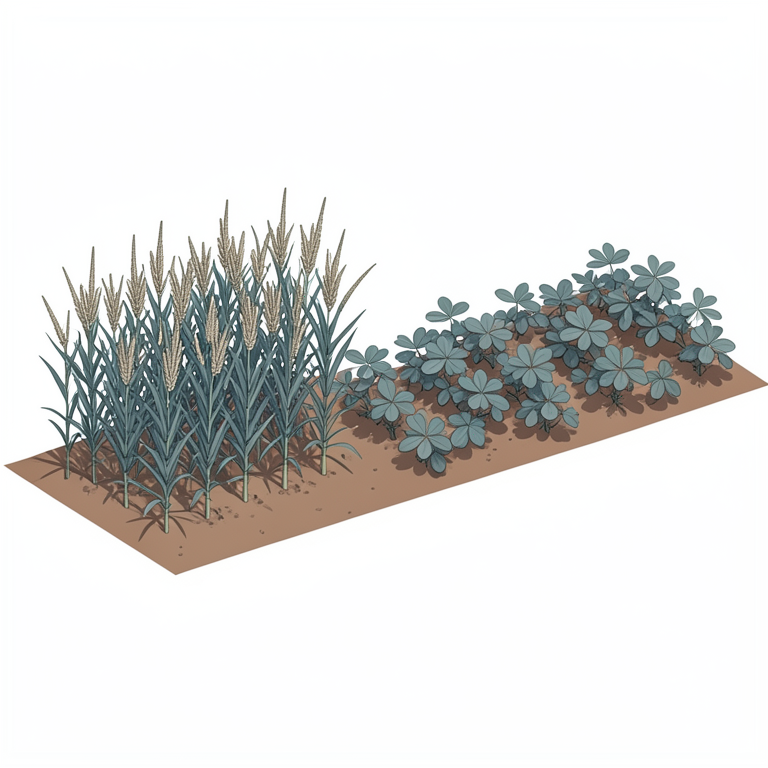
Experimental Layout
AI-generated conceptual illustration (pearl millet and cowpea plants in a field). It explains the idea and does not show study data.
View source evidence ↗Figures & tables
From the original paper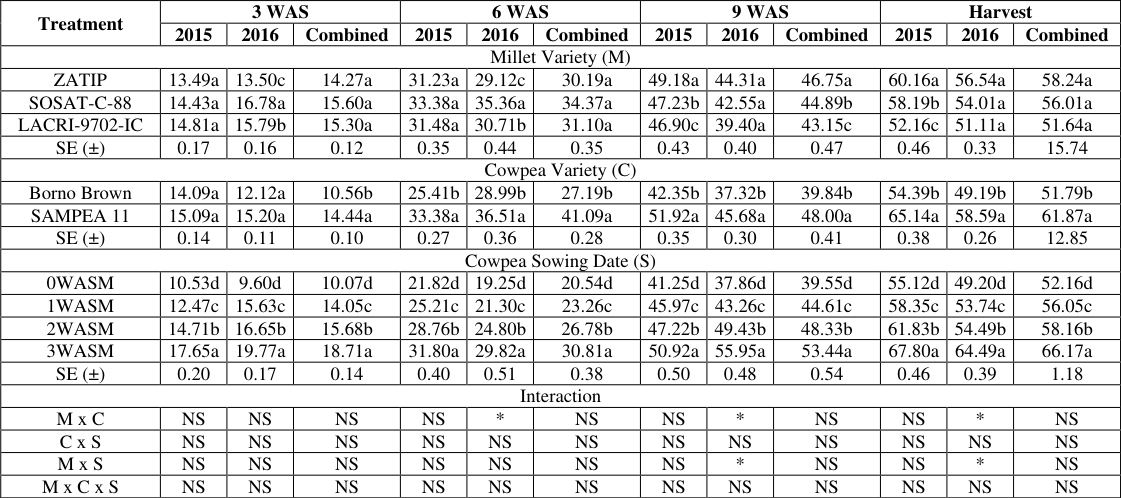 Table 1
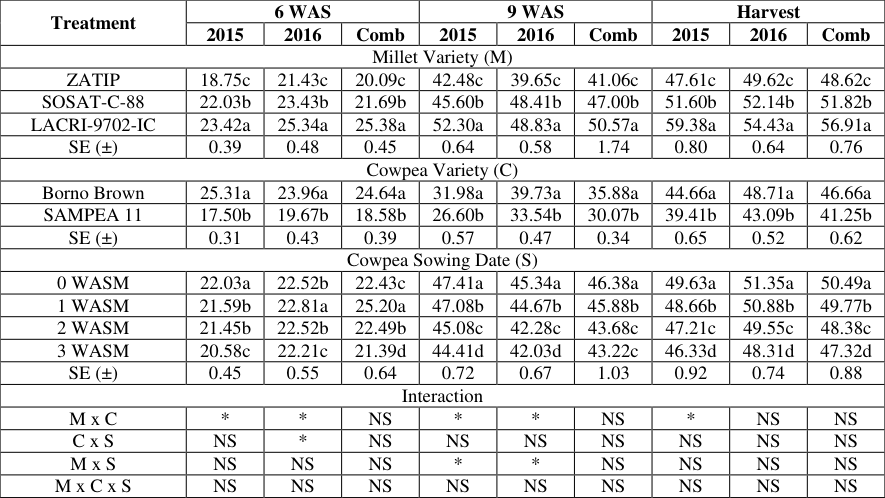 Table 2
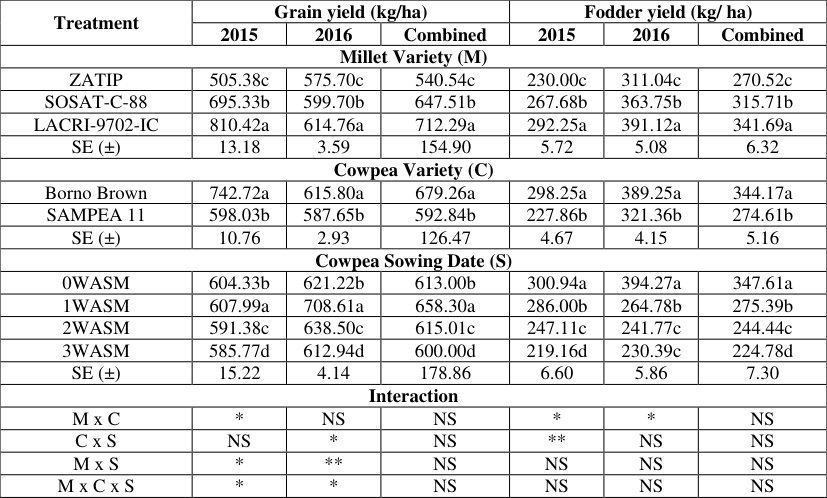 Table 3
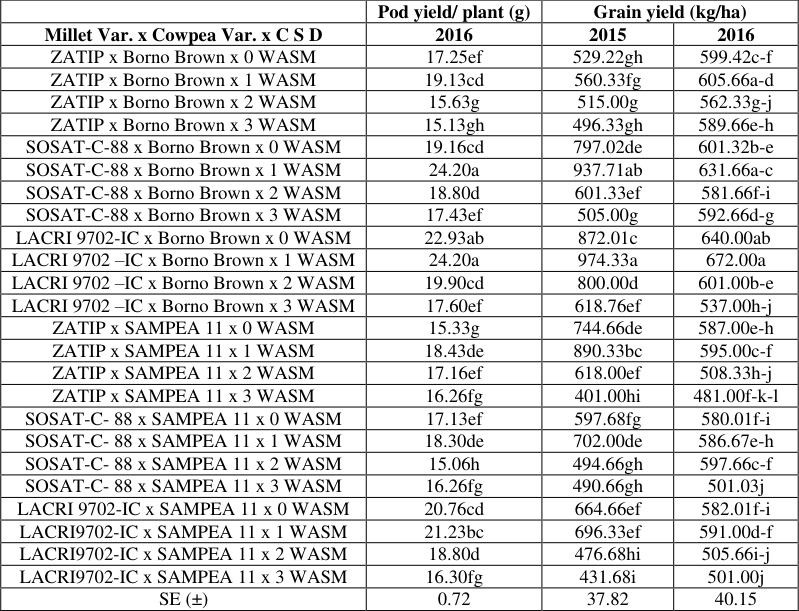 Table 4
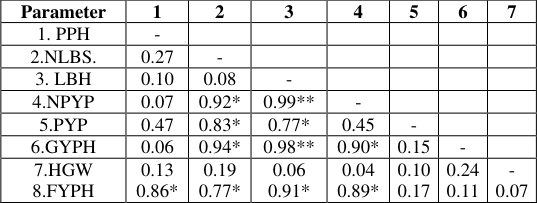 Table 5
Introduction
Cowpea is a major component of the traditional cropping system in Africa, Asia Central and South America where it is widely grown in mixture with other crops in various combinations. The performance of cowpea in this mixture is low, mainly due to low plant population, competition under intercropping and lack of crop protection measures. Studies have shown that the performance of cowpea in these systems could be enhanced through the use of improved varieties, appropriate date of planting with respect to the pearl millet, higher plant populations, improved soil fertility and suitable spatial arrangements. The fact that growing crops in mixtures ensure better land use efficiency is no longer disputable. But the dynamics of the intercrop overyielding, especially the main source of gains in the mixtures is an aspect that many scientists report contrasting findings. But generally planting early maturing varieties and slow growing crops together seems to be an agreeable arrangement leading to intercrop over-yielding. Also important are the relative statures and size of different crops, growth cycles and seasonal period available for growth (Parish, 2005) [8] . According to Andrews and Kassam (1976) [2] , the general criteria for intercropping are: Arrangement and relative numbers of the contributing crop plants will affect the expression of differences in competition. The effect of competition between crops is greatly alleviated when their maximum demands on the environment occur at different times. Intercropping is more effective where the seasonal period for growth is long enough. Legumes may be a necessary component under conditions of low soil fertility. Since intercropping has both space and time dimensions, it is possible, by judicious selection of crops variety to adjust the timing and spatial arrangement of the mixed crops to attain maximum leaf area production over longer periods of time than it is possible with sole cropping (Parish, 2005) [8] . Agoola and Eniola (2000) [1] screened legumes for performance under intercropping with pearl millet and suggested that early maturing legumes would be appropriate in intercropping with pearl millet. By this, soil fertility and crop yield can be increased. In regions with long growing seasons properly spaced growing habit offer positive yield advantage as it is possible in wetter savanna, but for semi-arid savanna, the latitude in sowing date is minimal and choice of planting dates can contribute greatly to the yield outcome of the intercrop. To delay or hasten the relative planting date of one component versus other crop in a mixture provide farmers more flexibility in an unpredictable environment. Earlier sown crops has an earlier comparative advantage, due to quicker access to resources pool, particularly light and minimizes competition for growth limiting factors (Zarafi and Emechebe, 2005) [11] . Blade et al. (2007) [3] found that delaying cowpea sowing date by two or three weeks resulted in a cowpea grain yield reduction of over 50 % in comparison to simultaneous millet and cowpea planting. The objective of the study is to determine the suitable sowing date for relaying cowpea into the pearl millet + cowpea mixture
Materials and Methods
The experiment was conducted during 2015 and 2016 rain-fed cropping seasons at the Teaching and Research Farm, Department of Crop Production Faculty of Agriculture, University of Maiduguri. The experimental site was located between latitude 11 0 47 1 N and 56 00 1 N, and longitude 03 0 12 1 and 16 0 E and altitude of 345 m above sea level, in the northern fringes of the Sudan savanna belt of Nigeria. The treatments consisted of three improved pearl millet varieties: (ZATIP, SOSAT-C-88 and LACRI-9702-IC) intercropped with two cowpea varieties: (Borno Brown and SAMPEA 11) and each sown at four cowpea sowing dates: (simultaneous, one week, two weeks and three weeks after sowing the millet WASM) in 2015 and 2016. The pearl millet was grown at (3) three plants/stand, while the cowpea were grown at 2 plants/stand (Dugje et al., 2009) [4] . experimental design was split-split plot with pearl millet varieties assigned to the main-plot, cowpea varieties assigned to the sub-plot and cowpea sowing date assigned to the sub-sub plots, which were replicated three times. The sub-plot size was 3.0 x 5.0 m (15.0 m 2 ). An alley of 2.0 m was allowed between the replicates, while 1.0 m and 0.50 m alley was allowed between the main plots and sub-plot, respectively. Data collected from the experiment were subjected to two-way Analysis of variance (ANOVA). Both the year wise and combined years' analysis was run using a Computer Software, Statistix Version 8.0 (Statistix, 2005) [9] . Differences between treatments means were compared using Duncan ' s multiple Range Text (DMRT) at 5% level of probability.
Growth and Development Parameters
Effect of pearl millet varieties on cowpea plant height showed that, relatively taller cowpea plants were produced in association with SOSAT-C-88 or LACRI-9702-IC compared to ZATIP at 3 and 6 WAS in 2015 (Table 1). Significantly (P<0.05) greater plant height was produced in association with ZATIP or SOSAT-C-88 compared to LACRI-9702-IC at 9 WAS and at harvest in 2015. There was no significant difference in cowpea variety plant height at 3 WAS, however SAMPEA 11 had slightly taller plants than Borno Brown. Plant height was significantly (P<0.05) shorter for Borno Brown compared to SAMPEA 11 at 6, 9 WAS and at harvest. Cowpea sowing date significantly influenced cowpea plant height at 3, 6, 9 WAS and harvest in 2015 cropping seasons. The 3 and 2 WASM significantly (P<0.001) produced taller plants compared to 0 or 1 WASM. Millet variety x cowpea variety, cowpea variety x cowpea sowing date and millet variety x cowpea sowing date interactions were not statistically significant in 2015 cropping seasons (Table 1). In 2016, cowpea produced significantly (P< 0.05) taller plants in association with SOSAT-C-88 and LACRI-9702-IC compared to ZATIP at 3 and 6 WAS (Table 22). Relatively taller plants were observed for cowpea intercropped with SOSAT-C-88 or ZATIP compared to LACRI-9702-IC at 9 WAS and at harvest. The cowpea grown in mixture with pearl millet variety ZATIP slightly promoted plant height compared to SOSAT-C-88 or LACRI-9702-IC (Table 1). The cowpea variety SAMPEA 11 produced significantly taller plants compared to Borno Brown at 9 WAS and at harvest. In 2016, cowpea sown at 3 or 2 WASM produced significantly taller plants compared to 0 or 1 WASM at 3, 6, 9 WAS and at harvest. Cowpea produced shorter plants when sown at 0 WASM compared to 1, 2 or 3 WASM respectively (Table 1). Interaction of millet variety x cowpea variety and millet variety x cowpea sowing date were significant at 6, 9 WAS and at harvest and millet variety x cowpea sowing date at 9 WAS and at harvest in 2016 cropping season. For the combined mean, there was no significant difference in plant height of cowpea variety at 3 and 6 WAS (Table 1). However, cowpea grown in association with ZATIP produced significantly (P<0.05) greater plant height compared to SOSAT-C-88 or LACRI-9702-IC at 9 WAS. Similar trend was observed at harvest when cowpea in association with ZATIP produced relatively taller plants compared to SOSAT-C-88 or LACRI-9702-IC. The cowpea variety SAMPEA 11 produced significantly (P<0.01) greater plant height than Borno Brown at 6, 9 WAS and at harvest. Sowing cowpea 2 or 3 WASM produced significantly (P<0.01) taller plants at 3, 6, 9 WAS and at harvest. Shorter plants were produced for simultaneous (0 WASM) cowpea sowing with millet or 1 WASM. There was no significant interaction for the combined mean.
| Treatment | 3 WAS | — | — | 6 WAS | — | — | 9 WAS | — | — | Harvest | — | — |
|---|---|---|---|---|---|---|---|---|---|---|---|---|
| 2015 | 2016 | Combined | 2015 | 2016 | Combined | 2015 | 2016 | Combined | 2015 | 2016 | Combined | |
| Millet Variety (M) | ||||||||||||
| ZATIP | 13.49a | 13.50c | 14.27a | 31.23a | 29.12c | 30.19a | 49.18a | 44.31a | 46.75a | 60.16a | 56.54a | 58.24a |
| SOSAT-C-88 | 14.43a | 16.78a | 15.60a | 33.38a | 35.36a | 34.37a | 47.23b | 42.55a | 44.89b | 58.19b | 54.01a | 56.01a |
| LACRI-9702-IC | 14.81a | 15.79b | 15.30a | 31.48a | 30.71b | 31.10a | 46.90c | 39.40a | 43.15c | 52.16c | 51.11a | 51.64a |
| SE (±) | 0.17 | 0.16 | 0.12 | 0.35 | 0.44 | 0.35 | 0.43 | 0.40 | 0.47 | 0.46 | 0.33 | 15.74 |
| Cowpea Variety (C) | ||||||||||||
| Borno Brown | 14.09a | 12.12a | 10.56b | 25.41b | 28.99b | 27.19b | 42.35b | 37.32b | 39.84b | 54.39b | 49.19b | 51.79b |
| SAMPEA 11 | 15.09a | 15.20a | 14.44a | 33.38a | 36.51a | 41.09a | 51.92a | 45.68a | 48.00a | 65.14a | 58.59a | 61.87a |
| SE (±) | 0.14 | 0.11 | 0.10 | 0.27 | 0.36 | 0.28 | 0.35 | 0.30 | 0.41 | 0.38 | 0.26 | 12.85 |
| Cowpea Sowing Date (S) | ||||||||||||
| 0WASM | 10.53d | 9.60d | 10.07d | 21.82d | 19.25d | 20.54d | 41.25d | 37.86d | 39.55d | 55.12d | 49.20d | 52.16d |
| 1WASM | 12.47c | 15.63c | 14.05c | 25.21c | 21.30c | 23.26c | 45.97c | 43.26c | 44.61c | 58.35c | 53.74c | 56.05c |
| 2WASM | 14.71b | 16.65b | 15.68b | 28.76b | 24.80b | 26.78b | 47.22b | 49.43b | 48.33b | 61.83b | 54.49b | 58.16b |
| 3WASM | 17.65a | 19.77a | 18.71a | 31.80a | 29.82a | 30.81a | 50.92a | 55.95a | 53.44a | 67.80a | 64.49a | 66.17a |
| SE (±) | 0.20 | 0.17 | 0.14 | 0.40 | 0.51 | 0.38 | 0.50 | 0.48 | 0.54 | 0.46 | 0.39 | 1.18 |
| Interaction | ||||||||||||
| M x C | NS | NS | NS | NS | * | NS | NS | * | NS | NS | * | NS |
| C x S | NS | NS | NS | NS | NS | NS | NS | NS | NS | NS | NS | NS |
| M x S | NS | NS | NS | NS | NS | NS | NS | * | NS | NS | * | NS |
| M x C x S | NS | NS | NS | NS | NS | NS | NS | NS | NS | NS | NS | NS |
Table text extracted from the original PDF; superscript letters are shown inline. The original table image is below.
View original table image
The effects of millet variety showed that, cowpea produced significantly (P<0.05) greater number of branches when intercropped with LACRI-9702-IC or SOSAT-C-88 than ZATIP (Table 2). Among the pearl millet varieties, cowpea significantly (P<0.05) produced lower number of branches in association with ZATIP compared to the other varieties at 6, 9 WAS and at harvest in 2015. Number of branches was significantly (P<0.01) greater for Borno Brown compared to SAMPEA 11. Cowpea number of branches was significantly affected by sowing date (Table 2). Cowpea sown simultaneously (0 WASM) with millet produced greater number of branches compared to 1 or 2 WASM that produced lower number of branches. The lowest number of branches was produced when cowpea was sown 3 WASM compared to 0, 1 or 2 WASM at 6, 9 WAS and harvest in 2015 cropping season (Table 2). There were significant interactions of millet variety x cowpea variety at 6, 9 WAS and at harvest and millet variety x cowpea sowing date at 9 WAS. There was significant effect of pearl millet variety on cowpea number of branches in 2016 with LACRI-9702-IC or SOSAT-C-88 allowing greater number of branches compared to ZATIP (Table 2). It was observed that the cowpea variety Borno Brown produced significantly (P<0.05) greater number of branches than SAMPEA 11 at 6, 9 WAS and at harvest. The effect of cowpea sowing date on cowpea number of branches showed that, 0 WASM produced significantly (P<0.001) greater number of branches compared to the 1 or 2 WASM. Significantly (P<0.05) lowest number of branches was produced at 3 WASM compared to 0, 1 or 2 WASM sowing date at 6, 9 WAS and at harvest in 2016 (Table 2). Millet variety x cowpea variety interaction was significant at 6 and 9 WAS, also cowpea variety x cowpea sowing date interaction was significant at 6 and millet variety x cowpea sowing date interaction was significant at 9 WAS.
| Treatment | 6 WAS | — | — | 9 WAS | — | — | Harvest | — | — |
|---|---|---|---|---|---|---|---|---|---|
| 2015 | 2016 | Comb | 2015 | 2016 | Comb | 2015 | 2016 | Comb | |
| Millet Variety (M) | |||||||||
| ZATIP | 18.75c | 21.43c | 20.09c | 42.48c | 39.65c | 41.06c | 47.61c | 49.62c | 48.62c |
| SOSAT-C-88 | 22.03b | 23.43b | 21.69b | 45.60b | 48.41b | 47.00b | 51.60b | 52.14b | 51.82b |
| LACRI-9702-IC | 23.42a | 25.34a | 25.38a | 52.30a | 48.83a | 50.57a | 59.38a | 54.43a | 56.91a |
| SE (±) | 0.39 | 0.48 | 0.45 | 0.64 | 0.58 | 1.74 | 0.80 | 0.64 | 0.76 |
| Cowpea Variety (C) | |||||||||
| Borno Brown | 25.31a | 23.96a | 24.64a | 31.98a | 39.73a | 35.88a | 44.66a | 48.71a | 46.66a |
| SAMPEA 11 | 17.50b | 19.67b | 18.58b | 26.60b | 33.54b | 30.07b | 39.41b | 43.09b | 41.25b |
| SE (±) | 0.31 | 0.43 | 0.39 | 0.57 | 0.47 | 0.34 | 0.65 | 0.52 | 0.62 |
| Cowpea Sowing Date (S) | |||||||||
| 0 WASM | 22.03a | 22.52b | 22.43c | 47.41a | 45.34a | 46.38a | 49.63a | 51.35a | 50.49a |
| 1 WASM | 21.59b | 22.81a | 25.20a | 47.08b | 44.67b | 45.88b | 48.66b | 50.88b | 49.77b |
| 2 WASM | 21.45b | 22.52b | 22.49b | 45.08c | 42.28c | 43.68c | 47.21c | 49.55c | 48.38c |
| 3 WASM | 20.58c | 22.21c | 21.39d | 44.41d | 42.03d | 43.22c | 46.33d | 48.31d | 47.32d |
| SE (±) | 0.45 | 0.55 | 0.64 | 0.72 | 0.67 | 1.03 | 0.92 | 0.74 | 0.88 |
| Interaction | |||||||||
| M x C | * | * | NS | * | * | NS | * | NS | NS |
| C x S | NS | * | NS | NS | NS | NS | NS | NS | NS |
| M x S | NS | NS | NS | * | * | NS | NS | NS | NS |
| M x C x S | NS | NS | NS | NS | NS | NS | NS | NS | NS |
Table text extracted from the original PDF; superscript letters are shown inline. The original table image is below.
View original table image
For the combined mean similar trend was observed for cowpea grown in association with SOSAT-C-88 or LACRI-9702-IC that produced greater number of branches compared to ZATIP at 6, 9 WAS and at harvest (Table 2). Cowpea variety Borno Brown produced significantly (P <0.05) greater number of branches compared to SAMPEA 11 variety at 6, 9 WAS and at harvest. The effect of cowpea sowing dates on cowpea number of branches was statistically significant at all the stages of growth. Simultaneous sowing of cowpea with millet (0 WASM) produced significantly (P<0.001) greater number of branches compared to 1 or 2 WASM. Among the sowing dates, cowpea produced lower number of branches at 3 WASM compared to 0,1 or 2 WASM at 6, 9 WAS and at harvest in the combined mean. There was no significant interaction of millet variety x cowpea variety x cowpea sowing in the combined mean.
Yield Parameters
Cowpea grain yield was significantly (P<0.05) greater when cowpea was intercropped with LACRI-9702-IC or SOSAT-C-88 (Table 3). Significantly (P<0.05) lower cowpea grain yield was produced when intercropped with ZATIP compared to the two millet varieties. Grain yield was significantly (P<0.05) greater for Borno Brown compared to SAMPEA 11 variety in 2015. Greater grain yield was observed for cowpea grown at 1 or 0 WASM compared to 2 or 3 WASM that produced lower grain yield. There was significant interaction of millet variety x cowpea variety, millet variety x cowpea sowing date and millet variety x cowpea variety x cowpea sowing date in 2015 cropping season. Cowpea intercropped with LACRI-9702-IC or SOSAT-C-88 produced significantly (P<0.01) greater grain yield compared to ZATIP variety in 2016. Borno Brown variety in combination with pearl millet produced significantly (P<0.05) greater grain yield compared to SAMPEA 11 variety (Table 3). Cowpea grain yield at 1 WASM was significantly (P<0.01) greater compared to 0 or 2 WASM. The 3 WASM significantly (P< 0.05) produced lower grain yield than 0, 1 or 2 WASM in 2016. There was significant interaction of cowpea variety x cowpea sowing date, millet variety x cowpea sowing date, and millet variety x cowpea variety x cowpea sowing date in 2016 cropping season on the grain yield of cowpea. For the combined mean, results showed that, cowpea grain yield was significantly (P<0.01) greater for cowpea in mixture with LACRI-9702-IC or SOSAT-C-88 compared to cowpea intercropped with ZATIP variety (Table 3). Similar trend was observed, when Borno Brown produced significantly (P<0.05) greater grain yield than SAMPEA 11 grown in association with pearl millet. Among the cowpea sowing date, the 1 WASM produced significantly (P<0.01) greater grain yield compared to 0, 2 or 3 WASM. The lowest grain yield was produced by 3 WASM compared to the three cowpea sowing dates. All the associated interactions were not significant. The effect of pearl millet variety on cowpea fodder yield showed that, cowpea in association with LACRI-9702-IC produced significantly (P<.0.05) greater fodder yield compared to SOSAT-C-88 (Table 3). ZATIP association produced lower cowpea fodder yield compared to the two varieties. Cowpea fodder yield was significantly (P<0.05) greater for Borno Brown compared to SAMPEA 11. Fodder yield of cowpea plant was significantly affected (P<0.05) by cowpea sowing dates, as cowpea sown at 0 or 1 WASM sowing date produced significantly greater fodder yield. Cowpea fodder yield was consistently lower at 3 WASM compared to 2 WASM in 2015 (Table 3). There was a significant interaction of millet variety x cowpea variety and cowpea variety x cowpea sowing date on fodder yield.
| Treatment | Grain yield (kg/ha) | — | — | Fodder yield (kg/ ha) | — | — |
|---|---|---|---|---|---|---|
| 2015 | 2016 | Combined | 2015 | 2016 | Combined | |
| Millet Variety (M) | ||||||
| ZATIP | 505.38c | 575.70c | 540.54c | 230.00c | 311.04c | 270.52c |
| SOSAT-C-88 | 695.33b | 599.70b | 647.51b | 267.68b | 363.75b | 315.71b |
| LACRI-9702-IC | 810.42a | 614.76a | 712.29a | 292.25a | 391.12a | 341.69a |
| SE (±) | 13.18 | 3.59 | 154.90 | 5.72 | 5.08 | 6.32 |
| Cowpea Variety (C) | ||||||
| Borno Brown | 742.72a | 615.80a | 679.26a | 298.25a | 389.25a | 344.17a |
| SAMPEA 11 | 598.03b | 587.65b | 592.84b | 227.86b | 321.36b | 274.61b |
| SE (±) | 10.76 | 2.93 | 126.47 | 4.67 | 4.15 | 5.16 |
| Cowpea Sowing Date (S) | ||||||
| 0WASM | 604.33b | 621.22b | 613.00b | 300.94a | 394.27a | 347.61a |
| 1WASM | 607.99a | 708.61a | 658.30a | 286.00b | 264.78b | 275.39b |
| 2WASM | 591.38c | 638.50c | 615.01c | 247.11c | 241.77c | 244.44c |
| 3WASM | 585.77d | 612.94d | 600.00d | 219.16d | 230.39c | 224.78d |
| SE (±) | 15.22 | 4.14 | 178.86 | 6.60 | 5.86 | 7.30 |
| Interaction | ||||||
| M x C | * | NS | NS | * | * | NS |
| C x S | NS | * | NS | ** | NS | NS |
| M x S | * | ** | NS | NS | NS | NS |
| M x C x S | * | * | NS | NS | NS | NS |
Table text extracted from the original PDF; superscript letters are shown inline. The original table image is below.
View original table image
Cowpea intercropped with LACRI-9702-IC or SOSAT-C-88 produced significantly (P<0.05) greater fodder yield compared to cowpea intercropped with ZATIP variety in 2016. The effect of cowpea variety on fodder yield showed that, Borno Brown variety produced significantly (P<0.01) greater fodder yield compared to SAMPEA 11. Cowpea produced significantly P (<0.05) lower fodder yield when sown at 3 WASM compared to 1 or 2 WASM respectively. However, the 0 WASM produced greater fodder yield compared to 1, 2 or 3 WASM in 2016 cropping season. There was significant interaction of millet variety x cowpea variety on cowpea fodder yield. Results for the combined mean revealed that, cowpea fodder yield was higher in association with LACRI-9702-IC compared to SOSAT-C-88, while the lowest fodder was statistically produced in association with pearl millet variety ZATIP (Table 3). Borno Brown significantly (P<0.05) produced greater fodder yield compared to SAMPEA 11. The effect of cowpea sowing date on cowpea fodder yield revealed that, 0 or 1 WASM produced higher fodder compared to 2 WASM. The 3 WASM produced the lowest fodder compared to the three sowing dates. No significant interactions on fodder yield was observed in the combined mean. Performance of cowpea showed that greater pod yield per plant was produced by LACRI-9702-IC x Borno Brown x 1 WASM or SOASAT-C-88 x Borno Brown x 1 WASM interactions compared to LACRI-9702-IC x SAMPEA 11 x 2 WASM or 3 WASM. The ZATIP x SAMPEA 11 x 3 WASM interaction produced lower pod yield compared to SOSAT-C88 x SAMPEA 11 x 0 or 1 WASM in 2016 cropping seasons (Table 4). There was significant interaction of millet variety x cowpea variety x cowpea sowing date on the cowpea grain yield in 2015 and 2016 cropping seasons. LACRI-9702-IC x Borno Brown x 0 WASM or LACRI-9702-IC x Borno Brown x 1 WASM produced significantly (P<0.05) greater grain yield/ha compared to SOSAT-C-88 x SAMPEA 11 x 2 WASM or ZATIP x SAMPEA 11 x 2 WASM. in 2015. The lowest grain yield was produced by the interaction of ZATIP x SAMPEA 11 x 3 WASM, SOSAT-C-88 x SAMPEA 11x 3 WASM or LACRI-9702-IC x SAMPEA 11 x 3 WASM compared to the other treatments (Table 4). The interaction of LACRI-9702-IC x Borno Brown x 1 or 0 WASM produced significantly (P<0.05) greater grain yield compared to SOSAT-C-88 x Borno Brown x 1 WASM interaction. Cowpea produced significantly (P<0.05) lower grain yield under the interaction of ZATIP XSAMPEA 11 x 3 WASM or SOSAT-C-88 x SAMPEA 11 x 3 WASM compared to the other treatments in 2016 cropping season. The effect of intercropping pearl millet + cowpea variety and cowpea sowing date on cowpea for the combined mean showed that, there was positive correlation between the plant height at harvest and fodder yield/ ha (r=0.86*) (Table 5). Number of leaf branches at harvest was positively correlated with number of pods per plant (r=0.92 *), pod per plant (r=0.83*), grain yield/ ha (r=0.94*) and fodder yield/ ha (r=0.77*).
| Parameter | 1 | 2 | 3 | 4 | 5 | 6 | 7 |
|---|---|---|---|---|---|---|---|
| 1. PPH | - | ||||||
| 2.NLBS. | 0.27 | - | |||||
| 3. LBH | 0.10 | 0.08 | - | ||||
| 4.NPYP | 0.07 | 0.92* | 0.99** | - | |||
| 5.PYP | 0.47 | 0.83* | 0.77* | 0.45 | - | ||
| 6.GYPH | 0.06 | 0.94* | 0.98** | 0.90* | 0.15 | - | |
| 7.HGW 8.FYPH | 0.13 0.86* | 0.19 0.77* | 0.06 0.91* | 0.04 0.89* | 0.10 0.17 | 0.24 0.11 | - 0.07 |
Table text extracted from the original PDF; superscript letters are shown inline. The original table image is below.
View original table image
| — | Pod yield/ plant (g) | Grain yield (kg/ha) | — |
|---|---|---|---|
| Millet Var. x Cowpea Var. x C S D | 2016 | 2015 | 2016 |
| ZATIP x Borno Brown x 0 WASM | 17.25ef | 529.22gh | 599.42c-f |
| ZATIP x Borno Brown x 1 WASM | 19.13cd | 560.33fg | 605.66a-d |
| ZATIP x Borno Brown x 2 WASM | 15.63g | 515.00g | 562.33g-j |
| ZATIP x Borno Brown x 3 WASM | 15.13gh | 496.33gh | 589.66e-h |
| SOSAT-C-88 x Borno Brown x 0 WASM | 19.16cd | 797.02de | 601.32b-e |
| SOSAT-C-88 x Borno Brown x 1 WASM | 24.20a | 937.71ab | 631.66a-c |
| SOSAT-C-88 x Borno Brown x 2 WASM | 18.80d | 601.33ef | 581.66f-i |
| SOSAT-C-88 x Borno Brown x 3 WASM | 17.43ef | 505.00g | 592.66d-g |
| LACRI 9702-IC x Borno Brown x 0 WASM | 22.93ab | 872.01c | 640.00ab |
| LACRI 9702 –IC x Borno Brown x 1 WASM | 24.20a | 974.33a | 672.00a |
| LACRI 9702 –IC x Borno Brown x 2 WASM | 19.90cd | 800.00d | 601.00b-e |
| LACRI 9702 –IC x Borno Brown x 3 WASM | 17.60ef | 618.76ef | 537.00h-j |
| ZATIP x SAMPEA 11 x 0 WASM | 15.33g | 744.66de | 587.00e-h |
| ZATIP x SAMPEA 11 x 1 WASM | 18.43de | 890.33bc | 595.00c-f |
| ZATIP x SAMPEA 11 x 2 WASM | 17.16ef | 618.00ef | 508.33h-j |
| ZATIP x SAMPEA 11 x 3 WASM | 16.26fg | 401.00hi | 481.00f-k-l |
| SOSAT-C- 88 x SAMPEA 11 x 0 WASM | 17.13ef | 597.68fg | 580.01f-i |
| SOSAT-C- 88 x SAMPEA 11 x 1 WASM | 18.30de | 702.00de | 586.67e-h |
| SOSAT-C- 88 x SAMPEA 11 x 2 WASM | 15.06h | 494.66gh | 597.66c-f |
| SOSAT-C- 88 x SAMPEA 11 x 3 WASM | 16.26fg | 490.66gh | 501.03j |
| LACRI 9702-IC x SAMPEA 11 x 0 WASM | 20.76cd | 664.66ef | 582.01f-i |
| LACRI9702-IC x SAMPEA 11 x 1 WASM | 21.23bc | 696.33ef | 591.00d-f |
| LACRI9702-IC x SAMPEA 11 x 2 WASM | 18.80d | 476.68hi | 505.66i-j |
| LACRI9702-IC x SAMPEA 11 x 3 WASM | 16.30fg | 431.68i | 501.00j |
| SE (±) | 0.72 | 37.82 | 40.15 |
Table text extracted from the original PDF; superscript letters are shown inline. The original table image is below.
View original table image
Length of branches at harvest was positively associated with number of pods per plant (r=0.99**), pod per plant (0.77*), grain yield/ ha (r=0.98**) and also fodder yield/ ha (r=0.91*). Number of pods per plant was significantly associated with grain yield/ ha (r=0.90*) and fodder yield/ ha (r=0.89*). No significant correlation was observed among the other agronomic parameters of the cowpea for the combined mean.
Discussion
Sowing cowpea simultaneous (0) or 1 week after sowing millet produced shorter plants with more and longer branches compared to sowing cowpea 3 weeks after sowing millet in both years and the combined mean. This could be attributed to relatively reduced competition in time and reduced shading from the pearl millet component early in the season. Early sowing provides adequate time for the cowpea plants to grow and express their full growth potentials in terms of more and longer branches and other associated growth characters in the presence of necessary mineral nutrients and other important growth factors. Elemo et al. (2006) [5] reported that, better utilization of light enhances canopy structure of the intercrops making up the crop mixture. Plant height for the cowpea sown at 2 and 3 weeks after sowing millet were taller than 0 and 1 weeks after sowing millet probably due to competition for light. The simultaneous cowpea sowing date probably availed better light (Solar radiation) distribution, made nutrients more available to the plants and reduced competition. Cowpea sown at 3 weeks after sowing millet produced less but longer branches than the other treatments probably due to above ground interplant competition since plants in the mixture were in close proximity. The interaction of pearl millet variety x cowpea variety revealed that SOSAT-C-88 x Borno Brown produced the highest grain yield and this may be attributed to greater vegetative and reproductive parameters over the other varieties. These interactions indicate a better performance of intercropping on growth and yield components in both years. Cowpea variety SAMPEA 11 produced shorter branches as well as lower grain yield in interaction with ZATIP which could be as results of competition for light and growth resources. This results confirms earlier reports by Makoi and Ndakidemi, (2010) [6] , that intercropping cowpea with taller millet variety reduced the performance of cowpea. The significant lower yields in interactions of cowpea variety x cowpea sowing date at 3 weeks after sowing millet in both the years could be attributed to the ability of crop system to form early canopy, thereby allowing pearl millet to suppress the lower storey crop as well as capturing more sunlight for photosynthesis (Terao et al., 2010) [10] .
Interaction of SOSAT-C-88 x Borno Brown x 1 weeks after sowing millet produced greater number of leaf branches, length of branches and grain yield/hectare. The low plant height, sparse canopy and early flowering of SOSAT-C-88 provided both spatial and temporal complementarities in resource use by the cowpea component which implies minimal competition for resource use. However, the choice of relative sowing date is affected by weather, soil moisture, labour constraints and cowpea variety (Olufajo and Singh, 2002) [7] . Sowing cowpea at these times as an intercrop will ensure the crop have sufficient moisture for grain production towards the end of the growing season. Therefore, while overstretched delay in sowing of intercropped cowpea may lead to significant interaction; achieving acceptable yield should be the overriding factor in deciding appropriate time of introducing cowpea into the millet component to ensure adequate crop production.
Conclusion
In terms of cowpea, the variety Borno Brown sown 1 week after pearl millet had the highest grain yield. This suggests that SOSAT-C-88 + Borno Brown sown one week after sowing pearl millet component optimized both staple grain and cash returns from pearl millet + cowpea intercropping system. Growing SOSAT-C-88 and Borno Brown variety sown 1week after sowing millet is suitable for intercropping system, Where the Farmers objective is to maximize grain and fodder yields from pearl millet and cowpea intercrop, then LACRI-9702-IC could be used for such system in North eastern of Nigeria.
References
11 in the original paper- Agboola AA, Eniola HT. Appropriate technology generation for small scale farmers in Nigeria. Pages 53-61. A Publication of the Nigerian National Farming Systems Research. Network August, 1991, 14-16.
- Andrews DJ, Kassam AH. The importance of multiple cropping in increasing world food supplies. In: Multiple cropping. ASA Spec. Pub. 27 Madison, WI, 1976, 1-10.
- Blade SF, DE Mather, Singh BB, OL Smith. Yield stability of cowpea under sole and intercropping management in Nigeria. Euphytica. 2007; 16:193-201.
- Dugje IY, Omoigui LO, Ekeleme F, Kamara AY, Ajeigbe H. Farmers Guide to Cowpea Production in West Africa. IITA, Ibadan, Nigeria, 2009, 20 pp.
- Elemo KA. Comparative ability of cowpea genotype in mixture with millet. Paper presented at the regional pearl millet workshop held at ICRISAT Sahelian centre, Niamey. 4-7 september, 2006.
- Makoi JH, Ndakidemi PA. Effect of Plant densities and Cropping Systems on Yield and Yield Components of Cowpea (Vigna unguiculata L. Walp.) genotypes and Sorghum (Sorghum bicolor L. Moench.). J Trop. Agric. 2016; 48:23-28.
- Olufajo OO, Singh BB. Advances in cowpea cropping research, 2002.
- Parish DH. Technical and research Aspects in soil fertility and fertilizer use. FAO regional seminar on planning and organisation fertilizer use development in Africa. 2005. Danish Funds in Trust. PhD Thesis Wageningen University, Netherlands, 2005.
- Statistix. Statistical package, version 8.0; Carry U.S.A, 2005.
- L. E. N., 129 -140. Co publication of International Institute of Tropical Agriculture (IITA) and Japan International Research Centre for Agricultural Sciences (JIRCAS). Ibadan: IITA. Response of diverse cowpea cultivars to planting date and cropping system. Ewansiha et al. 130 Tropical Agriculture (Trinidad) vol, 2010.
- Zarafi AB, Emechebe AM. Early sowing and metalaxyl seed treatment on the incidence of pearl millet diseases in Samaru, Nigeria Journal of Plant Protection Research. 2005; 3:163169.
Cited by 7
From OpenAlex, OpenCitations and reference lists read by Scinovex
- Evolutionary Adaptations in Drought-Resilient Crops and Their Impact on Agricultural Sustainability in Nigeria ↗
Courage Humphrey Ojeilua, Abisola Eniola Folorunso, Favour Nnennaya Eze, Ezinne Lerato Okaah, Oluwatimilehin Rebecca Alonge · African Journal of Agricultural Science and Food Research · 2025
Drought stress poses a major threat to food production in Nigeria, especially in the northern regions where rainfall has become increasingly irregular. While modern breeding programmes continue to focus on yield improvement, they often overlook the long-term resilience needed for sustainable agriculture. This review examines how evolutionary adaptations, such as deep rooting systems, early flowering, drought-induced dormancy, stomatal regulation, and…
❝ 2PDF - Performance of zinc and boron on content, uptake of micronutrient and yield of cowpea (Vigna unguiculata Walp.) in Alfisols of Konkan region of Maharashtra ↗
A.S. Yadav, DG Jondhale, NH Khobragade, TJ Bedse, AV Dahiphale, SB Bhagat et al. · Journal of Pharmacognosy and Phytochemistry · 2021
A field experiment was conducted at Research and Education Farm, Department of Agricultural Botany, College of Agriculture, Dapoli. The analytical work was carried out in the research laboratory of the Department of Soil Science and Agricultural Chemistry, College of Agriculture, Dapoli on Alfiosls to study the effect of micronutrient cations on yield and their uptake by Cowpea (Vigna unguiculata Walp.)
- Evaluation of cowpea (Vigna unguiculata (L.) Walp) genotypes under water stress condition in Konkan region
PC Jadhav, JS Tumdam, AV Mane, UB Pethe, RV Dhopavkar, R. B. Salunkhe · International Journal of Research in Agronomy · 2024
The field experiment was conducted during rabi season 2022 at Research and Education farm, Department of Agricultural Botany, College of Agriculture, Dapoli to evaluate the cowpea (Vigna unguiculata (L.) Walp) genotypes under water stress condition in Konkan region. The field experiment was laid out in strip plot design comprising five different water stress treatments with four genotypes replicated thrice. The result revealed that, the yield attributing characters of cowpea is highest in treatment T1 as compared other water stress treatment and when we consider about four different varieties,
- Impact of hot pepper, black pepper, Ginger and Moringa powder extracts against cowpea weevil Callosobruchus maculates and two storage methods on cowpea, Mogadishu, Somalia ↗
Abdihamid SH Abdi, Mohamed RA Samad, Abdirahman Barre, Abdulahi N Mohamed · Journal of Entomology and Zoology Studies · 2023
Cowpea weevil (Callosobruchus maculates) is a serious Cowpea pest which affects and destroys severely the grain within short period of 6 month in an open field and during storage period. This study aimed to evaluate the performance of hot pepper, black pepper, ginger and Moringa powder extracts and two storage methods against cowpea weevil. Laboratory experiment was conducted at plant…
❝ 0PDF - To determine the potential of agrohomeoeopathy by using calcarea phosphorica 200c by seed priming technique and analyzing the germination rate and growth rate of Vigna unguiculata plant (cow pea) plant ↗
Ankitha N Karanik, Sneha Jnanakshee HR, Skandhan S Kumar · International Journal of Homoeopathic Sciences · 2023
This study was undertaken to know the effectiveness of calcarea phos 200C on Agrohomoeopathy, a single blinded study that shows experimental group had good yield when compared to control group.Background: This article gives an insight to common man who is interested in farming or agriculture, to get accustomed with new technique and effectiveness of homoeopathic medicines in Agrohomoeopathy, how we…
❝ 0PDF - Study on genetic variability heritability and correlation studies in cowpea (Vigna unguiculata L. Walp.)
Datthi Satayanarayan, Deepanshu Deepanshu, Vijay Bahadur · International Journal of Horticulture and Food Science · 2022
The present investigation entitled “Study on genetic variability heritability and correlation studies in cowpea (Vigna unguiculata L. Walp.)” was conducted at Research field, Department of Horticulture, SHUATS, Prayagraj. (U.P) during Rabi season of 2020-2021 The soil of experimental plot was sandy loam in texture nearly neutral in soil reaction (pH6.7) The experiment was conducted in randomized block design (RBD), consisting of 33 treatments combinations with 3 replications and was allocated randomly in each replication which consists of 33 genotypes The result concluded that out of tested th
- Genetic variability studies in seed cowpea (Vigna unguiculata L. Walp) genotypes ↗
A. E. Patil, GC Shinde, VR Awari, SI Tambe · International Journal of Chemical Studies · 2021
The thirty three genotypes of cowpea were evaluated for variability, correlation and path analysis for seed yield and yield contributing characters at Post Graduate Farm, Mahatma Phule Krishi Vidyapeeth, Rahuri during Kharif, 2020-21. The high magnitude of GCV and PCV were found for plant height, number of pods per plant and seed yield per plant. High heritability estimates accompanied with