
Research article · 2021 · Full text
International Journal of Biology SciencesChanges in the species abundance and vertical distribution of insecticides "Karate", "Decis profi" and "Flint" in the soil of the Goygol national park of Azerbaijan
Volume 3(1) · Pages 50–53 · DOI: 10.33545/26649926.2021.v3.i1a.78 ↗
Research areasInsect and Pesticide Research
Abstract
Author-writtenThe article shows the data of changes in the species abundance and vertical distribution of insecticides "Karate", "Decis profi" and "Aggivo" in the soils of the Gay-Gel National Park. The toxic effect on the soil infusoria of all three insecticides studied by us manifests itself within a day after their treatment of control sites. The decomposition of the insecticides studied by us in the soil, i.e. the weakening of their toxic effect, is also different. For example, the increase in species abundance after the treatment of "Karate" begins only on the 7-8 day of the experiment. The decomposition of the drug "Decis Profi" becomes noticeable on the 5-6 day of the study, and the least toxic of the drugs studied by us "Aggivo" loses its effect after 3-4 days of exposure.
Summary
Source-checkedPlain-language reading of the full paper, prepared with AI and checked against the text. Each point links to the authors' own words.
Why it matters
- While the immediate effectiveness of pesticides is often prioritized, the long-term side effects and environmental saturation of toxic substances are frequently overlooked. View evidence ↗
- The toxic effects of insecticides on aquatic fauna are well-understood, but there is significantly less knowledge regarding the danger these substances pose to soil inhabitants. View evidence ↗
The question
- The study aimed to perform biotesting of insecticides using free-living infusoria in the Goygol National Park, as this had not been done previously. View evidence ↗
What they did
- Soil samples were collected seasonally from 8 sites in Goygol National Park, focusing on surface layers up to a depth of 25 cm. View evidence ↗
- Infusoria species abundance was determined by analyzing water-filled soil samples under a binocular in a Bogorov chamber and recalculating per 1 dm². View evidence ↗
What they found
- All three studied insecticides showed a toxic effect on soil infusoria within one day of treatment. View evidence ↗
- For 'Karate', the number of surviving species further decreased to 7 by the second day of exposure, with only a slight increase occurring at the end of the experiment. View evidence ↗
- While 'Decis Profi' appeared less toxic initially than 'Aggivo', its toxic effect became noticeably higher starting from the third day of exposure. View evidence ↗
- The strongest toxic effects occurred in the 0-10 cm soil layer; the effect diminished with depth and was practically absent at 20 cm. View evidence ↗
- Rainy weather reduced the toxic effect in upper soil layers but increased it in deeper layers (10-15 cm and below) due to the washing of insecticides downward. View evidence ↗
- In dry hot weather, the toxic effect was most severe in the top 0-5 cm layer, often nearly eliminating the entire infusoria community. View evidence ↗
What it means
- The authors conclude that the impact of insecticides on soil animals is influenced by a combination of biotic and abiotic factors. View evidence ↗
Visual summary
3 visualsIllustrations explain the paper; charts are replotted from the paper's own table values.
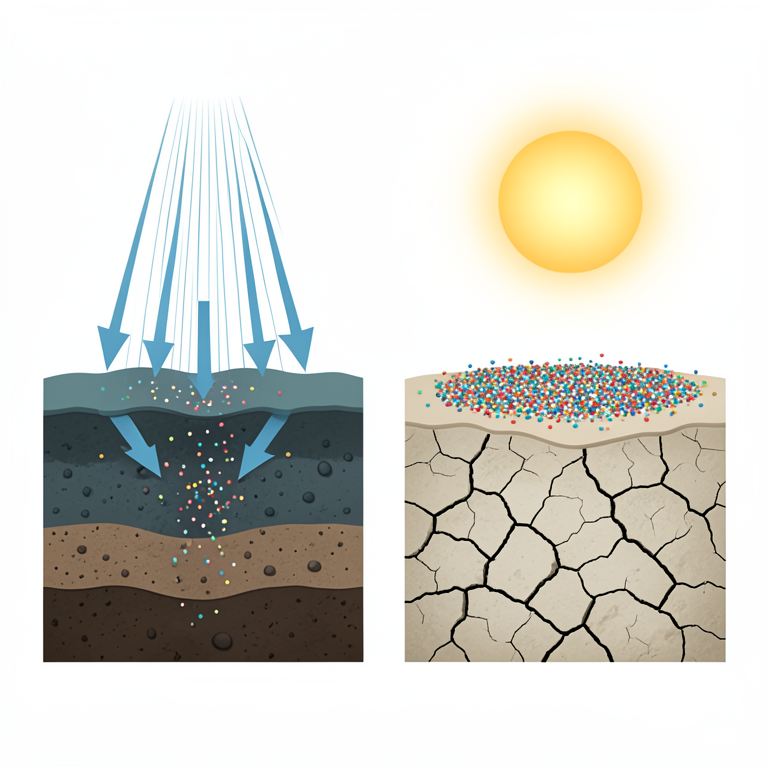
Weather Impact on Insecticide Penetration
AI-generated conceptual illustration (soil profiles in a national park). It explains the idea and does not show study data.
View source evidence ↗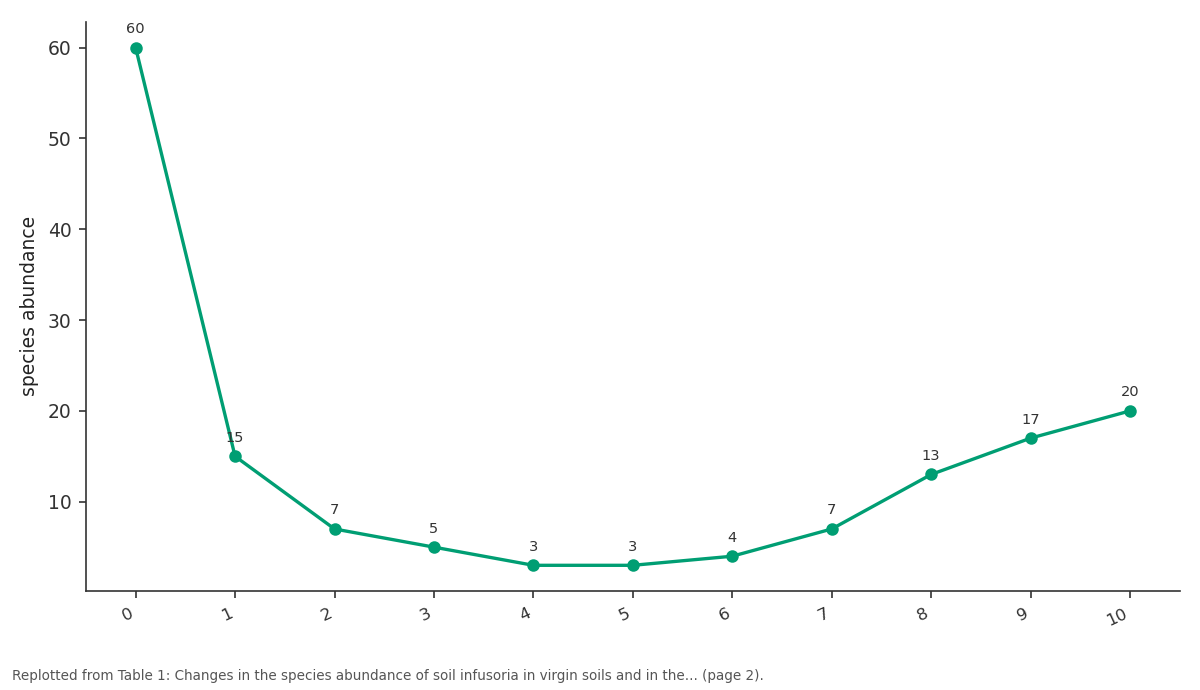
karate / Virgin soils: 0 vs 1 vs 2 vs 3 vs 4
Replotted from Table 1 (page 2) of the original paper. Every bar is the paper's own table value.
View source evidence ↗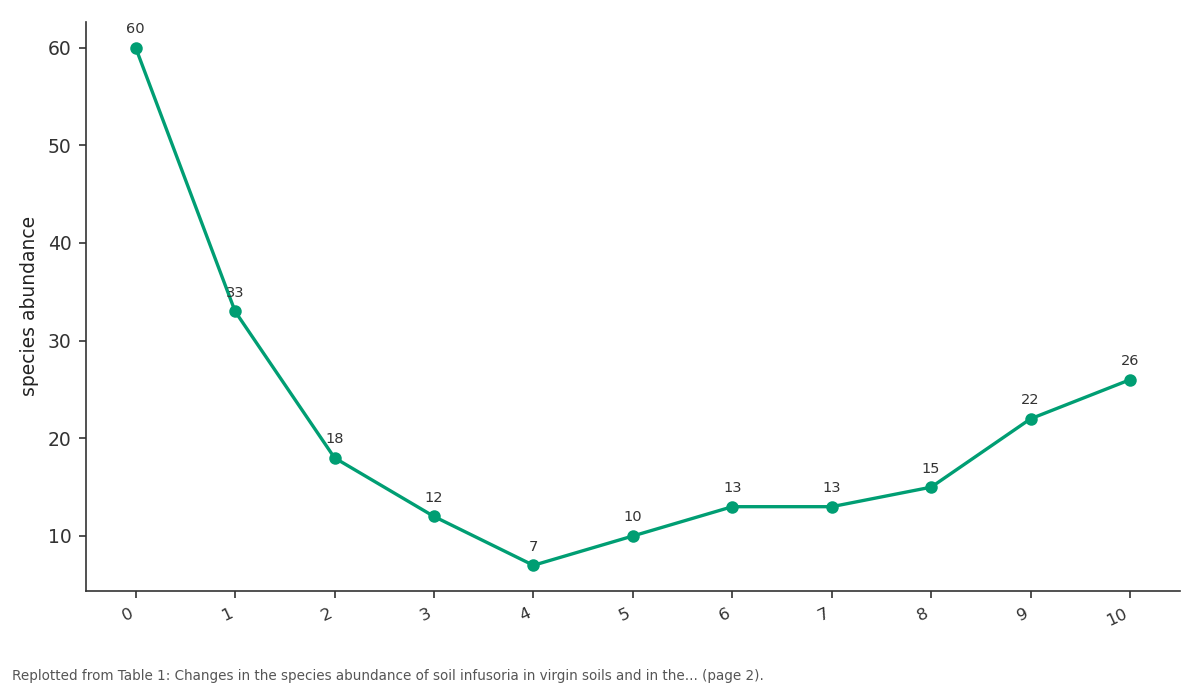
Decis pros: 0 vs 1 vs 2 vs 3 vs 4
Replotted from Table 1 (page 2) of the original paper. Every bar is the paper's own table value.
View source evidence ↗Figures & tables
From the original paper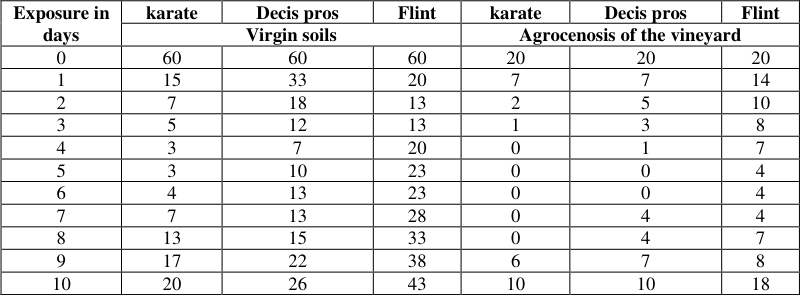 Table 1
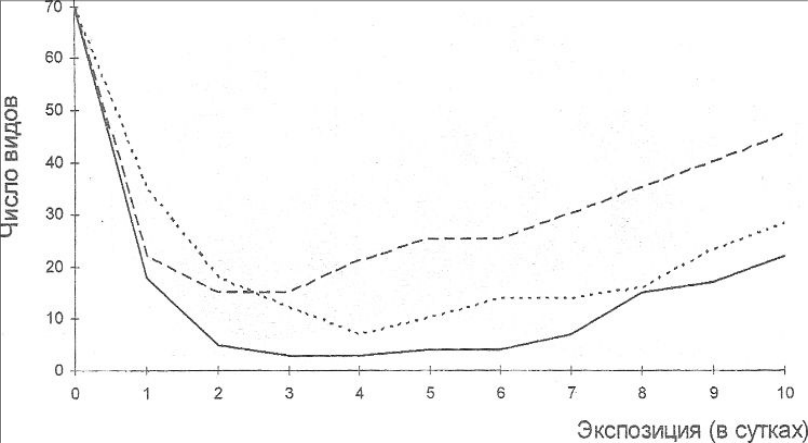 Figure 1
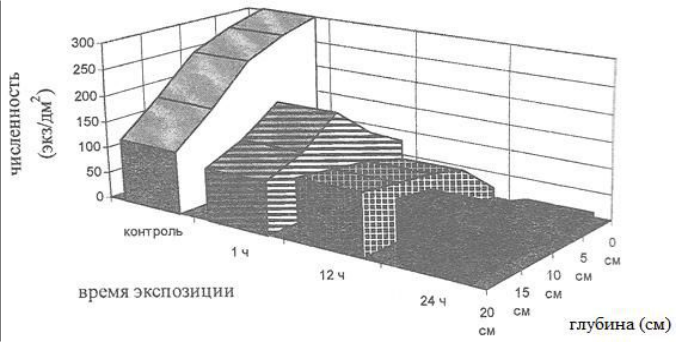 Figure 2
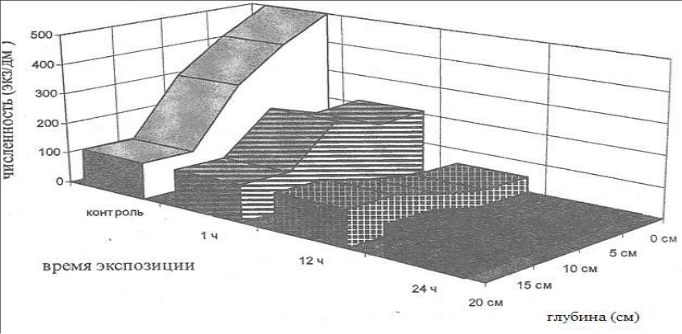 Figure 3
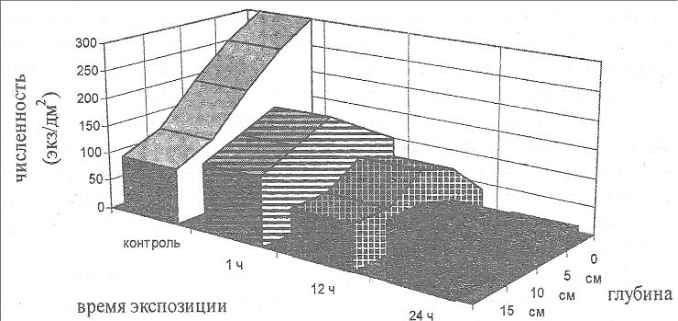 Figure 4
Introduction
When assessing the effectiveness of pesticides and insecticides both in agriculture and in other sectors of the national economy, the expected biological result (the success of eliminating harmful and "weed" organisms) and economic efficiency were taken into account first and foremost. Much less attention has been paid and is being paid to the side effects and more distant in time, which are fraught with saturation of the environment with toxic substances. Initially, the researchers' efforts were focused on finding out the prospects for the practical use of pesticides to protect crops and combat various harmful organisms -from agricultural weeds to soil nematodes and bluegreen algae inclusive, and the "side" effect attracted little attention. Analysis of these factors, observations and studies have shown that the cause of such environmental disasters is poisoning by insecticides brought by river water from the territories treated by them. However, if the main consequences of the toxic effect of insecticides on aquatic fauna have now been deciphered, already quite fully, then the situation is much worse with the assessment of the danger of these substances for soil inhabitants [1,3,6] . However, prior to our research, biotesting of insecticides using free-living infusoria was not carried out in the Goigal National Park.
Methodology
Soil samples were collected seasonally (at 8 sites) in the area of the Goi-Galli National Park. Samples were taken in the surface layers of the soil to a depth of 25 cm. The collected "live" samples were delivered to the laboratory as soon as possible for further processing. In total, more than 50 soil samples were collected and processed during the research. 10 laboratory experiments with different concentrations were performed (0, 05-0, 01-0, 005-0, 001 ml/l) with each of the two insecticides. Soil samples from the studied sites were taken in the upper 0-25 cm of the earth with metal and glass tubes with a diameter of 1 cm. [4,7] In the laboratory, soil samples with a volume of 1 cm3 were filled with distilled water with a small addition of dry peptone. Further, the water-filled samples were viewed every day. The number of individual types of infusoria was determined by calculating samples filled with water under a binocular in the Bogorov chamber, followed by recalculation by 1 dm 2. The types of infusoria difficult to determine in vivo were selected by microcapillaries and impregnated with Shatton-Lvov silver nitrate or protargol in a simplified modification of Alekperov [1,2] to clarify the species affiliation
The results of the study Our field experiments conducted on experimental plots of both virgin and cultivated lands showed that within an hour after the application of any of the three above-mentioned preparations, there are strong changes in the qualitative and quantitative distribution of soil infusoria. Figure 1 and Table 1 show the average results of changes in the species abundance of soil infusoria in the surface (0-10 cm) soil layer after the application of working concentrations (0.05-0.01 ml/l) of the studied insecticides [2,5] . As can be seen from the presented data, the toxic effect on the soil infusoria of all three insecticides studied by us manifests itself within a day after their treatment of control sites. At the same time, the toxicity of the insecticides studied by us is quite different from each other. So, for example, if after the treatment of "Karate" from the initial number-60 species-only single individuals of 10-15 species were noted within a day, then after treatment with the drug "Decis Profi" 20 species were found in the same time period, and after treatment with the drug "Aggivo" the number of remaining types of soil infusoria was 13. It should be noted that, at the later stages of the experiment, the toxic effect of the drugs studied by us also differs quite significantly from each other. When analyzing the data shown in Fig. 1. it can be seen that the insecticide "Karate" has the most toxic and prolonged effect.
| Exposure in days | karate | Decis pros | Flint | karate | Decis pros | Flint |
|---|---|---|---|---|---|---|
| Virgin soils | Agrocenosis of the vineyard | |||||
| 0 | 60 | 60 | 60 | 20 | 20 | 20 |
| 1 | 15 | 33 | 20 | 7 | 7 | 14 |
| 2 | 7 | 18 | 13 | 2 | 5 | 10 |
| 3 | 5 | 12 | 13 | 1 | 3 | 8 |
| 4 | 3 | 7 | 20 | 0 | 1 | 7 |
| 5 | 3 | 10 | 23 | 0 | 0 | 4 |
| 6 | 4 | 13 | 23 | 0 | 0 | 4 |
| 7 | 7 | 13 | 28 | 0 | 4 | 4 |
| 8 | 13 | 15 | 33 | 0 | 4 | 7 |
| 9 | 17 | 22 | 38 | 6 | 7 | 8 |
| 10 | 20 | 26 | 43 | 10 | 10 | 18 |
Table text extracted from the original PDF; superscript letters are shown inline. The original table image is below.
View original table image
After treatment with this drug, as already noted, from the initial 60 species of infusoria in the soil community, 15 individuals were registered a day later, and on the 2nd day of the exposure, the number of surviving species was already 7 and increased slightly only at the final stages of the experiment. An interesting effect on soil infusoria was noted after treatment with the insecticide "Decis Profi". Despite the fact that after the first day of exposure, its toxic effect would seem to be inferior to the drug "Aggivo", however, starting from the 3rd day of exposure, the toxic effect of the drug "Decis Profi" is noticeably higher, which is especially evident at the final stage of the experiment [1,8] . As can be seen from Fig. 1, the decomposition of the insecticides studied by us in the soil, i.e. the weakening of their toxic effect, is also different. For example, the increase in species abundance after the treatment of "Karate" begins only on the 7-8 day of the experiment. The decomposition of the drug "Decis Profi" becomes noticeable on the 5-6 day of the experiment, and the least toxic of the drugs studied by us "Aggivo" loses its effect after 3-4 days of exposure. Quantitative analysis of the toxic effect of the three insecticides studied by us on the layer-by-layer distribution of the total number of soil infusoria in virgin soils is presented in Fig. 1, 2 and 3. As can be seen from the data presented on them, all three drugs have the strongest toxic effect on soil infusoria in the surface layer of the soil 0-10 cm Deeper, the decrease in the total number of infusoria occurs more slowly, and at a depth of 20 cm, the effect of all three insecticides studied by us is practically absent. Later in time, the onset of the toxic effect of the drug "Decis Profi" in this series of experiments was noted after a 12-hour exposure (Fig. 3). It should be noted that the results of the above field experiments strongly depend on weather conditions. So, for example, in the case of rainy weather immediately after the treatment, the toxic effect of all three insecticides studied by us in the upper layers of the soil is somewhat lower, but in the deeper layers (10-15 cm and deeper) there was a stronger decrease in the total number of soil infusoria. In our opinion, this can be explained both by "washing" the surface layers with rainwater on the one hand, and by deeper penetration of insecticides into the soil due to their transfer by this water.
On the other hand, in the case of these experiments in dry hot weather, when the total number of soil infusoria in dry surface layers (0-10 cm) is usually lower than in deeper and wetter horizons, the toxic effect of insecticides is particularly strong in the uppermost layer of 0-5 cm, often leading to almost complete elimination of the entire community of soil infusoria. In addition, in our opinion, in the case of dry weather, the initial working concentrations of the insecticides studied by us remain practically unchanged after entering the soil, i.e. they are not diluted with rainwater, which contributes to prolonging their toxic effect on the soil fauna of free-living infusoria. Thus, the effect of insecticides on soil animals depends on both a variety of biotic and abiotic factors.
Conclusions
1. The toxic effect on the soil infusoria of all three insecticides studied by us manifests itself within a day after their treatment of control sites. 2. The decomposition of the insecticides studied by us in the soil, i.e. the weakening of their toxic effect, is also different. For example, the increase in species abundance after the treatment of "Karate" begins only on the 7-8 day of the experiment. The decomposition of the drug "Decis Profi" becomes noticeable on the 5-6 day of the experiment, and the least toxic of the drugs studied by us "Aggivo" loses its effect after 3-4 days of exposure.
Figures and tables from the paper
References
3 in the original paper- Mammadova VF, Abdullayeva LR, Mammadov VM. Soil ciliates of the Goygol National Park. Ukrainian Journal of Ecology Now Indexed in Emerging Sourges Citation Index Clarivate Analytics. 2020;10(3):187-190.
- Aliyev S, Mammadova VF, Abdullayeva LR. Macrozoobenthos of Alijanchay river-the primary indicator of biodiversity within the Greater Caucasusin the territory of Azerbaijan. Ukrainian İournal of Ekology Now Indexed in Emerging Sourges Citation Index Clarivate Analytics. 2021;11(6):54-62. doi:10.15421/2021_223.
- Mammadova VF. Abdullayeva LR, Mamedov VM. Changes in the species composition and total number of infusoria protobionts in Goy-Gol National park. İnternational symposium on recent advances in fundamental and applied sciences (İSFAS-2021), 2021, 10-12.